Home / Research / STEP 1 teardown
Study teardown · Sources checked October 15, 2026
STEP 1 teardown: what the semaglutide 2.4 mg obesity trial shows, and what it doesn't
STEP 1 is the trial behind the familiar “about 15% weight loss” number for semaglutide 2.4 mg (Wegovy). It was large, double-blind, and placebo-controlled. The headline effect is real and has held up in later trials. This page goes through the parts that headlines leave out: what the placebo group got, who ran the analysis, how missing data were handled, who was enrolled, and what happened after people stopped.[1][3]
The short version
- Effect size: mean weight change at week 68 was −14.9% with semaglutide and −2.4% with placebo. The drug-attributable difference is 12.4 percentage points (95% CI 11.5 to 13.4).[1]
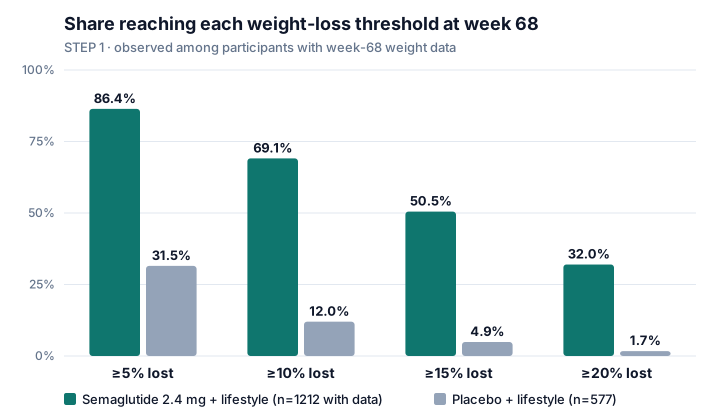
- Placebo was not “nothing”: both arms got counseling every 4 weeks for a reduced-calorie diet and more activity, and 31.5% of the placebo group with week-68 data lost at least 5%.[1]
- Sponsor role: Novo Nordisk designed the trial and did the data collation and analysis. A medical writer paid by the sponsor helped draft the paper.[1]
- Stopping: in an off-treatment extension, people regained about two-thirds of the weight they had lost within a year of stopping both the drug and the lifestyle program.[3]
- Replication: later trials in the STEP program found effects pointing the same way. All of the ones reviewed here were also funded by Novo Nordisk. In US health-record data, average weight loss in routine care was smaller.[5][6][8][9][10]
What was tested
STEP 1 was a randomized, double-blind, placebo-controlled trial at 129 sites in 16 countries in Asia, Europe, North America, and South America. From June through November 2018, 1,961 adults were randomly assigned 2:1 to once-weekly subcutaneous semaglutide 2.4 mg (1,306 people) or matching placebo (655 people) for 68 weeks. The dose was escalated over the first 16 weeks, and lower maintenance doses were allowed if people couldn't tolerate 2.4 mg.[1] The trial was registered on ClinicalTrials.gov (first submitted May 25, 2018) before randomization began.[2]
Both arms got a lifestyle program. Participants had individual counseling every 4 weeks to support a 500-kcal-per-day deficit and 150 minutes of weekly activity, and they logged diet and activity daily. People who stopped treatment early stayed in the trial for follow-up.[1]
Who could join: adults with a BMI of 30 or more, or 27 or more with at least one weight-related condition (hypertension, dyslipidemia, obstructive sleep apnea, or cardiovascular disease), and at least one self-reported unsuccessful attempt to lose weight by dieting. Key exclusions were diabetes or an HbA1c of 6.5% or higher, chronic pancreatitis or recent acute pancreatitis, previous obesity surgery, and use of anti-obesity medication in the previous 90 days.[1] The registry also excludes anyone with a self-reported weight change of more than 5 kg in the 90 days before screening.[2]
Endpoints: there were two coprimary endpoints: percent change in body weight and the share of people losing at least 5% by week 68. Confirmatory secondary endpoints were then tested in a fixed order: losing at least 10% and at least 15%, waist circumference, systolic blood pressure, and two physical-function scores.[1]
Two estimands: the main (“treatment policy”) analysis counts everyone as randomized, whether or not they stopped the drug or took rescue treatment. Missing data were filled in by multiple imputation. A second (“trial product”) estimand estimates the effect if everyone had taken the drug as intended.[1][4] The headline −14.9% comes from the more conservative treatment-policy analysis. The trial-product figure was −16.9% versus −2.4%.[1]
Who was enrolled
| Characteristic | Semaglutide (n=1,306) | Placebo (n=655) |
|---|---|---|
| Mean age | 46 years | 47 years |
| Female | 73.1% | 76.0% |
| White / Asian / Black | 74.5% / 13.9% / 5.5% | 76.2% / 12.2% / 6.0% |
| Mean body weight | 105.4 kg | 105.2 kg |
| Mean BMI | 37.8 | 38.0 |
| Mean HbA1c | 5.7% | 5.7% |
| Prediabetes | 45.4% | 40.2% |
| Mean blood pressure | 126/80 mm Hg | 127/80 mm Hg |
Headline results at week 68
All figures below are from the treatment-policy analysis. The threshold percentages are observed values among people who had a week-68 weight measurement (1,212 on semaglutide and 577 on placebo).[1]
| End point | Semaglutide | Placebo | Difference (95% CI) |
|---|---|---|---|
| Body weight, % | −14.85 | −2.41 | −12.44 (−13.37 to −11.51) |
| Body weight, kg | −15.3 | −2.6 | −12.7 (−13.7 to −11.7) |
| Waist circumference, cm | −13.54 | −4.13 | −9.42 (−10.30 to −8.53) |
| Systolic BP, mm Hg | −6.16 | −1.06 | −5.10 (−6.34 to −3.87) |
| Diastolic BP, mm Hg | −2.83 | −0.42 | −2.41 (−3.25 to −1.57) |
| HbA1c, percentage points | −0.45 | −0.15 | −0.29 (−0.32 to −0.26) |
| Fasting glucose, mg/dl | −8.35 | −0.48 | −7.87 (−9.04 to −6.70) |
| Triglycerides, ratio to baseline | 0.78 | 0.93 | 0.84 (0.81 to 0.87) |
| LDL cholesterol, ratio to baseline | 0.97 | 1.01 | 0.96 (0.94 to 0.98) |
| HDL cholesterol, ratio to baseline | 1.05 | 1.01 | 1.04 (1.02 to 1.05) |
| C-reactive protein, ratio to baseline | 0.47 | 0.85 | 0.56 (0.51 to 0.61) |
| SF-36 physical functioning score | +2.21 | +0.41 | +1.80 (1.18 to 2.42) |
Weight loss started at the first post-randomization visit (week 4) and bottomed out at week 60.[1] In the prediabetes subgroup, an exploratory endpoint, 84.1% of people on semaglutide and 47.8% on placebo had normal glucose levels at week 68.[1] Lipid, glucose, and C-reactive protein results were supportive endpoints and were not adjusted for multiple comparisons.[1]
Safety
| Event | Semaglutide (n=1,306) | Placebo (n=655) |
|---|---|---|
| Any gastrointestinal disorder | 74.2% | 47.9% |
| Nausea | 44.2% | 17.4% |
| Diarrhea | 31.5% | 15.9% |
| Vomiting | 24.8% | 6.6% |
| Constipation | 23.4% | 9.5% |
| Serious adverse events | 9.8% | 6.4% |
| Stopped drug/placebo because of an adverse event | 7.0% | 3.1% |
| …of which gastrointestinal | 4.5% | 0.8% |
| Gallbladder-related disorders | 2.6% | 1.2% |
| Cholelithiasis (gallstones) | 1.8% | 0.6% |
| Acute pancreatitis (adjudicated) | 0.2% (3 people) | 0 |
Most gastrointestinal events were mild to moderate and went away on their own. The higher rate of serious adverse events on semaglutide was mainly due to serious gastrointestinal events (1.4% vs 0%) and hepatobiliary events (1.3% vs 0.2%). The three pancreatitis cases were mild: one person had a prior history of acute pancreatitis, and the other two had gallstones. There was one death in each arm, and the adjudication committee judged neither one related to treatment.[1]
What a critical reader should notice
1. The comparator was placebo plus a structured lifestyle program, not another drug
The 12.4-point difference compares semaglutide plus counseling with counseling alone. It is not a comparison against an older drug or against usual care without counseling. The counseling had a real effect: the placebo group lost 2.4% on average.[1] In STEP 3, placebo plus a more intensive program (an initial 8-week low-calorie diet and 30 counseling visits) produced a mean loss of 5.7%, compared with 16.0% on semaglutide. That is a smaller gap of 10.3 points.[6] So how intense the program is changes the size of the gap. The one head-to-head trial in the program, STEP 8, compared semaglutide 2.4 mg with daily liraglutide 3.0 mg and found −15.8% vs −6.4%. That comparison was open-label.[9]
2. The manufacturer ran the trial and the analysis
The paper says the sponsor (Novo Nordisk) designed the trial and oversaw how it was run. Investigators collected the data, while the sponsor did site monitoring, data collation, and analysis. Three of the 14 named authors were Novo Nordisk employees, and an earlier draft was prepared with help from a medical writer paid by Novo Nordisk.[1] Several design features limit how much this can bias the result: the trial was registered in advance, double-blind, and had prespecified hierarchical endpoints, and an independent committee adjudicated cardiovascular events, pancreatitis, and deaths.[1][2] Readers should also know that every follow-on STEP trial cited below was funded by Novo Nordisk, so “replication” here means consistency within one sponsor's program.[5][6][7][8][9]
3. Dropout was low, and the reported percentages have a denominator detail
Overall, 94.3% of participants completed the trial, 91.2% had a week-68 weight measurement, and 81.1% stayed on treatment.[1] The registry's participant flow shows 66 of 1,306 people on semaglutide and 46 of 655 on placebo did not complete the trial. Most were lost to follow-up or withdrew.[2] The authors list these high completion and adherence rates as a strength of the trial, and that is fair.[1]
The detail people miss is that the familiar 86.4% / 69.1% / 50.5% / 32.0% figures are observed percentages among people who had a week-68 weight. That means 1,212 of 1,306 on semaglutide (94 without a measurement) and 577 of 655 on placebo (78 without one).[1] As a deliberately pessimistic check (our arithmetic, not an analysis in the paper), suppose everyone without a week-68 weight counts as not reaching the threshold. Then 1,047 of 1,306 (80.2%) reached ≥5% and 612 of 1,306 (46.9%) reached ≥15% on semaglutide, compared with 182 of 655 (27.8%) and 28 of 655 (4.3%) on placebo. The conclusion holds either way, but “half lost 15%” is the more generous way to read it.
4. Absolute versus relative framing
You can say semaglutide produced about six times the weight loss of placebo (14.9% vs 2.4%). That is accurate and flattering. The drug-attributable effect is a 12.4-point difference, about 12.7 kg from a starting average of about 105 kg.[1] The same trap works in the other direction for safety. Gallbladder-related disorders were “more than doubled” (2.6% vs 1.2%), which is 1.4 extra cases per 100 people over the trial. Stopping because of side effects was 7.0% vs 3.1%, so 3.9 extra people per 100 (our arithmetic from Table 3). Nausea is the large absolute difference: 44.2% vs 17.4%.[1]
Several secondary endpoints were modest in absolute terms. Systolic blood pressure fell 5.1 mm Hg more than placebo. HbA1c fell 0.29 points more, starting from an average of 5.7%. The SF-36 physical-functioning gain was 1.8 points on a scale built so the US general population averages 50 with a standard deviation of 10.[1] The average also hides a wide spread: 32.0% of people with week-68 data lost at least 20%, while 13.6% lost less than 5% (100% minus 86.4%).[1]
5. Who was enrolled limits who it generalizes to
Participants were mostly women (74.1%) and mostly White (75.1%), with a mean BMI of 37.9. People with diabetes were excluded, and everyone had to report a previous failed diet.[1] The authors themselves list as limitations the predominance of women and White participants, the relatively short duration, the exclusion of type 2 diabetes, and the possibility that volunteers were more committed to weight loss than the general population.[1] In people with type 2 diabetes, the same dose produced less weight loss: −9.6% vs −3.4% in STEP 2.[5]
6. What happened after stopping
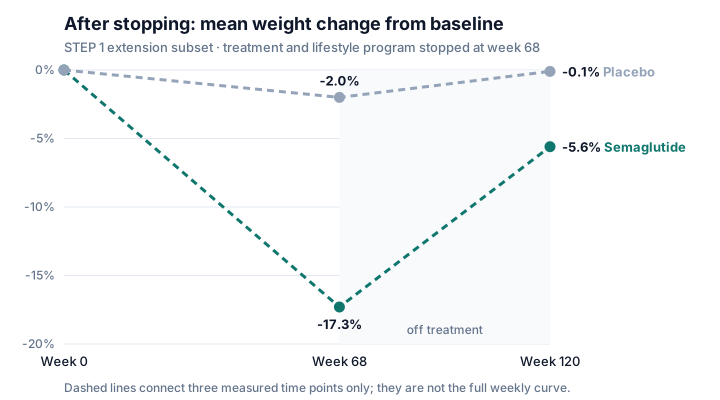
At week 68, both the drug and the lifestyle program stopped. An off-treatment extension followed 327 participants for another year. People in the semaglutide arm had lost 17.3% by week 68 and then regained 11.6 percentage points by week 120, leaving a net loss of 5.6%. The placebo arm went from −2.0% to −0.1%. Most cardiometabolic improvements also moved back toward baseline. Mean systolic blood pressure in the semaglutide arm, for example, went from 129 to 121 and then 131 mm Hg. All extension analyses were exploratory.[3]
Two details matter. First, only people still on their randomized treatment at the target dose at week 68 could enroll in the extension.[2] The authors note this is why the extension group's on-treatment loss (17.3%) was larger than the full trial's (14.9%). Site selection could also introduce bias.[3] Second, the lifestyle program was withdrawn at the same time as the drug, so the extension cannot separate the two. STEP 4 tested withdrawal more cleanly. After a 20-week run-in on semaglutide, people were randomized to continue or switch to placebo. Those who continued lost a further 7.9%, while those switched to placebo regained 6.9% over the next 48 weeks.[7]
Routine care looks somewhat different. In a Cleveland Clinic health-record cohort of 7,938 people who stopped semaglutide or tirzepatide within 3–12 months, average weight change in the year after stopping was small (+0.5% for those treating obesity). But 19.6% restarted the same drug and 35.2% received some other obesity treatment, and results varied widely between individuals.[11] Those people had also lost less before stopping (−8.4% for obesity), so this is not a like-for-like comparison with the trial extension.
7. Sixty-eight weeks of risk markers, not outcomes
STEP 1 measured weight and risk markers such as blood pressure, lipids, and glucose. It was not designed or powered to show fewer heart attacks, strokes, or deaths. The authors pointed to the separate SELECT cardiovascular outcomes trial for that question.[1] (See our semaglutide overview for SELECT.) Body composition was measured by DXA in only 140 people. In that group, lean mass fell in kilograms while the lean share of body weight rose. The detailed numbers are in a supplementary table we could not access, so we do not report them here.[1]
Did it replicate?
| Study | Population / design | Result |
|---|---|---|
| STEP 2 (Lancet 2021)[5] | 1,210 adults with type 2 diabetes; 68 weeks; vs placebo | −9.6% vs −3.4% (difference −6.2 points) |
| STEP 3 (JAMA 2021)[6] | 611 US adults; intensive behavioral therapy plus initial low-calorie diet in both arms | −16.0% vs −5.7% (difference −10.3 points) |
| STEP 4 (JAMA 2021)[7] | 803 people after a 20-week run-in on semaglutide; randomized to continue or switch to placebo | −7.9% vs +6.9% from week 20 to 68 |
| STEP 5 (Nat Med 2022)[8] | 304 adults; 104 weeks | −15.2% vs −2.6% (difference −12.6 points) |
| STEP 8 (JAMA 2022)[9] | 338 adults; vs liraglutide 3.0 mg, open-label | −15.8% vs −6.4% (difference −9.4 points) |
| Truveta health-record cohort (JAMA Intern Med 2024)[10] | New users of diabetes-labeled semaglutide (Ozempic) or tirzepatide in US care; 52% had type 2 diabetes | Semaglutide: −8.3% at 12 months among people still on treatment |
The real-world figure is not directly comparable to STEP 1. It used the diabetes-labeled product, about half the patients had diabetes, it measured only people still on treatment, and in 52.5% of semaglutide patients follow-up ended because they stopped.[10] Even so, it is a useful reminder that trial averages come from a selected, closely supported population.
What STEP 1 robustly shows
To be fair to the trial, it has real strengths. It was large, randomized 2:1, double-blind, and registered in advance, with low dropout. Its headline result came from the conservative treatment-policy analysis, and every confirmatory endpoint passed in the prespecified order.[1][2] The size of the effect, roughly 12 points beyond a structured lifestyle program, has shown up across STEP trials with different designs and durations.[6][8] The open questions are what it doesn't settle: performance against active treatments in routine care, durability without continued treatment, and long-term outcomes in people unlike the volunteers who enrolled.
References
- Wilding JPH, Batterham RL, Calanna S, et al.; STEP 1 Study Group. Once-Weekly Semaglutide in Adults with Overweight or Obesity. N Engl J Med. 2021;384(11):989-1002. doi:10.1056/NEJMoa2032183. PMID 33567185. Full text (Tables 1–3, Figure 1, Methods, Discussion, Notes): https://www.nejm.org/doi/full/10.1056/NEJMoa2032183; PubMed: https://pubmed.ncbi.nlm.nih.gov/33567185/. Checked October 15, 2026.
- ClinicalTrials.gov. NCT03548935: Effect and Safety of Semaglutide 2.4 mg Once-weekly in Subjects With Overweight or Obesity (STEP 1). Record including eligibility criteria and posted results (participant flow). https://clinicaltrials.gov/study/NCT03548935. Checked October 15, 2026 (via ClinicalTrials.gov API v2).
- Wilding JPH, Batterham RL, Davies M, et al. Weight regain and cardiometabolic effects after withdrawal of semaglutide: The STEP 1 trial extension. Diabetes Obes Metab. 2022;24(8):1553-1564. doi:10.1111/dom.14725. PMID 35441470; PMC9542252. https://pmc.ncbi.nlm.nih.gov/articles/PMC9542252/. Checked October 15, 2026.
- Wharton S, Astrup A, Endahl L, et al. Estimating and reporting treatment effects in clinical trials for weight management: using estimands to interpret effects of intercurrent events and missing data. Int J Obes (Lond). 2021;45(5):923-933. PMID 33462358. https://pubmed.ncbi.nlm.nih.gov/33462358/. Checked October 15, 2026.
- Davies M, Færch L, Jeppesen OK, et al. Semaglutide 2·4 mg once a week in adults with overweight or obesity, and type 2 diabetes (STEP 2). Lancet. 2021;397(10278):971-984. PMID 33667417. https://pubmed.ncbi.nlm.nih.gov/33667417/. Checked October 15, 2026.
- Wadden TA, Bailey TS, Billings LK, et al. Effect of Subcutaneous Semaglutide vs Placebo as an Adjunct to Intensive Behavioral Therapy on Body Weight in Adults With Overweight or Obesity: The STEP 3 Randomized Clinical Trial. JAMA. 2021;325(14):1403-1413. PMID 33625476; PMC7905697. https://pmc.ncbi.nlm.nih.gov/articles/PMC7905697/. Checked October 15, 2026.
- Rubino D, Abrahamsson N, Davies M, et al. Effect of Continued Weekly Subcutaneous Semaglutide vs Placebo on Weight Loss Maintenance in Adults With Overweight or Obesity: The STEP 4 Randomized Clinical Trial. JAMA. 2021;325(14):1414-1425. PMID 33755728; PMC7988425. https://pmc.ncbi.nlm.nih.gov/articles/PMC7988425/. Checked October 15, 2026.
- Garvey WT, Batterham RL, Bhatta M, et al. Two-year effects of semaglutide in adults with overweight or obesity: the STEP 5 trial. Nat Med. 2022;28(10):2083-2091. PMID 36216945; PMC9556320. https://pmc.ncbi.nlm.nih.gov/articles/PMC9556320/. Checked October 15, 2026.
- Rubino DM, Greenway FL, Khalid U, et al. Effect of Weekly Subcutaneous Semaglutide vs Daily Liraglutide on Body Weight in Adults With Overweight or Obesity Without Diabetes: The STEP 8 Randomized Clinical Trial. JAMA. 2022;327(2):138-150. PMID 35015037; PMC8753508. https://pmc.ncbi.nlm.nih.gov/articles/PMC8753508/. Checked October 15, 2026.
- Rodriguez PJ, Goodwin Cartwright BM, Gratzl S, et al. Semaglutide vs Tirzepatide for Weight Loss in Adults With Overweight or Obesity. JAMA Intern Med. 2024;184(9):1056-1064. PMID 38976257; PMC11231910. https://pmc.ncbi.nlm.nih.gov/articles/PMC11231910/. Checked October 15, 2026.
- Gasoyan H, Schulte R, Boyer CB, et al. Obesity Treatments and Weight Changes in Clinical Practice After Discontinuation of Semaglutide or Tirzepatide. Diabetes Obes Metab. 2026;28(6):4795-4805. doi:10.1111/dom.70660. PMID 41816857; PMC13146129. https://pubmed.ncbi.nlm.nih.gov/41816857/. Checked October 15, 2026.
This page analyzes published research. It is not medical advice and does not recommend starting, stopping, or changing any medication. Charts were rebuilt by Jabbit from the published numbers cited in each caption.