Home / Research / Selank anxiety teardown
Study teardown · Russian sources translated by Jabbit · Sources checked October 16, 2026
Can selank calm your anxiety without the drowsiness? It sedated far less than a benzodiazepine, but whether it works is unproven.
We can’t tell whether it works. In the main Russian study, selank caused almost none of the drowsiness a benzodiazepine did. It also reduced anxiety less while people were taking it, and with no placebo group nobody can say how much of the improvement came from the drug.[1] The studies were small, unblinded, partly funded by the company that sells selank, and never repeated outside Russia.[1][2][7]
Selank (Thr-Lys-Pro-Arg-Pro-Gly-Pro) is a synthetic heptapeptide. In Russia it is sold as 0.15% nasal drops, without a prescription, for anxiety and related conditions.[4] It is not an approved drug in the United States.[5][6] Claims that it is a “non-sedating anxiolytic” trace back to a few Russian studies. We read the most-cited one, Medvedev et al. 2014 (selank vs phenazepam), and its 2015 follow-up in the original Russian. We translated the key passages and rebuilt the published numbers.
Why we say that
The study behind most selank claims, Medvedev et al. 2014, took 60 outpatients with anxiety-phobic or somatoform disorders. It gave them either selank nasal drops (2.7 mg a day) or phenazepam, a benzodiazepine (2 mg a day), for 14 days, then watched them for a week off the drug.[1]
While people were on treatment, the benzodiazepine worked better. By day 14 anxiety scores had fallen 26.3% with selank and 55% with phenazepam, with 5 versus 7 responders out of 30. A week after stopping, the order flipped: 17 selank patients counted as responders versus 9 on phenazepam (p = 0.037).[1] The clearest difference was in side effects. At day 14 none of the selank group reported sedation, against all of the phenazepam group, and attention problems were 7% versus 97%.[1]
That still doesn’t tell you selank treats anxiety. The study was open-label (the authors call it “open naturalistic”), had no placebo, didn’t describe how patients were randomized, and had just 30 people per group.[1] Anxiety often eases on its own over three weeks, so without a placebo arm the improvement can’t be separated from time and expectation. Both the 2014 and 2015 papers were supported by Peptogen, which holds selank’s Russian registration, along with a state science grant.[1][2][4] We found no trial outside Russia, and ClinicalTrials.gov lists no selank studies.[7]
Where selank came from
Selank wasn’t designed as an anxiety drug. Its sequence was first patented as a memory stimulant, and the anxiety use was claimed sixteen years later by largely the same circle of Moscow researchers.
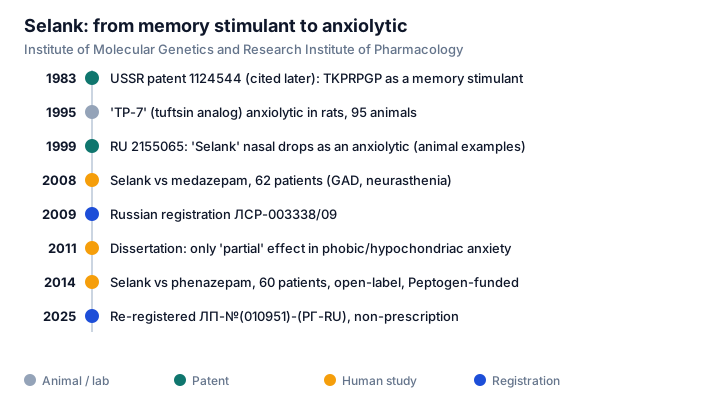
The sequence begins with tuftsin (Thr-Lys-Pro-Arg), a natural immune peptide fragment, and the 1995 rat paper calls the compound a tuftsin analog.[9] It ends with the same Pro-Gly-Pro tail as semax. The 1999 Russian patent that claims it as an anxiolytic was filed by the Institute of Molecular Genetics and the Research Institute of Pharmacology of the Russian Academy of Medical Sciences, and lists N.F. Myasoedov, S.B. Seredenin, and G.G. Neznamov among its inventors.[8]
«Известен гептапептид общей формулы (Thr-Lys-Pro-Arg-Pro-Gly-Pro) в качестве стимулятора памяти (Патент СССР N 1124544, приоритет от 30 июня 1983 г.). Однако возможность использовать его в качестве лекарственного препарата анксиолитического действия неизвестно.»
Our translation: “A heptapeptide of the general formula Thr-Lys-Pro-Arg-Pro-Gly-Pro is known as a memory stimulant (USSR Patent No. 1124544, priority June 30, 1983). However, the possibility of using it as an anxiolytic drug is not known.”[8]
We could not open the 1983 patent itself (it isn’t on Google Patents); we know it only from this citation.[8] The earliest PubMed paper we found on the anxiety effect is a 1995 rat study by Seredenin and colleagues, which calls the compound “TP-7.”[9] The patent then named the nasal drops “Селанк” (Selank), and the examples we read in it are mouse, rat, and rabbit experiments.[8]
The first human comparison we found, from 2008, matched selank against another benzodiazepine, medazepam, in 62 people with generalized anxiety disorder or neurasthenia. The abstract reports similar anxiety effects.[3] Selank was registered in Russia in 2009.[11]
The most interesting find is a 2011 medical dissertation by T.S. Syunyakov at the Research Institute of Pharmacology, the institution that co-holds the patent. Its summary is more cautious than the papers that followed. In patients with anxiety-phobic and anxiety-hypochondriac disorders, the same kinds of diagnoses studied in the 2014 trial, it found only a partial effect:[10][1]
«Установлена парциальность терапевтического действия селанка у больных с тревожно-фобическими и тревожно-ипохондрическими расстройствами в виде незначительной редукции тревоги при интактности психопатологической симптоматики более глубоких регистров.»
Our translation: “Selank’s therapeutic action was found to be partial in patients with anxiety-phobic and anxiety-hypochondriac disorders: a slight reduction in anxiety, while deeper-level psychopathological symptoms were left untouched.”[10]
The dissertation recommends selank for “structurally simple” anxiety and anxiety-asthenic disorders. Its contents list a chapter describing the study drug and placebo, but the full text is paywalled, so we haven’t seen the placebo results.[10]
How the claims changed. The claims went from a memory stimulant (1983), to an anxiolytic in animals (1995–1999), to “similar to a benzodiazepine” in a small comparison (2008). In the institute’s own dissertation it was partial and best for simple cases (2011). Online it has become a “non-sedating anxiolytic.” The sedation part does have support: the 2014 trial found almost none.[1] The “works as well as” part comes from small, open studies by the developers.
What the 2014 study tested
The study ran at two Moscow hospitals used as teaching sites by the psychiatry department of the Peoples' Friendship University of Russia (RUDN).[1] It enrolled adults aged 18–55 with mild-to-moderate anxiety-phobic, anxiety-hypochondriac, or somatoform disorders (ICD-10 F40.2–9, F41.1–9, F45.0–2) and a CGI severity score of at least 4. Depression, psychosis, substance dependence, and any psychotropic use in the prior year were exclusions.[1]
«Цель открытого натуралистического проспективного фармакотерапевтического исследования - сравнение терапевтической эффективности и переносимости препаратов селанк и феназепам»
Our translation: “The aim of this open, naturalistic, prospective pharmacotherapy study is to compare the therapeutic efficacy and tolerability of selank and phenazepam”[1]
«Случайным образом больные были рандомизированы в две группы. Пациенты 1-й группы (30 человек) получали монотерапию селанком в дозе 2,7 мг/сут, больные 2-й группы (30) - феназепамом в дозе 2 мг/сут. Терапию проводили в течение 14 дней.»
Our translation: “Patients were randomly assigned to two groups. Group 1 (30 people) received selank monotherapy at 2.7 mg/day, group 2 (30) phenazepam at 2 mg/day. Treatment lasted 14 days.”[1]
Assessments were at baseline, day 7, day 14, and day 21 (one week after stopping). Measures were the anxiety and depression subscales of a hospital anxiety/depression scale (labeled “HDRS” in the paper), the Spielberger self-report questionnaire, CGI, SF-36 quality of life, the Stroop test, verbal fluency, and the UKU side-effect scale. A “responder” was defined as a reduction of at least 50% in the anxiety score by day 14.[1]
Group 1 had 17 men and 13 women, group 2 had 12 men and 18 women, and mean ages were 44 and 43.[1]
The numbers
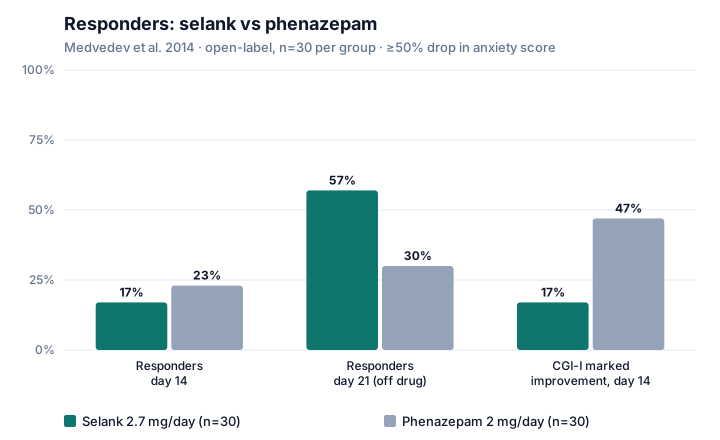
«выраженность тревоги к 14-му дню терапии уменьшалась на 26,3% при приеме селанка и на 55% - феназепама»
Our translation: “by day 14 of treatment, anxiety severity fell by 26.3% on selank and by 55% on phenazepam”[1]
While patients were taking the drugs, phenazepam did better on anxiety: a larger score drop, more responders (7 vs 5), and almost three times as many CGI-I “marked improvement” ratings (14 vs 5).[1] The case for selank rests on day 21. The paper says selank's effect held and grew after it was stopped, while phenazepam's faded quickly, and reports 17 vs 9 responders (χ² = 4.34, p = 0.037).[1] That fits a benzodiazepine wearing off. It does not show selank beat phenazepam at relieving anxiety during treatment.
Quality of life: the SF-36 mental-health component improved by 43.3% vs 3.1% at day 14 and 53.3% vs 6.3% at day 21, favoring selank. The physical component didn't differ.[1]
Side effects and safety
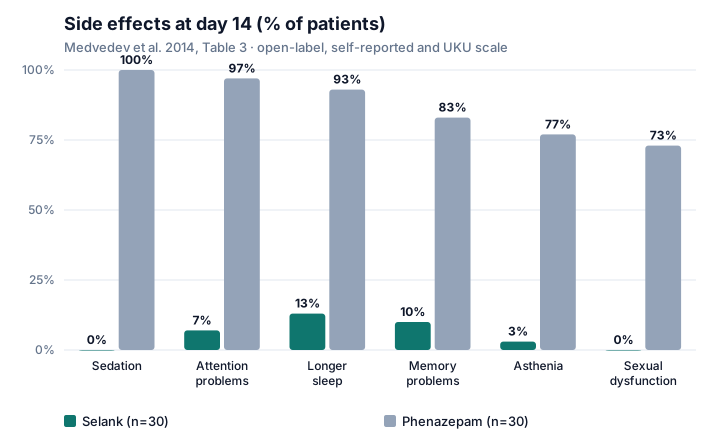
The tolerability gap is large and consistent across Table 3 and the cognitive tests. Phenazepam slowed Stroop performance and reduced verbal fluency; selank did not.[1] The paper says selank's most prominent complaint was nasal dryness. Table 3 records it for 7% of patients at day 21 and 0% at day 14.[1] One oddity: Table 3 gives sexual dysfunction for selank at day 7 as “1%”. With 30 patients, the smallest possible non-zero value is 3.3%, so this figure is probably a typo.
The phenazepam arm also isn't a neutral benchmark. It is a potent benzodiazepine, and all-day sedation in 100% of patients suggests a dose that is heavy for outpatients. That makes any lighter-touch drug look good by comparison. The Russian prescribing information for selank lists possible allergic reactions and an unpleasant taste if drops reach the throat, and contraindicates it in pregnancy, breastfeeding, and under 18.[4] In the US, FDA's compounding page says selank acetate “may pose risk for immunogenicity” and that FDA “lacks important information regarding any safety issues raised by selank acetate administered to humans.”[5]
What it got right
The study used an active comparator that Russian clinicians actually prescribe, not a straw man. It reported counts, not just p-values. It followed patients off drug to look for rebound, and it measured cognition objectively instead of relying only on complaints. The safety contrast is big enough that bias alone is unlikely to explain all of it.[1]
Design: what it can't tell you
Open-label. Patients and raters knew who got nasal drops and who got pills. Anxiety scales and side-effect reports are subjective, so this is the biggest weakness.[1]
No placebo. Anxiety often improves on its own over 3 weeks. Without a placebo arm, the selank group's improvement can't be separated from time, attention, and expectation.
Randomization not described. The paper says “randomly” but gives no method, concealment, or registration. Sex balance differed between groups (17/13 vs 12/18).[1]
Small and short. 30 per group, 14 days of treatment, and 7 days of follow-up. Many endpoints were compared with no prespecified primary outcome.[1]
Scale labeling. The paper calls its main scale “HDRS” but describes it as the hospital anxiety and depression scale. Baseline anxiety scores of 19–20 fit that scale's 0–21 range better than the Hamilton scale, but the exact instrument is not unambiguous.[1]
The follow-up and earlier studies
2015 add-on study (full text read). The same group randomized 70 patients to phenazepam alone (30) or phenazepam plus selank (40) for 14 days. It was again “open naturalistic,” and 20 of the combination patients continued selank alone to day 21.[2] Day-14 responders were 23% vs 40% (p = 0.14, not significant). At day 21, 75% of those who kept taking selank were responders, vs 30% after stopping phenazepam (p = 0.0018).[2] The authors report that adding selank reduced phenazepam's side effects.[2]
«Работа выполнена при поддержке ЗАО «Инновационный производственный центр «Пептоген» и РФФИ грант № 11−08−01327.»
Our translation: “The work was supported by CJSC Innovative Production Center Peptogen and Russian Foundation for Basic Research grant No. 11-08-01327.”[2]
2008 selank vs medazepam (abstract only). Zozulia et al. compared selank (30) with medazepam (32) in generalized anxiety disorder and neurasthenia. They report similar anxiolytic effects, with additional “antiasthenic and psychostimulant” effects for selank. PubMed indexes it as a randomized controlled trial.[3] We have not found an open full text on the publisher's site, so we haven't checked its tables.
Funding and conflicts
«Работа была поддержана ЗАО «Инновационный научно-производственный центр «Пептоген» и РФФИ грант №11-08-01327.»
Our translation: “The work was supported by CJSC Innovative Research and Production Center Peptogen and Russian Foundation for Basic Research grant No. 11-08-01327.”[1]
Peptogen holds the Russian registration for Selank.[4] N.F. Myasoedov is a co-author of the 2014, 2015, and 2008 papers.[1][2][3] In the 2015 paper one author group is affiliated with the Institute of Molecular Genetics, Russian Academy of Sciences, which the 2014 paper also credits for the receptor-binding work behind its proposed mechanism.[2][1] The 2014 paper has no separate conflict-of-interest statement beyond the funding note. Manufacturer funding with no blinding is the combination most likely to inflate results.
Replication outside Russia
Every human selank study we found on PubMed is from Russian groups, and most share authors. A ClinicalTrials.gov search for “selank” returns only unrelated studies matched by spelling similarity, with no selank trial registered.[7] There is no independent, blinded, placebo-controlled anxiety trial of selank in the sources we checked.
Regulatory status
In the United States, it is not FDA approved. Drugs@FDA returns no selank application,[6] and FDA's compounding page flags immunogenicity and safety-data gaps.[5]
In Russia, Selank 0.15% nasal drops are registered to JSC “INPC Peptogen” and sold without a prescription. The registration number is ЛП-№(010951)-(РГ-RU), dated July 15, 2025, replacing ЛСР-003338/09. Listed indications include anxiety states, neurasthenia, and adjustment disorders.[4]
Bottom line: in one small, open-label, manufacturer-funded study, selank caused far fewer benzodiazepine-type side effects than phenazepam. It relieved anxiety less than phenazepam during treatment, and patients did better than phenazepam patients in the week after both drugs were stopped. Whether selank beats placebo has never been tested in a blinded trial.
References
- Medvedev VE, Tereshchenko ON, Israelian AIu, Chobanu IK, Kost NV, Sokolov OIu, Miasoedov NF. [A comparison of the anxiolytic effect and tolerability of selank and phenazepam in the treatment of anxiety disorders]. Zh Nevrol Psikhiatr Im S S Korsakova. 2014;114(7):17-22. PMID 25176261. Russian full text with Tables 1–4 and Figures 1–5: https://www.mediasphera.ru/issues/zhurnal-nevrologii-i-psikhiatrii-im-s-s-korsakova/2014/7/031997-7298201473; PubMed: https://pubmed.ncbi.nlm.nih.gov/25176261/. Excerpts translated by Jabbit. Checked October 16, 2026.
- Medvedev VE, Tereshchenko ON, Kost NV, et al. [Optimization of the treatment of anxiety disorders with selank]. Zh Nevrol Psikhiatr Im S S Korsakova. 2015;115(6):33-40. doi:10.17116/jnevro20151156133-40. PMID 26356395. Russian full text: https://www.mediasphera.ru/issues/zhurnal-nevrologii-i-psikhiatrii-im-s-s-korsakova/2015/6/391997-72982015065; PubMed: https://pubmed.ncbi.nlm.nih.gov/26356395/. Checked October 16, 2026.
- Zozulia AA, Neznamov GG, Siuniakov TS, et al. [Efficacy and possible mechanisms of action of a new peptide anxiolytic selank in the therapy of generalized anxiety disorders and neurasthenia]. Zh Nevrol Psikhiatr Im S S Korsakova. 2008;108(4):38-48. PMID 18454096. Abstract only. https://pubmed.ncbi.nlm.nih.gov/18454096/. Checked October 16, 2026.
- Vidal Russia drug reference. Селанк® (Selank) nasal drops 0.15%: composition, indications, side effects, contraindications; non-prescription; registration ЛП-№(010951)-(РГ-RU) of 15.07.2025, holder Peptogen. https://www.vidal.ru/drugs/selank__21568. Checked October 16, 2026.
- U.S. Food and Drug Administration. Certain Bulk Drug Substances for Use in Compounding that May Present Significant Safety Risks (entry: Selank acetate (TP-7)). https://www.fda.gov/drugs/human-drug-compounding/certain-bulk-drug-substances-use-compounding-may-present-significant-safety-risks. Checked October 16, 2026.
- U.S. Food and Drug Administration. Drugs@FDA (no approved application for selank; openFDA drugsfda query returned no matches). https://www.accessdata.fda.gov/scripts/cder/daf/. Checked October 16, 2026.
- ClinicalTrials.gov search for “selank” (no selank studies; returned records were unrelated). https://clinicaltrials.gov/search?term=selank. Checked October 16, 2026.
- Andreeva LA, Alfeeva LYu, Grivennikov IA, Myasoedov NF, Nezavibat'ko VN, Seredenin SB, Kozlovskaya MM, Kozlovsky II, Valdman AV, Neznamov GG, et al. Anxiolytic agent and pharmaceutical composition of anxiolytic action [Анксиолитическое средство и фармацевтическая композиция анксиолитического действия]. Russian patent RU 2155065 C1; filed 1999-04-23; published 2000-08-27. Holders: Institute of Molecular Genetics RAS; Research Institute of Pharmacology RAMS. Full text read; cites USSR patent 1124544, which we could not open. https://patents.google.com/patent/RU2155065C1/ru. Checked October 16, 2026.
- Seredenin SB, Semenova TP, Kozlovskaia MM, Medvinskaia NI, Nezovibat'ko VN. [The characteristics of the anxiolytic action of taftsin and its analog TP-7 on behavior and serotonin metabolism in the brain of rats]. Eksp Klin Farmakol. 1995;58(6):3-6. PMID 8704608. Abstract only. https://pubmed.ncbi.nlm.nih.gov/8704608/. Checked October 16, 2026.
- Syunyakov TS. Clinical and pharmacological characteristics of the anxiolytic action of the new peptide drug selank [Клинико-фармакологическая характеристика анксиолитического действия нового пептидного препарата селанк]. Candidate of Medical Sciences dissertation, specialty 14.00.25. Moscow: Research Institute of Pharmacology RAMS; 2011. Summary and contents only; full text paywalled. https://www.dissercat.com/content/kliniko-farmakologicheskaya-kharakteristika-anksioliticheskogo-deistviya-novogo-peptidnogo-p. Checked October 16, 2026.
- Kolomin T, Shadrina M, Slominsky P, Limborska S, Myasoedov N. A new generation of drugs: synthetic peptides based on natural regulatory peptides. Neuroscience and Medicine. 2013;4:223-252. doi:10.4236/nm.2013.44035. https://doi.org/10.4236/nm.2013.44035. Checked October 16, 2026.
This page analyzes published research and regulatory documents. It is not medical advice and does not recommend using, sourcing, or dosing selank, or stopping or changing any anxiety medication. Russian excerpts are quoted from the cited sources, including patent and dissertation pages; English renderings are Jabbit's own translations. Charts were rebuilt by Jabbit from the published numbers.