Home / Research / Semax stroke teardown
Study teardown · Russian sources translated by Jabbit · Updated with origins and paper trail · Sources checked October 16, 2026
Does semax help you recover from a stroke? Maybe, but the studies can’t really tell us.
We can’t tell from the published evidence. Semax is a registered stroke drug in Russia, but the human studies behind it are small, have no placebo group, and include the team that invented it.[1][2] No one outside Russia has tested it for stroke.[9]
Semax is a synthetic heptapeptide (Met-Glu-His-Phe-Pro-Gly-Pro), an ACTH(4-10) analog. In Russia it is a registered prescription nasal drop, and its 1% strength is labeled for acute moderate-to-severe ischemic stroke.[5][6] In the United States it is not an approved drug.[7][8] Most English-language claims about semax and stroke trace back to a small number of Russian papers. We opened the most-cited recent one in Russian, translated the key passages, and rebuilt its tables. Where we only had an abstract, we say so.
Why we say that
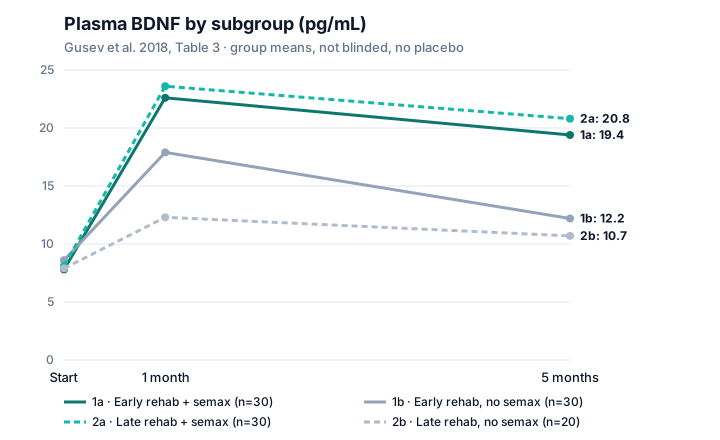
The study most people cite is Gusev et al. 2018. It enrolled 110 patients who were already in rehabilitation, roughly 3 or 7 months after an ischemic stroke, and gave some of them semax on top of rehab.[1] In the semax groups a blood marker called BDNF roughly tripled within a month (for example from 7.8 to 22.6 pg/mL) and stayed higher at 5 months. Everyday function, scored with the Barthel index, also improved faster with semax. By month 5, though, the early-rehab groups had nearly caught up with each other: 85.8 with semax, 84.1 without.[1]
The problem is how the study was run. There was no placebo and the paper describes no blinding, so patients, and possibly the people scoring them, knew who got the drops. It doesn’t say how patients were randomized. The groups had only 20 to 30 people each, and there was no prespecified main outcome or correction for the many comparisons.[1] Patients reported no side effects and 95% rated the drug well tolerated. That is a small, short, open-label sample, and the Russian label does list mild nasal irritation with long-term use.[1][5]
Who did the research matters too. Semax started out as a 1981 Soviet patent for a memory stimulant tested in rats, then became a nootropic in a 1994 patent. Stroke came later, and the inventors co-authored the first stroke papers.[11][13][2][3][4] The 2018 paper declares no conflicts and doesn’t state its funding.[1] We found no stroke trial of semax anywhere outside Russia, and ClinicalTrials.gov lists no semax trials at all.[9]
Origins and paper trail
Semax didn't start as a stroke drug. The paper trail runs from a 1981 Soviet patent for a rat memory stimulant, through a 1994 nootropic patent, to stroke indications later. The same small group of inventors runs through all of it.
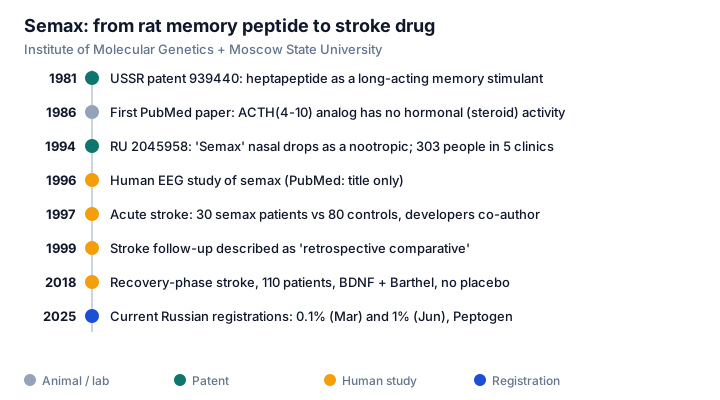
1981, a memory stimulant. USSR author's certificate 939440 (priority January 6, 1981) was filed by the Institute of Molecular Genetics of the USSR Academy of Sciences and Moscow State University. Its inventors were M.A. Ponomareva-Stepnaya, V.N. Nezavibat'ko, I.P. Ashmarin, and A.A. Kamensky. It claims Met-Glu-His-Phe-Pro-Gly-Pro, an ACTH(4-7) fragment with Pro-Gly-Pro added to slow enzymatic breakdown.[11]
«Гептапептид формулы Met-Glu-His-Phe-Pro-Gly-Pro в качестве стимулятора памяти пролонгированного действия.»
Our translation: “A heptapeptide of formula Met-Glu-His-Phe-Pro-Gly-Pro as a long-acting memory stimulant.” (the patent claim; the scanned text has OCR errors, normalized here)[11]
The earliest semax paper we found on PubMed (1986) only checked that the analog lacked the hormonal effects of ACTH: no steroid-releasing or melanocyte-stimulating activity.[12]
1994, “Semax” as a nootropic. Russian patent 2045958 (priority March 28, 1994; holder: Institute of Molecular Genetics, Russian Academy of Sciences) is where the name and the nasal-drop formula appear. The inventors were Andreeva, Ashmarin, Kamensky, Myasoedov, Nezavibat'ko, and Ryasina.[13]
«Лекарственной форме присвоено название "Семакс".»
Our translation: “The dosage form was given the name “Semax.””[13]
Its listed uses are broad: memory and intellectual problems in vascular brain disease, asthenia, recovery after neurosurgery and head injury, and improving how healthy operators and athletes cope with “extreme conditions.”[13] Its clinical example reports that semax was studied in 303 people across five institutions. In the patent text we read, it gives no control-group or blinding details.[13]
«Исследовано ноотропное действие семакса у 303 человек в 5 лечебных учреждениях»
Our translation: “The nootropic action of semax was studied in 303 people at 5 medical institutions”[13]
1997, stroke. The acute-stroke paper (30 patients vs 80 conventional controls, abstract only) includes inventors Myasoedov and Nezavibat'ko as co-authors.[2] The same year, the inventors' own 15-year review described semax as improving memory and attention “in healthy men under extreme conditions.” It said that in no case had it produced side effects.[4] The current Russian label reflects both lines: the 0.1% drops cover cognitive and stress indications, and the 1% drops cover acute ischemic stroke.[5][14]
How the claims changed. The claims went from a long-acting memory stimulant in rats (1981), to a broad nootropic for patients and healthy operators (1994), to an add-on for acute stroke (1997). By 2018 the claim had become a BDNF-raising aid to stroke rehabilitation.[11][13][2][1] At each step, the human evidence came from groups that included the inventors or worked with them. None of it was placebo-controlled.
Where the online claims trace back to. If you see “semax raises BDNF,” the human source is the 2018 open-label plasma measurement on this page.[1] The brain BDNF numbers (about 1.4-fold) come from rat hippocampus.[10] If you see “approved for stroke in Russia,” that is true of the 1% drops, for the acute period, as add-on therapy.[5] The “nootropic for healthy people” claim traces to the 1994 patent and the developers' 1997 review, not to a published controlled trial we could find.[13][4]
What we couldn't get. We did not find open full texts of the 1997 and 1999 stroke papers, the 1986 paper, or the 1996 human EEG study. On PubMed the 1996 study is title-only, so we have not checked its data.[2][3][12][15] The GRLS register site redirected our automated requests, so registration details come from the Vidal reference and a GRLS mirror.[5][6]
What the 2018 study tested
The study was run at the Pirogov Russian National Research Medical University and a Moscow municipal rehabilitation center.[1] It enrolled 110 patients aged 29–73 (mean 58.0 ± 9.7; 43 men, 67 women). They were split by when rehabilitation began: an “early” group of 60 patients (89 ± 9 days after the stroke) and a “late” group of 50 (214 ± 22 days). Each group was then divided into semax and no-semax subgroups: 1a (n=30) and 1b (n=30) early, and 2a (n=30) and 2b (n=20) late.[1]
«В свою очередь каждая группа была рандомизированно разделена на подгруппы больных, получавших семакс … и не получавших его»
Our translation: “Each group in turn was randomly divided into subgroups of patients who received semax … and who did not receive it”[1]
Everyone received the same rehabilitation program: medication, exercise therapy, mechanotherapy, biofeedback, massage, and psychotherapy. The semax subgroups also got the drug:[1]
«1% раствор семакса по 2 капли в каждый носовой ход 3 раза в день (6000 мкг/сут) в течение 10 сут (1-й курс). Через 20 дней после окончания 1-го курса лечение повторяли.»
Our translation: “1% semax solution, 2 drops into each nostril 3 times a day (6,000 mcg/day) for 10 days (1st course). 20 days after the end of the 1st course, treatment was repeated.”[1]
Patients were assessed at baseline and at 1, 2, and 5 months. Outcomes were plasma BDNF (by ELISA), limb strength on the British MRC scale, and the Barthel index, a 0–100 score of independence in daily activities.[1]
Note that this was a recovery-phase population. The Russian label for the 1% drops covers the acute period of moderate-to-severe ischemic stroke, as part of combination therapy.[5]
The numbers
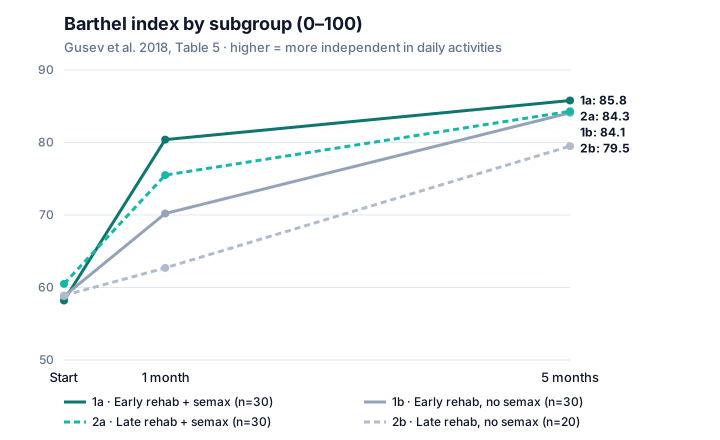
| Subgroup | Barthel start | 1 month | 5 months | Total gain | Share of gain by 1 month |
|---|---|---|---|---|---|
| 1a · early + semax (30) | 58.2 | 80.4 | 85.8 | +27.6 | 80% |
| 1b · early, no semax (30) | 58.8 | 70.2 | 84.1 | +25.3 | 45% |
| 2a · late + semax (30) | 60.5 | 75.5 | 84.3 | +23.8 | 63% |
| 2b · late, no semax (20) | 58.9 | 62.7 | 79.5 | +20.6 | 18% |
Gains and shares are our arithmetic from the table means. The paper's own text gives slightly different figures (for example total gains of 27.5 / 25.8 / 23.7 / 18.7 and a 1-month share of 78.5% for 1a), probably because it worked from unrounded values.[1] The pattern is the same either way. Semax subgroups improved sooner, while the 5-month gap between the early-rehab subgroups was under 2 points.
Strength (paresis). About 72–74% of patients had hemiparesis at entry. Limb strength improved in all subgroups. The paper attributes the between-group differences in strength mainly to when rehabilitation started, not to semax.[1]
BDNF and function. Barthel scores correlated with BDNF: r = 0.31 at 1 month and r = 0.24 at the end of the study.[1] Correlations of that size explain roughly 6–10% of the variation. BDNF is also a biomarker, not a clinical outcome.
A small inconsistency. The 5-month BDNF increase for subgroup 1b appears as 45.3% in one place and 41.9% in another. It doesn't change the conclusion, but it is the kind of slip that peer review usually catches.[1]
The authors' conclusion, in their words:
«Применение семакса оказывало основное влияние на уровень и динамику BDNF на протяжении всего наблюдения»
Our translation: “The use of semax had the main influence on the level and dynamics of BDNF throughout the entire observation period”[1]
What it got right
To be fair to the study, it has real strengths. It reported actual group means for every outcome at every visit, so the result can be rebuilt. Rehabilitation was standardized across subgroups, and baseline Barthel, BDNF, and paresis scores were similar between subgroups. The outcome scales are standard and widely used. It also did not overclaim on strength: it reported that semax didn't drive the motor results. The regimen, dose, and schedule are spelled out, and the full text is openly readable.[1]
Design: what it can't tell you
No placebo, and no blinding described. The comparison groups simply didn't get semax. Patients knew whether they were taking nose drops, and the paper doesn't say whoever scored the Barthel index was blinded. The Barthel index is partly based on observation and self-report, so this matters.[1]
Randomization method not reported. The paper says the groups were split “randomly” but gives no method, allocation concealment, or trial registration. In the late group the semax and no-semax subgroups differed significantly in time since stroke (231 ± 25 vs 188 ± 29 days), and their sizes were unequal (30 vs 20).[1]
Small groups, many tests. The subgroups had 20–30 patients. There were many t-tests across visits and outcomes, with no stated primary endpoint and no multiplicity adjustment. Results are reported as M ± m (mean ± standard error), which looks tighter than standard deviation.[1]
Short and surrogate-heavy. Follow-up lasted 5 months. Recurrence, mortality, and long-term disability weren't studied.[1]
The earlier acute-stroke work (abstracts only)
The study usually cited for acute stroke is Gusev, Skvortsova, Miasoedov et al., 1997. According to its PubMed abstract, 30 semax patients in the acute period of hemispheric ischemic stroke were compared with 80 conventionally treated patients with strokes “analogous in severity and location.” That describes a concurrent comparison group, not a randomized one. It reported “some influence on the rate of restoration of the damaged neurological functions,” with 12 mg/day (moderate strokes) and 18 mg/day (severe) for 5–10 days as the most effective doses.[2] A 1999 follow-up by Miasoedova, Skvortsova et al. was, according to its abstract, a “retrospective comparative” analysis of inflammatory markers.[3] We could not find open full texts of either paper, so we have not checked their tables.
Side effects and safety
The 2018 authors report:
«Прием препарата семакс не приводил к побочным эффектам и к ухудшению соматического состояния. … его переносимость как очень хорошую и хорошую отметили 95% пациентов.»
Our translation: “Taking semax did not lead to side effects or to worsening of physical condition. … 95% of patients rated its tolerability as very good or good.”[1]
The study didn't describe how adverse events were collected, and 60 people on the drug for two 10-day courses can't rule out uncommon harms. The current Russian prescribing information lists possible mild irritation of the nasal lining with long-term use. Contraindications include acute psychiatric disorders, anxiety disorders, a history of seizures, age under 18, and pregnancy or breastfeeding.[5] In the US, FDA lists semax among substances previously placed in compounding category 2 (nomination later withdrawn). It cites aggregation and impurity risks and states there is “no, or limited, safety-related information for proposed routes of administration.”[7]
Funding and conflicts
The 2018 paper states:
«Авторы заявляют об отсутствии конфликта интересов.»
Our translation: “The authors declare no conflict of interest.”[1]
The 2018 paper does not state its funding source.[1] The 1997 and 1999 acute-stroke papers include N.F. Miasoedov and V.N. Nezavibat'ko as co-authors.[2][3] Both also co-authored a 1997 review describing “15 years experience in [the] design and study” of semax.[4] In other words, the people who developed the drug were among the authors of its early clinical evaluation. That doesn't make the results wrong, but it is the kind of tie that independent replication is meant to rule out.
Replication outside Russia
We searched PubMed for semax with stroke or ischemia and found only Russian clinical studies. The rest were animal and gene-expression work, mostly from the same Moscow groups (for example rat BDNF data[10]). A ClinicalTrials.gov search for “semax” returned no registered studies.[9] No independent, placebo-controlled, blinded stroke trial of semax appears in the sources we checked.
Regulatory status
In the United States, it is not FDA approved. Drugs@FDA lists no approved product,[8] and FDA's compounding page flags safety concerns.[7]
In Russia, Semax 1% nasal drops are registered in the state drug register (GRLS) to JSC “INPC Peptogen” as a prescription medicine. The registration number is ЛП-№(010596)-(РГ-RU), dated June 18, 2025, replacing Р N000812/01. The 0.1% drops have a separate registration, ЛП-№(009449)-(РГ-RU).[6][5]
Bottom line: the Russian data show semax is consistently associated with higher plasma BDNF and earlier gains in daily-living scores in small, open-label studies. Those studies have no placebo, and the early work involved the drug's developers. None of this has been tested in a blinded, independently run trial, and no regulator outside Russia has reviewed it.
References
- Gusev EI, Martynov MY, Kostenko EV, Petrova LV, Bobyreva SN. [The efficacy of semax in the treatment of patients at different stages of ischemic stroke]. Zh Nevrol Psikhiatr Im S S Korsakova. 2018;118(3 Vyp 2):61-68. doi:10.17116/jnevro20181183261-68. PMID 29798983. Russian full text with Tables 1–5: https://www.mediasphera.ru/issues/zhurnal-nevrologii-i-psikhiatrii-im-s-s-korsakova-2/2018/3-2/1199772982018032061; PubMed: https://pubmed.ncbi.nlm.nih.gov/29798983/. Excerpts translated by Jabbit. Checked October 16, 2026.
- Gusev EI, Skvortsova VI, Miasoedov NF, Nezavibat'ko VN, Zhuravleva EIu, Vanichkin AV. [Effectiveness of semax in acute period of hemispheric ischemic stroke (a clinical and electrophysiological study)]. Zh Nevrol Psikhiatr Im S S Korsakova. 1997;97(6):26-34. PMID 11517472. Abstract only; full text not found. https://pubmed.ncbi.nlm.nih.gov/11517472/. Checked October 16, 2026.
- Miasoedova NF, Skvortsova VI, Nasonov EL, et al. [Investigation of mechanisms of neuro-protective effect of semax in acute period of ischemic stroke]. Zh Nevrol Psikhiatr Im S S Korsakova. 1999;99(5):15-19. PMID 10358912. Abstract only. https://pubmed.ncbi.nlm.nih.gov/10358912/. Checked October 16, 2026.
- Ashmarin IP, Nezavibat'ko VN, Miasoedov NF, et al. [A nootropic adrenocorticotropin analog 4-10-semax (15 years experience in its design and study)]. Zh Vyssh Nerv Deiat Im I P Pavlova. 1997;47(2):420-430. PMID 9173745. Abstract only. https://pubmed.ncbi.nlm.nih.gov/9173745/. Checked October 16, 2026.
- Vidal Russia drug reference. Семакс® (Semax) nasal drops 1%: composition, indications, side effects, contraindications; registration ЛП-№(010596)-(РГ-RU) of 18.06.2025. https://www.vidal.ru/drugs/semax__37577. Also 0.1% listing: https://www.vidal.ru/drugs/semax__28676. Checked October 16, 2026.
- State Register of Medicines (GRLS) entry for Семакс®, ЛП-№(010596)-(РГ-RU), holder JSC “INPC Peptogen”, as mirrored by zdravmedinform.ru: https://zdravmedinform.ru/grls/reg-lp-010596-rg-ru.html. Official register: https://grls.rosminzdrav.ru/. Checked October 16, 2026.
- U.S. Food and Drug Administration. Certain Bulk Drug Substances for Use in Compounding that May Present Significant Safety Risks. https://www.fda.gov/drugs/human-drug-compounding/certain-bulk-drug-substances-use-compounding-may-present-significant-safety-risks. Checked October 16, 2026.
- U.S. Food and Drug Administration. Drugs@FDA (no approved application for semax; searched via the openFDA drugsfda endpoint). https://www.accessdata.fda.gov/scripts/cder/daf/. Checked October 16, 2026.
- ClinicalTrials.gov search for “semax” (0 studies; API v2 query.term and query.intr). https://clinicaltrials.gov/search?term=semax. Checked October 16, 2026.
- Dolotov OV, Karpenko EA, Inozemtseva LS, et al. Semax, an analog of ACTH(4-10) with cognitive effects, regulates BDNF and trkB expression in the rat hippocampus. Brain Res. 2006;1117(1):54-60. PMID 16996037. https://pubmed.ncbi.nlm.nih.gov/16996037/. Checked October 16, 2026.
- Ponomareva-Stepnaya MA, Nezavibat'ko VN, Ashmarin IP, Kamensky AA. Heptapeptide as a long-acting memory stimulant [Гептапептид в качестве стимулятора памяти пролонгированного действия]. USSR author's certificate SU 939440 A1; priority 1981-01-06; published 1982-06-30. Applicants: Institute of Molecular Genetics, USSR Academy of Sciences; Moscow State University. https://patents.google.com/patent/SU939440A1/ru. Checked October 16, 2026.
- Ponomareva-Stepnaia MA, Porunkevich EA, Skuin'sh AA, Nezavibat'ko VN, Ashmarin IP. [Hormonal activity of the ACTH(4-10) analog—a prolonged-action stimulant of learning]. Biull Eksp Biol Med. 1986;101(3):267-268. PMID 3006824. Abstract only. https://pubmed.ncbi.nlm.nih.gov/3006824/. Checked October 16, 2026.
- Andreeva LA, Ashmarin IP, Kamensky AA, Myasoedov NF, Nezavibat'ko VN, Ryasina TV. Nootropic drug and pharmaceutical nootropic composition [Ноотропное средство и фармацевтическая композиция ноотропного действия]. Russian patent RU 2045958 C1; priority 1994-03-28; published 1995-10-20. Holder: Institute of Molecular Genetics, Russian Academy of Sciences. Full text read: https://patents.google.com/patent/RU2045958C1/ru. Checked October 16, 2026.
- Vidal Russia drug reference. Семакс® nasal drops 0.1%: indications; registration ЛП-№(009449)-(РГ-RU) of 26.03.2025 (previous ЛС-002553). https://www.vidal.ru/drugs/semax__28676. Checked October 16, 2026.
- Koroleva MV, Meizerov EE, Nezavibat'ko VN, Kamenskii AA, Dubynin VA. [Effect of the heptapeptide Semax on the human electroencephalogram]. Biull Eksp Biol Med. 1996;121(1):116-117. PMID 8679991. Title only (no abstract). https://pubmed.ncbi.nlm.nih.gov/8679991/. Checked October 16, 2026.
This page analyzes published research and regulatory documents. It is not medical advice and does not recommend using, sourcing, or dosing semax. Russian excerpts are quoted from the cited sources; English renderings are Jabbit's own translations. Charts were rebuilt by Jabbit from the published table means.