Home / Research / SURMOUNT-1 teardown
Study teardown · Sources checked October 16, 2026
SURMOUNT-1 teardown: what the tirzepatide obesity trial shows, and what it doesn't
SURMOUNT-1 is the trial behind the familiar “about 20% weight loss” number for tirzepatide (Zepbound) at 15 mg. It was large, double-blind, and placebo-controlled, with three active doses. The headline effect is real and has held up in later SURMOUNT trials. This page goes through the parts that headlines leave out: what the placebo group got, who ran the analysis, how missing data were handled, who was enrolled, the safety profile in absolute terms, and what happened when people stopped.[1][3]
The short version
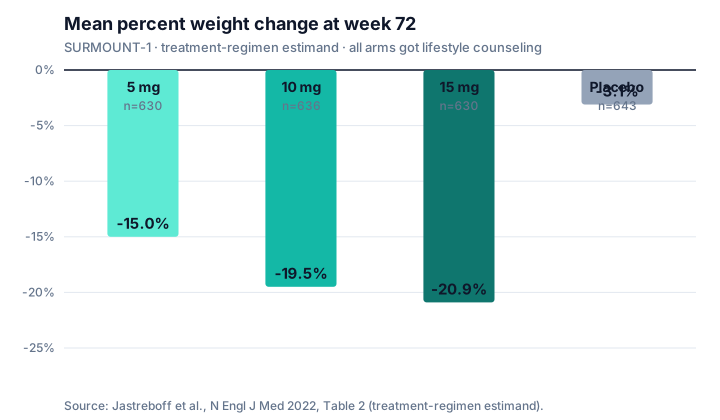
- Effect size: mean weight change at week 72 was −15.0% (5 mg), −19.5% (10 mg), and −20.9% (15 mg) with tirzepatide, versus −3.1% with placebo. Placebo-corrected differences were 11.9, 16.4, and 17.8 percentage points.[1]
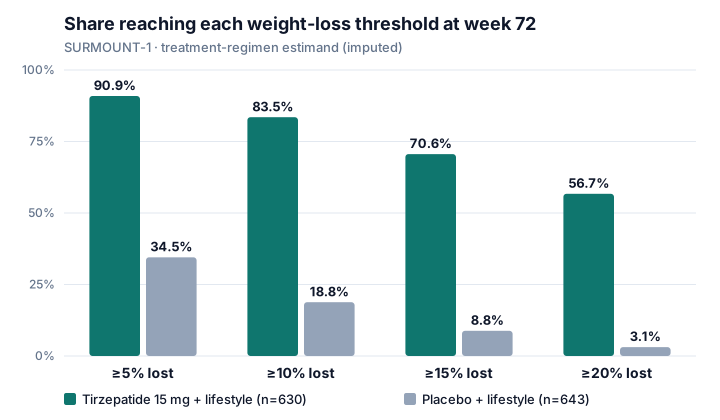
- Placebo was not “nothing”: both arms got regular counseling for a 500-kcal-per-day deficit and at least 150 minutes of weekly activity, and about 35% of the placebo group lost at least 5%.[1]
- Sponsor role: Eli Lilly designed the trial and did site monitoring, data collation, and analysis. Five of the 11 named authors were Lilly employees, and a Lilly medical writer helped draft an earlier version.[1]
- Stopping: in SURMOUNT-4, people who switched from tirzepatide to placebo after a 36-week lead-in regained substantially; those who continued lost more.[3]
- Replication: SURMOUNT-2 (obesity with type 2 diabetes) found smaller absolute losses; SURMOUNT-4 tested withdrawal. All were funded by Eli Lilly.[5][3]
What was tested
SURMOUNT-1 was a phase 3, multicenter, double-blind, randomized, placebo-controlled trial at 119 sites in nine countries. From December 2019 through April 2022, 2,539 adults were randomly assigned 1:1:1:1 to once-weekly subcutaneous tirzepatide 5 mg (630), 10 mg (636), or 15 mg (630), or matching placebo (643), for 72 weeks, including up to 20 weeks of dose escalation. Treatment started at 2.5 mg and rose by 2.5 mg every 4 weeks to the assigned maintenance dose.[1] The trial was registered on ClinicalTrials.gov (NCT04184622; first submitted December 2, 2019) before randomization began.[2]
Both arms got a lifestyle program. Participants had regular counseling from a dietitian or qualified clinician to support healthful meals with a 500-calorie-per-day deficit and at least 150 minutes of physical activity per week.[1]
Who could join: adults 18 or older with a BMI of 30 or more, or 27 or more with at least one weight-related complication (for example hypertension, dyslipidemia, obstructive sleep apnea, or cardiovascular disease), and at least one self-reported unsuccessful dietary effort to lose weight. Key exclusions were diabetes, a body-weight change of more than 5 kg in the 90 days before screening, previous or planned obesity surgery, and anti-obesity medication in the previous 90 days.[1][2]
Endpoints: coprimary endpoints were percent change in body weight and the share of people losing at least 5% by week 72. Key secondary endpoints included losing at least 10%, 15%, and 20%; change in weight by week 20; and week-72 changes in waist circumference, systolic blood pressure, fasting insulin and lipids, and SF-36 physical function. Body-fat mass by DXA was assessed in a 255-person subgroup.[1]
Two estimands: the main (“treatment regimen”) analysis counts everyone as randomized, whether or not they stopped the drug. Missing data were handled with mixed models and multiple imputation (Covid-19-related missingness differently from other missingness). A second (“efficacy”) estimand estimates the effect if everyone had taken the drug as intended.[1] The headline −15.0% / −19.5% / −20.9% figures come from the more conservative treatment-regimen analysis. The efficacy-estimand figures were −16.0%, −21.4%, and −22.5% versus −2.4%.[1]
Who was enrolled
| Characteristic | Total (N=2,539) | Notes across arms |
|---|---|---|
| Mean age | 44.9 years | Similar across arms (~44–46) |
| Female | 67.5% | ~67% in each arm |
| White / Asian / Black | 70.6% / 10.9% / 7.9% | Hispanic or Latino 47.8% |
| Mean body weight | 104.8 kg | Arm means 102.9–105.8 kg |
| Mean BMI | 38.0 | 94.5% had BMI ≥30 |
| Mean waist circumference | 114.1 cm | — |
| Mean HbA1c | 5.6% | Prediabetes 40.6% |
| Mean blood pressure | 123.3 / 79.5 mm Hg | — |
| Mean duration of obesity | 14.4 years | — |
Headline results at week 72
All figures below are from the treatment-regimen estimand unless noted. Threshold percentages in Table 2 combine imputed datasets (Rubin’s rules).[1]
| End point | 5 mg | 10 mg | 15 mg | Placebo |
|---|---|---|---|---|
| Body weight, % | −15.0 | −19.5 | −20.9 | −3.1 |
| Difference vs placebo, pts | −11.9 | −16.4 | −17.8 | — |
| ≥5% weight loss, % | 85.1 | 88.9 | 90.9 | 34.5 |
| ≥10% weight loss, % | 68.5 | 78.1 | 83.5 | 18.8 |
| ≥15% weight loss, % | 48.0 | 66.6 | 70.6 | 8.8 |
| ≥20% weight loss, % | 30.0 | 50.1 | 56.7 | 3.1 |
| ≥25% weight loss, % (exploratory) | 15.3 | 32.3 | 36.2 | 1.5 |
| Waist circumference, cm | −14.0 | −17.7 | −18.5 | −4.0 |
Pooled tirzepatide versus placebo also improved systolic blood pressure (−7.2 vs −1.0 mm Hg; difference −6.2), triglycerides, HDL, fasting insulin, and SF-36 physical function (key secondary endpoints under type I error control for pooled 10/15 mg where specified).[1] Among people with prediabetes at baseline, 95.3% on tirzepatide and 61.9% on placebo had reverted to normoglycemia at week 72.[1]
Side effects and safety
| Event | 5 mg (n=630) | 10 mg (n=636) | 15 mg (n=630) | Placebo (n=643) |
|---|---|---|---|---|
| Any adverse event | 81.0% | 81.8% | 78.9% | 72.0% |
| Nausea | 24.6% | 33.3% | 31.0% | 9.5% |
| Diarrhea | 18.7% | 21.2% | 23.0% | 7.3% |
| Vomiting | 8.3% | 10.7% | 12.2% | 1.7% |
| Constipation | 16.8% | 17.1% | 11.7% | 5.8% |
| Serious adverse events | 6.3% | 6.9% | 5.1% | 6.8% |
| Stopped drug/placebo because of an AE | 4.3% | 7.1% | 6.2% | 2.6% |
| Severe or serious GI events | 1.7% | 3.1% | 3.3% | 1.1% |
| Gallbladder disease (severe/serious) | 0.8% | 1.7% | 1.0% | 0.8% |
| Cholelithiasis | 1.1% | 1.4% | 0.6% | 0.9% |
| Cholecystitis (any listed) | 0.6% | 0.5% | 0 | 0 |
| Pancreatitis (adjudicated) | 0.2% (1) | 0.2% (1) | 0.2% (1) | 0.2% (1) |
Gastrointestinal effects were common but mostly temporary. Nausea, diarrhea, vomiting, and constipation were the most frequent events on tirzepatide. Most were mild to moderate and occurred primarily during dose escalation.[1]
Discontinuation. Adverse events led to stopping treatment in 4.3% (5 mg), 7.1% (10 mg), and 6.2% (15 mg), versus 2.6% on placebo. Nausea was the most common single reason listed (1.0% / 1.1% / 1.9% vs 0.3%).[1]
Gallbladder. Severe or serious gallbladder disease rates were low and not clearly separated from placebo at every dose (0.8% / 1.7% / 1.0% vs 0.8%). Cholelithiasis rates were similar across arms; cholecystitis was reported more often on tirzepatide at low absolute rates (≤0.6%). The authors note gallbladder events rise with substantial weight loss and with other incretin therapies.[1] The Zepbound label warns that acute gallbladder disease has been reported in clinical trials and that gallbladder studies are indicated if cholecystitis is suspected.[6]
Serious adverse events. SAEs were similar across tirzepatide and placebo (about 5–7%). Roughly 21% of SAEs were judged related to Covid-19; the trial ran almost entirely during the pandemic. Eleven deaths were reported (4 / 2 / 1 / 4 by arm); about one third were directly attributed to Covid-19. Adjudicated pancreatitis occurred in one person per arm, including placebo. No medullary thyroid cancers were reported.[1]
Lean mass / DXA. In a DXA subgroup (255 enrolled; 160 with evaluable baseline and week-72 data under the efficacy estimand), total body fat mass fell 33.9% with tirzepatide versus 8.2% with placebo (difference −25.7 points). The fat-to-lean mass ratio fell from 0.93 to 0.70 on tirzepatide versus 0.95 to 0.88 on placebo. The authors state fat mass fell about three times more than lean mass as a percent reduction, similar to lifestyle and surgical weight loss. Exact kilogram lean-mass figures beyond that ratio framing are not restated here from a supplementary figure we did not reopen as a separate numeric table.[1]
Heart rate. The SURMOUNT-1 main text does not report a single pooled beats-per-minute change for all doses in the tables we cite above. The current Zepbound label states that in a pool of Study 1 and Study 2, tirzepatide raised mean heart rate by 1 to 3 beats per minute versus no increase on placebo.[6]
What the FDA label warns about. The current Zepbound prescribing information carries a boxed warning for thyroid C-cell tumors seen in rodents. Whether this applies to humans is unknown; the drug is contraindicated with a personal or family history of medullary thyroid carcinoma or MEN 2. Other warnings and precautions cover:[6]
- severe gastrointestinal adverse reactions (not recommended in severe gastroparesis)
- acute kidney injury from volume depletion
- acute gallbladder disease
- acute pancreatitis
- hypersensitivity reactions (including anaphylaxis and angioedema in postmarketing experience)
- hypoglycemia when combined with insulin or insulin secretagogues
- diabetic retinopathy complications in people with type 2 diabetes
- pulmonary aspiration during general anesthesia or deep sedation
- never share a KwikPen between patients
Several of these came from the broader tirzepatide program or postmarketing experience, not from SURMOUNT-1 alone. SURMOUNT-1 was not designed to detect rare events.[6]
What it got right: how strong the result was
A large effect. At 15 mg, the placebo-corrected difference was 17.8 percentage points (95% CI 16.3 to 19.3). More than half of the 15 mg group reached ≥20% weight loss (56.7% vs 3.1% on placebo). Every coprimary and key secondary comparison with placebo under the type I error procedure was significant at P<0.001.[1]
Bigger than earlier obesity drugs — and larger than STEP 1’s placebo-corrected gap, with a caveat. These are separate trials with different populations, durations, and missing-data methods, so the comparisons are rough. They still show how large the jump was:
| Trial | Drug | Result vs placebo |
|---|---|---|
| XENDOS (Diabetes Care 2004)[7] | Orlistat 120 mg three times daily, 4 years | −5.8 vs −3.0 kg |
| CONQUER (Lancet 2011)[8] | Phentermine 15 mg / topiramate 92 mg, 56 weeks | −9.8% vs −1.2% |
| SCALE Obesity and Prediabetes (NEJM 2015)[9] | Liraglutide 3.0 mg daily, 56 weeks | −8.4 vs −2.8 kg |
| STEP 1 (NEJM 2021)[4] | Semaglutide 2.4 mg weekly, 68 weeks | −14.9% vs −2.4% (difference −12.4 pts) |
| SURMOUNT-1 (NEJM 2022)[1] | Tirzepatide 15 mg weekly, 72 weeks | −20.9% vs −3.1% (difference −17.8 pts) |
The SURMOUNT-1 authors themselves put the result next to older drugs’ roughly 3.0–8.6% placebo-adjusted losses and next to semaglutide 2.4 mg’s 12.4-point placebo-adjusted loss in STEP 1, and they warned that no direct comparison of those trials can be made.[1] See our STEP 1 teardown for that trial’s own caveats.
Size and rigor. The trial randomized 2,539 people at 119 sites in nine countries. It was double-blind and registered before enrollment. The planned sample gave greater than 90% power for superiority of 10 mg, 15 mg, or both versus placebo on the coprimaries. The primary analysis counted everyone as randomized. Overall, 86.0% completed the primary treatment period (about 88–90% on tirzepatide, 77.0% on placebo) despite Covid-19. An independent committee adjudicated deaths, cardiovascular events, and pancreatitis.[1][2]
What a critical reader should notice
1. The comparator was placebo plus a structured lifestyle program, not another drug
The 11.9–17.8-point differences compare tirzepatide plus counseling with counseling alone. They are not head-to-head results against semaglutide or against usual care without counseling. About 35% of the placebo group still lost at least 5%.[1] SURPASS-2 compared tirzepatide with semaglutide 1 mg in type 2 diabetes (a different dose and population than Wegovy’s obesity program); that is not a substitute for an obesity head-to-head at approved weight-management doses.[10]
2. The manufacturer ran the trial and the analysis
The paper says the sponsor (Eli Lilly) designed the trial and oversaw how it was run. Site investigators collected the data; the sponsor did site monitoring, data collation, and analysis. Five of the 11 named authors (Ahmad, Zhang, Liu, Bunck, Stefanski) were Lilly employees. Farai Chigutsa of Eli Lilly provided medical writing and editorial assistance with an earlier manuscript version.[1] Design features that limit how much this can bias the result: advance registration, double-blinding, prespecified hierarchical testing, and independent adjudication of key events.[1][2] SURMOUNT-2 and SURMOUNT-4 were also funded by Eli Lilly, so “replication” here means consistency within one sponsor’s program.[5][3]
3. Dropout was uneven, and threshold percentages use imputation
Overall completion was high (86%), but the placebo arm completed less often (77.0%) than the tirzepatide arms (88.4% to 89.8%). Treatment adherence was 81.9% overall (83.5–85.7% tirzepatide vs 73.6% placebo). AE discontinuations were higher on drug than placebo, as expected.[1]
The familiar 85% / 89% / 91% (≥5%) and 50% / 57% (≥20% at 10/15 mg) figures in headlines come from the treatment-regimen estimand with missing week-72 values imputed. That is appropriate for an intention-to-treat-style question, but it is not the same as an observed-cases percentage among people who showed up for a week-72 weigh-in. The paper also reports efficacy-estimand thresholds that are higher still (for example ≥5% of 96% at 10 and 15 mg).[1]
4. Absolute versus relative framing
You can say 15 mg produced about seven times the weight loss of placebo (20.9% vs 3.1%). That is accurate and flattering. The drug-attributable effect is a 17.8-point difference from a starting average of about 105 kg.[1] Safety needs the same absolute lens. Nausea at 15 mg was 31.0% vs 9.5% on placebo (about 21 extra people per 100). Stopping for an adverse event at 15 mg was 6.2% vs 2.6% (3.6 extra per 100). Serious adverse events were not higher on tirzepatide than placebo in this trial.[1]
5. Who was enrolled limits who it generalizes to
Participants were mostly women (67.5%) and mostly White (70.6%), with a large Hispanic/Latino share (47.8%), mean BMI 38.0, and no diabetes. Everyone had to report a previous failed diet. The authors list as limitations that volunteers may be more committed than the general population with obesity, that baseline cardiometabolic markers were relatively normal, and that only 5.5% had overweight rather than obesity.[1] In people with type 2 diabetes, SURMOUNT-2 found smaller losses: −12.8% (10 mg) and −14.7% (15 mg) versus −3.2% placebo at 72 weeks.[5]
6. What happened after stopping
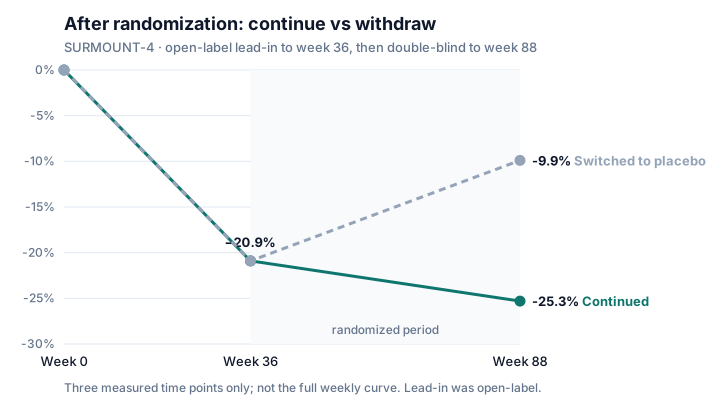
SURMOUNT-4 tested withdrawal more cleanly than an uncontrolled off-treatment extension. After 36 weeks of open-label tirzepatide (mean −20.9%), 670 people were randomized to continue the maximum tolerated dose (10 or 15 mg) or switch to placebo for 52 weeks. From week 36 to 88, mean change was −5.5% with continued tirzepatide versus +14.0% with placebo (difference −19.4 points). Net from week 0 to 88: −25.3% vs −9.9%. About 89.5% who continued maintained at least 80% of their lead-in loss, versus 16.6% on placebo.[3]
Two details matter. The lead-in was open-label, and only people who completed it and reached a maximum tolerated dose were randomized — a selected group. And lifestyle counseling continued in both arms during the randomized period, so the regain on placebo is regain while still getting the lifestyle program.[3]
7. Seventy-two weeks of risk markers, not hard outcomes
SURMOUNT-1 measured weight and cardiometabolic markers. It was not designed or powered to show fewer heart attacks, strokes, or deaths. Cardiovascular outcome data for tirzepatide come from other programs. Body composition is covered under side effects and safety above.
Did it replicate?
| Study | Population / design | Result |
|---|---|---|
| SURMOUNT-2 (Lancet 2023)[5] | 938 adults with obesity/overweight and type 2 diabetes; 72 weeks; 10 or 15 mg vs placebo | −12.8% / −14.7% vs −3.2% |
| SURMOUNT-4 (JAMA 2024)[3] | 670 after 36-week tirzepatide lead-in; continue vs placebo for 52 weeks | Week 36→88: −5.5% vs +14.0%; week 0→88: −25.3% vs −9.9% |
Both follow-ons were funded by Eli Lilly. The diabetes population in SURMOUNT-2 shows the effect is real but smaller when type 2 diabetes is present — the same pattern seen when STEP 2 is compared with STEP 1 for semaglutide.[5][4]
What SURMOUNT-1 robustly shows
To be fair to the trial, it has real strengths. It was large, randomized 1:1:1:1 across three doses, double-blind, and registered in advance, with high completion on drug despite a pandemic. Its headline results came from the conservative treatment-regimen analysis, and the key hierarchy endpoints beat placebo.[1][2] The size of the effect — on the order of 12 to 18 points beyond a structured lifestyle program at 5–15 mg — is unusually large for a medicine, and SURMOUNT-2 and SURMOUNT-4 point the same way within the sponsor’s program.[5][3] The open questions are what it doesn’t settle: performance against active obesity drugs in routine care, durability without continued treatment, and long-term hard outcomes in people unlike the volunteers who enrolled.
References
- Jastreboff AM, Aronne LJ, Ahmad NN, et al.; SURMOUNT-1 Investigators. Tirzepatide Once Weekly for the Treatment of Obesity. N Engl J Med. 2022;387(3):205-216. doi:10.1056/NEJMoa2206038. PMID 35658024. Full text (Tables 1–4, Figure 1, Methods, Discussion, Notes): https://www.nejm.org/doi/full/10.1056/NEJMoa2206038; PubMed: https://pubmed.ncbi.nlm.nih.gov/35658024/. Checked October 16, 2026.
- ClinicalTrials.gov. NCT04184622: A Study of Tirzepatide (LY3298176) in Participants With Obesity or Overweight (SURMOUNT-1). Record including eligibility, design, and sponsor. https://clinicaltrials.gov/study/NCT04184622. Checked October 16, 2026 (via ClinicalTrials.gov API v2).
- Aronne LJ, Sattar N, Horn DB, et al. Continued Treatment With Tirzepatide for Maintenance of Weight Reduction in Adults With Obesity: The SURMOUNT-4 Randomized Clinical Trial. JAMA. 2024;331(1):38-48. doi:10.1001/jama.2023.24945. PMID 38078870; PMC10714284. https://pmc.ncbi.nlm.nih.gov/articles/PMC10714284/. Checked October 16, 2026.
- Wilding JPH, Batterham RL, Calanna S, et al.; STEP 1 Study Group. Once-Weekly Semaglutide in Adults with Overweight or Obesity. N Engl J Med. 2021;384(11):989-1002. PMID 33567185. https://www.nejm.org/doi/full/10.1056/NEJMoa2032183. Also: our STEP 1 teardown. Checked October 16, 2026.
- Garvey WT, Frias JP, Jastreboff AM, et al. Tirzepatide once weekly for the treatment of obesity in people with type 2 diabetes (SURMOUNT-2). Lancet. 2023;402(10402):613-626. PMID 37385275. https://pubmed.ncbi.nlm.nih.gov/37385275/. Checked October 16, 2026.
- U.S. Food and Drug Administration. ZEPBOUND (tirzepatide) injection prescribing information (label PDF 217806s042lbl.pdf). Boxed Warning; Warnings and Precautions; Adverse Reactions (heart rate 1–3 bpm in Study 1 and 2 pool). https://www.accessdata.fda.gov/drugsatfda_docs/label/2026/217806s042lbl.pdf. Also confirmed via openFDA drug/label for brand ZEPBOUND (effective_time 20260828). Checked October 16, 2026.
- Torgerson JS, Hauptman J, Boldrin MN, Sjöström L. XENical in the prevention of diabetes in obese subjects (XENDOS) study. Diabetes Care. 2004;27(1):155-161. PMID 14693982. https://pubmed.ncbi.nlm.nih.gov/14693982/. Checked October 16, 2026.
- Gadde KM, Allison DB, Ryan DH, et al. Effects of low-dose, controlled-release, phentermine plus topiramate combination on weight and associated comorbidities in overweight and obese adults (CONQUER). Lancet. 2011;377(9774):1341-1352. PMID 21481449. https://pubmed.ncbi.nlm.nih.gov/21481449/. Checked October 16, 2026.
- Pi-Sunyer X, Astrup A, Fujioka K, et al. A Randomized, Controlled Trial of 3.0 mg of Liraglutide in Weight Management. N Engl J Med. 2015;373(1):11-22. PMID 26132939. https://pubmed.ncbi.nlm.nih.gov/26132939/. Checked October 16, 2026.
- Frías JP, Davies MJ, Rosenstock J, et al. Tirzepatide versus Semaglutide Once Weekly in Patients with Type 2 Diabetes. N Engl J Med. 2021;385(6):503-515. PMID 34170647. https://pubmed.ncbi.nlm.nih.gov/34170647/. Checked October 16, 2026.
This page analyzes published research. It is not medical advice and does not recommend starting, stopping, or changing any medication. Charts were rebuilt by Jabbit from the published numbers cited in each caption.