Home / Research / Epitalon and thymalin teardown
Study teardown · Russian sources translated by Jabbit · Sources checked October 16, 2026
Will Epitalon and Thymalin make you live longer? We can’t really tell, so probably not.
Nothing reliable shows that they do. The famous “halved mortality” numbers come from groups of about 20 elderly women, in studies run by the products’ own inventors, and they tested calf-gland extracts rather than the synthetic Epitalon sold online.[1][6] Nobody outside that research group has repeated them.[8]
The claim that epitalon “extends human life” usually traces back to one source. That is a 2002 Russian paper by V.Kh. Khavinson and V.G. Morozov, republished in English in 2003. It reports that elderly people given thymus and pineal peptide preparations died at half the rate of controls, or less.[1][2] We read the scanned Russian original, translated the key passages, and rebuilt its mortality tables. The study tested Epithalamin, a bovine pineal extract, not the synthetic tetrapeptide Epitalon sold online.[1][6]
Why we say that
Almost every claim that these peptides extend human life leads back to one 2002 paper by Khavinson and Morozov. It followed two groups of older people: 94 women, average age about 80, in a St Petersburg veterans’ home (plus a separate group of 20 there), and 152 outpatients in Kiev, average age about 70, most with coronary heart disease. That is 266 people in all.[1]
The headline numbers look dramatic. In St Petersburg, 81.8% of the placebo group died within six years, compared with 41.7% on thymalin, 45.8% on epithalamin, and 33.3% on both. In Kiev, eight-year mortality was 13.6% on placebo against 6.6% and 8.5%.[1] But each St Petersburg group had only 20 to 24 people, so that 81.8% is 18 deaths out of 22. The widely quoted “4.1-fold” reduction comes from the separate group of 20, which included men and sat outside the randomized design, compared against an all-female control group.[1] The paper also says that the mortality difference during the two years people were actually being treated was not statistically significant.[1]
The people who ran the study also developed the products. Khavinson and Morozov created both preparations and hold patents on them, and the paper describes its own centers as leaders in developing them.[1][7] We found no independent mortality trial, and ClinicalTrials.gov lists none.[8]
Epithalamin is not Epitalon
Thymalin and Epithalamin are complexes of low-molecular-weight peptides (under 10 kDa) extracted from calf thymus and pineal glands.[1] Epitalon (Ala-Glu-Asp-Gly) is a synthetic four-amino-acid peptide that Khavinson's group later designed based on the composition of the pineal extract.[6] Results for an animal extract can't simply be transferred to a single synthetic peptide. We found no human mortality study of synthetic Epitalon.
Where these peptides came from
These preparations began as cancer and endocrinology research, not longevity products. The trail starts in the early 1970s with V.M. Dilman’s and V.N. Anisimov’s oncology group in Leningrad, whose later papers list the Petrov Research Institute of Oncology. V.G. Morozov and V.Kh. Khavinson co-authored the first pineal-extract papers with them.[10][12]
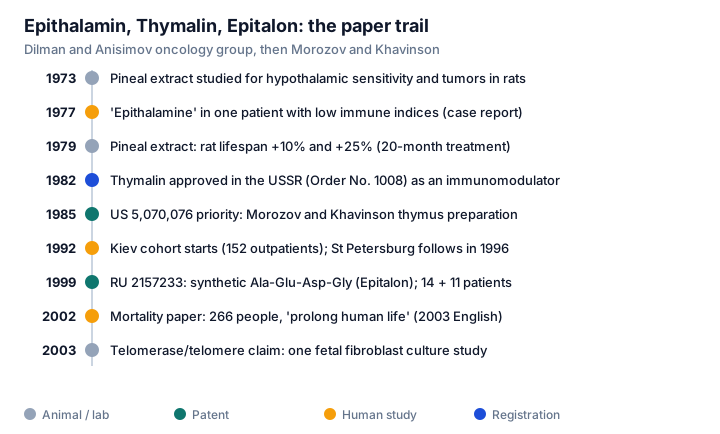
1973–1982, rats and one patient. The 1973 paper tested whether pineal extract changed how old female rats’ hypothalamus and pituitary responded to estrogen.[10] In 1977 Dilman reported giving the extract, by then called “epithalamine,” to one patient with low cellular-immunity readings, whose test results improved.[11] In 1979 the group reported that female rats treated with the extract for 20 months lived 10% to 25% longer on average, depending on dose. Tumor incidence didn’t fall, though tumors appeared later.[12] In 1982 they reported longer life and fewer tumors in mice given thymus and pineal factors.[13] That same year Thymalin was approved in the USSR, as an immune drug.[1]
1999, the synthetic version. Epitalon is a different substance. It was patented in 1999 by Khavinson’s St Petersburg Institute of Bioregulation and Gerontology as a new tetrapeptide, Ala-Glu-Asp-Gly:[14]
«Заявляемое пептидное соединение - тетрапептид - структурных аналогов не имеет.»
Our translation: “The claimed peptide compound, a tetrapeptide, has no structural analogs.”[14]
The patent’s human examples are small. Fourteen patients aged 34 to 69 with age-related disease received 10 micrograms by injection daily for 10 days, and antioxidant markers improved; another 11 people with aspirin-induced asthma got the same course.[14] We did not find a control group in those examples. The dose is also a thousand times smaller than the 10 milligrams of extract used in the mortality study, which is another reason extract results don’t carry over to Epitalon.[14][1]
2003, telomeres. The online claim that Epitalon “lengthens telomeres” traces to a one-page 2003 report from Khavinson’s group: telomerase activity and telomere elongation in a culture of human fetal fibroblasts.[15] That was cells in a dish, not people.
How the claims changed. The claims went from changes in rat hormone sensitivity (1973), to longer-lived rats (1979), to an immune drug (1982), to “prolonging human life” in the 2002 paper. Online they became a synthetic tetrapeptide that reverses aging. Each step moved further from the evidence underneath it. A 2026 narrative review by US clinicians reaches a similar conclusion. It finds human evidence “limited to small physiological or biomarker studies,” and says “no adequately powered randomized trial has established therapeutic efficacy.”[16]
What the St Petersburg study tested
«В основном исследовании участвовали 94 женщины в возрасте 66–94 лет, которые проживали в Доме ветеранов войны»
Our translation: “The main study involved 94 women aged 66–94 who lived in the War Veterans' Home”[1]
The paper describes residents in comfortable conditions (separate apartments) with a daily routine, regular medical care, and diet. All were women, chosen because women make up most of the population over 60, the authors explain.[1] Patients were split by stratified randomization into four groups: placebo (22), thymalin (24), epithalamin (24), and both (24).[1]
«Все препараты вводили ежедневно внутримышечно по 10 мг в течение 10 сут (курсовая доза 100 мг). Исследование проводилось методом двойного слепого анализа»
Our translation: “All preparations were given daily by intramuscular injection, 10 mg for 10 days (course dose 100 mg). The study was carried out using a double-blind method”[1]
A repeat course was given a year later (1997), so each person received two courses over two years. Follow-up then continued to six years.[1] The “double-blind” claim rests on a single citation, reference 24 in the paper. When we OCR’d the reference list, reference 24 turned out to be I.P. Lapin’s Плацебо и терапия (Placebo and Therapy, St Petersburg: Lan’, 2000), a general book about placebo, not a protocol for this study. The paper does not describe how blinding or randomization was done.[1]
«Отдельную группу составили 10 женщин и 10 мужчин, которые получали тималин и эпиталамин по 10 мг в течение 10 сут ежегодно в течение 6 лет (1996–2001 гг.)»
Our translation: “A separate group consisted of 10 women and 10 men who received thymalin and epithalamin, 10 mg for 10 days, every year for 6 years (1996–2001)”[1]
The numbers
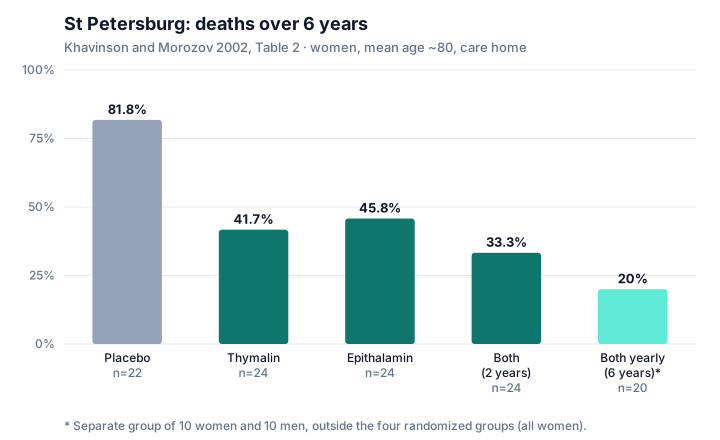
| St Petersburg group | n | Mean age | 6-year mortality | Deaths (our arithmetic) |
|---|---|---|---|---|
| Placebo | 22 | 80.2 | 81.8% | 18 |
| Thymalin (2 years) | 24 | 80.6 | 41.7% | 10 |
| Epithalamin (2 years) | 24 | 81.5 | 45.8% | 11 |
| Both (2 years) | 24 | 82.1 | 33.3% | 8 |
| Both yearly (6 years), separate group | 20 | 79.4 | 20.0% | 4 |
The paper's own text says the treatment period didn't reach significance:[1]
«в течение периода применения препаратов (2 года) снижение уровня смертности, хотя и было значительным, но оказалось статистически недостоверным»
Our translation: “during the period of drug use (2 years), the reduction in mortality, although considerable, turned out to be statistically non-significant”[1]
The difference appeared in the four years after treatment stopped. That is an unusual pattern for a short course of injections, and the paper does not explain it.[1]
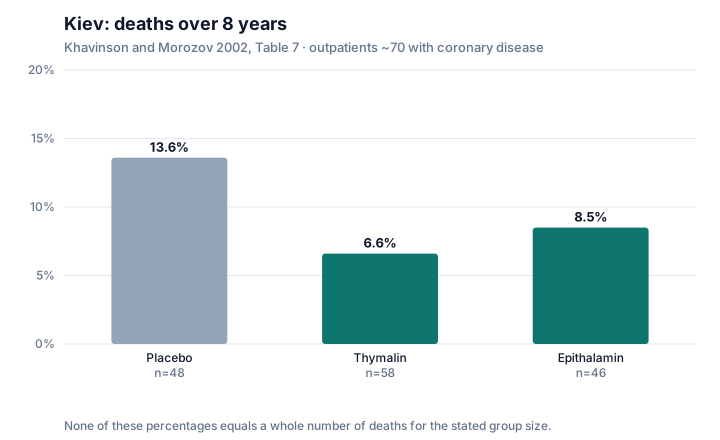
The Kiev cohort was 152 outpatients (71 men, 81 women), mostly with coronary heart disease and “accelerated aging,” and the accelerated-aging group also included 68 people without organic disease. It started in 1992.[1] They were randomized (stratified) into placebo, thymalin, and epithalamin groups. Treatment was 10 mg intramuscularly every 2–3 days for 5 doses, repeated every 5–6 months for 3 years.[1] One thing we can't reconcile: 13.6% of 48, 6.6% of 58, and 8.5% of 46 are 6.5, 3.8, and 3.9 people, not whole numbers. The control figure of 13.6% also appears in the St Petersburg tables, where it equals 3 of 22. The paper doesn't give death counts for Kiev, so we can't tell which number is wrong.[1]
A later 12-year report from the Kiev group (abstract only) gives a smaller effect: “28% lower” deaths with epithalamin than control. It calls this a randomized study in elderly patients with coronary disease.[3]
What it got right
For its time and setting, the study did several useful things. It used a placebo control and stratified randomization in two separate centers. It followed people for 6–8 years and published group sizes, ages, and mortality by period, which is what allows the arithmetic above. It also reported its own non-significant result for the treatment period instead of hiding it.[1] Thymalin has been a registered drug in Russia since 1982, so there is long clinical experience with its use as an immunostimulant.[1][4]
Design: what it can't tell you
Tiny groups. With 20–24 people per arm, a few deaths change the percentages a lot. The St Petersburg placebo group lost 18 of 22, which is unusually high even for women around 80, and the paper doesn't explain the causes.[1]
Methods not described. There is no randomization method, no allocation concealment, and no description of the blinding or of who recorded deaths. There is no trial registration (these studies predate routine registration) and no prespecified primary endpoint.[1]
Mixed comparisons. The most-quoted “4.1-fold” number compares a separate, mixed-sex group of 20 with an all-female randomized control group.[1][2]
Many outcomes, one paper. The paper reports dozens of immune, hormone, and metabolic markers and many symptoms alongside mortality, with no correction for multiple comparisons.[1]
Overstated certainty. The authors call the 6–8-year follow-up of 266 people, spread across two centers and many small arms, “quite sufficient” to establish efficacy, and they conclude the preparations should be used for people over 60.[1]
«всего в исследовании участвовали 266 человек пожилого и старческого возраста. Период наблюдения составил 6–8 лет, что является вполне достаточным для обоснования эффективности препаратов»
Our translation: “in total, the study involved 266 elderly and senile people. The observation period was 6–8 years, which is quite sufficient to substantiate the efficacy of the preparations”[1]
Side effects and safety
We found no adverse-event table for these cohorts in the paper. Instead it states that 25 years of clinical use had shown no allergic or other side effects.[1][2] It also notes that animal-derived preparations carry a theoretical risk of contamination (prions, viruses) and says its extraction process removes it.[2] The current Russian prescribing information for Thymalin lists possible allergic reactions, and contraindicates it in pregnancy and breastfeeding.[4] For synthetic Epitalon, FDA's compounding page says it “may pose risk for immunogenicity” and that FDA “has not identified safety-related information regarding epitalon for the proposed route of administration.”[5]
Funding and conflicts
The paper has no conflict-of-interest statement. A funding line near the end, which we missed in our first read of the scan and found when we re-checked it with OCR, says the work was partly supported by a Russian state science grant:[1]
«Работа частично поддержана грантом РФФИ (№ 02-04-49873).»
Our translation: “The work was partially supported by a grant from the Russian Foundation for Basic Research (No. 02-04-49873).”[1]
Morozov and Khavinson are the named inventors on a US patent for a thymus-gland preparation (US 5,070,076, granted December 1991).[7] The paper describes its own institutes as having “the leading role in the development and study of geroprotectors,” and says the peptides it isolated became the basis of Thymalin and Epithalamin.[1] So the developers of the products ran, analyzed, and wrote up the trials of those products.
Replication outside Russia
Every human mortality report we found for these preparations comes from Khavinson's St Petersburg institute or its Kiev partner. Most have Khavinson as an author.[1][2][3] A ClinicalTrials.gov search for epitalon, epithalon, epithalamin, or thymalin returns no registered studies.[8] There is no independent, registered, blinded trial of mortality or aging outcomes for Epithalamin, Thymalin, or Epitalon in the sources we checked.
Regulatory status
In the United States, none of these is FDA approved, and Drugs@FDA returns no matching application.[9] FDA's compounding page lists epitalon with immunogenicity and safety-data concerns.[5]
In Russia, Thymalin (calf thymus extract) is a registered prescription drug, ЛС-000267, held by Samson-Med. It is labeled for immunodeficiency states, not for aging.[4] The paper gives its original approval as USSR Ministry of Health Order No. 1008 of November 10, 1982.[1] We did not find a current Vidal listing for Epithalamin. Synthetic Epitalon is sold online as a “research peptide,” not as a registered medicine in the sources we checked.
Bottom line: the Khavinson papers report large drops in mortality. Those come from groups of about 20 people, with methods barely described, run by the products' inventors, and never independently repeated. They tested animal extracts, not synthetic Epitalon. They are a reason someone could run a proper trial, not evidence that these products extend human life.
References
- Khavinson VKh, Morozov VG. [Geroprotective effect of thymalin and epithalamin]. Adv Gerontol (Uspekhi gerontologii). 2002;10:74-84. PMID 12577695. Scanned Russian full text (Tables 1–7), hosted on the first author's site: https://khavinson.info/assets/files/russ/2002-khavinson_morozov.pdf; PubMed: https://pubmed.ncbi.nlm.nih.gov/12577695/. Excerpts translated by Jabbit from the scan. Checked October 16, 2026.
- Khavinson VKh, Morozov VG. Peptides of pineal gland and thymus prolong human life. Neuro Endocrinol Lett. 2003;24(3-4):233-240. PMID 14523363. English version; we read the abstract and the publisher record (the PDF link timed out from our server). https://pubmed.ncbi.nlm.nih.gov/14523363/; https://www.nel.edu/peptides-of-pineal-gland-and-thymus-prolong-human-life-2142/. Checked October 16, 2026.
- Korkushko OV, Khavinson VKh, Shatilo VB, Antonyuk-Shcheglova IA. Geroprotective effect of epithalamine (pineal gland peptide preparation) in elderly subjects with accelerated aging. Bull Exp Biol Med. 2006;142(3):356-359. doi:10.1007/s10517-006-0365-z. PMID 17426848. Abstract only. https://pubmed.ncbi.nlm.nih.gov/17426848/. Checked October 16, 2026.
- Vidal Russia drug reference. Тималин® (Thymalin, thymus extract) lyophilizate 10 mg for IM injection: indications, side effects, contraindications; prescription; registration ЛС-000267, holder Samson-Med. https://www.vidal.ru/drugs/thymalin__23838. Checked October 16, 2026.
- U.S. Food and Drug Administration. Certain Bulk Drug Substances for Use in Compounding that May Present Significant Safety Risks (entry: Epitalon). https://www.fda.gov/drugs/human-drug-compounding/certain-bulk-drug-substances-use-compounding-may-present-significant-safety-risks. Checked October 16, 2026.
- Araj SK, et al. Overview of Epitalon—Highly Bioactive Pineal Tetrapeptide with Promising Properties. Int J Mol Sci. 2025;26(6):2691. PMID 40141333. https://pubmed.ncbi.nlm.nih.gov/40141333/. Checked October 16, 2026.
- Morozov VG, Khavinson VK. Thymus-gland preparation and method for producing the same. US Patent 5,070,076 (priority 1985-07-02; published 1991-12-03). https://patents.google.com/patent/US5070076A/en. Checked October 16, 2026.
- ClinicalTrials.gov API v2 intervention search for epitalon, epithalon, epithalamin, thymalin (0 studies). https://clinicaltrials.gov/search?intr=epitalon. Checked October 16, 2026.
- U.S. Food and Drug Administration. Drugs@FDA (openFDA drugsfda query for epitalon or thymalin returned no matches). https://www.accessdata.fda.gov/scripts/cder/daf/. Checked October 16, 2026.
- Anisimov VN, Khavinson VKh, Morozov VG, Dil'man VM. [Effect of epiphyseal extracts in lowering the threshold sensitivity of the hypothalamo-hypophyseal system of old female rats to the action of estrogens]. Dokl Akad Nauk SSSR. 1973;213(2):483-485. PMID 4797507. Title only. https://pubmed.ncbi.nlm.nih.gov/4797507/. Checked October 16, 2026.
- Dil'man VM. [Improvement of the indicators of cellular immunity under the effect of polypeptide epiphyseal extract (epithalamine)]. Vopr Onkol. 1977;23(6):7-9. PMID 303411. Abstract only. https://pubmed.ncbi.nlm.nih.gov/303411/. Checked October 16, 2026.
- Dilman VM, Anisimov VN, Ostroumova MN, Khavinson VK, Morozov VG. Increase in lifespan of rats following polypeptide pineal extract treatment. Exp Pathol (Jena). 1979;17(9):539-545. doi:10.1016/s0014-4908(79)80076-9. PMID 575333. Abstract only. https://pubmed.ncbi.nlm.nih.gov/575333/. Checked October 16, 2026.
- Anisimov VN, Morozov VG, Khavinson VKh. [Increase of the life span and decrease in the tumor incidence in C3H/Sn mice as affected by thymus and epiphysis polypeptide factors]. Dokl Akad Nauk SSSR. 1982;263(3):742-745. PMID 6978806. Abstract only. https://pubmed.ncbi.nlm.nih.gov/6978806/. Checked October 16, 2026.
- Khavinson VKh. Tetrapeptide with geroprotective activity, pharmacological agent based on it, and method of its use [Тетрапептид, обладающий геропротекторной активностью, фармакологическое средство на его основе и способ его применения]. Russian patent RU 2157233 C1; priority 1999-05-11; published 2000-10-10. Holder: St Petersburg Institute of Bioregulation and Gerontology. Full text read. https://patents.google.com/patent/RU2157233C1/ru. Checked October 16, 2026.
- Khavinson VKh, Bondarev IE, Butyugov AA. Epithalon peptide induces telomerase activity and telomere elongation in human somatic cells. Bull Exp Biol Med. 2003;135(6):590-592. doi:10.1023/a:1025493705728. PMID 12937682. https://pubmed.ncbi.nlm.nih.gov/12937682/. Checked October 16, 2026.
- Jain A, Gallacher DM, Issa MA, Deer TR, Yong RJ, Diwan S. Epitalon and Epithalamin: a narrative review of mechanistic, preclinical, and clinical evidence. Int J Mol Sci. 2026;27(19). doi:10.3390/ijms27198922. PMID 42884164. https://pubmed.ncbi.nlm.nih.gov/42884164/. Checked October 16, 2026.
This page analyzes published research and regulatory documents. It is not medical advice and does not recommend using, sourcing, or dosing epitalon, epithalamin, or thymalin. Russian excerpts are transcribed by Jabbit from a scanned PDF and checked against Tesseract OCR (Russian model); English renderings are Jabbit's own translations. Charts were rebuilt by Jabbit from the published tables.