Study teardown · Semaglutide (Ozempic, Wegovy), tirzepatide (Zepbound) and other GLP-1-type drugs · Randomized trials, health-record studies, company and NIH releases, registry records, reviews and PubMed counts · Sources checked October 26, 2026
Published · Updated
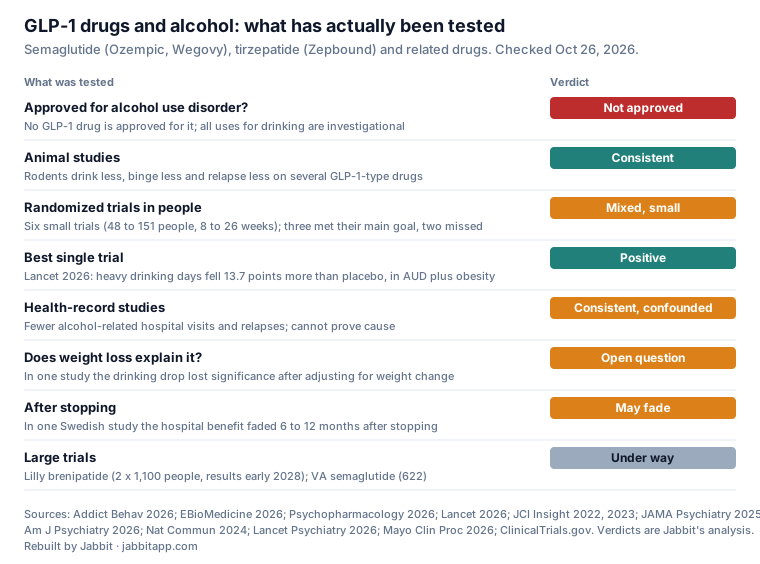
Do Ozempic, Wegovy and Zepbound make you drink less? Heineken warned UK pubs in October 2026 that weight-loss drugs could cut beer sales. Six small randomized trials are mixed but mostly encouraging, the best one in people with alcohol use disorder and obesity, and health-record studies point the same way. No GLP-1 drug is approved for alcohol use disorder, and the first large trials report in 2028 at the earliest.
GLP-1 drugs such as semaglutide (Ozempic, Wegovy) and tirzepatide (Zepbound) are approved for diabetes and weight loss, not for alcohol use disorder.[26] Many users report wanting to drink less, and on October 23, 2026, The Guardian reported, citing Reuters, that Heineken had warned UK pubs that the drugs “could reduce the desire to drink alcohol.”[1] Do they really cut drinking? Six small randomized trials, with 48 to 151 people each, have reported: three met their main goal, two missed, and one was a secondary analysis that found 29% less drinking.[5][2][9][6][4][8] The strongest, published in The Lancet in 2026, found semaglutide cut heavy drinking days by 13.7 percentage points more than placebo in people with alcohol use disorder and obesity.[2] Large health-record studies point the same way but cannot prove cause.[16][17][18] Tirzepatide has not yet reported a randomized alcohol trial in people, and the first large trials, of a newer Lilly drug, report in early 2028.[13][11][12]
Why this matters now
On October 23, 2026, The Guardian reported that Heineken had sent British bars and pubs a presentation, first revealed by Reuters, warning that weight-loss drug use could lead to lower beer and cider sales, citing “fullness and fewer serves.”[1] A Heineken spokesperson told the paper the company sees “some changes in consumption behaviour among (GLP-1) users” and will keep monitoring; the paper also reported that Carlsberg told Reuters its data did not support that view, and that Diageo has told investors any impact should be manageable.[1] Our analysis: these are business forecasts, not health evidence. The same month, two reviews took stock of the science: one counted only three randomized trials in alcohol use disorder, and another stressed that no GLP-1 drug is approved for it and that the evidence is limited by small samples, short follow-up, self-reported drinking and possible confounding by weight loss.[25][26] A PubMed search we ran on October 26, 2026 found 101 records naming a GLP-1 drug and alcohol use disorder in the title or abstract, far more papers than randomized trials.[15]
Timeline
| Date | Event |
|---|---|
| 2022 | The first full trial, of exenatide in 127 patients, misses its main goal; people with obesity appear to benefit in an exploratory analysis.[6] |
| 2023 | A Swiss secondary analysis of a smoking trial finds people on dulaglutide drank 29% less.[8] |
| 2024 | A US health-record study links semaglutide to a 50 to 56% lower risk of new or recurring alcohol use disorder.[17] |
| 2025 | A 48-person semaglutide trial lowers drinking in a lab session; a Swedish register study of 227,866 people ties semaglutide to fewer alcohol-related hospital stays.[5][16] |
| April 2026 | The Lancet publishes the 108-person Copenhagen trial; NIH calls the results encouraging.[2][3] |
| July 2026 | An oral semaglutide trial misses its craving goal but cuts heavy drinking days; Altimmune reports that pemvidutide met its main goal in about 100 people (company topline).[4][9][10] |
| September 2026 | Lilly says brenipatide is in phase 3 for alcohol use disorder, with results expected in early 2028.[11][12] |
| October 2026 | Two reviews say evidence is promising but limited; Heineken warns UK pubs about weight-loss drugs, The Guardian reports.[25][26][1] |
Why a diabetes drug might affect drinking
GLP-1 drugs mimic a gut hormone that slows the stomach and acts on appetite centers in the brain. In rodents, tirzepatide reduced drinking, binge drinking and relapse-like drinking, and semaglutide, tirzepatide and retatrutide all blunted how rats sense alcohol, an effect gone three days after the drug stopped.[23][24] One review of human brain-imaging and drinking studies describes reduced brain reactions to alcohol cues, mainly in people with overweight or obesity.[25]
The evidence, rung by rung
- The best trial. In Copenhagen, 108 adults with alcohol use disorder and obesity got therapy plus weekly semaglutide or placebo for 26 weeks. Heavy drinking days fell 41.1 points on semaglutide vs 26.4 on placebo, a 13.7-point difference; 81% completed the study.[2] NIH said blood markers of drinking backed up self-reports, and that the number needed to treat was 4.3, compared with 7 or higher for approved medicines.[3]
- The misses. Exenatide, an older GLP-1 drug, did not reduce heavy drinking days overall in 127 patients, though a blood marker of drinking diverged by week 26.[6][7] An oral semaglutide trial of 50 people missed its main goal, lab-measured craving, and did not cut drinks per day, but did cut heavy drinking days.[4]
- Smaller wins. In 48 people not seeking treatment, semaglutide reduced drinking in a lab session and drinks per drinking day, but not drinks per day or drinking days overall.[5] In a smoking-cessation trial, people on dulaglutide drank 29% less at 12 weeks.[8]
- Newer drugs. Altimmune says pemvidutide, an experimental glucagon/GLP-1 drug, cut heavy drinking days per week by 4.20 vs 2.75 on placebo over 24 weeks in its RECLAIM trial; these are company topline results, not yet peer reviewed.[9][10] Lilly’s 308-person mazdutide trial finished in March 2026 with no results posted.[12]
- Health records. In Sweden, semaglutide users had fewer alcohol-related hospital stays (adjusted hazard ratio 0.64) than when not on the drug; US studies report similar or larger drops in new diagnoses, relapses and hospital visits.[16][17][19][20] But in a large US survey data set, the link was small (a 5% lower drinking score), and in a Texas cohort the drop in drinking lost significance after accounting for weight change.[21][22]
The key trials, in one chart
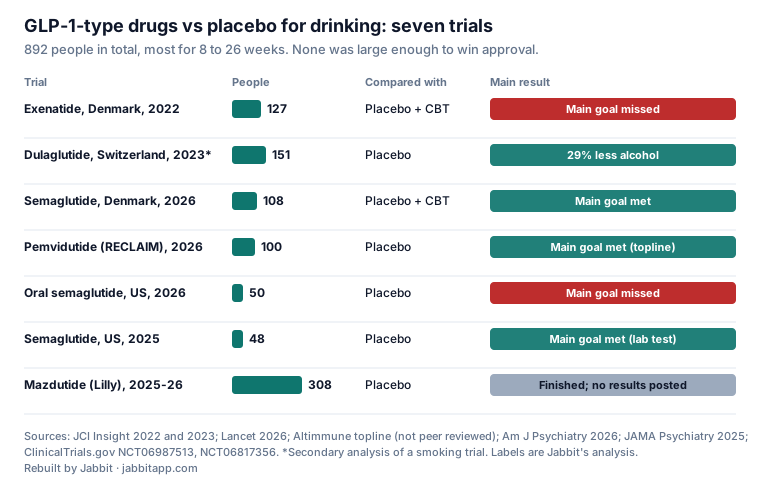
Our analysis: the trials disagree less than the headlines suggest. The clearest benefit is in people with alcohol use disorder who also have obesity, the group the exenatide trial singled out in 2022 and the Lancet trial then tested directly.[6][2][25] Whether the drugs help people without obesity, or people who drink moderately, is much less certain.[5][4][26]
The case for GLP-1 drugs, in fairness
Few medicines exist for alcohol use disorder, and NIH’s release says the approved ones are “vastly underutilized.”[3] The animal data are consistent across several drugs, the best randomized trial was blinded and placebo-controlled with blood-marker support, and register studies from several countries agree in direction.[23][24][2][3][16][18] A 2026 gastroenterology practice update says preliminary data suggest these drugs may reduce alcohol cravings and consumption.[30] Our analysis: that is a strong case for the large trials now under way, not proof that a weight-loss prescription treats alcohol use disorder.[12][13]
Safety
- Stomach side effects. In the Lancet trial, side effects were mostly short-lived, mild to moderate gastrointestinal effects, more common on semaglutide; in RECLAIM, Altimmune reported nausea in 44% on pemvidutide vs 24% on placebo, and 10% stopped because of side effects vs none on placebo.[2][9]
- Nutrition. A 2026 case report describes a man with obesity and alcohol use disorder who developed Korsakoff syndrome, a thiamine-deficiency brain disorder, during rapid weight loss on tirzepatide; the authors urge nutritional assessment and considering thiamine.[29] Our analysis: one case cannot show cause, but heavy drinking and rapid weight loss both strain nutrition.[29][30]
- After stopping. In a Swedish study, the drop in alcohol-related hospital stays persisted for about six months after stopping, then disappeared; the authors advise monitoring substance use when treatment stops.[18]
- What is unknown. No trial has run longer than 26 weeks, and none has tested the drugs in large groups of people without obesity.[26][2][6]
Legal status
No GLP-1 drug is approved by the FDA for alcohol use disorder; all such uses are investigational.[26] Lilly’s two phase 3 trials of brenipatide, each with about 1,100 people, are recruiting, with primary completion listed for April 2028; a VA trial of semaglutide in 622 veterans runs to 2029.[12][13] Altimmune says it plans to request an End-of-Phase 2 meeting with the FDA for pemvidutide.[9] One critical review counted 19 interventional trials in progress or completed but unpublished.[27][28][14]
What a careful reader should notice
These points are our analysis of the sources cited.
- Heineken’s warning is a sales forecast. It is not evidence that the drugs treat alcohol use disorder.[1]
- The best trial was in people with obesity. Its results may not carry over to people of normal weight.[2][6]
- Check the main goal. Two of six trials missed theirs, including the only oral semaglutide trial.[6][4]
- Health-record studies cannot rule out other explanations. Weight loss itself may account for part of the drop.[22][26]
- Company toplines are not papers. The pemvidutide results have not been peer reviewed yet.[9]
Frequently asked questions
- Does Ozempic or Wegovy reduce alcohol cravings?
- Possibly. In trials, semaglutide reduced heavy drinking days and some craving measures, but an oral semaglutide trial missed its lab craving goal.[2][5][4]
- Does Zepbound (tirzepatide) help people drink less?
- It reduced drinking in rodents, and health-record studies include it, but no randomized human alcohol trial of tirzepatide has reported yet; several are recruiting.[23][19][13]
- Are GLP-1 drugs approved to treat alcohol use disorder?
- No. All uses for drinking are investigational, and the first large trials report in 2028 at the earliest.[26][12]
- What did the 2026 Lancet trial find?
- In 108 people with alcohol use disorder and obesity, semaglutide plus therapy cut heavy drinking days by 13.7 percentage points more than placebo plus therapy over 26 weeks.[2]
- Why did Heineken warn UK pubs about weight-loss drugs?
- The Guardian, citing Reuters, reported that a Heineken presentation said GLP-1 use could reduce the desire to drink; Carlsberg told Reuters its data did not support that view.[1]
- Is it safe to drink alcohol on a GLP-1 drug?
- The trials did not test that question. Both cause stomach upset, and one case report flags thiamine deficiency during rapid weight loss; ask the prescriber.[2][29]
- Does the effect last after stopping?
- One Swedish study found fewer alcohol-related hospital stays for about six months after stopping, but not after that.[18]
Bottom line
GLP-1 drugs reliably reduce drinking in animals, and in people the best evidence, a 108-person Lancet trial in alcohol use disorder with obesity, is encouraging.[23][2] But the human trials are small and short, two missed their main goals, and health-record studies cannot separate the drug from weight loss.[6][4][22][26] No GLP-1 drug is approved for alcohol use disorder; Lilly’s phase 3 brenipatide trials, due in early 2028, are the next big test.[26][11][12]
References
- Sweney M. Boom in weight-loss drugs could lead to fall in beer sales, Heineken warns UK pubs. The Guardian, October 23, 2026: “Heineken has warned British bars and pubs that the boom in popularity of weight-loss drugs could lead to a fall in sales of beer and cider”; the presentation says GLP-1 use “could reduce the desire to drink alcohol” and refers to “fullness and fewer serves”; “The document, revealed by Reuters”; a Heineken spokesperson: “We see some changes in consumption behaviour among (GLP-1) users and will continue to monitor how these behaviours evolve in 2027”; “Carlsberg told Reuters that data did not support the view that the use of weight-loss drugs affected beer consumption trends”; Diageo “has told investors that any impact from GLP-1 drugs becoming mainstream should be manageable.” https://www.theguardian.com/business/2026/oct/23/weight-loss-drugs-beer-sales-heineken-british-pubs-wegovy. Checked October 26, 2026.
- Klausen MK, Justesen SK, Pedersen JN, et al. Once-weekly semaglutide versus placebo in patients with alcohol use disorder and comorbid obesity: a randomised, double-blind, placebo-controlled trial. Lancet. 2026;407(10540):1687-1698. PMID 42070571. Lancet 2026; SEMALCO, NCT05895643; Copenhagen-led. Abstract: “In a 26-week, single-centre, randomised, double-blinded, placebo-controlled trial”; “From June 10, 2023, to Feb 4, 2025, 108 participants (53 women and 55 men) were enrolled”; “Overall, 88 participants (81%) completed the full intervention”; “Semaglutide was associated with a reduction in heavy drinking days (-41·1 percentage points from baseline, 95% CI -48·7 to -33·5) compared with placebo (-26·4, -34·1 to -18·6; estimated treatment difference -13·7 percentage points, -22·0 to -5·4; p=0·0015)”; “Adverse events were transient, generally mild to moderate gastrointestinal effects, and occurred more frequently in the semaglutide group.” Funding includes “the Novo Nordisk Foundation”; disclosures include “AFJ has received an unrestricted grant from Novo Nordisk.” Abstract and disclosures read. https://pubmed.ncbi.nlm.nih.gov/42070571/. Checked October 26, 2026.
- National Institutes of Health news release, Thursday, April 30, 2026, “Adding weekly GLP-1 to cognitive behavioral therapy further reduces heavy drinking”: the study “enrolled 108 treatment-seeking patients with alcohol use disorder and comorbid obesity”; “participants receiving semaglutide experienced a 41.1% reduction in heavy drinking days, a 13.7% greater reduction than that of the placebo group”; “Measurements of blood-alcohol biomarkers supported the self-reported-data-based findings”; “its number needed to treat (NNT) — a metric of clinical efficacy — in this study was 4.3, while the NNT of approved medications is 7 or higher”; the director of NIH’s National Institute on Drug Abuse, a study co-author: “Questions remain but this is nonetheless very encouraging”; “Next, the authors would like to examine the effects of GLP-1s over a longer duration and in a larger population to confirm their findings here.” The release says NIH scientists, including the directors of NIAAA and NIDA, are co-authors of the trial. https://www.nih.gov/news-events/news-releases/adding-weekly-glp-1-cognitive-behavioral-therapy-further-reduces-heavy-drinking. Checked October 26, 2026.
- Schacht JP, Sakai JT, Raymond K, et al. Oral Semaglutide for Alcohol Use Disorder: A Randomized Clinical Trial. Am J Psychiatry. 2026;183(9):636-645. PMID 42522065. University of Colorado-led; NCT05892432. Abstract: “Fifty individuals with moderate to severe AUD were randomized”; “The primary outcome was laboratory-based alcohol cue-elicited craving at week 6”; “Semaglutide did not significantly reduce laboratory-assessed craving or drinks per day compared with placebo, but significantly reduced heavy drinking days”; “Semaglutide reduced alcohol-related consequences at a significantly greater rate than placebo”; results “suggest that continued development of semaglutide for AUD is warranted.” Disclosures include the “Alcohol Clinical Trials Initiative, which is currently supported by Eli Lilly and Imbrium Therapeutics.” Abstract and disclosures read; we do not reproduce the trial’s dosing. https://pubmed.ncbi.nlm.nih.gov/42522065/. Checked October 26, 2026.
- Hendershot CS, Bremmer MP, Paladino MB, et al. Once-Weekly Semaglutide in Adults With Alcohol Use Disorder: A Randomized Clinical Trial. JAMA Psychiatry. 2025;82(4):395-405. PMID 39937469. NCT05520775; led from the University of Southern California and the University of North Carolina. Abstract: “48 non-treatment-seeking participants with AUD were randomized”; “This was a phase 2, double-blind, randomized, parallel-arm trial involving 9 weeks of outpatient treatment”; “Semaglutide treatment did not affect average drinks per calendar day or number of drinking days, but significantly reduced drinks per drinking day”; findings support “justifying larger clinical trials to evaluate GLP-1RAs for alcohol use disorder.” Disclosures include “Dr Klein reported consulting fees from Novo Nordisk outside the submitted work.” Abstract read. https://pubmed.ncbi.nlm.nih.gov/39937469/. Checked October 26, 2026.
- Klausen MK, Jensen ME, Møller M, et al. Exenatide once weekly for alcohol use disorder investigated in a randomized, placebo-controlled clinical trial. JCI Insight. 2022;7(19). PMID 36066977. Copenhagen-led; NCT03232112. Abstract: “A total of 127 patients were enrolled”; “although exenatide did not significantly reduce the number of heavy drinking days compared with placebo”; “Exploratory analyses revealed that exenatide significantly reduced heavy drinking days and total alcohol intake in a subgroup of obese patients (BMI > 30 kg/m2)”; “Adverse events were mainly gastrointestinal.” Abstract read. https://pubmed.ncbi.nlm.nih.gov/36066977/. Checked October 26, 2026.
- Jensen ME, Klausen MK, Bergmann ML, et al. Blood phosphatidylethanol measurements indicate GLP-1 receptor stimulation causes delayed decreases in alcohol consumption. Alcohol Clin Exp Res (Hoboken). 2025;49(5):1161-1165. PMID 40123107. Secondary analysis of the exenatide trial using a blood marker of drinking: “A significant interaction between time and treatment was observed at Week 26”; “the difference in PEth blood levels between the exenatide and placebo groups was not significant at earlier time points.” Abstract read. https://pubmed.ncbi.nlm.nih.gov/40123107/. Checked October 26, 2026.
- Probst L, Monnerat S, Vogt DR, et al. Effects of dulaglutide on alcohol consumption during smoking cessation. JCI Insight. 2023;8(22). PMID 37991022. University Hospital Basel-led. Abstract: “This is a predefined secondary analysis of a double-blind, randomized, placebo-controlled trial evaluating the GLP-1 agonist dulaglutide as a therapy for smoking cessation”; “(n = 151; placebo n = 75, dulaglutide n = 76)”; “At week 12, participants receiving dulaglutide drank 29% less (relative effect = 0.71, 95% CI 0.52-0.97, P = 0.04) than participants receiving placebo.” “The authors have declared that no conflict of interest exists.” Abstract read. https://pubmed.ncbi.nlm.nih.gov/37991022/. Checked October 26, 2026.
- Altimmune, Inc. press release, July 28, 2026, filed with the US Securities and Exchange Commission as exhibit 99.1 to a Form 8-K (company topline; not peer reviewed). Pemvidutide is described as “an investigational balanced glucagon/GLP-1 dual receptor agonist.” Table: “Change from baseline in HDD/Week at Week 24 (Primary Endpoint) -2.75 (LS mean) -4.20 (LS mean) -1.45 (LS mean difference) 0.0014” (placebo, pemvidutide, difference, p); “Zero HDD in Week 21 through Week 24 17.4% (8/46) 42.2% (19/45)”; “Nausea 12 (24%) 22 (44%)”; “Vomiting 3 (6%) 9 (18%)”; “Study drug-related AEs leading to treatment discontinuation 0 (0%) 5 (10%)*”; “There was one serious adverse event (SAE) (hyponatremia) in the pemvidutide arm that was deemed possibly related to treatment drug by the principal investigator”; “Results from the RECLAIM trial will be submitted for presentation at a forthcoming medical conference and for publication in a peer-reviewed journal”; “The Company plans to request an End-of-Phase 2 meeting with the U.S. Food and Drug Administration (FDA).” We do not reproduce the dosing. https://www.sec.gov/Archives/edgar/data/1326190/000132619026000044/alt-20260728xex99d1.htm. Checked October 26, 2026.
- ClinicalTrials.gov NCT06987513 (Altimmune, Inc.; pemvidutide in alcohol use disorder): status completed; enrollment 100 (actual); primary outcome “Change from baseline in the average number of heavy drinking days per week.” https://clinicaltrials.gov/study/NCT06987513. Checked October 26, 2026.
- BioSpace, September 22, 2026, on Lilly’s Psych Congress 2026 presentation; the article says brenipatide is in the phase 3 RENEW-ALC-1 trial “for moderate-to-severe AUD”: “Brenipatide is the first GIP/GLP-1 receptor agonist to be investigated globally across AUD, Lilly said in its presentation”; “the RENEW-ALC-1 trial’s primary endpoint is not complete abstinence from alcohol but a change in drinking patterns”; “Topline data for both studies are expected in early 2028.” https://www.biospace.com/drug-development/lilly-presents-early-data-supporting-glp-1-gip-candidates-potential-in-depression-alcohol-use-disorder. Checked October 26, 2026.
- ClinicalTrials.gov records for Eli Lilly and Company: NCT07219966 (RENEW-ALC-1) and NCT07219953 (RENEW-ALC-2), brenipatide in alcohol use disorder, each recruiting, enrollment 1,100 (estimated), primary completion April 2028; NCT06817356, “A Study to Evaluate Mazdutide Compared With Placebo in Participants With Alcohol Use Disorder,” started February 6, 2025, completed, enrollment 308, primary completion March 19, 2026, no results posted. https://clinicaltrials.gov/study/NCT07219966; https://clinicaltrials.gov/study/NCT07219953; https://clinicaltrials.gov/study/NCT06817356. Checked October 26, 2026.
- ClinicalTrials.gov records: NCT07218354 (VA Office of Research and Development; CRAVE; semaglutide; recruiting; enrollment 622 estimated; primary completion March 31, 2029); NCT06994338 (University of Southern California; tirzepatide; recruiting; 42 estimated; primary outcome “Number of heavy drinking days”); NCT07046819 (NIAAA; “Tirzepatide in MetALD”, a liver disease linked to both metabolic risk and alcohol; recruiting; 120 estimated); NCT05891587 (Oklahoma State University Center for Health Sciences; STAR-T; semaglutide; completed July 2025; 80 enrolled; no results posted). https://clinicaltrials.gov/study/NCT07218354; https://clinicaltrials.gov/study/NCT06994338; https://clinicaltrials.gov/study/NCT07046819; https://clinicaltrials.gov/study/NCT05891587. Checked October 26, 2026.
- Jabbit census of ClinicalTrials.gov (API v2), alcohol-related conditions combined with GLP-1-type drug interventions (including semaglutide, tirzepatide, exenatide, pemvidutide and brenipatide, LY3537031): 29 records on October 26, 2026, including some studies that are not about alcohol use disorder; we did not classify every record. Data: https://jabbitapp.com/research/sources/glp1-alcohol-2026-10-26.json. Checked October 26, 2026.
- Jabbit PubMed search, October 26, 2026: (semaglutide OR tirzepatide OR liraglutide OR exenatide OR dulaglutide OR “GLP-1 receptor agonist” in title/abstract) AND “alcohol use disorder” in title/abstract: 101 records. Data: https://jabbitapp.com/research/sources/glp1-alcohol-2026-10-26.json. Checked October 26, 2026.
- Lähteenvuo M, Tiihonen J, Solismaa A, et al. Repurposing Semaglutide and Liraglutide for Alcohol Use Disorder. JAMA Psychiatry. 2025;82(1):94-98. PMID 39535805. Nationwide Swedish registers; Finland-led. Abstract: “The cohort included 227 866 individuals with AUD”; “Semaglutide (4321 users) was associated with the lowest risk (AUD: adjusted hazard ratio [aHR], 0.64; 95% CI, 0.50-0.83”; “Use of any AUD medication was associated with a modestly decreased risk (aHR, 0.98; 95% CI, 0.96-1.00)”; “clinical trials are urgently needed to confirm these findings.” Abstract read. https://pubmed.ncbi.nlm.nih.gov/39535805/. Checked October 26, 2026.
- Wang W, Volkow ND, Berger NA, et al. Associations of semaglutide with incidence and recurrence of alcohol use disorder in real-world population. Nat Commun. 2024;15(1):4548. PMID 38806481. Case Western Reserve University-led; US health records. Abstract: “In this retrospective cohort study of electronic health records of 83,825 patients with obesity”; “semaglutide compared with other anti-obesity medications is associated with a 50%-56% lower risk for both the incidence and recurrence of alcohol use disorder for a 12-month follow-up period.” “The authors declare no competing interests.” Abstract read. https://pubmed.ncbi.nlm.nih.gov/38806481/. Checked October 26, 2026.
- Bach P, Franck J, Hällgren J, et al. Association of GLP-1 receptor agonists with alcohol use disorder-related and substance use disorder-related hospital admissions during treatment and after discontinuation: a Swedish register-based within-individual observational study. Lancet Psychiatry. 2026;13(8):669-677. PMID 42456704. Karolinska Institutet-led; Swedish registers. Abstract: “167 026 individuals with type 2 diabetes”; “GLP-1 exposure was associated with lower rates of hospitalisations related to alcohol use disorder (RR 0·55, 95% CI 0·43-0·70)”; “the association with hospitalisation rate reduction persisted during days 1-182 after discontinuation of GLP-1 receptor agonists (0·70, 0·50-0·98) but was no longer evident during days 183-364 after discontinuation (1·07, 0·71-1·63)”; “Findings support clinical monitoring of substance use when GLP-1 receptor agonist treatment is stopped.” Abstract read. https://pubmed.ncbi.nlm.nih.gov/42456704/. Checked October 26, 2026.
- Rodriguez PJ, Lusk JB, Mehta HB, et al. Association between GLP-1 receptor agonists and alcohol-related hospitalisations among adults with alcohol use disorder: multi-target trial emulation study. BMJ Open. 2026;16(7):e109259. PMID 42481079. US health records (Truveta). Abstract: “A total of 40 703 adults met study criteria”; “the MAUD-T2D trial (HR 0.37, 95% CI 0.29 to 0.46) and the MAUD-obesity trial (HR 0.35, 95% CI 0.26 to 0.47)” (emulated trials, not randomized); “initiation of newer GLP-1 RAs was associated with a lower observed risk of alcohol-related hospitalisation.” Disclosure: “PJR is a former employee of Truveta and a current employee of Eli Lilly. This work was conducted and submitted prior to her employment with Eli Lilly. Eli Lilly had no role in this study.” Abstract and disclosure read. https://pubmed.ncbi.nlm.nih.gov/42481079/. Checked October 26, 2026.
- Gougol A, Kwo P, Pike W, et al. Real-World Alcohol Use Disorder Outcomes in Patients With Concurrent Metabolic Dysfunction: GLP-1 Receptor Agonists Versus FDA-Approved AUD Medications. Aliment Pharmacol Ther. 2026;63(11):1507-1516. PMID 41813606. Stanford-led; patients with alcohol use disorder and metabolic disease. Abstract: “GLP-1RA therapy was associated with lower 1-year AUD relapse [IRR 0.55, 95% CI 0.42-0.73; p < 0.01]”; “Patients exposed to GLP-1RA had higher BMI (35.5 vs. 30.1) and more T2DM (66% vs. 14%)”; “Mortality was similar.” Abstract read. https://pubmed.ncbi.nlm.nih.gov/41813606/. Checked October 26, 2026.
- Tyndall B, Gasdaska A, Brannock MD, et al. Association of GLP-1 Receptor Agonist Prescriptions and Alcohol Consumption in the National Institutes of Health's All of Us Cohort. Alcohol Clin Exp Res (Hoboken). 2026;50(7):e70357. PMID 42423024. RTI International-led; NIH All of Us data. Abstract: “Those with current GLP-1RA prescriptions had statistically significant but modestly lower AUDIT-C scores compared with those with future prescriptions (incidence rate ratio [IRR] = 0.95; 95% CI: 0.91-0.99; p = 0.01)”; a “significant association with GLP-1RA prescriptions and frequency of drinking but not drinks per occasion or binge drinking.” Abstract read. https://pubmed.ncbi.nlm.nih.gov/42423024/. Checked October 26, 2026.
- Basri T, Shea SJ, Brantley A, et al. Alcohol Use Following GLP-1 Receptor Agonist Therapy in the Cooper Center Longitudinal Study. Mayo Clin Proc. 2026. PMID 42486225. UT Southwestern-led; Cooper Center Longitudinal Study. Abstract: “The GLP-1RA treatment group had a greater reduction in weekly alcohol intake than the control group (-1.0 drinks/week; 95% CI -1.6 to -0.4; P =.002), which became non-significant after adjusting for weight change (P =.10).” Abstract read. https://pubmed.ncbi.nlm.nih.gov/42486225/. Checked October 26, 2026.
- Edvardsson CE, Adermark L, Gottlieb S, et al. Tirzepatide reduces alcohol drinking and relapse-like behaviours in rodents. EBioMedicine. 2026;124:106119. PMID 41506148. University of Gothenburg-led rodent study. Abstract: tirzepatide “dose-dependently reduced voluntary alcohol consumption (P < 0.001), prevented binge (P < 0.01) and relapse-like drinking (P < 0.001).” Abstract read. https://pubmed.ncbi.nlm.nih.gov/41506148/. Checked October 26, 2026.
- Windram M, Lovelock DF, Carew JM, et al. Semaglutide, tirzepatide, and retatrutide attenuate the interoceptive effects of alcohol in male and female rats. Psychopharmacology (Berl). 2026;243(5):1185-1197. PMID 40699363. University of North Carolina-led rat study. Abstract: “Acute administration of semaglutide, tirzepatide, and retatrutide each attenuated alcohol discrimination”; “alcohol discrimination returned to control levels three days after treatment cessation.” Abstract read. https://pubmed.ncbi.nlm.nih.gov/40699363/. Checked October 26, 2026.
- Klausen MK, Fink-Jensen A. Therapeutic Potential of Incretin-Based Therapies for Alcohol Use Disorder: A Narrative Review of Available Clinical Evidence. Biol Psychiatry. 2026;100(8):875-885. PMID 42486217. Narrative review, Copenhagen-led. Abstract: “To date, only 3 randomized controlled trials have examined GLP-1RAs in AUD, showing reductions in alcohol cue brain reactivity and alcohol consumption, particularly among individuals with overweight or obesity.” Abstract read. https://pubmed.ncbi.nlm.nih.gov/42486217/. Checked October 26, 2026.
- Nittur A, Belzar A, Rai C. Exploring semaglutide for alcohol use disorder: A review of clinical efficacy and neurobiological mechanisms. Addict Behav. 2026;185:108878. PMID 42880142. Review, published online October 2026. Abstract: “No GLP-1 receptor agonist currently carries FDA approval for alcohol use disorder, and all discussed clinical applications still remain investigational”; “Current evidence remains limited by small sample sizes, brief follow-up periods, self-reported outcomes, and potential confounding from weight loss.” Abstract read. https://pubmed.ncbi.nlm.nih.gov/42880142/. Checked October 26, 2026.
- Woo S, Zhu G, Castro C, et al. GLP-1 Receptor Agonists for Treating Alcohol Use Disorder: A Critical Review. Alcohol Clin Exp Res (Hoboken). 2026;50(5):e70312. PMID 42144979. Critical review. Abstract: “This yielded a total of 13 preclinical studies, 14 clinical studies, 4 published interventional trials, and 19 interventional trials in progress or completed but unpublished.” Disclosures include “Dr. Kranzler is a member of advisory boards for Altimmune.” Abstract and disclosure read. https://pubmed.ncbi.nlm.nih.gov/42144979/. Checked October 26, 2026.
- Patil S, Jha N, Jha MK. Glucagon-like peptide 1 receptor agonists in substance use disorders: A systematic review of ClinicalTrials.Gov. Addict Behav Rep. 2026;23:100671. PMID 41696398. Systematic review of ClinicalTrials.gov. Abstract: “Of 192 records, 33 met criteria: alcohol use disorder (n = 15).” Abstract read. https://pubmed.ncbi.nlm.nih.gov/41696398/. Checked October 26, 2026.
- Crelier VT, Vidal AS, Rezende NB, et al. Longitudinal 18F-Fluorodeoxyglucose Positron Emission Tomography (18F-FDG PET) Findings in Korsakoff Syndrome After Rapid Weight Loss During Tirzepatide Therapy: A Case Report. Cureus. 2026;18(6):e110101. PMID 42395251. Case report. Abstract: “a 50-year-old man with obesity and chronic alcohol use disorder who developed Korsakoff syndrome in the setting of rapid weight loss temporally associated with tirzepatide therapy”; “Despite intravenous thiamine replacement, cognitive deficits persisted”; the case “underscores the importance of nutritional assessment and consideration of thiamine supplementation when initiating these treatments.” Abstract read. https://pubmed.ncbi.nlm.nih.gov/42395251/. Checked October 26, 2026.
- Arab JP, Malhi H, Winder GS, et al. AGA Clinical Practice Update on the Evaluation and Management of Metabolic Dysfunction- and Alcohol-Associated Liver Disease: Expert Review. Clin Gastroenterol Hepatol. 2026. PMID 42776095. American Gastroenterological Association clinical practice update on MetALD. Abstract: “preliminary data suggests that glucagon-like peptide-1 and glucose-dependent insulinotropic polypeptide receptor agonists may reduce alcohol cravings and consumption and improve hepatic parameters”; “Medical management of patients with MetALD and moderate or severe alcohol use disorder should include use of alcohol use disorder pharmacotherapy and behavioral approaches to reduce alcohol consumption.” Abstract read. https://pubmed.ncbi.nlm.nih.gov/42776095/. Checked October 26, 2026.
This page analyzes published studies, company and government releases, news reports and registry data. It is not medical or legal advice and does not recommend any product or dose. No GLP-1 drug is approved for alcohol use disorder. Charts were rebuilt by Jabbit from the sources cited in each caption.