Study teardown · Amylin weight-loss drugs: petrelintide, eloralintide, cagrilintide and CagriSema · Every published phase 2 and phase 3 result we found, the latest company toplines, registry dates, the Wegovy, Zepbound and Symlin labels · Sources checked October 26, 2026
Published · Updated
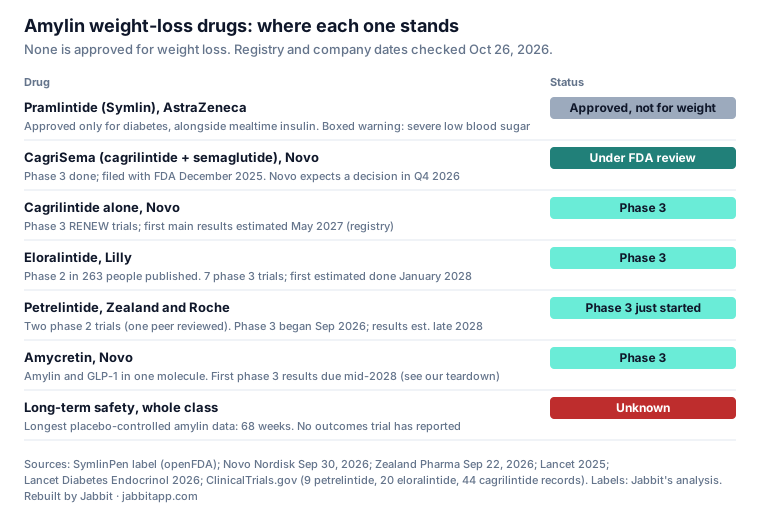
Petrelintide, eloralintide and cagrilintide: what are amylin weight-loss drugs, and are they better than Wegovy or Zepbound? So far, amylin drugs alone have produced about 9% to 12% weight loss in most trials, and up to 20% in one eloralintide trial. Nausea is still the main side effect. None is approved for weight loss; CagriSema, which pairs cagrilintide with semaglutide, has an FDA decision expected by the end of 2026.
Amylin is a hormone your pancreas releases with insulin after meals. It slows stomach emptying and helps end a meal.[20] Drugmakers are now testing long-acting versions as weight-loss shots: petrelintide (Zealand Pharma and Roche), eloralintide (Eli Lilly) and cagrilintide (Novo Nordisk), which Novo also pairs with semaglutide as CagriSema.[5][7][13] Do they work as well as Wegovy or Zepbound? Not on their own, in most trials so far. Petrelintide and cagrilintide alone produced about 9% to 12% weight loss, while Wegovy produced 14.9% and Zepbound up to 20.9% in their main trials.[1][4][11][12][15][16] The exception is eloralintide, whose best arms reached about 20% in a 263-person phase 2 trial.[7] Are they gentler on the stomach? Nausea is still the most common side effect; petrelintide’s rates look lower than the GLP-1 labels, but no trial has compared them head to head.[1][17][18] None is approved for weight loss. The only approved amylin drug, pramlintide (Symlin), is for diabetes, and its label carries a boxed warning for severe low blood sugar with insulin.[19] CagriSema is under FDA review, and Novo expects a decision in Q4 2026.[13][14]
Why this matters now
A run of amylin results landed in the past month. On September 22, Zealand said it had started its phase 3 ZUPREME program for petrelintide, and on September 29 the full ZUPREME 1 results were published in The Lancet Diabetes & Endocrinology.[5][1] On September 30, Lilly reported phase 2 results combining eloralintide with tirzepatide, and Novo said it expects an FDA decision on CagriSema in Q4 2026.[10][13] On October 7, Zealand reported topline results of a second phase 2 trial, in people with type 2 diabetes.[4] On October 19, two new phase 3 trials of eloralintide plus tirzepatide appeared on ClinicalTrials.gov.[23] Optum Rx, a pharmacy benefit manager, lists December 18, 2026 as the expected FDA decision date for CagriSema.[14] We covered CagriSema and amycretin, Novo’s single-molecule amylin and GLP-1 drug, in separate teardowns linked below; this page covers the amylin drugs themselves.
Timeline
| Date | Event |
|---|---|
| Before 2021 | Pramlintide (Symlin) is the only approved amylin drug, for diabetes alongside mealtime insulin.[19][20] |
| 2021 | Cagrilintide phase 2: 6.0% to 10.8% weight loss at 26 weeks vs 3.0% on placebo.[11] |
| 2025 | REDEFINE 1: CagriSema 20.4%, cagrilintide alone 11.5% at 68 weeks (June). Eloralintide phase 2: up to 20% at 48 weeks (November). Novo files CagriSema with the FDA (December).[12][7][13] |
| Dec 2025 to Feb 2026 | Lilly’s eloralintide phase 3 trials (ENLIGHTEN) start.[23] |
| March 5, 2026 | Zealand reports ZUPREME 1 topline: up to 10.7% at 42 weeks.[3] |
| September 2026 | Petrelintide phase 3 starts (Sep 22); ZUPREME 1 published (Sep 29); EloraTZP phase 2 topline (Sep 30).[5][1][10] |
| October 7, 2026 | ZUPREME-2 topline in type 2 diabetes: up to 9.2% at 28 weeks vs 2.0% on placebo.[4] |
| Q4 2026 | Expected FDA decision on CagriSema, per Novo; Optum lists December 18.[13][14] |
| 2027 to 2028 | Registry estimates for first phase 3 results: cagrilintide alone May 2027; eloralintide from January 2028; petrelintide October to December 2028.[24][23][22] |
What amylin drugs are
Amylin is made in the same pancreatic cells as insulin. It slows gastric emptying, suppresses glucagon and “promotes meal termination,” a 2026 review says.[20] Wegovy and Zepbound work mainly through a different gut hormone, GLP-1 (Zepbound also acts on GIP). That is why companies are testing amylin drugs both alone and paired with GLP-1 drugs.[20][13]
- Pramlintide (Symlin). The first approved amylin drug. It is approved only as an add-on for people with diabetes who use mealtime insulin, not for weight loss.[19] The same review says it “was limited by modest efficacy and frequent dosing.”[20]
- Cagrilintide (Novo Nordisk). A long-acting, once-weekly amylin drug. It is tested alone (RENEW trials) and with semaglutide as CagriSema (REDEFINE trials).[24][13]
- Eloralintide (Eli Lilly). A once-weekly drug that targets amylin receptors selectively. It is tested alone (ENLIGHTEN) and with tirzepatide (AMPLIFY).[7][23]
- Petrelintide (Zealand Pharma and Roche). A once-weekly amylin drug with a half-life of about 10 days in phase 1.[6] Zealand and Roche are co-developing it under a 2025 agreement.[5]
Where each drug stands
Weight loss: how they compare with Wegovy and Zepbound
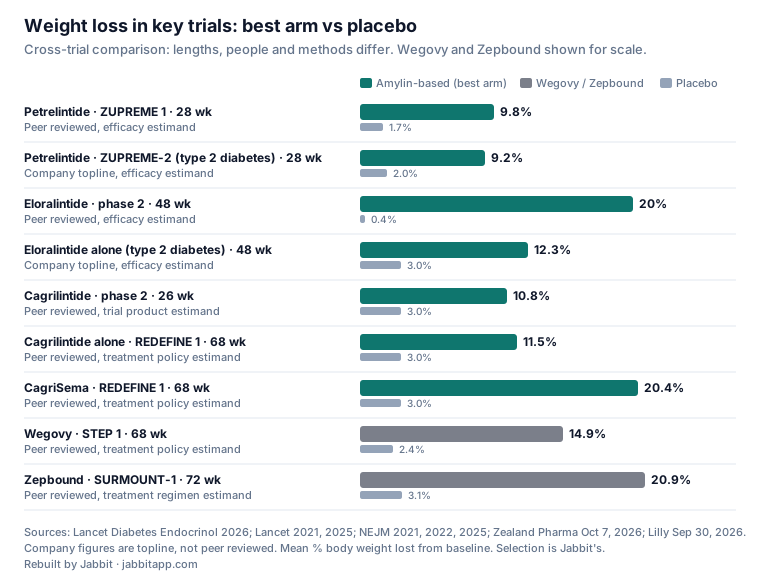
- Petrelintide. In ZUPREME 1 (485 people dosed), weight fell 7.9% to 9.8% at 28 weeks across arms vs 1.7% on placebo, and up to 10.7% by week 42.[1] In ZUPREME-2, in 220 people with type 2 diabetes, Zealand reports up to 9.2% at 28 weeks vs 2.0%; these are topline figures that have not been peer reviewed.[4]
- Eloralintide. In the 48-week phase 2 trial of 263 people, weight fell 9% to 20% across arms vs 0.4% on placebo.[7] In Lilly’s newer type 2 diabetes trial, eloralintide alone reached up to 12.3% vs 3.0%, by Lilly’s report.[10]
- Cagrilintide. 6.0% to 10.8% at 26 weeks in phase 2 vs 3.0%. The highest dose beat liraglutide (Saxenda’s drug), 10.8% vs 9.0%.[11] In the 68-week REDEFINE 1 trial, cagrilintide alone produced 11.5%, CagriSema 20.4%, semaglutide alone 14.9% and placebo 3.0%.[12]
- For scale. Wegovy produced 14.9% vs 2.4% at 68 weeks in STEP 1, and Zepbound 15.0% to 20.9% vs 3.1% at 72 weeks in SURMOUNT-1.[15][16]
Our analysis: the only time an amylin drug alone and semaglutide were tested in the same trial, semaglutide did better (14.9% vs 11.5%), and the combination beat both.[12] Eloralintide’s phase 2 result is the strongest for an amylin drug alone, but it comes from one 48-week trial of 263 people, 78% of them women, using the efficacy estimand. That estimand counts what happens to people who stay on treatment, which usually gives bigger numbers.[7]
Are they gentler on the stomach?
That is the main pitch, and the data are mixed.
| Trial or label | Nausea on drug | Nausea on placebo |
|---|---|---|
| Petrelintide, ZUPREME 1 (all arms) | 20% | 6% |
| Eloralintide, phase 2 (range across arms) | 11% to 64% | 14% |
| Cagrilintide, phase 2 (range across arms) | 20% to 47% | 18% |
| Wegovy label | 44% | 16% |
| Zepbound label (range across doses) | 25% to 29% | 8% |
| Pramlintide (Symlin) label, type 1 diabetes | 48% | 17% |
Sources: [1][7][11][17][18][19]
- Petrelintide. The ZUPREME 1 authors report “similar gastrointestinal tolerability to that of placebo apart from predominantly mild nausea during dose escalation.” Vomiting was 3% vs 6% on placebo.[1] Zealand reports that 4.8% in the arm it calls maximally effective stopped for adverse events, vs 4.9% on placebo, and that in ZUPREME-2 1.9% stopped for stomach side effects vs 1.7%.[3][4]
- Eloralintide. Nausea reached 64% in one arm, and fatigue reached 46% vs 12% on placebo.[7] Lilly says these were “seen more frequently in the higher dose arms.”[9] In Lilly’s type 2 diabetes trial, 0% to 10.8% stopped eloralintide alone for adverse events, vs 16.7% on placebo, by Lilly’s report.[10]
- Cagrilintide. Stomach side effects hit 41% to 63% vs 32% on placebo in phase 2.[11] In REDEFINE 1 they hit 54.0% on cagrilintide alone, vs 73.8% on semaglutide alone and 79.6% on CagriSema.[12]
Our analysis: petrelintide’s numbers look gentler than the Wegovy and Zepbound labels, and cagrilintide alone was gentler than semaglutide in REDEFINE 1. Those drugs also produced less weight loss, so part of the difference may simply be a weaker effect. Eloralintide’s higher arms were not gentle. A 2026 review argues that how these drugs engage the related calcitonin receptor may shape whether eating less reflects normal fullness or “aversive signaling,” which is unresolved.[21]
Safety signals
- Low blood sugar with insulin. Symlin’s boxed warning: “SYMLIN use with insulin increases the risk of severe hypoglycemia, particularly in patients with type 1 diabetes.”[19] The newer drugs have mostly been tested in people not on insulin, so this risk is not well characterized for them.
- Fatigue. Common with eloralintide at higher arms (up to 46% vs 12%).[7] Zealand reports “no unexpected safety signals” with petrelintide, “including for alopecia, fatigue, and neuropsychiatric adverse events.”[3]
- Injection-site reactions. In REDEFINE 1, 16.9% on cagrilintide alone vs 3.0% on placebo.[12]
- Pancreatitis. Four people (0.2%) on CagriSema in REDEFINE 1.[12]
- Serious events and deaths. “No deaths were reported” in ZUPREME 1; the eloralintide phase 1 trial reported no deaths and one serious adverse event, judged unrelated to the drug.[1][8]
- Long term. The longest placebo-controlled amylin data run 68 weeks, and no outcomes trial of an amylin drug has reported.[12][22] Rare side effects may not show up until much larger groups are treated.
When could any be approved?
- CagriSema (cagrilintide plus semaglutide): filed with the FDA in December 2025; Novo expects a decision in Q4 2026, and Optum lists December 18.[13][14] It would be the first approved weight-loss drug containing an amylin drug, but it is a combination, not an amylin drug alone.
- Cagrilintide alone: RENEW 1 and 2 have estimated primary completion in May 2027.[24]
- Eloralintide: seven phase 3 trials are registered; the earliest estimated primary completion is January 2028.[23]
- Petrelintide: phase 3 began in September 2026, with 64-week endpoints; ZUPREME-3 and -4 have estimated primary completion in December and October 2028.[5][22]
Our analysis: registry dates are sponsor estimates and often slip, and a filing and FDA review typically follow results. Barring a change in plans, a stand-alone amylin weight-loss drug looks unlikely to be approved before 2028.
The case for amylin drugs, in fairness
Amylin drugs work through a different hormone from GLP-1 drugs, so they could suit people who don’t tolerate GLP-1 drugs, and they add to GLP-1 drugs in combination.[20][12] Petrelintide reported placebo-like stopping rates in two trials, and eloralintide’s best phase 2 arms approached Zepbound’s pivotal result.[3][4][7][16] Large phase 3 programs are running, with about 7,000 people planned for petrelintide alone.[5][23][24] Our analysis: the phase 3 trials will show whether the early tolerability holds in bigger, longer trials.
Legal status
In the US, no amylin drug is approved for weight loss. Pramlintide is approved only for diabetes alongside mealtime insulin, and petrelintide, eloralintide and cagrilintide are investigational.[19][13][22][23] We do not name or rate sellers, pharmacies or clinics.
What a careful reader should notice
These points are our analysis of the sources cited.
- Most amylin trials so far are phase 2: tens to a few hundred people, for 26 to 48 weeks. Wegovy and Zepbound were judged on phase 3 trials of about 2,000 to 2,500 people.[1][7][11][15][16]
- Two of the newest results are company toplines (ZUPREME-2 and Lilly’s EloraTZP trial), not peer-reviewed papers.[4][10]
- Check the estimand. Petrelintide and eloralintide headline numbers use the efficacy estimand; STEP 1 and REDEFINE 1 headline the treatment-policy estimand, which usually gives smaller numbers.[1][7][15][12]
- Check who was enrolled. Eloralintide’s phase 2 trial was 78% women and petrelintide’s 53%, and Zealand says women lost “considerably more weight” than men.[7][1][3]
- Placebo comparisons can mislead. In Lilly’s type 2 diabetes trial, 16.7% on placebo stopped for adverse events, more than on several active arms.[10]
- Read the disclosures. ZUPREME 1 was funded by Zealand, the eloralintide trials by Lilly and the cagrilintide trials by Novo, and many authors disclose ties to these or other drugmakers. That does not make the results wrong.[1][7][8][11][12][2]
Frequently asked questions
- What is an amylin drug?
- A drug that mimics amylin, a pancreatic hormone released with insulin that slows stomach emptying and helps end meals. Petrelintide, eloralintide and cagrilintide are long-acting, once-weekly versions in testing.[20][5][7][24]
- Do amylin drugs work better than Wegovy or Zepbound?
- Not on their own, in most trials so far: about 9% to 12% weight loss vs 14.9% for Wegovy and up to 20.9% for Zepbound in their main trials. Eloralintide reached about 20% in one phase 2 trial. These are cross-trial comparisons.[1][11][12][7][15][16]
- Do amylin drugs cause less nausea than Ozempic or Wegovy?
- Petrelintide reported 20% nausea vs 6% on placebo, below the 44% on Wegovy’s label, but eloralintide reached 64% in one arm. No head-to-head trial has tested it.[1][17][7]
- What is the difference between cagrilintide and CagriSema?
- Cagrilintide is Novo’s amylin drug. CagriSema is a fixed-dose combination of cagrilintide and semaglutide, the drug in Wegovy.[13]
- When will petrelintide be approved?
- Not soon. Its phase 3 trials started in September 2026, with main results estimated in late 2028.[5][22]
- When will eloralintide be available?
- Its phase 3 trials have estimated primary completion from January 2028, so approval would come later.[23]
- Is any amylin drug approved for weight loss?
- No. Pramlintide (Symlin) is approved only for diabetes alongside mealtime insulin. CagriSema has an FDA decision expected in Q4 2026.[19][13]
Bottom line
Amylin drugs alone have so far produced less weight loss than Wegovy or Zepbound, except in one eloralintide phase 2 trial.[1][11][12][7][15][16] Petrelintide’s early tolerability looks promising, but nausea is still the main side effect, and long-term safety is unknown.[1][3][7] None is approved for weight loss. CagriSema’s FDA decision is expected in Q4 2026, while stand-alone amylin drugs await phase 3 results due from 2027 to 2028.[13][24][23][22]
References
- Garvey WT, Ard J, Connery L, et al. Petrelintide, a human amylin analogue for the treatment of obesity (ZUPREME 1): a randomised, double-blind, placebo-controlled, phase 2 trial. Lancet Diabetes Endocrinol. 2026;14(11):914-926. PMID 42810355. ZUPREME 1, phase 2; 493 adults without type 2 diabetes randomized at 32 sites in Poland, Romania and the USA, 485 dosed, 42 weeks; primary endpoint at week 28. Abstract: weight change at 28 weeks (efficacy estimand) −7·9% to −9·8% across petrelintide arms vs −1·7% on placebo; “Bodyweight continued to decline to week 42, with reductions of up to -10·7% with petrelintide.” Nausea 20% vs 6%; vomiting 3% vs 6%; “No deaths were reported.” Funding: Zealand Pharma. Declarations of interest include advisory work for Zealand Pharma and other drugmakers. https://pubmed.ncbi.nlm.nih.gov/42810355/. Checked October 26, 2026.
- Madsbad S, Holst JJ. Petrelintide and the evolving role of amylin agonism in obesity. Lancet Diabetes Endocrinol. 2026;14(11):872-873. PMID 42810353. Invited comment on ZUPREME 1 (no abstract). The commentary’s authors disclose ties to Novo Nordisk and other companies. https://pubmed.ncbi.nlm.nih.gov/42810353/. Checked October 26, 2026.
- Zealand Pharma. “Zealand Pharma announces positive Phase 2 results for petrelintide…” Press release, March 5, 2026 (company topline, not peer reviewed). “The treatment discontinuation rate due to adverse events (AEs) was 4.8% with petrelintide in the maximally effective treatment arm versus 4.9% with placebo.” “Notably, female participants lost considerably more weight than male participants in this trial.” https://www.globenewswire.com/news-release/2026/3/5/3250569/0/en/zealand-pharma-announces-positive-phase-2-results-for-petrelintide-an-amylin-analog-with-potential-to-redefine-the-weight-management-experience-for-people-living-with-overweight-an.html. Read via web fetch (the site blocks automated downloads); Checked October 26, 2026.
- Zealand Pharma. “Zealand Pharma announces positive Phase 2 ZUPREME-2 topline results for amylin analog petrelintide in people with overweight or obesity and type 2 diabetes.” Company announcement No. 54/2026, October 7, 2026 (topline, not peer reviewed). 220 people; “Petrelintide achieved up to 9.2% mean body weight reduction at week 28 versus 2.0% with placebo” (efficacy estimand; “range across treatment arms: 7.4-9.2%”); HbA1c fell by up to 0.65% vs a 0.23% increase on placebo; discontinuation for gastrointestinal adverse events 1.9% vs 1.7%; “The full trial results from ZUPREME-2 are expected to be presented at an upcoming scientific conference.” NCT06926842. https://www.globenewswire.com/news-release/2026/10/07/3376750/0/en/zealand-pharma-announces-positive-phase-2-zupreme-2-topline-results-for-amylin-analog-petrelintide-in-people-with-overweight-or-obesity-and-type-2-diabetes.html. Read via web fetch; Checked October 26, 2026.
- Zealand Pharma. “Zealand Pharma announces initiation of the registrational Phase 3 ZUPREME program of petrelintide in people with overweight or obesity.” Press release, September 22, 2026. ZUPREME-3, -4 and -5 “are expected to enroll approximately 7,000 participants in total”; “The primary endpoint in the Phase 3 ZUPREME trials is percentage change in body weight from baseline to week 64.” Co-developed with Roche under a 2025 agreement. https://www.globenewswire.com/news-release/2026/09/22/3366613/0/en/zealand-pharma-announces-initiation-of-the-registrational-phase-3-zupreme-program-of-petrelintide-in-people-with-overweight-or-obesity.html. Read via web fetch; Checked October 26, 2026.
- Brændholt Olsen M, Griffin J, Hövelmann U, et al. Safety, Tolerability, Pharmacokinetics, and Pharmacodynamics of Petrelintide for Weight Management: Two Randomized, Controlled Phase 1 Trials. Diabetes Obes Metab. 2026;28(7):5915-5925. PMID 42017294. Two phase 1 trials. Half-life about 10 days; weight down by up to 8.6% after 16 weeks; nausea 16.7%-33.3% on petrelintide vs 16.7% on placebo in the 16-week part of the multiple-dose trial. The paper states that Zealand Pharma sponsored the trials and funded the manuscript; several authors are Zealand employees and shareholders. https://pubmed.ncbi.nlm.nih.gov/42017294/. Checked October 26, 2026.
- Billings LK, Hsia S, Bays H, et al. Eloralintide, a selective amylin receptor agonist for the treatment of obesity: a 48-week phase 2, multicentre, double-blind, randomised, placebo-controlled trial. Lancet. 2025;406(10520):2631-2643. PMID 41207310. Phase 2; 263 adults without type 2 diabetes at 46 US research centres; 78% female; 48 weeks. Weight change at 48 weeks (efficacy estimand) −9% to −20% across arms vs −0·4% on placebo. Nausea 11%-64% across arms vs 14% on placebo; fatigue 0%-46% vs 12%. Funding: Eli Lilly; author affiliations include Eli Lilly and Company. NCT06230523. https://pubmed.ncbi.nlm.nih.gov/41207310/. Checked October 26, 2026.
- Bhattachar S, Tham LS, Tidemann-Miller B, et al. Eloralintide, a selective, long-acting amylin receptor agonist for treatment of obesity: Phase 1 proof of concept. Diabetes Obes Metab. 2026;28(4):2651-2660. PMID 41559929. Phase 1, 12 weeks, 100 participants at three US centres. Weight down 2.6% to 11.3% across dose groups; “Gastrointestinal adverse events, including diarrhoea (10% of participants), nausea (8%), and vomiting (4%), were infrequent in those receiving eloralintide.” Fatigue 11%. The paper states that the listed authors “are employees and stockholders of Eli Lilly and Company, USA.” https://pubmed.ncbi.nlm.nih.gov/41559929/. Checked October 26, 2026.
- Eli Lilly and Company. Press release on eloralintide phase 2 results, November 6, 2025. “The most common adverse events were mild to moderate gastrointestinal symptoms and fatigue, which were seen more frequently in the higher dose arms.” https://investor.lilly.com/news-releases/news-release-details/lillys-selective-amylin-agonist-eloralintide-demonstrated. Read via web fetch (the site blocks automated downloads); Checked October 26, 2026.
- Eli Lilly and Company. Press release on the EloraTZP (eloralintide plus tirzepatide) phase 2 trial, September 30, 2026 (company figures, not peer reviewed). 367 adults with obesity or overweight and type 2 diabetes, 48 weeks: “Eloralintide alone reduced body weight by up to an average of 28.6 lbs (12.3%)” vs 3.0% on placebo; “Treatment discontinuation rates due to adverse events were 10.8% to 27.0% with EloraTZP, 0% to 10.8% with eloralintide, 2.9% with tirzepatide and 16.7% with placebo.” “Eloralintide is already being evaluated as a single agent in Phase 3 trials for the treatment of obesity.” https://investor.lilly.com/news-releases/news-release-details/lillys-eloratzp-combination-eloralintide-and-tirzepatide. Read via web fetch; Checked October 26, 2026.
- Lau DCW, Erichsen L, Francisco AM, et al. Once-weekly cagrilintide for weight management in people with overweight and obesity: a multicentre, randomised, double-blind, placebo-controlled and active-controlled, dose-finding phase 2 trial. Lancet. 2021;398(10317):2160-2172. PMID 34798060. Phase 2; 706 people randomized to cagrilintide, 99 to liraglutide and 101 to placebo at 57 sites in ten countries; 26 weeks. Weight loss (trial product estimand) 6·0%-10·8% across cagrilintide doses vs 3·0% on placebo; the highest dose beat liraglutide (10·8% vs 9·0%). Gastrointestinal adverse events 41%-63% vs 32% on placebo, mainly nausea (20%-47% vs 18%). Funding: Novo Nordisk A/S; some authors disclose employment at Novo Nordisk. https://pubmed.ncbi.nlm.nih.gov/34798060/. Checked October 26, 2026.
- Garvey WT, Blüher M, Osorto Contreras CK, et al. Coadministered Cagrilintide and Semaglutide in Adults with Overweight or Obesity. N Engl J Med. 2025;393(7):635-647. PMID 40544433. REDEFINE 1, phase 3a; 3,417 adults without diabetes, 68 weeks. Abstract: −20.4% on CagriSema vs −3.0% on placebo; gastrointestinal adverse events 79.6% vs 39.9%. Full text (Fig. 1A, treatment-policy estimand; Table 3), as read for our CagriSema teardown on October 17, 2026: semaglutide alone −14.9%, cagrilintide alone −11.5%; gastrointestinal adverse events 79.6% (CagriSema), 73.8% (semaglutide), 54.0% (cagrilintide), 39.9% (placebo); stopped for adverse events 5.9%, 3.6%, 2.6%, 3.5%; injection-site reactions 12.2%, 2.6%, 16.9%, 3.0%; pancreatitis 4 people (0.2%) on CagriSema. Funded by Novo Nordisk. https://www.nejm.org/doi/full/10.1056/NEJMoa2502081 https://pubmed.ncbi.nlm.nih.gov/40544433/. Checked October 26, 2026.
- Novo Nordisk A/S. Press release on CagriSema data presented at EASD 2026, September 30, 2026. “CagriSema is a fixed-dose combination of a long-acting amylin receptor agonist, cagrilintide, and a GLP-1 receptor agonist, semaglutide.” Novo says it filed a New Drug Application with the FDA in December 2025; “A decision is expected in Q4 2026.” https://www.globenewswire.com/news-release/2026/09/30/3371858/0/en/novo-s-investigational-obesity-and-diabetes-drug-cagrisema-reduces-food-noise-and-shows-benefits-in-organ-and-bone-health-easd-2026.html. Read via web fetch; Checked October 26, 2026.
- Optum Rx. Notable new drugs report, fall 2026. Lists cagrilintide/semaglutide (CagriSema): “Expected FDA decision: December 18, 2026.” A pharmacy benefit manager’s estimate, not an FDA statement. https://business.optum.com/en/insights/notable-new-drugs-report-fall-2026.html. Checked October 26, 2026.
- Wilding JPH, Batterham RL, Calanna S, et al. Once-Weekly Semaglutide in Adults with Overweight or Obesity. N Engl J Med. 2021;384(11):989-1002. PMID 33567185. STEP 1; 1,961 adults without diabetes, 68 weeks: −14.9% on semaglutide (Wegovy) vs −2.4% on placebo; “Nausea and diarrhea were the most common adverse events with semaglutide”; stopped for gastrointestinal events 4.5% vs 0.8%. Funded by Novo Nordisk. https://pubmed.ncbi.nlm.nih.gov/33567185/. Checked October 26, 2026.
- Jastreboff AM, Aronne LJ, Ahmad NN, et al. Tirzepatide Once Weekly for the Treatment of Obesity. N Engl J Med. 2022;387(3):205-216. PMID 35658024. SURMOUNT-1; 2,539 adults without diabetes, 72 weeks: −15.0% to −20.9% across tirzepatide (Zepbound) doses vs −3.1% on placebo; adverse events led to stopping in 4.3%-7.1% vs 2.6%. Supported by Eli Lilly. https://pubmed.ncbi.nlm.nih.gov/35658024/. Checked October 26, 2026.
- US FDA. Wegovy (semaglutide) injection prescribing information, revised 06/2026 (215256s025). Table 3, adults: nausea 44% vs 16% on placebo, vomiting 24% vs 6%, diarrhea 30% vs 16%, constipation 24% vs 11%; 6.8% vs 3.2% permanently stopped for adverse reactions. https://www.accessdata.fda.gov/drugsatfda_docs/label/2026/215256s025lbl.pdf. Checked October 26, 2026.
- US FDA. Zepbound (tirzepatide) injection prescribing information (217806s042). Table 1, pooled adult trials: nausea 25%-29% vs 8% on placebo, vomiting 8%-13% vs 2%, diarrhea 19%-23% vs 8%; 4.8%-6.7% vs 3.4% permanently stopped for adverse reactions. https://www.accessdata.fda.gov/drugsatfda_docs/label/2026/217806s042lbl.pdf. Checked October 26, 2026.
- DailyMed. SymlinPen (pramlintide acetate) injection, AstraZeneca, label version 18, effective December 18, 2019 (NDA 021332). Indication: “SYMLIN is indicated as an adjunctive treatment in patients with type 1 or type 2 diabetes who use mealtime insulin therapy and who have failed to achieve desired glucose control despite optimal insulin therapy.” Boxed warning: “SYMLIN use with insulin increases the risk of severe hypoglycemia, particularly in patients with type 1 diabetes.” Most common adverse reactions include “nausea, vomiting, anorexia, headache”; Table 1 (type 1 diabetes): nausea 48% vs 17% on placebo. https://dailymed.nlm.nih.gov/dailymed/drugInfoBySetId.cfm?setid=4aea30ff-eb0d-45c1-b114-3127966328ff. Checked October 26, 2026.
- Alhazmi A, le Roux CW. Amylin Analogs: The Next Major Class of Weight Loss Therapy: A Review of Experimental Data and Early-Phase Clinical Trials. Diabetes Obes Metab. 2026;28 Suppl 5(Suppl 5):42-50. PMID 42452898. Narrative review of amylin drugs in development as of April 30, 2026. “Pramlintide, the first approved amylin analogue, established proof of concept but was limited by modest efficacy and frequent dosing.” Amylin “slows gastric emptying, suppresses glucagon secretion, and promotes meal termination through central mechanisms.” An author discloses fees from several drugmakers, including Eli Lilly and Novo Nordisk. https://pubmed.ncbi.nlm.nih.gov/42452898/. Checked October 26, 2026.
- Fischer SL, Borner T. Beyond GLP-1: Amylin-based pharmacotherapy and the search for better-tolerated weight-loss drugs. Pharmacol Res. 2026;232:108382. PMID 42586227. Review of amylin drug tolerability. It says “calcitonin receptor engagement, exposure kinetics, and downstream neural circuit recruitment may influence whether reduced food intake reflects physiological satiation or aversive signaling.” An author discloses research funding from Novo Nordisk, stated as not used for the work. https://pubmed.ncbi.nlm.nih.gov/42586227/. Checked October 26, 2026.
- ClinicalTrials.gov API v2, intervention “petrelintide”: 9 records (3 phase 1, 3 phase 2, 3 phase 3), sponsors Zealand Pharma and Hoffmann-La Roche. ZUPREME-1 (NCT06662539) completed, 493; ZUPREME-2 (NCT06926842) completed, 221; ZUPREME-3 (NCT07843498, Roche) recruiting, 3,900 estimated, primary completion estimated December 21, 2028; ZUPREME-4 (NCT07843485) 600, estimated October 20, 2028; ZUPREME-5 (NCT07843472) 2,500, estimated July 28, 2030. Records and counts saved in https://jabbitapp.com/research/sources/amylin-2026-10-26.json. https://clinicaltrials.gov/study/NCT07843498. Checked October 26, 2026.
- ClinicalTrials.gov API v2, intervention “eloralintide”: 20 records (9 phase 1, 4 phase 2, 7 phase 3), sponsor Eli Lilly and Company. Phase 3: ENLIGHTEN-1 (NCT07321886) recruiting, 1,980, primary completion estimated March 2028; ENLIGHTEN-2 in type 2 diabetes (NCT07282600), estimated January 2028; ENLIGHTEN-3, -4 and -6 estimated March to June 2028; AMPLIFY-1 (NCT07881432, 2,115) and AMPLIFY-2 (NCT07881458), eloralintide with tirzepatide, not yet recruiting, first posted October 19, 2026, estimated October 2029. Phase 2 NCT06230523 completed, results posted. https://clinicaltrials.gov/study/NCT07321886. Checked October 26, 2026.
- ClinicalTrials.gov API v2, intervention “cagrilintide”: 44 records (22 phase 3, 5 phase 2, 17 phase 1), sponsor Novo Nordisk. Cagrilintide alone: RENEW 1 (NCT07220642) active, not recruiting, primary completion estimated May 11, 2027; RENEW 2 in type 2 diabetes (NCT07220759) estimated May 12, 2027. REDEFINE 1 (NCT05567796) primary completion October 30, 2024. https://clinicaltrials.gov/study/NCT07220642. Checked October 26, 2026.
This page analyzes published studies, company press releases, drug labels and registry data. It is not medical or legal advice and does not recommend any product or dose. Petrelintide, eloralintide, cagrilintide and CagriSema are investigational and not approved for weight loss. Charts were rebuilt by Jabbit from the sources cited in each caption.