Home / Research / GLP-1s and joy
Evidence teardown · trial psychiatric analyses, FDA’s 2026 review, adverse-event reports, ClinicalTrials.gov count · Sources checked October 18, 2026
Do Ozempic, Wegovy and Zepbound dull your zest for life? In the big trials, mood and energy held up. Pleasure itself has barely been measured.
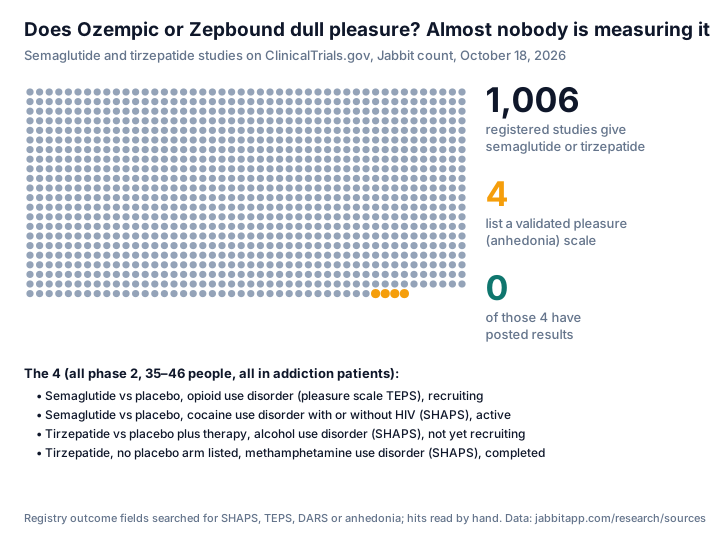
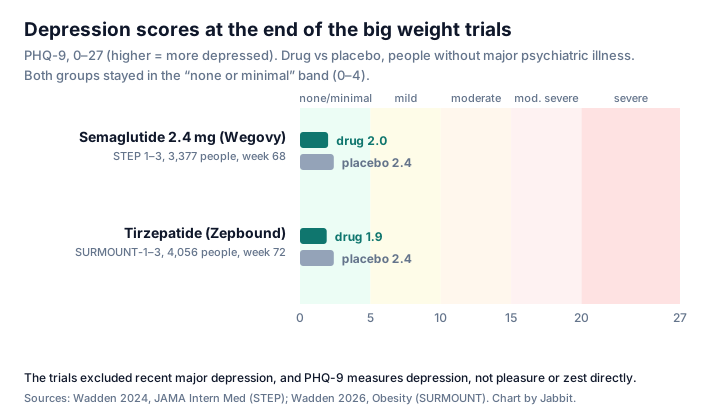
In the big weight trials of semaglutide (Ozempic, Wegovy) and tirzepatide (Zepbound, Mounjaro), more than 7,400 people filled out depression checklists every few weeks for well over a year. Scores stayed in the healthy range and ended slightly better than placebo, and tirzepatide users reported a bit more energy, not less.[3][4][6] FDA’s January 2026 review of 91 trials found no rise in depression or suicidal thinking.[5] But those trials screened out people with recent depression, and none of them measured pleasure itself. Of 1,006 semaglutide and tirzepatide studies registered on ClinicalTrials.gov, we found 4 that use a pleasure scale. All are small trials in people with addictions, and 0 have reported.[3][4][12] The drugs do turn down more than food cravings: in one trial, alcohol and cigarettes too.[7][8] Adverse-event reports of “anhedonia,” losing the ability to enjoy things, are rare but show up more than with other diabetes and weight drugs.[11][12]
Why this matters this week
On Sunday morning, October 18, the author Nassim Nicholas Taleb posted that “when you lose your appetite for food you lose your appetite for life,” and that people on GLP-1 drugs have “this absence of gusto in them that makes them poor companions.” By that evening the post had about 295,000 views and more than 100 quote posts.[1] The replies split the way you’d expect. Some users said they lost the “food noise” and “still love life.” Others said anhedonia is real but rare and that “lowering the dose almost always fixes this.” One reply put the evidence gap plainly: “depression scales don’t really measure gusto, and that’s the part nobody’s studied well.”[2] That last line is close to right, and it’s checkable. So we checked.
The short answer
In the trials that looked, people on these drugs didn’t get more depressed and didn’t lose energy. On average they got a little better on both.[3][4][6] What nobody has tested in a big trial is the thing Taleb is describing: whether everyday pleasure, zest or enthusiasm drops. There’s a plausible reason it might, because the drugs damp down cravings beyond food.[8] There’s also a small trial pointing the other way, in depressed patients who became more willing to work for a reward.[9] And a handful of people have reported anhedonia to FDA.[11][12] That adds up to “mood is fine on average, and pleasure is an open question,” not “GLP-1s kill joy.”
What the big trials measured
Semaglutide 2.4 mg (Wegovy). Novo Nordisk’s STEP 1, 2 and 3 trials gave 3,377 adults semaglutide or placebo for 68 weeks, and checked mood with the PHQ-9, a standard 0–27 depression questionnaire, plus a suicide-risk interview. Both groups started at about 2 points, which means no or minimal symptoms. At week 68 the semaglutide group averaged 2.0 and the placebo group 2.4. People on semaglutide were less likely to slide into a worse depression category (odds ratio 0.63). Suicidal thoughts or behavior showed up in 1% or fewer of people in both groups.[3]
Tirzepatide (Zepbound). Lilly’s SURMOUNT-1, 2 and 3 trials covered 4,056 adults for 72 weeks. PHQ-9 scores went from 2.7 to 1.9 on tirzepatide and from 2.6 to 2.4 on placebo. 18.2% of tirzepatide users moved to a worse category, against 24.3% on placebo. Suicidal thoughts were reported by 0.6% in each group.[4]
Energy. SURMOUNT-1 also used the SF-36, a general health survey scored so the average American is 50. On its Vitality scale, which asks about feeling full of life and having energy, tirzepatide users gained 2.3 to 3.2 points over 72 weeks against 0.2 on placebo. On its mental-health summary they gained 0.4 to 0.7 points, against a 0.5-point drop on placebo.[6] Those are small changes, a fraction of the survey’s 10-point standard deviation, but they run the opposite way from “absence of gusto.” Two caveats: participants started above the national average on vitality (about 54), and this analysis dropped data from people after they stopped the drug.[6]
FDA’s review. In January 2026, FDA pooled 91 placebo-controlled trials of GLP-1 drugs with 107,910 patients and found no increased risk of suicidal thinking or of “other relevant psychiatric adverse events such as anxiety, depression, irritability, or psychosis.” A claims study of 2.2 million new users found no rise in self-harm. FDA asked for the suicide warning to come off the Saxenda, Wegovy and Zepbound labels.[5]
What those trials didn’t measure
Three things limit how far the trial data reach. First, the trials excluded the people most at risk: anyone with major depression in the previous two years, other severe psychiatric illness, a PHQ-9 of 15 or more at screening, or any past suicide attempt.[3][4] Second, the PHQ-9 is a depression checklist. It has one question about “little interest or pleasure in doing things,” but neither paper’s main text reports that item on its own (the tirzepatide paper does break out the self-harm question).[3][4] Third, nobody in these trials filled out a scale built to measure pleasure.
To see whether anyone is measuring it now, we pulled every study on ClinicalTrials.gov that gives semaglutide or tirzepatide: 1,006 of them. 63 list some depression measure among their registered outcomes. Just 4 list a validated pleasure or anhedonia scale, such as the Snaith-Hamilton Pleasure Scale. All 4 are phase 2 trials of 35 to 46 people, and all are in people with addictions: opioids, cocaine, alcohol or methamphetamine. One has no placebo group. None has posted results.[12] There is no registered trial measuring pleasure in the people Taleb is talking about, adults taking these drugs to lose weight.[12]
Why the worry isn’t crazy: the drugs dim more than food
Dimming food reward is the point of these drugs. In a 2017 lab study, 30 adults on semaglutide ate 24% fewer calories at all-you-can-eat meals than on placebo, reported fewer food cravings, and were less drawn to high-fat foods.[7]
The effect reaches past food. In a 2025 trial in 48 adults with alcohol use disorder, low-dose semaglutide cut how much alcohol people drank in a lab test and how many drinks they had on days they drank, and reduced craving. In the smokers in the trial, it also cut cigarettes per day.[8] That’s good news for people trying to drink or smoke less. It also shows these drugs act on the brain’s reward system, not just the stomach, which is why the joy question deserves a real test rather than a shrug.[8] Note what the trial didn’t find: no change in how many days people drank, and no measure of pleasure in other parts of life.[8]
And a small trial that points the other way
In April 2026, JAMA Psychiatry published a 72-person trial in adults with major depression and overweight. Oral semaglutide or placebo was added to their usual treatment for 16 weeks. On a computer task that offers bigger rewards for more effort, people on semaglutide became more willing to do the harder work for the bigger payoff, because the effort seemed less costly to them.[9] That’s a measure of motivation, the opposite of the listlessness Taleb describes. It’s also a secondary analysis in a small group. Outside experts noted that it had no anhedonia assessment and showed possible unblinding, and that it doesn’t make semaglutide an antidepressant.[9][10]
What people report to FDA
FDA’s adverse event database (FAERS) collects reports from patients and doctors. As of its July 2026 update, it held 73,001 reports listing semaglutide. 42 of them mention anhedonia (0.06%) and 57 mention apathy. For comparison, 10,674 mention nausea. For tirzepatide it’s 34 anhedonia reports out of 160,663 (0.02%) and 61 apathy reports.[12]
Rare isn’t the same as nothing. A June 2026 analysis compared GLP-1 reports with reports for other diabetes and weight drugs such as metformin, insulin and phentermine. Relative to all reports in each group, anhedonia came up about 4.7 times as often with GLP-1 drugs (39 reports), and “emotional poverty,” a term close to emotional blunting, far more often (25 reports, with a very wide margin of error). Signals were stronger for semaglutide than tirzepatide.[11] Those numbers need context. 85% of the GLP-1 reports came from consumers rather than health professionals, against 49% for the other drugs, and psychiatric reports jumped after Europe’s drug regulator opened a safety review in 2023, which suggests publicity drove part of the rise. Report databases can flag a pattern, but they can’t show the drug caused it.[11]
Checking the claims going around
“When you lose your appetite for food you lose your appetite for life.”[1] In the people who were tested, lower appetite came with steady or slightly better mood and a bit more energy.[3][4][6] Appetite for life, meaning pleasure and zest, hasn’t been measured in a big trial, so “GLP-1 users lack gusto” is an impression, not a finding.[12]
Anhedonia is rare, and “lowering the dose almost always fixes this.”[2] Rare matches the report data.[11][12] The dose fix has never been tested. We found no trial that measured pleasure at different doses, or before and after a dose cut.[12]
“Tirzepatide, a GLP-2.”[2] No. Tirzepatide acts on two hormone receptors, GIP and GLP-1. It isn’t a GLP-2 drug.[13]
“Depression scales don’t really measure gusto.”[2] Fair. The trials used depression and suicide-risk scales, and only 4 of 1,006 registered studies use a pleasure scale.[3][4][12]
Safety
FDA’s current advice to patients is short: “Tell your health care professional if you experience new or worsening depression, suicidal thoughts, or any unusual changes in mood or behavior.”[5] If food was a main source of comfort or reward, losing interest in it is expected on these drugs. Losing interest in friends, hobbies or sex is a different thing, and it’s worth raising with whoever prescribes the drug. In the U.S., the 988 Suicide and Crisis Lifeline is available by call or text.[5] The trial safety data don’t cover people with recent major depression, bipolar disorder or a past suicide attempt, because they weren’t enrolled.[3][4]
What holds up
The mood data are strong for what they measured. They come from large, double-blind trials with frequent check-ins and high retention, and FDA’s independent pooled review of 91 trials agrees with them.[3][5] Energy didn’t drop in SURMOUNT-1, and the drugs’ effect on alcohol craving may be a real benefit for some people.[6][8] The weak spots are the people left out of the trials, the lack of any direct pleasure measure, and the fact that both trial analyses were funded by the drugmakers.[3][4][12]
Bottom line
Do Ozempic, Wegovy and Zepbound dull your zest for life? On average, the trial evidence says no. Mood and energy held steady or improved slightly in more than 7,400 people, and FDA found no psychiatric signal in 91 trials.[3][4][5][6] But pleasure itself has been measured in only 4 small addiction trials, none reported, and some people do report anhedonia.[11][12] The fair version of Taleb’s point isn’t that these drugs make people dull. It’s that nobody has properly checked, and they should.
References
- Nassim Nicholas Taleb (@nntaleb) on X, October 18, 2026, 10:23 AM ET: “When you lose your appetite for food you lose your appetite for life. People on GLP-1 have this absence of gusto in them that makes them poor companions. They are almost as unpleasant to be with as longevity-health optimizers.” 295,218 impressions, 5,814 likes and 109 quotes when pulled at about 9:57 PM ET the same day. https://x.com/nntaleb/status/2111825433641750732. Checked October 18, 2026.
- Replies and quotes on X, October 18, 2026 (ET): @gabusch, 9:38 PM (“GLP-1 has helped me curb ‘food noise’ and still love life”) https://x.com/gabusch/status/2111995367906849195; @getmealcoach, 9:41 PM (anhedonia “is a side effect only a minority of folks taking GLP-1 have at a higher dose. Lowering the dose almost always fixes this.”) https://x.com/getmealcoach/status/2111996213788913909; @tlatlz, 1:51 PM (“Tirzepitide, a glp2”) https://x.com/tlatlz/status/2111877938878853343; @ElevateBiohack, 2:06 PM (“depression scales don’t really measure gusto, and that’s the part nobody’s studied well”) https://x.com/ElevateBiohack/status/2111881547414655070; @aminoaiapp, 2:08 PM (“did you lose your spark, or just the food noise?”) https://x.com/aminoaiapp/status/2111882148810772818. Checked October 18, 2026.
- Wadden TA, Brown GK, Egebjerg C, et al. Psychiatric safety of semaglutide for weight management in people without known major psychopathology: post hoc analysis of the STEP 1, 2, 3, and 5 trials. JAMA Intern Med. 2024;184(11):1290-1300. doi:10.1001/jamainternmed.2024.4346. PMID 39226070; PMC11372653 (3,377 participants in STEP 1–3, 68 weeks; PHQ-9 baseline 2.0 vs 1.8, week 68 2.0 vs 2.4, difference −0.56, 95% CI −0.81 to −0.32; odds of shifting to a worse PHQ-9 category 0.63; C-SSRS suicidal ideation/behavior 1% or fewer, no difference; exclusions included major depressive disorder in the previous 2 years, other severe psychiatric disorders, screening PHQ-9 of 15 or more, or any lifetime suicide attempt; funded by Novo Nordisk, whose representatives took part in analysis and manuscript). https://pubmed.ncbi.nlm.nih.gov/39226070/. Checked October 18, 2026.
- Wadden TA, Oquendo MA, Kushner RF, et al. Psychiatric safety of tirzepatide in people with obesity and no known major psychopathology: a post hoc analysis of SURMOUNT. Obesity (Silver Spring). 2026;34(3):565-578. doi:10.1002/oby.70122. PMID 41537305; PMC12933222 (4,056 participants in SURMOUNT-1–3; PHQ-9 baseline 2.7 vs 2.6, week 72 1.9 vs 2.4, difference −0.6; shift to a worse category 18.2% vs 24.3%; suicidal ideation 17 of 2,793 vs 7 of 1,246, 0.6% each; nonfatal suicidal behavior 0.1% vs none; nervous-system adverse events 15.8% vs 13.0%, mainly dizziness and taste change; same style of psychiatric exclusions; funded by Eli Lilly). https://pubmed.ncbi.nlm.nih.gov/41537305/. Checked October 18, 2026.
- FDA Drug Safety Communication, January 13, 2026: FDA requests removal of suicidal behavior and ideation warning from Saxenda, Wegovy and Zepbound labels. Meta-analysis of 91 placebo-controlled GLP-1 trials, 107,910 patients (60,338 on a GLP-1 drug, 47,572 on placebo): no increased risk “for SI/B or for other relevant psychiatric adverse events such as anxiety, depression, irritability, or psychosis”; Sentinel claims study of 2,243,138 new users found no increased intentional self-harm vs SGLT2 inhibitors; patients should “tell your health care professional if you experience new or worsening depression, suicidal thoughts, or any unusual changes in mood or behavior.” https://www.fda.gov/drugs/drug-safety-communications/fda-requests-removal-suicidal-behavior-and-ideation-warning-glucagon-peptide-1-receptor-agonist-glp. Checked October 18, 2026.
- Gudzune KA, Stefanski A, Cao D, et al. Association between weight reduction achieved with tirzepatide and quality of life in adults with obesity: results from the SURMOUNT-1 study. Diabetes Obes Metab. 2025;27(2):539-550. doi:10.1111/dom.16046. PMID 39497468; PMC11701187 (SF-36v2 scores norm-based to the US population, mean 50, SD 10; Vitality baseline 54.4–54.9; change at week 72 +2.76, +2.33, +3.19 on 5, 10, 15 mg vs +0.21 on placebo; Mental Component Summary +0.72, +0.44, +0.71 vs −0.47; efficacy estimand, data after stopping treatment excluded; funded by Eli Lilly). https://pubmed.ncbi.nlm.nih.gov/39497468/. Checked October 18, 2026.
- Blundell J, Finlayson G, Axelsen M, et al. Effects of once-weekly semaglutide on appetite, energy intake, control of eating, food preference and body weight in subjects with obesity. Diabetes Obes Metab. 2017;19(9):1242-1251. doi:10.1111/dom.12932. PMID 28266779; PMC5573908 (30 adults, 12 weeks, semaglutide up to 1.0 mg; 24% lower total ad libitum energy intake, −3,036 kJ; less hunger and food cravings, better control of eating, lower preference for high-fat foods; nausea ratings similar). https://pubmed.ncbi.nlm.nih.gov/28266779/. Checked October 18, 2026.
- Hendershot CS, Bremmer MP, Paladino MB, et al. Once-weekly semaglutide in adults with alcohol use disorder: a randomized clinical trial. JAMA Psychiatry. 2025;82(4):395-405. doi:10.1001/jamapsychiatry.2024.4789. PMID 39937469; PMC11822619 (48 adults, 9 weeks, 0.25 mg rising to 0.5 mg then 1.0 mg for one week; lower grams of alcohol in a lab self-administration test, β −0.48, P = .01; no change in drinks per calendar day or drinking days; fewer drinks per drinking day, β −0.41, P = .04; less weekly craving, P = .01; fewer cigarettes per day in the subgroup who smoked, P = .005). https://pubmed.ncbi.nlm.nih.gov/39937469/. Checked October 18, 2026.
- Gill H, Badulescu S, Shah H, et al. Semaglutide and effort-based decision-making in major depressive disorder: a randomized clinical trial. JAMA Psychiatry. 2026;83(7):751-754 (published online April 29, 2026). doi:10.1001/jamapsychiatry.2026.0594. PMID 42054055; PMC13130066; NCT04466345 (72 adults with major depression and BMI 25 or more, oral semaglutide 14 mg or placebo added to usual treatment for 16 weeks; secondary analysis; more willing to exert effort for higher-value rewards, P = .02; reduced sensitivity to effort, P = .03). https://pubmed.ncbi.nlm.nih.gov/42054055/. Checked October 18, 2026.
- Science Media Centre (UK). Expert reaction to RCT which looks at semaglutide and motivation in depression, April 29, 2026 (Prof Ciara McCabe: “limited by its small sample size and the absence of any anhedonia assessment”; Dr Atheeshaan Arumuham: “this does not mean semaglutide is an antidepressant,” limitations include “evidence of possible unblinding”). https://www.sciencemediacentre.org/expert-reaction-to-rct-which-looks-at-semaglutide-and-motivation-in-depression/. Checked October 18, 2026.
- Moon S, Lee E, Kim D, Choi KH, Choi YJ, Shin S. Psychiatric safety signals of GLP-1 receptor agonists: a FAERS-based pharmacovigilance study with explainable machine learning. Pharmaceuticals. 2026;19(6):953 (published June 17, 2026). doi:10.3390/ph19060953 (FAERS 2021 Q2–2025 Q3, 111,105 GLP-1 cases vs 100,090 cases on other diabetes and weight drugs; anhedonia 39 reports, ROR 4.73, 95% CI 2.33–9.59; emotional poverty 25 reports, ROR 57.96, 95% CI 3.53–952; consumer reports 84.9% of GLP-1 cases vs 49.2% of comparators; psychiatric reporting rose after the EMA safety review began in 2023 Q3; signals larger for semaglutide than tirzepatide; “causal inference cannot be drawn”). https://www.mdpi.com/1424-8247/19/6/953. Checked October 18, 2026.
- Jabbit analysis, October 18, 2026. ClinicalTrials.gov API v2, interventions matching semaglutide or tirzepatide, deduplicated: 1,006 studies. 63 list a depression measure among registered outcomes. Registered outcomes were searched for the Snaith-Hamilton Pleasure Scale (SHAPS), Temporal Experience of Pleasure Scale (TEPS), Dimensional Anhedonia Rating Scale (DARS) or “anhedonia,” and each hit was read: 4 studies, all phase 2 and 35 to 46 people: NCT06639464 (semaglutide vs placebo, opioid use disorder, TEPS, recruiting), NCT06691243 (semaglutide vs placebo, cocaine use disorder with or without HIV, SHAPS, active, not recruiting), NCT07292519 (tirzepatide vs placebo with CBT, alcohol use disorder with overweight or obesity, SHAPS, not yet recruiting), NCT06745128 (tirzepatide, no placebo arm listed, obesity with methamphetamine use disorder, SHAPS, completed). 0 have posted results. openFDA drug-event (FAERS) API, data through 2026-07-30: reports listing semaglutide 73,001 (anhedonia 42, apathy 57, nausea 10,674); tirzepatide 160,663 (anhedonia 34, apathy 61, nausea 17,092). Script: ops/scripts/glp1_pleasure_analysis.py. Data: https://jabbitapp.com/research/sources/glp1-pleasure-ctgov-faers-2026-10-18.json. Checked October 18, 2026.
- Jastreboff AM, Aronne LJ, Ahmad NN, et al. Tirzepatide once weekly for the treatment of obesity. N Engl J Med. 2022;387(3):205-216. doi:10.1056/NEJMoa2206038. PMID 35658024 (tirzepatide is “a once-weekly glucose-dependent insulinotropic polypeptide and glucagon-like peptide-1 receptor agonist”). https://pubmed.ncbi.nlm.nih.gov/35658024/. Checked October 18, 2026.
This page analyzes published trials, regulatory documents, adverse-event reports and trial registries. It is not medical advice. Don’t start, stop or change a medicine without talking to your prescriber. The trial-registry and FAERS counts are Jabbit’s own; inputs are cited above.