News analysis · VDPHL01, minoxidil (Loniten, Rogaine), low-dose oral minoxidil (LDOM), finasteride (Propecia) · Veradermics’ Study 304 readout, FDA labels, ClinicalTrials.gov and safety studies · Sources checked October 19, 2026
Published · Updated
Should you take cheap generic oral minoxidil now instead of waiting for Veradermics’ VDPHL01 pill? Doctors already prescribe it off-label, but it isn’t the pill that just passed phase 3, and its label carries a boxed heart warning.
On October 19, Veradermics said its pill VDPHL01 grew hair in its second large trial. VDPHL01 is extended-release minoxidil, the 1970s blood-pressure drug behind Rogaine.[1][9] So the obvious question on X is why not just get the cheap generic now.[28] The short answer: you can ask a prescriber for it now. Veradermics itself counts about 3 million oral minoxidil prescriptions in 2024.[4] But the generic tablet hasn’t been through trials like these, its FDA label carries a boxed heart warning, and the trial results for the new pill don’t transfer to it automatically.[8][17] VDPHL01 isn’t approved, and no filing date has been announced.[1]
Why this matters now
Veradermics released Study 304 at 7 AM ET on October 19 and filed the results with the SEC the same day.[1][2] It was the company’s second positive placebo-controlled trial in men, after Study 302 in April.[5] English posts on X about minoxidil, Veradermics or VDPHL01 jumped from 122 on October 18 to 479 on October 19.[27] Many of them made the same point: it’s “just oral minoxidil,” so why wait?[28]
The short answer
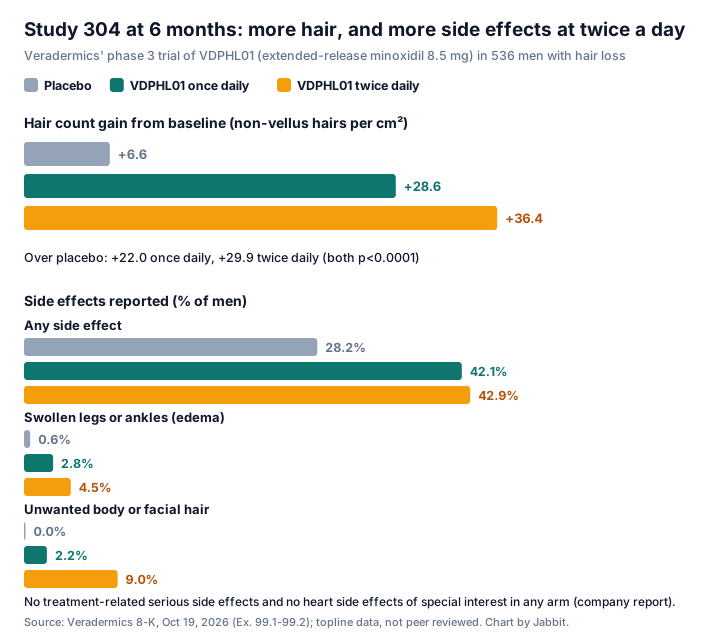
- VDPHL01 works in trials. Men gained 28.6 (once daily) or 36.4 (twice daily) hairs per square centimeter at 6 months, against 6.6 on placebo. Most noticed a difference.[1]
- Generic oral minoxidil is a different product. It’s the same molecule, but regular tablets release it fast. The randomized trial of the generic in men that we could fully check enrolled 90 men and compared it with topical minoxidil, not placebo. It didn’t beat topical.[17][7]
- The generic is already widely used. Veradermics itself counts about 3 million prescriptions in 2024.[4] A 1,404-patient safety series found mostly unwanted hair and few serious problems.[16]
- Its label is scary on purpose. Every one of the 32 generic tablet labels we checked carries the boxed warning about fluid around the heart. That warning was written for people with severe high blood pressure taking far higher doses.[7][8]
- The new pill’s trial screened out the riskiest people. Men with uncontrolled blood pressure, certain heart or thyroid conditions, or recent beta-blocker use couldn’t join.[6]
What Study 304 found
Study 304 enrolled 536 men aged 18 to 65 with mild-to-moderate pattern hair loss at 45 U.S. sites. They took VDPHL01 8.5 mg once a day, 8.5 mg twice a day, or placebo for 6 months. Neither the men nor their doctors knew who got what.[1][3] The trial counted thicker (non-vellus) hairs at a tattooed spot on the scalp, so the same patch was measured each time, and asked men to rate their own photos.[3]
- Hair count: +28.6 and +36.4 hairs/cm² vs +6.6 on placebo, or 22.0 and 29.9 more than placebo.[1][3]
- Men’s own rating: 55.7% and 68.7% rated their hair “improved” or “much improved,” vs 15.0% on placebo. Counting any improvement, it was 78.8% and 85.0% vs 35.3%.[1]
- Doctors’ rating: 78.4% and 82.7% improved.[1] Results separated from placebo by month 2, the earliest time point checked.[1]
- Repeat: Study 302, in 519 men, found +30.3 and +33.0 vs +7.3.[1]
The 78.8% and 85.0% figures count any improvement, including “a little improved.” The trial’s main endpoint was the stricter one: 55.7% and 68.7%.[1][3]
Side effects, and who was left out
Side effects of any kind were reported by 42.1% and 42.9% on VDPHL01 and 28.2% on placebo. Unwanted body or facial hair was the only common one that differed clearly: 2.2% once daily and 9.0% twice daily, vs none on placebo. Leg or ankle swelling was 2.8% and 4.5% vs 0.6%. Few men quit over side effects (2.2% and 2.8% vs 1.1%).[2][3] There were no treatment-related serious events and no heart side effects of special interest. The company says heart rate, blood pressure and ECGs didn’t differ meaningfully from placebo, but it didn’t publish those numbers.[1][3]
That is reassuring for the men studied, but read the entry rules. The trial’s registry listing excludes men with “uncontrolled blood pressure or orthostatic hypotension,” “symptoms or history of certain heart or thyroid conditions,” and anyone on beta blockers or calcium channel blockers in the prior 12 weeks.[6] The company’s baseline table lists 52.2% of men as hypertensive at baseline but doesn’t define the term.[3] 84.5% were white.[3] If you have a heart condition or take blood-pressure drugs, this trial doesn’t tell you much about your risk.
What extended release is supposed to fix
Regular minoxidil tablets peak in the blood within the first hour and fall off fast.[8] At blood-pressure doses, that drop in pressure makes the heart speed up and the kidneys hold salt and water. That is why Loniten is usually given with a beta blocker and a diuretic.[8] Veradermics argues that hair follicles need long, steady exposure instead. Follicles turn minoxidil into its active form, minoxidil sulfate, in a process the company calls “capacity-limited and time-dependent.” On that view, a short spike mostly works on blood vessels and adds little hair growth.[4][3]
Its numbers come from its own small studies. It says one 8.5 mg extended-release tablet put about twice as much minoxidil in the blood over 12 hours as a 2.5 mg regular tablet, kept it above a hair-growth level twice as long, and stayed below a “cardiac activity” level of 20 ng/mL.[4][3] The pharmacokinetic data are from 10 men. Its annual report calls 20 ng/mL “the FDA threshold” for cardiac and vascular changes. The slide sources that number to a 1996 study of intravenous minoxidil infusions in untreated hypertensive patients.[3] The company also says 5 mg of regular minoxidil peaks at 37 ng/mL.[4] A PubMed search for “VDPHL01” on October 19 returned nothing, so none of these data has been peer reviewed. One detail doesn’t match: the company’s 10-K describes a half-life of about 90 minutes, but the Loniten label gives 4.2 hours.[4][8]
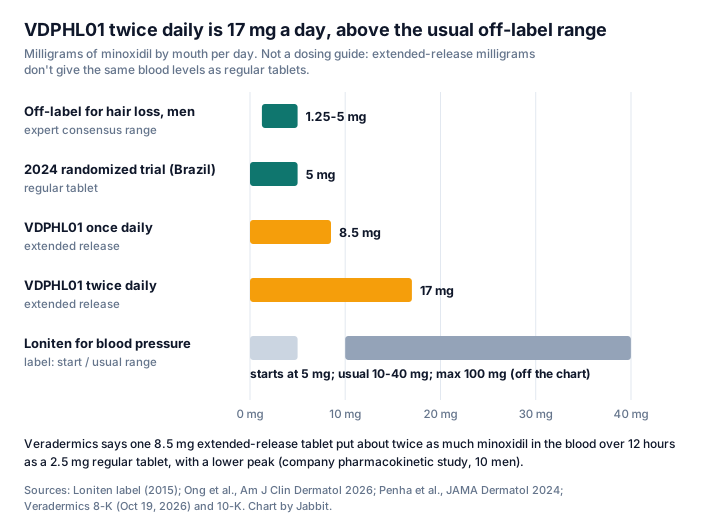
The twice-daily dose is 17 mg of minoxidil a day. That is well above the 1.25–5 mg a day an international expert consensus lists for men using regular tablets off-label, though below the 10–40 mg usual for blood pressure.[1][18][8] The twice-daily arm also had the most unwanted body hair.[2] Generic tablets come in only two strengths, 2.5 mg and 10 mg. So any lower dose means a split tablet or a compounded product.[7][9][4]
Generic oral minoxidil: what the evidence says
History. Minoxidil was approved as Loniten in October 1979 for severe high blood pressure.[9][4] Hair growth showed up as a side effect. In 1980 the New England Journal of Medicine published a letter titled “Reversal of baldness in patient receiving minoxidil for hypertension.”[13] The label says about 80% of Loniten users grow extra body hair.[8] Upjohn developed the topical version, Rogaine, approved in August 1988. It “produced some hair growth in four out of 10 men tested.” Even then, FDA’s spokesman said it could complicate health problems in people with heart conditions.[9][14] Low-dose oral use for hair came much later. In a 2018 open-label series, Australian dermatologist Rodney Sinclair treated 100 women with 0.25 mg plus the hormone blocker spironolactone.[15] Veradermics says prescriptions rose about ten-fold after a 2022 New York Times article.[4]
Efficacy. The trial evidence for the generic in men is thin. In a 2024 Brazilian trial, 90 men were randomized to 5 mg oral minoxidil or 5% topical minoxidil, and 68 finished. At 24 weeks oral wasn’t significantly better on hair density, though photo ratings favored it on the crown. Half the men on oral (49%) grew unwanted body hair.[17] A 2026 review calls oral efficacy “comparable” to topical, with better adherence and lower cost.[18] Veradermics argues regular tablets hit an “efficacy ceiling” on par with topical.[4] That is the company’s case for its product, and no trial has tested VDPHL01 against the generic.[3]
Safety at hair-loss doses.
- In the 1,404-patient multicenter series (Vañó-Galván et al.), unwanted hair affected 15.1%. Lightheadedness hit 1.7%, fluid retention 1.3% and fast heartbeat 0.9%. 1.7% stopped for side effects, and there were no life-threatening events. It had no control group.[16]
- In a U.S. records study of 9,724 people prescribed 2.5 mg and 9,724 matched hair-loss patients, pericardial effusions over a year were 15 vs 14. People with prior heart attack or heart failure were excluded. The senior author consults for Veradermics, among others.[20] A second large records study and a 100-person heart-ultrasound study found no excess either.[22][21]
- A 2025 review calls pericardial effusion at these doses “extremely rare and often linked to compounding errors comprising an excessive dose.”[19] For anyone filling low doses at a compounding pharmacy, that matters.
- FDA’s adverse-event reports (FAERS) show pericardial effusion reported more often with oral minoxidil than expected, even at 1.25 mg or less.[23][24] FAERS counts reports, not people exposed, so it can’t give a rate. The authors call their results signals, not proof.[23][24]
The label on the generic
We pulled every oral minoxidil tablet label on DailyMed, the federal label database, on October 19. There are 32, tied to six generic approvals. Seventeen were published in 2026.[7] All 32 carry the boxed warning that minoxidil “can cause pericardial effusion, occasionally progressing to tamponade, and angina pectoris may be exacerbated.” All 32 say using it “to promote hair growth is not an approved indication.”[7][8] The brand, Loniten, is discontinued. FDA has determined it wasn’t pulled for safety or effectiveness reasons, which lets the generics keep referring to it.[9][10]
The warning comes from patients with severe hypertension. In them, effusion occurred “in about 3% of treated patients not on dialysis, especially those with inadequate or compromised renal function.”[8] Expert reviews list pericardial disease, uncontrolled hypertension and pregnancy as reasons not to use oral minoxidil.[18]
| Question | VDPHL01 | Generic oral minoxidil | Topical (Rogaine) | Finasteride (Propecia) |
|---|---|---|---|---|
| What it is | Extended-release minoxidil tablet, investigational | Immediate-release minoxidil tablet (Loniten generics) | Topical minoxidil solution or foam | Finasteride 1 mg tablet[1][8][9][26] |
| FDA-approved for hair loss? | Not yet; no filing date announced | No: approved for hard-to-treat high blood pressure | Yes, since 1988; now sold over the counter | Yes, since 1997 (men)[1][8][9] |
| Best placebo-controlled data | Two trials, 1,055 men, 6 months, company-reported topline | No large placebo-controlled trial in men that we found; a 90-man trial vs topical | Approved in 1988 on trials where about 4 in 10 men saw some growth | Three 12-month trials, 1,879 men[1][3][17][7][14][26] |
| Hair gain over placebo | +22.0 to +29.9 hairs/cm² at 6 months | Not measured against placebo in the trial above | — | About +21 hairs/cm² at 12 months (107 hairs in 5.1 cm²)[3][17][26] |
| Label warning | Unknown; the company says it can’t predict whether FDA will require a boxed warning | Boxed warning: pericardial effusion, tamponade, angina | No boxed warning | No boxed warning; sexual side effects, depression reports[5][8][26] |
| Body or facial hair | 2.2% once daily, 9.0% twice daily | 15.1% in 1,404 low-dose users; 49% at 5 mg in the trial above | — | —[2][16][17] |
The finasteride comparison is rough. Its label reports 107 more hairs than placebo in a 1-inch circle (5.1 cm²) at 12 months, which works out to about 21 per cm².[26] VDPHL01’s gain over placebo was 22.0 to 29.9 per cm² at 6 months.[3] The counting methods and eras differ, and Veradermics itself calls cross-trial comparisons unreliable.[3] Finasteride’s label also lists sexual side effects (3.8% vs 2.1% in year one) and postmarketing reports of depression and suicidal thoughts.[26] That is part of why a non-hormonal pill appeals.
What we found in the trial registry
We searched ClinicalTrials.gov for minoxidil taken by mouth or under the tongue for hair loss. We kept 16 studies. None has posted results.[7] The registry search shows two more things:
- VDPHL01’s listings never say “minoxidil.” All four Veradermics entries call the drug only “VDPHL01 Extended Release (ER) Tablet,” so a search for minoxidil doesn’t find them.[6][7] Each lists two primary outcomes and no secondary outcomes, though the company says Study 304 “met all primary and secondary endpoints.”[6][1] Study 304’s entry, last updated in February, still shows 480 estimated participants, not the 536 enrolled.[6][1]
- VDPHL01 isn’t the only oral minoxidil in late trials. Three other companies have phase 3 trials of their own oral or sublingual versions, and a Pakistani institute lists a fourth phase 3.[7] The Australian sublingual trial is sponsored by Samson Clinical Operations. Sinclair discloses founding Samson Medical, which holds patents on oral and sublingual minoxidil for hair loss. The trial finished in May with no results posted.[7][25]
| Registry ID | Sponsor | What’s tested | People | Status |
|---|---|---|---|---|
| NCT06924632 | Samson Clinical Operations (Australia) | Sublingual tablet, men, phase 3 | 142 | Completed May 2026; no results posted |
| NCT05888922 | Industrial Farmacéutica Cantabria (Spain) | 1 mg tablet vs topical vs placebo, women, phase 3 | 520 (estimated) | Primary completion October 2026 |
| NCT07529977 | Eurofarma (Brazil) | Oral solution, men, phase 3 | 372 (estimated) | Not yet recruiting; completion 2028 |
| NCT07273799 | Sheikh Zayed Federal Postgraduate Medical Institute (Pakistan) | 2.5 mg tablet vs topical 5%, phase 3 | 200 (estimated) | Listed as not yet recruiting |
This is a lower bound. The 2024 Brazilian trial, for example, is in Brazil’s registry, not this one.[17][7]
The business: an old drug, a new clock
Veradermics plans a 505(b)(2) application. That route lets a company rely on what FDA already knows about an approved drug, here minoxidil, and add its own trials.[4] The company says the usual exclusivity for that is 3 years.[4][11] Its issued U.S. patents are method-of-use patents running to 2043. It says “Neither we, nor any other company, owns or has rights to composition of matter claims covering the active ingredient minoxidil.”[4] Nothing in that plan touches the generic tablets, which are approved for blood pressure. The company’s own market research frames the competition as “$15 Oral IR Minoxidil.”[3]
On timing, Veradermics didn’t give a filing date on October 19.[1] FDA’s goal for a standard review of this kind of application is 10 months from submission.[12] Still to come: Part B of Study 302 later in 2026 (each trial runs 52 weeks) and the women’s trial (Study 306, 4.5 mg) in the first half of 2027.[1][5] The company also says it can’t yet know whether FDA will put a boxed warning on VDPHL01.[5]
One more caution: open-label numbers shrink
In October 2025, Veradermics reported an average gain of 47.3 hairs/cm² after 4 months in 21 men in its open-label phase 2 study, with no placebo group.[4] With placebo control and more men, the 6-month gains were 28.6 to 36.4, and placebo itself added 6.6.[1] That is still a strong result. It is also a reminder that uncontrolled before-and-after numbers, including your own, overstate what a drug does.
Strengths and limits
Strengths. Two randomized, double-blind trials in more than 1,000 men, with matching results and a dose response.[1][3] Hair was counted at the same tattooed scalp spot each visit.[3]
Limits. These are company topline numbers from a press release and slides, not a peer-reviewed paper.[1][3] The trials ran 6 months against placebo. Twelve-month data aren’t out.[1] The trials excluded men with heart conditions, uncontrolled blood pressure or recent beta-blocker use.[6] No trial has compared VDPHL01 with generic oral minoxidil or finasteride.[3] Our registry and label counts are lower bounds from public databases.[7]
Bottom line
VDPHL01 looks like a real step for minoxidil in pill form. Two big trials show clear hair growth, few dropouts and no heart signal in screened men. The twice-daily dose grows more hair and more body hair.[1][2] It isn’t approved, and its timeline isn’t set.[1][12] Generic oral minoxidil is available now with a prescription and has a large, mostly reassuring real-world safety record at low doses. It has much weaker trial evidence and a label written for a sicker population.[16][20][17][8] If you go that route, go through a prescriber who knows your blood pressure and heart history. Be wary of compounded doses.[19][18] And give any treatment months, not weeks, before you judge it.[1]
Jabbit is a private iPhone log built for injections, such as GLP-1s and TRT. If you track those alongside a pill like this, it keeps your doses and dates in one place.
Frequently asked questions
- Should I take generic oral minoxidil now instead of waiting for VDPHL01?
- That is a call to make with a prescriber, but you don’t have to wait to have the conversation. Generic oral minoxidil tablets are already prescribed off-label for hair loss. They are a different product from VDPHL01, they have far less placebo-controlled hair data, and their label carries a boxed warning about fluid around the heart. VDPHL01 is not approved, and Veradermics hasn’t announced a filing date.
- What is VDPHL01?
- VDPHL01 is Veradermics’ extended-release minoxidil tablet. It is the same drug as Loniten and Rogaine, in a gel-matrix tablet designed to release minoxidil slowly and avoid the high blood-level peaks of regular tablets. The phase 3 trials used 8.5 mg once or twice a day.
- When could VDPHL01 be approved?
- Not before Veradermics files, and it hasn’t given a filing date. FDA’s goal for a standard review of this kind of application is 10 months from submission. The women’s trial reads out in the first half of 2027, and the second part of the first men’s trial reports later in 2026.
- Is oral minoxidil bad for your heart?
- At blood-pressure doses, the label warns of fluid around the heart in about 3% of patients, worse angina and a faster heart rate. At the low doses used for hair, large records studies have not found more pericardial effusions, and serious cases are rare and often tied to compounding errors that gave too high a dose. Swelling, dizziness and a faster pulse do happen. People with heart disease or uncontrolled blood pressure were excluded from the VDPHL01 trials.
- Is VDPHL01 better than finasteride?
- No trial has compared them. On paper, VDPHL01 added 22 to 30 hairs per square centimeter over placebo at 6 months, and finasteride about 21 at 12 months, but the trials used different methods decades apart. Finasteride works on hormones; minoxidil doesn’t. Some men use both.
- Why is VDPHL01’s dose 8.5 or 17 mg when people take 2.5 mg?
- Milligrams of an extended-release tablet aren’t the same as milligrams of a regular one. Veradermics says one 8.5 mg tablet put about twice as much minoxidil in the blood over 12 hours as a 2.5 mg regular tablet, with a lower peak. That claim comes from a small company study, not a published paper.
- Will VDPHL01 make generic oral minoxidil harder to get?
- Nothing about its approval would pull the generic tablets, which are approved for blood pressure. Veradermics says no company owns a patent on minoxidil itself; its issued patents cover methods of using its product. Whether doctors keep prescribing generics off-label is up to them.
References
- Veradermics, Inc. Press release: “Veradermics’ Oral VDPHL01 Achieved Early, Consistent, and Robust Hair Growth in Positive Phase 3 ‘304’ Clinical Trial in Male Pattern Hair Loss.” October 19, 2026, 7:00 AM ET; furnished as Exhibit 99.1 to Form 8-K (536 men randomized to 8.5 mg once daily, 8.5 mg twice daily or placebo; non-vellus target-area hair count +28.6 and +36.4 vs +6.6 hairs/cm² at month 6; AAIRS “improved” or “much improved” 55.7% and 68.7% vs 15.0%; any improvement 78.8% and 85.0% vs 35.3%; investigator-rated improvement 78.4% and 82.7%; Table 1 Study ‘302’ results; Table 2 edema and hypertrichosis; “no treatment-related serious adverse events (SAEs) and no adverse events of special interest (AESIs) of cardiac origin”; data from Part B of Study ‘302’ “later this year,” with each trial running 52 weeks; Study ‘306’ in women 1H 2027; separation from placebo at “Month 2, the earliest time point evaluated”; a “gel matrix” extended-release formulation; “The earliest expiring patent term is 2043”). https://www.sec.gov/Archives/edgar/data/1827635/000182763526000036/exhibit991datarelease101926.htm. Checked October 19, 2026.
- Veradermics, Inc. Form 8-K, October 19, 2026, Item 8.01 (“The only TEAE occurring in greater than 5% of patients with an imbalance between active and placebo was hypertrichosis (2.2% QD, 9.0% BID)”). SEC accession 0001827635-26-000036. https://www.sec.gov/Archives/edgar/data/1827635/000182763526000036/mane-20261019.htm. Checked October 19, 2026.
- Veradermics, Inc. Study ‘304’ Part A topline data presentation, October 19, 2026, furnished as Exhibit 99.2 to Form 8-K (536 men 18–65 at 45 U.S. sites, randomized 2:2:1:1; “Patient tattooed for location replicability”; baseline table: mean age 43.8, 84.5% white, “Hypertensive at Baseline” 52.2%; a “cardiac activity threshold (20 ng/mL)” citing Ferry et al., “Hemodynamic effects of minoxidil following intravenous infusions in untreated hypertensive patients,” Clin Pharmacol Ther 1996, with pharmacokinetic data from 10 men in Study QSC300720; cross-trial comparison with the note “No head-to-head studies comparing VDPHL01 to finasteride or other forms of minoxidil have been conducted”; any TEAE 42.1%, 42.9% vs 28.2%, discontinuation for side effects 2.2%, 2.8% vs 1.1%, the only serious event on VDPHL01 a humerus fracture “not deemed drug related”; “No clinically significant differences in heart rate, blood pressure, or ECG changes compared to placebo”; physician market research on reasons to prescribe VDPHL01 “Over $15 Oral IR Minoxidil”). https://www.sec.gov/Archives/edgar/data/1827635/000182763526000036/a304acallslidesfinal130a.htm. Checked October 19, 2026.
- Veradermics, Inc. Form 10-K for 2025, filed March 30, 2026 (plans a 505(b)(2) NDA; “typical” exclusivity for a previously approved active moiety “is 3 years”; issued patents are method-of-use patents expiring 2043; “Neither we, nor any other company, owns or has rights to composition of matter claims covering the active ingredient minoxidil”; IR oral minoxidil “prescribed approximately 3 million times in 2024,” about ten-fold more after a 2022 New York Times article; physicians “prescribe the 2.5 mg IR dosage form for approximately 90% of patients”; company statements that IR minoxidil “has a half-life of approximately 90 minutes,” that follicular conversion to minoxidil sulfate is “capacity-limited and time-dependent,” that 5 mg IR peaks at 37 ng/mL, above “the FDA threshold of 20 ng/mL for cardiac and vascular changes,” and that off-label IR use “has shown an efficacy ceiling”; open-label Study ‘207’ preliminary data announced October 2025: +47.3 hairs/cm² at 4 months, n=21 men; Loniten approved 1979). https://www.sec.gov/Archives/edgar/data/1827635/000182763526000013/mane-20251231.htm. Checked October 19, 2026.
- Veradermics, Inc. Form 10-Q for the quarter ended June 30, 2026, filed August 11, 2026 (“we do not know at this stage whether FDA is likely to require inclusion of a boxed warning for VDPHL01, if approved”; Study ‘302’ topline April 27, 2026; Study ‘306’ topline expected first half of 2027). https://www.sec.gov/Archives/edgar/data/1827635/000182763526000030/mane-20260630.htm. Checked October 19, 2026.
- ClinicalTrials.gov records for VDPHL01: NCT06972264 (Study ‘304’; last updated February 12, 2026; enrollment still shown as 480 estimated), NCT06724614 (‘302’), NCT07146022 (‘306’, women) and NCT06527365 (‘207’, open label). Each lists two primary outcomes and no secondary outcomes; none uses the word “minoxidil,” describing the drug only as “VDPHL01 Extended Release (ER) Tablet.” Exclusions include “uncontrolled blood pressure or orthostatic hypotension,” “symptoms or history of certain heart or thyroid conditions,” and systemic calcium channel blockers or beta blockers within 12 weeks. https://clinicaltrials.gov/study/NCT06972264. Checked October 19, 2026.
- Jabbit data file: ClinicalTrials.gov review of oral and sublingual minoxidil hair-loss studies (16 kept, 0 with posted results; exclusions listed) and a DailyMed scan of all 32 oral minoxidil tablet labels (strengths, boxed warning, hair-growth statement, generic application numbers). Built October 19, 2026. https://jabbitapp.com/research/sources/oral-minoxidil-ctgov-labels-2026-10-19.json. Checked October 19, 2026.
- Loniten (minoxidil tablets, USP) prescribing information, Pfizer, revised January 2015 (NDA 018154). Boxed warning: “may produce serious adverse effects. It can cause pericardial effusion, occasionally progressing to tamponade, and angina pectoris may be exacerbated,” reserved for hypertension not controlled by a diuretic plus two other drugs; pericardial effusion “in about 3% of treated patients not on dialysis”; temporary edema in 7%; hypertrichosis “in about 80%”; T-wave ECG changes in about 60%; half-life 4.2 hours; start 5 mg/day, usual 10–40, maximum 100; tablets 2.5 mg and 10 mg; “Use of LONITEN Tablets, in any formulation, to promote hair growth is not an approved indication.” https://www.accessdata.fda.gov/drugsatfda_docs/label/2015/018154s026lbl.pdf. Checked October 19, 2026.
- U.S. Food and Drug Administration. Drugs@FDA via the openFDA drugsfda endpoint: Loniten NDA 018154 (Pfizer), original approval October 18, 1979 as a new molecular entity, now discontinued with a Federal Register determination that it “was not discontinued or withdrawn for safety or effectiveness reasons”; oral minoxidil tablet generics only in 2.5 mg and 10 mg; Rogaine NDA 019501 approved August 17, 1988; Rogaine Extra Strength 5% NDA 020834, November 14, 1997; Propecia NDA 020788, December 19, 1997. https://open.fda.gov/apis/drug/drugsfda/. Checked October 19, 2026.
- 21 CFR 314.161: FDA determines whether a listed drug withdrawn from sale was withdrawn for safety or effectiveness reasons before generic applications that refer to it can be approved or kept. eCFR. https://www.ecfr.gov/current/title-21/section-314.161. Checked October 19, 2026.
- 21 CFR 314.108: three years of exclusivity for an application with new clinical investigations essential to approval (for example, a new formulation of a previously approved active moiety). eCFR. https://www.ecfr.gov/current/title-21/section-314.108. Checked October 19, 2026.
- U.S. Food and Drug Administration. PDUFA reauthorization performance goals and procedures, fiscal years 2023 through 2027 (goal: act on 90% of standard non-NME original NDAs “within 10 months of receipt,” priority within 6 months). https://www.fda.gov/media/151712/download. Checked October 19, 2026.
- Zappacosta AR. Reversal of baldness in patient receiving minoxidil for hypertension. N Engl J Med. 1980;303(25):1480-1481. doi:10.1056/NEJM198012183032516. PMID 7432414. https://pubmed.ncbi.nlm.nih.gov/7432414/. Checked October 19, 2026.
- Lichtblau E. FDA OKs drug that can cause hair to grow. Los Angeles Times, August 18, 1988 (Rogaine “produced some hair growth in four out of 10 men tested”; made by the Upjohn Co.; “an offshoot of a high-blood pressure drug called Loniten”; FDA spokesman: the drug “can complicate health problems in patients with heart conditions”). https://www.latimes.com/archives/la-xpm-1988-08-18-mn-767-story.html. Checked October 19, 2026.
- Sinclair RD. Female pattern hair loss: a pilot study investigating combination therapy with low-dose oral minoxidil and spironolactone. Int J Dermatol. 2018;57(1):104-109. doi:10.1111/ijd.13838. PMID 29231239 (100 women, minoxidil 0.25 mg plus spironolactone 25 mg daily for 12 months; open-label, no control group). https://pubmed.ncbi.nlm.nih.gov/29231239/. Checked October 19, 2026.
- Vañó-Galván S, Pirmez R, Hermosa-Gelbard A, et al. Safety of low-dose oral minoxidil for hair loss: a multicenter study of 1404 patients. J Am Acad Dermatol. 2021;84(6):1644-1651. doi:10.1016/j.jaad.2021.02.054. PMID 33639244 (retrospective, 10 centers’ patients treated at least 3 months, 943 women and 461 men; hypertrichosis 15.1%; lightheadedness 1.7%, fluid retention 1.3%, tachycardia 0.9%; 1.7% stopped for side effects; “No life-threatening adverse effects”; limitations: “Retrospective design and lack of a control group”). https://pubmed.ncbi.nlm.nih.gov/33639244/. Checked October 19, 2026.
- Penha MA, Miot HA, Kasprzak M, Müller Ramos P. Oral minoxidil vs topical minoxidil for male androgenetic alopecia: a randomized clinical trial. JAMA Dermatol. 2024;160(6):600-605. doi:10.1001/jamadermatol.2024.0284. PMID 38598226; Brazilian registry RBR-252w9r (90 men enrolled, 68 completed; 5 mg oral daily vs 5% topical twice daily for 24 weeks, double-dummy; frontal terminal-hair difference 3.1 hairs/cm², P=.27; vertex 23.4, P=.09; hypertrichosis 49% and headache 14% on oral; “did not demonstrate superiority”). https://pubmed.ncbi.nlm.nih.gov/38598226/. Checked October 19, 2026.
- Ong MM, Li Y, Lipner SR. Oral minoxidil for alopecia treatment: risks, benefits, and recommendations. Am J Clin Dermatol. 2026;27(1):101-119. doi:10.1007/s40257-025-00990-4. PMID 41118052 (efficacy “comparable” to topical; hypertrichosis 24%, transient shedding 16–22%, mild peripheral edema 2%; an international Delphi consensus range for men of 1.25–5 mg/day; contraindications include pericardial disease, uncontrolled hypertension and pregnancy). https://pubmed.ncbi.nlm.nih.gov/41118052/. Checked October 19, 2026.
- Jimenez-Cauhe J, Lo Sicco KI, Shapiro J, et al. Characterization and management of adverse events of low-dose oral minoxidil treatment for alopecia: a narrative review. J Clin Med. 2025;14(6):1805. doi:10.3390/jcm14061805. PMID 40142611 (fluid retention 1.3–10%; tachycardia or dizziness under 5%; severe events including pericardial effusion “extremely rare and often linked to compounding errors comprising an excessive dose”). https://pubmed.ncbi.nlm.nih.gov/40142611/. Checked October 19, 2026.
- Thang CJ, Levine J, Mo L, et al. Cardiovascular safety of low-dose oral minoxidil in nonscarring alopecia: a multicenter population-based cohort study using TriNetX. J Am Acad Dermatol. 2026;94(1):220-223. PMID 40902655; numbers from the authors’ meeting abstract LB1101, J Invest Dermatol 2025, doi:10.1016/j.jid.2025.06.1374 (9,724 patients prescribed 2.5 mg vs 9,724 matched hair-loss controls, prior heart attack or heart failure excluded; at 1 year, 15 vs 14 pericardial effusions, HR 1.09, 95% CI 0.53–2.26; no tamponade on minoxidil; angina HR 0.86). Senior author Benjamin Ungar lists consulting for Veradermics among other companies. https://pubmed.ncbi.nlm.nih.gov/40902655/ · https://doi.org/10.1016/j.jid.2025.06.1374. Checked October 19, 2026.
- Kincaid CM, Sharma AN, Sargent B, et al. Evaluation of pericardial effusions in alopecia patients on low-dose oral minoxidil therapy. J Drugs Dermatol. 2024;23(9):725-728. PMID 39231077 (bedside heart ultrasound in 51 patients on low-dose oral minoxidil and 49 not; small effusions in 5.8% vs 6%, none symptomatic). https://pubmed.ncbi.nlm.nih.gov/39231077/. Checked October 19, 2026.
- Neubauer ZJK, Lipner HI, Lipner SR. No association between low-dose oral minoxidil and pericardial effusion in a large retrospective cohort study of nonscarring alopecia patients. J Am Acad Dermatol. 2025;92(6):1454-1456. PMID 39993578. https://pubmed.ncbi.nlm.nih.gov/39993578/. Checked October 19, 2026.
- Gupta AK, Bamimore MA, Abdel-Qadir H, et al. Low-dose oral minoxidil and associated adverse events: analyses of the FDA Adverse Event Reporting System (FAERS) with a focus on pericardial effusions. J Cosmet Dermatol. 2025;24(1):e16574. PMID 39327649 (reporting signal for pericardial effusion at every dose band, including ≤1.25 mg; “life threatening” outcome association only at ≤10 mg; “In the absence of causal evidence”; authors advise ≤5 mg/day). https://pubmed.ncbi.nlm.nih.gov/39327649/. Checked October 19, 2026.
- Makkena HB, Kasu V. Cardiovascular safety signals of oral versus topical minoxidil in FAERS: a disproportionality analysis (analytic cohort 2012–2025). Life (Basel). 2026;16(3):522. PMID 41901041 (559 oral vs 56,947 topical reports; pericardial effusion reported disproportionately with oral use; with no exposed-patient denominators, results are “hypothesis-generating reporting signals rather than evidence of incidence”). https://pubmed.ncbi.nlm.nih.gov/41901041/. Checked October 19, 2026.
- Sinclair R, Sicinska J, Bokhari L, Kasprzak M. Sublingual minoxidil increases fibre diameter in male androgenetic alopecia. Clin Exp Dermatol. 2025;50(7):1362-1365. PMID 39774750 (Sinclair is founder of Samson Medical, “that holds patents on the use of oral minoxidil and sublingual minoxidil to treat hair loss disorders”). https://pubmed.ncbi.nlm.nih.gov/39774750/. Checked October 19, 2026.
- Propecia (finasteride 1 mg) prescribing information, Organon, DailyMed set 6f904709-65aa-44ce-b144-b4c8a0416e36, published October 14, 2024 (three trials in 1,879 men; “a 107-hair difference from placebo” at 12 months “within a 1-inch diameter circle (5.1 cm²)”; drug-related sexual side effects 3.8% vs 2.1% in year 1; postmarketing reports of depression, suicidal ideation and sexual dysfunction “that continued after discontinuation”). https://dailymed.nlm.nih.gov/dailymed/drugInfo.cfm?setid=6f904709-65aa-44ce-b144-b4c8a0416e36. Checked October 19, 2026.
- Jabbit count of English posts on X mentioning minoxidil, Veradermics or VDPHL01 via the X API recent-counts endpoint: 122 on October 18 and 479 on October 19, 2026 (UTC days), against 135 to 251 a day October 13–17 (October 13 counted from 01:00 UTC). Checked October 19, 2026.
- Example of the question on X: @jeffcafe_, October 19, 2026, 6:07 PM ET, replying to Polymarket: “It’s just oral minoxidil. They can’t also avoid waiting 3-4 more years for the FDA to approve the Veradermics version and just get prescribed the generic $5 a month one now…” (prices not verified by Jabbit). https://x.com/jeffcafe_/status/2112304691346637287. Checked October 19, 2026.
This page explains company filings, FDA labels and records, trial registries and published studies. It is not medical advice and not a dosing guide. Oral minoxidil is a prescription drug; it is not FDA-approved for hair loss, and VDPHL01 is investigational. Decisions about starting, dosing or stopping any medicine belong with your prescriber. The registry review and label scan are Jabbit’s own; their inputs are cited above.