Evidence review · Ozempic, Wegovy and Rybelsus (semaglutide), Zepbound and Mounjaro (tirzepatide) · DXA and MRI body-composition studies, muscle-drug trials, protein and creatine evidence, guidelines, ClinicalTrials.gov review · Sources checked October 19, 2026
Published · Updated
Muscle loss on Ozempic, Wegovy, Zepbound or Mounjaro: about a quarter to a third of the weight lost is lean mass. Lifting and protein are what guidelines back; creatine and the new muscle drugs are unproven on these drugs.
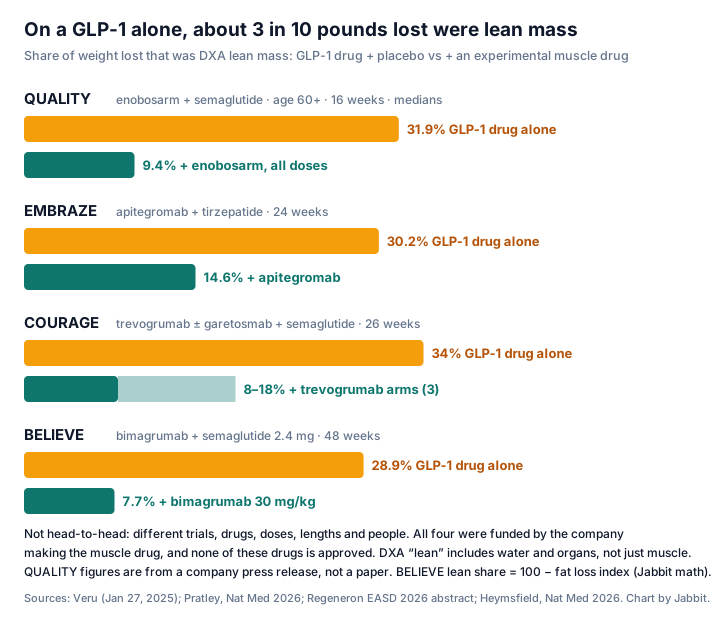
In four recent trials, about 29% to 34% of the weight people lost on semaglutide or tirzepatide alone was lean mass on a DXA scan.[6][5][2][4] That’s in the same range as diet and bariatric surgery, and “lean” on DXA includes water and organs as well as muscle.[4][10] Direct MRI scans show thigh muscle shrinking in line with the weight lost, while the fat inside the muscle goes down.[12][11] Strength and function mostly hold up in the trials that tested them. The clearest warning signs come from older people.[11][13][6][14] Experimental muscle drugs cut the lean share to roughly 8–18%, but none is approved, and one combination had serious safety problems.[1][3] Guidelines back resistance training and enough protein.[15][16] We read the ClinicalTrials.gov records: of 70 registered studies on muscle during GLP-1 treatment, 3 have posted results, and the only creatine trial is still recruiting.[26]
Why this matters now
On October 1, Regeneron presented one-year COURAGE results at the European diabetes meeting (EASD). It said its antibody trevogrumab preserved about 70% of the thigh muscle that semaglutide alone took off, and that the paper is in press at The Lancet. We found no published paper as of October 19.[1] In September, a Texas A&M study reporting that creatine added lean tissue in middle-aged adults even without exercise went from a university release to ScienceDaily.[23][22] On X, posts tying GLP-1 drugs to muscle loss ran at 13 to 29 a day last week, a small but steady stream.[25] The same audience is arguing about cardio versus lifting on these drugs and about testosterone as a muscle fix. For anyone over 40 on a weekly shot, the question is practical: how much muscle am I losing, and what actually protects it?
The short answer
- Some lean loss is normal for any big weight loss. On these drugs it runs about a quarter to a third of the weight lost, similar to diet or surgery.[4][15]
- Lean mass isn’t all muscle. DXA lumps in water, organs and bone. MRI shows thigh muscle shrinking about as much as expected for the weight lost, with less fat inside it.[10][12]
- Function mostly holds in trials, but older people are the concern. Chair stands and walking distance held or improved in two trials. In one company-reported trial of people over 60, 42.6% on semaglutide alone lost at least a tenth of their stair-climb power in 16 weeks.[11][13][6]
- Lifting and protein are what guidelines recommend. No randomized trial on these drugs has published results for either.[15][16][26]
- Creatine works with lifting in older adults, but it’s untested on GLP-1s. The one trial is due in 2027.[18][26]
- The muscle drugs aren’t available and aren’t proven to help strength. Of the four with published or presented results, none registered a strength or function outcome.[26]
How much of the weight lost is lean mass?
The big approval trials measured body composition by DXA in small subgroups. In STEP 1, 140 people on semaglutide had DXA scans. Fat and lean mass both fell in kilograms, but fat fell more, so lean mass made up a bigger share of what was left.[8] In SURMOUNT-1, fat mass fell 33.9% on tirzepatide versus 8.2% on placebo, and the fat-to-lean ratio dropped from 0.93 to 0.70.[9] The Wegovy label puts it plainly: semaglutide “lowers body weight with greater fat mass loss than lean mass loss.”[14]
The newer muscle-drug trials report the share directly, because that’s what they’re trying to change. In their GLP-1-plus-placebo groups, lean mass was 31.9% of weight lost in QUALITY (median, people over 60, 16 weeks), 30.2% in EMBRAZE (24 weeks), 34% in COURAGE (26 weeks) and 28.9% in BELIEVE (48 weeks, our arithmetic from the published fat loss index of 71.1%).[6][5][2][4] The BELIEVE authors write that with calorie restriction of any kind, including lifestyle change, incretin drugs and bariatric surgery, lean mass makes up roughly 25% to 40% of weight lost.[4] The U.S. nutrition advisory likewise says the losses are similar to bariatric surgery and very-low-calorie diets. It cites modeling that puts actual muscle at 10–15% of weight lost in women and 20–25% in men without strength training.[15]
Lean mass is not the same as muscle
DXA splits the body into fat, bone and “lean,” and lean “includes not only muscle but also organs, bone, fluids, and water in fat tissue,” as a 2024 review put it.[10] When fat tissue shrinks, the water in it goes too, and DXA counts that as lean loss. MRI measures muscle directly:
- SURPASS-3 MRI (tirzepatide, 246 people with type 2 diabetes, 52 weeks): thigh muscle volume fell 0.64 L. That was almost exactly what UK Biobank data predict for that much weight loss (a difference of 0.04 L, not significant). Fat inside the muscle fell more than expected. The study was Lilly-funded and post hoc.[12]
- STEP UP MRI (semaglutide 7.2 or 2.4 mg, 72 weeks): thigh muscle volume was 1.1 L lower than placebo, but the confidence interval crossed zero (p=0.07). Muscle fat infiltration fell 0.92 points. Only 55 of 1,407 participants had usable scans, and just 6 of them were on placebo.[11]
- COURAGE MRI (semaglutide 2.4 mg, 52 weeks): fat-free thigh muscle fell 1.03 L on semaglutide alone in a 75-person substudy, versus about 0.3 L with trevogrumab added.[1][2]
The 2024 review’s reading is that muscle changes on these drugs “appear to be adaptive”: about what you’d expect for the weight lost, with better muscle quality. It adds that older age and more severe disease may change who is a good candidate.[10]
Does it matter for strength and function?
The reassuring data. In the STEP UP MRI substudy, people did a mean of 13 chair stands in 30 seconds at the start and 15 at week 72. That figure pooled the semaglutide and placebo groups.[11] In STEP-HFpEF, 529 people with heart failure and obesity walked 21.5 m farther in six minutes on semaglutide and 1.2 m farther on placebo.[13] Less fat inside muscle, seen in SURPASS-3 and STEP UP, is generally a sign of better muscle quality.[12][11][10] In EMBRAZE, apitegromab saved 1.9 kg of lean mass. The exploratory strength and chair-stand tests showed “no notable differences” between groups, so the extra lean mass didn’t translate into measurable function over 24 weeks.[5]
The worrying data. QUALITY enrolled people over 60. After 16 weeks on Wegovy with placebo, 42.6% had lost at least 10% of their stair-climb power, compared with 19.4% with enobosarm added. That comes from a company press release, not a peer-reviewed paper.[6] The Wegovy label reports hip and pelvis fractures in 2.4% of people 75 and older on the drug in the cardiovascular outcomes trial, versus 0.6% on placebo. The label doesn’t say why, and nothing shows muscle loss caused them.[14] In one of only three registered muscle studies with posted results, 10 adults over 65 on semaglutide plus lifestyle counseling lost 1.73 kg of lean mass in 20 weeks (95% CI 0.40 to 3.06 kg). Ten on counseling alone lost 0.42 kg.[26]
The trials that showed a drug could save lean mass mostly didn’t test whether people got stronger. On ClinicalTrials.gov, none of BELIEVE, QUALITY, EMBRAZE or COURAGE lists a strength or physical-function outcome. QUALITY’s stair-climb result was a key secondary endpoint in Veru’s release, but it isn’t on the registry record.[26][6]
What preserves muscle
Resistance training
Every guideline we checked puts strength training first. The 2025 advisory from the American College of Lifestyle Medicine, American Society for Nutrition, Obesity Medicine Association and The Obesity Society says GLP-1s “should be prescribed together with a structured exercise program, aiming for regular strength training at least 3 times weekly plus at least 150 min of moderate-intensity aerobic exercise weekly.”[15] An international expert consensus says “a high protein intake alone does not increase muscle mass.” It advises moderate-to-high-intensity resistance training, and 2–3 sessions a week alongside aerobic activity.[16] That consensus was funded by Nestlé Health Science, which sells protein products. It also says its statements rest mainly on indirect evidence.[16]
The direct evidence on these drugs is thin. We found 15 registered trials adding resistance or structured exercise to a GLP-1 drug. 11 of them measure strength or function, and none has posted results.[26] We covered the cardio side, including the liraglutide-plus-exercise trial, in our cardio teardown.
Protein
No trial in GLP-1 users has set a protein target. The numbers come from general weight-loss and aging research:
- U.S. advisory (2025): the general RDA is 0.8 g per kg of body weight a day. “Higher targets, such as 1.2–1.6 g/kg/d, have also been proposed during active weight reduction.” For people with obesity, it says “it is unclear” whether to base the math on actual, adjusted or ideal weight, or fat-free mass, and that actual weight “can significantly overestimate protein requirements.” An absolute 80–120 g a day is an alternative. Avoid long-term intake at or above 2 g/kg.[15]
- Expert consensus (2025, Nestlé-funded): 1.2–1.5 g/kg of actual body weight a day while losing weight, an expert-opinion statement, and at least 0.8 g/kg during maintenance.[16]
- Older adults (PROT-AGE, 2013): at least 1.0–1.2 g/kg a day over age 65, at least 1.2 g/kg if active, and 1.2–1.5 g/kg with acute or chronic illness. People with severe kidney disease (eGFR under 30, not on dialysis) may need less.[17]
Ten registered trials are testing protein or nutrition products on GLP-1 drugs, including whey, yeast protein, a leucine blend, HMB and a high-protein diabetes formula. Two are industry-sponsored. None has results.[26]
Creatine
Creatine has the best supplement evidence for muscle in older adults, but only when combined with lifting. A 2017 meta-analysis pooled 22 randomized trials with 721 people aged 57 to 70 on average, training 2–3 days a week. It found 1.37 kg more lean tissue with creatine than placebo, plus small gains in chest press and leg press strength.[18] An earlier meta-analysis also found better 30-second chair-stand scores, but no difference in knee-extension strength.[19] A 2026 meta-analysis in postmenopausal women found a smaller gain of 0.37 kg of lean mass and 7.5 kg on the leg press. The benefit showed up at 5 g a day or more with resistance training, and trials using 3 g a day or less without training found nothing.[21]
The September Texas A&M study gave 10 g a day to 64 adults aged 45 to 65. Those who didn’t exercise gained 1.1 kg of lean tissue (95% CI 0.2–2.0) in 12 weeks. The groups were small (13–20 people), participants chose whether to exercise, and the senior author chairs the scientific advisory board of Alzchem, which makes creatine and supplied it.[22] Two cautions apply here. Creatine pulls water into muscle: early loading studies saw about 0.5–1.0 L of fluid retention, roughly matching the weight gained. DXA counts that water as lean mass.[24] Several of the meta-analysis authors also disclose creatine-industry ties.[20][21]
On GLP-1 drugs specifically, there’s no result. The only registered trial is NCT07625202 at the University of Saskatchewan. It gives 40 people starting a GLP-1 drug either 10 g a day of creatine or placebo during 12 weeks of resistance training. Its primary outcome is chair-stand performance, it is still recruiting, and its primary completion date is May 2027.[26] Neither the U.S. advisory nor the expert consensus mentions creatine.[15][16]
The new muscle drugs
Four drugmakers have reported results from adding a muscle drug to semaglutide or tirzepatide. All four trials were company-funded and phase 2, and none of the drugs is approved.[1][4][5][6]
- Trevogrumab (Regeneron, blocks myostatin, weekly injection). In COURAGE’s lower-dose part, lean mass fell 7.3% over a year on semaglutide alone, versus 5.8% and 4.2% with trevogrumab. Weight loss didn’t meaningfully change. Adverse events were similar, 77% versus 82% on placebo.[1] After people stopped semaglutide in the higher-dose part, lean mass returned to baseline in the trevogrumab arms.[2]
- Trevogrumab plus garetosmab (blocks activin A), the “triplet.” It saved the most lean mass, but at the June 2025 interim, 28.3% stopped for side effects (versus 4.6% on semaglutide alone), and 6.7% had a serious adverse event (versus 0.7%). There were two deaths, one of undetermined cause and one cardiac arrest in a person with heart disease. Regeneron said it found no causal link.[3] An echocardiography abstract found no harmful heart-muscle changes at 26 weeks.[2]
- Bimagrumab (Eli Lilly, blocks activin type II receptors, IV every 12 weeks). In BELIEVE (507 people, 48 weeks), adding it to semaglutide 2.4 mg raised weight loss to 17.8 kg from 14.2 kg, and the fat loss index rose to 92.3% from 71.1%. Muscle spasms, diarrhea and acne were common. Between 14.0% and 21.4% stopped for adverse events on bimagrumab alone, and up to 12.5% in the combination groups.[4]
- Apitegromab (Scholar Rock, blocks myostatin activation). In EMBRAZE (102 people, 24 weeks on tirzepatide), lean loss was 1.6 kg versus 3.5 kg, with similar weight loss. Side effects were similar to placebo, and function tests showed no notable difference.[5]
- Enobosarm (Veru, a selective androgen receptor modulator also called ostarine, daily pill). In QUALITY (168 people over 60, 16 weeks), the median lean share of weight lost was 9.4% versus 31.9%, with less stair-climb decline. Liver enzyme (ALT) rises occurred in 11% at 6 mg versus none on placebo. Results so far come from company press releases.[6][7]
The registry shows 13 muscle-drug add-on studies. 10 are industry-run and only 1 (BELIEVE) has posted results. Just 3 register any strength or function test.[26]
| Trial | What it tests | Sponsor | People | Status | Primary completion | Strength or function test registered | Results |
|---|---|---|---|---|---|---|---|
| NCT05616013 | Bimagrumab + semaglutide (BELIEVE) | Versanis / Eli Lilly | 507 | finished | 2024-05-16 | no | posted |
| NCT06643728 | Bimagrumab + tirzepatide | Eli Lilly | 252 | running, not recruiting | 2026-01-16 | no | none |
| NCT05933499 | Bimagrumab + tirzepatide | Massachusetts General Hospital | 63 | recruiting | 2028-12-31 | no | none |
| NCT06299098 | Trevogrumab ± garetosmab + semaglutide (COURAGE) | Regeneron | 1,005 | running, not recruiting | 2026-06-16 | no | none |
| NCT06445075 | Apitegromab + tirzepatide (EMBRAZE) | Scholar Rock | 102 | finished | 2025-03-04 | no | none |
| NCT06965413 | RO7204239 + tirzepatide | Hoffmann-La Roche | 285 | running, not recruiting | 2026-09-03 | no | none |
| NCT06282458 | Enobosarm + semaglutide, age 60+ (QUALITY) | Veru | 168 | finished | 2025-04-11 | no | none |
| NCT07446998 | Enobosarm + a GLP-1, age 65+ (PLATEAU) | Veru Inc. | 239 | running, not recruiting | 2027-10 | no | none |
| NCT07754045 | LUM-201 + semaglutide, age 60+ | Lumos Pharma | 202 | not started | 2028-02-15 | yes | none |
| NCT07411378 | BIO101 (20-hydroxyecdysone) + a GLP-1 | Biophytis | 164 | not started | 2027-06 | yes | none |
| NCT07101939 | (S)-pindolol benzoate + semaglutide | Actimed Therapeutics Ltd | 120 | recruiting | 2027-03 | yes | none |
| NCT07671391 | LAE102 + semaglutide | Shanghai Zhongshan Hospital | 60 | not started | 2027-07 | no | none |
| NCT06863363 | PEG-rhGH (long-acting growth hormone) + semaglutide | Shanghai Zhongshan Hospital | 212 | not started | — | no | none |
What we counted on ClinicalTrials.gov
We pulled 2,751 studies that list semaglutide, tirzepatide, retatrutide, orforglipron or liraglutide, or pair GLP-1 drug names with muscle, protein, creatine, muscle-drug or physical-function terms. Then we read the 605 keyword hits by hand. We kept 70 that make muscle, lean mass, strength or function an aim or primary outcome, or that add something to the GLP-1 drug and measure muscle.[26]
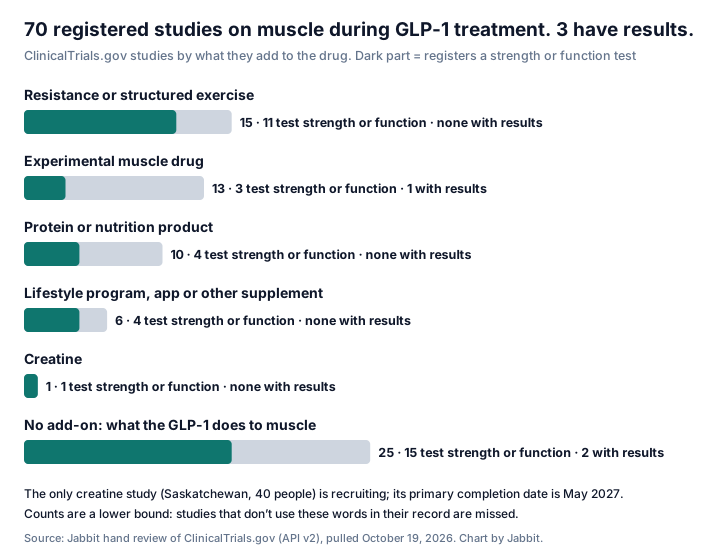
- 3 of 70 have posted results. They are BELIEVE and two pilots in people over 65 that enrolled 16 and 20 people. 54 are recruiting or haven’t started.[26]
- 38 register a strength or function test, but only 16 make it a primary outcome. Among the 13 muscle-drug studies, it is 3.[26]
- 10 enroll only people 60 or older, the group with the most to lose. That includes 6 of the 45 add-on trials.[26]
- Creatine: 1 trial, the 40-person Saskatchewan study.[26]
- Retatrutide and orforglipron: only one kept study names either drug, a Massachusetts General Hospital smartwatch-guided exercise trial open to people on several GLP-1 drugs.[26]
Every record, the excluded ones and our reasons are in the source file. These counts are a lower bound, since a study that doesn’t use these words in its record would be missed.[26]
What the evidence supports
- Expect some lean loss. About a quarter to a third of weight lost on these drugs is DXA lean mass, similar to other ways of losing a lot of weight.[4][15]
- Strength-train. The U.S. advisory says at least 3 times a week, plus 150 minutes of moderate aerobic exercise. The expert consensus says 2–3 resistance sessions. Neither target has been tested in a GLP-1 trial yet.[15][16][26]
- Get enough protein. Guideline ranges run from 0.8 g/kg up to the 1.2–1.6 g/kg proposed during active weight loss, and at least 1.0–1.2 g/kg over 65. Ask about your kidneys first if you have kidney disease.[15][16][17]
- Creatine is plausible, not proven here. It helps older adults who lift. On GLP-1 drugs the first trial isn’t done, and no GLP-1 guidance we checked recommends it.[18][26][15][16]
- Measure function, not just weight. The U.S. advisory lists checking muscle strength, function and body composition before starting. Chair stands, grip and stair climbs are what the trials use.[15][26]
- Muscle drugs: wait. None is approved, the strength benefit is untested, and one combination had serious safety problems.[1][3][5]
Strengths and limits
Strengths. The lean-share figures come from randomized, placebo-controlled groups using the same DXA method, and the effect of adding a muscle drug points the same way across four companies and three drug classes.[4][5][2][6] MRI studies measure muscle directly and include a check against population data.[12][11]
Limits. DXA lean mass is a stand-in for muscle, and creatine’s water effect makes it worse.[10][24] The MRI substudies were small or post hoc, and STEP UP had only 6 people on placebo.[11][12] Every muscle-drug trial was funded by the drug’s maker. COURAGE isn’t published yet, and QUALITY exists only as press releases.[1][6] The protein and exercise guidance is mostly expert opinion and indirect evidence.[16] And the people most at risk, older adults with low muscle, are a minority of trial participants.[26]
Bottom line
Muscle loss on Ozempic, Wegovy, Zepbound or Mounjaro is real but mostly proportional. About a quarter to a third of the weight lost is lean mass, like any big weight loss. MRI suggests the muscle that remains carries less fat.[4][12] For a middle-aged person with plenty of muscle, the trial data on strength and function are mostly reassuring. For someone over 65 or already frail, the signals on stair-climb power and fractures are reasons to plan for muscle from the start.[11][13][6][14] What the guidelines support is resistance training and adequate protein.[15][16] Creatine is a reasonable thing to ask your clinician about if you lift, but its first GLP-1 trial won’t finish until 2027.[18][26] The new muscle drugs look like they save lean mass on a scan. Nobody has shown they make people stronger, and none is approved.[5][26]
The trials that will settle this track the same things you can: dose, weeks on the drug, and how many chair stands or how much grip you have now versus when you started. Jabbit keeps a private, dated log of your shots on your iPhone so you can line those up.
Frequently asked questions
- How much muscle do you lose on Ozempic, Wegovy, Zepbound or Mounjaro?
- In trials, roughly a quarter to a third of the weight lost on these drugs was lean mass measured by a DXA scan: 28.9% to 34% in the semaglutide or tirzepatide control groups of four recent trials. That is in the same 25–40% range seen with diet and bariatric surgery. Lean mass is not the same as muscle. It also counts water, organs and bone. MRI studies that measure thigh muscle directly found smaller losses that were about what you’d expect for the amount of weight lost, and the fat inside the muscle went down.
- Does the muscle loss from GLP-1 drugs actually matter?
- It depends on how much muscle you start with. In the trials that tested it, strength and function mostly held up or improved: chair-stand counts rose in a small STEP UP substudy (drug and placebo groups pooled), and walking distance rose about 20 meters in the STEP-HFpEF heart-failure trial. The worry is older people. In one company-reported trial of people over 60, 42.6% of those on semaglutide alone lost at least 10% of their stair-climb power in 16 weeks. The Wegovy label also reports more hip and pelvis fractures in people 75 and older. Neither result shows that muscle loss was the cause.
- How much protein should I eat on a GLP-1?
- Guidance varies, and none of it comes from trials in GLP-1 users. A 2025 advisory from four U.S. nutrition and obesity societies cites the general RDA of 0.8 g per kg of body weight a day. It says targets of 1.2–1.6 g/kg have been proposed during active weight loss, that using actual body weight in people with obesity can overestimate needs, and that an absolute 80–120 g a day is an alternative. It also says to avoid long-term intake at or above 2 g/kg. A Nestlé-funded expert consensus suggests 1.2–1.5 g/kg of actual body weight while losing weight. For people over 65, the PROT-AGE group recommends at least 1.0–1.2 g/kg. People with kidney disease need their own advice.
- Does creatine help preserve muscle on Ozempic or Zepbound?
- Nobody knows yet. In older adults who lift weights, creatine adds about 1.4 kg of lean mass and modest strength gains on average, according to a 2017 meta-analysis of 22 trials. DXA counts the extra water creatine pulls into muscle as lean mass, and much of this research comes from creatine-industry-linked scientists. The only trial of creatine in people starting a GLP-1 drug is a 40-person University of Saskatchewan study that is still recruiting, with a primary completion date of May 2027. Neither GLP-1 nutrition guidance document we checked mentions creatine.
- What are trevogrumab, bimagrumab, apitegromab and enobosarm, and can I get them?
- They are experimental drugs meant to block muscle-loss signals (myostatin or activin) or, for enobosarm, to act on the androgen (testosterone) receptor. In company-funded phase 2 trials with semaglutide or tirzepatide, each cut the share of weight lost as lean mass, roughly from 30% to between 8% and 18%. None is approved. One combination, trevogrumab plus garetosmab, had 28.3% of people stop for side effects and two deaths in an interim readout, and Regeneron said it found no causal link to the drugs.
- Does lifting weights on a GLP-1 prevent muscle loss?
- It is what every guideline recommends, but there’s no published randomized trial testing it on these drugs. The U.S. advisory says GLP-1s should come with strength training at least three times a week plus 150 minutes of moderate aerobic exercise. We found 15 registered trials adding resistance or structured exercise to a GLP-1 drug. None has posted results yet.
References
- Regeneron Pharmaceuticals. Phase 2 COURAGE trial confirms trevogrumab prevents lean mass and muscle loss during GLP-1 receptor agonist-induced weight loss. Press release (GlobeNewswire), October 1, 2026 (presented at EASD; “in press with The Lancet”; lower-dose part, 52 weeks, DXA lean mass −7.3% semaglutide + placebo vs −5.8% trevogrumab 25 mg and −4.2% trevogrumab 75 mg; MRI fat-free thigh muscle volume −1.03 L vs −0.29 L and −0.32 L; at least one adverse event 77% on lower-dose trevogrumab vs 82% on placebo; planning a phase 2 trial in older adults with obesity and decreased muscle mass and/or strength; “not been evaluated by any regulatory authority”). https://www.globenewswire.com/news-release/2026/10/01/3373155/0/en/phase-2-courage-trial-confirms-trevogrumab-prevents-lean-mass-and-muscle-loss-during-glp-1-receptor-agonist-induced-weight-loss.html. We found no published Lancet paper as of October 19, 2026. Checked October 19, 2026.
- COURAGE abstracts, EASD 2026 Annual Meeting (Mosenzon O, Lighter J, Raya JG, Meadows J, Rosenstock J and others; first and most authors are Regeneron employees and shareholders): higher-dose part (599 people, 26 weeks) 34% of weight lost on semaglutide alone was lean mass vs 8–18% with trevogrumab ± garetosmab; lower-dose part (376 people) DXA lean −6.8% vs −4.9% and −3.4% at 26 weeks with similar weight loss (−10.3%, −11.0%, −9.7%); MRI substudy of 75 people, thigh muscle fat infiltration −0.09 vs −0.62 and −0.51 points, “Descriptive statistics … without formal hypothesis testing”; echocardiography, no adverse change in left-ventricular mass or ejection fraction at 26 weeks. Abstract text as compiled in a PDF posted online: https://waltersport.com/wp-content/uploads/2026/10/TREVOGRUMAB.pdf. Checked October 19, 2026.
- Regeneron Pharmaceuticals. Interim results from ongoing phase 2 COURAGE trial. Press release, June 2, 2025 (interim, 26 weeks; lean mass 34.5% of weight lost on semaglutide alone vs 17.0%, 16.8% and 6.6% in the combination arms; triplet semaglutide + trevogrumab + garetosmab: any adverse event 77.2% vs 64.9%, severe 10.1% vs 2.0%, serious 6.7% vs 0.7%, stopped for adverse events 28.3% vs 4.6%; two deaths in the triplet group, one of undetermined cause and one cardiac arrest, with no causal association identified by Regeneron). https://investor.regeneron.com/news-releases/news-release-details/interim-results-ongoing-phase-2-courage-trial-confirm-potential. Checked October 19, 2026.
- Heymsfield SB, Aronne LJ, Montgomery P, et al.; BELIEVE trial investigators. Bimagrumab plus semaglutide alone or in combination for the treatment of obesity: a randomized phase 2 trial. Nat Med. 2026;32(3):869-882. doi:10.1038/s41591-026-04204-0. PMID 41772149; NCT05616013 (507 adults, 48 weeks; weight −17.8 kg high-dose combination vs −14.2 kg semaglutide 2.4 mg; fat loss index 92.3% vs 71.1%; “lean mass comprising approximately 25–40% of total weight loss” with lifestyle, incretin and bariatric approaches; stopped for adverse events 14.0–21.4% on bimagrumab alone, 3.6–8.9% on semaglutide alone, up to 12.5% in combination groups, 3.6% placebo; muscle spasms, diarrhea and acne with bimagrumab; DXA only, muscle measured as part of lean mass; funded by Eli Lilly, several authors are Lilly or former Versanis employees). https://pubmed.ncbi.nlm.nih.gov/41772149/. Checked October 19, 2026.
- Pratley RE, Denham DS, Trivedi R, et al. Apitegromab for lean mass preservation during tirzepatide-induced weight loss: a randomized, double-blind, placebo-controlled phase 2 trial. Nat Med. 2026;32(7):2673-2678. doi:10.1038/s41591-026-04440-4. PMID 42260100; NCT06445075 (102 adults, 24 weeks; lean mass loss 1.6 vs 3.5 kg, difference 1.9 kg, 80% CI 1.2–2.7; lean share of weight lost 14.6% vs 30.2%; weight loss 11.2 vs 12.5 kg; exploratory physical function (handheld dynamometry, chair sit-to-stand): “no notable differences”; any adverse event 76% vs 71%, serious 1 vs 1, stopped for adverse events 4% vs 6%, one creatine phosphokinase rise after starting vigorous strength training; most authors Scholar Rock employees). https://pubmed.ncbi.nlm.nih.gov/42260100/. Checked October 19, 2026.
- Veru Inc. Veru announces positive topline data from phase 2b QUALITY clinical study. Press release, January 27, 2025 (168 adults over 60 on Wegovy, 16 weeks; median share of weight lost that was lean mass 31.9% placebo vs 9.4% enobosarm (all doses); weight loss −4.7 vs −4.4 kg; lost ≥10% stair-climb power 42.6% (20/47) vs 19.4% (19/98); enobosarm is also known as ostarine and is a selective androgen receptor modulator). https://ir.verupharma.com/news-events/press-releases/detail/225/veru-announces-positive-topline-data-from-phase-2b-quality. No peer-reviewed paper found. Checked October 19, 2026.
- Veru Inc. Veru reports positive safety results from phase 2b QUALITY study. Press release, May 28, 2025 (n=56 per arm; nausea 20% placebo, 11% enobosarm 3 mg, 14% 6 mg; ALT increased 0%, 2%, 11%; 4 serious adverse events, judged unrelated). https://ir.verupharma.com/news-events/press-releases/detail/234/veru-reports-positive-safety-results-from-phase-2b-quality. Checked October 19, 2026.
- Wilding JPH, Batterham RL, Calanna S, et al. Once-weekly semaglutide in adults with overweight or obesity (STEP 1). N Engl J Med. 2021;384(11):989-1002. doi:10.1056/NEJMoa2032183. PMID 33567185 (weight −15.3 kg vs −2.6 kg at 68 weeks; DXA in 140 participants: fat and lean mass both fell in kilograms, lean mass as a share of body weight rose). https://pubmed.ncbi.nlm.nih.gov/33567185/. Checked October 19, 2026.
- Jastreboff AM, Aronne LJ, Ahmad NN, et al. Tirzepatide once weekly for the treatment of obesity (SURMOUNT-1). N Engl J Med. 2022;387(3):205-216. doi:10.1056/NEJMoa2206038. PMID 35658024 (DXA subgroup: fat mass −33.9% vs −8.2%; fat-to-lean ratio 0.93 to 0.70 vs 0.95 to 0.88). https://pubmed.ncbi.nlm.nih.gov/35658024/. Checked October 19, 2026.
- Neeland IJ, Linge J, Birkenfeld AL. Changes in lean body mass with glucagon-like peptide-1-based therapies and mitigation strategies. Diabetes Obes Metab. 2024;26 Suppl 4:16-27. doi:10.1111/dom.15728. PMID 38937282 (lean mass reductions 40–60% of weight lost in some studies and about 15% or less in others; lean mass “includes not only muscle but also organs, bone, fluids, and water in fat tissue”; MRI-measured muscle changes “appear to be adaptive”; older age and disease severity may affect who is a suitable candidate). https://pubmed.ncbi.nlm.nih.gov/38937282/. Checked October 19, 2026.
- Hjelmesæth J, Bhat S, Garvey WT, et al. Effect of semaglutide on thigh skeletal muscle volume, fat infiltration and physical function in people with obesity: secondary analysis of STEP UP. Diabetes Obes Metab. Published online September 20, 2026. doi:10.1111/dom.71323. PMID 42764399 (55 of 1,407 participants with a valid baseline MRI, only 6 on placebo; thigh muscle volume −1.1 L vs placebo, 95% CI −2.3 to 0.1, p=0.07; muscle fat infiltration −0.92 points; 30-second sit-to-stand mean 13 at baseline and 15 at week 72 in the pooled groups; several authors are Novo Nordisk employees). https://pubmed.ncbi.nlm.nih.gov/42764399/. Checked October 19, 2026.
- Sattar N, Neeland IJ, Dahlqvist Leinhard O, et al. Tirzepatide and muscle composition changes in people with type 2 diabetes (SURPASS-3 MRI): a post-hoc analysis. Lancet Diabetes Endocrinol. 2025;13(6):482-493. doi:10.1016/S2213-8587(25)00027-0. PMID 40318682 (246 people, 52 weeks; thigh muscle volume −0.64 L; difference from the UK Biobank-based expectation for the weight lost −0.04 L, p=0.22; muscle fat infiltration fell 0.42 points more than expected; funded by Eli Lilly). https://pubmed.ncbi.nlm.nih.gov/40318682/. Checked October 19, 2026.
- Kosiborod MN, Abildstrøm SZ, Borlaug BA, et al. Semaglutide in patients with heart failure with preserved ejection fraction and obesity (STEP-HFpEF). N Engl J Med. 2023;389(12):1069-1084. doi:10.1056/NEJMoa2306963. PMID 37622681 (529 patients; 6-minute walk distance +21.5 m vs +1.2 m, difference 20.3 m, 95% CI 8.6–32.1). https://pubmed.ncbi.nlm.nih.gov/37622681/. Checked October 19, 2026.
- Wegovy (semaglutide) prescribing information, DailyMed set ee06186f-2aa3-4990-a760-757579d8f77b, version 19, effective June 18, 2026: section 12.2 (“lowers body weight with greater fat mass loss than lean mass loss”); section 6.1 (in the cardiovascular outcomes trial, hip and pelvis fractures 2.4% (17/703) vs 0.6% (4/663) in patients 75 and older, and 1% vs 0.2% in women). https://dailymed.nlm.nih.gov/dailymed/drugInfo.cfm?setid=ee06186f-2aa3-4990-a760-757579d8f77b. Checked October 19, 2026.
- Mozaffarian D, Agarwal M, Aggarwal M, et al. Nutritional priorities to support GLP-1 therapy for obesity: a joint Advisory from the American College of Lifestyle Medicine, the American Society for Nutrition, the Obesity Medicine Association, and The Obesity Society. Am J Clin Nutr. 2025;122(1):344-367. doi:10.1016/j.ajcnut.2025.04.023. PMID 40450457 (protein RDA 0.8 g/kg/d; “Higher targets, such as 1.2–1.6 g/kg/d, have also been proposed during active weight reduction”; for people with obesity “it is unclear” whether to base targets on actual, adjusted or ideal weight, or fat-free mass, “as the use of actual weight can significantly overestimate protein requirements”; or an absolute 80–120 g/d; avoid prolonged intake at or above 2 g/kg/d; GLP-1s “should be prescribed together with a structured exercise program, aiming for regular strength training at least 3 times weekly plus at least 150 min of moderate-intensity aerobic exercise weekly”; lean losses similar to bariatric surgery and very-low-calorie diets; modeling suggests muscle is 10–15% of weight lost in women and 20–25% in men without strength training; no mention of creatine; NIH-funded). https://pubmed.ncbi.nlm.nih.gov/40450457/. Checked October 19, 2026.
- Sievenpiper JL, Ard J, Blüher M, et al. Nutritional and lifestyle supportive care recommendations for management of obesity with GLP-1-based therapies: an expert consensus statement using a modified Delphi approach. Obes Pillars. 2026;17:100228. doi:10.1016/j.obpill.2025.100228. PMID 41502845 (52 statements, “primarily derived from indirect evidence”; “A high protein intake alone does not increase muscle mass”; resistance training at moderate-to-high intensity advised to preserve lean mass; 150 minutes aerobic plus 2–3 resistance sessions a week; protein 1.2–1.5 g/kg actual body weight per day during weight loss (expert opinion); at least 0.8 g/kg in maintenance; no mention of creatine; project management and medical writing funded by Nestlé Health Science). https://pubmed.ncbi.nlm.nih.gov/41502845/. Checked October 19, 2026.
- Bauer J, Biolo G, Cederholm T, et al. Evidence-based recommendations for optimal dietary protein intake in older people: a position paper from the PROT-AGE Study Group. J Am Med Dir Assoc. 2013;14(8):542-559. doi:10.1016/j.jamda.2013.05.021. PMID 23867520 (over 65: at least 1.0–1.2 g/kg/d; at least 1.2 g/kg/d if exercising; 1.2–1.5 g/kg/d with acute or chronic disease; exception for severe kidney disease, eGFR under 30, not on dialysis). https://pubmed.ncbi.nlm.nih.gov/23867520/. Checked October 19, 2026.
- Chilibeck PD, Kaviani M, Candow DG, Zello GA. Effect of creatine supplementation during resistance training on lean tissue mass and muscular strength in older adults: a meta-analysis. Open Access J Sports Med. 2017;8:213-226. doi:10.2147/OAJSM.S123529. PMID 29138605 (22 randomized trials, 721 people, mean age 57–70, resistance training 2–3 days a week for 7–52 weeks; lean tissue +1.37 kg, 95% CI 0.97–1.76; chest press SMD 0.35; leg press SMD 0.24; authors report no conflicts). https://pubmed.ncbi.nlm.nih.gov/29138605/. Checked October 19, 2026.
- Devries MC, Phillips SM. Creatine supplementation during resistance training in older adults: a meta-analysis. Med Sci Sports Exerc. 2014;46(6):1194-1203. doi:10.1249/MSS.0000000000000220. PMID 24576864 (357 older adults, about 12.6 weeks of training; more fat-free mass, chest and leg press 1RM and 30-second chair stand than training alone; no difference in knee extension or isokinetic torque). https://pubmed.ncbi.nlm.nih.gov/24576864/. Checked October 19, 2026.
- Forbes SC, Candow DG, Ostojic SM, Roberts MD, Chilibeck PD. Meta-analysis examining the importance of creatine ingestion strategies on lean tissue mass and strength in older adults. Nutrients. 2021;13(6):1912. doi:10.3390/nu13061912. PMID 34199420 (without loading-phase studies, no greater chest or leg press gain vs placebo; several authors disclose creatine-industry ties, including AlzChem advisory boards). https://pubmed.ncbi.nlm.nih.gov/34199420/. Checked October 19, 2026.
- Naddafha S, Antonio J, Kreider RB, Stout JR. Creatine monohydrate for lean mass, strength, and bone density in postmenopausal women: a systematic review and meta-analysis. J Int Soc Sports Nutr. 2026;23(1):2668435. doi:10.1080/15502783.2026.2668435. PMID 42141930 (7 trials, 608 women; lean mass +0.37 kg, 95% CI 0.05–0.69; leg press +7.5 kg; benefits when at least 5 g/day was combined with resistance training, no measurable effect at 3 g/day or less without training; bone density unchanged; Alzchem supported the article fee). https://pubmed.ncbi.nlm.nih.gov/42141930/. Checked October 19, 2026.
- Chun J, Liu Y, Kibler GL, et al. Effects of creatine supplementation with and without exercise and diet intervention on body composition, cognitive function, and markers of health in middle-aged and older adults. J Int Soc Sports Nutr. 2026;23(sup1):2716273. doi:10.1080/15502783.2026.2716273. PMID 42578920 (64 completers aged 45–65, 13–20 per group; exercise and diet chosen by participants, supplement randomized; 10 g/day; lean tissue +1.1 kg, 95% CI 0.2–2.0, at 12 weeks without exercise; +1.27 kg, 0.56–1.98, with exercise and diet; funded by a WoodNext Foundation gift, creatine supplied by Alzchem; senior author Kreider chairs Alzchem’s scientific advisory board). https://pubmed.ncbi.nlm.nih.gov/42578920/. Checked October 19, 2026.
- Texas A&M University. Study finds creatine’s benefits extend beyond the gym. Texas A&M Stories, September 18, 2026; picked up by ScienceDaily, September 28, 2026 (“Creatine may help build muscle even without exercise, researchers find”). https://stories.tamu.edu/news/2026/09/18/study-finds-creatines-benefits-extend-beyond-the-gym/; https://www.sciencedaily.com/releases/2026/09/260928100547.htm. Checked October 19, 2026.
- Kreider RB, Kalman DS, Antonio J, et al. International Society of Sports Nutrition position stand: safety and efficacy of creatine supplementation in exercise, sport, and medicine. J Int Soc Sports Nutr. 2017;14:18. doi:10.1186/s12970-017-0173-z. PMID 28615996 (“creatine loading promoted a short-term fluid retention (e.g., about 0.5 – 1.0 L) that was generally proportional to the acute weight gain”; weight gain is “the only consistently reported side effect”). https://pubmed.ncbi.nlm.nih.gov/28615996/. Checked October 19, 2026.
- Jabbit count of English posts on X (no reposts) pairing Ozempic, Wegovy, Zepbound, Mounjaro, semaglutide, tirzepatide or GLP-1 with “muscle loss,” “lean mass,” “muscle mass” or sarcopenia: 13 to 29 a day, October 13–18 (UTC days), and 27 on October 19 through about 4:15 PM ET, via the X API recent-counts endpoint. Checked October 19, 2026.
- Jabbit review of ClinicalTrials.gov (API v2), pulled October 19, 2026, about 4:07 PM ET: 2,751 unique studies listing semaglutide, tirzepatide, retatrutide, orforglipron or liraglutide, or matching GLP-1 drug names plus muscle, sarcopenia, resistance-training, protein, creatine, muscle-drug or physical-function terms; 605 keyword hits read by hand; 70 kept: 13 muscle-drug add-ons, 15 exercise, 10 protein or nutrition, 1 creatine, 6 other add-ons and 25 with no add-on. 3 have posted results (NCT05616013, NCT05302596, NCT05786521); 38 register a strength or physical-function test; 10 enroll only people 60 or older; 54 are recruiting or not yet recruiting. Lower bound; method, every study and reasons for exclusions: https://jabbitapp.com/research/sources/glp1-muscle-ctgov-2026-10-19.json. Checked October 19, 2026.
This page analyzes published trials, conference abstracts, company press releases, guidance documents, a drug label and trial-registry records. It is not medical advice. It does not recommend any diet, supplement, dose or drug; talk to your prescriber, especially if you are older, have kidney disease or take other medicines. The registry review is Jabbit’s own; its inputs are cited above.