Evidence review · testosterone cypionate, enanthate and undecanoate, AndroGel and other gels · TRAVERSE, T Trials, FDA label changes, DailyMed label check · Sources checked October 19, 2026
Published · Updated
Is testosterone therapy (TRT) a “wonder drug” for men over 40? In the biggest trials it helped sex drive, anemia and mood a little, did little for energy or strength, and came with more fractures and heart-rhythm problems.
An X post on Sunday saying Reacher star Alan Ritchson calls testosterone a “wonder drug” for men in their 40s passed 640,000 views, and X turned it into a trending story.[1][2] The two biggest placebo-controlled trials give a narrower picture. Testosterone improved sex drive and anemia, and mood a little. It did little for energy, strength or memory. It did not raise heart attacks or strokes, but fractures, atrial fibrillation, kidney injury and lung clots were more common.[6][7][11][13] In June, FDA asked makers to stop saying it is unproven for age-related low testosterone. Our check of DailyMed found that 14 of the 15 labels published since then still say it.[18][21]
Why this matters now
The viral post went up on October 18, and by the afternoon of October 19 it had 644,301 views and 1,174 bookmarks.[1] Its quotes echo what Ritchson told Men’s Health and GQ in 2023 and 2025. He said he had essentially no testosterone left after season one, that testosterone helps him avoid “surgery after every season,” and that he’s “a big advocate” for men in their forties.[4][5] English posts about testosterone on X run at about 2,700 to 3,300 a day.[3] Meanwhile the rules are moving. FDA held an expert panel on testosterone for men in December 2025, and in June 2026 it asked for a second major label change.[19][18] On October 15, three of the field’s best-known researchers, including Shalender Bhasin, an author of TRAVERSE and lead author of the Endocrine Society guideline, published a JAMA commentary on what the changes do and don’t settle.[20]
The short answer
- If your testosterone is truly low, it treats some symptoms. Sex drive and sexual function improved most clearly, and anemia corrected more often.[11][10]
- It isn’t much of an energy or strength drug at normal doses. In men 65 and older, a year of gel didn’t move a standard fatigue scale or walking in the men enrolled for it, and it didn’t help memory.[11][13] TRAVERSE found small gains in mood and energy.[9]
- The heart news is good, but it isn’t the whole safety picture. Heart attack and stroke didn’t rise. Atrial fibrillation, kidney injury, lung clots and fractures did.[6][8][7]
- It can shut down sperm production. Men who want children soon shouldn’t start it without a plan.[15][16]
- The diagnosis matters. Guidelines call for symptoms plus two low fasting morning tests and a look for the cause.[16]
What the trials found
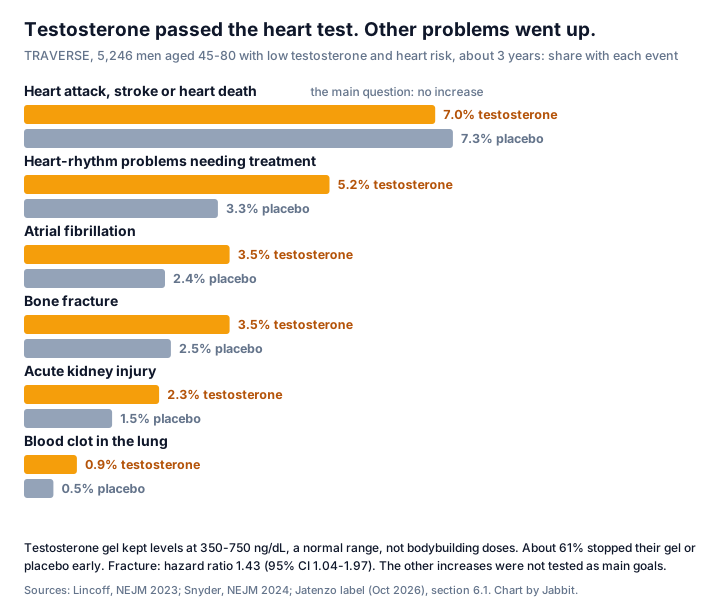
TRAVERSE is the largest testosterone trial ever run. It enrolled 5,246 men aged 45 to 80 with heart disease or high heart risk, symptoms of low testosterone and two fasting levels under 300 ng/dL. They used a daily testosterone gel, dosed to keep levels between 350 and 750 ng/dL, or a placebo gel, for an average of 22 months.[6] FDA called for it after reports of strokes, heart attacks and deaths in men on testosterone. On its main question, testosterone passed: heart attack, stroke or heart death in 7.0% vs 7.3%.[6][17] About 61% of men stopped their gel or placebo before the end, which makes small differences harder to detect.[8]
The T Trials asked the efficacy question. 790 men aged 65 and older with testosterone under 275 ng/dL and symptoms used gel or placebo for a year. Testosterone raised levels to the mid-normal range for men aged 19 to 40.[11] It improved sexual activity, desire and erections. It did not significantly improve vitality on the fatigue scale, and it did not improve walking distance in the men enrolled for physical function. Mood and depressive symptoms improved slightly.[11] A 2026 review of both trials by Brigham and Women’s endocrinologists sums it up: better sexual function and mood, “but not physical function, vitality, or cognitive function.”[13]
| Outcome | What testosterone did vs placebo | Trial |
|---|---|---|
| Sex drive and erections | Helped, moderately | T Trials (790 men 65+)[11][13] |
| Mood | Helped a little | T Trials; TRAVERSE across 5,204 men[11][9] |
| Energy and fatigue | Mixed: no change in the T Trials, a small gain in TRAVERSE | T Trials; TRAVERSE[11][9] |
| Walking and physical function | No clear benefit | T Trials physical-function trial[11][13] |
| Memory and thinking | No benefit | T Trials; TRAVERSE[13][9] |
| Anemia | Helped: corrected more often (41% vs 28% at 6 months) | TRAVERSE anemia study[10] |
| Heart attack and stroke | No increase (7.0% vs 7.3%) | TRAVERSE[6] |
| Fractures | More, not fewer (3.5% vs 2.5%) | TRAVERSE fracture study[7] |
| Soft coronary plaque | Grew more on testosterone | T Trials heart substudy (170 men)[12] |
The safety signals the headlines skip
Coverage of TRAVERSE mostly stopped at “no heart risk.” The label for every product that prints the trial lists more. Heart-rhythm problems needing treatment were 5.2% vs 3.3%. Atrial fibrillation was 3.5% vs 2.4%, acute kidney injury 2.3% vs 1.5%, and blood clots in the lung 0.9% vs 0.5%.[8] Blood pressure rose slightly on testosterone. In men with high blood pressure, one oral product raised it by 5.4/3.2 mm Hg.[8]
Fractures are the surprise. Testosterone raises bone density, so researchers expected fewer fractures. Over a median of 3.2 years, 3.50% of men on testosterone broke a bone against 2.46% on placebo, a hazard ratio of 1.43. Every other fracture measure also leaned the wrong way.[7] The review authors call the result “unexpectedly higher.”[13] In a smaller T Trials substudy, soft coronary plaque grew more on testosterone, though no one in either group had a heart event.[12]
Checking Ritchson’s claims against the evidence
“Testosterone helps” avoid surgery after every season. No trial has tested testosterone for healing injuries or preventing them. The one trial big enough to count fractures found more of them on testosterone.[4][7]
“It could be a mood stabilizer.” Partly supported. Both big trials found mood improved slightly. In the few TRAVERSE men with a formal low-grade depressive disorder, there was no significant difference.[4][11][9]
“Especially for people in their forties or above.” The T Trials enrolled men 65 and older. TRAVERSE enrolled men 45 to 80 with heart disease or heart risk. Healthy men in their 40s with borderline levels weren’t the group tested.[4][11][6]
“I had none” after season one. He described stress, fatigue and what he had done to his body. Guidelines say to confirm a low level with repeat fasting morning tests and to look for the cause before treating.[4][16] We don’t know what his tests showed.
“Increase it a little bit” to add muscle. He says he has never taken 600 mg a week. That figure matches a classic 1996 trial in which healthy men took 600 mg of testosterone enanthate weekly and lifted weights. They gained 6.1 kg of lean mass in 10 weeks.[4][14] That is three times the 200 mg weekly dose the WHO used to stop sperm production, and far above TRAVERSE, which adjusted the gel to keep blood levels in the normal 350–750 ng/dL range.[15][6] Doses above the normal range are a different question from treating low testosterone, and the trials above don’t answer it.
Fertility: the warning younger men miss
Testosterone taken as a drug switches off the body’s signals for making sperm. In a World Health Organization trial of 271 fertile men, 200 mg of testosterone enanthate a week left 65% with no sperm within six months. That trial was testing a male contraceptive.[15] Counts usually came back after stopping, with a median of 3.7 months to reach 20 million per mL.[15] The Endocrine Society advises against starting testosterone in men planning fertility in the near term.[16]
What FDA changed, and what the labels still say
For decades testosterone products were approved, in the JAMA authors’ words, “without requiring evidence of efficacy, requiring only that they reliably raise the testosterone level into normal range for healthy young men.”[20] In February 2025, FDA had makers add TRAVERSE and drop the boxed heart-risk language, but kept the line that safety and efficacy in “age-related hypogonadism” were not established.[17] On June 18, 2026, it asked makers to remove that line too. It also asked to narrow the prostate contraindication from “known or suspected” cancer to metastatic cancer only, while noting “important uncertainties” about long-term prostate risk.[18]
We pulled every testosterone prescription label on DailyMed, the federal label database, on October 19. Of 108 label versions, 93 still carry the age-related limitation, and none has the metastatic-only prostate wording. Fifteen were published on or after June 18. Fourteen of those still carry the limitation, including the oral capsules Jatenzo (October 15) and Kyzatrex (October 8). The other uses an older injectable format that never had it. All 15 still contraindicate known or suspected prostate cancer.[21][8] So four months after the request, almost every label still reads the old way.
Strengths and limits
Strengths. TRAVERSE and the T Trials were large, randomized and placebo-controlled, with blinded gels. TRAVERSE ran for about three years and its fractures were checked against medical records.[6][7][11]
Limits. Both used gels at normal-range doses. Neither tested injections, which many men use.[6][11] TRAVERSE’s men were older and at heart risk, and most stopped treatment early.[6][8] TRAVERSE was funded by AbbVie and others.[6] Our label check counts DailyMed versions, including repackager copies, and can lag FDA’s own database.[21]
Bottom line
Is TRT a wonder drug for men over 40? Not on the trial evidence. For men with symptoms and confirmed low testosterone, it reliably helps sex drive and anemia and lifts mood a little. The heart worry that hung over it for a decade did not show up in TRAVERSE. But fractures, atrial fibrillation, kidney injury and clots did tick up, and it can shut down sperm production.[11][10][6][7][15] It isn’t a proven fix for energy, strength or injury recovery at normal doses.[13] If you start it, the useful records are your doses and your bloodwork: testosterone, hematocrit and PSA on a schedule.[16]
Weekly or every-other-week injections are easy to drift on. Jabbit keeps a private dated log of each dose and injection site on your iPhone.
Frequently asked questions
- Is TRT safe for your heart?
- In the largest trial, TRAVERSE, 5,246 men aged 45 to 80 with heart disease or high heart risk used testosterone gel or a placebo gel for about two years. Heart attack, stroke or heart death happened in 7.0% vs 7.3%, so testosterone did not raise that risk. The same trial found more atrial fibrillation (3.5% vs 2.4%), heart-rhythm problems needing treatment (5.2% vs 3.3%), acute kidney injury (2.3% vs 1.5%) and blood clots in the lung (0.9% vs 0.5%). Testosterone labels also warn that it can raise blood pressure.
- Does TRT give you more energy?
- Not much, in the trials. In the T Trials, a year of testosterone gel in men 65 and older had no significant effect on a standard fatigue scale. In TRAVERSE, men on testosterone reported small but statistically significant gains in mood and energy. The clearest benefits in both trials were sex drive and sexual function, and correcting mild anemia.
- Does TRT make bones stronger or prevent injuries?
- It raises bone density, but in TRAVERSE, the only trial big enough to count fractures, men on testosterone had more fractures, not fewer: 3.50% vs 2.46% over about three years (hazard ratio 1.43). No trial has tested whether testosterone helps an athlete or actor avoid surgery or heal injuries faster.
- Can you take testosterone if you want kids?
- Taking testosterone switches off your own sperm production. In a World Health Organization study, 200 mg of testosterone enanthate a week made 65% of healthy men sperm-free within six months, which is why it was tested as a male contraceptive. Sperm usually came back within months of stopping. The Endocrine Society advises against starting testosterone in men planning to have children soon.
- What did FDA change about testosterone labels in 2026?
- On June 18, 2026, FDA asked makers to remove the line saying safety and effectiveness in men with age-related low testosterone have not been established, and to narrow the prostate warning so testosterone is contraindicated only in metastatic prostate cancer. In 2025 it had already removed the boxed heart-risk language and added blood-pressure warnings. When we checked DailyMed on October 19, none of the 15 testosterone labels published since June 18 had the new prostate wording, and 14 still carried the age-related limitation.
- How is low testosterone diagnosed?
- The Endocrine Society guideline says to diagnose it only when a man has symptoms and consistently low levels. That means a fasting morning total testosterone test, repeated on another day to confirm, plus a search for the cause. TRAVERSE required two fasting levels under 300 ng/dL. Under these guidelines a single test, or one taken later in the day or after eating, isn’t enough.
References
- @TsureX1 on X, October 18, 2026, 7:27 AM ET: “Alan Ritchson calls testosterone therapy a ‘wonder drug’ for men entering their 40s …” (644,301 views, 2,004 likes, 1,174 bookmarks when checked about 2:05 PM ET Oct 19). https://x.com/TsureX1/status/2111781126494630372. Checked October 19, 2026.
- X trending story, “Alan Ritchson Calls TRT a Wonder Drug for Men’s Vitality,” updated October 19, 2026 (a summary of posts on X). https://x.com/i/trending/2112029188773568723. Checked October 19, 2026.
- Jabbit count of English posts on X mentioning testosterone, testosterone therapy or TRT use (no reposts; “TRT World” news excluded): 2,749 to 3,255 a day, October 13–18, 2026 (UTC days), via the X API recent-counts endpoint. Checked October 19, 2026.
- Men’s Health. ‘Reacher’ star Alan Ritchson on how testosterone therapy helped him get season 2 ready. December 20, 2023 (quotes: “I had none by the time I was done with season one, due to the stress and the fatigue and what I had done to my body”; “I don’t want to have to have surgery after every season, and testosterone helps”; “I’m a big advocate of it, especially for people in their forties or above … It could be a mood stabilizer”; “If you increase it a little bit, which I have, you can start to put on muscle mass. I’ve never taken, like, 600 milligrams a week”). https://www.menshealth.com/fitness/a46189803/alan-ritchson-jack-reacher-testosterone-therapy/. Checked October 19, 2026.
- GQ. Can Reacher’s Alan Ritchson get any bigger? February 2025 (“I got on TRT a month after we wrapped season one, and I did notice that it made maintaining those gains much, much easier. But I got there on my own”). https://www.gq.com/story/alan-ritchson-gq-hype. Checked October 19, 2026.
- Lincoff AM, Bhasin S, Flevaris P, et al.; TRAVERSE Study Investigators. Cardiovascular safety of testosterone-replacement therapy. N Engl J Med. 2023;389(2):107-117. doi:10.1056/NEJMoa2215025. PMID 37326322; NCT03518034 (5,246 men aged 45–80 with heart disease or high heart risk, hypogonadal symptoms and two fasting testosterone levels under 300 ng/dL; 1.62% gel dosed to 350–750 ng/dL vs placebo gel; mean treatment 21.7 months, follow-up 33.0 months; heart attack, stroke or cardiovascular death 7.0% vs 7.3%, HR 0.96, 95% CI 0.78–1.17; “higher incidence of atrial fibrillation, of acute kidney injury, and of pulmonary embolism”; funded by AbbVie and others). https://pubmed.ncbi.nlm.nih.gov/37326322/. Checked October 19, 2026.
- Snyder PJ, Bauer DC, Ellenberg SS, et al. Testosterone treatment and fractures in men with hypogonadism. N Engl J Med. 2024;390(3):203-211. doi:10.1056/NEJMoa2308836. PMID 38231621 (TRAVERSE subtrial, 5,204 men, median 3.19 years; clinical fracture 91 (3.50%) vs 64 (2.46%), HR 1.43, 95% CI 1.04–1.97; “fracture incidence also appeared to be higher in the testosterone group for all other fracture end points”). https://pubmed.ncbi.nlm.nih.gov/38231621/. Checked October 19, 2026.
- Jatenzo (testosterone undecanoate) prescribing information, DailyMed set ed7b5d41-7475-4c10-99b9-b62b3434ae60, published October 15, 2026: limitation of use (“Safety and efficacy of JATENZO in men with ‘age-related hypogonadism’ have not been established”); TRAVERSE in section 6.1 (about 61% stopped gel or placebo; nonfatal arrhythmias warranting intervention 5.2% vs 3.3%, atrial fibrillation 3.5% vs 2.4%, acute kidney injury 2.3% vs 1.5%, bone fracture 3.5% vs 2.5%) and section 5 (VTE 1.7% vs 1.2%, pulmonary embolism 0.9% vs 0.5%; mean systolic blood pressure +1.0 vs −0.5 mm Hg at 36 months). https://dailymed.nlm.nih.gov/dailymed/drugInfo.cfm?setid=ed7b5d41-7475-4c10-99b9-b62b3434ae60. Checked October 19, 2026.
- Bhasin S, Seidman S, Travison TG, et al. Depressive syndromes in men with hypogonadism in the TRAVERSE trial: response to testosterone-replacement therapy. J Clin Endocrinol Metab. 2024;109(7):1814-1826. doi:10.1210/clinem/dgae026. PMID 38205962 (only 49 of 5,204 met criteria for late-life low-grade persistent depressive disorder, with no significant difference in that group; across all men, “modest but significantly greater improvements in mood and energy but not cognition or sleep quality”). https://pubmed.ncbi.nlm.nih.gov/38205962/. Checked October 19, 2026.
- Pencina KM, Travison TG, Artz AS, et al. Efficacy of testosterone replacement therapy in correcting anemia in men with hypogonadism: a randomized clinical trial. JAMA Netw Open. 2023;6(10):e2340030. doi:10.1001/jamanetworkopen.2023.40030. PMID 37889486 (TRAVERSE; anemia corrected at 6 months in 41.0% vs 27.5%, at 12 months 45.0% vs 33.9%). https://pubmed.ncbi.nlm.nih.gov/37889486/. Checked October 19, 2026.
- Snyder PJ, Bhasin S, Cunningham GR, et al.; Testosterone Trials Investigators. Effects of testosterone treatment in older men. N Engl J Med. 2016;374(7):611-624. doi:10.1056/NEJMoa1506119. PMID 26886521; NCT00799617 (790 men 65 and older, testosterone under 275 ng/dL, 1 year of gel vs placebo; improved sexual activity, desire and erectile function; “no significant benefit with respect to vitality”; 6-minute walk gain of at least 50 m not different in the physical-function trial; slightly better mood; NIH and others). https://pubmed.ncbi.nlm.nih.gov/26886521/. Checked October 19, 2026.
- Budoff MJ, Ellenberg SS, Lewis CE, et al. Testosterone treatment and coronary artery plaque volume in older men with low testosterone. JAMA. 2017;317(7):708-716. doi:10.1001/jama.2016.21043. PMID 28241355 (170 T Trials men; noncalcified plaque volume rose more on testosterone, estimated difference 41 mm³, 95% CI 14–67; no heart events in either group). https://pubmed.ncbi.nlm.nih.gov/28241355/. Checked October 19, 2026.
- Braga M, Basaria S. Key findings on the efficacy and safety of testosterone therapy from two large randomized trials. J Clin Endocrinol Metab. Published online September 26, 2026. doi:10.1210/clinem/dgag397. PMID 42800050 (T Trials and TRAVERSE: improved sexual function and mood “but not physical function, vitality, or cognitive function”; fracture rates “unexpectedly higher”). https://pubmed.ncbi.nlm.nih.gov/42800050/. Checked October 19, 2026.
- Bhasin S, Storer TW, Berman N, et al. The effects of supraphysiologic doses of testosterone on muscle size and strength in normal men. N Engl J Med. 1996;335(1):1-7. doi:10.1056/NEJM199607043350101. PMID 8637535 (43 men, 600 mg testosterone enanthate weekly or placebo for 10 weeks, with or without lifting; testosterone plus lifting gained 6.1 kg fat-free mass). https://pubmed.ncbi.nlm.nih.gov/8637535/. Checked October 19, 2026.
- World Health Organization Task Force on Methods for the Regulation of Male Fertility. Contraceptive efficacy of testosterone-induced azoospermia in normal men. Lancet. 1990;336(8721):955-959. PMID 1977002 (271 fertile men, 200 mg testosterone enanthate weekly; 65% had no sperm by 6 months, mean 120 days; median 3.7 months to recover a sperm count of 20 million/mL after stopping). https://pubmed.ncbi.nlm.nih.gov/1977002/. Checked October 19, 2026.
- Bhasin S, Brito JP, Cunningham GR, et al. Testosterone therapy in men with hypogonadism: an Endocrine Society clinical practice guideline. J Clin Endocrinol Metab. 2018;103(5):1715-1744. doi:10.1210/jc.2018-00229. PMID 29562364 (diagnose only with symptoms plus “unequivocally and consistently low” levels; fasting morning total testosterone, repeated to confirm; look for the cause; don’t start in men planning fertility soon or with elevated hematocrit, untreated severe sleep apnea and other conditions; aim for mid-normal levels; monitor testosterone, hematocrit and prostate risk). https://pubmed.ncbi.nlm.nih.gov/29562364/. Checked October 19, 2026.
- U.S. Food and Drug Administration. FDA issues class-wide labeling changes for testosterone products. February 28, 2025 (add TRAVERSE results; remove boxed-warning language on cardiovascular outcomes; keep the age-related hypogonadism limitation of use; add or update blood-pressure warnings). https://www.fda.gov/drugs/drug-alerts-and-statements/fda-issues-class-wide-labeling-changes-testosterone-products. Checked October 19, 2026.
- U.S. Department of Health and Human Services. HHS announces requested updates to testosterone therapy product labels. News release, June 18, 2026 (requests removing the limitation of use for age-related hypogonadism; contraindication only in men with metastatic prostate cancer; “important uncertainties remain because prostate cancer can take years to develop”; continued screening and monitoring). https://www.hhs.gov/press-room/fda-requests-updates-testosterone-therapy-labeling.html. Checked October 19, 2026.
- U.S. Food and Drug Administration. FDA Expert Panel on Testosterone Replacement Therapy for Men, December 10, 2025 (panel list and docket FDA-2025-N-6743). https://www.fda.gov/patients/fda-expert-panels/fda-expert-panel-testosterone-replacement-therapy-men-12102025. Checked October 19, 2026.
- Bhasin S, Auchus RJ, Matsumoto AM. FDA’s testosterone label changes: implications and unresolved issues. JAMA. Published online October 15, 2026 (opening: the two updates are “the most substantial revisions to the label in more than 70 years”; testosterone predates the 1962 efficacy rules, so FDA approved new products “without requiring evidence of efficacy, requiring only that they reliably raise the testosterone level into normal range for healthy young men”). https://jamanetwork.com/journals/jama/article-abstract/2855379. Checked October 19, 2026.
- Jabbit scan of DailyMed (U.S. National Library of Medicine), pulled October 19, 2026, about 2:05 PM ET: 160 listings for testosterone; 108 prescription label versions kept (homeopathic and veterinary excluded; repackager copies counted separately); 93 still state that safety and efficacy in “age-related hypogonadism” have not been established; 0 limit the prostate contraindication to metastatic cancer; 15 were published on or after June 18, 2026, and 14 of those still carry the limitation (the other uses the older injectable format that never had it), while all 15 still contraindicate known or suspected prostate cancer. Data: testosterone-labels-dailymed-2026-10-19.json.
This page analyzes published trials, a clinical guideline, FDA and HHS statements, drug labels, interviews and posts on X. It is not medical advice and does not recommend starting, stopping or changing testosterone or any other medicine; talk with your prescriber. The label scan is Jabbit’s own; its inputs are cited above.