Home / Research / TB-500 teardown
Paper-trail teardown · FDA review, trial registries and original papers read · Sources checked October 16, 2026
Is TB-500 the same as thymosin beta-4, your body’s healing protein? No. It’s a 7-amino-acid piece that has never been tested in people.
No. TB-500 is a lab-made copy of 7 of thymosin beta-4’s 43 amino acids, with an acetyl group added, and FDA found no record of it ever being given to a person.[1][2] Nearly every human trial you’ll see cited used the full protein, mostly as eye drops and skin gels, and the two biggest of those missed their main goals.[12][13] The only registered TB-500 trial we found describes itself as “fictional.”[20]
Why this matters this week
On October 14, 2026 FDA sent an “Interim Access Policy for Compounding Using Certain Peptides” to the White House. Its text isn’t public.[22] News reports say it is meant to open a legal pharmacy route for popular peptides.[27] TB-500 is one of the six that FDA’s advisory committee backed in July, against the advice of FDA’s own reviewers.[23][1] Posts about TB-500 on X went from about 70 a day on October 10–11 to 100–117 a day on October 12–15.[24] The confusion is right there in the posts. One vendor advertised on October 16 that it uses “TB-4 in all products. Not TB500. There is a difference.” Others use the two names as if they were the same thing.[24][1] So we traced both back to where they came from.
Why we say that
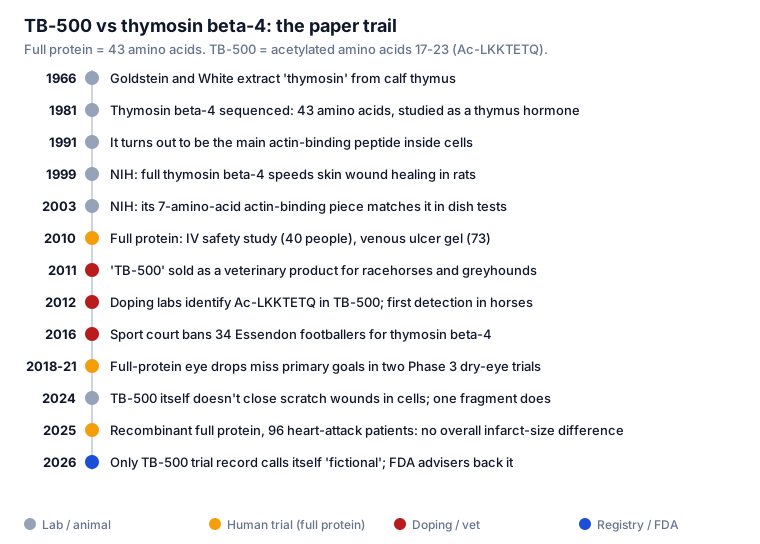
Thymosin beta-4 is real, it’s in you, and it has a long history. In 1966 Allan Goldstein and colleagues extracted a mix of peptides from calf thymus that they called “thymosin.”[4] In 1981 Goldstein’s group sequenced one of them, thymosin beta-4: 43 amino acids, which they described as a thymus hormone that helps immune cells mature.[5] Ten years later a Pennsylvania team showed it was something more basic. It is the main protein that holds actin, the cell’s scaffolding, in reserve, and it is found in many cell types, not just the thymus.[6] In 1999 an NIH team, with Goldstein as a co-author, reported that the full protein sped up skin wound healing in rats, with 42% to 61% more new skin cover than saline.[7] A 2004 Nature paper found it helped mouse hearts recover after a heart attack.[9]
TB-500 branches off in 2003. NIH researchers found that a seven-amino-acid stretch of thymosin beta-4, LKKTETQ (positions 17 to 23), was the part that binds actin. In cell and chick-artery tests it was about as active as the whole protein at promoting blood-vessel growth.[8] FDA’s reviewers date TB-500’s first synthesis to that paper. They say a veterinary product called TB-500 appeared in 2011, marketed to boost performance in racehorses and greyhounds.[1] In 2012 doping labs in Belgium and Hong Kong worked out what was in it: the 17–23 piece with an artificial acetyl group added to one end (Ac-LKKTETQ). The Hong Kong Jockey Club lab then detected it in horses for the first time.[2][3]
So when a product page calls TB-500 “synthetic thymosin beta-4,” that’s wrong. FDA’s reviewers say so directly: “thymosin beta-4 and TB-500 are not the same substance.”[1] The full protein has the human trials. TB-500 has the marketing.
The human trials are of the full protein, and they mostly came up short
Every controlled human trial we found tested full-length thymosin beta-4. In a safety study, 40 healthy volunteers got it intravenously at up to 1,260 mg a day for 14 days with no dose-limiting side effects.[10] In 73 people with venous leg ulcers, a skin gel looked safe and possibly helped at one dose.[11]
Then came the bigger tests, as eye drops for dry eye. In ARISE-2, with 601 people, the posted averages on both main measures were no better than placebo.[12] In ARISE-3, with 700 people, they were nearly identical: corneal staining improved by 0.41 points on the drops and 0.46 on placebo, and discomfort by 0.4 on both.[13] The company said ARISE-3 “did not meet its primary outcome measures” and pointed to an improvement in grittiness, a secondary measure.[13] An earlier 72-person dry-eye trial had also missed both of its primary endpoints.[26] For a rare corneal condition, a placebo-controlled trial was stopped at 18 people for a “business decision”; 6 of 10 healed on the drops versus 1 of 8 on placebo, which wasn’t statistically significant.[14]
The newest result is in hearts. A Chinese company’s recombinant version was tested in 96 heart-attack patients after stenting. Overall, infarct size didn’t differ from placebo at 90 days. It was smaller in the 43 people who got their first dose within 8 hours, a subgroup finding the authors say needs confirming.[15] A 189-person follow-up trial is registered but not yet recruiting.[25]
TB-500 itself has one listed trial, and it calls itself fictional
We searched ClinicalTrials.gov for TB-500 and found one record: “TBRIDGE-CV,” an 80-person Phase 1/2 in people with heart disease, listed as recruiting in Shenzhen since February 2026. Its summary opens: “This fictional study is an example of a ClinicalTrials.gov-style record.”[20] Its sponsor, “Hudson Biotech,” has seven other records at the same hospital with the same contact address. They cover BPC-157, MOTS-c, GHK-Cu, melanotan II and tesamorelin, plus tirzepatide and retatrutide. The tesamorelin one is titled “(Mock Study)” and the melanotan one calls itself an “example.” The tirzepatide and retatrutide records copy, word for word, the official titles of Eli Lilly’s finished trials; the tirzepatide copy even lists SURMOUNT-1’s 2,539 participants.[21] We think these are test or template entries, not real studies. We had cited the BPC-157 listing in our own BPC-157 teardown and have corrected it.
That leaves TB-500 where FDA found it: “no articles were found in which TB-500 was administered to humans.”[1]
What TB-500 has going for it
The biology it borrows from is solid. Thymosin beta-4’s role in holding actin is textbook cell biology, and the actin-binding stretch that TB-500 copies matched the whole protein in dish and chick-artery tests.[6][8] In the newest independent animal study, from Istanbul in 2026, TB-500 made repaired rat Achilles tendons stronger and better organized after four weeks. BPC-157 didn’t reach significance in the same study, and the combination did no better than either one alone.[17] The full protein has a reassuring safety record in people: in the two big eye-drop trials, serious adverse events were 3 of 299 on the drops versus 2 of 302 on placebo, and 0 versus 0 out of about 350 each.[12][13] High intravenous doses didn’t cause dose-limiting toxicity.[10]
The catch is that none of that was TB-500. And the cell test that did use TB-500 found something odd. A Korean doping-control lab found TB-500 itself didn’t close scratch wounds in fibroblast cultures, while one of its breakdown products, Ac-LKKTE, did a little. In rats it broke down mainly into Ac-LK within hours.[16] When FDA reviewed it, the agency found no animal study testing TB-500 for wound healing; the Istanbul tendon study came out afterward.[1][17]
Side effects and safety
For TB-500 specifically, FDA found nothing to go on. There were no acute or repeat-dose toxicity studies, no genotoxicity, reproductive or cancer studies, and no human safety data by any route. Its adverse-event database had no TB-500 reports through March 2025, which mostly reflects that nobody reports them.[1] FDA’s main worry is the immune system. Injected peptides can trigger antibodies, and impurities or clumping can make that more likely. FDA wrote that the consequences can range from nothing noticeable to “life-threatening and catastrophic reactions.”[1]
What’s in the vial is its own question. A French racing laboratory that tested products sold online as TB500 and TB1000 found their contents were “not systematically consistent” with how they had been described.[18] And because TB-500 is promoted for growing new blood vessels, the same process tumors rely on, the lack of any cancer study matters.[8][1] No one has shown it causes harm. No one has looked.
It’s also banned in sport. In 2016 the Court of Arbitration for Sport banned 34 current and former Essendon Australian-rules footballers over injections of thymosin beta-4, the full protein, given in a 2012 club supplement program.[19] FDA notes that TB-500 is on the World Anti-Doping Agency’s prohibited list.[1]
Where it stands now
TB-500 isn’t an approved drug anywhere FDA checked, including the US, Canada, the UK, Australia and the EU.[1] FDA’s reviewers recommended against putting it on the compounding list, the committee voted for it anyway, and the interim policy that may follow is still under White House review.[1][23][22] For the regulatory details, see our FDA peptide policy explainer.
Bottom line: thymosin beta-4 is a real, well-studied human protein whose drug trials have mostly disappointed. TB-500 is a modified fragment of it that took off as a racehorse product, has never been tested in a person, and whose only trial listing calls itself fictional.[1][3][12][13][20] If you see the two names used interchangeably, the seller is either confused or hoping you are.
References
- U.S. Food and Drug Administration. Pharmacy Compounding Advisory Committee briefing document: TB-500-related bulk drug substances (TB-500 free base and TB-500 acetate). July 2026. Sections on history of use (first synthesis 2003; veterinary product 2011), effectiveness, nonclinical studies, FAERS search, immunogenicity, and FDA’s recommendation. https://www.fda.gov/media/193349/download. Checked October 16, 2026.
- Esposito S, Deventer K, Goeman J, Van der Eycken J, Van Eenoo P. Synthesis and characterization of the N-terminal acetylated 17-23 fragment of thymosin beta 4 identified in TB-500, a product suspected to possess doping potential. Drug Test Anal. 2012;4(9):733-738. PMID 22962027. https://pubmed.ncbi.nlm.nih.gov/22962027/. Checked October 16, 2026.
- Ho EN, Kwok WH, Lau MY, et al. Doping control analysis of TB-500, a synthetic version of an active region of thymosin β4, in equine urine and plasma by liquid chromatography-mass spectrometry. J Chromatogr A. 2012;1265:57-69. PMID 23084823. https://pubmed.ncbi.nlm.nih.gov/23084823/. Checked October 16, 2026.
- Goldstein AL, Slater FD, White A. Preparation, assay, and partial purification of a thymic lymphocytopoietic factor (thymosin). Proc Natl Acad Sci USA. 1966;56(3):1010-1017. PMID 5230175. https://pubmed.ncbi.nlm.nih.gov/5230175/. Checked October 16, 2026.
- Low TL, Hu SK, Goldstein AL. Complete amino acid sequence of bovine thymosin beta 4: a thymic hormone that induces terminal deoxynucleotidyl transferase activity in thymocyte populations. Proc Natl Acad Sci USA. 1981;78(2):1162-1166. PMID 6940133. https://pubmed.ncbi.nlm.nih.gov/6940133/. Checked October 16, 2026.
- Safer D, Elzinga M, Nachmias VT. Thymosin beta 4 and Fx, an actin-sequestering peptide, are indistinguishable. J Biol Chem. 1991;266(7):4029-4032. PMID 1999398. https://pubmed.ncbi.nlm.nih.gov/1999398/. Checked October 16, 2026.
- Malinda KM, Sidhu GS, Mani H, et al. Thymosin beta4 accelerates wound healing. J Invest Dermatol. 1999;113(3):364-368. PMID 10469335. https://pubmed.ncbi.nlm.nih.gov/10469335/. Checked October 16, 2026.
- Philp D, Huff T, Gho YS, Hannappel E, Kleinman HK. The actin binding site on thymosin beta4 promotes angiogenesis. FASEB J. 2003;17(14):2103-2105. PMID 14500546. https://pubmed.ncbi.nlm.nih.gov/14500546/. Checked October 16, 2026.
- Bock-Marquette I, Saxena A, White MD, DiMaio JM, Srivastava D. Thymosin beta4 activates integrin-linked kinase and promotes cardiac cell migration, survival and cardiac repair. Nature. 2004;432(7016):466-472. PMID 15565145. https://pubmed.ncbi.nlm.nih.gov/15565145/. Checked October 16, 2026.
- Ruff D, Crockford D, Girardi G, Zhang Y. A randomized, placebo-controlled, single and multiple dose study of intravenous thymosin beta4 in healthy volunteers. Ann N Y Acad Sci. 2010;1194:223-229. PMID 20536472. https://pubmed.ncbi.nlm.nih.gov/20536472/. Checked October 16, 2026.
- Guarnera G, DeRosa A, Camerini R. The effect of thymosin treatment of venous ulcers. Ann N Y Acad Sci. 2010;1194:207-212. PMID 20536470. https://pubmed.ncbi.nlm.nih.gov/20536470/. Checked October 16, 2026.
- ClinicalTrials.gov. NCT02974907 (ARISE-2): 0.1% RGN-259 (thymosin beta-4) eye drops vs placebo for dry eye, Phase 3, 601 participants, sponsor ReGenTree, completed March 2018. Posted primary results: mean change in ocular discomfort +0.07 (95% CI −0.05 to 0.19) vs −0.04 (−0.15 to 0.08); corneal staining +0.07 (−0.06 to 0.20) vs −0.01 (−0.13 to 0.12). Serious adverse events 3/299 vs 2/302. https://clinicaltrials.gov/study/NCT02974907. Checked October 16, 2026.
- ClinicalTrials.gov. NCT03937882 (ARISE-3): 0.1% RGN-259 vs placebo for dry eye, Phase 3, 700 randomized, completed October 2021. Posted primary results: inferior corneal staining −0.41 vs −0.46; ocular discomfort −0.4 vs −0.4. Serious adverse events 0/350 vs 0/349. https://clinicaltrials.gov/study/NCT03937882. RegeneRx press release, March 18, 2021: ARISE-3 “did not meet its primary outcome measures”; ocular grittiness, a secondary endpoint, improved. https://www.sec.gov/Archives/edgar/data/707511/000110465921038870/tm2110350d1_ex99-1.htm. Checked October 16, 2026.
- Sosne G, Kleinman HK, Springs C, et al. 0.1% RGN-259 (thymosin ß4) ophthalmic solution promotes healing and improves comfort in neurotrophic keratopathy patients in a randomized, placebo-controlled, double-masked Phase III clinical trial. Int J Mol Sci. 2022;24(1):554. PMID 36613994. Two authors employed by the developer. https://pubmed.ncbi.nlm.nih.gov/36613994/. Trial NCT02600429 terminated after 18 participants (“business decision”). https://clinicaltrials.gov/study/NCT02600429. Checked October 16, 2026.
- Zhang Y, Dong Q, Bian X, et al. Recombinant human thymosin beta 4 improves ischemic cardiac dysfunction in mice and patients with acute ST-segment elevation myocardial infarction after reperfusion. Cardiovasc Res. 2025;121(17):2747-2758. PMID 41229390. Three authors employed by Beijing Northland Biotech. https://pubmed.ncbi.nlm.nih.gov/41229390/. Checked October 16, 2026.
- Rahaman KA, Muresan AR, Min H, et al. Simultaneous quantification of TB-500 and its metabolites in in-vitro experiments and rats by UHPLC-Q-Exactive orbitrap MS/MS and their screening by wound healing activities in-vitro. J Chromatogr B. 2024;1235:124033. PMID 38382158. https://pubmed.ncbi.nlm.nih.gov/38382158/. Checked October 16, 2026.
- Biçer O, Adanir O, Güleryüz Y, et al. Effects of BPC-157 and TB-500 on Achilles tendon healing in rats: a histopathological and biomechanical study. Jt Dis Relat Surg. 2026;37(3):822-837. PMID 42542926. https://pubmed.ncbi.nlm.nih.gov/42542926/. Checked October 16, 2026.
- Delcourt V, Garcia P, Chabot B, et al. TB500/TB1000 and SGF1000: a scientific approach for a better understanding of misbranded and adulterated drugs. Drug Test Anal. 2023;15(4):458-464. PMID 36482504. https://pubmed.ncbi.nlm.nih.gov/36482504/. Checked October 16, 2026.
- Court of Arbitration for Sport. Media release: WADA appeal against 34 current and former players of Essendon Football Club upheld; violation of anti-doping rules established; players suspended. Lausanne, January 11, 2016. https://www.afl.com.au/staticfile/AFL%20Tenant/AFL/Files/cas_essendon_verdict.pdf. World Anti-Doping Agency statement, January 11, 2016 (“the banned peptide Thymosin Beta-4”): https://www.wada-ama.org/en/news/wada-commends-cas-decision-uphold-agencys-appeal-afl-case. Checked October 16, 2026.
- ClinicalTrials.gov. NCT07487363 (“TBRIDGE-CV”): TB-500 for cardiovascular biomarkers in stable atherosclerotic disease, Phase 1/2, 80 planned, sponsor “Hudson Biotech,” site Peking University Shenzhen Hospital, first posted March 23, 2026, listed as recruiting. Brief summary begins: “This fictional study is an example of a ClinicalTrials.gov-style record.” https://clinicaltrials.gov/study/NCT07487363. Checked October 16, 2026.
- Jabbit pull of every ClinicalTrials.gov record with lead sponsor “Hudson Biotech,” October 16, 2026 (8 records, all at Peking University Shenzhen Hospital with the same central contact address domain): BPC-157 (NCT07437547), melanotan II (NCT07437560, summary calls itself “This example interventional study record”), GHK-Cu (NCT07437586), LY3437943/retatrutide (NCT07467447, official title identical to Lilly’s NCT04881760), tesamorelin (NCT07481734, “(Mock Study)”), tirzepatide (NCT07481747, official title identical to Lilly’s SURMOUNT-1, NCT04184622, with the same 2,539 participants), TB-500 (NCT07487363) and MOTS-c (NCT07505745). Query: https://clinicaltrials.gov/api/v2/studies?query.spons=Hudson%20Biotech. Our saved extract: https://jabbitapp.com/research/sources/hudson-biotech-ctgov-2026-10-16.json.
- Office of Information and Regulatory Affairs (OMB). Pending EO 12866 Regulatory Review: Interim Access Policy for Compounding Using Certain Peptides, RIN 0910-ZD94, received 10/14/2026. https://www.reginfo.gov/public/do/eoDetails?rrid=1568964. Checked October 16, 2026.
- Holland & Knight. Peptides at a Crossroads: What Wellness Providers Need to Know About HHS and FDA Actions. October 2026 (committee vote tallies). https://www.hklaw.com/en/insights/publications/2026/10/peptides-at-a-crossroads-what-wellness-providers-need-to-know. Checked October 16, 2026.
- X recent-search post counts for ("TB-500" OR TB500 OR "thymosin beta"), excluding reposts, pulled by Jabbit on October 16, 2026 (UTC days): 71 and 66 posts on October 10 and 11, then 109, 117, 112 and 100 on October 12–15. Example posts: a vendor saying it uses “TB-4 in all products. Not TB500. There is a difference” https://x.com/LifeIgniteRsrch/status/2111129222534054200; a 224,000-follower account crediting BPC-157 plus TB-500 for a dog’s recovery https://x.com/morellifit/status/2111134667684684188 (both October 16, 2026).
- ClinicalTrials.gov. NCT07586865: recombinant human thymosin beta-4 for injection (NL005) in acute myocardial infarction, Phase 2, 189 planned, sponsor Beijing Northland Biotech, not yet recruiting. https://clinicaltrials.gov/study/NCT07586865. Checked October 16, 2026.
- Sosne G, Ousler GW. Thymosin beta 4 ophthalmic solution for dry eye: a randomized, placebo-controlled, Phase II clinical trial conducted using the controlled adverse environment (CAE) model. Clin Ophthalmol. 2015;9:877-884. PMID 26056426. https://pubmed.ncbi.nlm.nih.gov/26056426/. Checked October 16, 2026.
- Associated Press. Kennedy’s HHS presses ahead with peptides plan. October 2026. https://apnews.com/article/peptides-kennedy-drugs-trump-bpc157-fb12641dfe791f443f7b7d1eb3bd4a0a. Checked October 16, 2026.
This page analyzes regulatory documents, trial registries and published research. It is not medical advice and does not recommend using, sourcing, or dosing TB-500 or thymosin beta-4. The registry pull and X counts are Jabbit’s own; inputs are cited above.