Home / Research / FDA peptide compounding policy
Regulatory explainer · FDA briefing documents read in full · Soviet sources translated by Jabbit · Sources checked October 16, 2026
Can a pharmacy legally make you BPC-157, semax or epitalon now? Not yet, and FDA’s own scientists said the evidence isn’t there.
Not yet. On October 14, 2026, FDA sent the White House a document called “Interim Access Policy for Compounding Using Certain Peptides,” but its text isn’t public and it isn’t in force.[1] News reports say it would tell pharmacies FDA won’t act against them for compounding some popular peptides, including BPC-157.[2][3] Whatever it ends up saying, it won’t make any of them an approved drug, and FDA’s own reviewers concluded this summer that the human evidence for all of them is thin to nonexistent.[5][6][7][8][9][10]
What actually happened this week
The only official record is a one-line listing on the White House regulatory review site: the title, the identifier RIN 0910-ZD94, a received date of October 14, and the stage, “Notice.” It lists no peptides, no conditions and no start date.[1] Two people familiar with the plan told reporters it would use enforcement discretion, meaning FDA would choose not to pursue qualifying pharmacies, to allow temporary compounding of some peptides while permanent rules are written.[2][3] That is a statement about enforcement, not a change in law. Until the text is cleared and published, nothing has changed for pharmacies or patients.
The policy follows a July 23–24 meeting of FDA’s Pharmacy Compounding Advisory Committee. The committee looked at seven peptides for the list of bulk ingredients that pharmacies may legally compound under section 503A.[4] FDA staff recommended against every one of them. The committee overruled staff on six.[12][13]
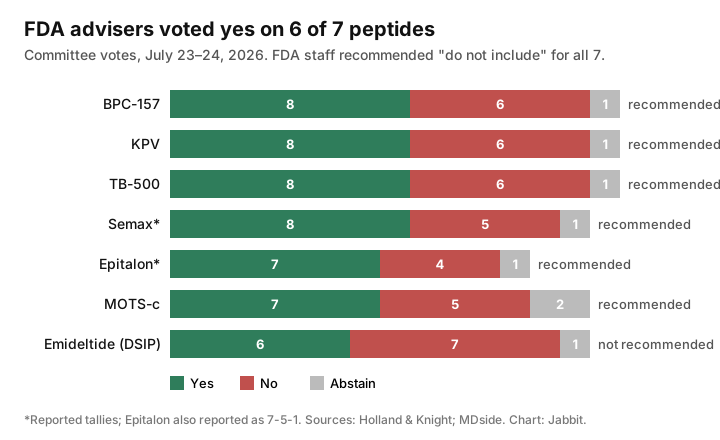
Most of those votes were close, and a committee vote is advice. To put a peptide on the list, FDA has to propose a rule, take comments and issue a final rule.[13][14] That has been slow before: FDA proposed five additions in 2019, and the list still holds only the six substances from that year’s final rule.[13][14]
Why FDA’s scientists said no
The briefing documents are long, but they make the same three points about every peptide. First, the ingredients are “not well-characterized.” Suppliers’ certificates didn’t identify individual impurities, and naming was inconsistent, so it isn’t clear what is actually in the vial.[5][9] Second, injecting or snorting short peptides can trigger an immune response, and the risk rises if the peptide clumps together (aggregates) or carries synthesis impurities. FDA wrote that the consequences “may range from antibody responses with no apparent clinical manifestations to life-threatening and catastrophic reactions.”[8][6] Third, for most of these peptides there are almost no human studies at all.[5][6][7][8][9][10]
To be fair to the other side, the committee members who voted yes weren’t claiming the evidence was strong. Their argument, as reported, was about who decides, and about the fact that people already buy these peptides on a gray market with no quality control. Some yes votes came with conditions such as authorized ingredient sourcing and adverse-event reporting.[13] That is a real argument about harm reduction. It just isn’t evidence that the peptides work.
The evidence, peptide by peptide
BPC-157 was first described in 1993 as a 15-amino-acid fragment of a protein isolated from human gastric juice. The nominated use FDA reviewed was ulcerative colitis.[5] The only human trial FDA found for it was a meeting abstract. People with ulcerative colitis got a BPC-157 enema or placebo for two weeks, and the difference between groups wasn’t significant (an estimated 1.6 points on a disease score, with a confidence interval spanning zero).[5] FDA found “no studies that administered BPC-157 to humans” by the oral, injected, nasal or skin routes people actually use. In animals its half-life was 5 to 15 minutes.[5] The rat studies on healing are numerous, and they are why it is popular. They don’t tell you what it does in people.
KPV is a three-amino-acid fragment of a hormone called alpha-MSH, proposed for wounds and inflammation. FDA found no information on its use in humans by any route, only lab and animal anti-inflammatory studies.[6]
TB-500 is a seven-amino-acid synthetic fragment of thymosin beta-4 (amino acids 17–23), nominated for wound healing. FDA found no report of it being given to patients for any condition. It also found no animal wound-healing studies of TB-500 itself. One lab study found it didn’t speed healing of scratched fibroblast cultures.[7]
MOTS-c is a 16-amino-acid mitochondrial-derived peptide, first described in 2015 and nominated for uses ranging from insulin resistance and obesity to osteoporosis and “longevity.” The supporting work is in cells and rodents. FDA found no human data on products containing it by any route.[8]
Semax was reviewed for cerebral ischemia, migraine and trigeminal neuralgia. FDA rated the stroke evidence insufficient: “the only available information was in the form of a meeting abstract.” In single small, uncontrolled studies, semax didn’t resolve pain for most migraine or trigeminal neuralgia patients.[9] FDA found no human pharmacokinetic studies and no safety data for injection, which is the route proposed.[9]
Epitalon was reviewed for insomnia. Human studies report changes in melatonin levels, but FDA found none that tested it in people with insomnia, and “no clinical data to support the safety” of epitalon in humans.[10]
Emideltide (DSIP), the “delta sleep-inducing peptide,” was the one the committee turned down, 6-7.[11][12]
Semax and epitalon: what the Soviet record shows
Two of the six peptides headed toward US pharmacies are Soviet inventions, and their paper trails show where today’s claims came from.
Semax began as USSR author’s certificate 939440, with a priority date of January 6, 1981. It was filed by Moscow’s Institute of Molecular Genetics and Moscow State University and claimed a modified ACTH fragment as a “long-acting memory stimulant” tested in rats.[16] The name “Semax” and the nasal-drop formula appear in a 1994 Russian patent that lists broad uses from vascular brain disease to helping healthy operators cope with “extreme conditions.”[17] Stroke came later. The most-cited recent stroke study, from 2018, had 110 patients in rehabilitation, no placebo and no described blinding. The semax groups improved faster on daily-living scores, but by five months the early-rehab groups were within two points of each other.[18] We translated that study in full in our semax teardown. When FDA reviewed semax this summer, it found no stroke evidence beyond an abstract.[9] After four decades, semax’s human record still comes almost entirely from Russian groups, and much of the early work was co-authored by its inventors.[18]
Epitalon traces to Vladimir Khavinson’s group in Leningrad (now St Petersburg). The headline longevity claims come from studies of calf pineal and thymus extracts (epithalamin, thymalin) in elderly people, with groups of about 20 per arm, run by the inventors.[19] The telomere claim comes from a 2003 cell-culture paper by the same group.[20] Our Khavinson teardown rebuilds those mortality tables from the Russian text. None of it is a trial of the synthetic epitalon now sold online, and FDA found no human safety data for it.[10]
Safety: what is and isn’t known
The honest answer for all six is that their safety in humans hasn’t been measured. That is different from saying they are known to be dangerous. FDA’s concerns are mostly about quality and immune reactions: products with unidentified impurities, peptides that can aggregate, and routes of administration (injection, nasal) that make immune responses more likely.[5][6][8] In the one BPC-157 trial, a few patients in both groups withdrew, “mainly” because their colitis got worse. The abstract gave little safety detail.[5] FDA still lists BPC-157 among substances for which it “has identified no, or only limited, safety-related information for the proposed routes of administration.”[15] A pharmacy-made product from an audited ingredient supplier would probably be cleaner than a “research use only” vial. It still would not be an evaluated medicine.
What to watch next
The thing to read is the policy text when FDA publishes it. Look for which peptides it covers, which routes and forms, what sourcing documentation pharmacies need, and whether it reaches outsourcing facilities as well as ordinary pharmacies.[1][13] A second committee meeting on five more peptides (GHK-Cu, LL-37, Dihexa, Melanotan II and PEG-MGF) is expected before the end of February 2027.[12] State pharmacy boards apply their own rules either way.[13]
Bottom line: the policy may soon give some peptides a legal supply route, but it doesn't answer whether they work. For BPC-157, KPV, TB-500 and MOTS-c, there is essentially no human efficacy data. For semax and epitalon, the human data are decades old, small, uncontrolled and mostly from their inventors. If you and your prescriber do decide to use one, keeping a dated record of doses and effects is the only way you’ll know what it did for you. That’s what Jabbit is for.
References
- Office of Information and Regulatory Affairs (OMB). Pending EO 12866 Regulatory Review: Interim Access Policy for Compounding Using Certain Peptides, RIN 0910-ZD94, received 10/14/2026, stage: Notice. https://www.reginfo.gov/public/do/eoDetails?rrid=1568964. Checked October 16, 2026.
- Associated Press. Kennedy’s HHS presses ahead with peptides plan. October 2026. https://apnews.com/article/peptides-kennedy-drugs-trump-bpc157-fb12641dfe791f443f7b7d1eb3bd4a0a. Checked October 16, 2026.
- The Clinical Times. HHS sends peptide compounding plan to White House for review (summarizing STAT, MedPage Today, Becker’s and The Hill). October 16, 2026. https://theclinicaltimes.com/story/2026-10-15-hhs-sends-peptide-compounding-plan-to-white-house-for-review. Checked October 16, 2026.
- U.S. Food and Drug Administration. Pharmacy Compounding Advisory Committee, July 23–24, 2026: introduction to briefing packages. https://www.fda.gov/media/193342/download. Checked October 16, 2026.
- FDA. PCAC briefing document: BPC-157-related bulk drug substances (free base and acetate). July 2026. https://www.fda.gov/media/193343/download. Checked October 16, 2026.
- FDA. PCAC briefing document: KPV-related bulk drug substances. July 2026. https://www.fda.gov/media/193346/download. Checked October 16, 2026.
- FDA. PCAC briefing document: TB-500-related bulk drug substances. July 2026. https://www.fda.gov/media/193349/download. Checked October 16, 2026.
- FDA. PCAC briefing document: MOTS-c-related bulk drug substances. July 2026. https://www.fda.gov/media/193347/download. Checked October 16, 2026.
- FDA. PCAC briefing document: Semax-related bulk drug substances. July 2026. https://www.fda.gov/media/193348/download. Checked October 16, 2026.
- FDA. PCAC briefing document: Epitalon-related bulk drug substances. July 2026. https://www.fda.gov/media/193345/download. Checked October 16, 2026.
- FDA. PCAC briefing document: Emideltide (DSIP)-related bulk drug substances. July 2026. https://www.fda.gov/media/193344/download. Checked October 16, 2026.
- Holland & Knight. Peptides at a Crossroads: What Wellness Providers Need to Know About HHS and FDA Actions. October 2026 (committee vote tallies). https://www.hklaw.com/en/insights/publications/2026/10/peptides-at-a-crossroads-what-wellness-providers-need-to-know. Checked October 16, 2026.
- MDside. The FDA advisory vote on six peptides: what has to happen before a clinic can use them. October 9, 2026 (vote tallies; 503A rulemaking history). https://www.mdside.com/peptide-advisory-vote-what-happens-next/. Checked October 16, 2026.
- Electronic Code of Federal Regulations. 21 CFR 216.23, Bulk drug substances that can be used to compound drug products under section 503A. https://www.ecfr.gov/current/title-21/chapter-I/subchapter-C/part-216/subpart-C/section-216.23. Checked October 16, 2026.
- FDA. Certain Bulk Drug Substances for Use in Compounding that May Present Significant Safety Risks (category 2 list). https://www.fda.gov/drugs/human-drug-compounding/certain-bulk-drug-substances-use-compounding-may-present-significant-safety-risks. Checked October 16, 2026.
- Ponomareva-Stepnaya MA, Nezavibat'ko VN, Ashmarin IP, Kamensky AA. Heptapeptide as a long-acting memory stimulant. USSR author's certificate SU 939440 A1; priority 1981-01-06. Institute of Molecular Genetics, USSR Academy of Sciences; Moscow State University. https://patents.google.com/patent/SU939440A1/ru. Checked October 16, 2026.
- Andreeva LA, Ashmarin IP, Kamensky AA, et al. Nootropic drug and pharmaceutical nootropic composition. Russian patent RU 2045958 C1; priority 1994-03-28 (names the drug “Semax”). https://patents.google.com/patent/RU2045958C1/ru. Checked October 16, 2026.
- Gusev EI, Martynov MY, Kostenko EV, et al. [The efficacy of semax in the treatment of patients at different stages of ischemic stroke]. Zh Nevrol Psikhiatr Im S S Korsakova. 2018;118(3 Vyp 2):61-68. PMID 29798983. https://pubmed.ncbi.nlm.nih.gov/29798983/. Checked October 16, 2026.
- Khavinson VKh, Morozov VG. [Geroprotective effect of thymalin and epithalamin]. Adv Gerontol. 2002;10:74-84. PMID 12577695. https://pubmed.ncbi.nlm.nih.gov/12577695/. Checked October 16, 2026.
- Khavinson VKh, Bondarev IE, Butyugov AA. Epithalon peptide induces telomerase activity and telomere elongation in human somatic cells. Bull Exp Biol Med. 2003;135(6):590-592. PMID 12937682. https://pubmed.ncbi.nlm.nih.gov/12937682/. Checked October 16, 2026.
This page analyzes public regulatory documents and published research. It is not medical or legal advice and does not recommend using, sourcing, or dosing any peptide. Russian sources are summarized from the cited originals; translations in linked teardowns are Jabbit’s own.