Home / Research / BPC-157 origins teardown
Paper-trail teardown · Patents, registries and FDA documents read in full · Sources checked October 16, 2026
Is BPC-157 a healing peptide your stomach already makes? Not exactly, and nearly all the research comes from one lab in Zagreb.
Not in any way anyone has shown. BPC-157 is a synthetic 15-amino-acid peptide. Its sequence comes from a 1989 patent that described a larger stomach-juice protein only by its weight and its first 15 building blocks.[1] We searched all 210,706 human protein sequences in UniProt and found no protein that contains it.[14] About 77% of the 222 BPC-157 papers on PubMed include the same Zagreb pharmacologist as a co-author, and there is still no published, completed randomized trial in people.[13][12]
Why this matters this week
On October 14, 2026 FDA sent an “Interim Access Policy for Compounding Using Certain Peptides” to the White House for review. Its text isn’t public yet.[21] News reports say it could let pharmacies make BPC-157.[25] In July, FDA’s advisory committee voted 8–6–1 in favor of adding BPC-157 to the compounding list, even though FDA’s own reviewers advised against it.[22][5] Posts about BPC-157 on X roughly doubled this week, from 105–161 a day on October 9–12 to 232–250 a day on October 13–15.[24] A line that keeps showing up in those posts, often next to a discount code, is that BPC-157 is “a fragment of something already in your gastric juice.”[24] So we went back to the original documents to see where that claim comes from.
Why we say that
The story starts with a patent, not a paper. In a US patent with a 1989 Yugoslav priority date, Predrag Sikirić and colleagues in Zagreb describe collecting stomach juice from 542 patients and purifying from it a substance they named BPC, short for “Body Protection Compound.” They reported a molecular weight of about 40,000 ± 5,000 daltons, measured by gel filtration, and only a partial sequence from one end of the protein. Those first 15 amino acids are the sequence now sold as BPC-157.[1] The 1993 paper that introduced BPC-157 says the same: a 40,000-dalton gastric juice peptide had been “recently isolated,” and the 15-amino-acid fragment is “thought to be essential for its activity.”[3]
Within three years the inventors themselves were stepping away from the natural protein. A 1992 patent application, which lists the drug company Pliva as assignee, says the natural BPC’s broad activity “can be probably a consequence of undetermined structure or even of insufficient purity or homogeneity of isolated compound BPC.” It calls the protein “obtainable only by difficult procedure from dubious natural source” and claims synthetic 8- to 15-residue peptides instead. BPC-157 is sequence number 2 in that filing.[2]
So “from human gastric juice” is shorthand for “copied from a partial sequence of a protein one lab reported purifying.” We didn’t find that protein in today’s databases. None of the 210,706 human sequences in UniProt contains BPC-157’s sequence, and no stretch of any of them matches more than 9 of its 15 positions.[14] A 2025 review likewise notes it “shows no sequence homology with known intestinal peptides.”[6] That doesn’t prove the parent protein doesn’t exist. Databases miss things, and the original isolate was never fully sequenced in anything we found. It does mean that “your body already makes this” is a claim nobody has confirmed.
One lab wrote most of the research
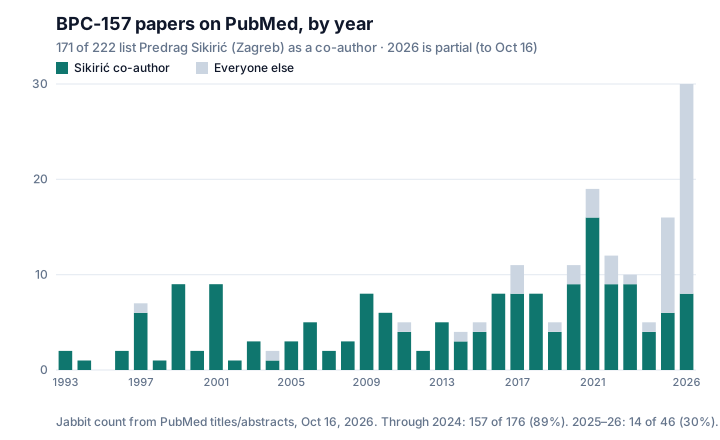
We pulled every PubMed record that mentions BPC-157 in its title or abstract: 222 in all. Of those, 171 list Sikirić as an author. Through the end of 2024 the share was 157 of 176, or 89%.[13] The picture changed only in the last two years. In 2025 and 2026 so far, outside authors wrote 32 of the 46 records, but 20 of those 32 are reviews or commentaries rather than new experiments.[13] PubMed tags none of the 222 as a clinical trial or randomized controlled trial.[13]
A literature dominated by one group isn’t automatically wrong. It does mean the usual check, other labs repeating the work and getting the same answer, has barely happened. A few independent groups have tested it. In lab dishes, a Taiwanese team found BPC-157 helped rat tendon cells grow out of tissue samples, survive stress and migrate.[15] A Chinese team measured how rats and dogs handle it: it breaks down fast, with a half-life under 30 minutes.[16] And in the newest independent animal test, a 2026 Istanbul study of repaired rat Achilles tendons, BPC-157 scored numerically better than controls but didn’t reach statistical significance on the main tissue scores, while TB-500 did.[26]
The paper trail
| Year | What happened | Source |
|---|---|---|
| 1989 | Yugoslav priority filing for “BPC,” a roughly 40 kDa substance purified from the stomach juice of 542 patients, with a partial 15-residue N-terminal sequence | [1] |
| 1992 | Patent application for synthetic 8–15-residue peptides (assignee listed as Pliva). The inventors call the natural source “dubious” and its purity possibly insufficient. BPC-157 is sequence no. 2 | [2] |
| 1993 | First PubMed papers on BPC-157, Zagreb Department of Pharmacology | [3][13] |
| 1997 | Patent application for salt forms of BPC peptides, including BPC-157 | [4] |
| 2002–2005 | Under the code PL 14736 it is tested as an enema for ulcerative colitis. The abstracts report the peptide wasn’t detected in blood after dosing. A 53-patient randomized trial, reported only as a meeting abstract, found no significant difference from placebo | [5] |
| 2015 | A company called PharmaCotherapia d.o.o. registers a 42-person Phase 1 of oral “Bepecin” tablets in Tijuana, Mexico. The registry hasn’t been updated since December 2015, and no results were posted | [7] |
| 2017 | PharmaCotherapia files a multiple sclerosis patent naming Sikirić as inventor | [8] |
| 2021–2025 | Three uncontrolled reports from Florida clinics: 16, 12 and 2 patients | [9][10][11] |
| July 2026 | FDA advisers vote 8–6–1 to put BPC-157 on the compounding list, against FDA staff advice | [22][5] |
| Oct 2026 | FDA’s interim peptide policy goes to the White House. A systematic review rates the human evidence “very low” certainty | [21][12] |
What the human evidence actually is
A systematic review published October 8, 2026 searched four databases through June 2026. It found three human studies with 30 people in total, none with a control group. It rated the certainty of evidence “very low” and concluded BPC-157 “should not be used clinically in humans outside ethically approved, regulated, high-quality clinical trials.”[12] The review covered orthopaedic and regenerative uses, so it left out the older colitis work, which FDA found and summarized.[5]
| Study | People | Design | What it found |
|---|---|---|---|
| Ulcerative colitis enema (PL 14736), 2005 abstract | 53 | Randomized, placebo, 2 weeks | Disease score fell 3.2 vs 1.6 points; difference 1.6 (95% CI −4.84 to 1.62), not significant. Abstract only |
| Knee pain, 2021 | 16 | Retrospective phone survey, no control | 14 of 16 said pain improved. No validated scales |
| Interstitial cystitis, 2024 | 12 | Single clinic, no control | 10 of 12 reported complete resolution on a global questionnaire |
| IV infusion safety, 2025 | 2 | Prospective, no control | No lab changes at 10 and 20 mg. Both had used IV BPC-157 before |
| Oral tablets Phase 1, 2015 | 42 planned | Randomized, placebo | No results posted |
Sources: colitis trial as summarized by FDA[5]; knee[9]; cystitis[10]; IV[11]; Phase 1 registry[7]. All three Florida reports share a first author and appeared in the same journal.[9][10][11]
Real trials are finally on the way. A 120-person, double-blind, placebo-controlled Phase 2 in hamstring strains has been recruiting in Shenzhen since February 2026, and a 30-person rotator-cuff pilot at the University of Arkansas is set to start in January 2027.[18][19] A 40-person single-arm study of BPC-157 gummies, sponsored by the company selling them, finished in November 2025 without posting results.[20]
What BPC-157 has going for it
To be fair, the animal record is large and strikingly consistent. Across rats and other species, BPC-157 has been reported to protect the stomach, liver and gut and to speed healing of tendon, ligament, muscle and bone, often at microgram-per-kilogram doses.[3][6] FDA’s reviewers summarized the same pattern in rodents.[5] Independent labs in Taiwan and Turkey have seen effects in the same direction in tendon cells and repaired rat tendons, though weaker in the Turkish study.[15][26] A published toxicology package found it wasn’t mutagenic and didn’t cause birth defects in pregnant rats.[5] And the three small human reports, for what they’re worth, didn’t describe treatment-related harms.[12] If the Shenzhen trial runs as registered, it will be the first blinded, placebo-controlled test of BPC-157 for an injury in people.[18]
Side effects and safety
What FDA found is mostly what’s missing. There are no carcinogenicity studies and no complete reproductive studies. There is no human pharmacokinetic data for the oral, injected, nasal or skin routes people actually use.[5] In 28-day injection studies in rats and dogs, FDA flagged changes in clotting times and liver-related signals (higher ALT, glucose and triglycerides) and noted that longer studies were unavailable.[5]
FDA’s adverse-event database held three reports through December 2025. One was injection-site redness and swelling. One was shortness of breath leading to an emergency room visit. In the third, a woman using a “research purposes only” BPC-157 plus TB-500 product developed skin and gum darkening, and it came back when she took the product again.[5] Compounders under section 503A generally don’t report adverse events to FDA, so these numbers say little about how often problems happen.[5]
Two more concerns come up repeatedly. First, BPC-157 is promoted for growing new blood vessels, and a 2017 study tied its effect to VEGFR2, a key receptor for blood-vessel growth.[17] The same process feeds tumors, which is why a 2025 review called for safety work on it.[6] No one has shown that BPC-157 causes or worsens cancer. No one has tested it either. Second, FDA lists BPC-157 among compounding substances that may pose significant safety risks. The agency cites possible immune reactions, peptide impurities and trouble characterizing the ingredient.[23][5]
Where it stands now
BPC-157 is not an FDA-approved drug. In July, FDA’s Pharmacy Compounding Advisory Committee voted to add it to the 503A bulk list over FDA staff objections. On October 14, an interim compounding policy that reportedly covers it reached the White House, and its final text isn’t public.[22][5][21] Even if pharmacies get a legal route, that is a supply decision. It wouldn’t show that the peptide works. For the full regulatory picture, see our FDA peptide policy explainer.
Bottom line: BPC-157 isn’t a known human stomach peptide. It is a synthetic copy of a partial sequence from a protein one lab reported isolating in 1989 and later called a “dubious natural source.”[1][2] Three decades of mostly single-lab animal work look promising. The human evidence is one null colitis abstract and 30 uncontrolled patients.[5][12] The first serious placebo-controlled trial is underway now, and that is the result worth waiting for.[18]
References
- Sikirić P, Petek M, Rotkvić I, Mise S, Krizanac S, Udovičić I, Suchanek E, Duvnjak M. Pharmacologically active substance BPC, the process for its preparation and its use in the therapy. US Patent 5,288,708; priority 1989-09-12 (Yugoslav application, family member YU176089A); filed 1990-09-11; granted 1994-02-22. https://patents.google.com/patent/US5288708A/en. Checked October 16, 2026.
- Petek M, Seiwerth S, Sikirić P, Grabarević Z, Rotkvić I, Duvnjak M, Turković B, Mise S, Suchanek E, Mildner B, et al. Peptides with organo-protective activity, process for their preparation and their use in the therapy. WO 1994/011394 A2; priority 1992-11-16; published 1994-05-26; assignee listed by Google Patents as Pliva Pharm & Chem Works. https://patents.google.com/patent/WO1994011394A2/en. Checked October 16, 2026.
- Sikirić P, Petek M, Rucman R, et al. A new gastric juice peptide, BPC. An overview of the stomach-stress-organoprotection hypothesis and beneficial effects of BPC. J Physiol Paris. 1993;87(5):313-327. PMID 8298609. https://pubmed.ncbi.nlm.nih.gov/8298609/. Checked October 16, 2026.
- Sikirić P, Petek M, Seiwerth S, et al. New BPC peptide salts with organo-protective activity, the process for their preparation and their use in therapy. WO 1998/052973 A1; priority 1997-05-23; published 1998-11-26. https://patents.google.com/patent/WO1998052973A1/en. Checked October 16, 2026.
- U.S. Food and Drug Administration. Pharmacy Compounding Advisory Committee briefing document: BPC-157-related bulk drug substances (free base and acetate). Meeting of July 23–24, 2026. Sections on history of use, the ulcerative colitis trial abstract (Ruenzi et al. 2005), human pharmacokinetics (Veljača et al. 2002, 2003), nonclinical toxicology, and FAERS reports. https://www.fda.gov/media/193343/download. Checked October 16, 2026.
- Józwiak M, Bauer M, Kamysz W, Kleczkowska P. Multifunctionality and possible medical application of the BPC 157 peptide: literature and patent review. Pharmaceuticals (Basel). 2025;18(2):185. PMID 40005999. https://pmc.ncbi.nlm.nih.gov/articles/PMC11859134/. Checked October 16, 2026.
- ClinicalTrials.gov. NCT02637284: PCO-02 safety and pharmacokinetics trial (Phase 1, Bepecin/BPC-157 oral tablets, 42 healthy volunteers planned; sponsor PharmaCotherapia d.o.o.; site Hospital Ángeles Tijuana, Mexico; last update posted December 2015; status unknown; no results posted). https://clinicaltrials.gov/study/NCT02637284. Checked October 16, 2026.
- Sikirić P (inventor); Pharmacotherapia d.o.o. (applicant). Compositions and methods for treating symptoms associated with multiple sclerosis. WO 2018/037020 A1; priority 2017-08-22; published 2018-03-01. https://patents.google.com/patent/WO2018037020A1/en. Checked October 16, 2026.
- Lee E, Padgett B. Intra-articular injection of BPC 157 for multiple types of knee pain. Altern Ther Health Med. 2021;27(4):8-13. PMID 34324435. https://pubmed.ncbi.nlm.nih.gov/34324435/. Checked October 16, 2026.
- Lee E, Walker C, Ayadi B. Effect of BPC-157 on symptoms in patients with interstitial cystitis: a pilot study. Altern Ther Health Med. 2024;30(10):12-17. PMID 39325560. https://pubmed.ncbi.nlm.nih.gov/39325560/. Checked October 16, 2026.
- Lee E, Burgess K. Safety of intravenous infusion of BPC157 in humans: a pilot study. Altern Ther Health Med. 2025;31(5):20-24. PMID 40131143. https://pubmed.ncbi.nlm.nih.gov/40131143/. Checked October 16, 2026.
- Poolton JT, Minett J, Kazmi A. Human evidence for BPC-157 in orthopaedic and regenerative medicine: a systematic review of efficacy and safety. Acta Orthop Belg. 2026 Oct 8;92(3). PMID 42885452. https://pubmed.ncbi.nlm.nih.gov/42885452/. Checked October 16, 2026.
- Jabbit count of PubMed records, October 16, 2026, via NCBI E-utilities. Query ("BPC-157"[tiab] OR "BPC 157"[tiab] OR "pentadecapeptide BPC"[tiab]) returned 222 records; adding Sikiric P[au] returned 171. Adding clinical trial or randomized controlled trial publication types returned 0. https://pubmed.ncbi.nlm.nih.gov/?term=%22BPC-157%22%5Btiab%5D+OR+%22BPC+157%22%5Btiab%5D+OR+%22pentadecapeptide+BPC%22%5Btiab%5D. The record list we counted, with PMIDs and our Sikirić flag: https://jabbitapp.com/research/sources/bpc157-pubmed-2026-10-16.json.
- Jabbit scan of every human protein sequence in UniProtKB (reviewed and unreviewed, organism 9606; 210,706 sequences downloaded October 16, 2026) for GEPPPGKPADDAGLV. Exact matches: 0. Best ungapped 15-residue window: 9 of 15 identical (an unreviewed menin fragment). Download: https://rest.uniprot.org/uniprotkb/stream?query=organism_id:9606&format=fasta&compressed=true. Script: https://jabbitapp.com/research/sources/bpc157-proteome-scan.py.
- Chang CH, Tsai WC, Lin MS, Hsu YH, Pang JH. The promoting effect of pentadecapeptide BPC 157 on tendon healing involves tendon outgrowth, cell survival, and cell migration. J Appl Physiol. 2011;110(3):774-780. PMID 21030672. https://pubmed.ncbi.nlm.nih.gov/21030672/. Checked October 16, 2026.
- He L, Feng D, Guo H, et al. Pharmacokinetics, distribution, metabolism, and excretion of body-protective compound 157, a potential drug for treating various wounds, in rats and dogs. Front Pharmacol. 2022;13:1026182. PMID 36588717. https://pubmed.ncbi.nlm.nih.gov/36588717/. Checked October 16, 2026.
- Hsieh MJ, Liu HT, Wang CN, et al. Therapeutic potential of pro-angiogenic BPC157 is associated with VEGFR2 activation and up-regulation. J Mol Med (Berl). 2017;95(3):323-333. PMID 27847966. https://pubmed.ncbi.nlm.nih.gov/27847966/. Checked October 16, 2026.
- ClinicalTrials.gov. NCT07437547: randomized, double-blind, placebo-controlled Phase 2 trial of BPC 157 for MRI-confirmed grade II hamstring strain (120 planned; sponsor Hudson Biotech; site Peking University Shenzhen Hospital; recruiting since February 2026). https://clinicaltrials.gov/study/NCT07437547. Checked October 16, 2026.
- ClinicalTrials.gov. NCT07803250: BPC-157 after arthroscopic rotator cuff repair (Phase 1 pilot, 30 planned; University of Arkansas; not yet recruiting, estimated start January 2027). https://clinicaltrials.gov/study/NCT07803250. Checked October 16, 2026.
- ClinicalTrials.gov. NCT07752381: single-arm, unblinded study of BPC-157 gummies (500 µg per serving) on hs-CRP and IL-6 (40 adults; sponsor Parlay Wellness with Citruslabs; completed November 2025; no results posted). https://clinicaltrials.gov/study/NCT07752381. Checked October 16, 2026.
- Office of Information and Regulatory Affairs (OMB). Pending EO 12866 Regulatory Review: Interim Access Policy for Compounding Using Certain Peptides, RIN 0910-ZD94, received 10/14/2026. https://www.reginfo.gov/public/do/eoDetails?rrid=1568964. Checked October 16, 2026.
- Holland & Knight. Peptides at a Crossroads: What Wellness Providers Need to Know About HHS and FDA Actions. October 2026 (committee vote tallies). https://www.hklaw.com/en/insights/publications/2026/10/peptides-at-a-crossroads-what-wellness-providers-need-to-know. Checked October 16, 2026.
- U.S. Food and Drug Administration. Certain Bulk Drug Substances for Use in Compounding that May Present Significant Safety Risks (category 2). https://www.fda.gov/drugs/human-drug-compounding/certain-bulk-drug-substances-use-compounding-may-present-significant-safety-risks. Checked October 16, 2026.
- X recent-search post counts for (BPC-157 OR "BPC 157" OR bpc157), excluding reposts, pulled by Jabbit on October 16, 2026: 105–161 posts a day on October 9–12, then 237, 250 and 232 on October 13–15 (UTC days). Example of the “already in your gastric juice” claim: https://x.com/HealthyAlfred/status/2106731075930132598 (October 4, 2026).
- Associated Press. Kennedy’s HHS presses ahead with peptides plan. October 2026. https://apnews.com/article/peptides-kennedy-drugs-trump-bpc157-fb12641dfe791f443f7b7d1eb3bd4a0a. Checked October 16, 2026.
- Biçer O, Adanir O, Güleryüz Y, et al. Effects of BPC-157 and TB-500 on Achilles tendon healing in rats: a histopathological and biomechanical study. Jt Dis Relat Surg. 2026;37(3):822-837. PMID 42542926. https://pubmed.ncbi.nlm.nih.gov/42542926/. Checked October 16, 2026.
This page analyzes patents, trial registries, regulatory documents and published research. It is not medical advice and does not recommend using, sourcing, or dosing BPC-157. Counts and the proteome scan are Jabbit’s own analyses; the scripts and inputs are cited above.