Study teardown · Efpeglenatide (Eppe) vs semaglutide (Wegovy) and tirzepatide (Zepbound) · Korea approval · Korean label, trial registries, outcome trials and US labels · Sources checked October 27, 2026
Published · Updated
What is efpeglenatide (Eppe), Korea’s new weight-loss shot, and how does it compare with Wegovy and Zepbound? South Korea approved it on October 7, 2026, for adults with obesity or overweight who do not have diabetes. In its 40-week Korean trial, people lost about 8 percentage points more weight than on placebo, less than Wegovy or Zepbound in their own longer trials, with fewer reported stomach side effects but a larger rise in heart rate. It is not approved in the US.
The short answer: efpeglenatide is a once-weekly GLP-1 injection from Hanmi Pharmaceutical, the same drug class as Wegovy. Korea’s drug regulator, the MFDS, approved it on October 7, 2026, as the first GLP-1 obesity drug developed in Korea.[1] Its approved Korean label reports that, over 40 weeks, people on the drug lost 9.02% of their body weight vs 0.89% on placebo, a difference of 8.13 percentage points.[2] That is a real effect, but smaller than what Wegovy and Zepbound showed in their own, longer trials.[17][18][15] It has not been approved by the FDA.[19]
Why this matters now
Aju Press reported on October 23 that Eppe “will become available at some clinics from Oct. 29,” and that Hanmi disclosed the date at a Seoul medical symposium.[6] It is a new entrant in the GLP-1 class, and one that already has a completed cardiovascular outcomes trial, run in people with type 2 diabetes.[10] Readers in the US are asking whether it is better than Wegovy or Zepbound and whether they can get it. This page sets the Korean label next to the US labels and the East Asian trials of Wegovy and Zepbound.
Two numbers are circulating. Hanmi’s October 2025 release and its October 2026 approval release give an interim topline weight loss of 9.75% vs 0.95%.[3][4] The approved label gives 9.02% vs 0.89%, from the full analysis set using multiple imputation for missing weights.[2] Our analysis: different analysis methods often give different numbers; the company release does not state its method, so we lead with the regulator-approved label figure.
Timeline
| Date | Event |
|---|---|
| 2019 | A phase 2 trial in 297 adults without diabetes reports 6.3 to 7.2 kg more weight loss than placebo over 20 weeks.[14] |
| 2020-2021 | Sanofi, then Hanmi’s partner, ends its efpeglenatide trials; registries list the reason as a sponsor decision “not related to safety concern.”[9][13] |
| July 2021 | AMPLITUDE-O, in 4,076 people with type 2 diabetes, reports 27% fewer major cardiovascular events and fewer kidney events than placebo.[10] |
| January 2024 to March 2026 | Hanmi’s Korean phase 3 obesity trial runs in 448 adults; primary completion August 2025.[7] |
| October 27, 2025 | Hanmi releases 40-week interim topline results.[3] |
| October 7, 2026 | MFDS approves efpeglenatide for chronic weight management in adults without diabetes.[1][2] |
| October 29, 2026 | Reported start of prescribing at some Korean clinics.[6] |
| November 2027 | Listed primary completion of a Korean phase 3 trial in type 2 diabetes.[8] |
What the Korean trial showed
- Who was in it. 448 Korean adults without diabetes, randomized 2 to 1 to drug or placebo; average age 43, 62% women, average weight 89 kg and BMI 32. At the start, 56% had high blood pressure and 61% abnormal blood fats.[2]
- Weight. 9.02% loss vs 0.89% at 40 weeks; 75% vs 14% lost at least 5% of their weight. The label says the loss tended to be maintained through week 64 in the open-label extension, where everyone got the drug.[2]
- Dropouts. 8.4% stopped the drug during the placebo period vs 8.7% on placebo; 1.2% stopped permanently because of stomach side effects.[2]
- Not yet in a journal. We found no peer-reviewed paper for this trial, and ClinicalTrials.gov had no posted results when we checked. The label is the most detailed public source.[7][2]
How it compares with Wegovy and Zepbound
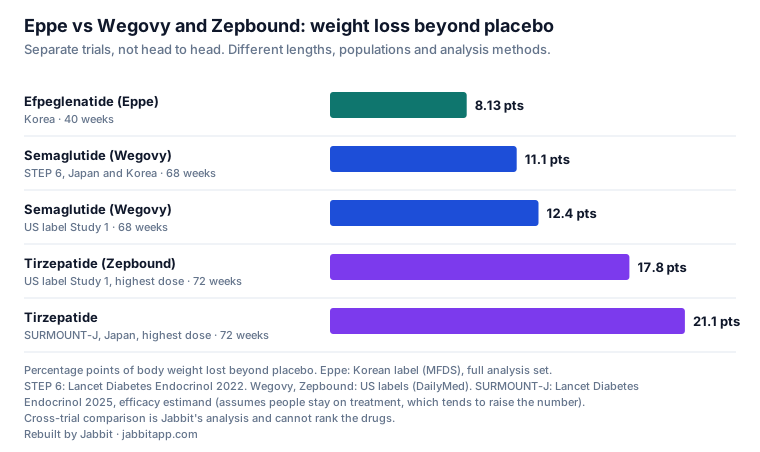
No trial has compared efpeglenatide directly with Wegovy or Zepbound. Side by side, the separate trials show a smaller effect: 8.13 percentage points beyond placebo at 40 weeks, against 11.1 points for Wegovy in STEP 6 (Japan and Korea, 68 weeks) and 12.4 points in its US label trial, and 17.8 points for the highest Zepbound dose in its US label trial.[2][15][17][18] Tirzepatide’s Japanese trial reported up to 21.1 points, using an on-treatment estimate that tends to give larger numbers.[16]
The trial’s principal investigator, as reported by Korea Biomedical Review, said trials of the imported drugs enrolled people with an average BMI around 38, vs about 32 here, and that this should be considered.[5] Our analysis: that is a fair point for the US trials, but STEP 6 also enrolled East Asian adults and still showed a larger effect over a longer trial, so a lower starting weight does not seem to explain the whole gap. Trial length matters too: weight loss on these drugs usually keeps building past 40 weeks.
Side effects
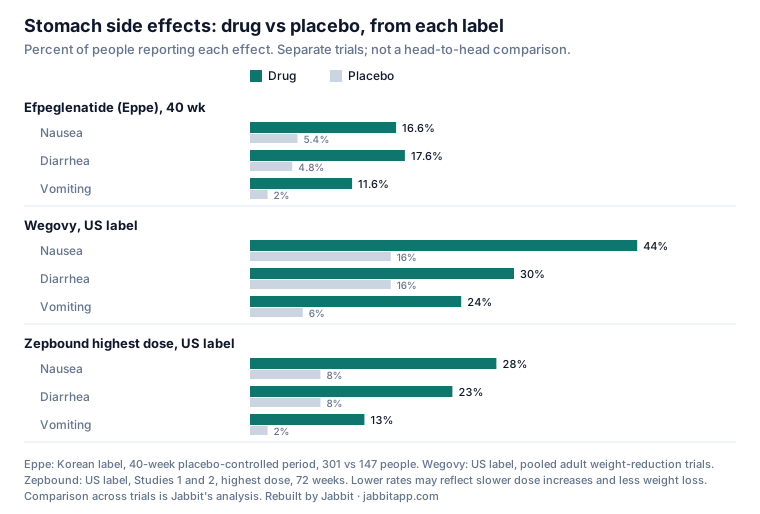
- Stomach effects. Nausea (16.6% vs 5.4% on placebo), diarrhea (17.6% vs 4.8%) and vomiting (11.6% vs 2.0%) were the most common, mostly mild to moderate and more frequent while the dose was being raised.[2] Those rates are lower than in the Wegovy and Zepbound labels.[17][18] Hanmi says its slower, stepwise dose increases are meant to reduce these effects, and has described its rates as lower than competitors’.[4][3] Our analysis: without a head-to-head trial, smaller weight loss and a different population could explain part of the difference. Korea Biomedical Review likewise notes that direct comparative trials would be needed to show better tolerability.[5]
- Heart rate. Resting heart rate rose by 6.8 beats per minute on average vs a 0.1 fall on placebo, and 8.4% vs 0.7% had a reading above 100 with a rise of at least 15.[2] The Wegovy and Zepbound labels list average rises of 1 to 4 and 1 to 3 beats per minute.[17][18] Our analysis: this is a cross-trial comparison, but the gap is large enough to be worth watching.
- Gallbladder, thyroid and pancreas. Gallstones occurred in 1.4% over the whole trial, and 2 people needed their gallbladder removed. Thyroid disorders (lumps, cysts, worsening Graves’ disease or an overactive thyroid) occurred in 1.4%, with none on placebo. Pancreatic enzyme levels (amylase and lipase) rose more on the drug than on placebo.[2]
- Antibodies. 17.5% developed antibodies to the drug and 3% neutralizing antibodies. The label says no evidence was found that antibodies affected how the drug worked, but allergic-type and injection-site reactions were more frequent in people who developed them.[2]
- Thyroid tumor warning. As with Wegovy and Zepbound, the label warns that the drug caused thyroid C-cell tumors in rats and that human relevance cannot be ruled out, and rules out use in people with a personal or family history of medullary thyroid cancer or MEN 2.[2][17][18]
Who it is approved for, and who was not studied
In Korea it is approved, alongside diet and exercise, for adults without diabetes with a BMI of 30 or more, or 27 or more with at least one weight-related condition.[2] The label does not recommend it for groups not studied: people with diabetes, moderate-to-severe kidney impairment, liver impairment, a history of severe psychiatric illness, severe heart failure, or those using other weight-loss products. It should be stopped at least 9 weeks before a planned pregnancy, and it was studied only in Korean adults.[2] We do not list doses here; dosing belongs with a prescriber and the label.
Healthy aging: why this matters for longevity
The longevity case for efpeglenatide rests on AMPLITUDE-O. In 4,076 people with type 2 diabetes and heart or kidney disease, major cardiovascular events fell from 9.2% to 7.0% (hazard ratio 0.73), and a kidney composite from 18.4% to 13.0%, over a median of 1.81 years.[10] The higher dose did better than the lower one, and a later analysis found that changes in LDL cholesterol and urine albumin, not weight, explained part of the benefit.[11][12] Our analysis: that is encouraging for heart and kidney health, but it was a diabetes trial funded by Sanofi, and there is no outcome trial in people with obesity alone, as Korea Biomedical Review also notes.[10][5]
The case for caution
The obesity evidence is one 40-week trial in one country, reported so far through a label and company releases rather than a peer-reviewed paper.[2][7] The two main numbers differ because of different analyses.[3][2] The heart-rate rise was larger than in the US labels of the leading drugs.[2][17][18] An earlier phase 2 trial saw 5% to 19% stop for side effects, though with different dosing.[14] And Sanofi’s global program was ended for reasons registries and the trial authors describe as not related to safety; the trial paper describes funding as the reason.[9][13]
What a careful reader should notice
- The label figure (9.02%) and the company topline (9.75%) come from different analyses; neither is “wrong.”[2][3]
- Comparing 40 weeks with 68 or 72 weeks favors the longer trials.[2][15][18]
- Lower stomach side-effect rates are not proven in a direct comparison.[2][5]
- The cardiovascular benefit comes from people with diabetes, not from the obesity trial.[10][5]
- Hanmi has not disclosed a price, as of the October 8 report.[5]
These points are our analysis.
Frequently asked questions
- What is Eppe (efpeglenatide)?
- A once-weekly GLP-1 injection from Hanmi Pharmaceutical, approved in South Korea on October 7, 2026, for weight management in adults with obesity or overweight without diabetes.[1][2]
- Is efpeglenatide better than Wegovy or Zepbound?
- No direct trial exists. In separate trials it showed smaller weight loss (8.13 points beyond placebo at 40 weeks) than Wegovy or Zepbound in their longer trials, with lower reported stomach side-effect rates.[2][17][18][15]
- How much weight do people lose on efpeglenatide?
- 9.02% on average at 40 weeks vs 0.89% on placebo, per the Korean label; 75% lost at least 5%. Hanmi’s earlier interim topline reported 9.75%.[2][3]
- Is efpeglenatide FDA-approved or available in the US?
- No. We found no FDA approval and no recruiting US trial; Hanmi’s current trial is in South Korea.[19][8]
- Does efpeglenatide raise heart rate?
- Yes, in its trial resting heart rate rose 6.8 beats per minute on average vs a 0.1 fall on placebo, more than the 1 to 4 beats listed for Wegovy and Zepbound in their own trials.[2][17][18]
- Does efpeglenatide protect the heart?
- In people with type 2 diabetes and heart or kidney disease, the AMPLITUDE-O trial found 27% fewer major cardiovascular events than placebo. It has not been tested for that in people with obesity alone.[10][5]
Bottom line
Efpeglenatide is a real addition to the GLP-1 class: approved in Korea, with a placebo-controlled weight-loss trial and a cardiovascular outcomes trial in diabetes behind it.[1][2][10] On weight loss, it looks smaller than Wegovy or Zepbound in separate trials, with fewer reported stomach side effects and a larger heart-rate rise.[2][17][18] Our analysis: for US readers it is not an option today, and for anyone else the right comparison will come from longer trials and, ideally, a head-to-head study.
References
- Ministry of Food and Drug Safety (MFDS), Republic of Korea. Press release, October 7, 2026 (Korean; attached PDF read). Headline: “국내 개발 첫 GLP-1 계열 비만치료제 신약 허가” (approval of the first domestically developed GLP-1 obesity drug). Says efpeglenatide is “국내에서 개발된 45번째 신약” (the 45th new drug developed in Korea), an injection “당뇨를 동반하지 않은 성인 비만 및 과체중 환자의 만성 체중 관리를 위해 저열량 식이요법 및 운동요법의 보조제로 투여되는” (given with a reduced-calorie diet and exercise for chronic weight management in adults with obesity or overweight without diabetes), reviewed by a dedicated product team, “품목전담팀 구성(19명)” (19 people), with clinical-trial (GCP) and manufacturing (GMP) inspections. Translations by Jabbit. https://www.mfds.go.kr/brd/m_99/view.do?seq=50399. Checked October 27, 2026.
- MFDS drug database (nedrug), efpeglenatide auto-injector prescribing information, Hanmi Pharmaceutical, approved October 7, 2026 (Korean). Read: indication; warnings (thyroid C-cell tumors: “인체에서의 관련성은 밝혀지지 않았으나, 완전히 배제할 수는 없다”, human relevance not established but cannot be fully ruled out; contraindicated with personal or family history of MTC or MEN 2); groups not studied and not recommended (“중등증~중증의 신장애가 있는 환자 - 당뇨병 환자 - 간장애가 있는 환자 - 중증의 정신질환의 병력이 있는 환자”, moderate-to-severe kidney impairment, diabetes, liver impairment, history of severe psychiatric illness; also NYHA class IV heart failure and other weight products); one phase 3 trial of 448 adults, 40-week placebo-controlled period plus 24-week open-label extension, 434 exposed; baseline “기저 평균 체중은 89kg, BMI는 32kg/m 2 였다”, “모두 아시아인(한국인)이었다”; Table 4 (full analysis set, “다중 대체법을 이용하여 ANCOVA 분석 수행”, multiple imputation): “체중 변화율의 최소 제곱평균(표준오차)(%) -9.02 (0.43) -0.89 (0.56) 위약과의 차이[95% CI](%) -8.13 [-9.43, -6.82]”; Table 5: “체중 감소율이 5% 이상인 환자 수(%) 75.05% 13.53%”; “이러한 체중 감소 수준은 64주 차까지 유지되는 경향을 보였다” (weight loss tended to be maintained to week 64); discontinuation during the placebo period “각각 8.4% 및 8.7%였다”; Table 3, drug vs placebo: diarrhea 17.6% vs 4.8%, nausea 16.6% vs 5.4%, constipation 14.6% vs 2.0%, vomiting 11.6% vs 2.0%, hypoglycemia 1.3% vs 0%; whole trial: permanent stops for stomach effects “1.2%(5/434명)”, gallstones “1.4%(6/434명)” (2 people went on to gallbladder or bile-duct inflammation and gallbladder removal), thyroid disorders “1.4%(6명/434명)” (none on placebo); heart rate rose “6.8회/분” (6.8 beats per minute) from a mean of 71.8 vs a 0.1 fall on placebo; heart rate above 100 with a rise of 15 or more “이 약 투여군 8.4%(25/299명), 위약 투여군 0.7%(1/145명)이었다”; anti-drug antibodies “17.5%(76/434명)”, neutralizing antibodies 3% (13/434), with “항체가 발생한 환자에서는 항체가 발생하지 않은 환자에 비해 과민반응 또는 주사 부위 반응이 더 빈번하게 관찰되었다” (hypersensitivity or injection-site reactions were seen more often in antibody-positive patients); thyroid disorders “갑상선 종괴, 갑상선 낭종, 그레이브스병 악화, 갑상선 항진증을 포함한다”; amylase and lipase rose 16.0% and 49.8% vs 0.9% and 4.6% on placebo; baseline “56%가 고혈압, 61%가 이상지질혈증”; stomach effects mostly “경증에서 중등증” (mild to moderate), with nausea, vomiting and diarrhea more frequent during dose escalation; rat studies: “암수 모두 모든 용량 수준에서 갑상선 C-세포 종양이 용량 의존적으로 증가하였다” (thyroid C-cell tumors rose with dose at every dose level in both sexes); pregnancy: stop “임신 예정 최소 9주 전에” (at least 9 weeks before a planned pregnancy). Translations by Jabbit; doses not reproduced. https://nedrug.mfds.go.kr/pbp/CCBBB01/getItemDetail?itemSeq=202603057. Checked October 27, 2026.
- Hanmi Pharmaceutical. Press release, October 27, 2025 (English), company statement. “Hanmi released the Week 40 interim topline data”; “The mean percent change in body weight from baseline in the efpeglenatide group was -9.75%, compared with -0.95% in the placebo group”; ≥5% weight loss 79.42% vs 14.49%, ≥10% 49.46% vs 6.52%, ≥15% 19.86% vs 2.90%; company claim that “efpeglenatide demonstrated a substantially lower incidence of these adverse events―by double-digit percentage points compared with previously reported rates” The release does not state the analysis population or method. https://www.hanmipharm.com/about/investor-relations/press/detail-3763.hm. Checked October 27, 2026.
- Hanmi Pharmaceutical. Press release, October 7, 2026 (Korean), company statement on approval. Restates the “40주 중간 톱라인 결과” (40-week interim topline result) of 9.75%; says Hanmi ran global trials “사노피와 함께 약 6000명의 제2형 당뇨병 환자를 대상으로” (with Sanofi in about 6,000 people with type 2 diabetes) before rights returned; describes “2+4주 간격의 단계적 용량 증량” (stepwise dose increases at 2- and 4-week intervals) intended to lower stomach side effects; says the drug is made at its Pyeongtaek plant. Translations by Jabbit. https://www.hanmi.co.kr/about/news-media/press/detail-5083.hm. Checked October 27, 2026.
- Korea Biomedical Review, news analysis, October 8, 2026. “Hanmi has yet to disclose the drug's price”; says “evidence from direct comparative trials would be needed to establish whether efpeglenatide is better tolerated”; reports that the trial’s principal investigator “noted that trials of imported obesity drugs generally enrolled patients with an average body mass index (BMI) of around 38 kg/m², compared with approximately 32 kg/m² in the Korean efpeglenatide trial”; notes the earlier diabetes outcome data “do not establish equivalent outcomes among patients receiving Eppe specifically for obesity.” https://www.koreabiomed.com/news/articleView.html?idxno=33438. Checked October 27, 2026.
- Aju Press, October 23, 2026. Reports Eppe “will become available at some clinics from Oct. 29, just three weeks after winning regulatory approval” and that “Hanmi disclosed the Oct. 29 prescription date at a medical symposium in Seoul on Thursday”; cites the label figure of 9.02% vs 0.89%. https://www.ajupress.com/view/20261023104607573. Checked October 27, 2026.
- ClinicalTrials.gov NCT06174779 (sponsor Hanmi Pharmaceutical): phase 3, randomized, placebo-controlled trial of HM11260C (efpeglenatide) in adults with obesity without diabetes, South Korea; enrollment 448; started January 3, 2024; primary completion August 14, 2025; completed March 13, 2026; primary outcomes percent weight change and share losing at least 5% at week 40; no results posted when checked. https://clinicaltrials.gov/study/NCT06174779. Checked October 27, 2026.
- ClinicalTrials.gov NCT07379333 (sponsor Hanmi Pharmaceutical): phase 3 trial of HM11260C (efpeglenatide) in type 2 diabetes not controlled on metformin and dapagliflozin; primary outcome change in HbA1c at 36 weeks; South Korea; recruiting; 118 people (estimated); primary completion November 2027 (estimated). https://clinicaltrials.gov/study/NCT07379333. Checked October 27, 2026.
- ClinicalTrials.gov records for Sanofi’s efpeglenatide program: NCT03496298 (AMPLITUDE-O, 4,076 people), NCT03684642, NCT03770728 and NCT03713684, all listed as terminated between October 2020 and January 2021 with the reason “Sponsor decision to cancel TRIAL, not related to safety concern.” AMPLITUDE-O still reported its primary results (see the NEJM paper). https://clinicaltrials.gov/study/NCT03496298; https://clinicaltrials.gov/study/NCT03684642; https://clinicaltrials.gov/study/NCT03770728; https://clinicaltrials.gov/study/NCT03713684. Checked October 27, 2026.
- Gerstein HC, Sattar N, Rosenstock J, et al. Cardiovascular and Renal Outcomes with Efpeglenatide in Type 2 Diabetes. N Engl J Med. 2021;385(10):896-907. PMID 34215025. AMPLITUDE-O, randomized, placebo-controlled, 344 sites in 28 countries, adults with type 2 diabetes and cardiovascular or kidney disease; doi 10.1056/NEJMoa2108269. Abstract: “A total of 4076 participants were enrolled; 2717 were assigned to receive efpeglenatide and 1359 to receive placebo”; major cardiovascular events 7.0% vs 9.2% “(hazard ratio, 0.73; 95% confidence interval [CI], 0.58 to 0.92; P<0.001 for noninferiority; P = 0.007 for superiority)”; kidney composite “occurred in 353 participants (13.0%) assigned to receive efpeglenatide and in 250 participants (18.4%) assigned to receive placebo (hazard ratio, 0.68; 95% CI, 0.57 to 0.79; P<0.001)”; “Diarrhea, constipation, nausea, vomiting, or bloating occurred more frequently with efpeglenatide than with placebo”; median follow-up 1.81 years. “(Funded by Sanofi; AMPLITUDE-O ClinicalTrials.gov number, NCT03496298.)” Abstract read. https://pubmed.ncbi.nlm.nih.gov/34215025/. Checked October 27, 2026.
- Gerstein HC, Li Z, Ramasundarahettige C, et al. Exploring the Relationship Between Efpeglenatide Dose and Cardiovascular Outcomes in Type 2 Diabetes: Insights From the AMPLITUDE-O Trial. Circulation. 2023;147(13):1004-1013. PMID 36802715. AMPLITUDE-O secondary analysis; doi 10.1161/CIRCULATIONAHA.122.063716. The higher dose arm had a hazard ratio of 0.65 for major cardiovascular events and the lower dose arm 0.82 (not significant); the abstract reports “A clear dose-response” for all primary and secondary outcomes. Abstract read. https://pubmed.ncbi.nlm.nih.gov/36802715/. Checked October 27, 2026.
- Raaschou-Oddershede D, Schwarz CR, Kovalova T, et al. Potential Mediators of Efpeglenatide's Cardiovascular Benefit: An Exploratory Analysis of the AMPLITUDE-O Trial. Diabetes Obes Metab. 2026;28(9):8552-8559. PMID 42387302. Exploratory post hoc mediation analysis of AMPLITUDE-O. Abstract: “changes in LDL cholesterol together with UACR but not weight were estimated to statistically account for a modest portion of the reduction in risk of MACE with efpeglenatide” (29.6% in the multivariable model). PubMed lists Hanmi Pharmaceutical and Sanofi as funders; author disclosures include industry fees. Abstract read. https://pubmed.ncbi.nlm.nih.gov/42387302/. Checked October 27, 2026.
- Aroda VR, Frias JP, Ji L, et al. Efficacy and safety of once-weekly efpeglenatide in people with suboptimally controlled type 2 diabetes: The AMPLITUDE-D, AMPLITUDE-L and AMPLITUDE-S randomized controlled trials. Diabetes Obes Metab. 2023;25(8):2084-2095. PMID 37013892. AMPLITUDE-D, -L and -S phase 3 diabetes trials. Abstract: “All trials were terminated early by the sponsor because of funding rather than safety or efficacy concerns”; efpeglenatide was non-inferior to dulaglutide on blood sugar; gastrointestinal adverse events were most frequent. Abstract read. https://pubmed.ncbi.nlm.nih.gov/37013892/. Checked October 27, 2026.
- Pratley RE, Kang J, Trautmann ME, et al. Body weight management and safety with efpeglenatide in adults without diabetes: A phase II randomized study. Diabetes Obes Metab. 2019;21(11):2429-2439. PMID 31264757. Phase 2, 20 weeks, 297 adults without diabetes on a reduced-calorie diet; placebo-adjusted weight change −6.3 to −7.2 kg; “Rates of study discontinuations as a result of adverse events ranged from 5% to 19% with efpeglenatide.” Author disclosures include consulting and research support from several drugmakers, including Sanofi. Abstract read. https://pubmed.ncbi.nlm.nih.gov/31264757/. Checked October 27, 2026.
- Kadowaki T, Isendahl J, Khalid U, et al. Semaglutide once a week in adults with overweight or obesity, with or without type 2 diabetes in an east Asian population (STEP 6): a randomised, double-blind, double-dummy, placebo-controlled, phase 3a trial. Lancet Diabetes Endocrinol. 2022;10(3):193-206. PMID 35131037. STEP 6, randomized, placebo-controlled; 401 adults; “was done at 28 outpatient clinics in Japan and South Korea”; 68 weeks; intention-to-treat; highest-dose semaglutide vs placebo “(estimated treatment difference [ETD] -11·1 percentage points [95% CI -12·9 to -9·2]”; 83% vs 21% lost at least 5%. Funding: Novo Nordisk. Author disclosures include fees from several drugmakers. Abstract read. https://pubmed.ncbi.nlm.nih.gov/35131037/. Checked October 27, 2026.
- Kadowaki T, Kiyosue A, Shingaki T, et al. Efficacy and safety of once-weekly tirzepatide in Japanese patients with obesity disease (SURMOUNT-J): a multicentre, randomised, double-blind, placebo-controlled phase 3 trial. Lancet Diabetes Endocrinol. 2025;13(5):384-396. PMID 40031941. SURMOUNT-J, randomized, placebo-controlled, Japanese adults with obesity disease without diabetes, 72 weeks, 225 people analyzed, “using the efficacy estimand” (which estimates the effect if people stay on treatment). “Estimated treatment differences relative to placebo in change in bodyweight at week 72 were -16·1% (95% CI -18·7 to -13·5; p<0·0001) and -21·1% (95% CI -23·6 to -18·5; p<0·0001)”. Funding: “Eli Lilly and Company.” Authors declare medical writing support paid by the funder. Abstract read. https://pubmed.ncbi.nlm.nih.gov/40031941/. Checked October 27, 2026.
- Wegovy (semaglutide) US prescribing information, Novo Nordisk, DailyMed (set ID ee06186f-2aa3-4990-a760-757579d8f77b). Study 1 (adults without diabetes, 68 weeks): “% change from baseline (LSMean) -2.4 -14.9” (placebo, Wegovy) and “% difference from placebo (LSMean) (95% CI) -12.4”; Table 3, pooled adult weight-reduction trials, placebo vs Wegovy: “Nausea 16 44 Diarrhea 16 30 Vomiting 6 24”; Warnings 5.9: “Mean increases in resting heart rate of 1 to 4 beats per minute (bpm) were observed” vs placebo; boxed warning on rodent thyroid C-cell tumors. https://dailymed.nlm.nih.gov/dailymed/drugInfo.cfm?setid=ee06186f-2aa3-4990-a760-757579d8f77b. Checked October 27, 2026.
- Zepbound (tirzepatide) US prescribing information, Eli Lilly, DailyMed (set ID 487cd7e7-434c-4925-99fa-aa80b1cc776b). Study 1 (adults without diabetes, 72 weeks): “% Change from baseline b -3.1 -15.0 -19.5 -20.9” (placebo, then three doses); difference from placebo at the highest dose “-17.8 (-19.3, -16.3)”; Table 1, Studies 1 and 2, placebo then three doses: “Nausea 8 25 29 28 Diarrhea a 8 19 21 23 Vomiting 2 8 11 13”; heart rate: “mean increase in heart rate of 1 to 3 beats per minute compared to no increase in placebo-treated patients”; boxed warning on rodent thyroid C-cell tumors. https://dailymed.nlm.nih.gov/dailymed/drugInfo.cfm?setid=487cd7e7-434c-4925-99fa-aa80b1cc776b. Checked October 27, 2026.
- US Food and Drug Administration, Drugs@FDA data via openFDA: a search for efpeglenatide returned no approved products. https://api.fda.gov/drug/drugsfda.json?search=openfda.generic_name:efpeglenatide. On ClinicalTrials.gov, the efpeglenatide trials that had US sites (Sanofi’s program and an earlier Hanmi-sponsored phase 3 diabetes trial, NCT03353350, completed in 2020) are terminated or completed; Hanmi’s current trial is in South Korea. Checked October 27, 2026.
- Jabbit source extract for this page: Korean label and press-release quotes, company and news quotes, abstract quotes, registry fields and US label rows checked against cached copies on October 27, 2026. https://jabbitapp.com/research/sources/efpeglenatide-2026-10-27.json. Checked October 27, 2026.
This page analyzes a Korean regulatory label, company releases, published studies, US labels and trial registries. It is not medical advice and does not recommend any product or dose. Korean passages were translated by Jabbit. Charts were rebuilt by Jabbit from the sources cited in each caption.