Study teardown · Tirzepatide (Zepbound, Mounjaro) vs semaglutide (Wegovy, Ozempic) · Head-to-head trials, meta-analyses, health records, FDA labels, a court docket and news reports · Sources checked October 26, 2026
Published · Updated
Zepbound vs Wegovy: which works better? In the only head-to-head obesity trial, people on Zepbound lost 20.2% of their weight vs 13.7% on Wegovy over 72 weeks, and pooled studies point the same way, with smaller gaps in real-world records. Serious side effects may be somewhat more common on tirzepatide. On October 26, 2026, a federal judge declined to block Lilly’s comparison ads while Novo Nordisk’s lawsuit goes on, Reuters reported. No trial has compared Zepbound with higher-dose Wegovy HD, or compared heart attacks or deaths.
Tirzepatide (sold as Zepbound for weight loss and Mounjaro for diabetes) and semaglutide (Wegovy and Ozempic) are the two leading drugs in the newest class of weight-loss medicines, and only one randomized trial has compared them head to head in people with obesity. In that trial, SURMOUNT-5, 751 adults without diabetes lost 20.2% of their body weight on tirzepatide vs 13.7% on semaglutide over 72 weeks.[3] The trial was open-label and funded by Lilly, which makes Zepbound.[3] A 2026 meta-analysis of 10 head-to-head studies with 41,381 people found 4.28 percentage points more weight loss with tirzepatide, and more serious side effects.[6] Real-world health records show smaller losses on both drugs, with median use of only about 4.6 months.[10] On October 26, 2026, Reuters reported that a federal judge in New Jersey denied Novo Nordisk’s request for a preliminary injunction against Lilly’s comparison ads; the lawsuit continues.[1][2]
Why this matters now
Reuters reported on October 26, 2026 that the judge found Novo Nordisk had not shown that Lilly’s ads “threatened sales, undermined its goodwill, or caused lasting damage to its clinical reputation,” the showing needed for a preliminary injunction.[1] Novo’s July lawsuit says the Zepbound and Mounjaro ads compared higher doses of Lilly’s drugs with lower doses of Wegovy and Ozempic, according to Reuters; one ad said Zepbound users lost 50 pounds on average vs 33 on Wegovy.[1] Lilly has denied wrongdoing and said it was pleased with the decision; Novo and its lawyers did not immediately respond, Reuters reported.[1] Our analysis: denying a preliminary injunction is not a final ruling that the ads are true or false. It means the court did not order them stopped while the case goes on.[1][2] For anyone choosing between the two drugs, the ruling changes nothing about the evidence, so we set out what the trials actually show.
Timeline
| Date | Event |
|---|---|
| 2021 | SURPASS-2, in 1,879 people with type 2 diabetes, finds tirzepatide lowers blood sugar more than semaglutide over 40 weeks.[5] |
| May 2025 | SURMOUNT-5 results are published in NEJM: 20.2% vs 13.7% weight loss at 72 weeks, Lilly announces.[3][4] |
| 2025 | Novo Nordisk’s STEP UP trial reports more weight loss with a higher semaglutide dose than the standard dose.[15] |
| March 19, 2026 | The FDA approves the higher-dose Wegovy HD.[16] |
| July 21, 2026 | Novo Nordisk sues Lilly in federal court in New Jersey under the Lanham Act, the federal false-advertising law; it seeks a preliminary injunction three days later.[2][1] |
| August 27-28, 2026 | The court holds a two-day hearing and reserves its decision.[2][1] |
| October 2026 | A meta-analysis of 10 head-to-head studies and an updated systematic review of 38 trials are published.[6][7] |
| October 26, 2026 | The judge denies the preliminary injunction, Reuters reports.[1] |
How the two drugs differ
Semaglutide mimics one gut hormone, GLP-1. Tirzepatide acts on two, GLP-1 and GIP; Lilly describes it as a dual receptor agonist.[4] Both are weekly injections; Wegovy also comes as a tablet.[18] Both carry the same boxed warning about thyroid C-cell tumors seen in rodents, and both labels say it is unknown whether the drug causes these tumors in people.[17][18]
The evidence, rung by rung
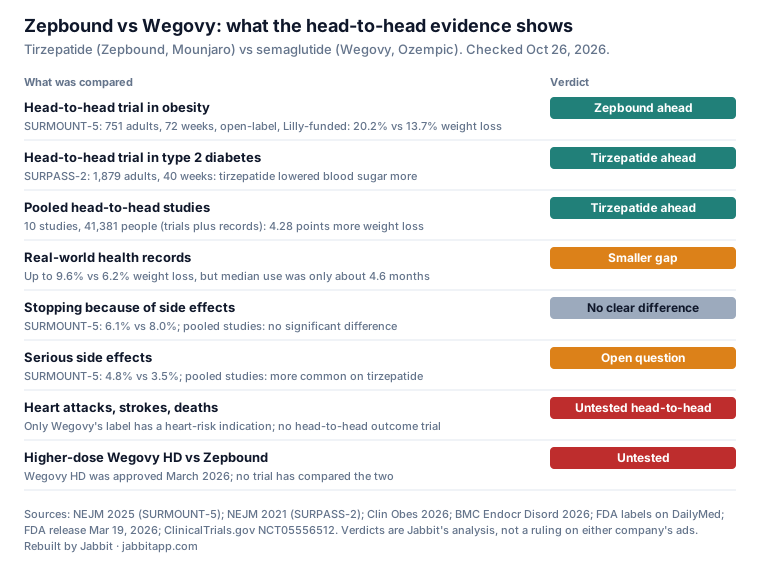
- The head-to-head trial. SURMOUNT-5 randomized 751 adults with obesity, or overweight plus a weight-related condition, without diabetes, in the US and Puerto Rico. Each group took its drug’s highest tolerated dose for 72 weeks. Weight fell 20.2% on tirzepatide vs 13.7% on semaglutide, and waist size fell 18.4 cm vs 13.0 cm.[3][4]
- Diabetes. In SURPASS-2, all three tirzepatide doses beat the semaglutide dose tested for blood sugar, and people lost more weight.[5] Novo’s court motion lists the SURPASS-2 paper and FDA approval letters for higher Wegovy and Ozempic doses among its exhibits, the docket shows.[2]
- Pooled studies. A 2026 meta-analysis of 10 head-to-head studies (41,381 people, including observational studies) found 4.28 percentage points more weight loss on tirzepatide.[6] An updated review of 38 randomized trials reported weight loss beyond placebo of up to 19.0% for tirzepatide and 14.8% for injected semaglutide, but said differences between trials prevented pooling the numbers.[7] A network meta-analysis noted “limited head-to-head evidence, and residual uncertainty.”[8] An indirect comparison by Lilly employees also favored tirzepatide.[9]
- Subgroups. SURMOUNT-5 analyses found similar gaps in 383 people meeting Japan’s obesity-disease criteria (20.1% vs 12.9%), and more people reaching 15% weight loss by week 24 on tirzepatide (44% vs 21%).[13][12]
- Real life. In US health records covering over a million people with anti-obesity drug use, weight loss reached up to 9.6% on tirzepatide and 6.2% on semaglutide; median use was about 4.6 months, far shorter than the trials.[10]
SURMOUNT-5, in one chart
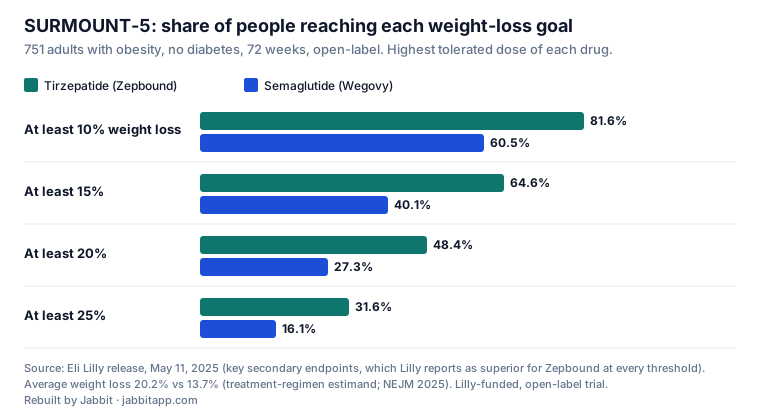
Our analysis: the 50 and 33 pound figures Reuters describes appear to match the average losses Lilly reported for SURMOUNT-5, 50.3 and 33.1 pounds, a result Lilly’s release footnotes as not controlled for multiple testing.[1][4] The percentage results, the trial’s main goal, were tested formally.[3] Whether the ads fairly describe the comparison is for the court to decide, and we take no view on it.
Wegovy HD: the comparison no one has run
SURMOUNT-5 was run before the FDA approved Wegovy HD in March 2026.[3][16] In Novo’s STEP UP trial, the higher dose produced 18.7% weight loss vs 15.6% for the standard dose over 72 weeks, with more stomach side effects and more altered skin sensation (dysaesthesia).[15] The FDA said the skin-sensation reports were common, more frequent at the higher dose, and under further investigation.[16] Our analysis: STEP UP and SURMOUNT-5 enrolled different people, in different countries, with different blinding, so their numbers cannot be lined up to say how Wegovy HD compares with Zepbound. Only a head-to-head trial can answer that, and we found none.[15][3]
The case for Wegovy, in fairness
Wegovy’s label includes reducing the risk of heart attack, stroke and cardiovascular death in adults with established heart disease and obesity or overweight, and a liver indication (MASH); Zepbound’s label lists sleep apnea and does not list a heart-outcome indication.[18][17] Serious side effects were slightly less common on semaglutide in both head-to-head trials and in pooled studies.[3][5][6] Our analysis: for someone with heart disease, the outcome evidence on the label can matter as much as extra weight loss.
Safety
- Serious side effects. In SURMOUNT-5, 4.8% on tirzepatide vs 3.5% on semaglutide had a serious adverse event, with no deaths in either group; in SURPASS-2 it was 5 to 7% vs 3%.[3][5] The 2026 meta-analysis found serious adverse events more frequent with tirzepatide (relative risk 1.83), with overall and stomach side effects similar.[6]
- Stopping because of side effects. 6.1% vs 8.0% in SURMOUNT-5; no significant difference in pooled studies.[3][6]
- Stomach and skin. Nausea was about equal (43.6% vs 44.4%); vomiting was less common on tirzepatide (15.0% vs 21.3%), and injection-site reactions more common (8.6% vs 0.3%).[3]
- Reports to the FDA. A 2026 analysis of FDA adverse-event reports found different reporting patterns for the two drugs, including more low-blood-sugar reports with tirzepatide; the authors call all findings hypothesis-generating.[14]
- Thyroid. Both labels carry a boxed warning about thyroid C-cell tumors in rodents.[17][18]
Healthy aging: what is and isn’t known
In a SURMOUNT-5 analysis of 425 people with prediabetes, 89.9% on tirzepatide vs 76.2% on semaglutide returned to normal blood sugar.[11] Our analysis: that is a promising sign for diabetes prevention, but it is a post hoc analysis of a Lilly-funded trial. No trial has compared the two drugs on heart attacks, strokes or deaths. Lilly’s SURMOUNT-MMO outcome trial of tirzepatide, with 15,374 people, lists primary completion in October 2027.[19]
Legal status
Zepbound and Wegovy are FDA-approved prescription drugs; this page does not compare prices or sellers.[17][18] The lawsuit, Novo Nordisk Inc. v. Eli Lilly and Company, No. 3:26-cv-09027 in the District of New Jersey, is a false-advertising case under the Lanham Act; according to Reuters, Lilly denies wrongdoing.[2][1] When we checked, the October 26 decision was not yet posted on the public docket, so the details here come from Reuters.[2][1]
What a careful reader should notice
These points are our analysis of the sources cited.
- One trial carries the head-to-head case in obesity. It was open-label and Lilly-funded, though its results fit the pooled studies.[3][6]
- A preliminary-injunction ruling is about harm while the case is pending, not about who is right.[1]
- As Reuters describes it, the dispute turns on comparing higher doses of Lilly’s drugs with lower doses of Novo’s. Wegovy HD has not been tested against Zepbound.[1][16][15]
- Real-world weight loss is much smaller than in trials, likely in part because people in health records stayed on the drugs for a median of only about 4.6 months.[10]
- The serious side effect difference is small in absolute terms, but it points the same way in both head-to-head trials and the pooled studies.[3][5][6] Quitting for side effects does not show the same pattern.[3][6]
Frequently asked questions
- Is Zepbound better than Wegovy for weight loss?
- On average, yes in the only head-to-head obesity trial: 20.2% vs 13.7% weight loss over 72 weeks. The trial was open-label and Lilly-funded, and individual results vary.[3]
- What did the judge decide about Lilly’s Zepbound ads?
- Reuters reported on October 26, 2026 that a federal judge denied Novo Nordisk’s request for a preliminary injunction. That is not a final ruling on the ads, and the case continues; Lilly denies wrongdoing.[1][2]
- Where do the 50 vs 33 pound figures come from?
- They appear to match the SURMOUNT-5 averages Lilly reported in 2025, 50.3 vs 33.1 pounds, a result Lilly footnoted as not controlled for multiple testing.[1][4]
- Is Zepbound or Wegovy safer?
- Neither is clearly safer. Serious side effects were somewhat more common on tirzepatide in pooled studies, while slightly fewer people quit it for side effects in SURMOUNT-5.[6][3]
- How does Wegovy HD compare with Zepbound?
- No trial has compared them. Wegovy HD beat the standard Wegovy dose in STEP UP, but comparing across trials is unreliable.[15][16]
- Does either drug lower heart attack risk?
- Wegovy’s label includes reducing major cardiovascular events in adults with heart disease and obesity or overweight. Zepbound’s does not; Lilly’s outcome trial lists completion in 2027.[18][17][19]
- Why do people lose less weight in real life?
- In US health records, median use was about 4.6 months, and losses reached up to 9.6% on tirzepatide and 6.2% on semaglutide.[10]
Bottom line
The trial evidence consistently favors tirzepatide (Zepbound) over standard-dose semaglutide (Wegovy) for weight loss, by about 4 to 7 percentage points, with serious side effects possibly a little more common.[3][6][5] Wegovy has a heart-outcome indication on its label that Zepbound lacks, and higher-dose Wegovy HD has never been tested against Zepbound.[18][17][16] The October 26 ruling left Lilly’s ads in place for now; it did not settle the science or the lawsuit.[1][2]
References
- Stempel J. US judge refuses to block Eli Lilly weight-loss drug ads, rules against Novo Nordisk. Reuters, October 26, 2026, 4:06 PM EDT (syndicated copy; the 25-page decision was not yet on the public docket when we checked): “A US judge rejected on Monday Novo Nordisk's request to block Eli Lilly from continuing advertisements for weight-loss drugs”; the judge “said Novo Nordisk did not deserve a preliminary injunction, having failed to show that Eli Lilly's ads threatened sales, undermined its goodwill, or caused lasting damage to its clinical reputation”; he called the claim of irreparable harm “inadequate to warrant the extraordinary relief it seeks”; “He ruled after a two-day hearing in late August”; Novo “sued Eli Lilly in July, saying ads for the obesity drug Zepbound and diabetes treatment Mounjaro violated federal and state false advertising and unfair competition laws by comparing higher doses of those products with lower doses of Novo Nordisk's Wegovy and Ozempic”; “One commercial included a voiceover claim, with a written disclaimer, that people using Zepbound on average lost 50 pounds (23 kg) while people using Wegovy on average lost 33 pounds (15 kg)”; “Novo Nordisk and its lawyers did not immediately respond to requests for comment. Eli Lilly, based in Indianapolis, has denied wrongdoing and said it was pleased with the decision”; the decision said that “while Novo Nordisk's witnesses were credible, Eli Lilly's ads had at most a negligible impact between April and July, with prescriptions for Novo Nordisk's products remaining stable,” and that “money damages could compensate Novo Nordisk for any ‘nontrivial harm’.” https://www.streetinsider.com/Reuters/US+judge+wont+block+Eli+Lilly+ads+for+weight-loss+drugs%2C+rules+against+Novo+Nordisk/27234058.html. Checked October 26, 2026.
- Novo Nordisk Inc. v. Eli Lilly and Company and Lilly USA, LLC, No. 3:26-cv-09027 (D.N.J.), docket via Justia: filed July 21, 2026; cause of action “15 U.S.C. § 1125” (Lanham Act); filing 8, July 24, 2026, motion for preliminary injunction, with exhibits listed as including the “STEP UP Publication,” the “SURMOUNT-5 Publication,” the “SURPASS 2 Publication,” Zepbound TV ads, and FDA approval letters for higher doses of Wegovy and Ozempic; filing 26, Lilly’s brief in opposition; filings 58 and 59, motion hearing held August 27 and resumed August 28, 2026, “Decision Reserved.” The latest entry listed when we checked was September 1, 2026. https://dockets.justia.com/docket/new-jersey/njdce/3:2026cv09027/603726. Checked October 26, 2026.
- Aronne LJ, Horn DB, le Roux CW, et al. Tirzepatide as Compared with Semaglutide for the Treatment of Obesity. N Engl J Med. 2025;393(1):26-36. PMID 40353578. SURMOUNT-5; NCT05822830. Abstract: “In this phase 3b, open-label, controlled trial”; “A total of 751 participants underwent randomization”; percentage change in weight at week 72 “-20.2% (95% confidence interval [CI], -21.4 to -19.1) with tirzepatide and -13.7% (95% CI, -14.9 to -12.6) with semaglutide (P<0.001)”; “The most common adverse events in both treatment groups were gastrointestinal, and most were mild to moderate in severity and occurred primarily during dose escalation.” “Funded by Eli Lilly; SURMOUNT-5.” Full text, Table 3 (tirzepatide vs semaglutide): serious adverse events 18 (4.8%) vs 13 (3.5%); adverse events leading to death 0 vs 0; discontinuation of trial treatment because of adverse events 23 (6.1%) vs 30 (8.0%); nausea 43.6% vs 44.4%; vomiting 15.0% vs 21.3%; injection-site reaction 8.6% vs 0.3%. Discussion: “A limitation is that the trial was not blinded.” Both groups received each drug’s maximum tolerated dose; we do not reproduce the doses. Abstract and full text read. https://pubmed.ncbi.nlm.nih.gov/40353578/. Checked October 26, 2026. Full text: https://www.nejm.org/doi/full/10.1056/NEJMoa2416394.
- Eli Lilly and Company news release, May 11, 2025, “Zepbound (tirzepatide) showed superior weight loss over Wegovy (semaglutide) in complete SURMOUNT-5 results published in The New England Journal of Medicine”: 20.2% vs 13.7% “at 72 weeks using the treatment-regimen estimand”; “Participants using Zepbound lost an average of 50.3 lbs (22.8 kg) and participants on Wegovy lost an average of 33.1 lbs (15.0 kg)”, footnoted “Not controlled for family-wise type 1 error rate”; key secondary endpoints, at least 10%, 15%, 20% and 25% weight loss: 81.6% vs 60.5%, 64.6% vs 40.1%, 48.4% vs 27.3% and 31.6% vs 16.1%; “6.1% of participants taking Zepbound discontinued treatment due to adverse events, compared to 8.0% of participants taking Wegovy. However, the study was not powered to compare the safety and tolerability of Zepbound and the safety and tolerability of Wegovy”; “The trial randomized 751 participants across the U.S. and Puerto Rico.” The release discloses that the principal investigator is a paid consultant and advisory board member for Lilly and a paid advisory board member for Novo Nordisk. https://investor.lilly.com/news-releases/news-release-details/zepbound-tirzepatide-showed-superior-weight-loss-over-wegovy. Checked October 26, 2026.
- Frías JP, Davies MJ, Rosenstock J, et al. Tirzepatide versus Semaglutide Once Weekly in Patients with Type 2 Diabetes. N Engl J Med. 2021;385(6):503-515. PMID 34170647. SURPASS-2, in type 2 diabetes. Abstract: “In an open-label, 40-week, phase 3 trial, we randomly assigned 1879 patients”; “Tirzepatide at all doses was noninferior and superior to semaglutide”; “Serious adverse events were reported in 5 to 7% of the patients who received tirzepatide and in 3% of those who received semaglutide.” “Funded by Eli Lilly; SURPASS-2.” We do not reproduce the doses. Abstract read. https://pubmed.ncbi.nlm.nih.gov/34170647/. Checked October 26, 2026.
- Paccola GP, de Oliveira RF, Mochetti MM, et al. Comparative Efficacy of Tirzepatide Versus Semaglutide for Weight Loss in Adults With Overweight or Obesity: A Systematic Review and Meta-Analysis of Head-to-Head Studies. Clin Obes. 2026;16(5):e70111. PMID 42670242. Systematic review and meta-analysis of head-to-head studies; Brazil-led. Abstract: “We included randomised controlled trials and observational studies”; “Ten studies including 41 381 participants were analysed”; tirzepatide produced greater percentage weight loss “(MD -4.28 percentage points; 95% CI -5.28 to -3.28; p < 0.00001)”; “There was no significant difference in treatment discontinuation due to adverse events (RR 1.28; p = 0.54), whereas serious adverse events were more frequent with tirzepatide (RR 1.83; p = 0.007)”; “Overall and gastrointestinal adverse events were similar between groups.” Disclosure: “The authors declare no conflicts of interest.” Abstract read. https://pubmed.ncbi.nlm.nih.gov/42670242/. Checked October 26, 2026.
- Moiz A, Filion KB, Samuels AE, et al. Efficacy and Safety of Glucagon-like Peptide-1 Receptor Agonists and Co-agonists for Weight Loss Among Adults Without Diabetes : An Updated Systematic Review. Ann Intern Med. 2026;179(10):1412-1429. PMID 42673585. Updated systematic review. Abstract: “Thirty-eight RCTs (n = 25 816) were included”; placebo-subtracted weight loss reached “-14.8% (CI, -16.2% to -13.4%) for subcutaneous semaglutide” and “-19.0% (CI, -21.6% to -16.4%) for tirzepatide”; head-to-head data showed “greater weight loss with tirzepatide and cagrilintide-semaglutide (CagriSema; Novo Nordisk) than semaglutide”; “Heterogeneity precluded quantitative synthesis.” Abstract read. https://pubmed.ncbi.nlm.nih.gov/42673585/. Checked October 26, 2026.
- Chen D, Ma B, Sun H, et al. Comparative efficacy and safety of glucagon-like peptide 1 based drugs for weight loss in adults with overweight or obesity without diabetes: network meta-analysis of randomised controlled trials. BMJ Med. 2026;5(1):e003026. PMID 42688617. Network meta-analysis. Abstract: “58 trials of 24 214 participants were analysed”; tirzepatide vs placebo “(-19.28%, -20.39% to -18.16%)”; “Differences in tolerability, limited head-to-head evidence, and residual uncertainty, however, should be considered when interpreting comparative treatment effects.” Abstract read. https://pubmed.ncbi.nlm.nih.gov/42688617/. Checked October 26, 2026.
- Ciudin A, Johansson E, Zimner-Rapuch S, et al. Indirect comparative efficacy and safety of tirzepatide vs semaglutide for the treatment of obesity or overweight in patients without type 2 diabetes. Int J Obes (Lond). 2026. PMID 42806056. Indirect comparison of the SURMOUNT-1 and STEP 1 trials through their placebo groups. Abstract: “This indirect treatment comparison (ITC) assessed the relative efficacy and safety of tirzepatide versus the GLP-1 RA semaglutide”; “Safety profiles of tirzepatide and semaglutide were generally similar.” Disclosures include authors who are an “Employee and shareholder of Eli Lilly and Company.” Abstract and disclosures read. https://pubmed.ncbi.nlm.nih.gov/42806056/. Checked October 26, 2026.
- Ruan X, Li R, Wang L, et al. Current status of anti-obesity medications and performance, an EHR based survey. BMC Endocr Disord. 2026;26(1). PMID 42897521. US health records (UT Physicians and Epic Cosmos). Abstract: “71,318 (11·7%) and 1 M (27·9%) individuals documented AOM exposures”; “Tirzepatide and Semaglutide outperformed other AOMs and were associated with up to 9·6[IQR:11]% and 6·2[IQR:11]% weight loss, respectively”; “The median exposure durations were approximately 4·6 months for the two GLP-1/GIP AOMs, far short of the 72-week duration typically required for peak therapeutic benefit in RCTs”; “while Tirzepatide led both cohorts, nearly 50% and 25% of individuals didn't achieve the 10% and 5% weight loss target respectively, after a minimum 72 weeks exposure.” “The authors declare no competing interests.” Abstract read; we rely on the abstract. https://pubmed.ncbi.nlm.nih.gov/42897521/. Checked October 26, 2026.
- Galindo RJ, Aronne LJ, Horn DB, et al. Reversion to normoglycemia with tirzepatide vs semaglutide in participants with obesity and prediabetes: a post hoc analysis of SURMOUNT-5. J Endocrinol Invest. 2026;49(7):1611-1620. PMID 42002673. Post hoc analysis of the Lilly-funded SURMOUNT-5 trial. Abstract: “Participants (N = 425) with baseline prediabetes”; “A greater proportion of tirzepatide-treated participants reverted to normoglycemia (89.9%) vs semaglutide (76.2%).” Abstract read. https://pubmed.ncbi.nlm.nih.gov/42002673/. Checked October 26, 2026.
- Aronne LJ, Horn DB, Kokkinos AD, et al. Relationship of early rapid weight loss to efficacy and safety of tirzepatide and semaglutide for obesity: SURMOUNT-5 post hoc analysis. Am J Med. 2026;139(7):913-921. PMID 41865857. SURMOUNT-5 post hoc analysis. Abstract: “Overall, 32.3% were rapid responders (tirzepatide: 44%, semaglutide: 21%)”; more stomach and liver-related side effects in rapid responders, but “this did not affect rates of study treatment completion relative to non-rapid responders.” Disclosures include fees from multiple companies, including Lilly and Novo Nordisk. Abstract read. https://pubmed.ncbi.nlm.nih.gov/41865857/. Checked October 26, 2026.
- Kitamoto T, Yoshino M, Shingaki T, et al. Tirzepatide compared with semaglutide in obesity disease: a subpopulation analysis applying Japan Society for the Study of Obesity criteria in the global SURMOUNT-5 trial. Curr Med Res Opin. 2026;42(6):1219-1231. PMID 42434924. SURMOUNT-5 subgroup meeting Japan’s obesity-disease criteria. Abstract: “Of 750 participants, 383 met the criteria for obesity disease”; at week 72 weight change was “-20.1%” on tirzepatide vs “-12.9%” on semaglutide. Abstract read. https://pubmed.ncbi.nlm.nih.gov/42434924/. Checked October 26, 2026.
- Liu X, Wang W. Real-World Adverse Event Reporting Patterns of Tirzepatide Versus Semaglutide: A Stratified Study of General and Healthcare Professional Cohorts in FAERS. Diabetes Obes Metab. 2026. PMID 42768828. Analysis of FDA Adverse Event Reporting System reports, May 2022 to June 2026. Abstract: “tirzepatide showed higher hypoglycaemia reporting (RORR 1.91, 95% CI 1.49-2.44)”; “all findings are hypothesis-generating and require confirmation with defined exposure denominators.” Abstract read. https://pubmed.ncbi.nlm.nih.gov/42768828/. Checked October 26, 2026.
- Wharton S, Freitas P, Hjelmesæth J, et al. Once-weekly semaglutide 7·2 mg in adults with obesity (STEP UP): a randomised, controlled, phase 3b trial. Lancet Diabetes Endocrinol. 2025;13(11):949-963. PMID 40961952. STEP UP; NCT05646706. Abstract: “STEP UP was a phase 3b, randomised, double-blind, placebo-controlled and active-controlled trial conducted across 95 hospitals, specialist clinics, and medical centres in 11 countries in adults with BMI 30 kg/m2 or greater, without diabetes”; “1407 participants were randomly assigned”; the higher dose vs the standard dose: “(-18·7% [SE 0·4] vs -15·6% [0·7]; estimated treatment difference [ETD] -3·1% [95% CI -4·7 to -1·6]; p<0·0001)”; gastrointestinal adverse events 70·8% vs 61·2%, and dysaesthesia (altered skin sensation) 22·9% vs 6·0%. Funding: Novo Nordisk. Abstract read; we do not reproduce the doses. https://pubmed.ncbi.nlm.nih.gov/40961952/. Checked October 26, 2026.
- US Food and Drug Administration press announcement, March 19, 2026, “FDA Approves Fourth Product Under National Priority Voucher Program, Higher Dose Semaglutide”: approval of Wegovy HD “was supported by clinical data demonstrating that the higher dose resulted in additional average weight reduction compared to previously approved doses”; “Reports of altered skin sensation (described as sensitivity, pain, or burning) were common, occurred more frequently at the higher Wegovy dosage than lower dosages”; “The FDA is currently conducting further investigations regarding this drug reaction.” https://www.fda.gov/news-events/press-announcements/fda-approves-fourth-product-under-national-priority-voucher-program-higher-dose-semaglutide. Checked October 26, 2026.
- Zepbound (tirzepatide) injection, US prescribing information, Eli Lilly and Company, DailyMed (set ID 487cd7e7-434c-4925-99fa-aa80b1cc776b): boxed “WARNING: RISK OF THYROID C-CELL TUMORS”; “It is unknown whether ZEPBOUND causes thyroid C-cell tumors”; indications include weight reduction and, “to treat moderate to severe obstructive sleep apnea (OSA) in adults with obesity.” The indications section does not list a cardiovascular-event indication. https://dailymed.nlm.nih.gov/dailymed/drugInfo.cfm?setid=487cd7e7-434c-4925-99fa-aa80b1cc776b. Checked October 26, 2026.
- Wegovy (semaglutide) injection and tablets, US prescribing information, Novo Nordisk, DailyMed (set ID ee06186f-2aa3-4990-a760-757579d8f77b): boxed “WARNING: RISK OF THYROID C-CELL TUMORS”; “It is unknown whether WEGOVY causes thyroid C-cell tumors”; indications include “to reduce the risk of major adverse cardiovascular (CV) events (CV death, non-fatal myocardial infarction, or non-fatal stroke) in adults with established CV disease and either obesity or overweight,” weight reduction, and (injection) “for the treatment of noncirrhotic metabolic dysfunction-associated steatohepatitis (MASH)” with moderate to advanced liver fibrosis. https://dailymed.nlm.nih.gov/dailymed/drugInfo.cfm?setid=ee06186f-2aa3-4990-a760-757579d8f77b. Checked October 26, 2026.
- ClinicalTrials.gov NCT05556512, “A Study of Tirzepatide (LY3298176) on the Reduction on Morbidity and Mortality in Adults With Obesity” (SURMOUNT-MMO; sponsor Eli Lilly and Company): status active, not recruiting; enrollment 15,374 (actual); primary completion October 2027 (estimated). https://clinicaltrials.gov/study/NCT05556512. Checked October 26, 2026.
- Jabbit source extract for this page: quotes, label text, trial tables and registry fields checked against the cached sources on October 26, 2026. https://jabbitapp.com/research/sources/zepbound-vs-wegovy-2026-10-26.json. Checked October 26, 2026.
This page analyzes published studies, FDA labels and releases, a public court docket and news reports. It is not medical or legal advice, does not recommend any product or dose, and takes no position on the pending lawsuit. Charts were rebuilt by Jabbit from the sources cited in each caption.