Study teardown · Semaglutide (Ozempic, Wegovy), tirzepatide (Mounjaro, Zepbound) and other GLP-1 drugs · Cancer risk · Meta-analyses of randomized trials, health-record studies, FDA labels and trial registries · Sources checked October 27, 2026
Published · Updated
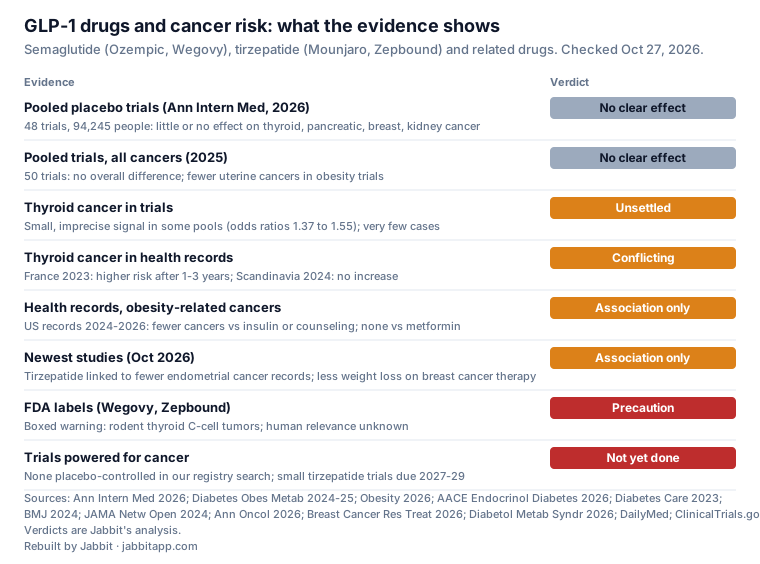
Do Ozempic, Wegovy or Zepbound raise or lower cancer risk? Pooled placebo-controlled trials show little or no effect on most cancers either way, while health-record studies link GLP-1 drugs to fewer obesity-related cancers, which cannot prove prevention. Thyroid cancer is still unsettled: the labels carry a boxed warning based on rodent studies, and human studies conflict. New in October 2026: a tirzepatide endometrial cancer study, a cancer review, and a breast cancer clinic study that found much less weight loss than in the big trials.
The short answer: so far, randomized trials do not show that GLP-1 drugs cause or prevent cancer. A 2026 pool of 48 placebo-controlled trials, with 94,245 people, found they “probably have little or no effect” on thyroid, pancreatic, breast or kidney cancer, while noting the trials “were not designed to evaluate cancer outcomes and had short follow-up.”[4] Health-record studies report fewer obesity-related cancers on these drugs, but those are associations, and the results change with the comparison group.[11][12] Thyroid cancer is the open question, and the Wegovy and Zepbound labels carry a boxed warning about it.[15][16]
Why this matters now
Three papers published in October 2026 revisit GLP-1 drugs and cancer. On October 13, a study of US health records reported that women with overweight or obesity who started tirzepatide had about 28% fewer new endometrial cancer diagnoses in the short term than matched women who started lifestyle programs; the authors say their “observational findings do not establish a preventive effect.”[3] A review in Obesity Reviews, indexed October 22, concludes that GLP-1 drugs “do not increase overall cancer risk and may reduce the risk of certain obesity-related cancers,” while flagging thyroid safety concerns.[2] And a breast cancer study indexed October 26 found that 269 patients on hormone-blocking (endocrine) therapy lost an average of 4.5% of their weight in a year on GLP-1 drugs, well below the 10% to 20% the authors cite from postmenopausal groups in the big trials.[1]
Our analysis: interest in GLP-1 drugs as cancer prevention is running ahead of the evidence. The strongest data, randomized trials, point to little or no effect so far, mainly because those trials were short and not built to count cancers.[4]
Timeline
| Date | Event |
|---|---|
| Approval to date | Wegovy and Zepbound labels carry a boxed warning: the drugs cause thyroid C-cell tumors in rodents, and whether they do in humans is unknown.[15][16] |
| 2022-2023 | A French national study links 1 to 3 years of GLP-1 use with more thyroid cancer, including medullary thyroid cancer.[9] |
| 2023-2024 | A trial meta-analysis finds a small, fragile thyroid signal; a Scandinavian cohort of over 145,000 GLP-1 users finds no increase.[8][10] |
| July 2024 | US health records in type 2 diabetes link GLP-1 drugs to lower risk of 10 of 13 obesity-associated cancers vs insulin, but not vs metformin.[12] |
| 2025 | A 50-trial meta-analysis finds no overall cancer difference, and fewer uterine cancers in obesity trials.[5] |
| Late 2025 to mid 2026 | A 48-trial Annals of Internal Medicine meta-analysis finds little or no effect on most cancers; record studies in people without diabetes report fewer cancers.[4][11][14] |
| October 13-26, 2026 | The tirzepatide endometrial cancer study, the Obesity Reviews review and the breast cancer weight-loss study are published.[3][2][1] |
| 2027-2029 | Small tirzepatide trials in breast and endometrial cancer list primary completion dates.[17][18][19] |
The evidence, rung by rung
What randomized trials show
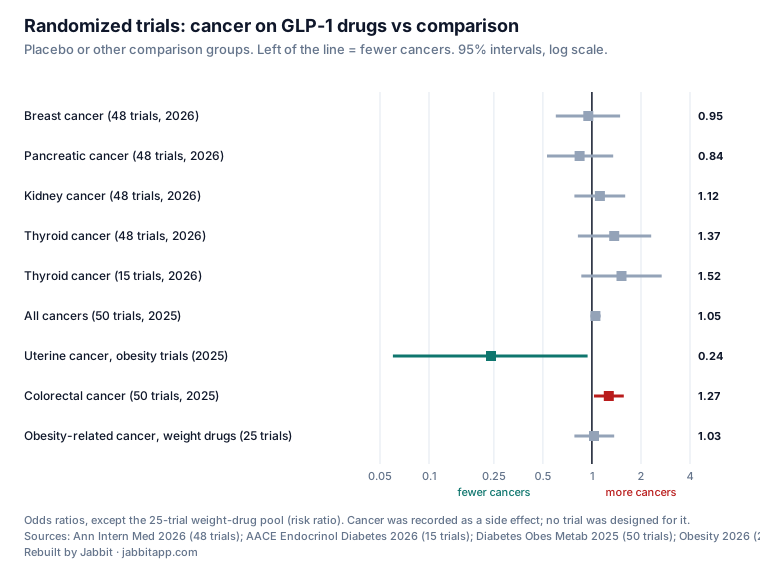
- Most cancers: little or no effect. In 48 placebo-controlled trials, odds ratios for thyroid, pancreatic, breast and kidney cancer all crossed 1, rated moderate certainty. In absolute terms, the thyroid estimate runs from 1 fewer to 9 more cases per 10,000 people treated. Results held for semaglutide and tirzepatide separately.[4]
- All cancers combined: no difference. A 50-trial meta-analysis found no overall change (odds ratio 1.05).[5] A 25-trial pool of weight-loss medicines found no link with obesity-related cancer (risk ratio 1.03).[6]
- Possible bright spots. Uterine cancer was less common on GLP-1 drugs in obesity trials (odds ratio 0.24), though with a wide range and few cases.[5] A subgroup of combination drugs, including tirzepatide, showed fewer obesity-related cancers (risk ratio 0.43, range 0.19 to 0.97).[6] Subgroup results like these are less reliable than the main results.
- Colorectal: likely more looking, not more cancer. The 50-trial analysis saw slightly more colorectal cancer only in shorter trials, and its authors suggest more diagnostic procedures in the drug groups may explain it.[5]
Thyroid cancer: the open question
Both labels say the drug caused thyroid C-cell tumors in rodents and that “it is unknown” whether it does in humans. They rule out use in people with a personal or family history of medullary thyroid carcinoma (MTC) or MEN 2, and list warning symptoms: a lump in the neck, trouble swallowing, shortness of breath or lasting hoarseness.[15][16]
- Trials: pooled estimates sit around 1.4 to 1.6 times the odds. One 2024 analysis was just significant, with a fragility index of 1, meaning one fewer case would erase significance; it estimated 1 extra case per 1,349 people treated for 5 years.[8] A 2026 analysis of 15 trials counted 28 vs 15 cases, found no significant link and rated certainty very low, but said it cannot rule out “a clinically relevant increase.”[7]
- Health records: a French study linked 1 to 3 years of use with more thyroid cancer (hazard ratio 1.58) and more MTC (1.78).[9] A Scandinavian cohort found no increase (0.93), with MTC too rare to call (1.19, range 0.37 to 3.86).[10]
- Screening: the labels say routine calcitonin blood tests or thyroid ultrasound are “of uncertain value” for catching MTC early.[15][16] See our thyroid monitoring guide.
Our analysis: people on these drugs may see doctors and get scans more often, which could turn up small thyroid cancers that would otherwise go unnoticed. None of the studies above settles this, so the label precautions stand.
What health records show
- People with obesity and without diabetes. In 161,798 matched US patients, GLP-1 users had 41% fewer obesity-associated cancers over a median of 2 years than people given diet or exercise counseling. The lower rate held in every subgroup except Black patients, and the authors say “prospective trials are needed to confirm causality.”[11]
- The comparison group matters. In 1.65 million people with type 2 diabetes, GLP-1 drugs were linked to lower risk of 10 of 13 obesity-associated cancers compared with insulin. Compared with metformin, there was no lower risk for any cancer, and kidney cancer was more common (hazard ratio 1.54).[12]
- Semaglutide vs tirzepatide. Against DPP-4 inhibitor diabetes pills, semaglutide was linked to 12% fewer obesity-associated cancers; tirzepatide’s estimate was similar but not significant.[13]
- Against surgery. One study found fewer colorectal and pancreatic cancers with full-strength GLP-1 treatment than after bariatric surgery, but no significant difference when all strengths were counted.[14]
- Endometrial cancer, October 2026. Tirzepatide users had a hazard ratio of 0.717 for new endometrial cancer diagnoses vs matched women who started lifestyle programs, which the authors call a short-term association.[3]
Breast cancer: the newest study
Women on endocrine therapy after breast cancer often struggle with weight. In the October 2026 single-center study, only 21.3% of 269 patients on a GLP-1 drug lost 10% or more of their weight in a year. Semaglutide and tirzepatide users lost more (5.8% and 4.7%) than dulaglutide users, and patients with progesterone receptor-negative tumors lost more than those with receptor-positive tumors. Most of the patients (70.6%) had type 2 diabetes, and the authors call for prospective trials.[1]
On cancer risk itself, the 48-trial pool found little or no effect on breast cancer, and a large diabetes record study found no lower risk of postmenopausal breast cancer.[4][12] Whether these drugs change breast cancer outcomes is being tested only in small trials so far (see below). Decisions during cancer treatment belong with the oncology team.
Healthy aging: why this matters for longevity
Researchers count 13 cancers as obesity-associated, meaning excess body fat raises their risk, which is why researchers are asking whether drug-driven weight loss lowers that risk.[12][11] Cancer usually takes years to develop, though, while most trials and record studies here followed people for about two to three years.[4][11][13] The review authors also flag an open question for long-term health: what happens to any benefit if weight comes back after stopping treatment.[2] Our analysis: for healthy aging, the reassuring part is that trials so far show no broad cancer increase; the hoped-for prevention benefit is unproven.
The case for caution
The trials pooled were built to test weight or blood sugar, not cancer, and were short.[4] Health-record studies compare people who were prescribed GLP-1 drugs with people who were not, and the result changes with the comparison: favorable against insulin or counseling, neutral against metformin.[12][11] Several of the record studies draw on the same US research network, TriNetX.[11][13][14][3] Thyroid findings conflict across countries and designs.[9][10] Some meta-analysis authors disclose fees from drug makers, outside the submitted work.[5][6]
Trials coming
- CLARA (University Hospitals Leuven, Belgium): randomized phase 2 trial of tirzepatide with letrozole in 168 people with breast cancer, measuring a tumor growth marker (Ki67); primary completion listed as March 2028.[17]
- Breast cancer, US: a Baylor phase 2 trial in 48 people tracks circulating tumor DNA and distant recurrence through 2029; Rutgers and Weill Cornell trials of 40 and 30 people test feasibility and weight loss.[18]
- Endometrial: a US National Cancer Institute trial pairs tirzepatide with a progestin IUD in 55 people, and a UNC randomized trial in 40 people measures tumor-cell growth; both list 2029 completion dates.[19]
- None of the registry records we checked is placebo-controlled or large enough to answer whether these drugs prevent cancer.[17][18][19]
What a careful reader should notice
These points are our analysis of the sources cited.
- “Little or no effect” in trials and “fewer cancers” in records can both be true: the trials were short and small for cancer counts, and records carry confounding.[4][11]
- A record study’s comparison group can flip its message.[12]
- The thyroid trial signal is fragile: a handful of cases decides significance.[8][7]
- Subgroup wins, such as uterine cancer or combination drugs, need confirmation.[5][6]
- The October endometrial study calls its own result an association, not prevention.[3]
- The breast cancer study was retrospective, at one center, mostly in people with diabetes.[1]
Frequently asked questions
- Does Ozempic or Wegovy cause cancer?
- A 2026 analysis of 48 placebo-controlled trials found semaglutide and similar drugs probably have little or no effect on thyroid, pancreatic, breast or kidney cancer. The trials were short and not designed for cancer.[4]
- Does Zepbound or Mounjaro cause thyroid cancer?
- Tirzepatide caused thyroid C-cell tumors in rats, and the label says it is unknown whether it does in humans. Human studies conflict, and the label rules out use with a personal or family history of MTC or MEN 2.[16][7][10][9]
- Can GLP-1 drugs prevent cancer?
- Unproven. Health-record studies link them to fewer obesity-related cancers, but those are associations, and placebo-controlled trials so far show little or no effect.[11][3][4]
- Does tirzepatide lower endometrial cancer risk?
- An October 2026 record study found about 28% fewer new diagnoses on tirzepatide vs lifestyle programs, and a trial pool found fewer uterine cancers in obesity trials. Neither proves prevention.[3][5]
- Do GLP-1 drugs work for weight loss during breast cancer treatment?
- In one 2026 study of 269 women on endocrine therapy, average one-year weight loss was 4.5%, well below big-trial results. Prospective trials are under way; treatment decisions belong with the oncology team.[1][17][18]
- Should I get calcitonin tests or a thyroid ultrasound on these drugs?
- The Wegovy and Zepbound labels say routine calcitonin or thyroid ultrasound is of uncertain value for catching MTC early. Report a neck lump, trouble swallowing or lasting hoarseness to a doctor.[15][16]
Bottom line
Pooled randomized trials so far show no broad increase or decrease in cancer on Ozempic, Wegovy, Zepbound or similar drugs.[4][5] Health-record studies, including the October 2026 tirzepatide endometrial study, link the drugs to fewer obesity-related cancers, but cannot prove prevention.[11][3] Thyroid cancer remains unsettled and the boxed warning stands.[15][16][7] Our analysis: for longevity, the cancer case for these drugs is a hypothesis to test, not a reason to start one.
References
- Cronin KM, Tiersten A. GLP-1 receptor agonist-associated weight loss in breast cancer patients receiving concurrent endocrine therapy: a retrospective cohort analysis. Breast Cancer Res Treat. 2026;220(1). PMID 42932003. Retrospective single-center cohort; PubMed record dated October 26, 2026; doi 10.1007/s10549-026-08096-z. Abstract: “We conducted a retrospective cohort analysis of 269 breast cancer patients at a single academic center receiving concurrent GLP-1 RA and adjuvant endocrine therapy”; “Mean one-year percentage weight loss was - 4.5% (95% CI: -6.0% to - 3.0%; -3.9 kg; 95% CI: -4.96 to - 2.93 kg), significantly below the 10-20% observed in postmenopausal subgroups of GLP-1 randomized trials (all p < 0.001)”; “Only 21.3% achieved ≥ 10% and 10.4% achieved ≥ 15% weight loss”; “semaglutide (- 5.8%) and tirzepatide (- 4.7%) outperformed dulaglutide (+ 0.1%), which is approved for type 2 diabetes only”; “PR-negative patients lost more than PR-positive patients (- 8.2% vs. -4.2%; p = 0.021, d = 0.46)”; “Type 2 diabetes was present in 70.6% of patients”; “prospective trials are needed.” Disclosure: “The authors declare no competing interests.” Abstract read. https://pubmed.ncbi.nlm.nih.gov/42932003/. Checked October 27, 2026.
- Hofseth LJ, Murphy EA, Playdon MC, et al. GLP-1 Receptor Agonists and Cancer Risk in Obesity Treatment. Obes Rev. 2026. PMID 42906947. Narrative review; PubMed record dated October 22, 2026; doi 10.1111/obr.70247. Abstract: “To date, data suggest that GLP-1 RAs do not increase overall cancer risk and may reduce the risk of certain obesity-related cancers”; the authors note “specific safety concerns (e.g., increased risk of medullary thyroid carcinoma)” and that “questions remain about the beneficial effects of weight loss and the sustainability of health benefits if weight is regained after stopping treatment.” The PubMed record lists US National Cancer Institute grant support and no disclosure statement. Abstract read. https://pubmed.ncbi.nlm.nih.gov/42906947/. Checked October 27, 2026.
- Kao PN, Lai CC, Wu JY. Tirzepatide use and the risk of endometrial cancer in women with overweight or obesity: a retrospective cohort study. Diabetol Metab Syndr. Published October 13, 2026. doi 10.1186/s13098-026-02329-3. Open access; not yet indexed in PubMed when checked. Abstract: “Using the TriNetX US Collaborative Network, we identified women with overweight or obesity who initiated tirzepatide (study group) or lifestyle modification interventions (control group) between January 1, 2022, and December 31, 2025”; “After matching, 176,981 patients were included in each group”; “tirzepatide use was associated with a lower hazard of newly recorded EC diagnoses compared with the comparator cohort (HR, 0.717; 95% CI, 0.593–0.867)”; “Tirzepatide use was associated with a lower short-term hazard of newly recorded EC diagnoses among women with overweight or obesity. These observational findings do not establish a preventive effect, and longer-term studies are needed to assess whether the association persists.” Funding: “This research received no external funding.” Competing interests: none declared. https://link.springer.com/article/10.1186/s13098-026-02329-3. Checked October 27, 2026.
- Ko A, Chang YC, Bahar F, et al. Risk for Cancer With Glucagon-Like Peptide-1 Receptor Agonists and Dual Agonists : A Systematic Review and Meta-analysis. Ann Intern Med. 2026;179(2):216-229. PMID 41359966. Systematic review and meta-analysis of placebo-controlled randomized trials with GRADE certainty ratings. Abstract: “The review included 48 trials involving 94 245 participants”; “GLP-1RAs probably have little or no effect on risk for thyroid cancer (OR, 1.37 [95% CI, 0.82 to 2.31]; 1 fewer to 9 more cases per 10 000 patients treated), pancreatic cancer (OR, 0.84 [CI, 0.53 to 1.35]; 9 fewer to 6 more per 10 000), breast cancer (OR, 0.95 [CI, 0.60 to 1.49]; 10 fewer to 12 more per 10 000), or kidney cancer (OR, 1.12 [CI, 0.78 to 1.60]; 5 fewer to 13 more per 10 000) (moderate certainty)”; “GLP-1RAs may have little or no effect on colorectal, esophageal, liver, gallbladder, ovarian, or endometrial cancer; multiple myeloma; or meningioma (low certainty)”; “The effect on gastric cancer is very uncertain”; “Results were consistent in sensitivity analyses of trials with low risk of bias and studies of semaglutide or tirzepatide”; “The included trials were not designed to evaluate cancer outcomes and had short follow-up.” Primary funding source: none. Abstract read. https://pubmed.ncbi.nlm.nih.gov/41359966/. Checked October 27, 2026.
- Silverii GA, Marinelli C, Bettarini C, et al. GLP-1 receptor agonists and the risk for cancer: A meta-analysis of randomized controlled trials. Diabetes Obes Metab. 2025;27(8):4454-4468. PMID 40437949. Meta-analysis of randomized trials of GLP-1 drugs vs any comparator, lasting at least 52 weeks. Abstract: “Fifty trials were included”; “GLP-1RA treatment was not associated with a significant difference in risk for overall cancer (MH-OR 1.05, 95% confidence interval [CI] [0.98, 1.13])”; “Uterine cancer was significantly reduced in the GLP-1RA arm in trials performed in subjects with obesity (MH-OR 0.24, 95% CI [0.06, 0.94]), but not in those aimed at diabetes treatment (MH-OR 0.92, [0.58, 1.47])”; “We detected an increase in the risk for thyroid cancer (MH-OR 1.55, [1.05, 2.27]), more evident in longer-term trials, and in the risk for colorectal cancer (MH-OR 1.27 [1.03, 1.57]), which, conversely, was significant only in shorter-term trials”; the authors suggest the colorectal finding “may be the effect of a disproportionate increase in diagnostic procedures in the GLP-1 RA arm.” Disclosures include speaking or consultancy fees from drug makers including Eli Lilly and Novo Nordisk, “outside the submitted work.” Abstract read. https://pubmed.ncbi.nlm.nih.gov/40437949/. Checked October 27, 2026.
- Li C, Lin C, Cai X, et al. Weight Loss, Obesity Medication, and Risk of Obesity-Associated Cancer: A Meta-Analysis of Randomized Controlled Trials. Obesity (Silver Spring). 2026;34 Suppl 2(Suppl 2):16-24. PMID 41189318. Meta-analysis of randomized trials of anti-obesity medicines. Abstract: “The analysis included 25 randomized controlled trials with 40,731 participants”; “Compared with placebo, AOMs showed no association with the risk of overall obesity-related cancer (RR = 1.03, 95% CI: 0.78 to 1.37) or site-specific cancer”; a “subgroup analysis revealed that coagonists (tirzepatide, cotadutide, and cagrilintide) significantly reduced overall obesity-associated cancer risk (RR = 0.43, 95% CI: 0.19 to 0.97).” One author discloses lecture and consulting fees from several drug makers, including Eli Lilly. Abstract read. https://pubmed.ncbi.nlm.nih.gov/41189318/. Checked October 27, 2026.
- Eisa N, Barood O. Incretin-Based Therapy and Thyroid Cancer Risk: A Systematic Review and Meta-Analysis of Randomized Controlled Trials. AACE Endocrinol Diabetes. 2026;13(3):400-409. PMID 42221413. Meta-analysis of randomized trials (at least 26 weeks) of GLP-1 drugs and dual GIP/GLP-1 drugs vs control groups. Abstract: “Fifteen RCTs enrolling 84 237 participants were included”; “28 thyroid cancer events occurred in the incretin-based therapy groups and 15 in the control groups”; “odds ratio 1.52, 95% CI 0.86-2.68; I2 = 0.0%”; “Certainty of evidence was rated very low due to serious imprecision related to rare events”; “limited follow-up and imprecision prevent exclusion of a clinically relevant increase, supporting the need for long-term surveillance.” Authors report no conflicts. Abstract read. https://pubmed.ncbi.nlm.nih.gov/42221413/. Checked October 27, 2026.
- Silverii GA, Monami M, Gallo M, et al. Glucagon-like peptide-1 receptor agonists and risk of thyroid cancer: A systematic review and meta-analysis of randomized controlled trials. Diabetes Obes Metab. 2024;26(3):891-900. PMID 38018310. Meta-analysis of randomized trials and thyroid cancer. Abstract: “We retrieved 64 trials, 26 of which reported at least one incident case of thyroid cancer”; “GLP-1RA treatment was associated with a significant increase in the risk of overall thyroid cancer (Mantel-Haenzel odds ratio [MH-OR] 1.52 [95% confidence interval {CI} 1.01, 2.29]; P = 0.04, I2 = 0%), with a fragility index of 1, and a 5-year number needed to harm of 1349”; “No significant association was found for papillary thyroid cancer (MH-OR 1.54 [95% CI 0.77, 3.06]; P = 0.22) or medullary thyroid cancer (MH-OR 1.44 [95% CI 0.23, 9.16]; P = 0.55).” Abstract read. https://pubmed.ncbi.nlm.nih.gov/38018310/. Checked October 27, 2026.
- Bezin J, Gouverneur A, Pénichon M, et al. GLP-1 Receptor Agonists and the Risk of Thyroid Cancer. Diabetes Care. 2023;46(2):384-390. PMID 36356111. Nested case-control study, French national health data, people with type 2 diabetes. Abstract: “A total of 2,562 case subjects with thyroid cancers were included in the study and matched with 45,184 control subjects”; “Use of GLP-1 RA for 1-3 years was associated with increased risk of all thyroid cancer (adjusted hazard ratio [HR] 1.58, 95% CI 1.27-1.95) and medullary thyroid cancer (adjusted HR 1.78, 95% CI 1.04-3.05).” Abstract read. https://pubmed.ncbi.nlm.nih.gov/36356111/. Checked October 27, 2026.
- Pasternak B, Wintzell V, Hviid A, et al. Glucagon-like peptide 1 receptor agonist use and risk of thyroid cancer: Scandinavian cohort study. BMJ. 2024;385:e078225. PMID 38683947. Cohort study, Denmark, Norway and Sweden, GLP-1 drugs vs DPP-4 inhibitors. Abstract: “76 of 145 410 patients (incidence rate 1.33 events per 10 000 person years) treated with GLP1 receptor agonists and 184 of 291 667 patients (incidence rate 1.46 events per 10 000 person years) treated with DPP4 inhibitors developed thyroid cancer”; “GLP1 receptor agonist use was not associated with increased risk of thyroid cancer (hazard ratio 0.93, 95% confidence interval 0.66 to 1.31; rate difference -0.13, 95% confidence interval -0.61 to 0.36 events per 10 000 person years)”; “The hazard ratio for medullary thyroid cancer was 1.19 (0.37 to 3.86).” Abstract read. https://pubmed.ncbi.nlm.nih.gov/38683947/. Checked October 27, 2026.
- Hsu AH, Ramirez PT, Chang YH, et al. GLP-1 receptor agonist use and cancer risk in obese nondiabetic adults. Ann Oncol. 2026;37(8):1178-1185. PMID 42252247. Target-trial emulation in US health records (TriNetX), adults with obesity and without diabetes. Abstract: “Patients prescribed GLP-1RAs were 1:1 propensity score matched to those receiving diet or exercise counseling”; “the study cohort included 161 798 patients: 80 899 GLP-1RA users versus 80 899 patients on diet or exercise consultation”; “With a median follow-up of 2 years (interquartile range 1-2 years), the propensity score matching analysis showed a significantly lower incidence of any OACs among GLP-1RA users (hazard ratio 0.59, 95% confidence interval 0.53-0.67)”; “in all subgroups, except for black race, GLP-1RA use was associated with a lower cumulative incidence of OACs”; “Prospective trials are needed to confirm causality.” Disclosure: “The authors have declared no conflicts of interest.” Abstract read. https://pubmed.ncbi.nlm.nih.gov/42252247/. Checked October 27, 2026.
- Wang L, Xu R, Kaelber DC, et al. Glucagon-Like Peptide 1 Receptor Agonists and 13 Obesity-Associated Cancers in Patients With Type 2 Diabetes. JAMA Netw Open. 2024;7(7):e2421305. PMID 38967919. Retrospective cohort, nationwide US multicenter health records, 1,651,452 people with type 2 diabetes, 13 obesity-associated cancers (OACs). Abstract: “GLP-1RAs compared with insulin were associated with a significant risk reduction in 10 of 13 OACs”; “GLP-1RAs were not associated with a reduced risk of postmenopausal breast cancer or thyroid cancer”; “Compared with metformin, GLP-1RAs were not associated with a decreased risk of any cancers, but were associated with an increased risk of kidney cancer (HR, 1.54; 95% CI, 1.27-1.87).” Abstract read. https://pubmed.ncbi.nlm.nih.gov/38967919/. Checked October 27, 2026.
- Ipaye T, Goldney J, Wilkinson TJ, et al. Weight loss interventions and obesity-associated cancers in people with type 2 diabetes and overweight/obesity: A real-world observational study. Diabetes Obes Metab. 2025;27(12):6914-6926. PMID 40903861. Target-trial emulation, US health records, type 2 diabetes and obesity; semaglutide, tirzepatide or bariatric surgery vs DPP-4 inhibitors. Abstract: “In 64,178 matched pairs (mean follow-up 911 days), semaglutide (vs. DPP-4i) was associated with lower rates of composite OAC (HR: 0.88; 95% CI: 0.82-0.95)”; “tirzepatide (vs. DPP-4i) was associated with a non-significant lower rate of composite OAC (0.84; 0.69-1.01).” Abstract read. https://pubmed.ncbi.nlm.nih.gov/40903861/. Checked October 27, 2026.
- Bitar ER, Besir K, Cummins KC, et al. Cancer risk of glucagon-like peptide-1 receptor agonists for obesity: comparison with bariatric surgery and other weight-loss drugs. J Gastrointest Surg. 2026;30(9):102497. PMID 42447648. Retrospective cohort, US health records, adults with obesity and without diabetes; GLP-1 drugs vs bariatric surgery and other weight-loss drugs. Abstract: “Compared with bariatric surgery, therapeutic-dose GLP-1 RA use was associated with a lower incidence of CRC (hazard ratio [HR], 0.72; P =.038) and pancreatic cancer (HR, 0.63; P =.041), but not HCC”; “The use of any dose was not associated with significant differences.” Abstract read. https://pubmed.ncbi.nlm.nih.gov/42447648/. Checked October 27, 2026.
- Wegovy (semaglutide) injection and tablets, US prescribing information, Novo Nordisk, DailyMed (set ID ee06186f-2aa3-4990-a760-757579d8f77b), boxed warning, Contraindications and Warnings 5.1: “In rodents, semaglutide causes dose-dependent and treatment-duration-dependent thyroid C-cell tumors at clinically relevant exposures”; “It is unknown whether WEGOVY causes thyroid C-cell tumors, including medullary thyroid carcinoma (MTC), in humans as human relevance of semaglutide-induced rodent thyroid C-cell tumors has not been determined”; “WEGOVY is contraindicated in patients with a personal or family history of MTC or in patients with Multiple Endocrine Neoplasia syndrome type 2 (MEN 2)”; patients should be informed “of symptoms of thyroid tumors (e.g., a mass in the neck, dysphagia, dyspnea, persistent hoarseness)”; “Routine monitoring of serum calcitonin or using thyroid ultrasound is of uncertain value for early detection of MTC in patients treated with WEGOVY.” https://dailymed.nlm.nih.gov/dailymed/drugInfo.cfm?setid=ee06186f-2aa3-4990-a760-757579d8f77b. Checked October 27, 2026.
- Zepbound (tirzepatide) injection, US prescribing information, Eli Lilly, DailyMed (set ID 487cd7e7-434c-4925-99fa-aa80b1cc776b), boxed warning, Contraindications and Warnings 5.1: “In rats, tirzepatide causes dose-dependent and treatment-duration-dependent thyroid C-cell tumors at clinically relevant exposures”; “It is unknown whether ZEPBOUND causes thyroid C-cell tumors, including medullary thyroid carcinoma (MTC), in humans as human relevance of tirzepatide-induced rodent thyroid C-cell tumors has not been determined”; contraindicated with “a personal or family history of MTC” or MEN 2; “Routine monitoring of serum calcitonin or using thyroid ultrasound is of uncertain value for early detection of MTC in patients treated with ZEPBOUND.” https://dailymed.nlm.nih.gov/dailymed/drugInfo.cfm?setid=487cd7e7-434c-4925-99fa-aa80b1cc776b. Checked October 27, 2026.
- ClinicalTrials.gov NCT07676331, CLARA trial (sponsor University Hospitals Leuven, Belgium): phase 2, randomized, open-label (no masking listed), tirzepatide and letrozole in people with breast cancer; primary outcome Ki67 proliferation marker; status not yet recruiting; enrollment 168 (estimated); primary completion March 1, 2028 (estimated). https://clinicaltrials.gov/study/NCT07676331. Checked October 27, 2026.
- ClinicalTrials.gov tirzepatide breast cancer trials, none placebo-controlled: NCT06517212 (Baylor Research Institute; phase 2, single group, 48 people with node-positive HR-positive, HER2-negative early breast cancer and obesity or overweight; primary outcomes circulating tumor DNA and distant disease-free survival; recruiting; primary completion August 31, 2029), https://clinicaltrials.gov/study/NCT06517212; NCT06518837 (FITWISE, Rutgers; phase 2 feasibility, 40 people; recruiting; September 30, 2027), https://clinicaltrials.gov/study/NCT06518837; NCT07257484 (Weill Cornell; phase 4, 30 postmenopausal HR-positive survivors; primary outcome visit completion; recruiting; December 3, 2027), https://clinicaltrials.gov/study/NCT07257484; NCT06485089 (University of Kansas Medical Center; breast-tissue biomarkers in women at higher risk; completed March 25, 2026, 25 people; primary outcomes feasibility), https://clinicaltrials.gov/study/NCT06485089. Checked October 27, 2026.
- ClinicalTrials.gov tirzepatide endometrial trials, none placebo-controlled: NCT07349641 (sponsor US National Cancer Institute; phase 2, tirzepatide with a progestin intrauterine device for endometrial hyperplasia or grade 1 endometrial cancer; primary outcome pathological complete response; not yet recruiting; 55 people; October 31, 2029), https://clinicaltrials.gov/study/NCT07349641; NCT07078838 (UNC Lineberger Comprehensive Cancer Center; phase 2, randomized window-of-opportunity trial in women with obesity and endometrial intra-epithelial neoplasia or grade 1 endometrial cancer; primary outcome anti-proliferative effect; not yet recruiting; 40 people; March 2029), https://clinicaltrials.gov/study/NCT07078838. Checked October 27, 2026.
- Jabbit source extract for this page: abstract quotes, disclosures, label text and registry fields checked against cached copies on October 27, 2026. https://jabbitapp.com/research/sources/glp1-cancer-risk-2026-10-27.json. Checked October 27, 2026.
This page analyzes published studies, FDA labels and trial registries. It is not medical advice and does not recommend any product or dose. Charts were rebuilt by Jabbit from the sources cited in each caption.