Study teardown · Semaglutide (Ozempic, Wegovy), tirzepatide (Mounjaro, Zepbound) and other GLP-1 drugs · Atrial fibrillation · Meta-analyses, trials, health records, a US guideline, FDA labels and trial registries · Sources checked October 27, 2026
Published · Updated
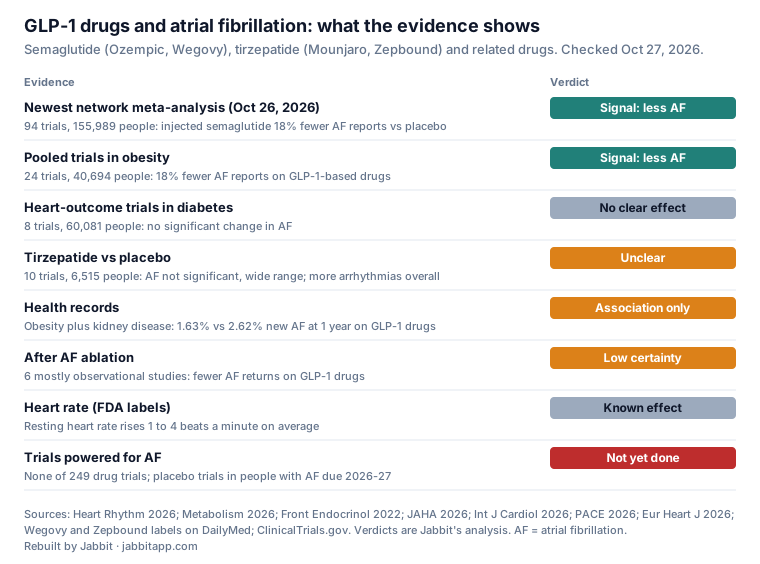
Do Ozempic, Wegovy or Zepbound lower the risk of atrial fibrillation (AFib)? Pooled trials suggest fewer AF reports on GLP-1 drugs, especially semaglutide, but certainty is low. A network meta-analysis of 94 trials published October 26, 2026 ranked injected semaglutide best and tirzepatide near the bottom, though tirzepatide-only data are too thin to call. None of the trials pooled was powered to detect AF, and the first placebo-controlled trials in people with AF list completion dates from December 2026.
Atrial fibrillation (AF, or AFib) is an irregular heart rhythm that becomes more common with age and weight, and raises the risk of stroke and death.[15] On October 26, 2026, the journal Heart Rhythm published a network meta-analysis of 94 randomized trials with 155,989 people. It found 18% fewer AF reports on injected semaglutide than on placebo, and fewer than on tirzepatide.[1] Earlier meta-analyses point the same way, most clearly in people with obesity.[6][2][3] But AF was mostly logged as a side effect, none of the 249 trials in one large analysis was adequately powered to detect it, and an umbrella review rates the certainty as low.[3][5] A tirzepatide-only analysis found no clear AF signal either way.[4]
Why this matters now
The new analysis ranked 12 GLP-1 drugs and combination drugs on AF. Injected semaglutide came out on top, while tirzepatide and dulaglutide scored far lower; the authors call for “further studies focusing on arrhythmic outcomes” to confirm the findings.[1] Our analysis: a ranking like this is easy to over-read. The semaglutide-vs-tirzepatide result is largely an indirect comparison across trials that were not designed to measure AF, and a separate 2026 meta-analysis found no difference between single-, dual- and triple-acting drugs.[1][2] We set out what each kind of evidence shows.
Timeline
| Date | Event |
|---|---|
| 2015 | The Australian LEGACY study links sustained weight loss of 10% or more with less AF, before GLP-1 weight-loss drugs.[14] |
| 2022 | Pooled heart-outcome trials in type 2 diabetes find no significant effect of GLP-1 drugs on AF.[7][8] |
| November 2023 | The US AF guideline recommends weight loss, ideally 10% or more, for people with AF and overweight or obesity.[15] |
| 2024 | A 10-trial meta-analysis reports 42% fewer AF reports on semaglutide, and a STEP-HFpEF analysis finds 45% of its heart-failure patients had AF.[6][10] |
| 2025-2026 | Meta-analyses in obesity report about 18 to 21% fewer AF reports on GLP-1 drugs; a European Heart Journal analysis notes none of its 249 trials was adequately powered for AF.[2][3] |
| July-September 2026 | An umbrella review rates the certainty low; a tirzepatide meta-analysis finds no clear AF link.[5][4] |
| October 26, 2026 | Heart Rhythm publishes the 94-trial network meta-analysis online.[1] |
| December 2026 to 2027 | Placebo-controlled trials of tirzepatide and semaglutide in people with AF list primary completion dates.[18][19][20] |
The evidence, rung by rung
What the pooled trials show
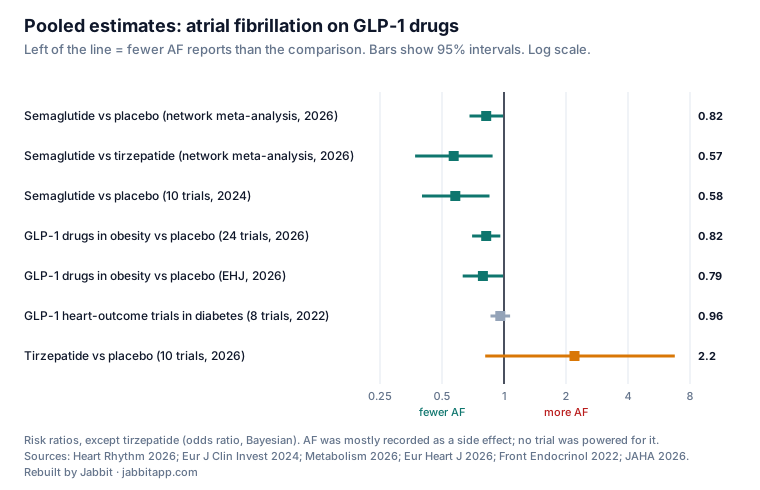
- Semaglutide. Fewer AF reports than placebo in the new network analysis (relative risk 0.82) and in a 2024 meta-analysis of 10 trials, mostly in diabetes (0.58).[1][6]
- GLP-1 drugs in obesity. 18% fewer AF reports across 24 trials with 40,694 people, with no difference by drug type and no link to how much weight people lost.[2] A 249-trial European Heart Journal analysis found a similar result for obesity treatment (0.79).[3]
- The whole class in diabetes. Eight large heart-outcome trials in type 2 diabetes, with 60,081 people, found no significant change in AF (0.96).[7] A network analysis of diabetes drugs found lower AF risk with SGLT-2 inhibitors than with GLP-1 drugs.[9]
- Tirzepatide. In 10 trials with 6,515 people, the odds ratio for AF was 2.20, but the range ran from 0.81 to 6.75, so the result is not significant. Any arrhythmia was more common (odds ratio 1.84), with low event rates; the authors urge caution.[4]
Heart rate: what the labels say
GLP-1 drugs speed up the resting heart a little. Wegovy’s label lists heart-rate increase as a warning: 1 to 4 extra beats per minute on average, with more people than on placebo having rises of 20 beats or more at some visit (26% vs 16%).[16] It tells patients to report palpitations or a racing heartbeat at rest, and to stop Wegovy if a resting heart-rate increase is sustained.[16] Zepbound’s label reports a mean rise of 1 to 3 beats per minute among its side effects.[17] Our analysis: a faster heart rate is not AF, and the trials above suggest fewer AF reports, not more. But palpitations on these drugs are worth raising with a prescriber rather than assuming they are harmless. For more on heart-rate changes, see our GLP-1 heart rate variability guide.
If you already have AFib
- Weight loss is in the guideline. The 2023 US guideline gives its strongest recommendation class to weight loss, ideally 10% or more, for people with AF and a BMI above 27; it does not name any GLP-1 drug.[15] The LEGACY study found people who kept off 10% or more were six times as likely to stay free of arrhythmia, though it was observational.[14]
- Heart failure plus AF. In Novo Nordisk-funded STEP-HFpEF trials, 518 of 1,145 people had AF. Semaglutide improved heart-failure symptom scores more in people with AF than without, and serious cardiac disorders were less common than on placebo regardless of AF history.[10]
- After ablation. In 6 mostly observational studies, AF came back less often in people on GLP-1 drugs (28.6% vs 32.9% at 12 months), with high variation between studies.[12] A 2026 review warns this evidence is open to “healthy-user bias”, meaning people who start these drugs may differ in other ways.[13]
Healthy aging: why AF matters for longevity
The US guideline puts lifetime AF risk at about 30% to 40% in White individuals and says AF carries a 1.5- to 2-fold higher risk of death.[15] Fat around the heart, especially next to the left atrium, may be one link between obesity and AF, a 2026 review suggests.[13] In US health records of adults with obesity and kidney disease, new AF over one year was 1.63% on GLP-1 drugs vs 2.62% in matched people not on them.[11] Our analysis: if the trial signal holds up, fewer AF cases would be a meaningful healthy-aging benefit. But the records study shows an association, not cause and effect, and the trial pools have not been confirmed by a trial designed to measure AF.[11][5]
The case for caution
An umbrella review of 10 meta-analyses rated none of them moderate or high quality, and found their agreement “partly reflects a shared set of primary trials rather than independent replication.”[5] The European Heart Journal analysis noted that 207 of its 249 trials found AF only through adverse-event reports.[3] Heart-outcome trials in diabetes found no clear class effect.[7][8] Our analysis: the semaglutide signal is consistent but not proven, and the tirzepatide ranking rests on few events.[1][4]
Trials coming
- TIRO-AF (Cleveland Clinic): tirzepatide vs placebo in 100 people with AF and obesity, measuring AF burden; primary completion listed as December 31, 2026.[18]
- DUTCH weight-control study (Rijnstate Hospital, Netherlands): semaglutide vs placebo in 280 people, double-blind; primary completion April 2027.[19]
- University of Chicago: semaglutide vs placebo in 200 people, measuring time to AF and AF burden; December 2027.[20]
- A San Francisco VA semaglutide trial is listed as suspended, citing a “company decision.”[21] Several trials of GLP-1 drugs around ablation are open-label or single-blind and run to 2027-2029.[22]
What a careful reader should notice
These points are our analysis of the sources cited.
- Most AF counts come from side-effect reports in weight and diabetes trials.[3]
- The meta-analyses overlap, so several papers agreeing is not several independent confirmations.[5]
- The semaglutide-vs-tirzepatide gap comes from one network analysis; a pooled obesity analysis found no difference by drug type, and tirzepatide trials have few AF events.[1][2][4]
- Results differ by population: clearer in obesity trials, neutral in diabetes heart-outcome trials.[2][7]
- The new paper’s disclosures were not in the PubMed record and its full text is paywalled; we relied on the abstract.[1]
Frequently asked questions
- Does Ozempic or Wegovy lower the risk of AFib?
- Pooled trials report fewer AF cases on semaglutide than on placebo, about 18% fewer in the newest analysis. But AF was mostly logged as a side effect and certainty is rated low.[1][5]
- Can Zepbound or Mounjaro cause AFib?
- Tirzepatide trials show no clear link: the AF estimate was not significant and had a wide range. Overall arrhythmias were somewhat more common, with few events.[4]
- Is semaglutide better than tirzepatide for AFib?
- One October 2026 network analysis ranked semaglutide higher. That is largely an indirect comparison, and another meta-analysis found no difference by drug type.[1][2]
- Do GLP-1 drugs raise heart rate?
- Yes, slightly. Labels report 1 to 4 extra beats per minute for Wegovy and 1 to 3 for Zepbound on average. Wegovy’s label asks patients to report a racing heartbeat at rest.[16][17]
- Should people with AFib take a GLP-1 drug?
- The US guideline recommends weight loss for people with AF and overweight, without naming a drug. Placebo-controlled AF trials list completion dates from late 2026; decisions belong with a cardiologist.[15][18][19]
- Do GLP-1 drugs stop AFib coming back after ablation?
- Mostly observational studies link them to fewer recurrences, about 29% vs 33% at one year. Randomized trials are still running.[12][22]
Bottom line
Trial pools consistently suggest fewer AF reports on GLP-1 drugs in people with obesity, most clearly for semaglutide, and the October 26 network analysis adds to that picture.[1][2][3] The certainty is low, tirzepatide data are too thin to rank, and the first placebo-controlled trials in people with AF list completion dates from December 2026.[5][4][18] Our analysis: this is a promising signal for healthy aging, not yet a reason to choose one drug over another.
References
- Barbosa LM, Rodrigues Oliveira VM, Ruelas MG, et al. Glucagon-Like Peptide-1 Receptor Agonists and Risk of Arrhythmias: A Network Meta-Analysis. Heart Rhythm. 2026. PMID 42933519. Network meta-analysis; online ahead of print October 26, 2026. Abstract: “A comprehensive search of databases was conducted from inception to December 2025”; “A total of 94 RCTs involving 155,989 patients were included, comparing 12 GLP-1 RAs and co-agonists”; “Subcutaneous semaglutide emerged as the most effective intervention, significantly reducing AF incidence compared with placebo (RR 0.82; 95% CI: 0.68 to 0.99), and compared with tirzepatide (RR 0.57; 95% CI: 0.37 to 0.88)”; “dulaglutide was associated with an increased risk of AF, while lixisenatide was associated with a decreased risk in atrioventricular blocks”; “For AF, semaglutide presented a p-score of 0.7885, while tirzepatide and dulaglutide scored 0.1830 and 0.1750, respectively”; “Further studies focusing on arrhythmic outcomes are needed to confirm these findings.” The PubMed record lists no funding or disclosure statement; the full text is paywalled and we did not read it. Abstract read. https://pubmed.ncbi.nlm.nih.gov/42933519/. Checked October 27, 2026. DOI: https://doi.org/10.1016/j.hrthm.2026.10.052.
- Karakasis P, Vlachos K, Antoniadis AP, et al. Effect of GLP-1 receptor agonists and co-agonists on atrial fibrillation risk in overweight or obesity: systematic review and meta-analysis of randomized controlled trials. Metabolism. 2026;175:156463. PMID 41349790. Meta-analysis of randomized trials in overweight or obesity. Abstract: “Twenty-four RCTs encompassing 40,694 participants were included”; GLP-1 drugs or co-agonists vs placebo “(Risk Ratio = 0.82; 95 % confidence interval, 0.70-0.96; P = 0.012; I2 = 0 %)”; “No significant between-subgroup differences were observed according to agent type (single-, dual-, or triple-receptor agonists)”, individual compound or route; “This cardioprotective benefit may, at least in part, operate independently of the magnitude of weight loss.” Disclosure: one author reports grants and consulting fees from many companies, including Novo Nordisk and Boehringer Ingelheim, and states “None is related to this manuscript”; the other authors declare none. Abstract and disclosure read. https://pubmed.ncbi.nlm.nih.gov/41349790/. Checked October 27, 2026.
- Raveendra K, Nadarajah R, Larvin H, et al. Non-antiarrhythmic pharmacotherapy in cardio-renal-metabolic disease and incident atrial fibrillation: a trial meta-analysis. Eur Heart J. 2026;47(23):2922-2933. PMID 41603358. Meta-analysis of 249 trials of heart, kidney and metabolic drugs. Abstract: “Two hundred and forty-nine RCTs involving 745 041 patients were included, of which 207 identified AF through adverse event reports”; “treatment of obesity with glucagon-like peptide-1 receptor agonists (RR 0.79, 95% CI 0.63-0.99)”; “However, the number of AF events per trial was low and none were adequately powered for incident AF.” Abstract read. https://pubmed.ncbi.nlm.nih.gov/41603358/. Checked October 27, 2026.
- Mansouri ES, Queiroga F, Barbosa LM, et al. Tirzepatide and the Incidence of Atrial Fibrillation in Adults With Overweight or Obesity: An Updated Meta-Analysis of Randomized Controlled Trials. J Am Heart Assoc. 2026;15(18):e044249. PMID 42714458. Bayesian meta-analysis, tirzepatide vs placebo in overweight or obesity. Abstract: “Our meta-analysis included 10 randomized controlled trials, including 6515 individuals, of whom 4491 (68.9%) were randomized to tirzepatide”; “The pooled OR was 2.20 (95% CrI, 0.81-6.75) for atrial fibrillation, 2.16 (95% CrI, 0.90-5.87) for atrial arrhythmia, and 1.84 (95% CrI, 1.04-3.90) for any arrhythmia”; “Tirzepatide was not associated with atrial fibrillation or atrial arrhythmia. Although higher odds of overall arrhythmias were observed, event rates were low and the findings should be interpreted cautiously.” The PubMed record lists no disclosure statement. Abstract read. https://pubmed.ncbi.nlm.nih.gov/42714458/. Checked October 27, 2026.
- Ramzy D, Isshak R, Patel D, et al. Glucagon-Like Peptide-1 Receptor Agonists, Semaglutide, and Atrial Fibrillation: An Umbrella Review With Methodological Appraisal of Overlapping Meta-Analyses. Cureus. 2026;18(7):e113641. PMID 42668799. Umbrella review of 10 meta-analyses. Abstract: “AMSTAR 2 ratings indicated low confidence in five reviews and critically low confidence in four; none achieved moderate or high confidence”; the reviews’ “consistency partly reflects a shared set of primary trials rather than independent replication”; “GLP-1 RAs/semaglutide are plausibly associated with lower AF burden, but certainty is low (incident AF) to very low (recurrence)”; “Adequately powered randomized trials with adjudicated, systematically monitored AF endpoints are required.” Disclosure: authors report “no financial relationships.” Abstract and disclosure read. https://pubmed.ncbi.nlm.nih.gov/42668799/. Checked October 27, 2026.
- Saglietto A, Falasconi G, Penela D, et al. Glucagon-like peptide-1 receptor agonist semaglutide reduces atrial fibrillation incidence: A systematic review and meta-analysis. Eur J Clin Invest. 2024;54(12):e14292. PMID 39058274. Meta-analysis of semaglutide vs placebo. Abstract: “Ten RCTs were included in the analysis”, 12,651 patients, mainly with type 2 diabetes; “Semaglutide reduces the risk of AF by 42% (RR .58, 95% CI .40-.85)”, with no difference between oral and injected forms. Abstract read. https://pubmed.ncbi.nlm.nih.gov/39058274/. Checked October 27, 2026.
- Wei J, Wang R, Ye H, et al. Effects of GLP-1 receptor agonists on arrhythmias and its subtypes in patients with type 2 diabetes: A systematic review and meta-analysis. Front Endocrinol (Lausanne). 2022;13:910256. PMID 36034440. Meta-analysis of GLP-1 heart-outcome trials in type 2 diabetes. Abstract: “A total of 60,081 randomized participants were included in the data of these 8 GLP-1RA cardiovascular outcomes trials”; “atrial fibrillation [RR=0.96, 95% CI (0.86, 1.07), p =0.43].” Authors declare no conflicts. Abstract read. https://pubmed.ncbi.nlm.nih.gov/36034440/. Checked October 27, 2026.
- Boulmpou A, Patoulias D, Papadopoulos CE, et al. Meta-analysis of cardiovascular outcome trials assessing the impact of glucagon-like peptide-1 receptor agonists on major cardiac arrhythmias. Acta Cardiol. 2023;78(5):519-524. PMID 35699112. Meta-analysis of 7 heart and kidney outcome trials in type 2 diabetes, 55,943 participants. Abstract: GLP-1 drugs “did not provide significant benefit in the risk for atrial fibrillation (RR = 0.81, 95%CI; 0.78-1.15, I2 = 51%).” Abstract read. https://pubmed.ncbi.nlm.nih.gov/35699112/. Checked October 27, 2026.
- Ye X, Wu Q, Hou L, et al. Network and Pairwise Meta-Analysis of the Association Between Novel Hypoglycemic Agents and Atrial Fibrillation Risk in Patients With Type 2 Diabetes Mellitus. Diabetes Metab Res Rev. 2026;42(5):e70202. PMID 42455922. Network meta-analysis of diabetes drugs; 4 randomized trials and 21 cohort studies, 2,171,267 patients. Abstract: SGLT-2 inhibitors were associated with lower AF risk than GLP-1 drugs (RR 0.86, 95% CI 0.79 to 0.95), and there was no significant difference in AF between GLP-1 drugs and DPP-4 inhibitors. Authors declare no conflicts. Abstract read. https://pubmed.ncbi.nlm.nih.gov/42455922/. Checked October 27, 2026.
- Verma S, Butler J, Borlaug BA, et al. Atrial Fibrillation and Semaglutide Effects in Obesity-Related Heart Failure With Preserved Ejection Fraction: STEP-HFpEF Program. J Am Coll Cardiol. 2024;84(17):1603-1614. PMID 39217565. STEP-HFpEF program secondary analysis (NCT04788511, NCT04916470). Abstract: “Of the 1,145 participants, 518 (45%) had a history of AF”; semaglutide improved heart-failure symptom scores more in people with AF than without “(11.5 points [95% CI: 8.3-14.8] vs 4.3 points [95% CI: 1.3-7.2]; P interaction = 0.001)”; “There were fewer serious adverse events and serious cardiac disorders in participants treated with semaglutide vs placebo irrespective of AF history.” Disclosure: “This trial was funded by Novo Nordisk A/S.” Abstract and disclosure read; we do not reproduce the dose. https://pubmed.ncbi.nlm.nih.gov/39217565/. Checked October 27, 2026.
- Hassan A, Okorigba E, Grace C, et al. GLP-1 receptor agonist therapy and incident atrial fibrillation in non-diabetic adults with obesity and chronic kidney disease: a propensity matched cohort study. Int J Cardiol. 2026;466:135000. PMID 42892471. Retrospective target-trial emulation in US health records (TriNetX), non-diabetic adults with obesity and chronic kidney disease, 7,326 matched patients per group. Abstract: “GLP-1RA use was associated with significantly lower incident AF (1.63% vs. 2.62%; HR 0.655, 95% CI 0.508-0.844; p = 0.001)”; the authors say the findings “support prioritizing this phenotype for dedicated randomized trials.” “All authors had no conflict of interest to declare.” Abstract read. https://pubmed.ncbi.nlm.nih.gov/42892471/. Checked October 27, 2026.
- Shubietah A, Elgendy MS, Awashra A, et al. Effect of GLP-1 Receptor Agonists on Post-Ablation Atrial Fibrillation Recurrence: A Meta‑Analysis. Pacing Clin Electrophysiol. 2026;49(8):1086-1099. PMID 42033283. Meta-analysis of studies of AF return after catheter ablation. Abstract: “Six studies met the inclusion criteria”; “A random-effects meta-analysis of five studies confirmed this benefit (HR 0.78, 95% CI: 0.61-0.99; I2 = 75%)”; at 12 months, 28.6% vs 32.9% had AF return; “GLP-1 RA therapy was associated with reduced AF recurrence after ablation, but methodological limitations warrant cautious interpretation.” Abstract read. https://pubmed.ncbi.nlm.nih.gov/42033283/. Checked October 27, 2026.
- Matteucci A, Bonanni M, Sgarra L, et al. Cardiometabolic Substrate Modification in Atrial Fibrillation: Obesity and Epicardial Adipose Tissue in the Era of Incretin-Based Therapies and Catheter Ablation. J Cardiovasc Dev Dis. 2026;13(10). PMID 42930907. Narrative review. Abstract: “Epicardial adipose tissue (EAT), particularly the peri-left-atrial depot, may provide a local mechanistic bridge” between metabolic disease and atrial disease; “evidence for reduced post-ablation recurrence remains predominantly non-randomized and is susceptible to residual confounding, treatment-selection effects, and healthy-user bias.” Abstract read. https://pubmed.ncbi.nlm.nih.gov/42930907/. Checked October 27, 2026.
- Pathak RK, Middeldorp ME, Meredith M, et al. Long-Term Effect of Goal-Directed Weight Management in an Atrial Fibrillation Cohort: A Long-Term Follow-Up Study (LEGACY). J Am Coll Cardiol. 2015;65(20):2159-69. PMID 25792361. LEGACY cohort, Australia, before GLP-1 weight-loss drugs. Abstract: 355 people with AF and a BMI of 27 or more were analyzed; “Weight loss ≥ 10% resulted in a 6-fold (95% confidence interval: 3.4 to 10.3; p < 0.001) greater probability of arrhythmia-free survival compared with the other 2 groups”; “Weight fluctuation >5% partially offset this benefit.” Observational. Abstract read. https://pubmed.ncbi.nlm.nih.gov/25792361/. Checked October 27, 2026.
- Joglar JA, Chung MK, et al. 2023 ACC/AHA/ACCP/HRS Guideline for the Diagnosis and Management of Atrial Fibrillation. Circulation. 2024;149(1):e1-e156. PMID 38033089; PMCID PMC11095842. Full text: “Overall lifetime risk is about 30% to 40% in White individuals”; “AF is associated with a 1.5- to 2-fold increased risk of death”; recommendation (class 1, level of evidence B-R): “In patients with AF who are overweight or obese (with body mass index [BMI] >27 kg/m2), weight loss is recommended, with an ideal target of at least 10% weight loss to reduce AF symptoms, burden, recurrence, and progression to persistent AF.” The guideline text does not mention GLP-1 drugs. Full text read. https://pmc.ncbi.nlm.nih.gov/articles/PMC11095842/. Checked October 27, 2026.
- Wegovy (semaglutide) injection and tablets, US prescribing information, Novo Nordisk, DailyMed (set ID ee06186f-2aa3-4990-a760-757579d8f77b), Warnings and Precautions 5.9 Heart Rate Increase: “Treatment with WEGOVY was associated with increases in resting heart rate”; “Mean increases in resting heart rate of 1 to 4 beats per minute (bpm) were observed in WEGOVY injection-treated adult patients compared to placebo in clinical trials for weight reduction”; more adults on Wegovy injection than placebo had maximum increases at any visit of 10 to 19 bpm “(41% versus 34%, respectively)” and of 20 bpm or more “(26% versus 16%, respectively)”; “Instruct patients to inform their healthcare providers of palpitations or feelings of a racing heartbeat while at rest”; “If patients experience a sustained increase in resting heart rate, discontinue WEGOVY.” https://dailymed.nlm.nih.gov/dailymed/drugInfo.cfm?setid=ee06186f-2aa3-4990-a760-757579d8f77b. Checked October 27, 2026.
- Zepbound (tirzepatide) injection, US prescribing information, Eli Lilly and Company, DailyMed (set ID 487cd7e7-434c-4925-99fa-aa80b1cc776b), adverse reactions: “Heart Rate Increase In a pool of Study 1 and 2, treatment with ZEPBOUND resulted in a mean increase in heart rate of 1 to 3 beats per minute compared to no increase in placebo-treated patients.” Heart-rate increase is not listed among the label’s highlighted warnings and precautions. https://dailymed.nlm.nih.gov/dailymed/drugInfo.cfm?setid=487cd7e7-434c-4925-99fa-aa80b1cc776b. Checked October 27, 2026.
- ClinicalTrials.gov NCT06802081, “TIRO-AF: TIRzepatide for the Treatment of Obesity in Patients With Atrial Fibrillation” (sponsor The Cleveland Clinic): phase 2, triple-masked, tirzepatide vs placebo; primary outcome “AFib burden”; status recruiting; enrollment 100 (estimated); primary completion December 31, 2026 (estimated). https://clinicaltrials.gov/study/NCT06802081. Checked October 27, 2026.
- ClinicalTrials.gov NCT06184633, “DUTCH Weight Control in Atrial Fibrillation Study” (sponsor Rijnstate Hospital): phase 4, multi-center, double-blind, semaglutide vs placebo in people with AF and obesity; status active, not recruiting; enrollment 280; primary completion April 10, 2027 (estimated). https://clinicaltrials.gov/study/NCT06184633. Checked October 27, 2026.
- ClinicalTrials.gov NCT06499857, “Semaglutide for Metabolic Intervention and Adipose Loss to Treat Atrial Fibrillation” (sponsor University of Chicago): phase 3, triple-masked, semaglutide vs placebo; primary outcomes time to first AF event and change in AF burden; status recruiting; enrollment 200 (estimated); primary completion December 2027 (estimated). https://clinicaltrials.gov/study/NCT06499857. Checked October 27, 2026.
- ClinicalTrials.gov NCT05209165, “Semaglutide to Reduce Atrial Fibrillation Burden” (sponsor San Francisco Veterans Affairs Medical Center): semaglutide vs placebo; status suspended; reason given: “Company decision.” The record does not say which company. https://clinicaltrials.gov/study/NCT05209165. Checked October 27, 2026.
- ClinicalTrials.gov ablation-timing trials, all with open or single-blind designs and none placebo-controlled: NCT07275697 (WAIT, semaglutide before ablation vs standard treatment; recruiting; primary completion December 2028), https://clinicaltrials.gov/study/NCT07275697; NCT07389941 (semaglutide before ablation, University of Luebeck; not yet recruiting; April 2029), https://clinicaltrials.gov/study/NCT07389941; NCT07382024 (tirzepatide after ablation vs standard care, National Taiwan University Hospital; not yet recruiting; December 2027), https://clinicaltrials.gov/study/NCT07382024. Checked October 27, 2026.
- Jabbit source extract for this page: abstract quotes, disclosures, guideline and label text and registry fields checked against cached copies on October 27, 2026. https://jabbitapp.com/research/sources/glp1-atrial-fibrillation-2026-10-27.json. Checked October 27, 2026.
This page analyzes published studies, a clinical guideline, FDA labels and trial registries. It is not medical advice and does not recommend any product or dose. Charts were rebuilt by Jabbit from the sources cited in each caption.