Evidence review · Folic acid, folate, vitamin B9 · UK mandatory flour fortification from December 13, 2026 · Parliament petition 769589 · cancer, vitamin B12, unmetabolised folic acid · UK regulations, government impact assessment, SACN and FSS reports, randomized trials, ClinicalTrials.gov · Sources checked October 20, 2026
Published · Updated
Will folic acid in UK flour cause cancer or hide B12 deficiency? Probably not at this dose: flour will add about 100 micrograms a day, a tenth of the upper limit, and the worrying studies used pills at 8 to 10 times that.
From December 13, UK millers must add 250 micrograms of folic acid to every 100 grams of non-wholemeal wheat flour, to prevent spina bifida and other neural tube defects (NTDs).[7][8] A petition to stop it has 117,907 signatures, enough for Parliament to consider a debate.[3] We traced the viral claims to their studies. The cancer and B12 worries come from pill trials at 800 to 1,000 micrograms a day.[29][27][37] By our math from the UK diet survey, flour will add about 100 micrograms a day on average.[14] That is a quarter of the standard pregnancy supplement and a tenth of the upper limit. Pooled trials of about 50,000 people found no overall rise in cancer, and B12 deficiency didn’t rise after the US fortified.[30][35] Some real unknowns remain, and the UK skipped one safeguard its advisers asked for.[13][11]
Why this matters now
The petition, started by Dr Clare Craig, passed 100,000 signatures on October 8 and stood at 117,907 at 10:21 AM ET on October 20. No debate date has been set, and the government already answered it in June.[3][4] The change takes effect in under eight weeks. Over the past week X has run a string of trending stories about it, from the petition to a viral photo of Brussels sprouts whose label lists “folic acid.”[1] English posts on X mentioning folic acid peaked at 945 on October 15 and totalled 4,626 in a week.[2] Two of the most-shared posts make specific claims. Dr Craig says folic acid “must be avoided by millions,” and former MP Andrew Bridgen says it brings “a 20% increased cancer risk” at an average dose of “250 micrograms per day.”[5][6] Those claims can be checked against the papers.
The short answer
- The dose is small. 250 micrograms is the amount per 100 grams of flour, not per day. Average intake works out to about 100 micrograms a day.[7][14]
- The benefit is real but modest. Folic acid before pregnancy prevents most NTDs in trials.[22][24] The UK expects fortification to cut them by about 19%, mostly as fewer terminations of affected pregnancies.[11]
- The cancer signals come from pills at higher doses. They appeared at 800 to 1,000 micrograms a day and weren’t confirmed when 13 trials were pooled.[29][27][30]
- B12 masking is a high-dose problem. The 1 milligram upper limit exists for it. Flour stays far below that, and the US saw no rise in masked B12 deficiency.[15][13][35]
- Some questions are open. No one knows if unmetabolised folic acid in the blood matters. The UK also didn’t adopt its advisers’ condition of capping voluntary fortification of other foods.[13][11]
What the law actually does
The England regulations were made on November 13, 2024 and laid before Parliament the next day, under the Food Safety Act 1990. Scotland, Wales and Northern Ireland have matching rules.[7][8] From December 13, 2026, non-wholemeal common wheat flour must contain 0.250 mg (250 µg) of folic acid per 100 g, “regardless of the natural level of folate in the flour.”[7][9] The rules apply to flour milled in or imported into the UK, which already must carry added calcium, iron, niacin and thiamin. They also change the required amounts of calcium carbonate, iron and niacin.[9][7]
Wholemeal flour is exempt, and so are small mills producing under 500 tonnes a year. Gluten-free, spelt and soya flours aren’t covered, and neither are imported foods made with flour.[7][9][4] Added folic acid must be named in the ingredients list, including when fortified flour is an ingredient.[4] Ministers made the change as secondary legislation, laid before Parliament rather than voted through as a bill. Scotland’s version states it was “subject to negative procedure,” which means it stands unless members vote to annul it.[7][8]
About the sprouts. UK nutrition labels must use the name “Folic acid” for vitamin B9, with a reference value of 200 µg.[17] A sprouts pack listing 135 µg “folic acid” at 68% of that value is describing the vegetable’s own folate (135 ÷ 200 = 68%), not an additive.[1][17] The ingredients list is where added folic acid has to appear.[4]
How much folic acid you’d actually get
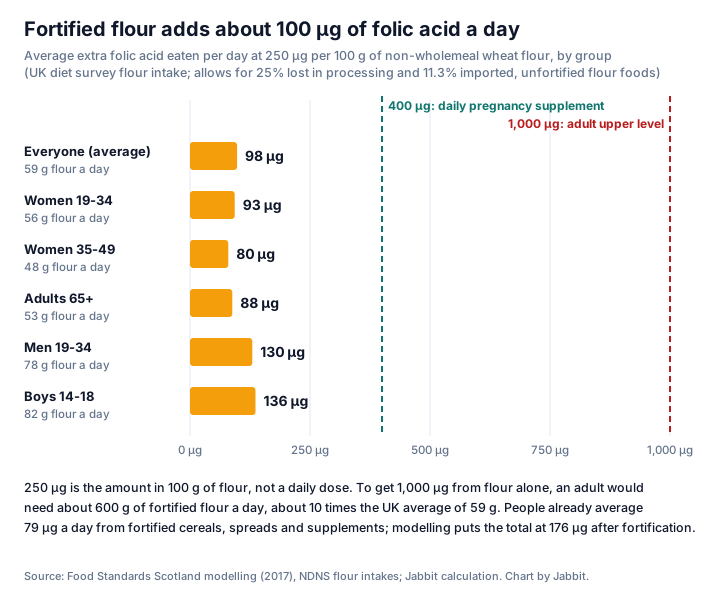
We started from the UK National Diet and Nutrition Survey figures in Food Standards Scotland’s 2017 modelling. Average non-wholemeal flour intake is 59 g a day, from 48 g for women aged 35 to 49 to 82 g for teenage boys.[14] At 2.5 µg per gram, 59 g holds 148 µg. The modelling assumes 25% is lost in processing and that 11.3% of flour and flour foods are imported and unfortified. On those assumptions people actually eat about 98 µg a day. That matches the model’s own figure of 97.5 µg.[14]
| Group | Flour eaten | In the flour | Eaten, after losses | Share of 400 µg supplement | Share of 1,000 µg upper level |
|---|---|---|---|---|---|
| Everyone, average | 59 g | 148 µg | 98 µg | 25% | 10% |
| Women 19–34 | 56 g | 140 µg | 93 µg | 23% | 9% |
| Women 35–49 | 48 g | 120 µg | 80 µg | 20% | 8% |
| Adults 65 and over | 53 g | 132 µg | 88 µg | 22% | 9% |
| Men 19–34 | 78 g | 195 µg | 130 µg | 32% | 13% |
| Boys 14–18 | 82 g | 205 µg | 136 µg | 34% | 14% |
To reach the 1,000 µg upper level from flour alone, an adult would need to eat about 600 g of fortified flour a day, roughly 10 times the average.[14] The real risk of going over is from stacking sources. People already average 79 µg a day of folic acid from fortified cereals, spreads and supplements, and the model puts the total at 176 µg after fortification.[14] About 0.42% of people are over the limit today. All 38 such people in the survey would drop below it without their main source, such as a supplement. The government estimates the share over the limit will rise to about 0.64%.[14][11]
So the claim that the average dose will be “250 micrograms per day” mixes up the amount per 100 g of flour with a daily dose. The real figure is closer to 100.[6][7][14]
The case for it
The trial evidence is strong. In the 1991 MRC Vitamin Study, women who had already had an affected pregnancy took 4 mg of folic acid or not. There were 6 NTDs in the folic acid groups and 21 in the others, a 72% reduction.[22][37] A Hungarian trial of a multivitamin with 0.8 mg prevented first occurrences: 0 vs 6 cases.[23] A Cochrane review of 5 trials found folic acid cut NTD risk by about 69%, rated high-quality evidence.[24]
Fortification worked elsewhere. After Canada fortified white flour in 1998, NTDs fell 46%, from 1.58 to 0.86 per 1,000 births. The biggest drops came in provinces with the highest rates.[25] In the US, anencephaly and spina bifida fell 28% overall, 35% where programs counted prenatal diagnoses. That is about 1,326 fewer affected births a year.[26]
Why the UK says it needs it. About half of UK pregnancies are unplanned, and only about one in five women take folic acid before pregnancy.[12][4] The national diet survey found 89% of women aged 16 to 49 had blood folate levels that may raise NTD risk, and their folate intakes fell from 2008 to 2019.[12]
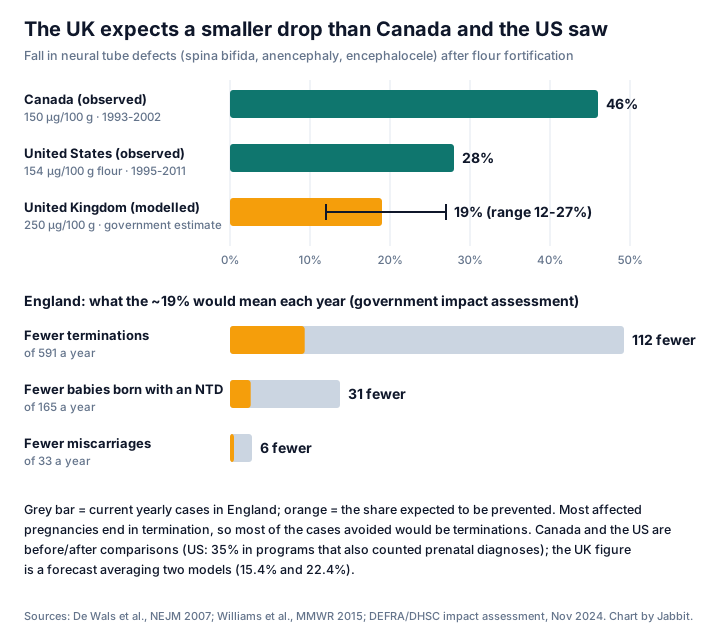
What “200 cases” means. The government says fortification will prevent about 200 NTD-affected pregnancies a year, about 20% of UK cases.[10][4] Its impact assessment breaks the England figures down. About 112 fewer terminations are expected each year, out of 591, along with 31 fewer babies born with an NTD and 6 fewer miscarriages.[11] Termination is the most common outcome of an affected pregnancy, so most of the “cases” prevented would be terminations that are no longer needed.[11] The 19% is an average of two models, 15.4% and 22.4%. That is well below what Canada and the US saw, even though the UK level is higher.[11][25][26]
The viral claims, traced
| Claim | Where it comes from | What the evidence shows | Source |
|---|---|---|---|
| “Folic acid raises cancer risk 20%” | No study named. Closest match: two Norwegian trials in heart patients, 800 µg pills plus B12 for about 3 years: cancer 10.0% vs 8.4% (HR 1.21). | Pooling 13 trials and 49,621 people, including those investigators, found no significant increase (RR 1.06). Flour adds about 100 µg a day. | [29][30] |
| “Folic acid feeds bowel and prostate cancer” | One US polyp trial at 1 mg a day: more advanced polyps at the second check (11.6% vs 6.9%) and more prostate cancer (9.7% vs 3.3%). | Real signals at 10 times the flour dose, not confirmed in the pooled trials. SACN calls the prostate evidence inconclusive. | [27][28][30][13] |
| “Bowel cancer rose when the US and Canada fortified” | A 2007 hypothesis paper: rates ran 4 to 6 per 100,000 above trend from 1996–98. A Chile study counted hospital discharges. | Timing only; the authors say it doesn’t prove cause. Reviews since found no significant rise in US cancer rates. | [31][32][13] |
| “It masks B12 deficiency” | 1950s-era case reports of pernicious anaemia patients treated with high-dose folic acid; the basis of the 1 mg/day upper level. | Real at high doses. US B12 deficiency without anaemia didn’t rise after fortification (4.0% vs 3.9%). Flour stays far below 1 mg. | [37][13][35][15] |
| “Unmetabolised folic acid builds up in your blood” | UMFA is detectable in most people in fortifying countries, and in about two-thirds of UK adults already. | True that it’s there; unknown whether it matters. One observational study links it to lower test scores in seniors with low B12. | [36][13][34] |
| “The NHS says millions must avoid it” | NHS page on folic acid tablets: may not suit people with cancer, a stent or B12 deficiency anaemia. | That page says it “does not cover folic acid that has been added to food,” which is “much lower.” | [5][16] |
“A 20% increased cancer risk.” Mr Bridgen’s post cites no study.[6] The closest match we found is two Norwegian trials in 6,837 heart patients. They took 800 µg of folic acid plus vitamin B12 for a median of 39 months. Over about six years, 10.0% got cancer vs 8.4% without folic acid (hazard ratio 1.21), driven mainly by lung cancer. Norway didn’t fortify food.[29] Those investigators then joined a pooled analysis of 13 trials covering 49,621 people over an average of 5.2 years, including the US polyp trial below. Folic acid quadrupled blood levels but didn’t significantly change cancer rates: 1,904 vs 1,809 cancers (RR 1.06, 95% CI 0.99–1.13). It had no significant effect on any single site, including bowel, prostate, lung and breast.[30] The authors note fortification doses are “on average, an order of magnitude smaller.”[30]
Polyps and prostate cancer. The strongest single warning comes from a US trial of 1 mg a day in 1,021 people with previous bowel polyps. Folic acid didn’t prevent polyps. At the second check, 11.6% had an advanced lesion vs 6.9% on placebo, a borderline result (P = .05).[27] Among the trial’s 643 men, 9.7% on folic acid were diagnosed with prostate cancer within 10 years vs 3.3% on placebo.[28] The UK’s Scientific Advisory Committee on Nutrition (SACN) calls the prostate evidence “inconclusive.” It concluded that, overall, the data “do not suggest a detrimental effect,” while noting the trials were generally underpowered.[13]
The trend-line argument. A 2007 paper noticed that US and Canadian bowel cancer rates stopped falling around 1996–98, when fortification began, and ran 4 to 6 cases per 100,000 above trend. They found changes in colonoscopy use didn’t seem to explain it. Still, they called it a hypothesis and wrote that the observations alone “do not prove causality.”[31] A Chilean study found colon cancer hospital discharges were 2.6 to 2.9 times higher in 2001–04 than in 1992–96, after fortification at 220 µg per 100 g. Hospital discharges aren’t new diagnoses, though, and the study couldn’t separate fortification from a decade of other changes.[32] SACN’s 2017 review cites an Irish assessment that US rates of all cancers, bowel and prostate cancer had not significantly increased since fortification.[13]
Masking B12 deficiency. This concern is the reason for the upper limit. High-dose folic acid can fix the anaemia of B12 deficiency while nerve damage continues unnoticed. The UK’s 1 mg a day upper level was set by its Expert Group on Vitamins and Minerals in 2003 and reaffirmed by its toxicology committee in 2018.[15][11] The US also uses 1 mg. Its limit rests on 23 studies of patients with pernicious anaemia, mostly from the 1950s, and 11 of them were single-patient case reports. Nicholas Wald and colleagues argue the limit should be scrapped.[37] SACN says the masking evidence comes mainly from doses over 1 mg a day.[13] After the US fortified, the share of adults over 50 with B12 deficiency but no anaemia, the masked kind, stayed flat: 4.0% before and 3.9% after.[35] The open question is narrower. In US seniors with low B12, high blood folate went with more anaemia (OR 3.1) and cognitive impairment (OR 2.6). That is an observational link that can’t show cause.[33]
Unmetabolised folic acid (UMFA). It is real and common. It is detectable in more than 95% of Americans.[36] In UK diet survey samples taken before mandatory fortification, it was below detection in only about a third of adults (32.6% aged 19 to 64), so roughly two-thirds already had it. SACN says UMFA makes up 1–3% of total blood folate.[13] SACN found no clear dose-response between folic acid intake and UMFA, and “insufficient data” to say whether it causes harm.[13] The best-known worry comes from a US study of seniors with low B12, where detectable UMFA went with lower cognitive test scores.[34]
“Must be avoided by millions.” The petition cites an NHS page listing people with cancer, a stent or low B12.[3][5] That page is about tablets. It says folic acid tablets “may not be suitable” for people with cancer, a coronary stent or B12 deficiency anaemia. It also says it “does not cover folic acid that has been added to food,” which is “much lower” than in supplements.[16]
Epilepsy and cancer drugs, MTHFR and miscarriage. The NHS lists folic acid tablets as possibly interacting with phenytoin, phenobarbital and primidone.[16] In the 2021 consultation, 38 respondents raised drug interactions, including lamotrigine and methotrexate. The government said the folic acid levels in fortified foods are “not enough to reach the tolerable upper level alone.” It recommends that people on medication speak to their GP or a healthcare professional if they’re concerned.[12] On MTHFR gene variants, the government accepted that carriers process folate less well. It said extra folic acid still raises their blood folate.[12] On pregnancy loss, the Cochrane review found no clear effect on miscarriage from folic acid supplements (RR 1.10, 95% CI 0.94–1.28, 5 trials).[24]
Consent. This part is a values question, not a lab result. The petition calls folic acid “a medicine not a food” and calls fortification mass medication without consent.[3] The petition also says wholemeal and gluten-free products are increasingly adding folic acid voluntarily, which makes it harder to avoid.[3] The government calls it “an evidenced public health measure, not a medical intervention,” and points to unfortified wholemeal and non-wheat flours as the opt-out.[4] An earlier petition asking for at least one unfortified white flour drew 24,140 signatures.[3]
The safeguard the UK didn’t adopt
SACN backed mandatory fortification in 2006, 2009 and again in 2017. Each time it said it “should only be introduced alongside restrictions on voluntary dietary fortification,” so that no more people end up over the upper limit.[13] The 2021 consultation response left limits on voluntary fortification to “a later date.”[12] The 2024 regulations change flour only, and the government’s impact assessment works on the basis of no restrictions. Its own table shows the difference. With caps on fortified cereals, spreads and supplements, the share of people over the limit would be about 0.07%. Without them, it is 0.64%.[7][11] In both cases that is a small minority, mostly people taking supplements.[14] But it means the policy that starts in December is not quite the one SACN set out.
How the UK compares
| Country | Level | Flour covered | Since | NTD change | Source |
|---|---|---|---|---|---|
| United Kingdom | 250 µg | Non-wholemeal wheat flour | From Dec 13, 2026 | 19% fewer NTDs (government forecast, 12–27%) | [7][11] |
| Chile | 220 µg | Wheat flour | In place by 2001 | Not checked for this page | [32] |
| United States | About 154 µg | Enriched flour (FDA policy: 140 µg per 100 g of enriched cereal-grain products) | Since 1998 | 28% fewer (35% counting prenatal diagnoses) | [18][26] |
| Canada | 150 µg | White flour (also enriched pasta and cornmeal) | Since 1998 | 46% fewer | [19][25] |
The UK level is higher than the US or Canadian level but within the global range of about 50 to 330 µg per 100 g.[20] The US also fortifies many other enriched grain products, such as bread, so its total exposure isn’t comparable gram for gram.[18][26] The Food Fortification Initiative counts 85 countries that require wheat flour fortification. In 2002 only 38 countries required fortification of any grain.[20] How many require folic acid depends on the source. FFI’s fact sheet says 81 of 86, using 2017 legislation data, and a 2025 preprint citing the Global Fortification Data Exchange counts 70.[20][21]
What is being studied
Not much on the open questions. ClinicalTrials.gov lists 10 studies that mention UMFA. All measure it, or folate, in blood. One has posted results, and none registers a cancer, cognitive or dementia outcome.[38] Of 88 registered studies pairing folic acid with fortification, mostly iron and multi-nutrient programs abroad, 3 test fortified flour or bread. All 3 measure blood levels.[38] PubMed has 124 papers on UMFA, only 17 of them tagged as randomized trials.[39] The government plans to watch NTD rates, blood folate, B12 status and cancer registries. It concedes that cancer trends will be hard to pin on any one cause.[11]
What to do with this
- If you could become pregnant, UK advice hasn’t changed: 400 µg of folic acid a day before conception and for the first 12 weeks. Fortified flour adds roughly a quarter of that.[12][4][14]
- If you want to avoid it, the government points to wholemeal flour, gluten-free products and non-wheat flours. Read the ingredients list, where added folic acid must be named.[4]
- If you take epilepsy, cancer or other long-term drugs, the official advice is to speak to your GP or a healthcare professional about interactions.[12][4]
- If you take folic acid supplements on top, remember that stacking sources, not bread, is what pushes people over the 1 mg upper level.[14][15]
- Fortification doesn’t replace a B12 diagnosis. Low B12 can damage nerves whatever your folate level, and it needs testing and treatment.[11][13]
Strengths and limits
Strengths. The benefit side rests on randomized trials and large national registries.[22][24][25][26] The safety side includes a pooled analysis of about 50,000 people.[30] Our intake math uses the government’s own survey data and assumptions, and it reproduces the model’s published figure.[14]
Limits. The cancer trials tested pills at higher doses for about five years, not lifetime exposure from food.[30] The B12 and UMFA evidence is mostly observational.[33][34][35] The UK forecast is a model with a wide range.[11] The diet survey intake data predate 2017, and people who eat far more bread than average will get proportionally more.[14] We didn’t check the trend data behind every country’s program.[20]
Bottom line
At the UK’s dose, flour will add about 100 micrograms of folic acid a day. That is enough to cut neural tube defects modestly, by about a fifth in the government’s forecast, and far below the levels where cancer or B12 signals appeared.[14][11][29][27] The “20% cancer risk” and “avoid it” claims rely on pill trials and a supplements page.[6][5][16] What’s honestly unknown is the long-term meaning of unmetabolised folic acid, and whether skipping SACN’s cap on other fortified foods will matter.[13][11] Whether the trade is worth it for everyone else is a values call that Parliament may now debate.[3]
If you get vitamin B12 injections, or want a dated record of supplements and shots to show your GP with your blood results, Jabbit keeps a private log on your iPhone.
Frequently asked questions
- When does folic acid go into UK flour, and which flour?
- From December 13, 2026, millers in all four UK nations must add 250 micrograms of folic acid to every 100 grams of non-wholemeal wheat flour, the white and brown flour already fortified with calcium, iron, niacin and thiamin. Wholemeal flour, non-wheat flours and flour from small mills producing under 500 tonnes a year are exempt. Imported flour must be fortified, but imported foods made with flour are not covered. Folic acid must appear in the ingredients list.
- How much folic acid will I actually get from bread and flour?
- About 100 micrograms a day on average. UK diet survey data put average non-wholemeal flour intake at 59 grams a day, and official modelling assumes about a quarter is lost in processing and 11% of flour foods are imported unfortified. That gives roughly 80 to 140 micrograms a day across age groups, a quarter of the 400 microgram pregnancy supplement and about a tenth of the 1,000 microgram adult upper level.
- Does folic acid in flour cause cancer?
- No large study shows that it does at flour doses. The concern comes from pill trials at 800 to 1,000 micrograms a day: a Norwegian trial in heart patients found 10.0% vs 8.4% got cancer, and a US polyp trial found more advanced polyps and prostate cancer. When 13 trials with about 50,000 people were pooled, folic acid didn’t significantly raise cancer rates. The UK’s nutrition advisers say the data don’t suggest harm but note the trials had limited power.
- Can folic acid in flour hide vitamin B12 deficiency?
- At high doses, folic acid can correct the anaemia of B12 deficiency while nerve damage continues, which is why the UK and US set a 1 milligram a day upper level. Flour adds about a tenth of that. In the US, the share of older adults with B12 deficiency but no anaemia, the masked kind, didn’t rise after fortification. People with low B12 still need it diagnosed and treated.
- What is unmetabolised folic acid (UMFA), and is it harmful?
- It is folic acid that circulates in the blood before the body converts it. It is detectable in more than 95% of Americans and, before mandatory fortification, in about two-thirds of UK adults tested. UK nutrition advisers found no clear link between intake and UMFA levels and not enough data to say whether it causes harm. One US study linked it to lower test scores in seniors with low B12, which can’t show cause.
- Can I avoid fortified flour, and should women still take a folic acid supplement?
- To avoid it, the government points to wholemeal flour, gluten-free products and non-wheat flours such as spelt or soya, and to the ingredients list, where folic acid must be named. People on medication who are worried are advised to speak to their GP or a healthcare professional. UK advice for anyone who could become pregnant is unchanged: 400 micrograms of folic acid a day before conception and for the first 12 weeks of pregnancy, or a higher dose if a doctor advises it because of a higher risk of an affected pregnancy.
References
- X trending stories (summaries of posts on X): “UK Petition Challenges Folic Acid Flour Fortification Plan,” updated October 20, 2026, 9:25 AM ET (link); “UK Folic Acid Flour Mandate Sparks Consent Debate Ahead of 2026,” updated October 19, 6:08 PM ET, summary names Andrew Bridgen and missing labels on Marks & Spencer holiday foods (link); “Folic Acid on Brussels Sprouts Labels Sparks Food Safety Concerns,” updated October 17, 8:49 AM ET, an Ocado pack listing 135 µg “folic acid” (68% NRV) (link). Checked October 20, 2026.
- Jabbit count of English posts on X (no reposts) via the X API recent-counts endpoint, pulled October 20, 2026, 9:59 AM ET (UTC days). Mentioning “folic acid”: 658 (Oct 14), 945 (Oct 15), 721, 569, 447, 623 (Oct 19); 4,626 from 10:05 AM ET Oct 13 to the pull. Folic acid or folate together with flour, bread, fortification or petition: 104 to 193 a day on full days, 1,176 in total. Checked October 20, 2026.
- UK Parliament petition 769589, “End the mandatory fortification of white flour with folic acid immediately,” created by Dr Clare Craig; opened June 8, 2026; government response threshold reached June 12; 100,000-signature debate threshold reached October 8, 2026 (2:12 PM ET); 117,907 signatures (116,742 from the UK) at 10:21 AM ET October 20, 2026; no debate date scheduled; open until December 8, 2026. Text: “Folic acid is a medicine not a food. We believe it is unethical to mass medicate the entire population without their knowledge or consent”; “The NHS website lists sections of the population (including people with cancer, a stent or low vitamin B12 levels) who should avoid folic acid exposure.” Read from the petition’s JSON feed. An earlier petition, 751401, asking for at least one unfortified non-wholemeal flour and an organic exemption, closed June 24, 2026 with 24,140 signatures. https://petition.parliament.uk/petitions/769589. Checked October 20, 2026.
- Department of Health and Social Care. Government response to petition 769589, June 29, 2026: “Folic acid fortification is an evidenced public health measure, not a medical intervention”; projected to prevent “around 200 NTD-affected pregnancies annually—approximately 20 per cent of UK cases”; “almost half of pregnancies in the UK are unplanned”; folic acid “must be labelled in the product’s ingredients list,” including when fortified flour is an ingredient; wholemeal, gluten-free, soya and spelt flours and small mills are not covered; “Foods in the UK have been voluntarily fortified with folic acid for many years … without evidence of adverse health effects.” https://petition.parliament.uk/petitions/769589. Checked October 20, 2026.
- Craig C (@ClareCraigPath). “Folic acid must be avoided by millions and yet the government is adding it to our flour! Sign the petition.” X, October 18, 2026, 11:36 AM ET (16,810 views, 815 reposts at about 10:17 AM ET October 20). https://x.com/ClareCraigPath/status/2111843833889612258. Checked October 20, 2026.
- Bridgen A (@ABridgen). X, October 7, 2026, 7:18 AM ET (41,238 views at about 10:17 AM ET October 20): “Increased Synthetic Folic Acid levels below 1000 micrograms a day gives a 20% increased cancer risk. The average doses of Synthetic Folic Acid with mandated flour with be 250 micrograms per day”; no study cited. https://x.com/ABridgen/status/2107792769943007671. Mr Bridgen lost his North West Leicestershire seat in the July 4, 2024 general election (UK Parliament election results, North West Leicestershire, July 2024). Checked October 20, 2026.
- The Bread and Flour (Amendment) (England) Regulations 2024, SI 2024/1162. Made November 13, 2024; laid before Parliament November 14, 2024; folic acid provisions in force December 13, 2026. Schedule 1: folic acid “0.250” mg per 100 g, “in the form of pteroylmonoglutamic acid”; requirements do not apply to wholemeal flour or to flour from a small mill (maximum annual capacity of 500 tonnes and under 500 tonnes produced in each of the last three years); made under the Food Safety Act 1990. https://www.legislation.gov.uk/uksi/2024/1162/made. Checked October 20, 2026.
- Scotland: The Bread and Flour Amendment (Scotland) Regulations 2024, SSI 2024/387, policy note (“subject to negative procedure”; transitional period December 2024 to December 2026), policy note. Wales: The Bread and Flour (Wales) Regulations 2025, WSI 2025/88 (folic acid 0.25 mg/100 g; in force December 13, 2026), legislation.gov.uk. Northern Ireland: Department of Health, “Non-wholemeal flour to be fortified with folic acid,” November 25, 2024, health-ni.gov.uk. Checked October 20, 2026.
- GOV.UK. Bread and flour: labelling and composition (guidance): folic acid 0.250 mg per 100 g of non-wholemeal common wheat flour from December 13, 2026, “regardless of the natural level of folate in the flour”; covers non-wholemeal common wheat flour “milled in or imported into the UK”; existing nutrients calcium carbonate, iron, niacin and thiamin; “Imported products made up of multiple ingredients including flour are not covered.” https://www.gov.uk/guidance/bread-and-flour-labelling-and-composition. Checked October 20, 2026.
- Department of Health and Social Care and Defra. Birth defects prevented by fortifying flour with folic acid. Press release, November 14, 2024 (“around 200 cases” a year; “reduce neural tube defects by 20%”; NHS savings of about £20 million over 10 years). https://www.gov.uk/government/news/birth-defects-prevented-by-fortifying-flour-with-folic-acid. Checked October 20, 2026.
- Defra/DHSC. De Minimis Assessment: Amending the Bread and Flour Regulations 1998, final, November 13, 2024 (published with SI 2024/1162): about 800 NTD-affected pregnancies a year in England; FSS model risk reduction 15.4% (Daly) and 22.4% (Crider), averaged to 19%, range 12–27%; Table 13: 31 fewer live NTD births a year (its text derives this from about 165 live NTD births a year in England, while the table header says UK); Table 18: 6 fewer of 33 NTD-related miscarriages; Table 20: 112 fewer of 591 NTD-related terminations in England; Table 11: 0.42% of people above the 1 mg guidance level now, 0.64% at 250 µg/100 g without restrictions on voluntary fortification, 0.07% with restrictions; “Evidence of a link between excess folic acid intake and cancer is inconsistent”; plans to monitor B12 status and cancer registries, noting it “may be difficult to attribute a specific cause.” https://www.legislation.gov.uk/uksi/2024/1162/pdfs/uksiod_20241162_en_001.pdf. Checked October 20, 2026.
- DHSC and devolved administrations. Proposal to add folic acid to flour: consultation response, September 21, 2021 (1,438 responses; 89% of women aged 16 to 49 have blood folate concentrations “that may result in an increased risk of an NTD-affected pregnancy”; “only one-fifth of women report taking folic acid before pregnancy”; folate intakes of women “continued to decline” 2008–2019; 54 respondents raised B12 masking and 38 interactions with drugs such as lamotrigine and methotrexate; on MTHFR, “the evidence shows that an increased folic acid intake will raise blood folate concentrations”; limits on voluntary fortification left to “a later date”). https://www.gov.uk/government/consultations/adding-folic-acid-to-flour/outcome/proposal-to-add-folic-acid-to-flour-consultation-response. Checked October 20, 2026.
- Scientific Advisory Committee on Nutrition. Update on folic acid. Public Health England, July 12, 2017 (mandatory fortification recommendation “remains unchanged”; it “should only be introduced alongside restrictions on voluntary dietary fortification”; masking evidence “mainly from folic acid interventions over 1 mg/d”; B12 deficiency “did not increase after mandatory fortification in the USA”; cancer data “do not suggest a detrimental effect” but “statistical power is generally low”; prostate cancer evidence “inconclusive”; UMFA “1-3% of total folate,” no clear dose-response, “insufficient data to assess whether the presence of UMFA in the systemic circulation is related to any adverse health outcomes”; UK NDNS samples: UMFA below detection in 32.6% of adults 19–64 and 28.5% of those 65+; annex: FSAI (2016) noted US rates of all cancers, colorectal and prostate cancer had not significantly increased since fortification). https://assets.publishing.service.gov.uk/media/5a82c5e240f0b62305b94444/SACN_Update_on_folic_acid.pdf. Checked October 20, 2026.
- Food Standards Scotland. Stochastic modelling to estimate the potential impact of fortification of flour with folic acid in the UK. Final report, July 31, 2017 (Table 5, NDNS non-wholemeal flour intake: 59 g/day overall, 56 g women 19–34, 48 g women 35–49, 78 g men 19–34, 82 g boys 14–18, 53 g age 65+; assumptions: 25% processing loss, 11.3% of wheat flour or flour products imported and not fortified; Table 8: +39 µg/day folic acid per 100 µg/100 g, +37 women 19–34, +32 women 35–49; Table 9, all non-wholemeal flour at 250 µg/100 g, no capping: mean folic acid 79 to 176 µg/day, below RNI 29.8% to 7.4%, above UL 0.4% to 0.6%; the 38 survey participants above the UL would all fall below it without their main source, such as supplements). https://www.foodstandards.gov.scot/downloads/STOCHASTIC_MODELLING_TO_ESTIMATE_THE_POTENTIAL_IMPACT_OF_FORTIFICATION_OF_FLOUR_WITH_FOLIC_ACID_IN_THE_UK_-_FINAL_REPORT_-_July_31_2017.pdf. Checked October 20, 2026.
- Baroness Merron, written answer HL1122, House of Lords, September 25, 2024 (“An upper limit of 1 milligram per day was set in the UK by the UK Expert Group on Vitamins and Minerals in 2003, which was later reviewed and agreed by COT in 2018”; “Fortification above this level would allow for greater reductions in NTD risk but would increase the risk of people exceeding the recommended upper level”). https://questions-statements.parliament.uk/written-questions/detail/2024-09-13/HL1122 (text read via the Parliament written-questions API; the page itself blocked our fetch). Checked October 20, 2026.
- NHS. Folic acid: who can and cannot take folic acid (page last reviewed May 5, 2026): “This information is about folic acid taken as a medicine or supplement and does not cover folic acid that has been added to food. The amount of folic acid added to food (such as bread or cereals) is much lower than the amount of folic acid in medicines or supplements”; tablets “may not be suitable” with B12 deficiency anaemia or pernicious anaemia, a coronary stent, or cancer; may not mix with phenytoin, phenobarbital, primidone and other drugs. https://www.nhs.uk/medicines/folic-acid/who-can-and-cannot-take-folic-acid/. Checked October 20, 2026.
- Regulation (EU) No 1169/2011 on the provision of food information to consumers, as retained in UK law, Annex XIII Part A: the vitamin is declared as “Folic acid (μg) 200” (nutrient reference value). https://www.legislation.gov.uk/eur/2011/1169/annex/XIII. Checked October 20, 2026.
- US Code of Federal Regulations, 21 CFR 137.165 (enriched flour: “0.7 milligrams of folic acid” per pound, about 154 µg per 100 g) and 21 CFR 136.115 (enriched bread: 0.43 mg per pound), read via the eCFR API. https://www.ecfr.gov/current/title-21/chapter-I/subchapter-B/part-137/subpart-B/section-137.165. Checked October 20, 2026.
- Canada, Food and Drug Regulations, C.R.C., c. 870, section B.13.001(1): white flour must contain “0.15 mg of folic acid” per 100 g. https://laws-lois.justice.gc.ca/eng/regulations/C.R.C.,_c._870/section-B.13.001.html. Checked October 20, 2026.
- Food Fortification Initiative. Global Progress (legislation status August 2026): 86 countries mandate fortification of at least one industrially milled cereal grain, 85 of them wheat flour; “When FFI was founded in 2002, only 38 countries mandated fortification of wheat flour, maize flour, or rice.” https://ffinetwork.org/global-progress/. FFI, Fortification with Folic Acid (fact sheet, 2025, using 2017 legislation data): folic acid mandated in wheat flour in 81 of 86 countries, at 0.5–3.3 mg/kg (50–330 µg per 100 g). PDF. Checked October 20, 2026.
- Impact of mandatory grain fortification with folic acid on population folate levels and the risk of folate deficiency and insufficiency: a systematic review and meta-analysis. medRxiv preprint, 2025, doi:10.1101/2025.08.22.25334177 (not peer reviewed; states that, as of 2025, 70 countries include folate in mandatory grain fortification standards, citing the Global Fortification Data Exchange). https://doi.org/10.1101/2025.08.22.25334177. Checked October 20, 2026.
- MRC Vitamin Study Research Group. Prevention of neural tube defects: results of the Medical Research Council Vitamin Study. Lancet. 1991;338(8760):131-137. PMID 1677062 (1,817 women with a previous affected pregnancy, 33 centres in 7 countries; 6 vs 21 NTDs, a 72% protective effect, RR 0.28, 95% CI 0.12–0.71; “no demonstrable harm,” though the study’s ability to detect rare or slight adverse effects was limited; dose 4 mg/day per Wald 2018). https://pubmed.ncbi.nlm.nih.gov/1677062/. Checked October 20, 2026.
- Czeizel AE, Dudás I. Prevention of the first occurrence of neural-tube defects by periconceptional vitamin supplementation. N Engl J Med. 1992;327(26):1832-1835. PMID 1307234 (Hungary; multivitamin with 0.8 mg folic acid; 0 vs 6 NTDs). https://pubmed.ncbi.nlm.nih.gov/1307234/. Checked October 20, 2026.
- De-Regil LM, Peña-Rosas JP, Fernández-Gaxiola AC, Rayco-Solon P. Effects and safety of periconceptional oral folate supplementation for preventing birth defects. Cochrane Database Syst Rev. 2015;(12):CD007950. PMID 26662928 (5 trials, 7,391 women; NTDs RR 0.31, 95% CI 0.17–0.58, high-quality evidence; miscarriages RR 1.10, 0.94–1.28, moderate quality, no clear effect). https://pubmed.ncbi.nlm.nih.gov/26662928/. Checked October 20, 2026.
- De Wals P, Tairou F, Van Allen MI, et al. Reduction in neural-tube defects after folic acid fortification in Canada. N Engl J Med. 2007;357(2):135-142. PMID 17625125 (seven provinces, 1993–2002, live births, stillbirths and terminations; 1.58 to 0.86 per 1,000 births, a 46% reduction, 95% CI 40–51; spina bifida −53%). https://pubmed.ncbi.nlm.nih.gov/17625125/. Checked October 20, 2026.
- Williams J, Mai CT, Mulinare J, et al. Updated estimates of neural tube defects prevented by mandatory folic acid fortification — United States, 1995–2011. MMWR Morb Mortal Wkly Rep. 2015;64(1):1-5. PMID 25590678 (US mandated 140 µg per 100 g of enriched cereal grain products from 1998; anencephaly and spina bifida down 28% overall, 35% in programs with prenatal ascertainment, 10.7 to 7.0 per 10,000; about 1,326 NTD-affected births averted a year). https://pubmed.ncbi.nlm.nih.gov/25590678/. Full text. Checked October 20, 2026.
- Cole BF, Baron JA, Sandler RS, et al. Folic acid for the prevention of colorectal adenomas: a randomized clinical trial. JAMA. 2007;297(21):2351-2359. PMID 17551129 (1,021 people with prior adenomas, 1 mg/day vs placebo; first 3 years any adenoma 44.1% vs 42.4%; at the second follow-up, advanced lesions 11.6% vs 6.9%, RR 1.67, 95% CI 1.00–2.80, P = .05; higher risks of 3 or more adenomas and of non-colorectal cancers). https://pubmed.ncbi.nlm.nih.gov/17551129/. Checked October 20, 2026.
- Figueiredo JC, Grau MV, Haile RW, et al. Folic acid and risk of prostate cancer: results from a randomized clinical trial. J Natl Cancer Inst. 2009;101(6):432-435. PMID 19276452 (643 men in the same polyp trial; 10-year probability of prostate cancer 9.7% on 1 mg/day folic acid vs 3.3% on placebo, HR 2.63, 1.23–5.65; dietary folate and plasma folate in non-multivitamin users were inversely associated, not significant after adjustment). https://pubmed.ncbi.nlm.nih.gov/19276452/. Checked October 20, 2026.
- Ebbing M, Bønaa KH, Nygård O, et al. Cancer incidence and mortality after treatment with folic acid and vitamin B12. JAMA. 2009;302(19):2119-2126. PMID 19920236 (NORVIT and WENBIT, 6,837 Norwegian heart patients; 0.8 mg folic acid plus 0.4 mg B12, with or without B6, vs no folic acid; median 39 months of treatment plus 38 months of follow-up; cancer 10.0% vs 8.4%, HR 1.21, 1.03–1.41; cancer deaths 4.0% vs 2.9%; mainly lung cancer; Norway did not fortify foods). https://pubmed.ncbi.nlm.nih.gov/19920236/. Checked October 20, 2026.
- Vollset SE, Clarke R, Lewington S, et al. Effects of folic acid supplementation on overall and site-specific cancer incidence during the randomised trials: meta-analyses of data on 50,000 individuals. Lancet. 2013;381(9871):1029-1036. PMID 23352552 (13 trials, 49,621 participants, average 5.2 years; plasma folic acid quadrupled; 1,904 vs 1,809 cancers, RR 1.06, 95% CI 0.99–1.13, P = 0.10; no significant effect on large intestine, prostate, lung, breast or any other site; fortification doses are “on average, an order of magnitude smaller”; 10 cardiovascular trials and 3 colorectal adenoma trials; collaborators include the Norwegian and US polyp trial investigators; funded by the British Heart Foundation, Medical Research Council, Cancer Research UK and the Food Standards Agency). https://pubmed.ncbi.nlm.nih.gov/23352552/. Checked October 20, 2026.
- Mason JB, Dickstein A, Jacques PF, et al. A temporal association between folic acid fortification and an increase in colorectal cancer rates may be illuminating important biological principles: a hypothesis. Cancer Epidemiol Biomarkers Prev. 2007;16(7):1325-1329. PMID 17626997 (US and Canadian colorectal cancer rates began rising in 1996 and 1998 and stayed 4 to 6 cases per 100,000 above the pre-1996/97 trends; changes in endoscopy “do not seem to account for this increase”; “These observations alone do not prove causality”). https://pubmed.ncbi.nlm.nih.gov/17626997/. Checked October 20, 2026.
- Hirsch S, Sanchez H, Albala C, et al. Colon cancer in Chile before and after the start of the flour fortification program with folic acid. Eur J Gastroenterol Hepatol. 2009;21(4):436-439. PMID 19190501 (hospital discharges for colon cancer, 2001–2004 vs 1992–1996, after fortification at 220 µg/100 g of wheat flour: rate ratios 2.6 at ages 45–64 and 2.9 at 65–79). https://pubmed.ncbi.nlm.nih.gov/19190501/. Checked October 20, 2026.
- Morris MS, Jacques PF, Rosenberg IH, Selhub J. Folate and vitamin B-12 status in relation to anemia, macrocytosis, and cognitive impairment in older Americans in the age of folic acid fortification. Am J Clin Nutr. 2007;85(1):193-200. PMID 17209196 (NHANES 1999–2002, 1,459 seniors; with low B12, serum folate above 59 nmol/L was associated with anemia, OR 3.1, and cognitive impairment, OR 2.6; with normal B12, high folate was associated with less cognitive impairment, OR 0.4). https://pubmed.ncbi.nlm.nih.gov/17209196/. Checked October 20, 2026.
- Morris MS, Jacques PF, Rosenberg IH, Selhub J. Circulating unmetabolized folic acid and 5-methyltetrahydrofolate in relation to anemia, macrocytosis, and cognitive test performance in American seniors. Am J Clin Nutr. 2010;91(6):1733-1744. PMID 20357042 (UMFA detected in about 33% of 1,858 seniors; in those with low B12, detectable UMFA was associated with lower cognitive test scores). https://pubmed.ncbi.nlm.nih.gov/20357042/. Checked October 20, 2026.
- Qi YP, Do AN, Hamner HC, Pfeiffer CM, Berry RJ. The prevalence of low serum vitamin B-12 status in the absence of anemia or macrocytosis did not increase among older U.S. adults after mandatory folic acid fortification. J Nutr. 2014;144(2):170-176. PMID 24306216 (adults over 50, NHANES 1991–1994 vs 2001–2006: B12 deficiency without anemia 4.0% vs 3.9%, aPR 0.98, 0.67–1.44; marginal deficiency without anemia 25.1% vs 20.7%). https://pubmed.ncbi.nlm.nih.gov/24306216/. Checked October 20, 2026.
- Pfeiffer CM, Sternberg MR, Fazili Z, et al. Unmetabolized folic acid is detected in nearly all serum samples from US children, adolescents, and adults. J Nutr. 2015;145(3):520-531. PMID 25733468 (NHANES 2007–2008; detectable in more than 95% of supplement users and non-users; above 1 nmol/L in 33.2%). https://pubmed.ncbi.nlm.nih.gov/25733468/. Checked October 20, 2026.
- Wald NJ, Morris JK, Blakemore C. Public health failure in the prevention of neural tube defects: time to abandon the tolerable upper intake level of folate. Public Health Rev. 2018;39:2. PMID 29450103 (the MRC trial used 4 mg/day; the US Institute of Medicine based the 1 mg limit on 23 studies of patients with pernicious anaemia, “mainly conducted in the 1950s, 11 of which were single-patient case reports”; argues the limit is flawed and should be removed; authors declare no competing interests). https://pubmed.ncbi.nlm.nih.gov/29450103/. Checked October 20, 2026.
- Jabbit review of ClinicalTrials.gov (API v2), pulled October 20, 2026, about 10:10 AM ET. Query "unmetabolized folic acid" OR "unmetabolised folic acid" OR UMFA: 10 studies, 1 with posted results (NCT03981029, a 4 mg pregnancy-trial biomarker substudy); all measure UMFA or folate in blood; none registers a cancer, cognitive or dementia outcome. Folic acid with fortification terms: 88 studies, 4 with results, mostly iron or multi-nutrient programs abroad; 3 test folic-acid-fortified flour or bread (NCT06100146 Ethiopia, NCT00353353 Netherlands, NCT01570088 Canada), all measuring blood levels, none cancer. List: https://jabbitapp.com/research/sources/folic-acid-uk-flour-2026-10-20.json. Checked October 20, 2026.
- Jabbit PubMed counts, October 20, 2026: “unmetabolized/unmetabolised folic acid” in title or abstract 124 records; tagged randomized controlled trial 17; of those, 3 also mention cancer, cognition or B12. Queries in the source file. Checked October 20, 2026.
This page analyzes UK regulations, government assessments, expert committee reports, randomized trials, cohort studies, trial-registry records and public posts. It is not medical advice and does not recommend taking, avoiding or changing any supplement, food or medicine. The intake calculation, claim tracing, registry and PubMed counts are Jabbit’s own; their inputs are cited above. Jabbit has no stake in flour fortification policy.