Home / Research / NAD+ shots and drips teardown
Paper-trail teardown · trials, preprints, FDA files, 1961–1973 papers, trial registry and PubMed counts read · Sources checked October 17, 2026
Do NAD+ shots and IV drips slow aging? No placebo-controlled trial has tested that.
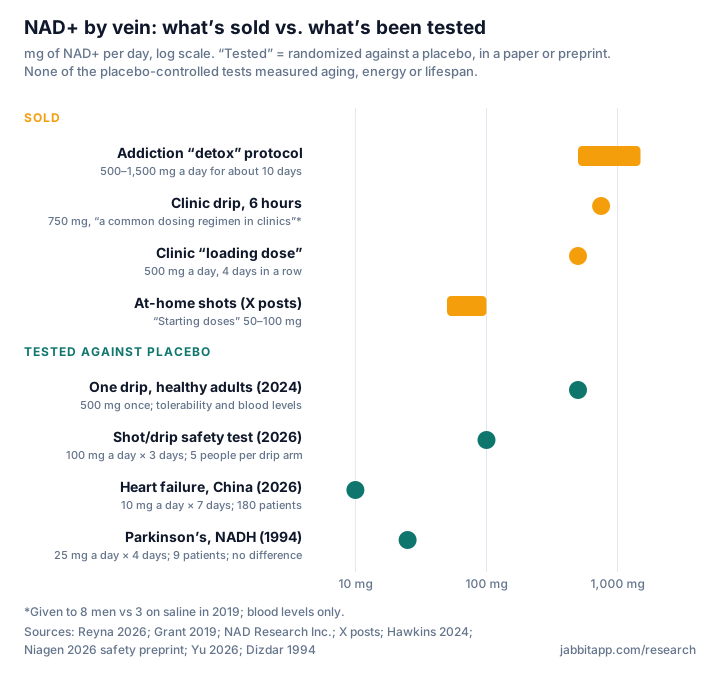
NAD+ IV drips and at-home NAD+ shots are sold as anti-aging. We found five tests that gave NAD+ or NADH by vein against a placebo, going back to 1994. None measured aging, energy or lifespan, and the largest used 10 mg a day, about a fiftieth of a typical clinic drip.[13][8][5][4][16][7] The drip’s own history starts with two short “preliminary reports” on addiction in 1961, and the next big NAD claim, a 1960s schizophrenia cure, fell apart in a double-blind test.[10][11][12] In one 2026 review of clinic records, every NAD+ drip client reported moderate to severe cramping, nausea and chest pressure.[7] FDA proposed in 2019 not to let pharmacies compound NAD. It never finished that rule, so under an interim policy they still can.[17][18][19]
Why this matters this week
On October 8, JAMA published a large, year-long test of an NAD+ booster in a disease of aging: 410 people with early Parkinson’s took oral nicotinamide riboside (NR, sold as Niagen) or a placebo for a year in Norway. The NR group did slightly worse than placebo.[1][2] Six days later, ChromaDex, the company that makes Niagen, posted a new study of daily NR shots, in a medRxiv preprint. It had no placebo group.[3] Meanwhile NAD+ is selling on X: Katie Price told followers on October 10 to message a seller for NAD+ “at cheap price,” calling it “amazing for anti aging,” and another account argued for drips because “NAD benefits taken orally are lost through the digestion process.”[33] By our count, English posts pairing NAD+ with health terms ran at about 45 to 73 a day from October 11 to 16. That’s steady chatter, not a spike.[33]
What NAD+ is, and what’s in the bag
NAD+ (nicotinamide adenine dinucleotide) is a molecule every cell uses to turn food into energy and to run enzymes that repair DNA. It was once called DPN, and in Chinese hospitals it’s sold as “coenzyme I.”[10][32] Three different things get sold under the NAD+ label. An NAD+ drip or shot is the whole molecule, compounded by a pharmacy. NR and NMN are smaller building blocks that cells turn into NAD+, sold mostly as pills.[26][22] Nearly all the controlled human evidence is for the pills, not the drips.[26][32] ChromaDex, which owns the Niagen ingredient, funded the three U.S. injection trials discussed below.[5][3][4] No NAD+ or NR injection is approved by FDA.[34]
Where the drip came from: addiction in 1961, schizophrenia in 1966
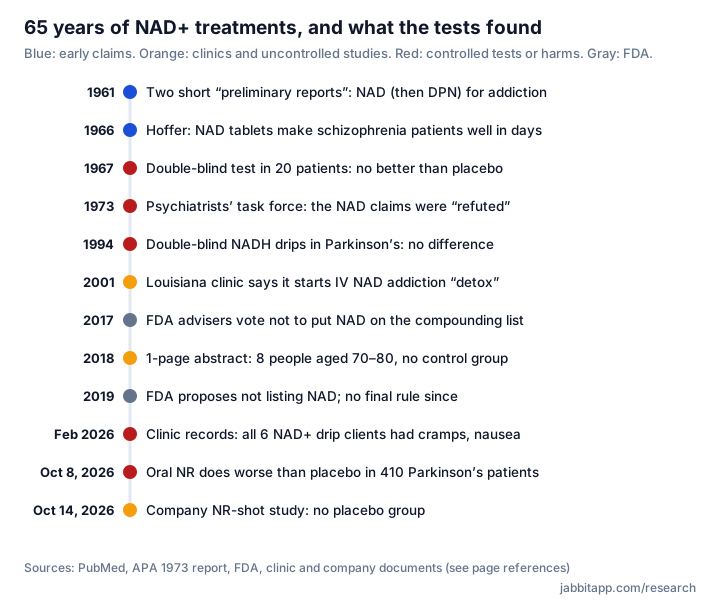
When ChromaDex’s researchers wrote up their October preprint, they traced IV NAD+ to a single source: “first documented by O’Hollaren in 1961.”[3] That source is two short papers by Paul O’Hollaren in the Western Journal of Surgery, Obstetrics and Gynecology, three and four pages long, each subtitled “a preliminary report.” One was on problem drinkers, the other on drug addiction.[10] PubMed lists no abstract and no later follow-up by him.[10]
Then came a bigger claim. In March 1966 the psychiatrist Abram Hoffer told a symposium that NAD had treated 13 of 17 schizophrenia patients in 3 to 5 days, and his paper with Humphry Osmond said oral NAD made 11 of 18 chronic patients well within days.[11][12] It got wide press. The American College of Neuropsychopharmacology quickly ran a double-blind test: 20 patients in matched pairs got NAD or placebo for two months. Both groups improved slightly, and the placebo group improved more on interviews.[11][12] Other groups tried it, including by vein in four patients, and found nothing.[12] In 1973 an American Psychiatric Association task force wrote that “evidence that NAD is effective has been refuted clinically.”[12] It also argued that NAD probably doesn’t enter cells intact.[12]
A small double-blind test of NADH (the reduced form) by vein in Parkinson’s patients in 1994 also found no difference from saline.[13] The modern drip came back through Louisiana. Springfield Wellness Center says it “introduced NAD+ treatment to the United States” and was founded in 2001. Its BR+ NAD addiction program ran 500 to 1,500 mg a day, 5 to 10 hours a day, for about 10 days. The evidence posted by NAD Research, Inc., whose director is also the clinic’s medical director, is a poster: a look back at 60 patients’ own craving ratings, with no comparison group.[14][15][8] The clinic’s home page now says NAD+ can “slow the progression of Parkinson’s and Alzheimer’s” and “promote anti-aging.”[14]
The “longevity genes” study is a one-page abstract
One human study still cited for IV NAD+ and aging has a sweeping title: IV NAD+ “increased expression of longevity genes safely in elderly humans.” It’s a 2018 one-page abstract by Nady Braidy, in the Journal of Cellular Neuroscience and Oxidative Stress. It describes 8 healthy people aged 70 to 80 given 1,000 mg by vein for 6 days, with no control group described. It says the treatment is “a safe and efficient way to slow down age-related decline in NAD+.”[9] We found no full paper of that study in PubMed, but a September 2026 review of IV NAD+ still cites it.[9][31]
The one full paper from the same group came a year later. In 2019, Ross Grant, Braidy and colleagues gave 8 men a 750 mg drip over 6 hours, against 3 on saline, at the Louisiana clinic. They picked the dose because it “reflects a common dosing regimen in clinics.” For the first two hours, blood NAD+ didn’t rise at all. The infused NAD+ was “rapidly and completely removed from the plasma,” apparently broken down. By hour six it was up 398%. The study measured blood chemistry, not health. It was funded in part by NAD+ Research Inc., whose director, the clinic’s medical director, was a co-author.[8]
What’s actually been tested against a placebo
We read every human NAD+ injection study we could find that had a placebo group. There are five. Two are company-funded preprints in healthy adults: a single 500 mg drip in 2024, and three days of 100 mg in 2026 with five people per drip group.[5][4] Both measured comfort and blood levels. The 2019 drip study measured blood levels in 11 men.[8] The 1994 Parkinson’s test had 9 patients.[13] The only one with a real health outcome is a Chinese trial in 180 heart-failure patients: 10 mg a day by vein for a week improved heart pumping (ejection fraction) at one month, 45.4% vs 42.4%. It didn’t significantly cut heart events.[16] That’s a promising result in a sick population, at a dose about one-fiftieth of the 500 mg drip clinics sell as a “loading dose.” It says nothing about aging.[16][7]
What we counted
We searched ClinicalTrials.gov for every trial giving NAD+, NADH, NR or NMN and found 162. Only 9 give NAD+ or NR by vein or injection, and we read each one. None has posted results.[32] Three are ChromaDex studies in healthy or tired adults. The other six are Chinese hospital trials of “coenzyme I for injection,” mostly in diseases like liver cancer and hearing loss.[32] Exactly one registered trial puts an NAD+ drip against a placebo on an aging measure: a 60-person study of blood-vessel aging in Shanghai, listed as not yet recruiting.[32] No registered trial tests a 500–1,000 mg wellness drip against placebo on aging, energy or lifespan.[32]
On PubMed, 490 human records mention NAD+ or NADH alongside injection or infusion. Just 13 are tagged as randomized trials. When we read those, only two had actually randomized people to injected NAD+ or NADH: the 2026 heart trial and the 1994 Parkinson’s test. The rest were about other drugs.[32][16][13]
This month’s two new studies
The Parkinson’s trial (oral NR). NOPARK was large, double-blind and independently funded by Norwegian research money. ChromaDex supplied the pills and placebo.[1] After a year, symptoms had worsened 2.45 points on NR and improved 0.27 on placebo, a gap of 2.72 points favoring placebo. That gap is below the 5.2 points the authors count as clinically meaningful worsening, so the fair reading is “no benefit, maybe slight harm,” not “NR is toxic.” Serious adverse events were actually less common on NR (8.3% vs 14.1%).[1] It tested pills in Parkinson’s, not drips in healthy people. The study’s leader put the lesson plainly: “NR clearly increased NAD metabolism, but this did not translate into clinical improvement.” His university calls it the largest trial yet of an NAD-boosting treatment in a neurological disease.[2]
The NR shot study. ChromaDex’s October preprint gave 39 tired adults 50 or 100 mg of NR by shot into muscle or under the skin for three days, at a Florida clinic that also sells NAD+ infusions.[3] Fatigue scores fell in some groups, but there was no placebo. To enroll, people had to report high fatigue, so scores were likely to drift down on retest anyway (regression to the mean), and some participants knew each other and “may have discussed” the study.[3] The authors flag both problems themselves.[3] The headline biology also didn’t land: “three days of injections did not result in statistically significant increases in whole blood NAD+ with each administration.” Peak times ranged from 15 minutes to 24 hours.[3] One more thing we noticed: the preprint cites the Restore clinic study with a DOI that points to an unrelated kidney-injury paper.[35][7]
Drips vs pills: what blood levels do and don’t prove
The pitch for drips is that pills get digested. That’s partly right for NAD+ itself. FDA wrote in 2019 that NADH is “likely to be degraded before absorption after oral dosing.”[17] But the drip doesn’t cleanly deliver NAD+ either. In the 2019 drip study, infused NAD+ vanished from blood for two hours.[8] In ChromaDex’s 2024 test, a 500 mg NR drip raised blood NAD+ more than a 500 mg NAD+ drip at three hours.[5] The precursor pills do raise blood NAD+ in controlled trials, and that’s their strongest result.[27][26]
A higher blood level isn’t a health benefit. That was the lesson of the Parkinson’s trial, where NR raised NAD metabolism and patients still did no better.[2] In aged men, NR pills raised NAD+-related molecules in muscle but didn’t change how the muscle’s mitochondria made energy.[30] In obese men, 2,000 mg a day for 12 weeks didn’t improve insulin sensitivity.[29] A 2025 review in Nature Metabolism summed up human trials of NAD+ precursors as showing “limited efficacy.”[26]
Is it legal?
No NAD+ or NR injection is FDA-approved.[34] Drips and shots come from compounding pharmacies. FDA reviewed NAD for pharmacy compounding years ago. Its advisers voted against it on May 8, 2017, and FDA’s 2019 proposal found NAD “degrades substantially” at room temperature and that there were “no published studies” for the use it was nominated for. It proposed keeping NAD off the list.[17] FDA never finalized that rule. NAD is still listed as “under evaluation” (Category 1) as of May 2026. While it sits there, FDA’s interim policy says it “does not intend to take regulatory action” against pharmacies that compound it, as long as they meet other conditions.[17][18][19][20] Injectable NR goes through a different door. Niagen says its IV and shot products are made by 503B outsourcing facilities for clinics, by prescription, and NR chloride sits on FDA’s 503B “under evaluation” list.[21][22]
NMN pills had their own fight. In 2022 FDA said NMN couldn’t be sold as a supplement because it had first been studied as a drug. In September 2025, answering an industry petition, FDA reversed that and concluded NMN “is not excluded” from the supplement definition.[23]
Safety
The clearest harm is the drip itself. In a 2026 review of clinic records at Restore Hyper Wellness in Austin, all six clients who got 500 mg NAD+ drips on four days in a row reported “moderate to severe abdominal cramping, diarrhea, nausea, vomiting, increased heart rates, pain in throat, congestion, and chest pressure.” Symptoms stopped when the drip did, and the drips took about 97 minutes because clients slowed them down.[7] In ChromaDex’s 2024 trial, NAD+ drips raised white blood cell counts, which the authors read as an inflammatory response.[5] In the April 2026 safety test, NAD+ drips drew 14 unpleasant symptom reports against 2 for saline drips, including chest tightness and shortness of breath. Five minutes after dosing, one person in the NAD+ drip group and one in the NAD+ shot group described “paralysis/can’t move.” These were free-text reports from a handful of people.[4] We found no published long-term safety data on repeated NAD+ or NR injections in people, and the published NR toxicity tests so far are single-dose animal studies.[6][3]
What holds up
NAD+ biology is real and important, and the precursor pills have a fair record. They reliably raise blood NAD+, they’re generally well tolerated in trials, and a few small trials found signals worth testing: blood pressure and artery stiffness in older adults, and muscle insulin sensitivity in women with prediabetes taking NMN.[27][28][29] The Chinese heart-failure trial is a real randomized result for injected NAD+ in a sick population.[16] And in fairness to the drip clinics, short-term drips at these doses haven’t produced serious harm in the small studies so far. The problems found were discomfort, not injury.[5][7][8]
Checking the claims going around this week
“By age 50 your NAD+ levels have dropped by roughly 50%.”[33] A widely cited source for the decline claim is a 2012 study of skin removed during surgery, by the same Australian group that later ran the drip studies.[24] In a 2022 blood study of 1,518 adults, women showed no significant difference across age groups. In men, only those 60 and older differed from the youngest group, by about 2 μmol/L out of 34.5, roughly 6%.[25] A September 2026 review says large human datasets show whole-blood NAD+ doesn’t decline with healthy aging as such.[31][26]
“NAD taken orally is lost through digestion,” so drips are better.[33] Partly true for whole NAD+, but drip NAD+ is also broken down fast, and NR by vein raised blood NAD+ more than NAD+ by vein at three hours in the company’s own test.[17][8][5]
Side effects are “mostly about speed and dose.”[33] Speed matters. Clients in the Restore records slowed their own drips to cope.[7] But at 100 mg, within the range X sellers call a starting dose, NAD+ drips still drew 14 symptom reports to saline’s 2, including chest tightness.[4][33]
“The injections make me feel like I’m 30 again.”[33] That’s exactly what an unblinded test can’t separate from expectation. In the 1967 double-blind test of the last NAD craze, the placebo patients improved more on interviews.[12][11]
Bottom line
Do NAD+ shots and drips slow aging? Nobody has run the test that could show it. The placebo-controlled trials measured comfort, blood levels, or symptoms in sick patients, at doses as low as a fiftieth of what clinics sell.[4][5][16][32] The company studies are small and posted as preprints, and the newest one had no placebo.[3][4][5] The drip has been sold on preliminary reports since 1961, and the controlled tests have mostly come back flat, from schizophrenia in 1967 to Parkinson’s this month.[10][12][13][1] If you want the version with the most evidence, it’s a pill, and even those trials show “limited efficacy.”[26]
References
- Brakedal B, Skeie GO, Derad C, et al. Nicotinamide riboside for patients with early-stage Parkinson disease: the NOPARK randomized clinical trial. JAMA. Published online October 8, 2026. doi:10.1001/jama.2026.18828. PMID 42848371; PMC13650695; NCT03568968 (410 randomized, 11 Norwegian centers, 500 mg twice daily or placebo for 52 weeks; MDS-UPDRS parts I–III change 2.45 vs −0.27, difference 2.72 points, 95% CI 0.47–4.98, P = .02, favoring placebo; clinically important worsening 5.2 points; non-motor score difference 4.22, P = .009; serious adverse events 8.3% vs 14.1%; ChromaDex supplied NR and placebo; two authors hold a patent on NR for Parkinson disease licensed to Niagen Bioscience). https://pubmed.ncbi.nlm.nih.gov/42848371/. Checked October 17, 2026.
- University of Bergen. Major trial of NAD-boosting treatment finds no benefit in Parkinson’s disease. Press release via EurekAlert!, October 8, 2026 (“NR clearly increased NAD metabolism, but this did not translate into clinical improvement”; NOPARK “is the largest trial to date of an NAD-boosting treatment in a neurological disorder”; difference “below the commonly used threshold for a clinically important difference”; “ChromaDex Inc, a Niagen Bioscience company, supplied NR and placebo”). https://www.eurekalert.org/news-releases/1146813. Checked October 17, 2026.
- Nkrumah-Elie Y, Kwon J, Russ A, et al. Part 1 of a 2-part, open-label clinical trial evaluating repeated nicotinamide riboside parenteral administration: 3 consecutive days of intramuscular and subcutaneous injections. medRxiv preprint, posted October 14, 2026. doi:10.64898/2026.10.12.26365345. NCT07251608. (39 analyzed, 50 or 100 mg NR by IM or SC injection daily for 3 days, then 7-day washout; no blinding and no placebo; enrollment required baseline fatigue, FAS ≥22; one clinic in Aventura, Florida; Niagen Plus compounded by Wells Pharma; “three days of injections did not result in statistically significant increases in whole blood NAD+ with each administration”; tmax 15 minutes to 24 hours; “some participants were acquainted and may have discussed aspects of the study”; limitations section names regression to the mean and expectancy bias; injection-site findings incl. redness 52.6% and itching 57.9% with SC; 6 adverse events, all mild; authors employed by ChromaDex, which funded the study and holds patents on NR injection; the clinic offers NAD+ infusions. Introduction: IV NAD+ “was first documented by O’Hollaren in 1961” and “controlled clinical trials of parenteral NAD+ have remained sparse”.) https://www.medrxiv.org/content/10.64898/2026.10.12.26365345v1. Checked October 17, 2026.
- Nkrumah-Elie Y, Kwon J, Simpson S, et al. Preliminary safety analysis of two pilot clinical trials involving injections of Niagen®, nicotinamide riboside chloride. medRxiv preprint, posted April 30, 2026. doi:10.64898/2026.04.28.26352007. Trial 1, NCT06919328 (Huntsville, Alabama; double-blind; 100 mg NR, NAD+ or placebo by IV, IM or SC daily for 3 days; 4 to 6 people per arm, 5 per IV arm; participants paid $350). Table 4: free-text symptoms during injection, categorized after the fact, totaling 14 in the NAD+ IV arm vs 2 in the placebo IV arm, incl. chest tightness/heaviness and shortness of breath; Table 5: “Paralysis/can’t move” 5 minutes after injection, one report each in the NAD+ IV and NAD+ SC arms. https://www.medrxiv.org/content/10.64898/2026.04.28.26352007v1. Checked October 17, 2026.
- Hawkins J, Idoine R, Kwon J, et al. Randomized, placebo-controlled, pilot clinical study evaluating acute Niagen®+ IV and NAD+ IV in healthy adults. medRxiv preprint, posted June 10, 2024. doi:10.1101/2024.06.06.24308565. NCT06382688 (single 500 mg NR IV, 500 mg NAD+ IV, oral NR or saline; 37 and 16 analyzed in two parts; tolerable infusion time 75% shorter with NR IV; NAD+ IV raised white blood cells and neutrophils, “suggesting the presence of an inflammatory response”; NR IV peak blood NAD+ +20.7%; funded by ChromaDex). https://www.medrxiv.org/content/10.1101/2024.06.06.24308565v1. Checked October 17, 2026.
- Kwon J, Nkrumah-Elie Y, Mavoyan JS, et al. Acute toxicological profile of pharmaceutical-grade nicotinamide riboside: a route-dependent assessment across intravenous, intramuscular, and subcutaneous administration. bioRxiv preprint, posted March 2, 2026. doi:10.64898/2026.02.27.708010 (single-dose, acute toxicity studies in animals). https://doi.org/10.64898/2026.02.27.708010. Checked October 17, 2026.
- Reyna K, Heinzen G, Patel N, et al. Intravenous infusion of nicotinamide adenine dinucleotide (NAD+) versus nicotinamide riboside (NR): a retrospective tolerability pilot study in a real-world setting. Front Aging. 2026;7:1652582. doi:10.3389/fragi.2026.1652582. PMID 41704678; PMC12907335 (records of 6 NAD+ IV and 8 NR IV clients at Restore Hyper Wellness, Austin; 500 mg in 500 mL saline on 4 consecutive days, “the typical commercial ‘loading dose’”; “All clients (n = 6) in the NAD+ group reported moderate to severe abdominal cramping, diarrhea, nausea, vomiting, increased heart rates, pain in throat, congestion, and chest pressure during infusion”; infusion time about 97 vs 37 minutes; NAD+ from Empower Pharmacy; funded by Restore Hyper Wellness; NR donated by Niagen). https://pmc.ncbi.nlm.nih.gov/articles/PMC12907335/. Checked October 17, 2026.
- Grant R, Berg J, Mestayer R, et al. A pilot study investigating changes in the human plasma and urine NAD+ metabolome during a 6 hour intravenous infusion of NAD+. Front Aging Neurosci. 2019;11:257. doi:10.3389/fnagi.2019.00257. PMID 31572171; PMC6751327 (8 men given 750 mg over 6 hours vs 3 given saline, at Springfield Wellness Center; dose “reflects a common dosing regimen in clinics (e.g., Springfield Wellness Clinic)”; NAD+ “is rapidly and completely removed from the plasma for at least the first 2 h”; plasma NAD+ +398% only at 6 hours; no adverse events observed; funded in part by NAD+ Research Inc., whose director, R. Mestayer, is a co-author). https://pubmed.ncbi.nlm.nih.gov/31572171/. Checked October 17, 2026.
- Braidy N. Intravenous NAD+ effectively increased the NAD metabolome, reduced oxidative stress and inflammation, and increased expression of longevity genes safely in elderly humans. J Cell Neurosci Oxid Stress. 2018;10(3):779 (one-page abstract; 1,000 mg IV for 6 days in 8 healthy adults aged 70 to 80; no control group described). doi:10.37212/jcnos.610084. https://doi.org/10.37212/jcnos.610084. We found no full paper of this study in PubMed. Checked October 17, 2026.
- O’Hollaren P. Pyridine nucleotides in the prevention, diagnosis and treatment of problem drinkers: a preliminary report. West J Surg Obstet Gynecol. 1961;69:101-104. PMID 13730083 https://pubmed.ncbi.nlm.nih.gov/13730083/; and O’Hollaren P. Diphosphopyridine nucleotide in the prevention, diagnosis and treatment of drug addiction: a preliminary report. West J Surg Obstet Gynecol. 1961;69:213-215. PMID 13730082 https://pubmed.ncbi.nlm.nih.gov/13730082/. No abstracts in PubMed. Checked October 17, 2026.
- Kline NS, Barclay GL, Cole JO, et al. Controlled evaluation of nicotinamide adenine dinucleotide in the treatment of chronic schizophrenic patients. Br J Psychiatry. 1967;113(500):731-742. doi:10.1192/bjp.113.500.731. PMID 4292729 (opening: Hoffer told a March 30, 1966 symposium of “apparently successful treatment in 13 of 17” patients “in 3 to 5 days” with 1 to 2 g of oral NAD) https://www.cambridge.org/core/journals/the-british-journal-of-psychiatry/article/abs/controlled-evaluation-of-nicotinamide-adenine-dinucleotide-in-the-treatment-of-chronic-schizophrenic-patients/04BE7970D1203E0AF3C67404C5613B11; and Kline NS, et al. Diphosphopyridine nucleotide in the treatment of schizophrenia. JAMA. 1967;200:881-882. PMID 4290500. Checked October 17, 2026.
- American Psychiatric Association Task Force on Vitamin Therapy in Psychiatry (Lipton MA, chair). Megavitamin and Orthomolecular Therapy in Psychiatry. Task Force Report 7, July 1973. NAD section: Hoffer and Osmond’s 1966 claim that oral NAD made 11 of 18 chronic patients well within days; replications “invariably failed”; the Rockland State Hospital double-blind study matched 20 patients in 10 pairs for two months, “Both groups improved, though insignificantly. Patients on placebo improved more as measured by interviews”; NAD given intravenously to 4 patients produced no change (reported as a personal communication); “evidence that NAD is effective has been refuted clinically.” https://www.psychiatry.org/File%20Library/Psychiatrists/Directories/Library-and-Archive/task-force-reports/tfr1973_Megavitamin.pdf. Checked October 17, 2026.
- Dizdar N, Kågedal B, Lindvall B. Treatment of Parkinson’s disease with NADH. Acta Neurol Scand. 1994;90(5):345-347. doi:10.1111/j.1600-0404.1994.tb02735.x. PMID 7887134 (double-blind; 5 patients given NADH 25 mg IV daily for 4 days, then by intramuscular injection, vs 4 on saline; no significant changes “neither clinically nor biochemically”). https://pubmed.ncbi.nlm.nih.gov/7887134/. Checked October 17, 2026.
- Springfield Wellness Center (Louisiana), home page: “the pioneering force that introduced NAD+ treatment to the United States … Founded in 2001”; BR+ NAD® formulation; says its NAD+ treatments can “slow the progression of Parkinson’s and Alzheimer’s” and “promote anti-aging.” https://springfieldwellnesscenter.com/. Checked October 17, 2026.
- Broom SL, Mestayer R, et al. Intravenous administration of nicotinamide adenine dinucleotide significantly reduces self report craving ratings associated with opiate and alcohol withdrawal. Poster, NAD Research, Inc. (retrospective review of 60 Springfield Wellness Center patients, 6 omitted; Brain Restoration Plus, IV NAD 500–1,500 mg a day for 5 to 10 hours daily over an average of 10 days, plus vitamins, amino acids and other drugs; self-rated cravings; 27 reached at follow-up; no control group). https://www.nadresearch.org/brnad-reduces-cravings/. Checked October 17, 2026.
- Yu X, Xu J, Cao J, et al. Effect of nicotinamide adenine dinucleotide on heart failure caused by ischemic cardiomyopathy: a randomized, placebo-controlled trial. Am J Cardiovasc Drugs. 2026;26(1):97-106. doi:10.1007/s40256-025-00764-7. PMID 40954388; PMC12779688 (single center; 180 adults with LVEF ≤45%; IV NAD+ 10 mg/day or placebo for 7 days on top of standard treatment; LVEF at 1 month 45.44% vs 42.44%, p = 0.024; major cardiac events 14.6% vs 24.7%, p = 0.089, not significant). https://pubmed.ncbi.nlm.nih.gov/40954388/. Checked October 17, 2026.
- Food and Drug Administration. Amendments to the List of Bulk Drug Substances That Can Be Used to Compound Drug Products in Accordance With Section 503A. Proposed rule. Federal Register 84 FR 46688, September 5, 2019, document 2019-18951. Item (21) NAD, evaluated for fatigue in multiple sclerosis: it “degrades substantially when exposed to light, moisture, alkaline pH, or standard room temperatures”; “We identified no published studies that support the use of NAD for the treatment of fatigue in patients with multiple sclerosis”; advisory committee voted May 8, 2017 not to include NAD; “The proposed rule would not place NAD on the 503A Bulks List.” Item (22) NADH: “likely to be degraded before absorption after oral dosing.” https://www.federalregister.gov/documents/2019/09/05/2019-18951/amendments-to-the-list-of-bulk-drug-substances-that-can-be-used-to-compound-drug-products-in. A Federal Register search found no later final rule on NAD. Checked October 17, 2026.
- FDA. Bulk Drug Substances Nominated for Use in Compounding Under Section 503A, updated May 14, 2026: “Nicotinamide Adenine Dinucleotide (NAD)” and NADH listed in Category 1, “Under Evaluation”; “Beta-Nicotinamide Adenine Dinucleotide” in Category 3, “Nominated Without Adequate Support.” https://www.fda.gov/media/94155/download. Checked October 17, 2026.
- FDA. Interim Policy on Compounding Using Bulk Drug Substances Under Section 503A of the FD&C Act. Guidance for industry, January 2025: FDA “does not intend to take regulatory action” for compounding with a substance that “appears on Category 1,” among other conditions, “until the Agency addresses these substances in a final rule.” https://www.fda.gov/media/174456/download. Checked October 17, 2026.
- Electronic Code of Federal Regulations, 21 CFR 216.23, bulk drug substances that can be used to compound drug products under section 503A (NAD not listed). https://www.ecfr.gov/current/title-21/chapter-I/subchapter-C/part-216/subpart-C/section-216.23. Checked October 17, 2026.
- FDA. Bulk Drug Substances Nominated for Use in Compounding Under Section 503B, updated March 21, 2025: “Beta-Nicotinamide Adenine Dinucleotide” and “Nicotinamide riboside chloride” listed in Category 1, “Under Evaluation.” https://www.fda.gov/media/94164/download. Checked October 17, 2026.
- Niagen Bioscience press release, April 9, 2026, on a USP dietary-supplement monograph for nicotinamide riboside chloride, “expected to be codified and enforced in October 2026”; states that Niagen IV and injections “are compounded and distributed by U.S. FDA-registered 503B outsourcing facilities and are available exclusively at clinics with a prescription,” and lists remaining on FDA’s 503B Category 1 list as a business risk. https://investors.niagenbioscience.com/news/news-details/2026/Niagen-Bioscience-Collaborates-with-USP-to-Establish-First-Ever-USP-Monograph-for-Nicotinamide-Riboside-Chloride-NRCl-the-Patented-Form-in-Niagen/default.aspx. Checked October 17, 2026.
- FDA Human Foods Program, letter to the Natural Products Association and Alliance for Natural Health USA responding to citizen petition FDA-2023-P-0872, signed September 29, 2025: FDA had said in October and November 2022 that NMN was excluded from the dietary supplement definition because it was first studied as a drug (MIB-626, which FDA says is the same substance); FDA now concludes “NMN is not excluded from the definition of dietary supplement.” Copy posted by the law firm AWG Law: https://awglaw.com/wp-content/uploads/2025/10/FDA-2023-P-0872-2754_attachment_1-response-to-NPA.pdf; docket https://www.regulations.gov/docket/FDA-2023-P-0872. Checked October 17, 2026.
- Massudi H, Grant R, Braidy N, et al. Age-associated changes in oxidative stress and NAD+ metabolism in human tissue. PLoS One. 2012;7(7):e42357. doi:10.1371/journal.pone.0042357. PMID 22848760 (pelvic skin removed during surgery from patients aged 15 to 77, plus newborn foreskin). https://pubmed.ncbi.nlm.nih.gov/22848760/. Checked October 17, 2026.
- Yang F, Deng X, Yu Y, et al. Association of human whole blood NAD+ contents with aging. Front Endocrinol (Lausanne). 2022;13:829658. doi:10.3389/fendo.2022.829658. PMID 35388296 (1,518 adults; mean 33.0 μmol/L; men 34.5, women 31.3; in men, only the ≥60 group differed from ≤29, β −2.16 μmol/L; in women, no significant difference across five age groups). https://pubmed.ncbi.nlm.nih.gov/35388296/. Checked October 17, 2026.
- Vinten KT, Trętowicz MM, Coskun E, et al. NAD+ precursor supplementation in human ageing: clinical evidence and challenges. Nat Metab. 2025;7(10):1974-1990. doi:10.1038/s42255-025-01387-7. PMID 41083806 (age-related decline “consistently observed only in a limited number of studies”; human trials “have shown limited efficacy”). https://pubmed.ncbi.nlm.nih.gov/41083806/. Checked October 17, 2026.
- Martens CR, Denman BA, Mazzo MR, et al. Chronic nicotinamide riboside supplementation is well-tolerated and elevates NAD+ in healthy middle-aged and older adults. Nat Commun. 2018;9(1):1286. doi:10.1038/s41467-018-03421-7. PMID 29599478 (2 × 6-week randomized, double-blind crossover; blood pressure and arterial stiffness flagged for future trials). https://pubmed.ncbi.nlm.nih.gov/29599478/. Checked October 17, 2026.
- Yoshino M, Yoshino J, Kayser BD, et al. Nicotinamide mononucleotide increases muscle insulin sensitivity in prediabetic women. Science. 2021;372(6547):1224-1229. doi:10.1126/science.abe9985. PMID 33888596 (10-week randomized, double-blind trial in postmenopausal women with prediabetes and overweight or obesity). https://pubmed.ncbi.nlm.nih.gov/33888596/. Checked October 17, 2026.
- Dollerup OL, Christensen B, Svart M, et al. A randomized placebo-controlled clinical trial of nicotinamide riboside in obese men: safety, insulin-sensitivity, and lipid-mobilizing effects. Am J Clin Nutr. 2018;108(2):343-353. doi:10.1093/ajcn/nqy132. PMID 29992272 (2,000 mg/day for 12 weeks “appears safe, but does not improve insulin sensitivity”). https://pubmed.ncbi.nlm.nih.gov/29992272/. Checked October 17, 2026.
- Elhassan YS, Kluckova K, Fletcher RS, et al. Nicotinamide riboside augments the aged human skeletal muscle NAD+ metabolome and induces transcriptomic and anti-inflammatory signatures. Cell Rep. 2019;28(7):1717-1728.e6. doi:10.1016/j.celrep.2019.07.043. PMID 31412242 (12 aged men, 1 g/day for 21 days, crossover; NR raised NAD+-related metabolites in muscle “without altering mitochondrial bioenergetics” and lowered circulating inflammatory cytokines). https://pubmed.ncbi.nlm.nih.gov/31412242/. Checked October 17, 2026.
- Alangari A, Arif J, Al Qureshah F, Alkhodairy F. Narrative review of intravenous NAD+ and NAD+ precursors in wellness and translational medicine. Front Aging. 2026;7:1887175. doi:10.3389/fragi.2026.1887175. PMID 42787547; PMC13601825 (abstract: “recent large-scale human data indicate that whole-blood NAD+ concentrations do not decline with healthy aging per se”). https://pubmed.ncbi.nlm.nih.gov/42787547/. Checked October 17, 2026.
- Jabbit analysis, October 17, 2026: ClinicalTrials.gov API v2 search of interventions for NAD+, NADH, nicotinamide riboside/Niagen and NMN (364 records; 162 interventional trials giving NAD+, NR or NMN after removing a defibrillation trial that uses the acronym “NAD”); route, placebo and results flags, with each injection or IV record read by hand (9 trials; one oral-NMN vaccine trial excluded). PubMed counts: 490 human records mentioning NAD+/NADH with intravenous, infusion, injection, subcutaneous or intramuscular in title or abstract; 13 tagged as randomized controlled trials, which we read. Script: ops/scripts/nad_trials_analysis.py. Data: https://jabbitapp.com/research/sources/nad-trials-ctgov-pubmed-2026-10-17.json. Checked October 17, 2026.
- Posts on X (impressions when pulled October 17, 2026): @KatiePrice, October 10, 2026 (“he has NAD + At cheap price it’s amazing for anti aging”) https://x.com/KatiePrice/status/2108985559335022774; @1Immortals1, October 11, 2026 (“by age 50 your NAD+ levels have dropped by roughly 50%”; IV drips “$250 to $1,000 per session”) https://x.com/1Immortals1/status/2109335218742321614; @1Immortals1, October 14, 2026 (“destroying up to 95% of your NAD+”) https://x.com/1Immortals1/status/2110362236598300895; @OHMpeptides, October 10, 2026 (subcutaneous NAD+: flushing, chest tightness and nausea “are mostly about speed and dose. Starting doses usually sit around 50 to 100 mg”) https://x.com/OHMpeptides/status/2108951698924314712; @MTGolfer2, October 5, 2026 (“NAD benefits taken orally are lost through the digestion process”) https://x.com/MTGolfer2/status/2106941444736831612; @niagenplus, October 6, 2026 (“infusion times up to 75% faster than traditional NAD+ IV”) https://x.com/niagenplus/status/2107599984514527453; @YatYas1070, October 15, 2026 (“The injections make me feel like I’m 30 again”) https://x.com/YatYas1070/status/2110781983001296917; @DailyMail, October 5, 2026 (NAD+ IV drip parties) https://x.com/DailyMail/status/2107035004844863515. Daily counts are Jabbit’s, from X’s recent-search counts: English posts mentioning NAD+ or NAD with health terms (injection, IV, drip, longevity, aging, NMN, NR, Niagen, mitochondria or peptides), excluding reposts, October 11–16, 2026 (UTC): 61, 67, 73, 53, 58, 45. Checked October 17, 2026.
- openFDA Drugs@FDA API searches for “nicotinamide adenine” and “nicotinamide riboside” as generic or active-ingredient names returned no matches. https://open.fda.gov/apis/drug/drugsfda/. Checked October 17, 2026.
- Crossref record for doi:10.3389/fimmu.2026.1721884, the DOI given for the Restore Hyper Wellness study in reference 39 of the October 14 preprint: it resolves to “NMN protects cisplatin-associated AKI via NAD+/SIRT1 pathway,” Frontiers in Immunology. https://api.crossref.org/works/10.3389/fimmu.2026.1721884. Checked October 17, 2026.
This page analyzes published trials, preprints, regulatory documents, clinic pages and trial registries. It is not medical advice and does not recommend using, sourcing, or dosing NAD+, NR or NMN. The trial-registry and PubMed counts and X counts are Jabbit’s own; inputs are cited above.