Evidence review · Ozempic, Wegovy and Rybelsus (semaglutide), Zepbound and Mounjaro (tirzepatide) · Randomized trials, conference posters, records studies, meta-analyses, 9 US drug labels, ClinicalTrials.gov review · Sources checked October 20, 2026
Published · Updated
Do Ozempic, Wegovy, Zepbound or Mounjaro weaken your bones? Hip bone density drops a little as the weight comes off, fracture data are mixed, and tirzepatide has the newest warning signs and the least testing.
On semaglutide or liraglutide, hip bone density falls a little more than with placebo or exercise, roughly in line with the weight lost. In the one trial that added exercise to the drug, bone density stayed at placebo levels.[10][11][12] Fracture data are mixed. Pooled diabetes trials show no harm or even fewer fractures, but Wegovy’s label reports more hip and pelvis fractures in women and in people 75 and older.[14][15][3] The newest warning signs involve tirzepatide (Zepbound, Mounjaro): a 3.2% hip density drop in six months in a small trial, and more fractures in pooled trials, from a conference abstract.[6][5] We also checked the labels and the trial registry. Of 9 US GLP-1 labels, only Wegovy’s mentions fractures, and none mentions bone density.[4] Of 30 registered studies that measure bone on these drugs, 2 have posted results, none tests tirzepatide against placebo, and Eli Lilly runs none.[21]
Why this matters now
Today, October 20, is World Osteoporosis Day.[1] Over the past week, English posts on X tying GLP-1 drugs to bone ran at 8 to 18 a day. They ranged from claims that the drugs “cause massive bone density loss” to a peptide seller promising better “bone density.”[2] The research is moving too. A 60-study meta-analysis came out in Drugs in September, and Novo Nordisk presented CagriSema bone-marker data at the European diabetes meeting the same month. Records studies on tirzepatide keep landing.[15][19][8][7] Hip fractures are among the most serious injuries of aging. For anyone in their 50s, 60s or 70s on a weekly shot, the practical question is whether they’re trading fat for fragile bones, and what they can do about it.
The short answer
- Bone density dips at the hip, mostly in proportion to weight loss. On semaglutide, a year cost about 0.02 g/cm² of hip density more than placebo in a trial of people at higher fracture risk.[10]
- Exercise erased the drop in the one trial that tested it. Liraglutide plus exercise kept hip and spine density at placebo levels despite the biggest weight loss.[11]
- Fracture data conflict. Diabetes trial pools find no harm or fewer fractures, but Wegovy’s label flags more hip and pelvis fractures in women and in people 75 and older.[14][15][3]
- Tirzepatide has the newest warning signs and the least testing. The evidence is a small trial, a conference abstract and conflicting records studies. No registered trial compares it with placebo on bone.[6][5][7][8][21]
- The labels are mostly silent. Only Wegovy’s label mentions fractures. Ozempic’s, Zepbound’s and Mounjaro’s don’t.[4]
What happens to bone density
Bone responds to load. Carry less weight, and the skeleton tends to shed some density, especially at the hip. That happened with diet and exercise alone in the Look AHEAD trial.[18][16] The question is whether GLP-1 drugs cause more loss than the weight loss alone would, and whether it matters.
- Semaglutide, randomized (Hansen 2024, Denmark). 64 adults with low bone density or a recent fracture, mean age 63, mostly postmenopausal women, took semaglutide 1.0 mg or placebo for a year. The trial’s main question was whether the drug would increase bone formation, and it didn’t (P1NP, p=0.418). Instead, the bone-breakdown marker CTX rose, and total hip density ended 0.020 g/cm² lower than placebo (p=0.001). Spine density was lower too. People lost 6.8 kg more on the drug.[10] The registry record still lists the trial’s status as unknown, with no results posted.[21]
- Liraglutide vs exercise, randomized (S-LiTE, Denmark). 195 adults aged 18 to 65 lost weight on an 800-calorie diet, then spent a year on placebo, exercise, liraglutide 3.0 mg, or both. Liraglutide alone lowered hip density 0.013 g/cm² more than exercise alone (p=0.03) despite similar weight loss. The combination group lost the most weight, 16.9 kg, yet its hip and spine density was no different from placebo.[11]
- Older adults, randomized pilot (Dinkla 2025). 20 adults with a mean age of 72.7 took semaglutide 1.0 mg plus counseling or counseling alone for 20 weeks. There was no significant difference in whole-body density or bone markers, though the authors note the semaglutide group had “consistently lower BMD and higher bone turnover.”[13]
- Real-world scans (Liu 2026, JCEM). 255 semaglutide or tirzepatide users at higher fracture risk, 92% women, mean age 64, were compared with 255 matched nonusers. Over a median 17 months, both groups lost hip density at similar rates. In people without diabetes, users lost more (−1% vs −0.6%, P=.04), and the more weight people lost, the more hip bone they lost.[12]
- Tirzepatide, randomized (TABFAT, Slovenia). 34 premenopausal women with obesity took tirzepatide or placebo for six months. The tirzepatide group lost a median 13.5% of body weight, 3.2% of total hip density and 4.4% at the femoral neck. Both drops were greater than placebo. Spine density rose 2.1%, bone breakdown (CTX) rose 84%, and bone formation (PINP) fell 16.8%.[6] That is a large drop for six months in women under 50. It is a poster, not a paper, and the trial’s registry record lists brown-fat outcomes, not bone.[6]
The pooled view is calmer. A 2026 meta-analysis in Drugs of 60 studies and over 1.25 million people found no significant effect on bone density or fractures in its most-adjusted models. It rated the certainty low.[15] A 2025 review in Diabetes, Obesity and Metabolism called GLP-1 effects on bone markers and density “neutral or negative” but not clinically significant, and noted that bone data on dual and triple agonists are mostly from animals.[16]
Fractures: what the trials and labels say
Bone density is a stand-in. Fractures are what matter, and no trial of these drugs was built to count them.
The reassuring data. A 2025 meta-analysis of 44 randomized diabetes trials (47,823 people, 292 fractures) found fewer fractures on GLP-1 drugs than on placebo or other diabetes drugs (RR 0.77). The benefit came from liraglutide (RR 0.42) and treatment longer than 78 weeks. Other GLP-1 drugs showed no benefit.[14]
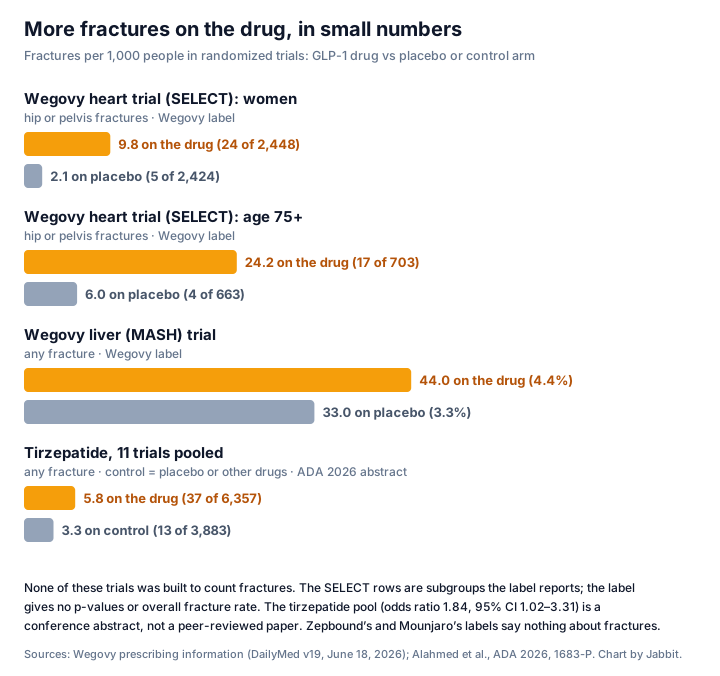
The worrying data. The Wegovy label reports that in SELECT, the large heart-outcomes trial, “more fractures of the hip and pelvis were reported on WEGOVY than on placebo in female patients: 1% (24/2,448) vs. 0.2% (5/2,424), and in patients ages 75 years and older: 2.4% (17/703) vs. 0.6% (4/663).” In Wegovy’s liver (MASH) trial, where the median age was 61, fractures occurred in 4.4% on the drug versus 3.3% on placebo.[3] These are subgroup counts, and the label gives no p-values for them. They are also the only fracture warnings on any of the nine GLP-1 labels we checked.[3][4]
The label gap. We read the current prescribing information for Wegovy, Ozempic, Rybelsus, Zepbound, Mounjaro, Saxenda, Victoza, Foundayo and Trulicity. Only Wegovy’s mentions fractures, and none mentions bone density.[4] The SELECT and MASH findings are on Wegovy’s label because those were Wegovy trials. Ozempic is the same molecule at up to 2 mg a week, but its label is silent. Zepbound’s and Mounjaro’s labels say nothing about fractures, even though an ADA abstract counted 37 fractures on tirzepatide versus 13 on control across 11 of its trials.[4][5]
Weight loss itself has a fracture cost in older adults. In Look AHEAD, 5,145 adults aged 45 to 76 with type 2 diabetes were followed for a median of 11.3 years. The lifestyle group lost more weight (6.0% vs 3.5%). Total and hip fracture rates didn’t differ, but frailty fractures were 39% more common in the weight-loss group (HR 1.39, 95% CI 1.02–1.89).[17] Men in the lifestyle group also lost more hip bone over 8 to 16 years.[18] That trial used no drugs, and the GLP-1 drugs produce bigger weight losses.
Tirzepatide: the conflicting evidence
Zepbound and Mounjaro also act on a second hormone receptor (GIP), and researchers have flagged it as a possible extra risk for bone.[6] The human data so far split:
| Study | Design | Finding | Direction | Source |
|---|---|---|---|---|
| TABFAT (ENDO 2026 poster) | Randomized, 34 premenopausal women, 6 months | Total hip −3.2%, femoral neck −4.4%, more than placebo | Hip loss | [6] |
| ADA 2026 abstract | 11 randomized trials pooled, 10,240 people | Fractures 0.58% vs 0.33%; OR 1.84 (1.02–3.31) | More fractures | [5] |
| Hsu 2025 (TriNetX) | Records, 66,329 per group, 14 months | Osteoporosis or fragility fracture HR 1.44 vs other GLP-1 drugs | More fractures | [7] |
| Lilly post hoc (SURMOUNT, SUMMIT) | Trial data, age 65+ | “No clinically meaningful differences” in falls or fractures vs placebo | No signal | [9] |
| Chen 2026 (TriNetX) | Records, age 65+, 12,808 matched, 1 year | Femoral fracture 0.2% vs 0.4% vs DPP-4 pills; HR 0.45 | Fewer fractures | [8] |
Three of the five point to harm, but they are a small trial, a conference abstract and a records study comparing users with people on other GLP-1 drugs.[6][5][7] The records study that found fewer fractures compared older adults with people on DPP-4 diabetes pills, which don’t cause weight loss. Comparisons like that can mix up drug effects with who gets prescribed what.[8] The abstract’s authors note “there were a few fractures in total,” 50 across all 11 trials.[5] Lilly’s own pooled analysis of people 65 and older found no meaningful difference in falls or fractures.[9] None of the 5 registered tirzepatide bone studies is randomized against placebo, and Lilly sponsors none of them.[21]
What we counted on ClinicalTrials.gov
We pulled 1,712 studies that list semaglutide, tirzepatide, retatrutide, orforglipron, liraglutide or cagrilintide, or pair GLP-1 drug names with bone terms, and read the 189 keyword hits by hand. We kept 30 that give one of these drugs and register a bone outcome: bone density, bone markers, bone microstructure or fracture.[21]
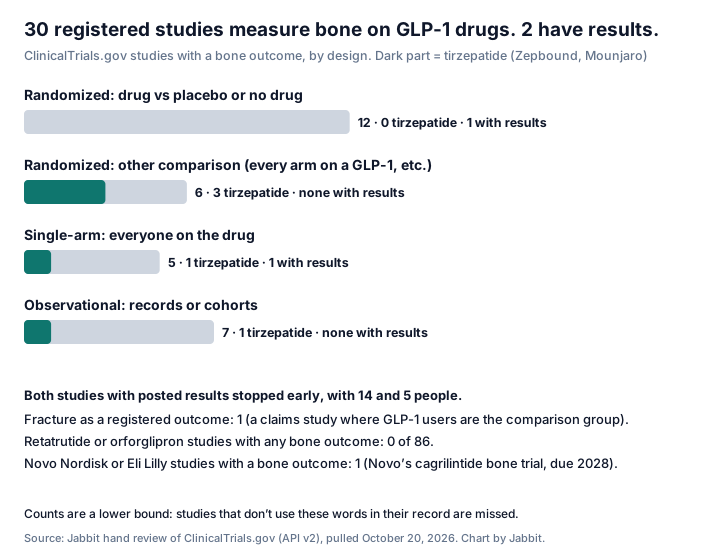
- 2 of 30 have posted results, and both stopped early, with 14 and 5 people. The Danish semaglutide trial was published in 2024 but hasn’t posted results to the registry.[21][10]
- 1 registers fractures as an outcome. It is a Boehringer Ingelheim claims study of its own diabetes drug, with GLP-1 users as a comparison group.[21]
- No tirzepatide trial is randomized against placebo on bone. The closest are a tirzepatide-vs-semaglutide trial in Taiwan and a 40-person single-arm study of people 65 and older at Wake Forest.[21]
- Drugmakers are barely looking. The only Novo Nordisk or Eli Lilly study with a bone outcome is Novo’s 144-woman cagrilintide trial, due in May 2028. It is designed to test whether cagrilintide “can reduce the decline in bone mass associated to weight loss.” None of the 86 registered retatrutide or orforglipron studies measures bone.[21]
| Trial | What it tests | Sponsor | People | Status | Primary completion | Bone outcome |
|---|---|---|---|---|---|---|
| NCT07010432 | Cagrilintide vs semaglutide vs CagriSema vs placebo, postmenopausal women 50–70 | Novo Nordisk | 144 | recruiting | 2028-05-03 | hip bone density (QCT) |
| NCT06861439 | Tirzepatide for 9 months, age 65+ (single arm) | Wake Forest | 40 | running, not recruiting | 2027-10-30 | hip and spine bone density |
| NCT07589322 | Tirzepatide vs semaglutide | Tri-Service General Hospital, Taiwan | 120 | recruiting | 2028-09-30 | secondary: bone density, P1NP, CTX |
| NCT07165158 | Semaglutide + metformin vs metformin, age 50–75 | Xiamen | 150 | not started | 2026-12-31 | lumbar spine bone density |
| NCT06050577 | Oral semaglutide (Rybelsus) vs placebo | Odense | 64 | running, not recruiting | 2027-01-15 | P1NP (bone formation) |
| NCT05933499 | Tirzepatide ± bimagrumab | Massachusetts General Hospital | 63 | recruiting | 2028-12-31 | lean mass; bone in title |
| NCT07760948 | HMB + vitamin D vs placebo in older adults starting semaglutide | Vanderbilt | 90 | not started | 2029-11-30 | secondary: bone density, trabecular bone score |
| NCT07625202 | Creatine vs placebo with resistance training, people starting a GLP-1 | Saskatchewan | 40 | recruiting | 2027-05-30 | secondary: bone density |
Every record, the excluded ones and our reasons are in the source file. These counts are a lower bound, since a study that doesn’t use these words in its record would be missed. TABFAT and the 20-person older-adult pilot both reported bone results, but neither registry record lists a bone outcome.[21][6][13]
CagriSema and the next drugs
Novo’s CagriSema adds cagrilintide, an amylin drug, to semaglutide, and Novo is now testing whether cagrilintide can reduce the bone loss that comes with weight loss.[21] In a Novo-funded post hoc look at the REIMAGINE 2 diabetes trial, bone breakdown marker CTX rose about the same on CagriSema 2.4/2.4 mg (+152.6 pg/mL) as on semaglutide 2.4 mg (+151.1), versus +59.8 on placebo, after 68 weeks and 14.2% vs 10.2% weight loss. The authors called it “preliminary reassurance,” but the trial measured no bone density.[19] For a full look at the drug, see our CagriSema teardown.
What the evidence supports
- Expect a small hip density dip. It mostly tracks how much weight you lose.[10][12][6]
- Exercise is the one tested protection. In S-LiTE, a GLP-1 drug plus exercise kept bone density at placebo levels. That was liraglutide in people under 65.[11]
- Know your risk group. The fracture signals show up in women, people 75 and older and older adults losing weight. Spain’s menopause society says GLP-1 treatment in menopause should account for fracture risk, resistance exercise and protein.[3][17][20]
- Ask about bone if you’re at risk. If you’re older, postmenopausal, or have had a fracture or osteoporosis, ask your clinician whether a DXA scan or other fracture-risk check makes sense before or during treatment. None of the sources we checked sets a GLP-1-specific scanning schedule.[20][16]
- Tirzepatide: watch the data. The signals are early, mixed and mostly unpublished, and the trials that could settle them won’t report until 2027 or later.[6][5][8][21]
Strengths and limits
Strengths. The semaglutide and liraglutide density findings come from randomized, placebo-controlled trials using DXA.[10][11] The fracture meta-analyses pool tens of thousands of trial participants.[14][15] The label and registry checks are direct reads of primary records.[4][21]
Limits. No trial of these drugs was built to count fractures, so the fracture numbers are small subgroups or pooled side-effect reports.[3][5] The tirzepatide bone data are a poster, an abstract and records studies, which can’t rule out confounding.[6][5][7][8] TABFAT’s rising spine density alongside falling hip density shows that one site can’t stand in for the whole skeleton.[6] Most participants were middle-aged.[10][11][12] The people with the most to lose, frail adults over 75, are few in these studies.[3][13]
Bottom line
For most people, GLP-1 drugs don’t look like bone killers. Hip density slips a little with the weight, pooled fracture data show no clear harm, and exercise blunted the loss in the one trial that tested it.[10][15][14][11] The concern is concentrated where it is for any big weight loss: older adults, postmenopausal women and people who already have weak bones. That is where Wegovy’s label and Look AHEAD show fracture signals.[3][17] Tirzepatide is the open question. The signals are early and conflicting, and nobody, including Lilly, has registered a placebo-controlled bone trial to settle it.[6][5][8][21]
The studies that will answer this track the same things you can: which drug, what dose, how many weeks, how much weight lost, and a scan before and after. Jabbit keeps a private, dated log of your shots on your iPhone so you can line those up with your next DXA.
Frequently asked questions
- Do Ozempic and Wegovy cause bone loss?
- Some, mostly at the hip, and mostly in step with the weight lost. In a 64-person Danish trial in adults at higher fracture risk, a year of semaglutide 1.0 mg (the Ozempic dose range) left total hip bone density 0.020 g/cm² lower than placebo, and a bone-breakdown marker rose. Spine density was lower too. Bone formation didn’t change. A 20-person pilot in adults averaging 73 found no significant change, though the numbers leaned the same way. A 2026 meta-analysis of 60 studies found no significant effect on bone density or fractures overall, with low certainty.
- Do Zepbound and Mounjaro (tirzepatide) cause bone loss or fractures?
- The data are thin and point in different directions. In TABFAT, a 34-woman Slovenian trial presented as a poster, six months of tirzepatide cut total hip bone density 3.2% and femoral neck density 4.4%, more than placebo. A conference abstract pooling 11 tirzepatide trials counted 37 fractures among 6,357 people on the drug versus 13 among 3,883 controls (odds ratio 1.84). One large records study linked tirzepatide to more osteoporosis or fragility fractures than other GLP-1 drugs (HR 1.44). Another found fewer femoral fractures than with DPP-4 diabetes pills in people over 65. Lilly’s own analysis of older adults found no meaningful difference in fractures. No registered trial compares tirzepatide with placebo on bone.
- Do GLP-1 drugs raise your fracture risk?
- Not clearly, and it may depend on who you are. A 2025 meta-analysis of 44 diabetes trials found 23% fewer fractures on GLP-1 drugs, driven by liraglutide and longer treatment. The Wegovy label, though, reports more hip and pelvis fractures on the drug in women (1% vs 0.2%) and in people 75 and older (2.4% vs 0.6%) in its heart-outcomes trial. None of these trials was designed to count fractures. Among the drug labels we checked, Wegovy’s is the only one that mentions fractures.
- Who should think most about bone on a GLP-1?
- The groups where the signals show up: people 75 and older, postmenopausal women, people who already have osteoporosis or a past fracture, and anyone losing a lot of weight fast. In the Look AHEAD diet-and-exercise trial, intentional weight loss in older adults with diabetes didn’t raise total or hip fractures but raised frailty fractures by 39%. Spain’s menopause society says GLP-1 treatment in menopause should take fracture risk into account. Whether you need a bone density (DXA) scan is a question for your clinician.
- Can exercise protect your bones on a GLP-1?
- In the one randomized trial that tested it, yes. In S-LiTE, adults who took liraglutide 3.0 mg and exercised for a year lost 16.9 kg, the most of any group, and their hip and spine bone density was no different from placebo. Liraglutide alone lowered hip and spine density more than exercise alone, though both groups lost similar weight. The trial used liraglutide, not semaglutide or tirzepatide, and enrolled people 18 to 65.
- What about CagriSema, retatrutide and orforglipron (Foundayo)?
- There’s almost nothing on bone yet. Novo’s CagriSema poster from September found bone breakdown markers rose about as much on CagriSema as on semaglutide, but measured no bone density. Novo is running a 144-woman trial of cagrilintide and bone density that isn’t due until 2028. We found no registered retatrutide or orforglipron study with any bone outcome, out of 86.
References
- International Osteoporosis Foundation. World Osteoporosis Day, October 20. https://www.worldosteoporosisday.org/. Checked October 20, 2026.
- Jabbit count of English posts on X (no reposts) pairing Ozempic, Wegovy, Zepbound, Mounjaro, semaglutide, tirzepatide or GLP-1 with bone, osteoporosis, fracture or “bone density”: 14, 9, 18, 8, 12, 12 and 14 a day, October 13–19 (UTC days), 87 in all, via the X API recent-counts endpoint; sample posts included an October 15 claim that “GLP-1 drugs cause massive bone density loss” and a peptide seller’s October 17 post claiming benefits for “lean skeletal muscle mass and bone density.” Checked October 20, 2026.
- Wegovy (semaglutide) prescribing information, DailyMed set ee06186f-2aa3-4990-a760-757579d8f77b, version 19, effective June 18, 2026: section 6.1 (“In the CV outcomes trial in adults, more fractures of the hip and pelvis were reported on WEGOVY than on placebo in female patients: 1% (24/2,448) vs. 0.2% (5/2,424), and in patients ages 75 years and older: 2.4% (17/703) vs. 0.6% (4/663), respectively. In a clinical trial in adults with MASH, fractures occurred in 4.4% of WEGOVY-treated patients (2.6 cases per 100 patient years) compared to 3.3% of placebo-treated patients (2 cases per 100 patient years)”; the MASH trial’s median age was 61); section 8.5 repeats the hip and pelvis finding for patients 75 and older. https://dailymed.nlm.nih.gov/dailymed/drugInfo.cfm?setid=ee06186f-2aa3-4990-a760-757579d8f77b. Checked October 20, 2026.
- Jabbit scan of the current DailyMed prescribing information for Wegovy (v19, June 18, 2026), Ozempic (v20, June 1, 2026), Rybelsus (v14, January 30, 2026), Zepbound (v40, August 28, 2026), Mounjaro (v40, August 27, 2026), Saxenda (v22, February 25, 2026), Victoza (v31, October 14, 2025), Foundayo (orforglipron, v10, July 29, 2026) and Trulicity (v62, June 16, 2026), downloaded October 20, 2026: only Wegovy’s label mentions fractures; none mentions bone mineral density. Set IDs and matched sentences: https://jabbitapp.com/research/sources/glp1-bone-ctgov-labels-2026-10-20.json. Checked October 20, 2026.
- Alahmed FBF, Alahmed H, Khan LZ. Fracture risk associated with tirzepatide: a systematic review and meta-analysis of randomized controlled trials and real-world evidence. Abstract 1683-P, American Diabetes Association 86th Scientific Sessions. Diabetes. 2026;75(Suppl 1). doi:10.2337/db26-1683-P (11 trials, 10,240 people, 6,357 on tirzepatide and 3,883 on control arms; 50 fractures, 37 vs 13, 0.58% vs 0.33%; Peto odds ratio 1.84, 95% CI 1.02–3.31, I²=25%, p=0.04; in the retrospective comparison with other GLP-1 drugs, HR 1.16, 0.89–1.52, p=0.28; “There were a few fractures in total”; PROSPERO CRD420261278843; no disclosures listed). https://doi.org/10.2337/db26-1683-P. Conference abstract, not peer-reviewed as a full paper. Checked October 20, 2026.
- Herman R, Jensterle M, Goricar K, Janez A. Early tirzepatide-induced weight loss is associated with hip bone loss and increased bone resorption: a randomized trial. Poster MON-800, ENDO 2026, June 15, 2026 (TABFAT, 34 premenopausal women with obesity, 17 tirzepatide and 17 placebo, DXA at baseline and 6 months; median weight loss −13.5%; lumbar spine BMD +2.1%, p=0.034; total hip −3.2%, p<0.001; femoral neck −4.4%, p=0.020; whole body −0.9%, p=0.044; hip and femoral neck loss greater than placebo, both p<0.01; CTX +84%, PINP −16.8%; hip loss correlated with weight loss, rho 0.50–0.63; presenting author reports no financial relationships). https://endo2026.endocrine.org/fsPopup.asp?PresentationID=1843850&mode=presInfo. The trial is registered as NCT06893211 (University Medical Centre Ljubljana); that record lists brown-fat and energy-expenditure outcomes, not bone. Checked October 20, 2026.
- Hsu YH, Liang YC, Chan KC, et al. Association of tirzepatide use with risk of osteoporosis compared with other GLP-1 receptor agonists: a retrospective cohort study using the TriNetX database. Diabetes Res Clin Pract. 2025;230:112995. doi:10.1016/j.diabres.2025.112995. PMID 41218687 (66,329 matched people per group, type 2 diabetes or obesity, 14-month follow-up; new osteoporosis or fragility fracture HR 1.44, 95% CI 1.22–1.69, vs other GLP-1 drugs; starting osteoporosis treatment HR 1.61, 1.22–2.12; tirzepatide vs nonusers HR 1.48, 1.26–1.75; other GLP-1 drugs vs nonusers HR 1.07, 1.00–1.15). https://pubmed.ncbi.nlm.nih.gov/41218687/. Checked October 20, 2026.
- Chen HY, Wu JY, Chu YH, Chen TW, Huang CF. Lower fall and femoral fracture risks with semaglutide and tirzepatide compared with DPP-4 inhibitors in older adults with type 2 diabetes. Osteoporos Int. Published online July 11, 2026. doi:10.1007/s00198-026-08134-y. PMID 42435064 (TriNetX, age 65 and older with type 2 diabetes and BMI 25 or higher, 1-year outcomes; semaglutide, 27,896 matched: femoral fracture 0.3% vs 0.5%, HR 0.488, falls 3.6% vs 5.4%; tirzepatide, 12,808 matched: femoral fracture 0.2% vs 0.4%, HR 0.452, falls 3.6% vs 5.7%; authors declare no conflicts). https://pubmed.ncbi.nlm.nih.gov/42435064/. Checked October 20, 2026.
- Alfaris N, Kushner RF, Li J, et al. Tirzepatide for obesity in adults ≥65 years: a post hoc analysis of the SURMOUNT and SUMMIT clinical trials. Diabetes Obes Metab. 2026;28(9):8072-8083. doi:10.1111/dom.70991. PMID 42303274 (“No clinically meaningful differences in adverse event (AE) rates between tirzepatide and placebo were observed in older adults for gastrointestinal tolerability, falls, fractures …”; five of seven authors are Eli Lilly employees). https://pubmed.ncbi.nlm.nih.gov/42303274/. Checked October 20, 2026.
- Hansen MS, Wölfel EM, Jeromdesella S, et al. Once-weekly semaglutide versus placebo in adults with increased fracture risk: a randomised, double-blinded, two-centre, phase 2 trial. eClinicalMedicine. 2024;72:102624. doi:10.1016/j.eclinm.2024.102624. PMID 38737002; NCT04702516 (64 people, 55 postmenopausal women and 9 men, mean age 63, T-score below −1.0 or a recent low-energy fracture; semaglutide 1.0 mg vs placebo for 52 weeks; bone formation marker P1NP no different, ETD 3.8 μg/L, p=0.418; resorption marker CTX higher, ETD 166.4 ng/L, p=0.021; total hip aBMD ETD −0.020 g/cm², p=0.001; lumbar spine lower, p=0.007; femoral neck no difference; weight ETD −6.8 kg; at least one adverse event 97% vs 56%; Novo Nordisk Foundation among funders, Novo Nordisk supplied drug and placebo). https://pubmed.ncbi.nlm.nih.gov/38737002/. Checked October 20, 2026.
- Jensen SBK, Sørensen V, Sandsdal RM, et al. Bone health after exercise alone, GLP-1 receptor agonist treatment, or combination treatment: a secondary analysis of a randomized clinical trial. JAMA Netw Open. 2024;7(6):e2416775. doi:10.1001/jamanetworkopen.2024.16775. PMID 38916894 (S-LiTE; 195 adults aged 18–65 without diabetes, after an 8-week 800 kcal/day diet, then 52 weeks of placebo, exercise, liraglutide 3.0 mg or both; weight loss 7.03, 11.19, 13.74 and 16.88 kg; combination vs placebo hip −0.006 g/cm², p=0.24, spine −0.010, p=0.20; liraglutide vs exercise hip −0.013 g/cm², 95% CI −0.024 to −0.001, p=0.03, spine −0.016, p=0.04; “Liraglutide treatment alone reduced BMD at clinically relevant sites more than exercise alone despite similar weight loss”; several authors report Novo Nordisk ties outside the submitted work). https://pubmed.ncbi.nlm.nih.gov/38916894/. Checked October 20, 2026.
- Liu Y, Walzer D, Schmitz S, et al. Skeletal effect of semaglutide and tirzepatide in patients with increased risk of fractures. J Clin Endocrinol Metab. 2026;111(7):1959-1966. doi:10.1210/clinem/dgag052. PMID 41655226 (retrospective, 255 users with DXA scans before and after vs 255 matched nonusers; 92% female, mean age 64; median 5% weight loss over a median 17 months; both groups lost hip and femoral neck BMD by similar amounts; in people without diabetes, total hip −1% vs −0.6%, P=.04; weight loss correlated with hip bone loss, r=0.32). https://pubmed.ncbi.nlm.nih.gov/41655226/. Checked October 20, 2026.
- Dinkla L, Beavers KM, Robbins R, et al. Bone mineral density and turnover response to GLP-1 receptor agonists in older adults with overweight/obesity and prediabetes/type 2 diabetes: a 20-week pilot trial post hoc analysis. Front Aging. 2025;6:1691007. doi:10.3389/fragi.2025.1691007. PMID 41393101; NCT05786521 (20 adults, mean age 72.7; semaglutide 1.0 mg + lifestyle counseling vs counseling alone; weight −5.3% vs −0.89%; no significant difference in whole-body BMD or CTX/P1NP, but “consistently lower BMD and higher bone turnover at follow-up” in the semaglutide group). https://pubmed.ncbi.nlm.nih.gov/41393101/. Checked October 20, 2026.
- Zhang Y, Chen G, Wang W, et al. Association of glucagon-like peptide-1 receptor agonists use with fracture risk in type 2 diabetes: a meta-analysis of randomized controlled trials. Bone. 2025;192:117338. doi:10.1016/j.bone.2024.117338. PMID 39603373 (44 randomized trials, 47,823 people with type 2 diabetes, 292 fractures, 138 vs 154; RR 0.77, 95% CI 0.61–0.96; benefit only with more than 78 weeks of treatment; liraglutide RR 0.42, 0.21–0.85; other GLP-1 drugs no benefit over other diabetes drugs). https://pubmed.ncbi.nlm.nih.gov/39603373/. Checked October 20, 2026.
- Beaudart C, Malréchauffé Y, van Heden S, et al. GLP-1 receptor agonists and musculoskeletal outcomes: a systematic literature review and meta-analysis. Drugs. 2026;86(10):1661-1691. doi:10.1007/s40265-026-02365-3. PMID 42730869 (no significant effects on bone mineral density or fractures at any site in the most-adjusted models; lean body mass fell, SMD 0.52; “the certainty of evidence was low”; one author is president of ESCEO, which receives unrestricted educational grants from corporate partners). https://pubmed.ncbi.nlm.nih.gov/42730869/. Checked October 20, 2026.
- Anastasilakis AD, Paccou J, Palermo A, et al. The effects of anti-obesity medications on bone metabolism: a critical appraisal. Diabetes Obes Metab. 2025;27(9):4674-4688. doi:10.1111/dom.16541. PMID 40555693 (review: GLP-1 effects on bone turnover markers and BMD neutral or negative but not clinically significant; fracture risk does not appear increased; data on dual and triple agonists and amylin analogues mostly preclinical). https://pubmed.ncbi.nlm.nih.gov/40555693/. Checked October 20, 2026.
- Johnson KC, Bray GA, Cheskin LJ, et al.; Look AHEAD Study Group. The effect of intentional weight loss on fracture risk in persons with diabetes: results from the Look AHEAD randomized clinical trial. J Bone Miner Res. 2017;32(11):2278-2287. doi:10.1002/jbmr.3214. PMID 28678345 (5,145 people aged 45–76 with type 2 diabetes, median 11.3 years; weight loss 6.0% vs 3.5%; 731 fractures, 373 lifestyle vs 358 control; no difference in total or hip fractures; frailty fracture HR 1.39, 95% CI 1.02–1.89; “When intentional weight loss is planned, consideration of bone preservation and fracture prevention is warranted”). https://pubmed.ncbi.nlm.nih.gov/28678345/. Checked October 20, 2026.
- Johnson KC, Anderson A, Beavers KM, et al. The long-term effect of intentional weight loss on changes in bone mineral density in persons with type 2 diabetes: results from the Look AHEAD randomized trial. Arch Osteoporos. 2023;18(1):97. doi:10.1007/s11657-023-01303-0. PMID 37452151 (DXA substudy at 5 of 16 centers; greater total hip bone loss in men in the lifestyle group at year 8 and years 12–16; not seen in women). https://pubmed.ncbi.nlm.nih.gov/37452151/. Checked October 20, 2026.
- Haluzík M, Fabricius TW, Gajria R, Manogaran S, Ponzetti M, Fonseca JE. Effect of CagriSema on bone biomarkers in participants with inadequately controlled type 2 diabetes: REIMAGINE 2. Poster, EASD 2026 (late-breaking abstract 85), Novo Nordisk-funded (weight change at week 68: CagriSema 2.4/2.4 mg −14.2%, semaglutide 2.4 mg −10.2%, placebo −1.5%; CTX-1 rose 152.6 pg/mL on CagriSema 2.4/2.4 and 151.1 on semaglutide 2.4 vs 59.8 on placebo, from baselines of about 246–260; P1NP +9.5, +6.0 and +1.6 ng/mL; mean age 57.1, 42.9% female; no bone density measured; authors conclude “preliminary reassurance regarding bone changes with CagriSema in T2D”). https://sciencehub.novonordisk.com/congresses/easd2026/haluzik.html. Numbers read from the poster image. Checked October 20, 2026.
- Sánchez-Prieto M, Romero-Domínguez M, Orozco R, et al. Incretin-based therapies in peri- and postmenopausal women with obesity: an expert position statement from the Spanish Menopause Society. Maturitas. 2026;213:109101. doi:10.1016/j.maturitas.2026.109101. PMID 42664617 (therapy in menopause “should be considered within a cardiometabolic and functional framework that incorporates visceral adiposity, skeletal muscle health, fracture risk, cardiovascular prevention, individualized hormone therapy decision-making, resistance exercise, adequate protein intake, and structured monitoring”). https://pubmed.ncbi.nlm.nih.gov/42664617/. Checked October 20, 2026.
- Jabbit review of ClinicalTrials.gov (API v2), pulled October 20, 2026, about 1:56 AM ET: 1,712 unique studies listing semaglutide, tirzepatide, retatrutide, orforglipron, liraglutide or cagrilintide, or pairing GLP-1 drug names with bone density, osteoporosis, fracture or bone-marker terms; 189 keyword hits read by hand; 30 kept that give a GLP-1 drug or cagrilintide and register a bone outcome: 12 randomized against placebo or no drug (none on tirzepatide), 6 randomized with another comparison, 5 single-arm and 7 observational. 2 have posted results (NCT01381926, NCT04964388, both terminated early); 11 make bone a primary outcome; 1 registers fractures (NCT03363464, an empagliflozin claims study that uses GLP-1 users as a comparison group); 0 of 86 retatrutide or orforglipron studies register a bone outcome; the only Novo Nordisk or Eli Lilly study with one is NCT07010432; 15 are recruiting or not yet recruiting. Lower bound; method, every study and reasons for exclusions: https://jabbitapp.com/research/sources/glp1-bone-ctgov-labels-2026-10-20.json. Checked October 20, 2026.
This page analyzes published trials, conference posters and abstracts, records studies, meta-analyses, drug labels and trial-registry records. It is not medical advice. It does not recommend any drug, dose, supplement or test; talk to your prescriber, especially if you are older, postmenopausal, have osteoporosis or have had a fracture. The label and registry reviews are Jabbit’s own; their inputs are cited above.