Evidence check · Ivermectin (Stromectol), mebendazole (Emverm, Vermox), fenbendazole · Oct 19, 2026 review, retraction notices, Crossref, trials, FDA labels, ClinicalTrials.gov · Sources checked October 20, 2026
Published · Updated
Do ivermectin and mebendazole treat cancer? A new review by Peter McCullough and colleagues makes the case for them as add-on treatment. Two of the three human studies it counts as positive are now retracted, and we found no study that has tested the pair against a control group.
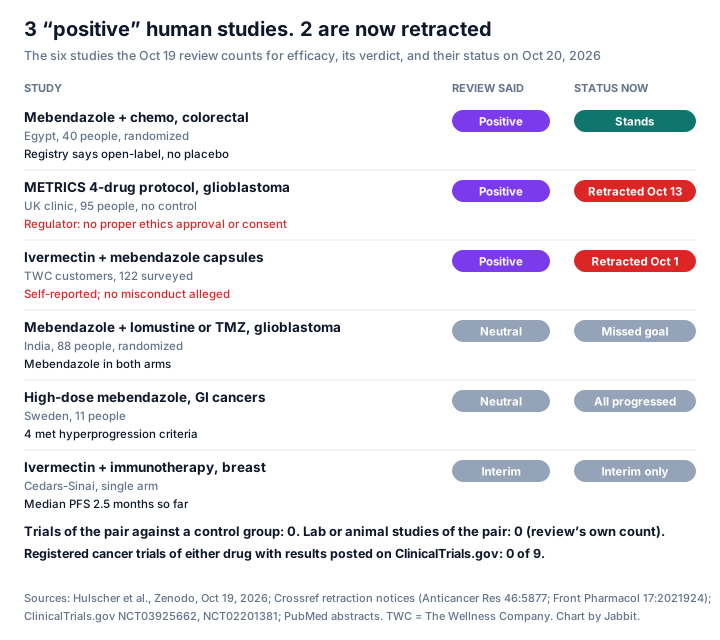
On October 19, Nicolas Hulscher, Peter McCullough, Harvey Risch and three colleagues posted a 151-reference review arguing that ivermectin and mebendazole, two cheap antiparasitic drugs, should be studied and used as add-ons to cancer treatment.[1] We checked every DOI it cites and the human studies it relies on. Of the three human studies the review counts as positive, the journals that published two of them have retracted them: one on October 13, six days before the review went up, and one on October 1.[4][5][7] The one left standing is a 40-person mebendazole trial from Egypt that doesn’t include ivermectin.[11] The review itself says no lab or animal study has ever tested the two drugs together.[1] And by our calculation from the label, ivermectin’s lab doses are about 94 times higher than the blood level its label dose produces.[18][20] The numbers below come from the documents linked in the references; where we compare or estimate, we say so.
Why this matters now
The review was trailed on X a day early. Hulscher’s October 19 teaser, “Within 48 hours, the FULL POWER of ivermectin and mebendazole for cancer will be revealed,” passed 398,429 impressions, and his October 20 post announcing the paper had 86,807 impressions and 3,841 bookmarks by mid-afternoon. X made “Review Highlights Anticancer Potential of Ivermectin and Mebendazole Combo” a trending story.[2] The topic was already big: we counted 8,071 English posts on X pairing ivermectin, mebendazole or fenbendazole with cancer from October 14 through 3:54 PM ET on October 20, over 1,000 on every full day.[3] Real prescribing follows the talk. After a January 2025 celebrity podcast, US co-prescribing of ivermectin with a benzimidazole like mebendazole roughly doubled, and rose 2.63-fold among people with cancer.[23]
The short answer
- Two of the three positive human studies are retracted. METRICS, whose retraction notice says the UK regulator found it was run without appropriate ethics approval or informed consent, and the authors’ own customer survey, which its journal retracted for methodological problems without alleging misconduct.[5][7]
- We found no controlled test of the pair. Not in people, and by the review’s own count not in a single lab or animal study.[1][25]
- The one randomized win is for mebendazole alone, in 40 people, and its registry entry (last updated in 2019) doesn’t match the paper.[11][12]
- Ivermectin’s lab doses look out of reach. By our estimate from label data, about 94 times the label dose’s peak blood level, and still about 9 times at ten times the dose.[18][20][19]
- The authors disclose ties to a seller. The review’s conflict statement says all authors “are affiliated with and/or receive salary support from The Wellness Company (TWC).” TWC’s website listed the combined capsule at $599.99 for 90 on October 20, 2026.[1][24]
- Nothing is proven either way. Mebendazole has a real but small signal, both drugs are cheap and usually well tolerated at worm doses, and two ivermectin trials are coming.[11][21][25]
Finding 1: two of the three “positive” studies are retracted
The review sorts the human evidence into six studies with efficacy outcomes and calls three of them positive.[1]
METRICS. This was a UK clinic program, not run by the review’s authors, that gave 95 people with glioblastoma metformin, atorvastatin, mebendazole and doxycycline alongside standard care. It reported a median survival of 26.3 months against historical comparators of about 15.[5] The review says the journal’s 2023 expression of concern “remained unresolved at the time of writing.”[1] On October 13, 2026, Frontiers retracted it. The retraction notice says the UK Medicines and Healthcare products Regulatory Agency found METRICS was “a clinical trial conducted without appropriate ethics approval or informed consent,” and that its “data were found to contain inaccuracies and lack quality control.”[5] The review may have been written before the notice. Its registry entry, which the review cites, is listed as withdrawn with 0 people enrolled: “Prospective recruitment not possible.”[6] Even before the retraction, a four-drug protocol couldn’t separate what mebendazole did.[1]
The customer survey. The only human data on the actual ivermectin and mebendazole combination is the authors’ own. It surveyed 197 people with cancer who had been prescribed the capsules through The Wellness Company’s telemedicine platform, according to the paper. They were “invited by TWC via email ... As part of an internal assessment of clinical services and product outcomes.” Of the 122 who answered at six months, 84.4% reported their cancer was gone, smaller or stable.[8] All outcomes were self-reported. At follow-up, 27.9% were also on chemotherapy, 21.3% had radiation and 49.2% took other cancer supplements.[8] The paper itself said: “Given these threats to validity, therapeutic benefit cannot be inferred.”[8]
Anticancer Research retracted it on October 1. The editor said “methodological and analytical problems undermine the reliability of its central clinical-benefit conclusions.” Disease status was recorded with two categories at baseline and four at follow-up, and “No baseline NED measure was collected, so the data cannot establish whether NED preceded exposure.”[7] The journal made “No allegation of research misconduct” and no claim of arithmetic error. The authors dispute the retraction and offered a correction instead.[7] The review discloses the retraction and, in its authors’ words, calls it “scientific censorship.”[1]
Finding 2: more problems in the reference list
We ran all 138 DOIs in the review’s 151 references through Crossref, the registry publishers use to post corrections and retractions. Four cited papers carry retraction notices.[4] The review notes two of them, its own survey and a 2022 ivermectin-plus-sorafenib liver cancer study. We did not find a mention of METRICS’s retraction, which came six days before the review was posted, and it cites a 2019 ivermectin glioma lab paper in Bioscience Reports as evidence; Crossref shows that paper was retracted on March 26, 2026.[4][9]
A fifth cited paper has a live warning. The 2021 mouse study reporting ivermectin turning “cold” breast tumors “hot” with immunotherapy is often cited as lab support for ivermectin in breast cancer. In June 2026, npj Breast Cancer put an editorial expression of concern on it over “multiple highly similar images” in one figure. The notice says “the original data are no longer available” and tells readers to “interpret these data with caution.”[10] An expression of concern is a warning, not a finding of misconduct. We did not find it mentioned in the review. In that study, “neither agent alone showed efficacy in vivo.”[10]
Finding 3: the best trial is smaller and looser than it sounds
The review’s strongest human result is Hegazy 2022, from Tanta University in Egypt. Forty people with metastatic colorectal cancer got bevacizumab plus FOLFOX4 chemotherapy, with either placebo or mebendazole 500 mg twice a day for 12 weeks. Response at 12 weeks was 65% with mebendazole versus 10%, and median progression-free survival 9.25 versus 3 months.[11] The paper calls it double-blind and placebo-controlled, and notes it was “registered retrospectively.”[11] Its ClinicalTrials.gov entry lists masking as “None,” an active comparator rather than a placebo arm, and a primary outcome of tumor response at 6 months, not 12 weeks. The entry was last updated in April 2019 and still shows “Recruiting,” with completion estimated for December 2028.[12] Registry entries are often left un-updated, so this may be an outdated record rather than a sign the trial was run differently, but as of October 20, 2026 the paper and the registry don’t match.
The bigger question, in our analysis, is the control arm. This is our comparison across trials, which differ in patients and setting, so treat it as a rough check. In large trials, bevacizumab with oxaliplatin chemotherapy held cancer back for a median 9.4 months as first treatment (NO16966) and 7.3 months even in people already treated (E3200).[13][14] Hegazy’s control group got 3.0 months and a 10% response rate. That is close to what bevacizumab alone did in E3200, 2.7 months and 3.3%.[11][14] The mebendazole arm’s 9.25 months is about what this chemotherapy usually achieves. Small trials can have unlucky control arms, and the patients may have differed. In our view, the “tripling” of progression-free survival the review describes may say as much about a weak control group as about mebendazole.
The other mebendazole studies are neutral or worse. In a randomized Indian trial in recurrent glioblastoma, both arms got mebendazole with chemotherapy and missed their 55% 9-month survival goal, at 36.6% and 45%.[15] In a Swedish study dosing up to 4 g a day, every treated patient stopped because their cancer grew, and four met criteria for hyperprogression. Its registry lists it as terminated for “Lack of effect.”[16] The only ivermectin trial with results is an interim abstract: median progression-free survival 2.5 months with immunotherapy in heavily pretreated breast cancer, with no comparison group.[17]
Finding 4: the concentration gap
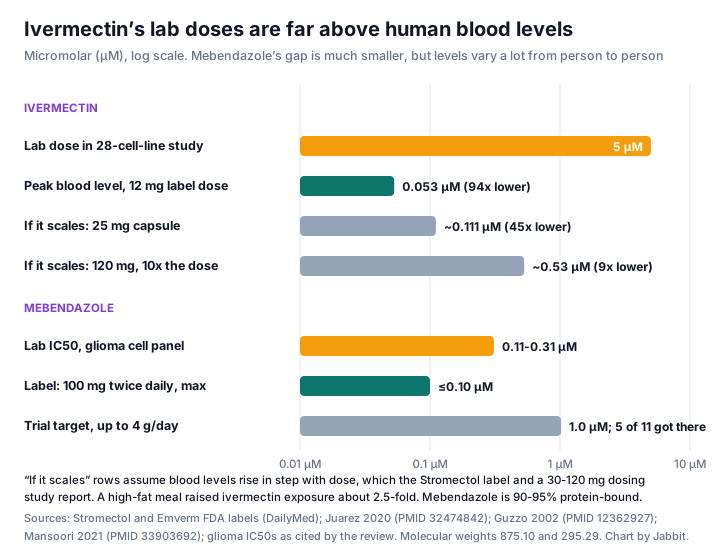
Most of the review’s cancer mechanisms come from cells in dishes. The key ivermectin study treated 28 cancer cell lines at 5 µM, which its authors argued is reachable in people.[18][1] 5 µM is about 4,376 ng/mL. The Stromectol label gives a mean peak of 46.6 ng/mL after a 12 mg dose, about 0.053 µM, so the lab dose is about 94 times higher.[20] The label and Merck’s high-dose study both say blood levels rise roughly in proportion to dose.[20][19] On that basis, the 25 mg capsule would peak around 0.11 µM (45 times short), and 120 mg, ten times the usual dose and the highest single dose in Merck’s safety study, around 0.53 µM (about 9 times short). Taking 120 mg with a fatty meal, which raised exposure about 2.5-fold on the label, would still leave it about 4 times short.[20][19] These are our estimates from label numbers, not measured levels. ASCO puts it bluntly: reaching the lab concentrations “would likely require doses far exceeding established safety limits.”[22]
Mebendazole is a different story, and the review’s case for it is stronger. In a glioma cell panel it worked at 0.11 to 0.31 µM.[1] At the worm dose of 100 mg twice daily, the label says blood levels stay at or below 0.03 mcg/mL, about 0.10 µM, because most of the drug stays in the gut.[21] Higher doses can get closer, but unreliably: in the Swedish study, only 5 of 11 patients reached the 300 ng/mL target (about 1.0 µM) even at up to 4 g a day.[16] The review also cites brain concentrations of 7.1 µM for some forms of the drug, and mechanisms that act in the nanomolar range.[1]
Finding 5: disclosed ties, and the product
The review’s conflict statement says all authors “are affiliated with and/or receive salary support from The Wellness Company (TWC).” In the review text we checked, we did not find a statement that TWC sells an ivermectin and mebendazole product; the review describes the survey patients’ capsules as prescribed “through a United States telemedicine platform” without naming it.[1] The survey paper itself says the patients were TWC telemedicine customers and that “TWC also offers compounded formulations of ivermectin and mebendazole.”[8] On October 20, 2026, TWC’s product page listed “Ivermectin + Mebendazole” capsules, 25 mg plus 250 mg, at $599.99 for 90 or $349.99 for 45, through a telemedicine consult. The product page calls it “Our Most Popular Parasite Cleanse” and adds “Doctor’s available to consult for off-label use.”[24] Neither drug is approved for cancer; their US labels cover worm infections.[20][21]
As of October 20, 2026, TWC’s cancer-study page presents the retracted survey. It says “Retracted by the journal” and links to an explanation. It also says the paper “Passed a rigorous three-month review” and that “No errors were found,” and it includes “Order now & talk to a provider” next to the line “Ivermectin + Mebendazole An important tool in the battle against cancer.”[24] For context, the journal’s article page lists the paper as received April 8, 2026, revised April 20 and accepted April 24; we could not tell what period the “three-month” figure refers to.[8] The retraction notice says the decision rests on “methodological and analytical problems,” not on misconduct or “arithmetic miscalculation.”[7] The paper itself said therapeutic benefit “cannot be inferred.”[8]
What’s being studied
We searched ClinicalTrials.gov for registered studies that test ivermectin, mebendazole or fenbendazole against cancer. We found 2 for ivermectin and 7 for mebendazole. None of the 9 has posted results, and none tests the two drugs together.[25] The one to watch is ICONIC, an 80-person randomized trial of ivermectin doses with immunotherapy, due to start in December 2026.[25] No registered study tests fenbendazole, the veterinary dewormer often discussed alongside them.[25]
| Study | Drug | Title | People | Status | Results |
|---|---|---|---|---|---|
| NCT07487805 | Ivermectin | Ivermectin Combined With Immune Checkpoint Inhibition in Cancer (ICONIC) | 80 | Not yet recruiting | No |
| NCT05318469 | Ivermectin | Ivermectin in Combination With Balstilimab or Pembrolizumab in Patients With Metastatic Triple Negative Breast Cancer | 34 | Recruiting | No |
| NCT01837862 | Mebendazole | A Phase I Study of Mebendazole for the Treatment of Pediatric Gliomas | 10 | Active, not recruiting | No |
| NCT02201381 | Mebendazole | Study of the Safety, Tolerability and Efficacy of Metabolic Combination Treatments on Cancer | 0 | Withdrawn, 0 enrolled | No |
| NCT03628079 | Mebendazole | A Clinical Safety and Efficacy Study of Mebendazole on GI Cancer or Cancer of Unknown Origin. | 11 | Terminated | No |
| NCT02644291 | Mebendazole | Phase I Study of Mebendazole Therapy for Recurrent/Progressive Pediatric Brain Tumors | 16 | Completed | No |
| NCT03925662 | Mebendazole | Mebendazole as Adjuvant Treatment for Colon Cancer | 40 | Recruiting | No |
| NCT01729260 | Mebendazole | Mebendazole in Newly Diagnosed High-Grade Glioma Patients Receiving Temozolomide | 24 | Completed | No |
| NCT04443049 | Mebendazole | To Study the Effects of Addition of Mebendazole to Lenvatinib in Cirrhotics With Advanced Hepatocellular Carcinoma. | 170 | Unknown (not updated) | No |
Safety
At worm doses, both drugs have long safety records. Ivermectin single doses up to 120 mg were “generally well tolerated” in 68 healthy volunteers.[19] Cancer use is different: higher doses, months of use and other drugs on board. Mebendazole’s label warns that “Neutropenia and agranulocytosis have been reported in patients receiving mebendazole at higher doses and for prolonged duration,” and tells prescribers to monitor blood counts. It also warns of Stevens-Johnson syndrome with metronidazole and lists hepatitis after marketing.[21] ASCO warns that high-dose ivermectin can cause “ataxia, seizures, coma, hypotension, and even death,” and that ivermectin and fenbendazole go through liver enzymes that could change how cancer drugs work.[22] Mebendazole is also “extensively metabolized primarily by the liver.”[21] The review lists case reports of ivermectin neurotoxicity in a patient self-treating breast cancer, ivermectin toxicity in a child with cancer, and severe liver injury (ALT 1764 U/L) in a man taking veterinary fenbendazole and ivermectin.[1]
Strengths and limits
What the review gets right. Mebendazole’s lab activity happens at concentrations near what people can reach, and the Egyptian trial is a real signal worth repeating properly.[1][11] Both drugs are cheap and off patent, so no company has much reason to pay for big trials. The review says it should be tested in randomized trials, and two ivermectin trials are registered.[1][25] It discloses its own retraction and its conflicts.[1]
What it doesn’t. It isn’t peer reviewed or systematic. Its human evidence for the combination is a retracted customer survey. As far as we found, it cites a retracted lab paper and a paper under an expression of concern without noting either.[1][4] Our limits. Our concentration estimates assume blood levels scale with dose and ignore tissue levels. Our registry search could miss studies that don’t use these drug names. The Crossref check finds only notices publishers have filed.[4][25]
Bottom line
Ivermectin and mebendazole are not proven to treat cancer, and the new review doesn’t change that. Of its three positive human studies, two are retracted and the third tests only mebendazole in 40 people. Ivermectin’s lab doses are far beyond what people reach in their blood.[5][7][11][20] In our view, mebendazole deserves a well-run trial. We found no registered trial of the pair that TWC sells as a combined capsule.[25][24] If you have cancer and are thinking about either drug, talk to your oncologist first, especially about blood counts, liver tests and drug interactions.[21][22] If you do take anything alongside treatment, keep a dated log of doses, side effects and lab results to show your care team. Jabbit is a private iPhone log built for that.
Frequently asked questions
- Do ivermectin and mebendazole cure cancer?
- We found no good evidence that they do. The new review counts six human studies with efficacy results. Two of its three positive ones have been retracted, and the one left is a 40-person mebendazole trial with no ivermectin in it. No trial has tested the two drugs together against a control group, and the review itself says no lab or animal study has tested the pair either.
- What does the October 19 McCullough review claim?
- It argues that ivermectin and mebendazole act on dozens of cancer pathways in lab studies and that the human evidence justifies trials. It’s a narrative review posted on Zenodo, not peer reviewed, and it says it did not use a systematic search. Its conflict statement says all authors “are affiliated with and/or receive salary support from The Wellness Company (TWC),” which sells a combined ivermectin and mebendazole capsule.
- Why were the studies retracted?
- Frontiers retracted the METRICS glioblastoma study on October 13, 2026. Its notice says the UK drug regulator found it was a clinical trial run without appropriate ethics approval or informed consent, and that its data contained inaccuracies. METRICS was not run by the review’s authors. Anticancer Research retracted the authors’ own 197-person survey on October 1, saying methodological problems, including no comparable baseline for self-reported outcomes, undermined its 84.4% benefit figure. That journal made no misconduct allegation, and the authors dispute the retraction.
- Is the Egyptian mebendazole trial good evidence?
- It is the best human result in the review and deserves a proper repeat. But it is small (40 people), and its registry entry, last updated in 2019, lists no masking, no placebo and a 6-month response goal, while the paper reports a double-blind placebo trial measured at 12 weeks. In our comparison with large trials, its control group also did worse than the same chemotherapy usually does, which can make an add-on look bigger than it is.
- Can you reach the lab doses in the blood?
- Probably not for ivermectin, by our estimate. The lab studies use about 5 µM. The label’s 12 mg dose peaks near 0.053 µM, about 94 times lower, and even 120 mg would be roughly 9 times short if levels rise in line with dose. Mebendazole is closer: lab IC50s of 0.11 to 0.31 µM versus up to 0.10 µM on the worm dose, but high-dose levels vary a lot between people.
- Is it safe to take with chemotherapy?
- Ask your oncologist before you do. Ivermectin goes through the same liver enzymes as many cancer drugs, and ASCO warns it may change how those drugs work. High-dose mebendazole can cause dangerously low white blood cell counts, and ivermectin overdose can cause seizures and coma. Published case reports include ivermectin neurotoxicity and severe liver injury in people self-treating cancer.
- Are there real trials?
- A few, none finished. Cedars-Sinai is testing ivermectin with immunotherapy in 34 people with triple-negative breast cancer, and the 80-person ICONIC trial is due to start in December 2026. We found 7 registered mebendazole cancer studies. None of the 9 has posted results on ClinicalTrials.gov, and none tests ivermectin and mebendazole together.
References
- Hulscher N, Thorp JA, Victory K, Gillooly P, McCullough PA, Risch H. Combination ivermectin and mebendazole: a comprehensive review of anticancer mechanisms, preclinical activity, and clinical evidence as adjunctive treatment in cancer patients. Zenodo preprint, October 19, 2026. doi:10.5281/zenodo.23475387 (not peer reviewed; 151 references; “This is a narrative review; a systematic search with recorded screening yields was not undertaken, and no Preferred Reporting Items for Systematic Reviews and Meta-Analyses (PRISMA)” flow was used; “a clinical evidence base of six studies reporting efficacy outcomes, one of them placebo-controlled, and not a single preclinical study testing the two agents together in any model”; METRICS “expression of concern ... remained unresolved at the time of writing”; on its own retracted cohort: “In our view this amounts to scientific censorship”; “Conflict of Interest Statement: All authors are affiliated with and/or receive salary support from The Wellness Company (TWC)”). https://doi.org/10.5281/zenodo.23475387. Checked October 20, 2026.
- @NicHulscher (Nicolas Hulscher, 312,142 followers), October 20, 2026, 9:12 AM ET, announcing the review: 86,807 impressions, 6,228 likes, 2,473 reposts and 3,841 bookmarks by about 4:02 PM ET. https://x.com/NicHulscher/status/2112532337451782188; his October 19, 8:28 AM ET teaser, “Within 48 hours, the FULL POWER of ivermectin and mebendazole for cancer will be revealed”: 398,429 impressions. X trending story “Review Highlights Anticancer Potential of Ivermectin and Mebendazole Combo”: https://x.com/i/trending/2112552619117891920. X API post lookups. Checked October 20, 2026.
- Jabbit count of English posts on X (reposts excluded) via the X API recent-counts endpoint, UTC days: posts mentioning ivermectin, mebendazole or fenbendazole with cancer ran 1,415, 1,483, 1,040, 1,176, 1,066, 1,010 a day, October 14-19, 2026, and 881 on October 20 through 3:54 PM ET (8,071 total); original posts only, excluding a repeated “cancer survivor” template, 1,323. Queries: https://jabbitapp.com/research/sources/ivermectin-mebendazole-cancer-review-checks-2026-10-20.json. Checked October 20, 2026.
- Jabbit check of all 138 DOIs in the review’s 151 references against the Crossref REST API (works/{doi} and works?filter=updates:{doi}), October 20, 2026: 137 resolved; 4 cited works carry retraction notices (refs 36, 72, 127 and 133); ref 50 carries a correction and an editorial expression of concern. Full list: https://jabbitapp.com/research/sources/ivermectin-mebendazole-cancer-review-checks-2026-10-20.json. Checked October 20, 2026.
- Frontiers Editorial Office. Retraction: A new method for ethical and efficient evidence generation for off-label medication use in oncology (a case study in glioblastoma). Front Pharmacol. 2026;17:2021924, published October 13, 2026 (“the Medicines and Healthcare products Regulatory Agency found that the METRICS study described in this article was a clinical trial conducted without appropriate ethics approval or informed consent. In addition, data were found to contain inaccuracies and lack quality control”). https://doi.org/10.3389/fphar.2026.2021924; original: Agrawal S, et al. Front Pharmacol. 2019;10:681 (PMID 31316378; 95 people with glioblastoma; metformin, atorvastatin, mebendazole and doxycycline; median survival 26.3 months against historical comparators of about 15 months, as summarized in the review). https://pubmed.ncbi.nlm.nih.gov/31316378/. Checked October 20, 2026.
- ClinicalTrials.gov NCT02201381, Study of the Safety, Tolerability and Efficacy of Metabolic Combination Treatments on Cancer (sponsor Health Clinics Limited; the review cites it as the METRICS registration): status Withdrawn, enrollment 0 (actual), “Prospective recruitment not possible.” Checked October 20, 2026.
- Anticancer Research. Retraction: Real-world clinical outcomes of ivermectin and mebendazole in cancer patients. Anticancer Res. 2026;46(10):5877, October 1, 2026 (“methodological and analytical problems undermine the reliability of its central clinical-benefit conclusions”; “No baseline NED measure was collected, so the data cannot establish whether NED preceded exposure”; it “could not establish baseline comparability between the 122 respondents and 75 nonrespondents”; “No allegation of research misconduct is made”; “The authors dispute the grounds for retraction and propose correction as an alternative”). https://ar.iiarjournals.org/content/46/10/5877. Checked October 20, 2026.
- Hulscher N, Victory K, Thorp JA, et al. RETRACTED: Real-world clinical outcomes of ivermectin and mebendazole in cancer patients: results from a prospective observational cohort. Anticancer Res. 2026;46(6):3243-3255. PMID 42203321 (197 people with cancer surveyed, 122 followed up; self-reported; 84.4% “clinical benefit”; patients were TWC telemedicine customers “invited by TWC via email ... As part of an internal assessment of clinical services and product outcomes”; at follow-up 27.9% also had chemotherapy, 21.3% radiation, 19.7% surgery and 49.2% other cancer supplements; “Given these threats to validity, therapeutic benefit cannot be inferred”; received April 8, 2026, revision received April 20, accepted April 24; expression of concern June 2026; “All Authors are affiliated with and/or receive salary support from The Wellness Company (TWC) ... TWC also offers compounded formulations of ivermectin and mebendazole”). https://ar.iiarjournals.org/content/46/6/3243. Checked October 20, 2026.
- Retraction: Ivermectin induces autophagy-mediated cell death through the AKT/mTOR signaling pathway in glioma cells. Biosci Rep, March 26, 2026 (Crossref retraction record https://doi.org/10.1042/bsr20192489_ret; original doi:10.1042/BSR20192489, the review’s ref 72, cited without a retraction note). Checked October 20, 2026.
- Editorial Expression of Concern: Ivermectin converts cold tumors hot and synergizes with immune checkpoint blockade for treatment of breast cancer. npj Breast Cancer, published June 5, 2026 (“concerns have been raised regarding multiple highly similar images between Fig. 4d and f”; “The authors have stated that the original data are no longer available. Readers are therefore advised to interpret these data with caution”). https://doi.org/10.1038/s41523-026-00988-z; correction February 27, 2026, https://doi.org/10.1038/s41523-026-00908-1; original: Draganov D, et al. npj Breast Cancer. 2021;7:22, PMID 33654071 (mouse study; “neither agent alone showed efficacy in vivo”). Checked October 20, 2026.
- Hegazy SK, El-Azab GA, Zakaria F, Mostafa MF, El-Ghoneimy RA. Mebendazole; from an anti-parasitic drug to a promising candidate for drug repurposing in colorectal cancer. Life Sci. 2022;299:120536. PMID 35385794 (Tanta University, Egypt; described as “prospective, randomized double blind placebo-controlled”; 40 people with metastatic colorectal cancer; bevacizumab + FOLFOX4 with placebo or mebendazole 500 mg twice daily for 12 weeks; response at 12 weeks 10% vs 65%; median progression-free survival 3 vs 9.25 months; “GOV ID: NCT03925662, retrospectively”). https://pubmed.ncbi.nlm.nih.gov/35385794/. Checked October 20, 2026.
- ClinicalTrials.gov NCT03925662, Mebendazole as Adjuvant Treatment for Colon Cancer (first submitted April 22, 2019): masking None (open label); arms Active Comparator and Experimental; primary outcome number of patients with tumour response at 6 months; status Recruiting; estimated enrollment 40; primary completion December 2028. Checked October 20, 2026.
- Saltz LB, Clarke S, Díaz-Rubio E, et al. Bevacizumab in combination with oxaliplatin-based chemotherapy as first-line therapy in metastatic colorectal cancer: a randomized phase III study. J Clin Oncol. 2008;26(12):2013-2019. PMID 18421054 (NO16966; 1,401 people; median progression-free survival 9.4 months with bevacizumab vs 8.0 with placebo; “Response rates were similar in both arms”). https://pubmed.ncbi.nlm.nih.gov/18421054/. Checked October 20, 2026.
- Giantonio BJ, Catalano PJ, Meropol NJ, et al. Bevacizumab in combination with oxaliplatin, fluorouracil, and leucovorin (FOLFOX4) for previously treated metastatic colorectal cancer: results from the Eastern Cooperative Oncology Group Study E3200. J Clin Oncol. 2007;25(12):1539-1544. PMID 17442997 (829 people; median progression-free survival 7.3 months on FOLFOX4 + bevacizumab, 4.7 on FOLFOX4 alone, 2.7 on bevacizumab alone; response 22.7%, 8.6% and 3.3%). https://pubmed.ncbi.nlm.nih.gov/17442997/. Checked October 20, 2026.
- Patil VM, Menon N, Chatterjee A, et al. Mebendazole plus lomustine or temozolomide in patients with recurrent glioblastoma: a randomised open-label phase II trial. EClinicalMedicine. 2022;49:101449. PMID 35747192 (88 people, 44 per arm; 9-month survival 36.6% and 45% against a pre-set 55% bar; “The addition of MBZ to TMZ or CCNU failed to achieve the pre-set benchmark”). https://pubmed.ncbi.nlm.nih.gov/35747192/. Checked October 20, 2026.
- Mansoori S, Fryknäs M, Alvfors C, Loskog A, Larsson R, Nygren P. A phase 2a clinical study on the safety and efficacy of individualized dosed mebendazole in patients with advanced gastrointestinal cancer. Sci Rep. 2021;11:8981. PMID 33903692 (11 enrolled, 10 treated, dosed up to 4 g/day to target 300 ng/mL; “Only five patients reached the target serum-mebendazole concentration”; all stopped for progressive disease; “Four patients also fulfilled criteria suggested for hyperprogression”; “No severe adverse effects were observed”; three authors co-founded Repos Pharma; registry NCT03628079: terminated, “Lack of effect”). https://pubmed.ncbi.nlm.nih.gov/33903692/. Checked October 20, 2026.
- Yuan Y, Bitar JS, Walker M, et al. A phase I/II study evaluating the safety and efficacy of ivermectin in combination with balstilimab in patients with metastatic triple negative breast cancer. J Clin Oncol. 2025;43(16_suppl):e13146 (meeting abstract; interim median progression-free survival 2.5 months and 4-month clinical benefit rate 37.5%, as summarized in the review). https://doi.org/10.1200/JCO.2025.43.16_suppl.e13146; registry NCT05318469 (Cedars-Sinai, 34 planned, recruiting). Checked October 20, 2026.
- Juarez M, Schcolnik-Cabrera A, Dominguez-Gomez G, et al. Antitumor effects of ivermectin at clinically feasible concentrations support its clinical development as a repositioned cancer drug. Cancer Chemother Pharmacol. 2020;85(6):1153-1163. PMID 32474842 (“Twenty-eight malignant cell lines were treated with 5 μM ivermectin”). https://pubmed.ncbi.nlm.nih.gov/32474842/. Checked October 20, 2026.
- Guzzo CA, Furtek CI, Porras AG, et al. Safety, tolerability, and pharmacokinetics of escalating high doses of ivermectin in healthy adult subjects. J Clin Pharmacol. 2002;42(10):1122-1133. PMID 12362927 (Merck Research Laboratories; 68 healthy adults; single doses up to 120 mg “generally well tolerated, with no indication of associated CNS toxicity”; “AUC and Cmax were generally dose proportional”; AUC 2.6 times higher with food). https://pubmed.ncbi.nlm.nih.gov/12362927/. Checked October 20, 2026.
- STROMECTOL (ivermectin) tablets, US prescribing information, DailyMed set ID 681888c9-af79-4b7d-ae80-c3f4f6f1effd, version 20 (indications: strongyloidiasis and onchocerciasis; “plasma concentrations are approximately proportional to the dose”; mean peak plasma concentration of the major component 46.6 ng/mL after a single 12 mg dose in fasting volunteers; “an approximate 2.5-fold increase in bioavailability” after a high-fat meal; molecular weight 875.10). https://dailymed.nlm.nih.gov/dailymed/drugInfo.cfm?setid=681888c9-af79-4b7d-ae80-c3f4f6f1effd. Checked October 20, 2026.
- EMVERM (mebendazole) chewable tablets, US prescribing information, DailyMed set ID a8c46363-f739-4f6e-bca8-1ce5e8d3f78d, version 11 (indicated for gut worm infections; at 100 mg twice daily for 3 days, plasma mebendazole does “not exceed 0.03 mcg/mL”; “Neutropenia and agranulocytosis have been reported in patients receiving mebendazole at higher doses and for prolonged duration. Monitor blood counts”; Stevens-Johnson syndrome/toxic epidermal necrolysis with metronidazole; plasma protein binding 90 to 95%; molecular weight 295.29; postmarketing hepatitis). https://dailymed.nlm.nih.gov/dailymed/drugInfo.cfm?setid=a8c46363-f739-4f6e-bca8-1ce5e8d3f78d. Checked October 20, 2026.
- American Society of Clinical Oncology. ASCO clinical notice recommending against ivermectin and fenbendazole for cancer treatment. May 26, 2026 (“ivermectin and fenbendazole should not be used for the treatment of cancer, nor as an adjunct to established cancer therapies, outside the regulatory safeguards of a well-designed clinical trial”; “Achieving drug concentrations required to replicate these preclinical effects in humans would likely require doses far exceeding established safety limits”; “High doses of ivermectin can cause neurologic and systemic toxicity, including ataxia, seizures, coma, hypotension, and even death”; both are metabolized via cytochrome P450 and “may alter the pharmacokinetics of proven systemic cancer therapies”). https://connection.asco.org/do/asco-clinical-notice-recommending-against-ivermectin-and-fenbendazole-cancer-treatment. Checked October 20, 2026.
- Rockwell MS, Kahn KL, Fendrick AM, Vangala S, Mafi JN. Ivermectin-benzimidazole prescribing following celebrity endorsement. JAMA Netw Open. 2026;9(5):e2616780. PMID 42118539 (68,373,949 patients in 67 US health systems; same-day co-prescribing January-July 2025, after a January 9, 2025 celebrity podcast, vs the same months of 2024: rate ratio 1.97 overall and 2.63 in people with cancer, as reported in the review). https://pubmed.ncbi.nlm.nih.gov/42118539/. Checked October 20, 2026.
- The Wellness Company. “Ivermectin + Mebendazole” product page (“Our Most Popular Parasite Cleanse”; 25 mg ivermectin + 250 mg mebendazole per capsule; $599.99 for 90 capsules or $349.99 for 45; “Doctor’s available to consult for off-label use”; “Use for 21 days followed by a 21 day break. Repeat this 3 times for a total of 4 cycles”), https://www.twc.health/products/ivermectin-mebendazole; and “Ivermectin Mebendazole Cancer Study” page (“Retracted by the journal. Click here to find out why”; “Passed a rigorous three-month review.”; “Peer reviewed. Published. Then retracted. No errors were found. The data didn’t change.”; “Order now & talk to a provider”; “Ivermectin + Mebendazole An important tool in the battle against cancer.”), https://www.twc.health/pages/ivermectin-mebendazole-cancer-study. Both read October 20, 2026, about 4:05 PM ET.
- Jabbit review of ClinicalTrials.gov (API v2), October 20, 2026: ivermectin, mebendazole and fenbendazole crossed with cancer conditions, hand-checked to keep studies that test the drug against cancer. Ivermectin: 2 (NCT05318469, Cedars-Sinai, 34 planned, recruiting; NCT07487805, ICONIC, University of Florida, 80 planned, not yet recruiting, start December 2026). Mebendazole: 7, including NCT03925662, NCT02201381 and NCT03628079. Results posted: 0 of 9. Studies testing both drugs together: 0. Fenbendazole: none. Full list: https://jabbitapp.com/research/sources/ivermectin-mebendazole-cancer-review-checks-2026-10-20.json. Checked October 20, 2026.
This page analyzes a preprint review, published studies, retraction notices, drug labels, registry records, a seller’s web pages and posts on X. It is not medical advice. It does not recommend any drug, dose or product. Ivermectin and mebendazole are not approved to treat cancer. Don’t start, stop or change any cancer treatment, or add these drugs to it, without your oncologist. The Crossref, label, registry and X reviews, the cross-trial comparison and the concentration estimates are Jabbit’s own analysis; their inputs are cited above, and the text labels them as ours. Statements about named people and organizations quote or summarize the linked documents as they read on October 20, 2026; retraction findings are the journals’ and regulators’, as stated in their notices. Spot an error? See our corrections policy.