Home / Research / Compounded GLP-1 and peptide powder
Supply-chain teardown · FDA listing and registration files, import alerts, warning letters and inspection reports read · Sources checked October 17, 2026
Who makes the powder in compounded Wegovy and Zepbound copies, BPC-157 and retatrutide? Mostly Chinese plants, and FDA’s files still list ones it flagged.
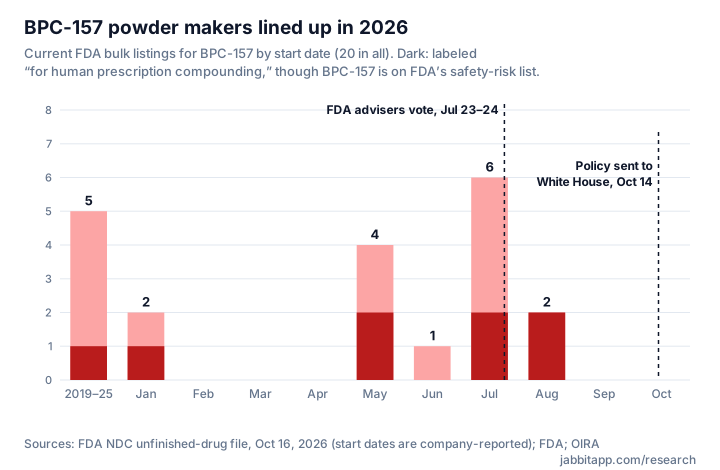
Compounded semaglutide and tirzepatide, the cheaper copies of Wegovy and Zepbound, start as powder bought from an ingredient maker. So do the BPC-157 and retatrutide vials sold online. We went through FDA’s own files to see who lists that powder. China dominates every list.[9] One Chinese plant FDA flagged in September after inspectors found black mold and staff hiding documents still has semaglutide and tirzepatide listed with FDA “for human prescription compounding,” and it is still registered.[1][2][8][9] Seven companies, all in China or Hong Kong, list bulk retatrutide, a drug FDA says can’t legally be compounded at all.[6][9] And 15 of the 20 BPC-157 powder listings began in 2026, as FDA moved toward letting pharmacies use it.[9][12][13]
Why this matters this week
On October 15, Bloomberg published FDA inspection reports from two Chinese plants that make semaglutide and tirzepatide for compounding. At Chengdu Shengnuo Biopharm, inspectors in August found black mold on equipment, “gross contamination” on floors and “significant insect activity” in ceilings. They saw quality staff stuff documents into lockers and pour samples into sinks “in a seemingly coordinated effort.” At Nanjing Chengong Pharmaceutical, workers had bought ingredients made at other factories and put Chengong’s own seal on them without checking the test data.[1] Michael Rogers, a former FDA associate commissioner for inspections, said the findings “suggest a serious accident waiting to happen.”[1] The story spread on X through Bloomberg, the New York Post, peptide accounts and the House China committee.[16]
Meanwhile FDA’s interim policy on compounding peptides such as BPC-157 has been at the White House since October 14, and its text isn’t public.[12] BPC-157 posts on X roughly doubled over the week, and accounts are calling it “one FDA rule away from going mainstream.”[16] If pharmacies get to make it, the next question is whose powder they use. So we checked.
What a pharmacy is supposed to check
Federal law lets a compounding pharmacy use a bulk ingredient only if it comes from an FDA-registered plant and arrives with a certificate of analysis, a test sheet for that batch.[10] The ingredient must also meet an official quality standard, be part of an approved drug, or be on FDA’s list of allowed substances.[10] Semaglutide and tirzepatide qualify because they’re in Wegovy and Zepbound. Retatrutide, cagrilintide and BPC-157 aren’t in any approved drug.[6][11]
What a pharmacy doesn’t have to do is the plant-level quality work. FDA wrote on October 9 that pharmacies working under these rules “are exempt from CGMP requirements, including the requirement to ensure API used in manufacturing meets specifications for impurities or potency.”[3] So a pharmacy relies on the plant’s registration and the plant’s own test sheet. The inspection reports show why that is thin. One plant was hiding documents; the other was putting its seal on other factories’ powder.[1]
What we found in FDA’s files
FDA publishes every listing for bulk drug ingredients, the raw powder before it becomes a finished drug, plus every registered drug plant with its address. We matched the current listings for each substance to the country where the company is registered.[7][8][9]
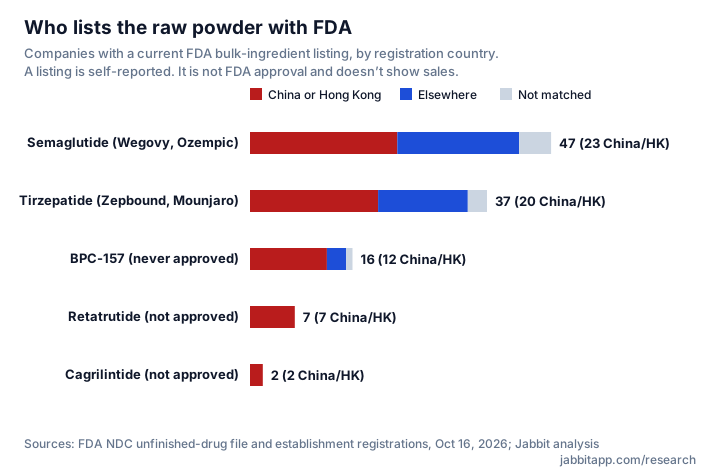
Semaglutide and tirzepatide. 47 companies list semaglutide powder and 37 list tirzepatide. 23 and 20 of them are registered in China or Hong Kong. Counting both drugs, 58 companies list one or the other, 27 of them in China.[9] FDA’s “Green List,” the plants it says may ship GLP-1 powder into the US, has 21 entries, 12 of them in China. FDA blanked out the company names.[3][9]
Plants on FDA’s import alert are still listed and registered. FDA’s import alert for plants that failed manufacturing standards includes five Chinese companies tied to GLP-1 ingredients: Chengdu Shengnuo (added September 19, 2026), Nanjing Chengong (October 1), its parent Nanjing Hanxin (June 22), Harbin Jixianglong (February 27) and Chengdu Brilliant (July 2025).[2] All five were still registered with FDA in the October 16 file, with registrations running to the end of 2026 or 2027.[8] Three still have GLP-1 listings. Chengdu Shengnuo has two semaglutide products and one tirzepatide product labeled “bulk ingredient for human prescription compounding,” certified through December 31, 2027.[9] Harbin Jixianglong still lists tirzepatide and retatrutide, and Chengdu Brilliant lists semaglutide.[9]
An import alert means FDA can hold that company’s shipments at the border without examining them, so a listing doesn’t mean powder is getting in.[2] The Bloomberg reports say both plants are on the alert.[1] But the alert lives in a separate FDA database from the listing and the registration. A pharmacy that checks only “registered plant, test sheet attached,” the two checks in the law, would see nothing wrong with these companies on paper.[8][10]
The Green List has its own gap. Harbin Jixianglong was added to the Green List on September 5, 2025, the day it launched.[4][5] When FDA inspected it that November, the plant had bought semaglutide from a factory that wasn’t on the Green List, labeled it as its own and shipped it to the US. FDA wrote that this “may have been an attempt to circumvent safeguards” of the Green List. The company told FDA it “occasionally purchased the product externally for resale.”[5] That is the same move Bloomberg describes at Nanjing Chengong.[1] Harbin recalled two batches in February 2026 and lost its Green List spot.[5][2] FDA says it has also seen companies register as GLP-1 makers, offer powder for import, refuse to hand over records and then deregister, “all within a short period of time.”[3] Of the 48 GLP-1 ingredient sites it checked, it found 21% out of compliance.[3]
Retatrutide: 7 suppliers for a drug nobody can compound
Retatrutide is Lilly’s experimental triple-hormone shot. It is not approved, and FDA says it “cannot be used in compounding under federal law.”[6] Yet seven companies list bulk retatrutide powder with FDA, all of them in China or Hong Kong. One listing, from Sinopep-Allsino, started September 1, 2026 and is labeled “for human prescription compounding.”[9] Two Chinese companies list cagrilintide, the other experimental half of Novo’s CagriSema.[9] FDA has warned telehealth companies marketing retatrutide, ingredient distributors “selling retatrutide and other GLP-1 drugs to compounders,” outsourcing facilities repackaging it, and a “research peptide” site that sold it as “GLP-1-R peptide.”[6][14] A listing is not permission. FDA says plainly that an NDC number “does not in any way denote FDA approval.”[7]
BPC-157: the powder makers moved first
BPC-157 has never been approved anywhere, and FDA keeps it on its list of substances that may pose significant safety risks in compounding. FDA cites possible immune reactions and “complexities with regard to peptide-related impurities and active pharmaceutical ingredient (API) characterization.”[11] That is a warning about exactly the powder question. FDA’s advisers voted 8 to 6, with 1 abstaining, in July to let pharmacies use it, and the policy that would act on that vote is now at the White House.[13][12]
The powder makers didn’t wait. 16 companies hold 20 current BPC-157 bulk listings; 12 of the companies are in China.[9] 15 of the 20 listings started in 2026, and 5 started between July 24, the second day of the advisory meeting, and August 11. 8 are labeled “for human prescription compounding.”[9] Start dates are what each company reported, not shipment records, and a listing doesn’t show anyone bought anything.[7] FDA’s Green List covers GLP-1 ingredients only; the import alert doesn’t mention BPC-157.[3]
Do people know whose powder they’re taking?
Often not. A study published September 22 had people send photos of the GLP-1 products they were using. Of 322 photos, 83 showed compounded products. When asked what they were taking, 54 of those 83 people, about two-thirds, named a brand-name drug like Wegovy or Zepbound.[15] If a patient doesn’t know the vial is compounded, they aren’t going to ask whose powder is in it.
What’s reassuring
This isn’t a case against every compounded vial. 12 of the 21 Green List entries are Chinese sites FDA accepted, and Chinese plants also supply ingredients for approved generic drugs.[3][1] Import alerts work at the border, and FDA put these plants on them.[2] FDA had 990 adverse-event reports for compounded semaglutide and more than 730 for compounded tirzepatide through May 31, 2026. FDA says many look like the side effects of the brand drugs, and some involved dosing errors; none of that points to contamination. They are likely undercounts, though, because most pharmacies don’t have to report them.[6] And our counts come from company-submitted listings that FDA doesn’t verify; they show who is offering powder, not how much reached any pharmacy.[7]
What you can ask
If you use a compounded GLP-1, ask the pharmacy who made the active ingredient and for that batch’s certificate of analysis. Check the maker’s name against FDA’s Import Alert 66-40 page, not just the registration list.[2][10] For retatrutide, the answer is simpler: there is no legal compounded version, so any vial sold as one isn’t one.[6] For BPC-157, even if the White House clears FDA’s policy, it won’t tell you whose powder is in the vial.[12]
Bottom line
The cheap copies and the peptide vials run on a supply chain FDA can see only in pieces. Its listing file shows who says they make the powder. Its registration file shows who signed up. Its import alerts show who failed. Those files don’t talk to each other. A plant FDA caught hiding documents in August still has its semaglutide listed for compounding today.[1][2][8][9] Seven firms offer retatrutide powder FDA says nobody may compound.[6][9] And BPC-157 makers are lining up before FDA has even said what it will allow.[9][12]
References
- Bloomberg News. Black mould, bugs found at Chinese plants making GLP-1 compounding agents. Republished by The Straits Times, October 15, 2026 (FDA inspection reports obtained under the Freedom of Information Act; Chengdu Shengnuo inspected in August, Nanjing Chengong in September; last prior inspections September 2023 and March 2025; Michael Rogers quote; Amphastar’s 11.5% stake in Nanjing Hanxin; Brookings 2025 analysis naming Nanjing Hanxin a large supplier). https://www.straitstimes.com/world/united-states/black-mould-bugs-found-at-chinese-plants-making-glp-1-compounding-agents. Checked October 17, 2026.
- U.S. Food and Drug Administration. Import Alert 66-40, Detention Without Physical Examination of Drugs From Firms Which Have Not Met Drug GMPs. Red-list entries: Chengdu Shengnuo Biopharm Co., Ltd. (published 09/19/2026), Nanjing Chengong Pharmaceutical Co., Ltd. (10/01/2026), Nanjing Hanxin Pharmaceutical Technology Co., Ltd. (06/22/2026), Harbin Jixianglong Biotech Co., Ltd. (02/27/2026), Chengdu Brilliant Biopharmaceutical Co., Ltd. (07/09/2025). https://www.accessdata.fda.gov/cms_ia/importalert_189.html. Checked October 17, 2026.
- U.S. Food and Drug Administration. Import Alert 66-80, Detention Without Physical Examination of GLP-1 Active Pharmaceutical Ingredients (APIs), revised and published 10/09/2026. FDA evaluated 48 GLP-1 API sites and found 21% noncompliant; describes “a pattern of sites that register as GLP-1 API manufacturers, offer GLP-1 APIs for import, refuse to answer FDA’s requests for records, and then deregister”; states 503A compounders “are exempt from CGMP requirements, including the requirement to ensure API used in manufacturing meets specifications for impurities or potency.” The Green List has 21 entries with firm names redacted (China 12, India 3, and one each in Belgium, Canada, Denmark, Ireland, Italy and Portugal, by Jabbit’s count). https://www.accessdata.fda.gov/cms_ia/importalert_1186.html. Checked October 17, 2026.
- U.S. Food and Drug Administration. FDA launches Green List to protect Americans from illegal imported GLP-1 drug ingredients. Press release, September 5, 2025. https://www.fda.gov/news-events/press-announcements/fda-launches-green-list-protect-americans-illegal-imported-glp-1-drug-ingredients. Checked October 17, 2026.
- U.S. Food and Drug Administration. Warning letter to Harbin Jixianglong Biotech Co., Ltd., 320-26-73, May 1, 2026 (inspection November 3–7, 2025; “Your firm was added to the Green List on September 5, 2025”; bought semaglutide API from a facility not on the Green List and labeled it as its own; “occasionally purchased the product externally for resale”; voluntary recall of two batches initiated February 19, 2026). https://www.fda.gov/inspections-compliance-enforcement-and-criminal-investigations/warning-letters/harbin-jixianglong-biotech-co-ltd-723330-05012026. Checked October 17, 2026.
- U.S. Food and Drug Administration. FDA’s Concerns with Unapproved GLP-1 Drugs Used for Weight Loss. Content current as of October 1, 2026 (“Retatrutide and cagrilintide cannot be used in compounding under federal law”; warning letters to API distributors selling retatrutide to compounders; as of May 31, 2026, 990 adverse-event reports for compounded semaglutide and more than 730 for compounded tirzepatide; state-licensed pharmacies generally are not required to report adverse events to FDA). https://www.fda.gov/drugs/drug-alerts-and-statements/fdas-concerns-unapproved-glp-1-drugs-used-weight-loss. Checked October 17, 2026.
- U.S. Food and Drug Administration. National Drug Code Directory (“Inclusion in the NDC Directory does not indicate that FDA has verified the information provided or that the products are FDA-approved”; “Assignment of an NDC number does not in any way denote FDA approval of the product”). Unfinished-drug file used here: https://www.accessdata.fda.gov/cder/ndc_unfinished.zip, dated October 16, 2026. https://www.fda.gov/drugs/drug-approvals-and-databases/national-drug-code-directory. Checked October 17, 2026.
- U.S. Food and Drug Administration. Drug Establishments Current Registration Site file, dated October 16, 2026 (Chengdu Shengnuo registration through 12/31/2027; Nanjing Hanxin 12/31/2027; Chengdu Brilliant, Harbin Jixianglong and Nanjing Chengong 12/31/2026). https://www.accessdata.fda.gov/cder/drls_reg.zip. Checked October 17, 2026.
- Jabbit analysis of the FDA files in [7] and [8], October 17, 2026: current bulk-ingredient and further-processing listings matched on substance name, by product code; companies matched to registration country by name. Full listing table, method and country matches: https://jabbitapp.com/research/sources/glp1-peptide-api-listings-2026-10-17.json.
- Federal Food, Drug, and Cosmetic Act § 503A(b)(1)(A), 21 U.S.C. § 353a: bulk drug substances must meet a USP or NF monograph, be a component of an approved drug, or appear on FDA’s 503A bulks list; come from a registered establishment; and carry valid certificates of analysis. https://www.law.cornell.edu/uscode/text/21/353a. Checked October 17, 2026.
- U.S. Food and Drug Administration. Certain Bulk Drug Substances for Use in Compounding that May Present Significant Safety Risks (Category 2). Content current as of April 22, 2026. BPC-157 “may pose risk for immunogenicity” and has “complexities with regard to peptide-related impurities and active pharmaceutical ingredient (API) characterization.” https://www.fda.gov/drugs/human-drug-compounding/certain-bulk-drug-substances-use-compounding-may-present-significant-safety-risks. Checked October 17, 2026.
- Office of Information and Regulatory Affairs (OMB). Pending EO 12866 Regulatory Review: Interim Access Policy for Compounding Using Certain Peptides, RIN 0910-ZD94, received 10/14/2026; no conclusion listed when checked. https://www.reginfo.gov/public/do/eoDetails?rrid=1568964. Checked October 17, 2026.
- Vote tallies from the July 23–24, 2026 Pharmacy Compounding Advisory Committee meeting (BPC-157 8 yes, 6 no, 1 abstain): Holland & Knight, Peptides at a Crossroads, October 2026 https://www.hklaw.com/en/insights/publications/2026/10/peptides-at-a-crossroads-what-wellness-providers-need-to-know; MDside, The FDA advisory vote on six peptides, October 9, 2026 https://www.mdside.com/peptide-advisory-vote-what-happens-next/. Checked October 17, 2026.
- U.S. Food and Drug Administration. Warning letter to Gram Peptides, 721806, March 31, 2026 (retatrutide sold as “GLP-1-R peptide” and tirzepatide as “GLP-2 peptide”; the products are unapproved new drugs). https://www.fda.gov/inspections-compliance-enforcement-and-criminal-investigations/warning-letters/gram-peptides-721806-03312026. Checked October 17, 2026.
- Katz JM, Gearhardt AN, Griauzde DH. Obesity Science & Practice. 2026;12(5):e70200. Published September 22, 2026. doi:10.1002/osp4.70200. PMID 42774636 (322 photos of GLP-1 products analyzed; 83, or 25.8%, were compounded; 54 of those 83 users, 65.1%, reported a brand-name drug when asked what they used; one author reports grant support from Eli Lilly). https://pubmed.ncbi.nlm.nih.gov/42774636/. Checked October 17, 2026.
- X posts and counts, pulled by Jabbit on October 17, 2026: @business (Bloomberg), October 15 https://x.com/business/status/2110757624572522517; @PeptideBase, October 15 https://x.com/PeptideBase/status/2110873116465369280; @nypost, October 15 https://x.com/nypost/status/2110858956394348733; @ChinaSelect (House Select Committee on the CCP), October 15 https://x.com/ChinaSelect/status/2110829846834143623; @BowTiedBills, October 16, “BPC-157 is one FDA rule away from going mainstream” https://x.com/BowTiedBills/status/2111200259259179414. Recent-search count for BPC-157 (“BPC-157” OR BPC157 OR “BPC 157”, excluding reposts), UTC days October 11–16: 110, 161, 237, 250, 232 and 285 posts.
This page analyzes FDA databases, import alerts, warning letters, news reports of FDA inspection records and published research. It is not medical or legal advice and does not recommend buying, sourcing or using any product. Listing and country counts are Jabbit’s own from FDA files; method and data are linked above.