Research review · Magnesium glycinate · Sleep · Anxiety · Older adults · Ozempic · Zepbound · Updated October 28, 2026
Published · Updated
Does magnesium glycinate help sleep or anxiety? The evidence is thin. The one placebo-controlled glycinate trial we found showed a small four-week drop in insomnia scores and no change in stress, anxiety or mood, and the widely shared “248 mg” anxiety trial tested a different form, without a placebo.
Magnesium glycinate is having a moment on X. Posts this week credit it with calmer nerves and deeper sleep, and a trending summary cites a trial in which 248 mg a day “cut depression and anxiety scores.” Readers want to know whether it actually helps sleep or anxiety. Our plain answer: the best glycinate trial we found showed a real but small improvement in one insomnia score over four weeks, with no effect on stress, anxiety or mood scores. The “248 mg” trial used magnesium chloride and had no placebo group. A 2026 review of 12 trials concluded that current evidence “does not support oral magnesium as a routine treatment for insomnia.”[3][5][7][6]
Why this matters now
Posts on X mentioning magnesium glycinate rose from 126 on October 22 to 261 on October 27, 2026, by Jabbit’s count.[4] On October 27, entrepreneur Pieter Levels (@levelsio) posted that his diet gives him “about 200mg of magnesium per day” against a need of “about 420mg,” and that “About 60% of people are magnesium deficient.” The post had about 138,000 impressions by the evening of October 28.[2] The next morning he posted “+30min REM sleep with magnesium glycinate!” adding, fairly, “It's just one day so too early to conclude.”[1] The same day, an X trending summary said “a trial showed 248 mg daily cut depression and anxiety scores noticeably in weeks.”[3] We check those claims against the published research. We do not assess the people who made them.
Timeline
| Year | Event |
|---|---|
| 1994 | In 12 patients with bowel resections, magnesium glycinate and magnesium oxide are absorbed about equally (23.5% vs 22.8%). The glycinate form is better tolerated.[12] |
| 2012 | A placebo-controlled trial in 46 older adults with insomnia uses magnesium oxide. Total sleep time does not differ from placebo.[9] |
| 2017 | An open-label trial of magnesium chloride in 126 adults reports lower depression and anxiety scores. The trial had no placebo. That year, a review of 18 studies rates the anxiety evidence as poor quality.[7][11] |
| 2021 | A meta-analysis of 3 trials in 151 older adults finds people fell asleep about 17 minutes faster, at moderate-to-high risk of bias.[8] |
| 2024 | A review of 15 studies finds mixed but mostly positive small studies of sleep and anxiety.[10] |
| 2025 | The first large placebo-controlled glycinate sleep trial, in 155 adults, reports a small effect on insomnia scores.[5] |
| Aug 2026 | A review of 12 trials rates the sleep evidence low to very low certainty.[6] |
| Oct 27–28, 2026 | Magnesium glycinate trends on X.[4][1][2][3] |
The glycinate trial: what it found
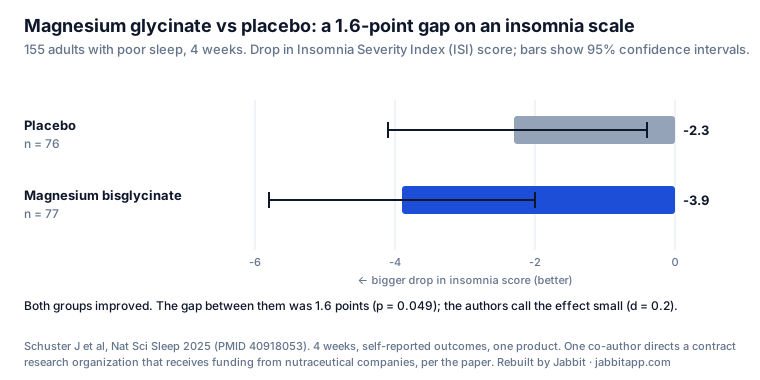
- The design. 155 adults aged 18 to 65 with self-reported poor sleep took magnesium bisglycinate or a placebo for four weeks, at sites across Germany. The trial arm got 250 mg of elemental magnesium a day.[5]
- The main result. Insomnia Severity Index scores fell 3.9 points with magnesium and 2.3 with placebo. The 1.6-point gap was just statistically significant (p = 0.049). The authors call the effect “small,” at a Cohen’s d of 0.2, “indicating a modest benefit.”[5]
- Placebo did a lot. Jabbit’s analysis: by these figures, the placebo group got more than half of the improvement seen with magnesium.[5]
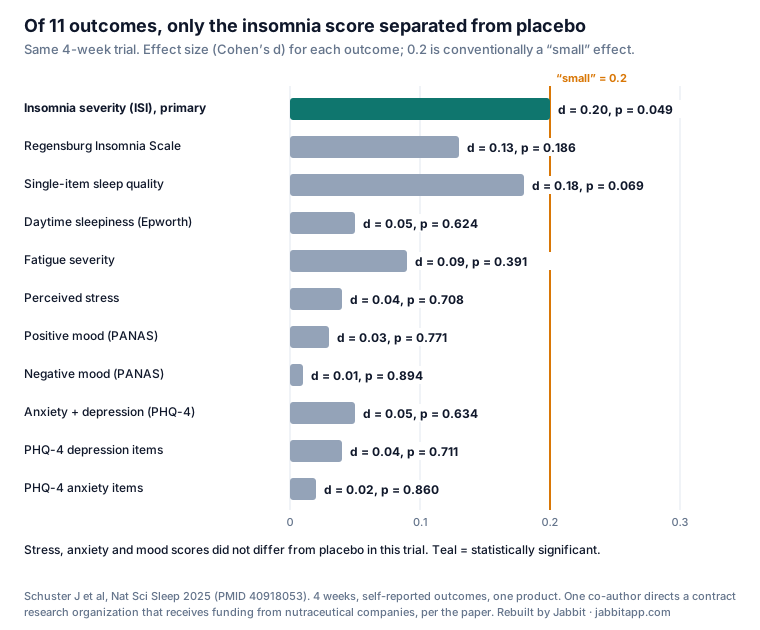
- Everything else. The trial measured 10 other outcomes, including a second insomnia scale, sleep quality, daytime sleepiness, fatigue, perceived stress, mood and a short anxiety-and-depression screen. None differed from placebo.[5]
- A subgroup signal. In exploratory analyses, people who reported lower dietary magnesium seemed to improve more. The authors note their diet tool was not validated.[5]
The “248 mg” anxiety trial, checked
The 248 mg figure in the trending summary matches a 2017 US trial run in primary care clinics.[3][7] In it, 126 adults with mild-to-moderate depression took 248 mg of elemental magnesium a day for six weeks, compared with six weeks of no treatment. Depression scores (PHQ-9) improved by a net 6.0 points and anxiety scores (GAD-7) by 4.5 points.[7] Three things matter here:
- It was not glycinate. The tablets were magnesium chloride.[7]
- There was no placebo. The paper says “There was no placebo arm and randomization was not blinded for either the study team or the volunteer.”[7] People who know they are getting a treatment often report feeling better.
- It enrolled people with depression. It did not test magnesium in healthy people with everyday stress.[7]
Jabbit’s analysis: when the glycinate form was tested against placebo, anxiety and stress scores did not move.[5]
What reviews of all the trials say
- Sleep, 2026. A review of 12 randomized trials found results “inconsistent” across sleep scores, brain-wave sleep recordings, actigraphy, consumer wearables and lab markers. Certainty was “low to very low.” It says magnesium “may provide modest benefits for selected subjective outcomes in some adults.”[6]
- Older adults, 2021. Pooling 3 trials in 151 older adults, people fell asleep 17.4 minutes faster with magnesium. Total sleep time rose 16 minutes, but that result was not significant. All three trials were at moderate-to-high risk of bias, and none used glycinate. They used magnesium oxide or citrate.[8]
- Sleep and anxiety, 2024. A review of 15 studies found improvements in 5 of 8 sleep studies and 5 of 7 anxiety studies. The authors say firm conclusions were limited by small, varied studies.[10]
- Anxiety and stress, 2017. A review of 18 studies called the evidence quality “poor.” None used a validated stress measure.[11]
Sleep in later life: the longevity angle
Much of the older magnesium sleep research was done in older adults. That group may have the most reason to pay attention. NIH says older adults eat less magnesium than younger adults, absorb less from the gut, and lose more through the kidneys.[14] Even so, the trials in older adults are small. They used forms other than glycinate and carry a high risk of bias.[8][9] In the 2012 trial in 46 older adults, total sleep time did not differ from placebo.[9] Jabbit’s analysis: no glycinate trial we found tested people over 65. The 2025 trial’s upper age limit was 65.[5]
Is it the magnesium or the glycine?
Magnesium glycinate is magnesium bound to the amino acid glycine. Glycine has been studied for sleep on its own. In the 2025 trial, the daily dose included 1,523 mg of glycine, and the authors note that some studies suggest about 3 g of glycine may help sleep quality.[5] An older glycine study used 3 g.[13] Jabbit’s analysis: the trial dose had about half that amount of glycine, and the trial was not designed to tell the two apart.[5][13]
Claims in the posts, checked
- “+30min REM sleep.” One night of wearable data cannot show an effect, as the poster himself said.[1] The 2026 review found consumer wearable estimates among the outcomes that were inconsistent across trials.[6]
- “About 420mg per day.” NIH’s adult RDAs range from 310 to 420 mg depending on age and sex. That includes food.[14][2]
- “About 60% of people are magnesium deficient.” We could not match this figure in NIH’s fact sheet. NIH says 48% of Americans take in less magnesium from food than the average requirement. It also says there is “no current data on magnesium status” in the US, and that symptomatic deficiency from low intake is “uncommon” in otherwise healthy people.[14] Jabbit’s reading: low intake is common, but low intake is not the same as a measured deficiency.
- Is glycinate the better-absorbed form? The evidence is thinner than often claimed. NIH lists aspartate, citrate, lactate and chloride as better absorbed than oxide and sulfate, and does not list glycinate.[14] In one small 1994 study, glycinate and oxide were absorbed about equally, though glycinate was better tolerated.[12]
Safety: what is known
- Upper limit. NIH sets the adult upper limit for magnesium from supplements and medicines at 350 mg a day. That limit does not count food.[14]
- Diarrhea. NIH says carbonate, chloride, gluconate and oxide are the forms most often reported to cause diarrhea.[14] In the 2025 trial, there were 7 adverse events with placebo vs 2 with magnesium. Two placebo-group participants withdrew because of stomach pain.[5]
- Kidneys. The risk of magnesium toxicity “increases with impaired renal function or kidney failure.”[14]
- Medicine interactions. NIH notes that magnesium can bind some antibiotics (tetracyclines and quinolones) and lower absorption of bisphosphonates used for bone loss. It advises taking those antibiotics at least 2 hours before or 4 to 6 hours after magnesium. Long-term proton pump inhibitor use can lower magnesium levels.[14] Ask a pharmacist about timing.
What a careful reader should notice
- One trial, one product, four weeks. The glycinate evidence rests mainly on a single trial with self-reported outcomes. Fewer than 10% of participants completed their sleep diaries.[5]
- Who ran it. One co-author directs a contract research organization that “receives research funding from nutraceutical companies,” per the paper.[5] That does not make the data wrong, and the trial’s own modest result is reported plainly.
- The p-value was borderline. At p = 0.049, with 10 other outcomes not significant, the main finding is fragile. That is our analysis.[5]
- Forms get mixed up. Viral claims often cite chloride or oxide trials as evidence for glycinate.[7][8][9]
- Some findings are positive. Small trials and reviews do report benefits for sleep onset and self-reported anxiety. Better trials could still confirm a modest effect.[8][10]
If you are on a GLP-1 drug
People on Ozempic, Wegovy, Zepbound or Mounjaro often eat much less. Jabbit’s analysis: eating less food likely also means getting less magnesium from food. We found no trial of magnesium supplements in GLP-1 users. Stomach side effects matter too. Some magnesium forms can cause diarrhea, and GLP-1 drugs commonly cause gut side effects of their own, including constipation.[14][15] Our reading: a change in bowel habits after adding magnesium could be hard to pin on one cause. Our GLP-1 constipation guide covers what helps there. Tell your prescriber or pharmacist about any supplement, especially if you have kidney disease or take the medicines listed above. Logging doses, sleep and side effects can help you and your prescriber see what is changing. Jabbit keeps that log privately on your iPhone.
FAQ
- Does magnesium glycinate help you sleep?
- Possibly a little. In the largest placebo-controlled glycinate trial, 155 adults’ insomnia scores improved 1.6 points more than with placebo over four weeks, a small effect. Other sleep measures did not differ. A 2026 review says magnesium is not supported as a routine insomnia treatment.
- Does magnesium glycinate help anxiety?
- It is not proven. In the glycinate trial, stress and anxiety scores did not differ from placebo. A widely cited 2017 trial that found lower anxiety scores used magnesium chloride and had no placebo group.
- Was the “248 mg” trial about magnesium glycinate?
- No. The 2017 trial gave 248 mg of elemental magnesium a day as magnesium chloride, to adults with depression, compared with no treatment. It was open-label, with no placebo.
- Is magnesium glycinate better absorbed than other forms?
- That is not well established. NIH lists aspartate, citrate, lactate and chloride as better absorbed than oxide and sulfate. A small 1994 study found glycinate and oxide absorbed about equally, though glycinate was better tolerated.
- Are most people magnesium deficient?
- NIH says 48% of Americans get less magnesium from food than the average requirement, but US magnesium status is not tracked, and symptomatic deficiency is uncommon in otherwise healthy people.
- Can I take magnesium with Ozempic or Zepbound?
- No trial has tested it in GLP-1 users. Both can affect your gut, and magnesium interacts with some antibiotics and bone drugs. Ask your prescriber or pharmacist, especially if you have kidney disease.
Bottom line
Magnesium glycinate may modestly help self-reported insomnia, based mainly on one four-week trial with a small, borderline result. The same trial found no effect on stress, anxiety or mood. The anxiety trial behind the viral “248 mg” claim used a different form and had no placebo, and one night of wearable data cannot settle anything. In our read, the honest claim today is “small, uncertain benefit for sleep, unproven for anxiety.” Longer independent trials, including in older adults and people on GLP-1 drugs, would answer the question better than any post.
References
- Pieter Levels (@levelsio), public post on X created October 28, 2026, 7:31 AM ET: “+30min REM sleep with magnesium glycinate!” and “It's just one day so too early to conclude but interesting direction.” The X API reported 49,763 impressions when Jabbit read it on October 28, 2026 at about 8:00 PM ET. https://x.com/levelsio/status/2115406004297077033. Checked October 28, 2026.
- Pieter Levels (@levelsio), public post on X created October 27, 2026, 2:54 PM ET: “based on my nutrition I get about 200mg of magnesium per day”; “You need to get about 420mg per day”; “About 60% of people are magnesium deficient and symptoms can be anxiety (and in turn bad sleep).” The X API reported 137,656 impressions at the same read. https://x.com/levelsio/status/2115155070706720857. Checked October 28, 2026.
- X trending-story summary, “Magnesium Glycinate Gains Popularity for Stress Relief and Better Sleep,” last updated October 27, 2026, 8:22 PM ET, which says “a trial showed 248 mg daily cut depression and anxiety scores noticeably in weeks.” Read through the X API October 28, 2026. https://x.com/i/trending/2115165543208825089. Checked October 28, 2026.
- Jabbit counts of posts on X containing “magnesium glycinate” (reposts excluded), X API recent-counts endpoint, read October 28, 2026 at about 8:00 PM ET, by UTC day from October 22: 126, 154, 158, 138, 214, 261 and 234 (partial day); 1,285 total. https://jabbitapp.com/research/sources/magnesium-glycinate-2026-10-28.json. Checked October 28, 2026.
- Schuster J, Cycelskij I, Lopresti A, et al. Magnesium Bisglycinate Supplementation in Healthy Adults Reporting Poor Sleep: A Randomized, Placebo-Controlled Trial. Nat Sci Sleep. 2025;17:2027-2040. PMID 40918053. Randomized, placebo-controlled trial. Abstract: it “enrolled 155 adults aged 18-65 years with self-reported poor sleep quality,” given “250 mg elemental magnesium, daily” for four weeks; Insomnia Severity Index change “(-3.9 [95% CI: -5.8 to -2.0] vs -2.3 [95% CI: -4.1 to -0.4], respectively; p = 0.049)”; “The effect size was small (Cohen's d = 0.2), indicating a modest benefit”; “No significant differences were observed in other psychological outcomes.” Full text: the daily dose provided “250 mg of magnesium and 1523 mg of glycine”; “Two participants in the placebo group withdrew due to stomach pain”; adverse events, Table: 7 placebo, 2 magnesium; “fewer than 10% of participants provided complete entries” in sleep diaries; “Given the non-validated nature of the dietary assessment tool”; disclosure: “Adrian Lopresti is the managing director of Clinical Research Australia, a contract research organization that receives research funding from nutraceutical companies.” Registered DRKS00031494. Abstract, tables and disclosures read. https://pubmed.ncbi.nlm.nih.gov/40918053/ · https://pmc.ncbi.nlm.nih.gov/articles/PMC12412596/. Checked October 28, 2026.
- Lopresti AL, Smith SJ, Drummond PD. Magnesium Supplementation for Sleep in Adults: A Systematic Review of Randomized Controlled Trials. J Diet Suppl. 2026;23(5):553-581. PMID 42661485. Systematic review, published August 2026. Abstract: “Twelve randomized controlled trials were included in the main synthesis on sleep, insomnia, or poor sleep”; “Findings were inconsistent across subjective outcomes, EEG, research-grade actigraphy, consumer wearable-derived estimates, and physiological markers”; “Certainty of evidence was low to very low”; “Current evidence does not support oral magnesium as a routine treatment for insomnia”; “It may provide modest benefits for selected subjective outcomes in some adults.” Abstract read. https://pubmed.ncbi.nlm.nih.gov/42661485/. Checked October 28, 2026.
- Tarleton EK, Littenberg B, MacLean CD, et al. Role of magnesium supplementation in the treatment of depression: A randomized clinical trial. PLoS One. 2017;12(6):e0180067. PMID 28654669. Open-label crossover trial. Abstract: “An open-label, blocked, randomized, cross-over trial was carried out in outpatient primary care clinics on 126 adults”; “6 weeks of active treatment (248 mg of elemental magnesium per day) compared to 6 weeks of control (no treatment)”; “net improvement in PHQ-9 scores of -6.0 points (CI -7.9, -4.2; P<0.001)” and “net improvement in Generalized Anxiety Disorders-7 scores of -4.5 points (CI -6.6, -2.4; P<0.001)”; the conclusion refers to “over-the-counter magnesium chloride.” Full text: “Participants were instructed to take four 500 mg tablets of magnesium chloride daily for a total of 248 mg of elemental magnesium per day”; “There was no placebo arm and randomization was not blinded for either the study team or the volunteer.” Abstract and methods read. https://pubmed.ncbi.nlm.nih.gov/28654669/ · https://pmc.ncbi.nlm.nih.gov/articles/PMC5487054/. Checked October 28, 2026.
- Mah J, Pitre T. Oral magnesium supplementation for insomnia in older adults: a Systematic Review & Meta-Analysis. BMC Complement Med Ther. 2021;21(1):125. PMID 33865376. Systematic review and meta-analysis. Abstract: “Three randomized control trials (RCT) were identified comparing oral magnesium to placebo in 151 older adults in three countries”; “post-intervention sleep onset latency time was 17.36 min less after magnesium supplementation compared to placebo”; “Total sleep time improved by 16.06 min in the magnesium supplementation group but was statistically insignificant”; “All trials were at moderate-to-high risk of bias and outcomes were supported by low to very low quality of evidence.” Full text: the trials used “two formulations (magnesium oxide and magnesium citrate tablets).” A correction was published in 2024 (PMID 39702257). Abstract and methods read. https://pubmed.ncbi.nlm.nih.gov/33865376/ · https://pmc.ncbi.nlm.nih.gov/articles/PMC8053283/. Checked October 28, 2026.
- Abbasi B, Kimiagar M, Sadeghniiat K, et al. The effect of magnesium supplementation on primary insomnia in elderly: A double-blind placebo-controlled clinical trial. J Res Med Sci. 2012;17(12):1161-9. PMID 23853635. Abstract: “A double-blind randomized clinical trial was conducted in 46 elderly subjects”; “total sleep time (P = 0.37) did not show any significant between-group differences.” Full text: “Magnesium was administered as magnesium oxide tablets twice a day (each tablet containing 414 mg magnesium oxide as 250 mg elemental magnesium) for 8 weeks.” Abstract and methods read. https://pubmed.ncbi.nlm.nih.gov/23853635/ · https://pmc.ncbi.nlm.nih.gov/articles/PMC3703169/. Checked October 28, 2026.
- Rawji A, Peltier MR, Mourtzanakis K, et al. Examining the Effects of Supplemental Magnesium on Self-Reported Anxiety and Sleep Quality: A Systematic Review. Cureus. 2024;16(4):e59317. PMID 38817505. Systematic review. Abstract: “Magnesium, in particular, is popular on social media for the treatment of anxiety and insomnia”; “This query returned 860 articles of which 15 met full inclusion criteria”; “Five out of eight sleep-related studies reported improvements in sleep parameters”; “Five out of seven studies measuring anxiety-related outcomes reported improvements in self-reported anxiety”; “Firm conclusions were limited by the heterogeneity of the data and the small number of participants involved in most of the studies.” Abstract read. https://pubmed.ncbi.nlm.nih.gov/38817505/ · https://pmc.ncbi.nlm.nih.gov/articles/PMC11136869/. Checked October 28, 2026.
- Boyle NB, Lawton C, Dye L. The Effects of Magnesium Supplementation on Subjective Anxiety and Stress-A Systematic Review. Nutrients. 2017;9(5). PMID 28445426. Systematic review. Abstract: “18 studies were included in the review”; “No study administered a validated measure of subjective stress as an outcome”; “However, the quality of the existing evidence is poor.” Abstract read. https://pubmed.ncbi.nlm.nih.gov/28445426/ · https://pmc.ncbi.nlm.nih.gov/articles/PMC5452159/. Checked October 28, 2026.
- Schuette SA, Lashner BA, Janghorbani M. Bioavailability of magnesium diglycinate vs magnesium oxide in patients with ileal resection. JPEN J Parenter Enteral Nutr. 1994;18(5):430-5. PMID 7815675. Older comparison study. Abstract: “a double-blind, randomized crossover trial with 12 patients who had ileal resections”; absorption “(23.5% vs 22.8% for magnesium chelate and MgO, respectively)”; the glycinate form was “better tolerated by all patients.” Abstract read. https://pubmed.ncbi.nlm.nih.gov/7815675/. Checked October 28, 2026.
- Bannai M, Kawai N, Ono K, et al. The effects of glycine on subjective daytime performance in partially sleep-restricted healthy volunteers. Front Neurol. 2012;3:61. PMID 22529837. Older glycine study, used only for comparison. Abstract: “3 g of glycine or placebo were ingested.” Abstract read. https://pubmed.ncbi.nlm.nih.gov/22529837/ · https://pmc.ncbi.nlm.nih.gov/articles/PMC3328957/. Checked October 28, 2026.
- NIH Office of Dietary Supplements, “Magnesium: Fact Sheet for Health Professionals,” “Updated: January 6, 2026.” Quotes: RDAs “range from 310 to 420 mg for adults”; “48% of Americans of all ages ingest less magnesium from food and beverages than their respective EARs”; “There is no current data on magnesium status among people who live in the United States”; “Symptomatic magnesium deficiency due to low dietary intake in otherwise healthy people is uncommon”; “Older adults have lower dietary intakes of magnesium than younger adults” and “magnesium absorption from the gut decreases and renal magnesium excretion increases with age”; “Small studies have found that magnesium in the aspartate, citrate, lactate, and chloride forms is absorbed more completely and is more bioavailable than magnesium oxide and magnesium sulfate”; “The Tolerable Upper Intake Level for supplemental magnesium is 350 mg for adults”; “The ULs only include magnesium from dietary supplements and medications; they do not include magnesium found naturally in food and beverages”; “The forms of magnesium that are most commonly reported to cause diarrhea include magnesium carbonate, chloride, gluconate, and oxide”; “The risk of magnesium toxicity increases with impaired renal function or kidney failure”; certain antibiotics “should be taken at least 2 hours before or 4 to 6 hours after a magnesium-containing supplement”; magnesium “can decrease the absorption of oral bisphosphonates”; proton pump inhibitors “can cause hypomagnesemia when taken for prolonged periods (typically more than a year).” https://ods.od.nih.gov/factsheets/Magnesium-HealthProfessional/. Checked October 28, 2026.
- Jabbit, “GLP-1 constipation guide” (Ozempic, Wegovy, Mounjaro, Zepbound), which cites the prescribing information for each drug there. https://jabbitapp.com/glp1-constipation-guide.html. Checked October 28, 2026.
- Jabbit source extract for this page: abstract, full-text and fact-sheet quotes checked against cached copies, trial table values, X API reads and chart values, October 28, 2026. https://jabbitapp.com/research/sources/magnesium-glycinate-2026-10-28.json. Checked October 28, 2026.
This page analyzes published studies, an NIH fact sheet, public posts on X and Jabbit’s own counts. It is not medical advice and does not recommend magnesium, any product or any dose. Doses appear only as tested in trials or as official reference values. Only public claims are assessed, not the people who made them. Charts were rebuilt by Jabbit from the sources cited in each caption.