Research review · Creatine · Pre-workout · Soft-tissue injuries · Cramps · Ozempic · Zepbound · Updated October 27, 2026
Published · Updated
Does creatine cause soft-tissue injuries or cramps? The published evidence does not show it. In college football players followed over three seasons, creatine users had injury rates lower than or in line with their share of the team, and a 2025 analysis of 685 trials found no overall rise in side effects. A few small studies do flag caveats.
A viral post this week told athletes to stop taking creatine, saying it is “like filling a balloon with air” and that this is “why soft tissue injuries happen.” Many people now take creatine, including some on Ozempic, Wegovy, Zepbound or Mounjaro who want to protect muscle. The reader’s question: does creatine cause muscle strains, pulls or cramps? Our plain answer: the studies that counted injuries in athletes did not find more of them in creatine users, and pooled trial data show no overall rise in side effects. The evidence has real limits, though: the football studies were open-label and run largely by researchers with creatine-industry ties, and a few small studies found pressure and muscle-damage signals worth knowing about.[1][4][7]
Why this matters now
On October 27, 2026, a public X account whose bio describes him as a retired NFL defensive tackle posted “STOP TAKING CREATINE,” comparing it to a balloon that fails “under stress.” The post had about 1.09 million impressions by that evening. The night before, the same account posted that “All soft tissue injuries among athletes come from creatine and pre-workout.”[1][2] English posts on X pairing creatine with injuries jumped from 3 to 5 a day earlier in the week to 145 on October 27, by Jabbit’s count.[3] We assess the claim, not the person.
Timeline
| Year | Event |
|---|---|
| 2000 | A survey of college athletes finds that 38% of creatine users report perceived side effects such as cramping or stomach upset. An American College of Sports Medicine statement advises some athletes training hard or in heat to avoid creatine.[20][11] |
| 2001–2006 | Small studies find creatine can raise pressure inside the lower-leg muscle compartment.[13][14][15] |
| 2003 | Football studies at one university find injury and cramping rates lower or in line with creatine use, and no change in a broad blood and urine panel.[5][4][6] |
| 2008–2009 | A review calls the cramping and dehydration idea a “fallacy”; a meta-analysis finds no harm to heat tolerance or fluid balance.[11][12] |
| 2022 | A meta-analysis finds muscle-damage markers lower after one hard bout but higher with long-term use.[19] |
| 2025–2026 | Analyses of about 685 trials find no overall rise in side effects; a small independent soccer pilot reports fewer injuries, not significant.[7][8][21] |
| Oct 26–27, 2026 | Viral posts blame creatine and pre-workout for athletes’ soft-tissue injuries.[1][2] |
What the injury studies show
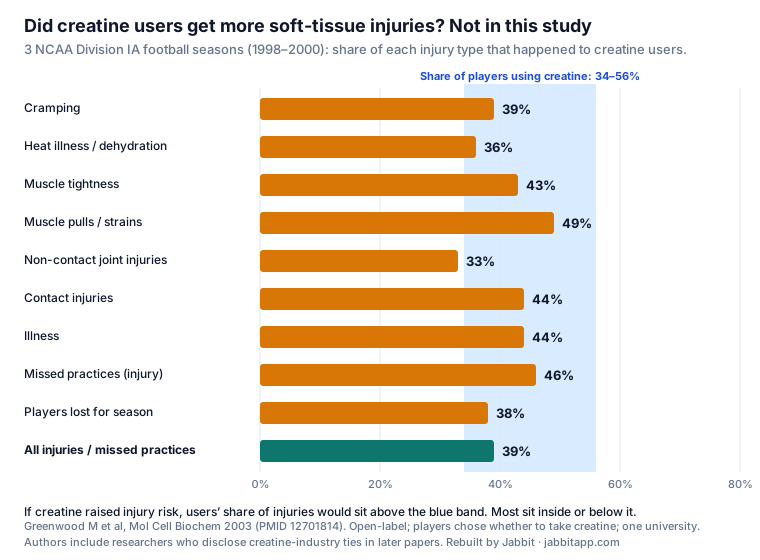
- Three football seasons. At one NCAA Division IA program, 34% to 56% of players took creatine from 1998 to 2000. Creatine users accounted for 39% of cramping cases, 49% of muscle pulls and strains, 43% of muscle tightness and 39% of all injuries and missed practices, which the authors describe as “generally lower or proportional to the creatine use rate.”[4] Jabbit’s reading: if creatine raised injury risk, users’ share of injuries should sit above their share of the team. It did not.
- One season, more detail. In 1999, 38 of 72 players chose creatine. Users had significantly less cramping and no difference in non-contact joint injuries.[5]
- Health markers. Over 21 months, 98 players showed no adverse change in a 69-item blood and urine panel.[6]
- A newer randomized pilot. In 23 amateur soccer players over 14 weeks, injuries were 8.3% with creatine vs 36.4% with placebo. The confidence interval is wide and the result was not significant (p = 0.155).[21]
- Women’s football. In 71 female players taking creatine, kidney and liver tests stayed normal. Creatine kinase, a muscle-damage marker, varied in a way the authors attribute to training load. There was no placebo group.[22]
- Cramps and heat. A meta-analysis of 10 studies found no evidence that creatine hurts heat tolerance or fluid balance.[12] An earlier review called the cramping-and-dehydration idea “a fallacy” driven by “media claims and anecdotal reports.”[11]
What 685 trials report
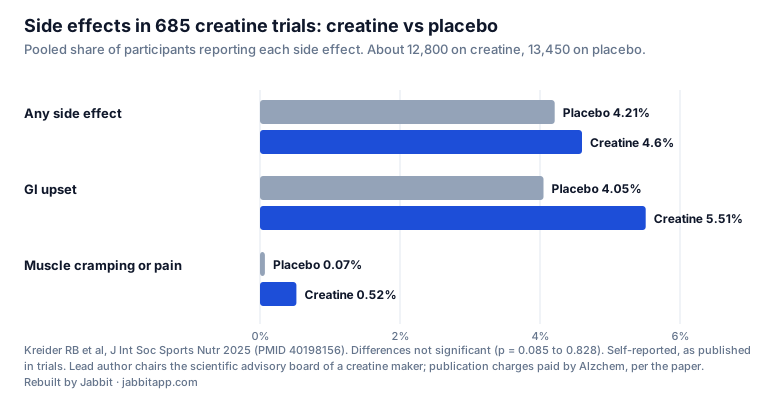
A 2025 analysis pooled side effects from 685 published creatine trials with about 12,800 people on creatine and 13,450 on placebo. Side effects were reported in 13.7% of creatine study arms vs 13.2% of placebo arms, not a significant difference. Per participant, any side effect was reported by 4.60% vs 4.21%.[7] A 2026 follow-up analysis concluded creatine “does not increase the risk of gastrointestinal, renal, liver, musculoskeletal, or other SEs compared to placebo.”[8]
One signal to note: counted by study, muscle cramping or pain was reported in 2.9% of creatine arms vs 0.9% of placebo arms (p = 0.008). Counted by person, it was 0.52% vs 0.07%, which was not significant (p = 0.085).[7] Both rates are low, and the papers’ authors read them as no clear risk. Jabbit’s analysis: a small cramping signal cannot be ruled out from these data.
The “balloon” claim: water and muscle
- Creatine does add water. It raises total body water, and it can raise lean mass on scans partly for that reason.[16][18]
- But the water goes where it normally does. In 32 men and women, creatine raised muscle creatine, body mass and total body water, but “fluid distribution was not changed.”[16] In 27 trained men, the ratio of water inside cells to muscle mass did not change, which suggests the muscle gained was not just water.[17]
- Pressure in the lower leg. This is the closest evidence to the balloon idea. In a blinded study of 14 men, creatine raised pressure in the front lower-leg muscle compartment at rest and after running.[13] One man’s pressure rose markedly and fell after he stopped.[14] In 11 trained men exercising in heat, pressure also rose, but the changes “did not induce symptoms” and were transient.[15] None of these studies measured injuries.
Safety: what is known
- Muscle-damage markers. A 2022 meta-analysis of 23 studies found lower damage markers 2 to 4 days after a single hard workout with creatine, but higher markers at 24 hours with long-term use during training. The authors write that training stress “could be exacerbated.”[19] Markers in blood are not the same as injuries.
- Reported cramps. In a 2000 survey, 38% of creatine-using college athletes reported perceived negative effects, mainly cramping or stomach upset.[20] Surveys can’t separate creatine from training, heat or expectation.
- Case reports. One 23-year-old man developed severe rhabdomyolysis (muscle breakdown) after a training session of more than 4 hours while taking several supplements.[23] A 17-year-old developed acute kidney injury after a high-dose creatine loading phase.[24] Case reports can’t show cause, but they are a reason for caution, especially in teens.
- Kidney labs. Creatine can raise blood creatinine, which is used to estimate kidney function. In a cited review, most studies showed no rise or a rise within normal range, and reported kidney cases were confounded by medicines, existing kidney disease or other supplements.[9] Tell your clinician you take creatine before kidney tests.
- Adverse-event reports. Of FDA adverse-event reports mentioning creatine, 63% involved other forms of creatine or use with other supplements or drugs, per the 2025 analysis.[7]
What about pre-workout?
“Pre-workout” is a category, not one ingredient. A review of multi-ingredient pre-workout products found them relatively safe in short studies, mostly under 8 weeks, but warned that “many formulations may intentionally contain banned substances as ingredients or unintentionally as contaminants” and flagged “proprietary blends” that hide amounts.[25] A review of synephrine, a stimulant in some products, gathered 30 case reports of 35 people with medical complaints, mostly heart-related, while noting that caffeine may have played a role.[26] We found no study linking pre-workout as a category to soft-tissue injuries. Its stimulant and contamination risks are a different issue from creatine.
The case for the warning
The concern is not baseless. Creatine adds water and can raise compartment pressure in the lower leg.[16][13][14] A 2022 meta-analysis found higher damage markers with long-term use.[19] Athletes have long reported cramping, and a small study-level cramping signal appears in pooled data.[20][7] An American College of Sports Medicine statement advised caution in 2000.[11] Supplements with several ingredients carry contamination and stimulant risks.[25] And good diet and sleep matter for recovery regardless.
What a careful reader should notice
- No large randomized injury trial. The football data are open-label, at one university, with players choosing creatine. Users may have differed from non-users in other ways.[5][4]
- Who ran the studies. Several key papers come from researchers who disclose creatine-industry ties. One analysis’s lead author chairs the scientific advisory board of a creatine maker, which paid the publication charges, per the paper. A review was prepared with support from a supplement trade group.[7][8][9][10] That does not make the data wrong. The one independent injury pilot we found, with no external funding, pointed the same way but was too small to be conclusive.[21]
- Side effects were self-reported. Pooled trial data depend on how each trial recorded side effects, and many did not look for injuries.[7]
- Pressure is not injury. Compartment-pressure studies are small and short and did not track injuries.[13][15]
- “All” is a strong word. Soft-tissue injuries happened among non-users too in every study cited here.[4][21]
- Some claims go the other way. An industry-linked position stand says creatine may help prevent or reduce injuries. That is not proven either.[10]
If you take creatine, on or off a GLP-1
Some people on Ozempic, Wegovy, Zepbound or Mounjaro take creatine to protect muscle. No trial has reported results in GLP-1 users yet. The only registered trial we found, NCT07625202, is still recruiting 40 people, with results expected after May 2027.[27] Our muscle-loss teardown covers what trials show for protein, resistance training and creatine.[28] Creatine can also make lean mass on a scan look higher, partly from water.[16][18] Talk with your prescriber, especially if you have kidney disease, are under 18, or take other supplements. Logging doses, weight and side effects can help you and your prescriber see what is changing. Jabbit keeps that log privately on your iPhone.
FAQ
- Does creatine cause soft-tissue injuries?
- The studies that counted injuries did not find more in creatine users. In three college football seasons, creatine users’ share of strains, pulls and other injuries was lower than or in line with their share of the team. Those studies were open-label, and there is no large randomized injury trial.
- Does creatine cause muscle cramps?
- Most evidence says no. In football players, users had less cramping, and a meta-analysis found no harm to heat tolerance or fluid balance. In pooled trial data, cramping or pain was a bit more often reported in creatine arms, but per person the difference was small and not significant.
- Is creatine just water weight?
- Partly. Creatine raises total body water, which can inflate lean mass on scans. But in the studies here the water was not redistributed abnormally, and the ratio of water inside cells to muscle mass did not change in trained men.
- Does pre-workout cause injuries?
- We found no study linking pre-workout as a category to soft-tissue injuries. The bigger documented risks are stimulants, hidden amounts in proprietary blends and possible contamination with banned substances.
- Is creatine safe for your kidneys?
- In healthy people, pooled trials have not found kidney harm. Creatine can raise blood creatinine, a lab marker of kidney function, and there are rare case reports of kidney injury, including in a teenager after high-dose loading. If you have kidney disease or take other medicines, ask your clinician first.
- Can I take creatine with Ozempic or Zepbound?
- There are no trial results yet. One trial testing creatine with GLP-1 drugs is recruiting, with results expected after May 2027. Ask your prescriber, and tell them before any kidney tests.
Bottom line
Creatine is one of the most-studied supplements, and the data available do not show that it causes soft-tissue injuries or cramps. Injury rates in creatine-using athletes were lower than or in line with non-users, and pooled trials show no overall rise in side effects. The limits are real: the injury data are open-label and often industry-linked, a small cramping signal and higher muscle-damage markers with long-term use cannot be ruled out, and creatine has not been tested in GLP-1 users. In our read, the evidence does not support blaming “all soft tissue injuries” on creatine, though a larger independent injury trial would settle the question better than any post.
References
- Public post on X created October 27, 2026, 7:16 AM ET, by an account whose public bio describes him as a retired NFL defensive tackle (not named here). It says: “I’m telling all athletes…STOP TAKING CREATINE.” and “Creatine is like filling a balloon with air it looks bigger and better till it’s time to put it under stress. That’s why soft tissue injuries happen.” The X API reported 1,092,289 impressions and 368 bookmarks when Jabbit read it on October 27, 2026 at about 7:55 PM ET. https://x.com/i/status/2115039881600655427. Checked October 27, 2026.
- Public post on X by the same account, created October 26, 2026, 9:24 PM ET: “All soft tissue injuries among athletes come from creatine and pre-workout.” The X API reported 384,201 impressions at the same read. https://x.com/i/status/2114890996823531655. Checked October 27, 2026.
- Jabbit counts of English posts on X (reposts excluded) matching creatine together with “injury,” “injuries” or “soft tissue,” X API recent-counts endpoint, read October 27, 2026 at about 7:55 PM ET, by UTC day from October 21: 3, 3, 5, 5, 3, 4, and 145 for October 27; 168 total. https://jabbitapp.com/research/sources/creatine-injury-2026-10-27.json. Checked October 27, 2026.
- Greenwood M, Kreider RB, Melton C, et al. Creatine supplementation during college football training does not increase the incidence of cramping or injury. Mol Cell Biochem. 2003;244(1-2):83-8. PMID 12701814. Open-label cohort over three seasons at one university; players chose whether to take creatine. Abstract: creatine use “ranged between 34-56% of players during the course of the study”; “The incidence of cramping (37/96, 39%), heat/dehydration (8/28, 36%), muscle tightness (18/42, 43%), muscle pulls/strains (25/51, 49%), non-contact joint injuries (44/132, 33%), contact injuries (39/104, 44%), illness (12/27, 44%), number of missed practices due to injury (19/41, 46%), players lost for the season (3/8, 38%), and total injuries/missed practices (205/529, 39%) were generally lower or proportional to the creatine use rate among players”; “Creatine supplementation does not appear to increase the incidence of injury or cramping in Division IA college football players.” Abstract read. https://pubmed.ncbi.nlm.nih.gov/12701814/. Checked October 27, 2026.
- Greenwood M, Kreider RB, Greenwood L, et al. Cramping and Injury Incidence in Collegiate Football Players Are Reduced by Creatine Supplementation. J Athl Train. 2003;38(3):216-219. PMID 14608430. One season, open-label. Abstract: “Thirty-eight of 72 athletes (53.0%) participating in the 1999 Division IA collegiate football season from the same university volunteered to take creatine in this study”; “Creatine users had significantly less cramping”; “There were no significant differences between groups regarding noncontact joint injuries”; “The incidence of cramping or injury in Division IA football players was significantly lower or proportional for creatine users compared with nonusers.” Abstract read. https://pubmed.ncbi.nlm.nih.gov/14608430/ · https://pmc.ncbi.nlm.nih.gov/articles/PMC233174/. Checked October 27, 2026.
- Kreider RB, Melton C, Rasmussen CJ, et al. Long-term creatine supplementation does not significantly affect clinical markers of health in athletes. Mol Cell Biochem. 2003;244(1-2):95-104. PMID 12701816. Abstract: “Over a 21-month period, 98 Division IA college football players” were followed with “a 69-item panel of serum, whole blood, and urinary markers”; long-term creatine “does not appear to adversely effect markers of health status in athletes undergoing intense training.” Abstract read. https://pubmed.ncbi.nlm.nih.gov/12701816/. Checked October 27, 2026.
- Kreider RB, Gonzalez DE, Hines K, et al. Safety of creatine supplementation: analysis of the prevalence of reported side effects in clinical trials and adverse event reports. J Int Soc Sports Nutr. 2025;22(sup1):2488937. PMID 40198156. Analysis of side effects reported in published trials plus US FDA adverse-event reports. Abstract: “This study evaluated side effects reported from 685 human clinical trials on creatine supplementation”; “A total of 13,452 participants in 652 studies ingested placebos (PLA), while 12,839 participants in 685 studies consumed creatine (Cr)”; “Side effects were reported in 13.2% of studies in the PLA groups and 13.7% of studies in the Cr-supplemented groups, with no significant differences observed between the groups (p = 0.776)”; by share of studies, “muscle cramping/pain (PLA 0.9%, Cr 2.9%, p = 0.008)”; by participants, “no significant difference in the total frequency of side effects reported among participants (PLA 4.21%, Cr 4.60%, p = 0.828)” and “muscle cramping/pain: PLA 0.07%, Cr 0.52%, p = 0.085; GI issues: PLA 4.05%, Cr 5.51%, p = 0.820”; “63% of AERs with Cr in the product involved the use of other types of Cr or ingestion with other supplements or drugs.” Full text: the authors write that prior work “found that creatine supplementation did not increase the incidence of musculoskeletal injuries”; the lead author states “he serves as Chair of the Scientific Advisory Board for AlzChem (a company that makes creatine monohydrate)” and that “charges for the publication of this paper will be funded by Alzchem Group AG.” Abstract and full text read. https://pubmed.ncbi.nlm.nih.gov/40198156/ · https://pmc.ncbi.nlm.nih.gov/articles/PMC11983583/. Checked October 27, 2026.
- Gonzalez DE, Dickerson BL, Hines K, et al. Creatine Supplementation Dose and Duration Are Not Associated with Increased Side Effects: A Structured Review and Study-Level Dose-Response Analysis of Randomized Controlled Trials. Sports (Basel). 2026;14(4). PMID 42043069. Abstract: “Data from trials involving more than 12,800 participants within CrM and placebo study arms of 684 randomized clinical trials were analyzed”; creatine “does not increase the risk of gastrointestinal, renal, liver, musculoskeletal, or other SEs compared to placebo, even at high doses or longer durations.” Full text: an author states “he serves as Chair of the Scientific Advisory Board for AlzChem (a company that makes creatine monohydrate).” Abstract and disclosures read. https://pubmed.ncbi.nlm.nih.gov/42043069/ · https://pmc.ncbi.nlm.nih.gov/articles/PMC13120166/. Checked October 27, 2026.
- Antonio J, Candow DG, Forbes SC, et al. Common questions and misconceptions about creatine supplementation: what does the scientific evidence really show?. J Int Soc Sports Nutr. 2021;18(1):13. PMID 33557850. Review of common questions, including “5. Does creatine lead to dehydration and muscle cramping?” Full text: “In the early 2000’s, with limited data and based primarily on speculation, the American College of Sports Medicine (ACSM) recommended that individuals controlling their weight and exercising intensely or in hot environments should avoid the use of creatine supplementation”; on kidneys, a cited review “found no increase in serum creatinine in 12 studies, 8 studies showed an increase that remained within the normal range,” and case reports of kidney problems “were confounded by medications, pre-existing kidney disease, concomitant supplement ingestion.” Disclosures: “JA is Chief Executive Officer of the ISSN, an academic non-profit that receives support and/or sponsorship from companies that manufacture and/or sell creatine or creatine-containing products,” and “DGC serves on the Scientific Advisory Board for Alzchem (a company which manufactures creatine).” Abstract and full text read. https://pubmed.ncbi.nlm.nih.gov/33557850/ · https://pmc.ncbi.nlm.nih.gov/articles/PMC7871530/. Checked October 27, 2026.
- Kreider RB, Kalman DS, Antonio J, et al. International Society of Sports Nutrition position stand: safety and efficacy of creatine supplementation in exercise, sport, and medicine. J Int Soc Sports Nutr. 2017;14:18. PMID 28615996. International Society of Sports Nutrition position stand. Abstract: creatine “can play a role in preventing and/or reducing the severity of injury, enhancing rehabilitation from injuries.” Full text: “Support to prepare this manuscript was provided by the Council for Responsible Nutrition,” and one author “is a university approved scientific advisor for Nutrabolt.” Abstract and disclosures read. https://pubmed.ncbi.nlm.nih.gov/28615996/ · https://pmc.ncbi.nlm.nih.gov/articles/PMC5469049/. Checked October 27, 2026.
- Dalbo VJ, Roberts MD, Stout JR, et al. Putting to rest the myth of creatine supplementation leading to muscle cramps and dehydration. Br J Sports Med. 2008;42(7):567-73. PMID 18184753. Review. Abstract: “a fallacy appears to exist among the general public, driven by media claims and anecdotal reports, that creatine supplementation can result in muscle cramps and dehydration”; it notes that “a recent position statement by the American College of Sports Medicine (ACSM) in 2000 advised individuals who are managing their weight and exercising intensely or in hot environments to avoid creatine supplementation”; “little evidence exists that creatine supplementation in the heat presents additional risk.” Abstract read. https://pubmed.ncbi.nlm.nih.gov/18184753/. Checked October 27, 2026.
- Lopez RM, Casa DJ, McDermott BP, et al. Does creatine supplementation hinder exercise heat tolerance or hydration status? A systematic review with meta-analyses. J Athl Train. 2009;44(2):215-23. PMID 19295968. Meta-analysis. Abstract: “Ten studies were selected on the basis of inclusion and exclusion criteria”; “No evidence supports the concept that creatine supplementation either hinders the body's ability to dissipate heat or negatively affects the athlete's body fluid balance.” Abstract read. https://pubmed.ncbi.nlm.nih.gov/19295968/ · https://pmc.ncbi.nlm.nih.gov/articles/PMC2657025/. Checked October 27, 2026.
- Schroeder C, Potteiger J, Randall J, et al. The effects of creatine dietary supplementation on anterior compartment pressure in the lower leg during rest and following exercise. Clin J Sport Med. 2001;11(2):87-95. PMID 11403120. Placebo-controlled, blinded. Abstract: “14 college-age males received creatine or placebo supplementation for 34 days”; “Subjects and investigators were blinded as to treatment administration”; “These data indicate that creatine supplementation abnormally increases anterior compartment pressure in the lower leg at rest and following 20 minutes of level running at 80% of maximal aerobic power.” Abstract read. https://pubmed.ncbi.nlm.nih.gov/11403120/. Checked October 27, 2026.
- Potteiger JA, Randall JC, Schroeder C, et al. Elevated Anterior Compartment Pressure in the Leg After Creatine Supplementation: A Controlled Case Report. J Athl Train. 2001;36(1):85-88. PMID 12937519. Single-subject report. Abstract: “To report abnormal changes in lower leg anterior compartment pressure in 1 subject who consumed creatine as a dietary supplement”; “Anterior compartment pressure decreased after cessation of creatine supplementation”; “These data indicate that creatine supplementation can substantially increase anterior compartment pressure in the leg.” Abstract read. https://pubmed.ncbi.nlm.nih.gov/12937519/ · https://pmc.ncbi.nlm.nih.gov/articles/PMC155408/. Checked October 27, 2026.
- Hile AM, Anderson JM, Fiala KA, et al. Creatine supplementation and anterior compartment pressure during exercise in the heat in dehydrated men. J Athl Train. 2006;41(1):30-5. PMID 16619092. Abstract: “Double-blind, randomized, crossover design”; “Eleven well-trained, non- heat-acclimated, healthy males”; pressure rose with creatine, “but the changes did not induce symptoms and the pressure changes were transient.” Abstract read. https://pubmed.ncbi.nlm.nih.gov/16619092/ · https://pmc.ncbi.nlm.nih.gov/articles/PMC1421498/. Checked October 27, 2026.
- Powers ME, Arnold BL, Weltman AL, et al. Creatine Supplementation Increases Total Body Water Without Altering Fluid Distribution. J Athl Train. 2003;38(1):44-50. PMID 12937471. Abstract: 16 men and 16 women; “The Cr supplementation protocol was effective for increasing muscle Cr concentrations, body mass, and TBW; however, fluid distribution was not changed.” Abstract read. https://pubmed.ncbi.nlm.nih.gov/12937471/ · https://pmc.ncbi.nlm.nih.gov/articles/PMC155510/. Checked October 27, 2026.
- Ribeiro AS, Avelar A, Kassiano W, et al. Creatine Supplementation Does Not Influence the Ratio Between Intracellular Water and Skeletal Muscle Mass in Resistance-Trained Men. Int J Sport Nutr Exerc Metab. 2020;30(6):405-411. PMID 32916658. Randomized trial. Abstract: “Twenty-seven resistance-trained men received either Cr (n = 14) or placebo (n = 13) over 8 weeks”; “The SMM/ICW ratio did not change in either group (p > .05)”; “the increase in muscle mass induced by Cr combined with resistance training occurs without alteration of the ratio of ICW to SMM in resistance-trained men.” Abstract read. https://pubmed.ncbi.nlm.nih.gov/32916658/. Checked October 27, 2026.
- Brooks SJ, Candow DG, Roe AJ, et al. Creatine monohydrate supplementation changes total body water and DXA lean mass estimates in female collegiate dancers. J Int Soc Sports Nutr. 2023;20(1):2193556. PMID 36960692. Small trial in female collegiate dancers. Abstract: “CR demonstrated a significant increase in TBW”; “larger samples sizes with resistance training are needed to determine if CR supplementation increases muscle mass.” Abstract read. https://pubmed.ncbi.nlm.nih.gov/36960692/ · https://pmc.ncbi.nlm.nih.gov/articles/PMC10044149/. Checked October 27, 2026.
- Doma K, Ramachandran AK, Boullosa D, et al. The Paradoxical Effect of Creatine Monohydrate on Muscle Damage Markers: A Systematic Review and Meta-Analysis. Sports Med. 2022;52(7):1623-1645. PMID 35218552. Meta-analysis. Abstract: “In total, 23 studies were included”; after a single hard bout, “the CrM group exhibited significantly lower indirect muscle damage markers (i.e., creatine kinase, lactate dehydrogenase, and/or myoglobin) at 48-90 h post-exercise for the acute training response (SMD - 1.09; p = 0.03)”; “However, indirect muscle damage markers were significantly greater in the CrM group at 24 h post-exercise (SMD 0.95; p = 0.04) for the chronic training response”; “training-induced stress could be exacerbated following long-term supplementation of CrM.” Abstract read. https://pubmed.ncbi.nlm.nih.gov/35218552/ · https://pmc.ncbi.nlm.nih.gov/articles/PMC9213373/. Checked October 27, 2026.
- Greenwood M, Farris J, Kreider R, et al. Creatine supplementation patterns and perceived effects in select division I collegiate athletes. Clin J Sport Med. 2000;10(3):191-4. PMID 10959929. Survey of college athletes. Abstract: “Of the 219 athletes surveyed, 90 (41%) reported using creatine”; “Creatine users (34 athletes, 38%) reporting perceived negative effects”; “the perceived negative effects (cramping/gastrointestinal distress) were consistent with anecdotal reports surrounding creatine supplementation.” Abstract read. https://pubmed.ncbi.nlm.nih.gov/10959929/. Checked October 27, 2026.
- Soler Hurtado M, Treguier M, González-de-la-Flor Á, et al. Effectiveness of a soccer injury prevention program based on creatine supplementation and internal load monitoring: a randomized controlled pilot study. J Int Soc Sports Nutr. 2025;22(sup1):2633251. PMID 41704196. Randomized pilot. Abstract: “A 14-week randomized controlled pilot trial was conducted with 23 amateur soccer players”; “Injury incidence was lower with creatine (8.3%) than placebo (36.4%) (RR = 0.23, 95% CI 0.03-1.75; p = 0.155).” Full text: “The authors declare no financial or other conflicts of interest related to this work” and “The study received no external funding.” Abstract and disclosures read. https://pubmed.ncbi.nlm.nih.gov/41704196/ · https://pmc.ncbi.nlm.nih.gov/articles/PMC12918267/. Checked October 27, 2026.
- Garcia MP, Longobardi I, Saito T, et al. Safety of long-term creatine supplementation in women's football players: a real-world in-season study. J Int Soc Sports Nutr. 2025;22(sup1):2591782. PMID 41328005. Single-arm study “in 71 female athletes from youth and professional football teams.” Abstract: “All analytes, except creatine phosphokinase (CPK), remained within reference ranges”; “CPK levels variation likely reflected training load rather than supplementation effects.” Abstract read. https://pubmed.ncbi.nlm.nih.gov/41328005/ · https://pmc.ncbi.nlm.nih.gov/articles/PMC12673977/. Checked October 27, 2026.
- Chowaniec P, Miedziaszczyk M, Kucia M, et al. Exercise-Induced Rhabdomyolysis With Supplements (Creatine, β-Alanine, Citrulline Malate, and β-Ecdysterone). Cureus. 2026;18(3):e104852. PMID 41952948. Case report. Abstract: “We report the case of a 23-year-old physically active man admitted with severe myalgia, muscle weakness, fever, and dark brown urine following a prolonged (>4 hours) resistance training session”; “This case highlights the potential risk of severe rhabdomyolysis associated with intensive exercise combined with multi-ingredient supplementation.” Abstract read. https://pubmed.ncbi.nlm.nih.gov/41952948/ · https://pmc.ncbi.nlm.nih.gov/articles/PMC13055871/. Checked October 27, 2026.
- Filler G, Maung E, Díaz González de Ferris ME, et al. Acute kidney injury with cast nephropathy following creatine loading in a 17-year-old. Pediatr Nephrol. 2025;40(10):3089-3092. PMID 40304760. Case report. Abstract: “This case highlights a 17-year-old male who developed acute kidney injury (AKI) with cast nephropathy following a 6-day high-dose creatine loading regimen,” with “the absence of rhabdomyolysis markers.” Abstract read. https://pubmed.ncbi.nlm.nih.gov/40304760/. Checked October 27, 2026.
- Harty PS, Zabriskie HA, Erickson JL, et al. Multi-ingredient pre-workout supplements, safety implications, and performance outcomes: a brief review. J Int Soc Sports Nutr. 2018;15(1):41. PMID 30089501. Review of multi-ingredient pre-workout supplements. Abstract: “most studies that have assessed the safety of MIPS are relatively short (less than eight weeks)”; “many formulations may intentionally contain banned substances as ingredients or unintentionally as contaminants”; and it flags “the widespread use of "proprietary blends" that do not disclose specific amounts of ingredients.” Abstract read. https://pubmed.ncbi.nlm.nih.gov/30089501/ · https://pmc.ncbi.nlm.nih.gov/articles/PMC6083567/. Checked October 27, 2026.
- de Jonge MLL, Kieviet LC, Sierts M, et al. Review of Case Reports on Adverse Events Related to Pre-workout Supplements Containing Synephrine. Cardiovasc Toxicol. 2023;23(1):1-9. PMID 36639595. Review of case reports. Abstract: “We obtained 30 case reports describing a total of 35 patients who suffered from medical complaints following use of synephrine-containing supplements”; “However, we cannot exclude a role of possible confounding factors such as caffeine.” Abstract read. https://pubmed.ncbi.nlm.nih.gov/36639595/ · https://pmc.ncbi.nlm.nih.gov/articles/PMC9859859/. Checked October 27, 2026.
- ClinicalTrials.gov, NCT07625202, “Creatine Supplementation During GLP-1a Therapy.” Status recruiting; start May 25, 2026; estimated enrollment 40; estimated primary completion May 30, 2027. https://clinicaltrials.gov/study/NCT07625202. Checked October 27, 2026.
- Jabbit, “Muscle loss on Ozempic, Wegovy and Zepbound” teardown, which covers what GLP-1 trials show on lean mass, protein, resistance training and creatine, each cited to its primary source there. https://jabbitapp.com/research/muscle-loss-ozempic-wegovy-zepbound-lean-mass-creatine.html. Checked October 27, 2026.
- Jabbit source extract for this page: abstract and full-text quotes checked against cached copies, ClinicalTrials.gov record, X API reads and chart values, October 27, 2026. https://jabbitapp.com/research/sources/creatine-injury-2026-10-27.json. Checked October 27, 2026.
This page analyzes published studies, public posts on X and Jabbit’s own counts. It is not medical advice and does not recommend creatine, any product or any dose. The poster is not named; only his public claim is assessed. Charts were rebuilt by Jabbit from the sources cited in each caption.