Study teardown · DSIP (delta sleep-inducing peptide, emideltide, sold online as a sleep peptide) · FDA’s briefing document, the committee vote, every human sleep study we could find, registry, FAERS and PubMed counts · Sources checked October 24, 2026
Published · Updated
DSIP (delta sleep-inducing peptide, emideltide): does it help you sleep, and is it safe? The positive results come from small 1980s IV studies, the two independent placebo-controlled trials found little benefit, FDA found no human data for injection under the skin, and its compounding advisers voted against it.
DSIP is a nine-amino-acid peptide first described in 1977 by a Basel lab that infused it into rabbits’ brains and saw more deep-sleep brain waves.[8] It is now sold as an injection or nasal spray for sleep. In people, the encouraging results come from a handful of small intravenous studies in the 1980s, most by the group that discovered it, while the two independent placebo-controlled insomnia trials found little or weak benefit.[13][16][17][18] FDA called the insomnia evidence “inconclusive and at best preliminary,” found no human studies of injection under the skin, and recommended against letting pharmacies compound it; its advisory committee voted 6-7-1 against.[1][3][4] The honest answer: it has not been shown to help sleep, and its safety in the forms sold today is unknown.
Why this matters now
At FDA’s Pharmacy Compounding Advisory Committee meeting on July 23-24, 2026, DSIP (listed as emideltide) was the only one of the seven peptides on the agenda that the committee voted not to add to the list of substances pharmacies may compound. The tally was 6 yes, 7 no and 1 abstention for both forms, as transcribed from the webcast; FDA has not posted minutes.[3][4][2] By PeptideBase’s transcription, all six yes votes came from members newly seated in 2026, one of whom voted no, while the longer-standing members and representatives who voted cast the other six no votes and the abstention. That pattern is our reading of the transcription, and the stated reasons are in CSPI’s member-by-member table.[3][5] FDA’s own staff had recommended against it.[1] The final call is FDA’s, and FDA’s separate interim peptide compounding policy has been under White House review since October 14, 2026, with its peptide list not public.[7] Meanwhile DSIP is promoted online for deep sleep, stress and recovery. For the wider policy, see our FDA peptide compounding explainer.
Timeline
| Date | Event |
|---|---|
| 1977 | A Basel lab publishes the peptide’s sequence and reports that infusing it into rabbits’ brains increased delta (deep-sleep) brain waves.[8] |
| 1980 | A Zurich sleep lab reports no significant increase in sleep or delta power in rats.[9] |
| 1981 | First human studies: 6 healthy volunteers and 6 people with insomnia, given IV DSIP; the authors report better sleep.[12][13] |
| 1984 | Open-label reports in insomnia, a single case of narcolepsy and 107 inpatients in alcohol or opioid withdrawal.[14][19][20] |
| 1986-1987 | Further positive insomnia reports from the same clinical investigator, without a separate placebo group.[15][16] |
| 1987 | An independent randomized placebo-controlled crossover trial finds the sleep improvement “of little clinical significance.”[17] |
| 1992 | A second independent placebo-controlled trial finds weak effects, “not likely to be of major therapeutic benefit.”[18] |
| 2006 | A review calls DSIP “a still unresolved riddle”: no gene, precursor protein or receptor has been found.[10] |
| 2009 | The last human trial we found: IV DSIP during surgery raised heart rate and reduced delta rhythm.[22] |
| 2020 | A DSIP vial is among products in a voluntary sterility recall.[28] |
| July 24, 2026 | FDA staff recommend against listing emideltide; the committee votes 6-7-1 against.[1][3] |
| October 14, 2026 | FDA’s interim peptide compounding policy goes to White House review; its contents are not public.[7] |
What DSIP is
DSIP is a short peptide, Trp-Ala-Gly-Gly-Asp-Ala-Ser-Gly-Glu, made synthetically. Its drug name is emideltide, and it is sold as the free base or the acetate salt.[8][1] Despite the name, it is not clear that the body makes it as a sleep signal. Decades on, no gene, precursor protein or receptor for it has been identified, and a 2006 review called the sleep-factor hypothesis “extremely poorly documented and still weak.”[10] FDA notes that it disappears from human blood within minutes, with a plasma half-life of about 8 minutes.[1] No country searched by FDA has registered it as a drug, and there is no USP monograph for it.[1] A Russian preparation, Deltaran, combines it with glycine.[25][1]
The evidence, rung by rung
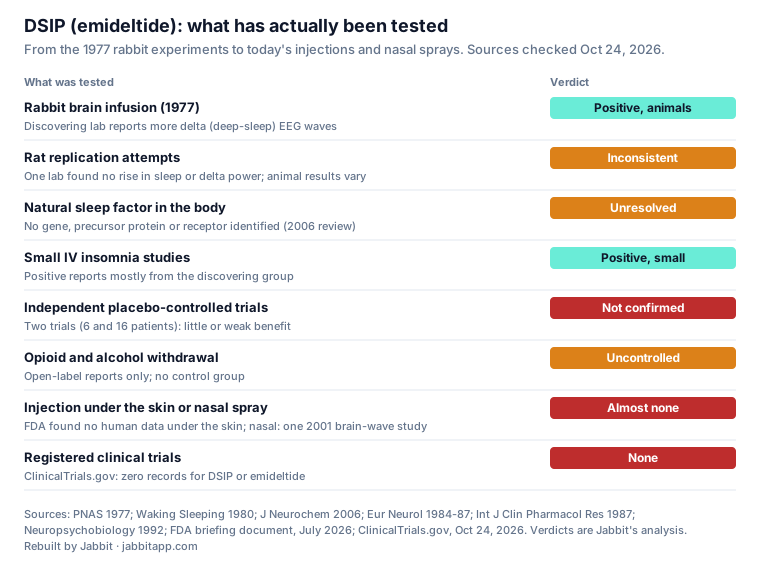
- Animals. The discovering lab’s rabbit work was positive, but other labs got mixed results, and one rat study found no significant increase in sleep or delta power.[8][9][11][1]
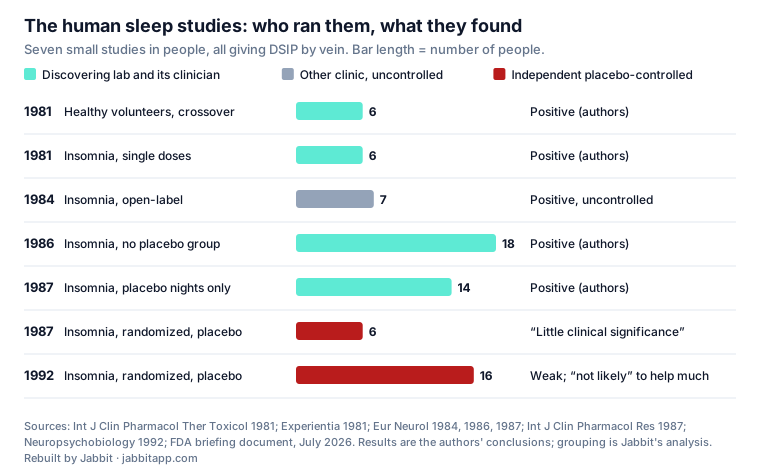
- Insomnia, the main claim. Four positive reports in people with insomnia or healthy volunteers came from the discovering group or its clinical collaborator, with 6 to 18 participants each, and an open-label series of 7 was also positive.[12][13][15][16][14] The two independent double-blind placebo-controlled trials, with 6 and 16 patients, found effects that were not clinically meaningful or were weak.[17][18] FDA said the studies “did not reach the same conclusions” and called the results “inconclusive and at best preliminary.”[1]
- Narcolepsy. One case report, in one man.[19]
- Opioid and alcohol withdrawal. A 1984 open-label series of 107 inpatients reported rapid improvement, but there was no control group and its authors said nothing allowed a conclusion about maintenance treatment. A 1998 open-label study of 7 people found only two completed the schedule.[20][21][1]
- Hormones and heart rate. In 8 healthy women, IV DSIP had no effect on growth hormone. In a 2009 randomized study during anaesthesia, it raised heart rate, lowered heart rate variability and, unexpectedly, reduced delta rhythm.[23][22]
- The forms sold now. Every sleep study above gave DSIP into a vein. FDA found no human studies of injection under the skin, and the only nasal study we found measured a brain-wave response, not sleep.[1][24]
- Trials today. ClinicalTrials.gov lists none, and PubMed’s DSIP output peaked in the 1980s.[26][29]
Safety: what is and isn’t known
FDA counted 209 people given IV DSIP for 1 to 15 days in the studies it found.[1] In the 107-patient withdrawal study, FDA reports, nine had minor transient effects such as sweating, headache, nausea and vertigo, and three had serious effects: two had low blood pressure at the first injection, one of whom had “progressive hypotension” after a second, and one had repeated episodes of discomfort.[1][20] FDA searched its adverse event database through March 2024 and found zero reports, and our openFDA search found none either, but unapproved products bought online are rarely reported.[1][27]
The bigger gap is what has never been studied. FDA found no human data for injection under the skin, no repeat-dose toxicology, and no studies of addiction potential, even though animal work suggests DSIP acts partly through the body’s opioid system; it also flags a possible interaction with drugs such as the blood pressure medicine captopril, which could slow its breakdown.[1] FDA describes the substance as “not well characterized,” with no endotoxin testing for injection and a risk of immune reactions to impurities or clumped peptide.[1][6] A DSIP vial was part of a 2020 voluntary sterility recall.[28] The mouse study reporting fewer tumors with Deltaran is often cited online, but FDA says that finding may not be due to DSIP at all.[25][1]
Legal status
No DSIP product is approved by FDA, and Drugs@FDA lists none.[27][1] FDA lists emideltide among compounding nominations that were withdrawn, with safety concerns.[6] The nominations were withdrawn and FDA evaluated it anyway; its staff proposed not adding either form to the 503A bulks list, and the committee voted 6-7-1 against.[1][3][4] The committee’s vote is advisory and FDA has not announced a final decision. Bulk powders are registered in FDA’s NDC directory, but a listing is not approval.[28] FDA reports that clinics, med spas and online retailers sell DSIP injections and nasal sprays; whether any given product was legally compounded is a separate question.[1]
What a careful reader should notice
These points are our analysis of the sources cited.
- The core sleep claim rests mainly on one research group’s small studies; when other teams ran placebo-controlled trials, the benefit mostly disappeared.[16][17][18][1]
- Every human sleep study gave DSIP into a vein, while the products sold now are injected under the skin or sprayed into the nose.[1][24]
- A peptide that lasts about 8 minutes in the blood is being marketed for whole nights of deeper sleep, and the mechanism has never been pinned down.[1][10]
- Claims about growth hormone and heart rate do not match the human data we found: no growth hormone effect in one study, and a higher heart rate in another.[23][22]
- No new human trial has been registered or published for years.[26][29]
- Supporters at the July meeting made a historical case from the 1970s and 1980s studies; FDA and a majority of voting members found that record insufficient for today’s uses.[3][1]
Frequently asked questions
- Does DSIP help you sleep?
- It has not been shown to. Small IV studies in the 1980s, mostly from the group that discovered it, reported better sleep, but two independent placebo-controlled trials found little or weak benefit. FDA called the evidence “inconclusive and at best preliminary.”[16][17][18][1]
- Is DSIP safe?
- No one knows for the forms sold today. About 209 people received it by vein in older studies, and a few had low blood pressure or other effects. FDA found no human data for injection under the skin and no long-term toxicology.[1][20]
- Is DSIP FDA approved?
- No. There is no approved DSIP product in the United States, and FDA found it is not registered as a drug in any country it searched.[27][1]
- Can pharmacies compound DSIP?
- FDA’s staff recommended against adding it to the list of substances pharmacies may compound, and FDA’s advisory committee voted 6-7-1 against in July 2026. The vote is advisory and FDA has not announced a final decision.[1][3][4]
- Does DSIP work as a nasal spray?
- There is no evidence it helps sleep that way. The only nasal study we found measured a brain-wave response, and all sleep studies gave DSIP into a vein.[24][1]
- Does DSIP raise growth hormone or lower heart rate?
- The human data we found do not support those claims. One study found no growth hormone effect, and a randomized study during surgery found DSIP raised heart rate. A lower heart rate was seen in rats.[23][22][1]
- Is the body’s own DSIP a natural sleep hormone?
- That remains unproven. No gene, precursor protein or receptor for DSIP has been identified, and a 2006 review called the sleep-factor idea “extremely poorly documented and still weak.”[10]
Bottom line
DSIP earned its name from rabbit experiments in 1977 and a run of small, encouraging human studies in the 1980s.[8][13][16] When independent researchers tested it against placebo, the benefit was weak or clinically trivial, and in the decades since nobody has registered a new trial.[17][18][26] FDA found the evidence inconclusive, the substance poorly characterized and no human data for the injections now sold, and its advisers voted against compounding it.[1][3] Anyone using DSIP for sleep would be relying on unconfirmed 1980s IV data for a product given a different way. FDA notes that approved insomnia treatments exist, and the professional guideline it cites recommends cognitive behavioral therapy for insomnia first.[1]
References
- U.S. Food and Drug Administration. FDA Briefing Document, Pharmacy Compounding Advisory Committee meeting, July 23-24, 2026: evaluation of emideltide-related bulk drug substances, emideltide (free base) and emideltide acetate, also called delta sleep-inducing peptide (DSIP), for the 503A bulks list, for chronic insomnia, narcolepsy and opioid withdrawal. Key statements: insomnia results “appear inconclusive and at best preliminary”; IV emideltide was given “to 209 subjects for 1 to 15 days” in the studies FDA identified; “Clinical studies were not identified” for injection under the skin; a FAERS search through March 3, 2024 “retrieved zero reports”; a “short plasma half-life of 8 minutes”; the substances “are not well characterized” and lack endotoxin testing for injection; used in compounding “since at least 2018”; “not registered drugs in any country searched via GlobalEdge”; conclusion: “we propose not adding emideltide (free base) or emideltide acetate to the 503A Bulks List.” Full document read. https://www.fda.gov/media/193344/download. Checked October 24, 2026.
- U.S. Food and Drug Administration. July 23-24, 2026 Meeting of the Pharmacy Compounding Advisory Committee (content current as of 08/06/2026). Lists emideltide among the substances discussed; no minutes or official vote record were posted when we checked. https://www.fda.gov/advisory-committees/advisory-committee-calendar/july-23-24-2026-meeting-pharmacy-compounding-advisory-committee-07232026. Checked October 24, 2026.
- PeptideBase. “Emideltide (DSIP)” PCAC July 23-24, 2026 dossier and FDA vote tracker. Transcribed from the public webcast: free base 6-7-1 (yes-no-abstain, 14 voting), recorded at 03:15:17; acetate 6-7-1, recorded at 03:22:37; summarizes public testimony that made “a historical-clinical case” citing the Basel discovery work, a 1981 Lancet report and the 1984 withdrawal series; Day 2 results marked provisional pending the FDA transcript. PeptideBase also lists peptide vendors; none is named or endorsed here. https://peptidebase.io/fda/pcac-july-2026/emideltide; https://peptidebase.io/fda-vote-tracker. Checked October 24, 2026.
- MDside. “The FDA advisory vote on six peptides: what has to happen before a clinic can use them.” October 2026. Table entry: “Emideltide (DSIP) Not recommended; reported as 6-7-1”; tallies from trade press and a law firm summary; FDA had not posted minutes. https://www.mdside.com/peptide-advisory-vote-what-happens-next/. Checked October 24, 2026.
- Center for Science in the Public Interest. Letter to FDA regarding the July 2026 Pharmacy Compounding Advisory Committee, October 14, 2026, including a member-by-member table of votes and stated rationales for each peptide, emideltide among them. CSPI is a consumer advocacy group; the letter urges FDA to side with its own scientific staff rather than the committee’s recommendations. Its views are its own and are not adopted here. https://www.cspi.org/sites/default/files/2026-10/CSPI%20Letter%20to%20FDA%20re%20PCAC.pdf. Checked October 24, 2026.
- U.S. Food and Drug Administration. “Certain Bulk Drug Substances for Use in Compounding that May Present Significant Safety Risks” (content current as of 04/22/2026). Emideltide (DSIP) is listed under bulk drug substances nominated but withdrawn. FDA’s summary: “Compounded drugs containing emideltide may pose risk for immunogenicity for certain routes of administration and may have complexities with regard to peptide-related impurities and API characterization. FDA has not identified safety-related information regarding emideltide for the proposed route of administration. Therefore, the agency lacks sufficient information to know whether the drug would cause harm if administered to humans.” https://www.fda.gov/drugs/human-drug-compounding/certain-bulk-drug-substances-use-compounding-may-present-significant-safety-risks. Checked October 24, 2026.
- Office of Information and Regulatory Affairs (OMB). Pending EO 12866 Regulatory Review: Interim Access Policy for Compounding Using Certain Peptides, RIN 0910-ZD94, received 10/14/2026, stage: Notice. The text and the list of peptides are not public. https://www.reginfo.gov/public/do/eoDetails?rrid=1568964. Checked October 24, 2026.
- Schoenenberger GA, Monnier M. Characterization of a delta-electroencephalogram (-sleep)-inducing peptide. Proc Natl Acad Sci U S A. 1977;74(3):1282-1286. PMID 265572. Rabbits, brain (intraventricular) infusion under double-blind conditions, 58 animals including controls; gives the sequence Trp-Ala-Gly-Gly-Asp-Ala-Ser-Gly-Glu; only synthetic DSIP “showed significant and specific enhancement/induction of delta and spindle electroencephalogram patterns.” Abstract read. https://pubmed.ncbi.nlm.nih.gov/265572/. Checked October 24, 2026.
- Tobler I, Borbély AA. Effect of delta sleep inducing peptide (DSIP) and arginine vasotocin (AVT) on sleep and motor activity in the rat. Waking Sleeping. 1980;4(2):139-153. PMID 7405185. Rats: after systemic or brain-ventricle DSIP, motor activity was not significantly reduced, “nor were sleep and the power of the EEG delta-band significantly increased.” Abstract read. https://pubmed.ncbi.nlm.nih.gov/7405185/. Checked October 24, 2026.
- Kovalzon VM, Strekalova TV. Delta sleep-inducing peptide (DSIP): a still unresolved riddle. J Neurochem. 2006;97(2):303-309. PMID 16539679. Review: the link to sleep “has never been further characterized, in part because of the lack of isolation of the DSIP gene, protein and possible related receptor”; “the hypothesis regarding DSIP as a sleep factor is extremely poorly documented and still weak.” Abstract read. https://pubmed.ncbi.nlm.nih.gov/16539679/. Checked October 24, 2026.
- Graf MV, Kastin AJ. Delta-sleep-inducing peptide (DSIP): an update. Peptides. 1986;7(6):1165-1187. PMID 3550726. Review of animal and early human work; physiological functions and mechanism “remain to be established.” FDA’s brief summarizes this review as finding the human sleep effects unclear. Abstract read. https://pubmed.ncbi.nlm.nih.gov/3550726/. Checked October 24, 2026.
- Schneider-Helmert D, Gnirss F, Monnier M, Schenker J. Acute and delayed effects of DSIP (delta sleep-inducing peptide) on human sleep behavior. Int J Clin Pharmacol Ther Toxicol. 1981;19(8):341-345. PMID 6895513. First human study: 6 healthy volunteers, double-blind crossover, slow IV infusion; authors report more sleep in the 130 minutes after DSIP than after placebo. Abstract read. https://pubmed.ncbi.nlm.nih.gov/6895513/. Checked October 24, 2026.
- Schneider-Helmert D, Schoenenberger GA. The influence of synthetic DSIP (delta-sleep-inducing-peptide) on disturbed human sleep. Experientia. 1981;37(9):913-917. PMID 7028502. 6 middle-aged people with chronic insomnia, single IV doses; authors report longer, less interrupted sleep and no daytime sedation. Abstract read. A short Lancet report the same year (Lancet 1981;1(8232):1256-1257, PMID 6112579) covered the same work. https://pubmed.ncbi.nlm.nih.gov/7028502/. Checked October 24, 2026.
- Kaeser HE. A clinical trial with DSIP. Eur Neurol. 1984;23(5):386-388. PMID 6391926. Open-label series of 7 people with severe insomnia given a course of injections; the author reports sleep normalized in all but 1, with no control group. Abstract read. https://pubmed.ncbi.nlm.nih.gov/6391926/. Checked October 24, 2026.
- Schneider-Helmert D. Efficacy of DSIP to normalize sleep in middle-aged and elderly chronic insomniacs. Eur Neurol. 1986;25(6):448-453. PMID 3792404. 18 people with chronic insomnia (two age groups), a week of IV DSIP, no placebo group; the author reports normalized sleep. Abstract read. https://pubmed.ncbi.nlm.nih.gov/3792404/. Checked October 24, 2026.
- Schneider-Helmert D. Effects of delta-sleep-inducing peptide on 24-hour sleep-wake behaviour in severe chronic insomnia. Eur Neurol. 1987;27(2):120-129. PMID 3622582. 14 people with chronic insomnia, 7 nights of IV DSIP; placebo was given only on a baseline night and a post-treatment night, and FDA’s brief puts the study’s “placebo-controlled” label in quotation marks. The author reports substantially improved sleep and daytime performance. Abstract read. https://pubmed.ncbi.nlm.nih.gov/3622582/. Checked October 24, 2026.
- Monti JM, Debellis J, Alterwain P, Pellejero T, Monti D. Study of delta sleep-inducing peptide efficacy in improving sleep on short-term administration to chronic insomniacs. Int J Clin Pharmacol Res. 1987;7(2):105-110. PMID 3583493. Montevideo; 6 people with insomnia, randomized double-blind placebo crossover, IV for four nights. Some measures improved, but “no significant differences were found in comparison to baseline or to double-blind placebo nights” for most, and the authors conclude improvement “is of little clinical significance.” Abstract read. https://pubmed.ncbi.nlm.nih.gov/3583493/. Checked October 24, 2026.
- Bes F, Hofman W, Schuur J, Van Boxtel C. Effects of delta sleep-inducing peptide on sleep of chronic insomniac patients. A double-blind study. Neuropsychobiology. 1992;26(4):193-197. PMID 1299794. Netherlands; 16 people with chronic insomnia, double-blind placebo-controlled parallel groups, IV on three afternoons. Sleep efficiency and latency looked better, but the effects “were weak and in part could be due to an incidental change in the placebo group”; subjective sleep quality did not change; conclusion: “not likely to be of major therapeutic benefit.” Abstract read. https://pubmed.ncbi.nlm.nih.gov/1299794/. Checked October 24, 2026.
- Schneider-Helmert D. Effects of DSIP on narcolepsy. Eur Neurol. 1984;23(5):353-357. PMID 6548968. Single case: one man with narcolepsy given repeated IV injections; the author reports fewer sleep attacks. Abstract read. https://pubmed.ncbi.nlm.nih.gov/6548968/. Checked October 24, 2026.
- Dick P, Costa C, Fayolle K, Grandjean ME, Khoshbeen A, Tissot R. DSIP in the treatment of withdrawal syndromes from alcohol and opiates. Eur Neurol. 1984;23(5):364-371. PMID 6548969. Geneva; open-label, 107 inpatients in alcohol (47) or opioid (60) withdrawal given IV DSIP, judged by clinical staff; 13% and 22% could not be evaluated; authors report symptoms resolved or improved in most. FDA quotes the authors: “nothing allows [sic] to draw any conclusion as to a potential usefulness of a maintenance treatment with DSIP.” Abstract read. https://pubmed.ncbi.nlm.nih.gov/6548969/. Checked October 24, 2026.
- Backmund M, Meyer K, Rothenhaeusler HB, Soyka M. Opioid detoxification with delta sleep-inducing peptide: results of an open clinical trial. J Clin Psychopharmacol. 1998;18(3):257-258. PMID 9617990. Munich; open-label, 7 people in opioid withdrawal. Per FDA’s summary, only two completed the scheduled injections, symptoms recurred after later injections in all but one, and the authors called its usefulness “an open question.” https://pubmed.ncbi.nlm.nih.gov/9617990/. Checked October 24, 2026.
- Pomfrett CJ, Dolling S, Anders NR, Glover DG, Bryan A, Pollard BJ. Delta sleep-inducing peptide alters bispectral index, the electroencephalogram and heart rate variability when used as an adjunct to isoflurane anaesthesia. Eur J Anaesthesiol. 2009;26(2):128-134. PMID 19142086. Manchester; 24 women having surgery, 12 randomized to saline and 12 to IV DSIP. “DSIP significantly increased heart rate, decreased HRV and, paradoxically, significantly reduced delta rhythm” at the lowest dose during anaesthesia. Abstract read. https://pubmed.ncbi.nlm.nih.gov/19142086/. Checked October 24, 2026.
- Giusti M, Carraro A, Porcella E, et al. Delta sleep-inducing peptide administration does not influence growth hormone and prolactin secretion in normal women. Psychoneuroendocrinology. 1993;18(1):79-84. PMID 8475226. 8 healthy women given IV DSIP: “no effects were noted” on growth hormone or prolactin. Abstract read. https://pubmed.ncbi.nlm.nih.gov/8475226/. Checked October 24, 2026.
- Hruz P, Zechner S, Heimberg D, et al. Intranasal administration of delta sleep-inducing peptide increases P300. J Clin Psychopharmacol. 2001;21(6):626-628. PMID 11763019. Short report on a brain-wave (P300) measure after nasal DSIP, with a member of the discovering lab among the authors; no abstract on PubMed. The only nasal study we found. https://pubmed.ncbi.nlm.nih.gov/11763019/. Checked October 24, 2026.
- Popovich IG, Voitenkov BO, Anisimov VN, et al. Effect of delta-sleep inducing peptide-containing preparation Deltaran on biomarkers of aging, life span and spontaneous tumor incidence in female SHR mice. Mech Ageing Dev. 2003;124(6):721-731. PMID 12782416. Mice (54 per group) injected under the skin for five days each month with Deltaran, a Russian DSIP-plus-glycine preparation: no change in mean life span, longer maximum life span, fewer spontaneous tumors. FDA’s brief cautions the tumor finding “may be unrelated to the presence of emideltide in Deltaran” and notes design limits. Abstract read. https://pubmed.ncbi.nlm.nih.gov/12782416/. Checked October 24, 2026.
- ClinicalTrials.gov API v2, pulled October 24, 2026. Searches for “delta sleep-inducing peptide,” “delta sleep inducing peptide,” “DSIP,” “emideltide” and “Deltaran” each return 0 records. Census: https://jabbitapp.com/research/sources/dsip-emideltide-2026-10-24.json. Checked October 24, 2026.
- openFDA, October 24, 2026. FDA Adverse Event Reporting System searches of patient.drug.medicinalproduct for “DSIP,” “emideltide” and “delta sleep(-)inducing peptide” return no reports; 13 reports under “Deltaran” are for a German brand of an unrelated arthritis and pain medicine and were excluded. Drugs@FDA returns no emideltide product. Zero reports is not evidence of safety: unapproved products bought online are rarely reported. https://open.fda.gov/apis/drug/event/; counts: https://jabbitapp.com/research/sources/dsip-emideltide-2026-10-24.json. Checked October 24, 2026.
- openFDA NDC directory and enforcement reports, October 24, 2026. Four bulk-ingredient (powder) listings coded as emideltide, with marketing start dates from February 2020 to August 2026; a listing is a registration, not FDA approval. One FDA enforcement record (D-0138-2021, Class II, initiated November 30, 2020) covers a DSIP injection vial among products voluntarily recalled for “Lack of Assurance of Sterility.” Labelers and firm not named here. https://api.fda.gov/drug/ndc.json?search=generic_name:%22DSIP%22; https://api.fda.gov/drug/enforcement.json?search=product_description:%22DSIP%22. Checked October 24, 2026.
- PubMed searches, October 24, 2026: DSIP / delta sleep-inducing peptide / emideltide returns 540 records, 220 of them from the 1980s and 10 since 2020. Of 20 records tagged as human clinical or randomized trials, the DSIP ones are small IV studies from 1981 to 2009 (several hits are unrelated uses of the acronym); 1 is dated 2016 or later, and it is unrelated. Queries and counts: https://jabbitapp.com/research/sources/dsip-emideltide-2026-10-24.json. Checked October 24, 2026.
This page analyzes regulator documents, published studies, committee vote records and registry data. It is not medical or legal advice and does not recommend any product or dose. DSIP is not approved by FDA. Charts were rebuilt by Jabbit from the sources cited in each caption.