Evidence teardown · GLP-1 drugs · Women’s health · Updated October 27, 2026
Published · Updated
Is “Ozempic vagina” real? Can Ozempic, Wegovy or Zepbound cause vaginal prolapse or change the vulva? No study we found links GLP-1 drugs to pelvic organ prolapse, and weight-loss trials found fewer bladder leaks, not more prolapse. “Ozempic vulva” is a social-media name for fat loss around the labia and pubic mound that doctors say can follow any big weight loss; a large 2026 health-record abstract found no rise in diagnosed vulvar changes. Effects on desire and dryness rest on case reports.
Ozempic and Wegovy (semaglutide) and Mounjaro and Zepbound (tirzepatide) are now blamed online for making the vagina “fall out.” The reader’s question is simple: is that real? Our plain answer: we found no study that ties these drugs to pelvic organ prolapse. Weight loss itself has been tested, without drugs, and it cut bladder leaks while leaving prolapse symptoms unchanged. What doctors do describe is a cosmetic change, a looser, less padded vulva after large weight loss, which they say is not specific to any drug. Below is what is known, what is not, and what to ask a clinician.
Why this matters now
Early on October 27, 2026, a post on X claimed “Ozempic is causing people’s vaginas to fall out of their bodies” and asked about the link with the pelvic floor. It passed 293,000 impressions within about four hours.[1] The worry builds on a phrase, “Ozempic vulva,” that a plastic surgeons’ society and Medscape covered earlier in 2026, and on a 2026 conference abstract that looked for vulvar diagnoses in more than 617,000 GLP-1 users.[12][13][10] Clinicians quoted by Medscape add that menopause can cause some of the same symptoms people blame on the drug.[13] Separating the evidence from the meme is worth doing.
Timeline
| Date | Event |
|---|---|
| 2008 | A systematic review finds surgical and non-surgical weight loss improve pelvic floor symptoms, with little evidence on prolapse.[7] |
| 2009 | PRIDE trial (NEJM): a diet and exercise program cuts weekly leak episodes 47% vs 28%.[3] |
| 2012 | Look AHEAD: fewer new cases of incontinence with a lifestyle program. A PRIDE analysis finds weight loss did not improve bothersome prolapse symptoms.[6][5] |
| 2025 | Single case reports describe low desire, dryness and orgasm problems on GLP-1 drugs.[16][17] A 200-woman pelvic floor study is registered and is still listed as not yet recruiting.[20] |
| Jan 22, 2026 | The American Society of Plastic Surgeons publishes “Ozempic vulva? What you need to know.”[12] |
| Feb 2026 | A TriNetX health-record study of vulvar diagnoses is presented at the ISSWSH meeting; its abstract appears in a Journal of Sexual Medicine supplement.[11][10] |
| Apr 7, 2026 | Medscape reports clinicians’ views on sexual and pelvic floor effects in women.[13] |
| 2026 | Two reviews call the evidence on sexual effects mixed and limited.[14][15] |
| Oct 27, 2026 | A post claiming the drug makes vaginas “fall out” goes viral on X.[1] |
The evidence, claim by claim
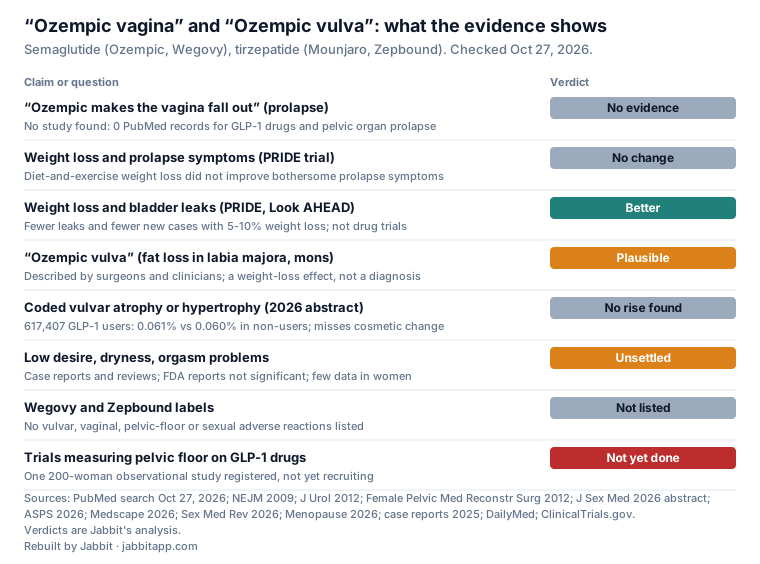
Can Ozempic make the vagina “fall out”?
The real condition behind the phrase is pelvic organ prolapse, when the bladder, uterus or bowel sag into the vagina and can cause a bulge. Here is what we found:
- No GLP-1 prolapse studies. A PubMed search for semaglutide, tirzepatide, liraglutide or GLP-1 together with pelvic organ, uterine or vaginal prolapse returned zero records on October 27, 2026.[2]
- Extra weight goes with bulge symptoms. In PRIDE, 13% of women with obesity reported feeling vaginal bulging vs 0% of overweight women.[5]
- Losing weight did not change prolapse symptoms. After 6 months, bothersome prolapse symptoms improved no more with the weight-loss program than with education. The authors’ conclusion: “Weight loss did not improve bothersome prolapse symptoms.”[5] A 2008 review likewise found “little evidence” to guide prolapse care in women with obesity.[7]
- Possible indirect pathways, untested. Constipation is among the most common side effects on both the Wegovy and Zepbound labels.[18][19] A pelvic health physiotherapist quoted by Medscape said constipation “can lead to straining that increases their risk for urinary incontinence and pelvic organ prolapse,” and that most symptoms she sees come from “the consequences of rapid weight loss,” not the drug itself.[13] The plastic surgeons’ society article says pelvic floor muscle weakness or loss “may lead some patients to experience minor urinary incontinence or discomfort.”[12] No study has measured whether either pathway causes prolapse on these drugs. Jabbit’s analysis: these are reasonable hypotheses from clinicians, not findings.
Bladder leaks: the strongest evidence points to benefit
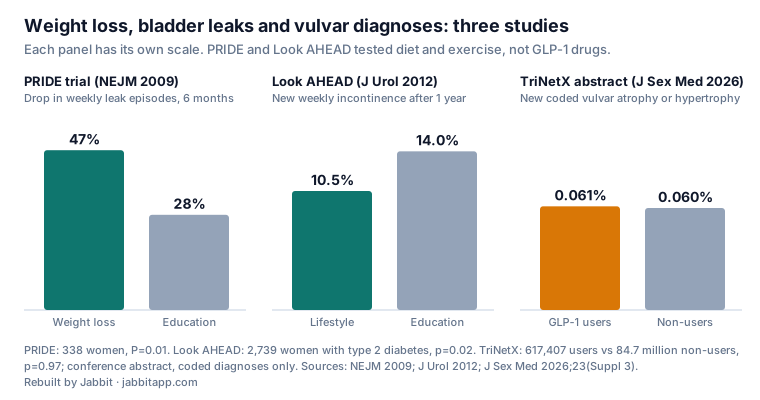
- PRIDE (338 women): 8.0% average weight loss vs 1.6%; weekly leak episodes fell 47% vs 28% (P=0.01). Stress leaks improved; urge leaks did not differ significantly.[3] Losing 5% to 10% of body weight was enough for a significant benefit.[4]
- Look AHEAD (2,739 women with type 2 diabetes, average age 57.9): among women without leaks at the start, 10.5% developed them on the lifestyle program vs 14.0% (p=0.02). The program did not resolve existing leaks more often.[6]
- After bariatric surgery: a 2026 review of 84 studies reports that leaks and overactive bladder improve or resolve in 50% to 70% of women.[8]
- On GLP-1 drugs specifically: a 2026 review expects an “indirect benefit” for stress incontinence and overactive bladder via weight loss, but flags “a near-complete absence of data in women.”[9]
What “Ozempic vulva” means
“Ozempic vulva” is not a diagnosis. The American Society of Plastic Surgeons calls it “a phrase being used, especially on social media,” for how rapid weight loss affects the female genitals. A plastic surgeon quoted there says weight loss from GLP-1 drugs “or really any form of weight loss” can deflate the soft tissue, “resulting in a more baggy labia majora and possibly more protrusion of the labia minora.”[12] Medscape reported the same picture: labia minora that look more prominent after fat loss in the labia majora. An ob/gyn quoted there notes “how broad normal vulvar appearance can be.”[13]
Jabbit’s analysis: on the current evidence this is best seen as part of the same fat loss that changes the face (see Ozempic face), not a drug toxicity. The Zepbound label takes a similar view of another body change, stating that hair loss reactions on the drug “were associated with weight reduction.”[19]
The 617,407-woman health-record study
The largest data set so far is a conference abstract by Hammad, Nakamura and Yih that used TriNetX health records from 162 health-care organizations. It compared non-diabetic women given GLP-1 drugs with women who were not.[10]
- Result: vulvar atrophy or hypertrophy was diagnosed in 375 of 617,407 users (0.061%) vs 51,157 of 84.7 million non-users (0.060%). The difference was 0.001% (p=0.97). Average follow-up was 680 days.[10]
- What it can’t see: it counted only four diagnosis codes. The authors call for imaging, tissue and patient-reported data to look for “subclinical or aesthetic tissue alterations.”[10] In an interview, Yih asked whether prescribers are “screening or diagnosing patients with those diagnoses” at all. Medscape quoted her saying GLP-1 prescribers often “wouldn’t think to ask” about genital or sexual concerns.[11][13]
- Methods detail: the abstract describes comparing incidence proportions with z-tests. In the interview, Yih described the analysis as using propensity score matching. We could not read a full paper to reconcile the two, so treat the result as preliminary.[10][11]
- Author’s takeaway: “It’s not really something that everybody has to worry about.”[11]
Desire, dryness and orgasm: unsettled
- Case reports: a 36-year-old woman on tirzepatide reported lower desire, genital dryness and trouble reaching orgasm. Her sexual function score rose from 12.7 to 28.7 after stopping and fell to 14.7 when she restarted.[16] Another report describes loss of orgasm after starting a GLP-1 drug and notes that “very little is known” about this side effect.[17] Single cases cannot show cause or frequency.
- Reviews: one 2026 review calls human evidence “mixed.” It says FDA adverse-event analyses found “insignificant associations,” while case reports raise possible female effects.[14] A Mayo Clinic review says the drugs “may paradoxically suppress sexual desire and arousal” but that “systematic clinical evidence remains limited.” It also notes that lifestyle programs and bariatric surgery improve sexual function. One author has consulted for Novo Nordisk, the maker of Ozempic and Wegovy, and another advises Weight Watchers.[15]
- Menopause overlap: a pelvic floor physical therapist told Medscape that symptoms “could be partly from the GLP-1, but it could also be GSM symptoms,” meaning the genitourinary syndrome of menopause.[13] See our GLP-1 and menopause hormone therapy teardown.
- Labels: neither the Wegovy nor the Zepbound label mentions vulvar, vaginal, pelvic floor, incontinence, prolapse or sexual side effects.[18][19]
The case for caution
Absence of evidence is not proof of safety. The reassuring prolapse and leak data come from diet and exercise trials, not from drugs that cause faster weight loss, frequent constipation and, in trials, loss of some lean mass (see muscle loss on GLP-1 drugs). The only health-record study counted coded diagnoses, which miss cosmetic and mild changes. The one registered pelvic floor study that compares GLP-1 drugs with bariatric surgery plans 200 women and is listed as not yet recruiting. Its record was last updated in September 2025.[20] Until such studies report, nobody can say whether prolapse or leaks behave differently on these drugs than with other weight loss.
What a careful reader should notice
- The viral claim names a real condition, prolapse, but no published study links it to GLP-1 drugs.[2][1]
- The best randomized data on weight loss and the pelvic floor show fewer leaks and no change in prolapse symptoms. They tested diet and exercise, not drugs.[3][5][6]
- “Ozempic vulva” describes fat loss that surgeons say follows “any form of weight loss.”[12]
- The 617,407-user abstract is reassuring on diagnoses but blind to appearance. It is a conference abstract, not a full paper.[10]
- Sources that promote cosmetic treatment and sources with drug-company ties both appear in this field. We list the disclosures we found and do not reproduce treatment advice.[12][15]
FAQ
- Can Ozempic or Wegovy cause vaginal prolapse?
- We found no study linking semaglutide, tirzepatide or other GLP-1 drugs to pelvic organ prolapse; a PubMed search on October 27, 2026 returned zero records. In a randomized trial, diet-and-exercise weight loss did not change bothersome prolapse symptoms. Clinicians quoted by Medscape suggest constipation and straining could add strain, but that has not been studied.
- What is “Ozempic vulva”?
- A social-media term, not a diagnosis, for a looser, less padded labia majora and more visible labia minora after large weight loss. Surgeons quoted by the American Society of Plastic Surgeons say it can follow any form of weight loss, not only GLP-1 drugs.
- Do GLP-1 drugs cause vulvar atrophy?
- A 2026 conference abstract of 617,407 non-diabetic women on GLP-1 drugs found coded vulvar atrophy or hypertrophy in 0.061%, vs 0.060% of non-users, with no significant difference. It counted only diagnosis codes, so it could miss cosmetic or mild changes, and it has not been published as a full paper.
- Does losing weight on Ozempic help bladder leaks?
- Likely, but it has not been tested directly. In the PRIDE trial, a diet and exercise program cut weekly leak episodes 47% vs 28%, and losing 5% to 10% of weight was enough for benefit. A 2026 review expects an indirect benefit on GLP-1 drugs but notes almost no data in women.
- Can Zepbound or Ozempic lower libido or cause vaginal dryness?
- Possibly in some people, but the evidence is case reports and reviews. One woman on tirzepatide had low desire and dryness that eased after stopping and returned on restarting. Reviews call the evidence mixed and limited, and the Wegovy and Zepbound labels do not list sexual side effects. Menopause can cause similar symptoms.
- What should I do if I notice a bulge, leaks or pain on a GLP-1 drug?
- Tell your prescriber or a gynecologist, because a bulge, new leaks, pain or sexual changes are worth checking whatever the cause. Clinicians quoted by Medscape note that GLP-1 prescribers may not ask about genital or sexual health, so you may need to raise it yourself. This page does not give treatment advice.
Bottom line
The claim that Ozempic makes the vagina fall out is not supported by any study we could find. The randomized evidence on weight loss points the other way for bladder leaks and shows no change in prolapse symptoms, though none of it tested GLP-1 drugs. “Ozempic vulva” is a real-sounding name for ordinary fat loss in a sensitive place, and the one large health-record study found no rise in diagnosed vulvar changes. Desire and dryness effects are possible but unproven. The honest gap is that no trial has yet measured the pelvic floor on these drugs.
References
- Public post on X created October 27, 2026, 1:44 AM ET (poster, a private individual, not named here): “Ozempic is causing people’s vaginas to fall out of their bodies” … “What is the correlation between the pelvic floor and Ozempic????” The X API reported 293,094 impressions when Jabbit read it at about 5:55 AM ET. https://x.com/i/status/2114956421393723815. Checked October 27, 2026.
- Jabbit PubMed searches, October 27, 2026: (semaglutide OR tirzepatide OR liraglutide OR “GLP-1”) AND (“pelvic organ prolapse” OR “uterine prolapse” OR “vaginal prolapse”) returned 0 records; (semaglutide OR tirzepatide OR “GLP-1”) AND (vulva OR vulvar OR labia) returned 10 records, none a study of vulvar tissue on GLP-1 drugs (the 2026 abstract below was not indexed). https://pubmed.ncbi.nlm.nih.gov/?term=%28semaglutide+OR+tirzepatide+OR+liraglutide+OR+%22GLP-1%22%29+AND+%28%22pelvic+organ+prolapse%22+OR+%22uterine+prolapse%22+OR+%22vaginal+prolapse%22%29. Checked October 27, 2026.
- Subak LL, Wing R, West DS, et al. Weight loss to treat urinary incontinence in overweight and obese women. N Engl J Med. 2009;360(5):481-90. PMID 19179316. PRIDE randomized trial of a diet, exercise and behavior program (no drug). Abstract: “We randomly assigned 338 overweight and obese women with at least 10 urinary-incontinence episodes per week to an intensive 6-month weight-loss program that included diet, exercise, and behavior modification (226 patients) or to a structured education program (112 patients)”; “The women in the intervention group had a mean weight loss of 8.0% (7.8 kg), as compared with 1.6% (1.5 kg) in the control group (P<0.001)”; “After 6 months, the mean weekly number of incontinence episodes decreased by 47% in the intervention group, as compared with 28% in the control group (P=0.01)”; “the intervention group had a greater decrease in the frequency of stress-incontinence episodes (P=0.02), but not of urge-incontinence episodes (P=0.14).” Abstract read. https://pubmed.ncbi.nlm.nih.gov/19179316/. Checked October 27, 2026.
- Wing RR, Creasman JM, West DS, et al. Improving urinary incontinence in overweight and obese women through modest weight loss. Obstet Gynecol. 2010;116(2 Pt 1):284-292. PMID 20664387. PRIDE secondary analysis by amount of weight lost. Abstract: “Weight losses between 5% and 10% of body weight were sufficient for significant urinary incontinence benefits”; “approximately 75% of women who lost 5% to less than 10% of their body weight reported being moderately or very satisfied with their changes in urine leakage.” Abstract read. https://pubmed.ncbi.nlm.nih.gov/20664387/. Checked October 27, 2026.
- Myers DL, Sung VW, Richter HE, et al. Prolapse symptoms in overweight and obese women before and after weight loss. Female Pelvic Med Reconstr Surg. 2012;18(1):55-9. PMID 22453270. PRIDE prolapse-symptom analysis, same 338 women. Abstract: “A higher proportion of obese women reported feeling vaginal bulging compared with overweight women (13% vs 0%, P = <0.01)”; “At 6 months, there were no significant differences in improvement of self-reported bothersome prolapse symptoms in women in the weight loss or the control group”; “Weight loss did not improve bothersome prolapse symptoms.” Abstract read. https://pubmed.ncbi.nlm.nih.gov/22453270/. Checked October 27, 2026.
- Phelan S, Kanaya AM, Subak LL, et al. Weight loss prevents urinary incontinence in women with type 2 diabetes: results from the Look AHEAD trial. J Urol. 2012;187(3):939-44. PMID 22264468. Look AHEAD randomized trial substudy, intensive lifestyle program (no drug) in women with type 2 diabetes. Abstract: “Women in this substudy (2,739, mean ± SD age 57.9 ± 6.8 years, body mass index 36.5 ± 6.1 kg/m(2))”; “At 1 year fewer women in the intensive lifestyle intervention group reported urinary incontinence (25.3% vs 28.6% in the diabetes support and education group, p = 0.05)”; “Among participants without urinary incontinence at baseline 10.5% of intensive lifestyle intervention and 14.0% of diabetes support and education participants experienced urinary incontinence after 1 year (p = 0.02)”; “There were no significant group differences in the resolution of urinary incontinence (p >0.17)”; “weight losses of 5% to 10% reduced these odds by 47% (p = 0.002).” Abstract read. https://pubmed.ncbi.nlm.nih.gov/22264468/. Checked October 27, 2026.
- Greer WJ, Richter HE, Bartolucci AA, et al. Obesity and pelvic floor disorders: a systematic review. Obstet Gynecol. 2008;112(2 Pt 1):341-9. PMID 18669733. Systematic review. Abstract: “Weight loss studies indicate that both bariatric and nonsurgical weight loss lead to significant improvements in pelvic floor disorder symptoms”; “There is little evidence on which to base clinical decisions regarding the treatment of fecal incontinence and POP in obese women.” Abstract read. https://pubmed.ncbi.nlm.nih.gov/18669733/. Checked October 27, 2026.
- Khalil W, Bibi K, Fareed T, et al. Urological Complications of Morbid Obesity and the Role of Bariatric Surgery and Glucagon-Like Peptide-1 Receptor Agonists in Their Management: A Systematic Review. Cureus. 2026;18(6):e110952. PMID 42465136. Systematic review of 84 studies. Abstract: “Urinary incontinence and overactive bladder improve or resolve in 50-70% of women after bariatric surgery.” Authors declare no financial relationships. Abstract read. https://pubmed.ncbi.nlm.nih.gov/42465136/. Checked October 27, 2026.
- Klotz T. [GLP-1 Receptor Agonists in Urology and Andrology: Indications, Opportunities and Clinically Relevant Adverse Effects]. Zentralbl Chir. 2026. PMID 42748969. Narrative review (German, English abstract). Abstract lists “indirect benefit for stress incontinence and overactive bladder via weight loss” and, among warning signals, “a near-complete absence of data in women.” Author declares no conflict of interest. Abstract read. https://pubmed.ncbi.nlm.nih.gov/42748969/. Checked October 27, 2026.
- Hammad MA, Nakamura HS, Yih J. (010) Vulvar Tissue Changes in Non-diabetic Women Receiving GLP-1 Receptor Agonists: A Global Federated Cohort Analysis. J Sex Med. 2026;23(Suppl 3):qdag063.010. Conference abstract (ISSWSH 2026), not a full peer-reviewed paper; not indexed in PubMed when checked. Abstract: the GLP-1 group was “totaling 618 362 individuals” and “The control group comprised 84 711 992 non-diabetic females with no GLP-1RA exposure,” from “162 health-care organizations”; outcomes were ICD-10 codes “N90.5 (atrophy of vulva), N90.6 (hypertrophy of vulva), N90.68 (unspecified hypertrophy of vulva), and N90.69 (other specified hypertrophy of vulva)”; “617 407 GLP-1RA users with a mean follow-up of 680 ± 656 days and 84 711 992 non-users were included in the final analysis”; “Vulvar atrophy or hypertrophy was diagnosed in 375 GLP-1RA users (0.061%) and 51 157 non-users (0.060%)”; “The absolute risk difference was 0.001% (95% CI –0.02 to 0.02), with a two-tailed p-value of 0.97”; methods: “Incidence proportions were calculated and compared between groups using z-tests for two independent proportions”; “Further research incorporating imaging, histologic, and patient-reported data is warranted to explore potential subclinical or aesthetic tissue alterations following rapid weight loss.” Disclosure: “No.” Abstract text read via Crossref. https://doi.org/10.1093/jsxmed/qdag063.010. Checked October 27, 2026.
- Contemporary OB/GYN, “Jessica Yih, MD, on GLP-1RAs and vulvar tissue disorders,” February 23, 2026 (video interview and summary). The study was presented “at the 2026 International Society for the Study of Women’s Sexual Health (ISSWSH) annual meeting.” Yih describes the analysis “with the propensity score matching” and asks about a limitation: “Is the provider who’s prescribing these medications screening or diagnosing patients with those diagnoses? Or is it really only when those patients have significant concerns that they’re coming forward and being evaluated for that?” She concludes: “It’s not really something that everybody has to worry about.” https://www.contemporaryobgyn.net/view/jessica-yih-md-on-glp-1ras-and-vulvar-tissue-disorders. Checked October 27, 2026.
- American Society of Plastic Surgeons (ASPS), “Ozempic vulva? What you need to know,” Alia Willson, January 22, 2026: “Ozempic vulva is a phrase being used, especially on social media, to describe how rapid weight loss affects the female genitalia.” Plastic surgeon Karen Horton, MD, is quoted: “significant weight loss from GLP-1 medications – or really any form of weight loss – can cause deflation of the soft tissues, resulting in a more baggy labia majora and possibly more protrusion of the labia minora.” The article also states: “Muscle weakness or loss in the pelvic floor may lead some patients to experience minor urinary incontinence or discomfort.” The article, published by a surgeons’ society, also describes cosmetic procedures, which this page does not cover. https://www.plasticsurgery.org/news/articles/ozempic-vulva-what-you-need-to-know. Checked October 27, 2026.
- Medscape, “The Nuanced Sexual and Pelvic Floor Effects of GLP-1s on Women,” Sarah Amandolare, April 07, 2026 (read via a text fetch): “The labia minora prominence that can result from fat loss in the labia majora has been dubbed “ Ozempic vulva.””; a pelvic health physiotherapist says patients “report constipation, which can lead to straining that increases their risk for urinary incontinence and pelvic organ prolapse” and that “Most of the symptoms I see are not caused directly by the medication itself but rather by the consequences of rapid weight loss that hasn’t been properly supported”; a pelvic floor physical therapist says sexual symptoms “could be partly from the GLP-1, but it could also be GSM symptoms” (genitourinary syndrome of menopause); an ob/gyn notes “it can be helpful to understand how broad normal vulvar appearance can be”; Yih says GLP-1 prescribers often are clinicians “who wouldn’t think to ask about vulvar skin or genital concerns or sexual health concerns.” “The sources declared no financial conflicts of interest.” https://www.medscape.com/viewarticle/nuanced-sexual-and-pelvic-floor-effects-glp-1s-women-2026a1000ah4. Checked October 27, 2026.
- Merhi Z. GLP-1 receptor agonists and sexual function in women and men: a narrative review of emerging evidence and the need for further research. Sex Med Rev. 2026;14(1). PMID 41870138. Narrative review. Abstract: “In humans, evidence remains mixed”; “Pharmacovigilance analyses from the FDA Adverse Event Reporting System revealed reports of erectile dysfunction, decreased libido, and orgasmic dysfunction among GLP-1 RA users, but disproportionality analyses indicated insignificant associations”; “However, recent clinical case reports have identified possible female sexual side effects.” Abstract read. https://pubmed.ncbi.nlm.nih.gov/41870138/. Checked October 27, 2026.
- Castaneda R, Sepulveda D, Hurtado Andrade MD, et al. Weight loss interventions and sexual function in midlife women: the emerging role of glucagon-like peptide-1 receptor agonists. Menopause. 2026. PMID 42517362. Narrative review (Mayo Clinic authors). Abstract: GLP-1 drugs “may paradoxically suppress sexual desire and arousal through central neuroendocrine mechanisms”; “While emerging case reports and preclinical data support this concern, systematic clinical evidence remains limited”; “lifestyle interventions and bariatric surgery have demonstrated meaningful improvements in sexual function.” Disclosures include: “M.D.H.A. has served as a consultant for Novo Nordisk, Hoffman-La Roche, and Verge Genomics,” research funding including from Eli Lilly, and another author “serves on the scientific advisory board for Weight Watchers.” Abstract read. https://pubmed.ncbi.nlm.nih.gov/42517362/. Checked October 27, 2026.
- Mohammed GF, Al-Dhubaibi MS, Bahaj SS, et al. Tirzepatide Affect Sexual Function in Women: Case Report. Clin Med Insights Case Rep. 2025;18:11795476251347753. PMID 40487373. Single case report, a 36-year-old woman on tirzepatide. Abstract: “During treatment, the patient started to complain of decreasing sexual drive, genital dryness, and failure to catch orgasm; female sexual function index (FSFI) = 12.7”; “Symptoms decreased after stopping the tirzepetide (FSFI = 28.7) and reappeared after retaking the injection (FSFI = 14.7).” Authors declare no conflicts. Treatment details in the abstract are not reproduced here. Abstract read. https://pubmed.ncbi.nlm.nih.gov/40487373/. Checked October 27, 2026.
- Visvabharathy V, MacPhedran S, Shupp K, et al. Anorgasmia following initiation of GLP-1 agonist. Sex Med. 2025;13(3):qfaf047. PMID 40666108. Single case report of anorgasmia after starting a GLP-1 drug. Abstract: “very little is known regarding sexual dysfunction as a side effect of GLP-1 agonists.” Conflicts: “None declared.” Abstract read. https://pubmed.ncbi.nlm.nih.gov/40666108/. Checked October 27, 2026.
- Wegovy (semaglutide) US prescribing information, Novo Nordisk, DailyMed (set ID ee06186f-2aa3-4990-a760-757579d8f77b): “Most common adverse reactions (incidence ≥5%) in adults or pediatric patients aged 12 years and older are: nausea, diarrhea, vomiting, constipation, abdominal pain, dysesthesia, headache, fatigue, dyspepsia, dizziness, abdominal distension, eructation, hypoglycemia in patients with type 2 diabetes, flatulence, gastroenteritis, gastroesophageal reflux disease, and hair loss.” A text search of the full label found none of the words vulva, vagina, pelvic, genital, labia, libido, sexual, prolapse or incontinence. https://dailymed.nlm.nih.gov/dailymed/drugInfo.cfm?setid=ee06186f-2aa3-4990-a760-757579d8f77b. Checked October 27, 2026.
- Zepbound (tirzepatide) US prescribing information, Eli Lilly, DailyMed (set ID 487cd7e7-434c-4925-99fa-aa80b1cc776b): “most common adverse reactions, reported in ≥5% of patients treated with ZEPBOUND are: nausea, diarrhea, vomiting, constipation, abdominal pain, dyspepsia, injection site reactions, fatigue, hypersensitivity reactions, eructation, hair loss, gastroesophageal reflux disease”; “Hair loss adverse reactions in ZEPBOUND-treated patients were associated with weight reduction.” A text search of the full label found none of the words vulva, vagina, pelvic, genital, labia, libido, sexual, prolapse or incontinence. https://dailymed.nlm.nih.gov/dailymed/drugInfo.cfm?setid=487cd7e7-434c-4925-99fa-aa80b1cc776b. Checked October 27, 2026.
- ClinicalTrials.gov NCT07175805, “Pelvic Floor Disorder Symptoms in Women Seeking Weight Loss Therapy” (sponsor Hartford HealthCare): observational, 200 women (estimated) starting a GLP-1 or GLP-1/GIP drug or bariatric surgery; primary outcomes are changes at 6 months on the Urogenital Distress Inventory and the Colorectal-Anal Distress Inventory; status not yet recruiting; estimated primary completion October 2026; record last updated September 16, 2025. https://clinicaltrials.gov/study/NCT07175805. Checked October 27, 2026.
- Jabbit source extract for this page: abstract quotes, disclosures, article quotes, label text checks, PubMed search counts and registry fields checked against cached copies on October 27, 2026. https://jabbitapp.com/research/sources/glp1-vulva-pelvic-floor-2026-10-27.json. Checked October 27, 2026.
This page analyzes published studies, journal abstracts, news and society articles, FDA labels and trial registries. It is not medical advice and does not recommend any product, dose or procedure. Charts were rebuilt by Jabbit from the sources cited in each caption.