Evidence teardown · facial scan studies, Wegovy and Zepbound labels, ClinicalTrials.gov review · Sources checked October 23, 2026
Published · Updated
Is “Ozempic face” caused by Ozempic, Wegovy and Zepbound, or by losing weight fast? In the largest scan study we found, facial fat loss tracked weight lost. No study has compared the drug with the same weight loss without it.
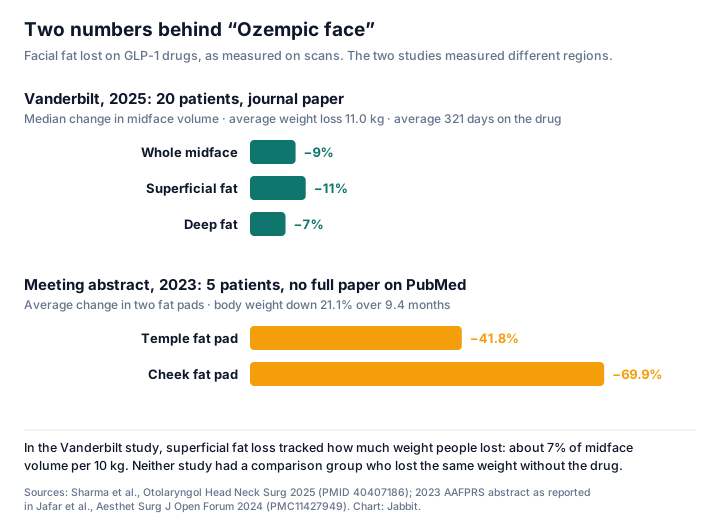
Galderma, L’Oréal and Natura are testing treatments for “Ozempic face,” the hollow, saggy look some people describe after weight loss on semaglutide (Ozempic, Wegovy) or tirzepatide (Mounjaro, Zepbound), Reuters reported on October 21, 2026.[1] The most alarming number online, a 70% loss of cheek fat, come from 5 patients in a 2023 meeting abstract who lost 21% of their body weight.[4] The largest scan study we found, 20 patients at Vanderbilt, found a median 9% drop in midface volume, and the more weight people lost, the more superficial facial fat they lost.[3] Neither drug label lists facial fat loss, and no study has compared people on the drug with people who lost the same weight another way.[10][11][13] Of 10 registered “Ozempic face” studies, 9 test a cosmetic fix and 0 have posted results.[13]
Why this matters this week
On October 21, Reuters reported that Galderma, the Brazilian cosmetics group Natura and L’Oréal are testing products and procedures on GLP-1 users, citing a Boston Consulting Group estimate that revenue from these clinical treatments could grow from about $700 million to $2 billion over five years.[1] X ran a trending story on it that day, and another on “Ozempic face” memes on October 23. Posts mentioning the term roughly doubled, from 25–44 a day in the week before to 77 and 79 on October 21 and 22, by our count.[2] If you’re on one of these drugs, or thinking about it, the useful question isn’t whether your face can change. It can. It’s whether the drug does something to your face beyond the weight loss itself.
The short answer
The evidence so far points to weight loss. In the largest published study we found that measured facial fat on scans before and after GLP-1 treatment, superficial fat loss rose with weight lost, about 7% of midface volume per 10 kg.[3] Reuters summed up the expert view the same way: the volume loss “is linked to rapid weight loss rather than GLP-1 drugs themselves.”[1] In our analysis, the case that the drugs hit the face harder than the rest of the body rests on a mismatch between two different studies (more below). It hasn’t been tested directly: 0 of 10 registered studies compare the drug against the same weight loss without it.[13]
Where the scary numbers come from
The 41.8% (temples) and 69.9% (cheeks) figures that circulate come from an abstract presented at the 2023 American Academy of Facial Plastic and Reconstructive Surgery meeting. A 2024 systematic review describes it: 5 people taking Ozempic, scanned before and after, who lost an average of 21.1% of their body weight over 9.4 months. The review notes the patients were all Caucasian, 4 of 5 were women, and only two fat pads were measured.[4] We found no full paper from the abstract’s authors on PubMed.[4] For scale, 21% is more than the average loss on Wegovy in STEP 1 (14.9%) and about the average on the top Zepbound dose in SURMOUNT-1 (20.9%).[14][15]
The Vanderbilt study is bigger and published in a journal. Researchers found 20 patients who happened to have CT or MRI scans of the face before and after a GLP-1 prescription. On average they had been on the drug for 321 days and lost 11.0 kg. Midface volume fell a median 9%: 11% in the superficial fat just under the skin and 7% in the deeper fat.[3] Superficial fat loss tracked weight loss closely (rho 0.590, P = .006). Deep fat loss varied a lot and didn’t track weight (P = .629).[3] It had no comparison group, and 20 people is small.[3]
Drug or weight loss?
The “it’s the drug” argument goes like this. A 2025 article in the Journal of Cosmetic Dermatology set the 5-patient facial figures beside a 9.2% fall in whole-body fat mass on semaglutide and called the pattern “partial lipodystrophy.”[5] A 2026 letter in the same journal repeated the 9.2% figure as coming from “the same cohort” and suggested the drugs “may directly and preferentially target facial adipose depots.”[6]
But the 9.2% comes from a different trial: 30 people with type 2 diabetes on semaglutide for 12 weeks, who lost about 6% of their body weight.[5][7] The facial patients lost 21% over 9 months.[4] In our analysis, comparing fat loss in people who lost 6% with people who lost 21% can’t show the face is singled out, and the letter’s references are reviews and commentaries rather than new measurements.[6] Doctors have long described the same hollowing after bariatric surgery: 11 of the 14 studies in the 2024 review were of surgery patients, not drugs.[4] A drug-specific effect is possible. Nobody has measured it.
A study that could help is registered: a 3D imaging study of identical twins, with one visit planned at the Twins Days Festival in August 2026. It plans to enroll 200 identical twins and look at whether GLP-1 use is related to measurable differences in facial aging.[13][16] Its registry record still says not yet recruiting, and it won’t separate the drug from weight loss unless its analysis accounts for weight change.[16]
What the beauty companies have tested
Of the 10 ClinicalTrials.gov studies we found that enroll GLP-1 users and measure the face or skin, 9 test a treatment: 5 fillers or collagen stimulators, 2 devices and 2 topical serums. 9 list an industry or private-practice sponsor. 2 are randomized, both against no treatment. 0 have posted results.[13]
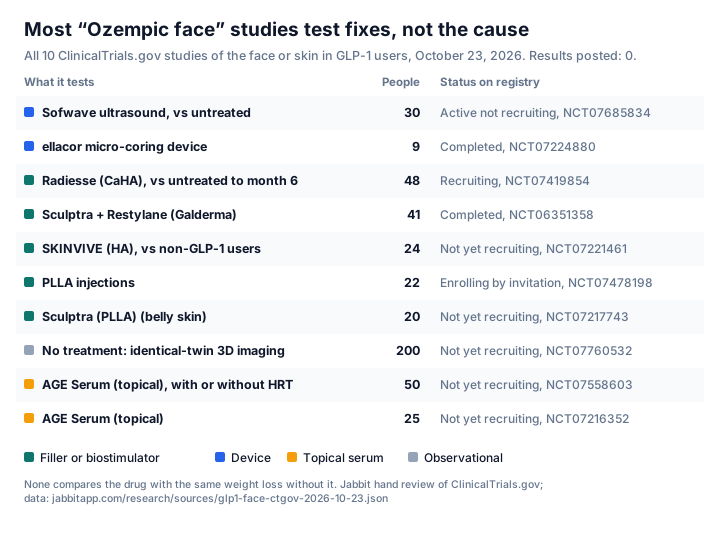
The only one published so far is Galderma’s. 41 people with facial changes after drug-driven weight loss got Sculptra (poly-L-lactic acid) and Restylane hyaluronic acid fillers, open-label, for 9 months.[8] Galderma said 85.7% felt their face looked less gaunt.[9] The paper says Galderma funded it and was responsible for design, analysis and the decision to publish, and that four authors are Galderma employees. It also notes that “the lack of a control group” limited what it could conclude.[8] The two randomized studies, a Sofwave ultrasound device trial in people starting tirzepatide and a Radiesse filler trial with an untreated group through month 6, are still running.[13][16]
Safety
Fillers are medical devices with real risks. The FDA says the most concerning is accidental injection into a blood vessel, which can cause tissue death, vision problems including blindness, and stroke. It also says the risks of unapproved uses are not known.[12] Galderma’s Chevrier told Reuters its treatments “were not approved specifically for GLP-1 users.”[1] On the drug side, the Wegovy label lists hair loss in 3.3% of people on 2.4 mg (vs 1% on placebo), and both labels tie it to weight reduction. Zepbound’s label reports hair loss in 7.1% of women on the drug vs 1.3% on placebo.[10][11] Neither label lists facial fat loss as a side effect.[10][11] If you are bothered by changes in your face, it’s worth talking with your prescriber, and with a board-certified clinician before any procedure.
What holds up
Vanderbilt measured facial fat volume on CT and MRI scans rather than judging photos, and it reports the weight link with statistics.[3] The Galderma study was published in a peer-reviewed journal with its funding and conflicts disclosed, and its trial is registered.[8] The limits: every facial scan study so far is small, has no comparison group, and can’t separate the drug from the weight loss.[3][4][8][13] The 5-patient figures were never published as a full paper.[4]
Bottom line
Is “Ozempic face” caused by the drug? The best data we found say the face loses fat roughly in step with the body, and the bigger the loss, the more it shows.[3] The claim that GLP-1 drugs single out facial fat leans on a 5-patient abstract set against a different, shorter trial.[4][5][7] The beauty industry is testing fixes faster than anyone is testing the cause: 9 of 10 studies try a treatment, and 0 compare the drug with the same weight loss without it.[13]
References
- Naidu R, Patton D, Marrow A. Beauty giants target “Ozempic face” as weight-loss drugs reshape demand. Reuters, October 21, 2026, 2:06 AM ET (syndicated on Yahoo Finance). Reports that Galderma, Natura and L’Oréal are testing treatments for facial sagging and volume loss; “Experts say the loss of facial volume is linked to rapid weight loss rather than GLP-1 drugs themselves”; Galderma’s Anne-Cécile Chevrier said “the treatments were not approved specifically for GLP-1 users”; L’Oréal’s Delphine Viguier-Hovasse: “We are now testing products on GLP-1 users in separate studies”; Boston Consulting Group 2025 estimate of revenue from these clinical treatments growing over the next five years (about $700 million to $2 billion). https://finance.yahoo.com/healthcare/articles/beauty-giants-target-ozempic-face-060150396.html. Checked October 23, 2026.
- X trending stories “Beauty Brands Tackle Ozempic Face with New Treatments” (updated October 21, 2026, 5:41 PM ET) https://x.com/i/trending/2113018476872749455 and “Ozempic Face Memes Highlight Gaunt Look from Weight Loss Drugs” (updated October 23, 12:56 AM ET) https://x.com/i/trending/2113493477493461043. Jabbit count of original X posts (no reposts) containing “Ozempic face” or “GLP-1/Wegovy/Mounjaro face,” X API recent counts, UTC days: 25–44 a day October 16–20, 77 on October 21 and 79 on October 22. Separately, a post by @newstart_2024 on October 22, 11:24 AM ET, summarizing a video clip of comedian Gabriel Iglesias describing muscle loss on Ozempic, had 5,017,335 impressions when pulled; we did not verify the clip. https://x.com/newstart_2024/status/2113290449985077370. Checked October 23, 2026.
- Sharma RK, et al. Facial fat volume changes in patients on glucagon-like peptide-1 receptor agonists. Otolaryngol Head Neck Surg. 2025;173(2):360-366. doi:10.1002/ohn.1209. PMID 40407186 (Vanderbilt; retrospective; 20 patients with face CT or MRI before and after a GLP-1 prescription, 2017–2024; median age 54; average 321 days on a GLP-1 drug; mean weight loss 11.0 kg; midface volume median −9.0%, superficial fat −11.0%, deep fat −7.0%; superficial fat loss correlated with weight loss, rho 0.590, P = .006; deep fat did not, P = .629; about 7% of midface volume per 10 kg lost, P = .0293; no comparison group). https://pubmed.ncbi.nlm.nih.gov/40407186/. Checked October 23, 2026.
- Jafar AB, et al. Facial changes after massive weight loss: a systematic review. Aesthet Surg J Open Forum. 2024;6:ojae069. PMID 39346804; PMC11427949 (14 studies, 11 of bariatric surgery; reports a 2023 AAFPRS meeting abstract by Neal Deot et al., Upstate University Hospital: objective volumetric analysis of 5 people taking Ozempic, superficial temporal fat pad −41.8% and cheek fat pad −69.9% on average, body weight −21.1% over 9.4 months; review lists the abstract’s limits as Caucasian-only patients, a 4:1 female ratio and two regions measured; also cites an opinion that patients with massive weight loss can look up to 5 years older). https://pubmed.ncbi.nlm.nih.gov/39346804/; https://pmc.ncbi.nlm.nih.gov/articles/PMC11427949/. A PubMed search on October 23, 2026 found no full paper by these abstract authors on GLP-1 drugs. Checked October 23, 2026.
- Kruglikov IL. J Cosmet Dermatol. 2025;24(12):e70584. PMC12663710 (author affiliation Wellcomet GmbH; compares the 41.8% and 69.9% facial figures with a 9.2% fall in whole-body fat mass in a separate semaglutide trial (ref 7) and describes the pattern as “partial lipodystrophy”). https://pmc.ncbi.nlm.nih.gov/articles/PMC12663710/. Checked October 23, 2026.
- Feng M, Huang X. J Cosmet Dermatol. 2026;25(7):e71077. PMC13385476 (letter, Zunyi Medical University; describes the whole-body fat loss as “approximately 9.2% in the same cohort” and suggests GLP-1 drugs “may directly and preferentially target facial adipose depots”; its five references are reviews and commentaries). https://pmc.ncbi.nlm.nih.gov/articles/PMC13385476/. Checked October 23, 2026.
- Anyiam O, et al. Clin Nutr. 2024;43(8):1907-1913. PMID 38996661 (30 adults with type 2 diabetes, 12 weeks, semaglutide vs a very-low-calorie diet vs both; the semaglutide-only figures used in ref 5 are fat mass 43.5 to 39.5 kg and weight 103.2 to 97.1 kg). https://pubmed.ncbi.nlm.nih.gov/38996661/. Checked October 23, 2026.
- Lorenc ZP, et al. Aesthet Surg J. 2026;46(5):509-519 (published April 7, 2026). doi:10.1093/asj/sjaf240. PMID 41243519; PMC13064655; NCT06351358 (41 subjects with facial changes after medication-driven weight loss; open-label, nonrandomized; poly-L-lactic acid (Sculptra) plus hyaluronic acid fillers (Restylane Lyft, Restylane Contour), 9 months; funded by Galderma, which the paper says was responsible for study design, analysis and the decision to publish; four authors are Galderma employees and one a former employee; the paper notes “the lack of a control group prevented distinction” of treatment effects). https://pubmed.ncbi.nlm.nih.gov/41243519/; https://pmc.ncbi.nlm.nih.gov/articles/PMC13064655/. Checked October 23, 2026.
- Galderma press release, July 17, 2025: final nine-month data in medication-driven weight loss; the company said 85.7% of subjects said their face looked less gaunt and 91.4% would recommend the treatment. https://www.galderma.com/news/galderma-unveils-final-nine-month-data-medication-driven-weight-loss. Checked October 23, 2026.
- WEGOVY (semaglutide) injection prescribing information, revised 06/2026: hair loss (alopecia) in 3.3% on 2.4 mg vs 1% on placebo and 5.8% on 7.2 mg, described as “associated with weight reduction”; no adverse reaction listed for facial fat, facial volume or facial wasting (Jabbit text search: 0 hits for “facial fat,” “facial volume,” “facial wasting,” “lipoatrophy,” “facial aging,” “gaunt” and “ozempic face”); the face appears only under allergic swelling; lipodystrophy appears only in the injection-site rotation instructions. https://www.accessdata.fda.gov/drugsatfda_docs/label/2026/215256s025lbl.pdf. Checked October 23, 2026.
- ZEPBOUND (tirzepatide) prescribing information, revised 02/2026: “Hair loss adverse reactions in ZEPBOUND-treated patients were associated with weight reduction”; in a pool of two trials, 7.1% of women vs 0.5% of men on the drug (1.3% vs 0% on placebo); same 0-hit text search for facial fat or volume terms as ref 10. https://www.accessdata.fda.gov/drugsatfda_docs/label/2026/217806s042lbl.pdf. Checked October 23, 2026.
- U.S. Food and Drug Administration. Dermal fillers (soft tissue fillers), content current as of July 6, 2023: the most concerning risk is unintentional injection into a blood vessel, with complications that can include tissue death (necrosis), vision problems including blindness, and stroke; fillers are approved for adults 22 and older for specific uses; the risks of unapproved uses are not known. https://www.fda.gov/medical-devices/aesthetic-cosmetic-devices/dermal-fillers-soft-tissue-fillers. Checked October 23, 2026.
- Jabbit analysis, October 23, 2026 (pulled about 2:05 AM ET). ClinicalTrials.gov API v2 search for GLP-1 drug names with face, facial, cheek, midface, filler, skin laxity or skin quality: 53 records, each read by hand. Kept: studies that enroll people taking a GLP-1 drug and measure the face or skin: 10 (NCT07685834 Sofwave; NCT07224880 ellacor; NCT07419854 Radiesse; NCT06351358 Galderma; NCT07221461 SKINVIVE; NCT07478198 PLLA; NCT07217743 Sculptra, abdominal skin; NCT07760532 identical-twin 3D imaging, no treatment; NCT07558603 and NCT07216352 AGE Serum). 9 test a cosmetic treatment (5 fillers or biostimulators, 2 devices, 2 topicals); 0 have posted results; 2 are randomized (NCT07685834 and NCT07419854, both against no treatment); 9 list an industry or private-practice sponsor; 0 compare people on the drug with people who lost the same weight without it. Scripts: ops/scripts/glp1_face_ctgov.py, ops/scripts/glp1_face_review.py. Data: https://jabbitapp.com/research/sources/glp1-face-ctgov-2026-10-23.json. Checked October 23, 2026.
- Wilding JPH, Batterham RL, Calanna S, et al.; STEP 1 Study Group. Once-weekly semaglutide in adults with overweight or obesity. N Engl J Med. 2021;384(11):989-1002. doi:10.1056/NEJMoa2032183. PMID 33567185 (mean weight change at 68 weeks −14.9% with semaglutide 2.4 mg vs −2.4% with placebo). https://pubmed.ncbi.nlm.nih.gov/33567185/. Checked October 23, 2026.
- Jastreboff AM, Aronne LJ, Ahmad NN, et al.; SURMOUNT-1 Investigators. Tirzepatide once weekly for the treatment of obesity. N Engl J Med. 2022;387(3):205-216. doi:10.1056/NEJMoa2206038. PMID 35658024 (mean weight change at 72 weeks −15.0%, −19.5% and −20.9% with 5, 10 and 15 mg vs −3.1% with placebo). https://pubmed.ncbi.nlm.nih.gov/35658024/. Checked October 23, 2026.
- Registry records cited individually: NCT07685834 https://clinicaltrials.gov/study/NCT07685834; NCT07419854 https://clinicaltrials.gov/study/NCT07419854; NCT07760532 https://clinicaltrials.gov/study/NCT07760532. Checked October 23, 2026.
This page analyzes published studies, drug labels, trial registry records and news reports. It is not medical advice. Talk to your prescriber about changes you notice on a GLP-1 medicine, and to a qualified clinician before any cosmetic procedure. The registry review and comparisons labeled as analysis are Jabbit’s own; inputs are cited above.