Evidence review · Ozempic, Wegovy (semaglutide), Zepbound, Mounjaro (tirzepatide), CagriSema · Menopause Society 2026 abstracts, trial post hoc analyses, 9 US drug labels, FDA hormone-therapy label changes, ClinicalTrials.gov review · Sources checked October 20, 2026
Published · Updated
Do Ozempic, Wegovy, Zepbound or CagriSema work after menopause, and does hormone therapy help? They work, with about 3 to 4 points less weight loss than before menopause. The hormone-therapy boost shrank as studies grew, and no trial has tested it.
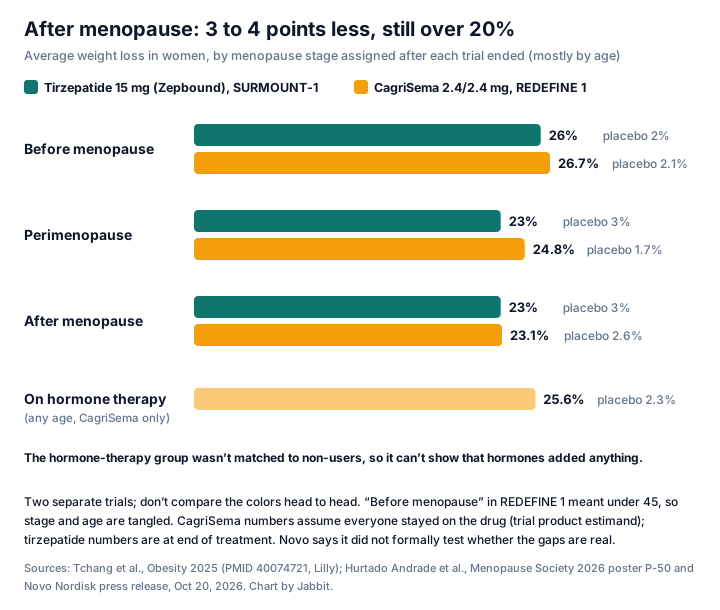
GLP-1 drugs keep working after menopause. In two big trials re-analyzed by menopause stage, women classed as postmenopausal lost 23% of their weight on tirzepatide and 23.1% on CagriSema. That compares with 26% and 26.7% before menopause, and about 2 to 3% on placebo.[8][5] The Menopause Society’s own headline this week is about hormone therapy. A Mayo Clinic study of 2,379 women on semaglutide found hormone users lost 11.9% of their weight versus 10.9% for matched non-users.[2][1] We lined that up against Mayo’s earlier, smaller studies. The edge was 4 points with 16 women on hormones and 5.2 points with 40. With 793 it was 1.5 points at a year. In the 1,476-woman tirzepatide cohort, it was 0.7 points at 3 months and not significant after that.[3][4][2] No randomized trial has tested whether hormones add to weight loss. The one trial that randomizes both has blood sugar, not weight, as its main outcome.[17]
Why this matters now
The Menopause Society’s 2026 Annual Meeting opened in San Diego on October 20. That day the society released a statement headlined “Hormone Therapy May Increase Weight Loss Effectiveness of GLP-1s.” It says about one in five US women aged 50 to 64 report current or past GLP-1 use.[1] The same day, Novo Nordisk announced that women on CagriSema lost 25.0% of their weight on average in its phase 3 trial, with results broken down by menopause stage. Novo says an FDA decision on CagriSema is expected this quarter.[6] On X, posts pairing menopause with a GLP-1 drug ran at 0 to 5 a day last week and reached 18 by noon Tuesday. CagriSema posts hit 60, against 6 to 21 a day the week before.[18] It comes eight months after the FDA removed heart, breast-cancer and dementia statements from the boxed warning on menopausal hormone therapy.[16]
The short answer
- The drugs still work after menopause. Weight loss was about 3 to 4 points lower than before menopause, and still over 20% on tirzepatide and CagriSema.[8][5]
- Part of that gap is age. In the CagriSema analysis, “before menopause” meant under 45, and stages were assigned afterward, mostly by age.[5][6]
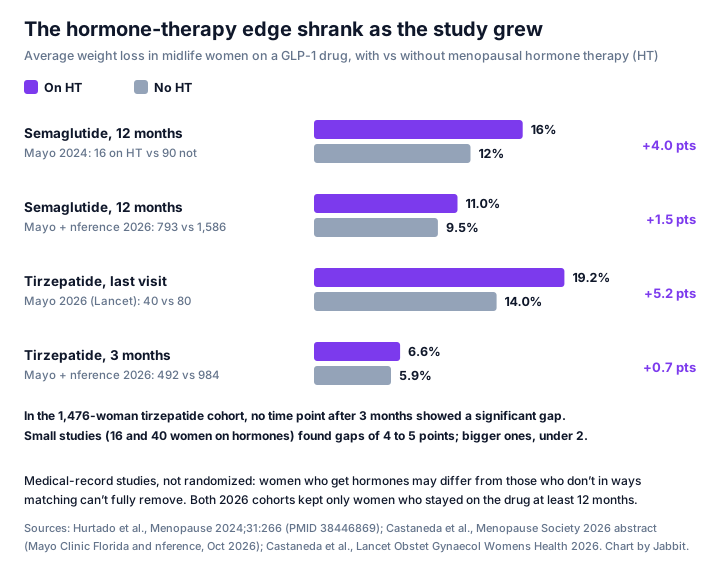
- The hormone-therapy boost is small and shrinking. It was 4 to 5 points in studies with 16 and 40 hormone users, and under 2 points with 793.[3][4][2]
- Nobody has randomized it. All three Mayo studies are medical-record reviews. Of 10 registered studies in menopausal or midlife women, 1 randomizes hormone therapy, and 5 exclude hormone users.[17]
- Don’t start hormones for weight. The lead author, the Spanish Menopause Society and a 2026 review all say so.[1][14][15]
- Pill interactions are unmeasured. None of the 9 US GLP-1 labels mentions menopause or hormone therapy. Seven tested a birth-control pill, and none tested a menopausal hormone.[10]
Does menopause blunt GLP-1 weight loss?
A little, on paper. Lilly re-sorted the women in SURMOUNT-1 by reproductive stage after the trial. On tirzepatide 15 mg (or the highest dose they tolerated), premenopausal women lost 26% of their weight, perimenopausal 23% and postmenopausal 23%. Placebo groups lost 2 to 3%.[8] Novo did the same with REDEFINE 1. On CagriSema, premenopausal women lost 26.7%, perimenopausal 24.8% and postmenopausal 23.1%, versus 1.7 to 2.6% on placebo. Losses of 20% or more fell from 78.3% of premenopausal women to 63.2% after menopause.[5] Across all 2,309 women, CagriSema produced 25.0% weight loss, semaglutide alone 19.0% and cagrilintide alone 13.4%.[6] These are trial-product numbers, which assume everyone stayed on the drug.[5] Counting everyone randomized, men and women, the full trial’s result was 20.4%.[7]
Two cautions. First, the stages were assigned after the trials ended. In REDEFINE 1, “premenopause” meant under 45 with no sign of menopause, and the poster notes the groups differed in age, weight and race.[5] So the 3-to-4-point drop may be partly or mostly about age, not hormones. Second, Novo’s release notes that “formal treatment-by-subgroup interaction testing was not performed.” So we don’t know if the differences between stages are real or chance.[6] The lead author calls them “numerical differences” that need more research.[6]
What changes most at menopause may be body composition, not weight. In the SWAN cohort, which followed women with body scans for years, the rate of fat gain doubled at the start of the menopause transition and lean mass started to fall, while the rate of weight gain didn’t change.[9] That matters on a GLP-1, where some of the weight lost is lean mass. Our muscle-loss review covers what helps keep it.
Does hormone therapy boost weight loss?
The idea comes mostly from one Mayo Clinic group, in three medical-record studies, plus Novo’s trial:
- 2024, semaglutide. 16 postmenopausal women on hormone therapy lost 16% of their weight at 12 months, versus 12% for 90 women not on it. The women not on hormones had more dyslipidemia and depression. The authors called for larger studies.[3]
- 2026, tirzepatide. 40 hormone users matched to 80 non-users lost 19.2% versus 14.0% by their last visit, a 5.2-point gap, published in The Lancet Obstetrics, Gynaecology, & Women’s Health.[4]
- 2026, both drugs, presented this week. Working with the company nference, the group matched 793 hormone users on semaglutide to 1,586 non-users. The gap was 1.6 points at 9 months, 1.5 at 12, 1.9 at 15 and 1.0 by the last visit (about 26 months). For tirzepatide, 492 users and 984 non-users differed by 0.7 points at 3 months, with “no significant differences” later.[2]
- CagriSema. Women using hormone therapy, at any age, lost 25.6% versus 2.3% on placebo.[5] That group wasn’t compared with matched non-users, so it can’t show that hormones added anything. Novo’s press release says the group was analyzed separately but doesn’t give its result.[6]
That’s the pattern the chart shows. As the hormone-user groups grew from 16 and 40 women to 793 and 492, the gap went from 4 to 5 points to 1 to 2. That is what you’d expect if early results were partly noise. The Menopause Society’s release frames it differently: lead author Regina Castaneda says “we are seeing a consistent signal.” She also says the findings need prospective trials, and that “weight loss is not an indication for menopause hormone therapy.”[1] Two disclosures are worth knowing. The society’s medical director, Stephanie Faubion, who comments on the study in the release, is one of its authors.[1][2] And Maria Hurtado Andrade, a co-author of the Mayo hormone studies, also led Novo’s CagriSema menopause analyses and reports advising Novo Nordisk.[3][4][6] The 2026 large cohort lists no funding source.[2]
Matching can’t fix everything in medical-record studies. Women prescribed hormones may differ in ways that age, BMI and diabetes don’t capture. The large cohort also kept only women who stayed on the drug for at least a year.[2] The Spanish Menopause Society’s 2026 position statement calls the link “hypothesis-generating.” It says it “should not justify initiating hormone therapy solely to augment weight loss.”[14]
Do GLP-1 drugs interfere with hormone therapy?
Nobody has measured it. Our scan of 9 current US labels found none that mentions menopause or menopausal hormone therapy. Seven report a drug-interaction study with an ethinyl estradiol birth-control pill. None reports one with the estradiol or progesterone products used after menopause.[10] The concern is stomach emptying. A single 5 mg dose of tirzepatide cut peak levels of birth-control-pill hormones by 55% to 66% and total exposure by 20% to 23%. A 2026 Maturitas review notes that “no equivalent data exist for progestogens used in… menopausal indications.”[11] That matters because the progestogen in hormone therapy is there to protect the uterine lining.[11] Zepbound and Mounjaro already advise backup birth control for 4 weeks after starting and after each dose increase. They give no comparable advice for hormone therapy.[10] More on the birth-control data is in our GLP-1 and birth control guide.
The registry confirms the gap. Five ClinicalTrials.gov studies ran birth-control-pill interaction tests in postmenopausal volunteers, three of them Novo Nordisk’s and one Lilly’s for retatrutide. We found none that tests whether a GLP-1 drug changes absorption of menopausal hormones.[17] What exists are case reports. One woman on oral estrogen had worse hot flashes and mood changes during semaglutide dose increases, which eased when titration was slowed.[12] Another, aged 58, developed postmenopausal bleeding after a semaglutide dose increase. Cancer was ruled out, and the bleeding stopped within five weeks of quitting the drug.[13] Single cases can’t prove cause. But bleeding after menopause always needs to be checked.[13]
What changed for hormone therapy this year
On February 12, 2026, the FDA approved label changes for six hormone-therapy products. These removed risk statements on cardiovascular disease, breast cancer and probable dementia from the boxed warning. The agency had started the process in November 2025, and 29 companies had submitted proposed changes.[16] The FDA’s release states that women who start hormone therapy within 10 years of menopause, generally before 60, “have a reduction in all-cause mortality and fractures.” It says about 41 million US women were 45 to 64 in 2020, yet only about 2 million women aged 46 to 65 received a hormone-therapy prescription.[16] None of that makes hormone therapy a weight-loss drug. A 2026 review puts it plainly: it “should be prescribed for established menopausal indications rather than for weight loss.”[15]
Bone, muscle and aging: the longevity questions
For women after menopause, the bigger long-term questions may be bone and muscle, not a point of weight loss. Wegovy’s label reports more hip and pelvis fractures in women in its heart-outcomes trial: 1% (24 of 2,448) versus 0.2% (5 of 2,424) on placebo.[10] Hormone therapy started near menopause cuts fractures, according to the FDA.[16] But the studies that could tell us how the two interact mostly leave hormone users out. Novo’s 144-woman cagrilintide bone study excludes recent systemic hormone therapy. Both Mayo biological-age trials and Colorado’s 200-woman aging-clock study exclude hormone users too.[17] Our bone review and aging-clock review cover the wider evidence.
What’s being studied
| Study | Sponsor | What | People | Hormone users | Primary completion |
|---|---|---|---|---|---|
| NCT07850050 | Boehringer Ingelheim | Survodutide vs placebo, 52 weeks, phase 3 | 600 | Not stated | Jul 2028 (starts Oct 31) |
| NCT06715514 | University of Bern | Estradiol patch + progesterone, semaglutide, or both | 96 | Randomized | Dec 2026 |
| NCT07057310 | Mayo Clinic | Semaglutide or tirzepatide + lifestyle vs lifestyle; biological age | 30 | Excluded | Dec 2026 |
| NCT07218445 | Mayo Clinic | Tirzepatide vs placebo; hot flashes, biological age | 40 | Excluded | Sep 2027 |
| NCT06975111 | University of Colorado | GLP-1 drug or other treatments, not randomized; PhenoAge, GrimAge | 200 | Excluded | Oct 2029 |
| NCT07010432 | Novo Nordisk | Cagrilintide, semaglutide, CagriSema or placebo; hip bone density | 144 | Excluded | May 2028 |
| NCT07422987 | University of Kansas | Observational; bone density, lean mass | 50 | Not stated | Jun 2027 |
| NCT07787533 | LSU | App-based strength training on a GLP-1 drug | 15 | Not excluded | Jun 2027 |
| NCT04964388 | Univ. of Mississippi | GLP-1 drug vs none; bone score | 5 | Not stated | Terminated; results posted |
| NCT01381926 | UAB | Exenatide vs placebo; bone turnover | 14 | Excluded | Terminated; results posted |
We found 10 studies. Only 2 have posted results, and both are bone studies that were stopped early with 5 and 14 people.[17] The only trial that randomizes hormone therapy and a GLP-1 drug is in Bern. It gives 96 early postmenopausal women an estradiol patch with progesterone, semaglutide up to 1 mg, or both. Its primary outcome is blood sugar at 12 weeks, not weight, and it finishes in December 2026.[17] The largest new trial is Boehringer Ingelheim’s SYNCHRONIZE-HERA. It will test survodutide in 600 peri- and postmenopausal women, starting October 31, and its public listing doesn’t say whether hormone users can join.[17] Three studies measure biological age. Mayo’s 40-woman tirzepatide trial also measures hot flashes. Lilly sponsors none of the 10.[17] PubMed lists 90 papers on menopause and GLP-1 drugs. Of the 12 that also cover hormone therapy with semaglutide or tirzepatide, none is a randomized trial.[19]
Strengths and limits
Strengths. The stage results come from large randomized trials, with placebo groups in every stage.[8][5] The 2026 Mayo cohort is big and matched, and it reports results at several time points.[2] The label and registry reviews are direct reads of primary records.[10][17]
Limits. Every stage analysis is post hoc. Stages were assigned mostly by age, and no interaction testing was done.[5][6] The CagriSema results are conference posters funded by Novo, and the SURMOUNT analysis was written mostly by Lilly employees.[5][8] All the hormone-therapy data come from one health system’s records, and the newest results are a meeting abstract, not a peer-reviewed paper.[2] The registry search can miss studies that don’t use the words we searched for.[17]
Bottom line
If you’re past menopause, Ozempic, Wegovy, Zepbound and, if approved, CagriSema should still work. Expect perhaps 3 to 4 points less weight loss than younger women in the same trials, and some of that is age.[8][5] Hormone therapy may add a point or two on semaglutide, but that comes from medical records, not trials. The edge shrank as the studies grew, and the people running them say not to start hormones for weight.[2][1][14] The real open questions are whether these drugs change how hormone pills are absorbed, and what happens to bone and muscle. Most registered studies leave women on hormones out.[10][11][17]
If you’re on both, a simple log helps you and your prescriber see what’s going on. Note the date and dose of each shot, your weight, any hot flashes or bleeding, and any change to your hormone therapy. Jabbit keeps that private, dated record on your iPhone, so a dose step and a symptom change aren’t left to memory.
Frequently asked questions
- Do Ozempic, Wegovy or Zepbound work after menopause?
- Yes. In Lilly’s SURMOUNT-1 trial, women classed as postmenopausal lost 23% of their weight on tirzepatide 15 mg versus 3% on placebo, compared with 26% versus 2% before menopause. In Novo Nordisk’s CagriSema trial the numbers were 23.1% after menopause and 26.7% before. Menopause stage was assigned after the trials ended, mostly by age, so part of the gap is simply age.
- Does hormone therapy make GLP-1 drugs work better?
- It hasn’t been tested in a randomized trial. Mayo Clinic medical-record studies found women on hormone therapy lost more weight, but the gap shrank as the studies grew: 4 points at a year in 106 women on semaglutide, 1.5 points in 2,379. In 1,476 women on tirzepatide, the edge was 0.7 points at 3 months and not significant after that. The study’s lead author says weight loss is not a reason to start hormone therapy.
- Should I start HRT to lose more weight on a GLP-1?
- No major group recommends that. Hormone therapy is approved for hot flashes, vaginal symptoms and preventing bone loss, not weight loss. The Spanish Menopause Society says the association “should not justify initiating hormone therapy solely to augment weight loss.” If you have menopause symptoms, hormone therapy is a separate decision to make with your clinician.
- Can Ozempic or Zepbound affect estrogen or progesterone pills?
- Possibly, but it hasn’t been measured. These drugs slow stomach emptying, and a 5 mg tirzepatide dose cut peak levels of birth-control-pill hormones by 55% to 66%. No study has tested menopausal estradiol or progesterone, and none of the 9 US labels mentions menopause or hormone therapy. One published case describes worse hot flashes on oral estrogen during semaglutide dose increases, which eased when the dose steps were slowed.
- Is CagriSema approved, and how did women do?
- Not yet. Novo Nordisk says the FDA decision is expected in the fourth quarter of 2026. In its 68-week trial, women on CagriSema lost 25.0% of their weight versus 3.0% on placebo, assuming everyone stayed on treatment. Stopping because of side effects was 5.9% versus 3.5%, and nausea hit 55% versus 12.6%.
- What about muscle and bone after menopause on these drugs?
- That’s the bigger open question. Fat gain speeds up and lean mass starts to fall at the start of the menopause transition, and Wegovy’s label reports more hip and pelvis fractures in women in its heart trial (1% vs 0.2%). Of 10 registered studies of these drugs in menopausal or midlife women, 5 focus on bone or strength, and the only 2 with results were stopped early at 5 and 14 people.
- Is any bleeding after menopause on a GLP-1 drug normal?
- No. Bleeding after menopause always needs to be checked by a clinician. One 2026 case report describes bleeding that began after a semaglutide dose increase and stopped within five weeks of quitting the drug, but the authors stress ruling out cancer first.
References
- The Menopause Society. “Hormone Therapy May Increase Weight Loss Effectiveness of GLP-1s.” Press release, Cleveland, October 20, 2026 (“Around 20% (one in five) of women aged 50 to 64 report current or past use of a GLP-1”; quotes lead author Regina Castaneda, MD: “it’s important to remember that weight loss is not an indication for menopause hormone therapy”; quotes Stephanie Faubion, MD, the society’s medical director, who is also a co-author of the study). https://menopause.org/press-releases/hormone-therapy-may-increase-weight-loss-effectiveness-of-glp-1s. Checked October 20, 2026.
- Castaneda R, Murugadoss K, Hurtado Andrade MD, Venkatakrishnan AJ, Soundararajan V, Shufelt C, Faubion S. Menopause hormone therapy and weight loss response to GLP-1–based therapies in midlife women: a retrospective cohort study. Abstract S-1, The Menopause Society 2026 Annual Meeting, San Diego, October 20-24, 2026 (Mayo Clinic Florida and nference; health records February 2017 to December 2025; women 45 and older, BMI 27 or more, at least 12 months of treatment; each hormone user matched to two non-users on age, BMI, prior obesity drugs and diabetes; hormone therapy meant oral or transdermal estrogen with or without progesterone. Semaglutide: 793 vs 1,586 women, −9.8% vs −8.2% at 9 months, −11.0% vs −9.5% at 12, −11.6% vs −9.7% at 15, −11.9% vs −10.9% at last follow-up, p=0.020, median 26 months; at least 20% loss 22% vs 18%. Tirzepatide: 492 vs 984, −6.6% vs −5.9% at 3 months, p=0.031; “no significant differences were observed at later timepoints or for higher weight loss thresholds”; median follow-up 17 and 16 months. “Sources of Funding: None”). https://menopause.org/wp-content/uploads/2026/10/MENOPAUSE26_Regular-LB_Abstracts-4-1.pdf. Checked October 20, 2026.
- Hurtado MD, Tama E, Fansa S, et al. Weight loss response to semaglutide in postmenopausal women with and without hormone therapy use. Menopause. 2024;31(4):266-274. doi:10.1097/GME.0000000000002310. PMID 38446869 (16 women on hormone therapy vs 90 not; 12-month weight loss 16% vs 12%, P=0.04; women not on hormones had more dyslipidemia and depression; “Larger studies should be conducted to confirm these results”). https://pubmed.ncbi.nlm.nih.gov/38446869/. Checked October 20, 2026.
- Castaneda R, Bechenati D, Tama E, et al. The role of menopause hormone therapy in modulating tirzepatide-associated weight loss in postmenopausal women with overweight or obesity: a retrospective cohort study. Lancet Obstet Gynaecol Womens Health. 2026;2(2):e118-e128. doi:10.1016/S3050-5038(25)00145-1 (Mayo Clinic Health System; 40 women on systemic hormone therapy matched to 80 not, all on tirzepatide for at least 12 months; −19.2% vs −14.0% at last follow-up, mean difference 5.2 points, p=0.0023; 94% White; funded by NIH and the Mayo Clinic Center for Women’s Health Research; the senior author reports advising Novo Nordisk). https://doi.org/10.1016/S3050-5038(25)00145-1. Checked October 20, 2026.
- Hurtado Andrade MD, Hagemann CA, Osorto Contreras CK, et al. Effect of CagriSema on body weight reduction and cardiometabolic risk factors in women by menopause status and hormone therapy use: a post hoc analysis of the REDEFINE 1 trial. Poster P-50, and Effect of CagriSema on body weight reduction and cardiometabolic risk factors in women. Poster P-51. The Menopause Society 2026 Annual Meeting (“Sources of Funding: Novo Nordisk A/S”; trial product estimand. P-51: 1,902 women, CagriSema −25.0% vs placebo −3.0%; at least 10%, 20% and 30% loss in 93.3%, 68.7% and 29.5% vs 12.7%, 1.8% and 0.3%; waist −20.5 vs −4.7 cm. P-50: premenopause meant “aged <45 years with no indication of menopause”; CagriSema vs placebo −26.7% vs −2.1% before menopause (408 and 122 women), −24.8% vs −1.7% in perimenopause (256 and 81), −23.1% vs −2.6% after menopause (530 and 168), and −25.6% vs −2.3% in hormone users of any age (247 and 90); at least 20% loss 78.3%, 70.4%, 63.2% and 69.4%; “differences in age, body weight, and race were evident across the four groups”). https://menopause.org/wp-content/uploads/2026/10/MENOPAUSE26_Regular-LB_Abstracts-4-1.pdf. Checked October 20, 2026.
- Novo Nordisk. “Novo’s CagriSema was associated with 25% weight loss on average for women in a post hoc analysis of REDEFINE 1 presented at The Menopause Society Annual Meeting.” Press release, PR Newswire, October 20, 2026 (2,309 women in all four arms: CagriSema −25.0%, semaglutide −19.0% (199 women), cagrilintide −13.4% (208), placebo −3.0%; menopause status “was derived post hoc using age, medical history, and recorded symptoms”; “formal treatment-by-subgroup interaction testing was not performed”; women using hormone therapy “were evaluated as a separate group,” but the release does not give that group’s result; discontinuation due to adverse events 5.9% vs 3.5%; gastrointestinal events 79.6% vs 39.9%, nausea 55% vs 12.6%, vomiting 26.1% vs 4.1%; “Novo filed a New Drug Application… in December 2025… A decision is expected in Q4 2026. CagriSema is not approved for use in the United States.”). https://www.prnewswire.com/news-releases/novos-cagrisema-was-associated-with-25-weight-loss-on-average-for-women-in-a-post-hoc-analysis-of-redefine-1-presented-at-the-menopause-society-annual-meeting-302914051.html. Checked October 20, 2026.
- Garvey WT, Blüher M, Osorto Contreras CK, et al. Coadministered cagrilintide and semaglutide in adults with overweight or obesity. N Engl J Med. 2025;393(7):635-647. PMID 40544433 (REDEFINE 1, 3,417 adults without diabetes, 68 weeks; CagriSema −20.4% vs −3.0% on placebo by treatment policy, counting everyone randomized). https://pubmed.ncbi.nlm.nih.gov/40544433/. Checked October 20, 2026.
- Tchang BG, Mihai AC, Stefanski A, et al. Body weight reduction in women treated with tirzepatide by reproductive stage: a post hoc analysis from the SURMOUNT program. Obesity (Silver Spring). 2025;33(5):851-860. doi:10.1002/oby.24254. PMID 40074721 (SURMOUNT-1 women, tirzepatide 15 mg or maximum tolerated dose vs placebo, stage assigned retrospectively: premenopause 26% vs 2%, perimenopause 23% vs 3%, postmenopause 23% vs 3%; “Similar results were observed in SURMOUNT-3 and -4”; most authors are Eli Lilly employees). https://pubmed.ncbi.nlm.nih.gov/40074721/. Checked October 20, 2026.
- Greendale GA, Sternfeld B, Huang M, et al. Changes in body composition and weight during the menopause transition. JCI Insight. 2019;4(5):e124865. PMID 30843880 (SWAN cohort, DXA scans: “At the start of the MT, rate of fat gain doubled, and lean mass declined”; “there is no discernable change in rate of weight gain at the start of the MT”; NIH-funded). https://pubmed.ncbi.nlm.nih.gov/30843880/. Checked October 20, 2026.
- Jabbit scan of 9 current US prescribing labels on DailyMed: Wegovy (v19, https://dailymed.nlm.nih.gov/dailymed/drugInfo.cfm?setid=ee06186f-2aa3-4990-a760-757579d8f77b), Ozempic (v20), Rybelsus (v14), Zepbound (v40, https://dailymed.nlm.nih.gov/dailymed/drugInfo.cfm?setid=487cd7e7-434c-4925-99fa-aa80b1cc776b), Mounjaro (v40), Saxenda (v22), Victoza (v31), Trulicity (v62) and Foundayo (v10). None mentions menopause or menopausal hormone therapy. Seven (Mounjaro, Ozempic, Rybelsus, Saxenda, Victoza, Wegovy, Zepbound) report a drug-interaction study with an ethinyl estradiol birth-control pill; none reports one with a menopausal estradiol or progesterone product. Zepbound and Mounjaro advise backup contraception for 4 weeks after starting and after each dose increase for people on oral birth control. Wegovy: “In the CV outcomes trial in adults, more fractures of the hip and pelvis were reported on WEGOVY than on placebo in female patients: 1% (24/2,448) vs. 0.2% (5/2,424).” Details: https://jabbitapp.com/research/sources/glp1-menopause-ctgov-labels-2026-10-20.json. Checked October 20, 2026.
- Viana DPDC, Invitti AL, Jacobsen L, Schor E. Tirzepatide and oral progestogens: a hypothesis-generating review of a biologically plausible pharmacokinetic interaction in gynaecologic disease control and menopausal hormone therapy. Maturitas. 2026;214:109116. PMID 42721915 (a single 5 mg tirzepatide dose with a birth-control pill cut peak levels of ethinyl estradiol, norgestimate and norelgestromin by 59%, 66% and 55% and overall exposure by 20%, 21% and 23%; “No equivalent data exist for progestogens used in therapeutic gynaecologic or menopausal indications”). https://pubmed.ncbi.nlm.nih.gov/42721915/. Checked October 20, 2026.
- Parker AE. Worsening vasomotor symptoms in the setting of estradiol and semaglutide: a case report. Menopause. 2025;32(12):1168-1170. PMID 40729307 (a 51-year-old on oral estrogen had more frequent and intense hot flashes and mood changes during semaglutide dose increases; they resolved after titration was slowed; the author hypothesizes reduced estrogen absorption). https://pubmed.ncbi.nlm.nih.gov/40729307/. Checked October 20, 2026.
- Prasad S, Parmar V, Sharma A, et al. Postmenopausal bleeding associated with semaglutide: a diagnostic challenge. JCEM Case Rep. 2026;4(10):luag261. PMID 42751094 (a 58-year-old with new vaginal bleeding six weeks after starting semaglutide; cancer and structural causes excluded; Naranjo score 6, “probable”; resolved within five weeks of stopping; the authors call for “malignancy-first evaluation”). https://pubmed.ncbi.nlm.nih.gov/42751094/. Checked October 20, 2026.
- Sánchez-Prieto M, Romero-Domínguez M, Orozco R, et al. Incretin-based therapies in peri- and postmenopausal women with obesity: an expert position statement from the Spanish Menopause Society. Maturitas. 2026;213:109101. PMID 42664617 (the hormone-therapy association “remains hypothesis-generating and should not justify initiating hormone therapy solely to augment weight loss”; semaglutide evidence in menopause “remains limited and largely observational”; tirzepatide and dual agonists “require menopause-specific evaluation”). https://pubmed.ncbi.nlm.nih.gov/42664617/. Checked October 20, 2026.
- Lee Y, Oh B. Clinical evaluation and treatment of obesity in women across selected life stages: a narrative review. Womens Health Nurs. 2026;32(3):180-189. PMID 42860281 (“Menopausal hormone therapy should be prescribed for established menopausal indications rather than for weight loss”; lean mass loss “also reflects aging”). https://pubmed.ncbi.nlm.nih.gov/42860281/. Checked October 20, 2026.
- US Food and Drug Administration. “FDA Approves Labeling Changes to Menopausal Hormone Therapy Products.” News release, February 12, 2026 (six products; risk statements on cardiovascular disease, breast cancer and probable dementia removed from the boxed warning; removal initiated in November 2025; 29 companies submitted proposed changes; FDA states that “women who initiate HRT within 10 years of the onset of menopause (generally before age 60) have a reduction in all-cause mortality and fractures”; “about 41 million U.S. women were ages 45–64 — yet only about 2 million women ages 46–65 received a hormone-therapy prescription”). https://www.fda.gov/news-events/press-announcements/fda-approves-labeling-changes-menopausal-hormone-therapy-products; updated products (Prometrium, Divigel, Cenestin, Enjuvia, Estring, Bijuva): https://www.fda.gov/drugs/drug-safety-and-availability/menopausal-hormone-therapies-updated-prescribing-information. Checked October 20, 2026.
- Jabbit review of ClinicalTrials.gov (API v2), pulled October 20, 2026, 12:06 PM ET: menopause, perimenopause, postmenopausal, midlife women, hormone therapy or estradiol, crossed with semaglutide, tirzepatide, liraglutide, dulaglutide, exenatide, retatrutide, orforglipron, cagrilintide, CagriSema, survodutide, mazdutide, brand names or “GLP-1” (139 records). Hand review found 10 studies of GLP-1-class drugs in menopausal or midlife women: Boehringer Ingelheim survodutide phase 3 SYNCHRONIZE-HERA NCT07850050 (600 women, first posted September 30, 2026, start October 31, 2026); Bern NCT06715514 (96, randomizes transdermal estradiol plus progesterone and semaglutide; primary completion December 17, 2026); Mayo Clinic NCT07057310 (30) and NCT07218445 (40, tirzepatide vs placebo for hot flashes and biological aging); University of Colorado NCT06975111 (200, PhenoAge and GrimAge); Novo Nordisk cagrilintide bone study NCT07010432 (144); University of Kansas NCT07422987 (50); LSU NCT07787533 (15); and two terminated bone studies with posted results, NCT04964388 (5 people) and NCT01381926 (14). Five exclude hormone users; one randomizes hormone therapy; three measure biological age; none is sponsored by Eli Lilly. Five birth-control-pill interaction studies enrolled postmenopausal volunteers (Novo Nordisk 3, Boehringer 1, Lilly 1 for retatrutide); none tests whether a GLP-1 drug changes absorption of menopausal hormones. Full list: https://jabbitapp.com/research/sources/glp1-menopause-ctgov-labels-2026-10-20.json. Checked October 20, 2026.
- Jabbit count of posts on X via the recent-counts endpoint (no reposts), UTC days. English posts with menopause, perimenopause or menopausal: 1,301, 1,480, 1,410, 1,123, 1,543 and 1,439 a day, October 14-19, 2026, and 862 on October 20 through 12:06 PM ET. English posts pairing a menopause term with a GLP-1 drug term (GLP-1, Ozempic, Wegovy, Zepbound, Mounjaro, semaglutide, tirzepatide and similar): 3, 3, 5, 0, 2 and 3 a day, then 18 on October 20 through about noon ET. Posts naming CagriSema, any language: 7, 9, 14, 21, 6 and 15 a day, then 60 on October 20 through about noon ET. Checked October 20, 2026.
- Jabbit PubMed searches, October 20, 2026: menopaus*[tiab] with semaglutide, tirzepatide, liraglutide, “GLP-1”, “glucagon-like peptide-1” or cagrilintide returns 90 records; adding hormone therapy, estrogen or hormone replacement and limiting to semaglutide or tirzepatide returns 12, and none of the 12 is a randomized trial (reviews, a position statement, case reports, cohort and animal studies). Queries: https://jabbitapp.com/research/sources/glp1-menopause-ctgov-labels-2026-10-20.json. Checked October 20, 2026.
This page analyzes published trials, conference abstracts, press releases, drug labels, registry records and posts on X. It is not medical advice and not a dosing guide. It does not recommend any drug, dose or product. Menopausal hormone therapy is not approved for weight loss, and CagriSema is not approved in the US. Don’t start, stop or change either without your clinician. The label, registry, PubMed and X reviews are Jabbit’s own; their inputs are cited above.