Evidence review · Ozempic, Wegovy and Rybelsus (semaglutide), Zepbound and Mounjaro (tirzepatide) · new ANESTHESIOLOGY 2026 records study, randomized trial, ultrasound studies, guidelines, ClinicalTrials.gov review · Sources checked October 19, 2026
Published · Updated
Should you stop Ozempic, Wegovy, Zepbound or Mounjaro before surgery? U.S. guidance now says most people can keep taking it, but the one randomized test found food left in the stomach far more often when people didn’t skip a dose.
On October 18, anesthesiologists presented a study of about 2 million surgeries: people already on GLP-1 drugs had 11% lower odds of heart complications and 8% lower odds of infections afterward.[1] In plain numbers that is 1.0% vs 1.1% and 4.9% vs 5.3%, and the study didn’t establish whether anyone held a dose.[2][3] The worry it doesn’t settle is a full stomach under anesthesia. These drugs slow stomach emptying, and their labels now carry an aspiration warning.[17][18] The only randomized test of skipping a dose found food blocking the exam in 25% of people who kept taking the drug and 3% of those who held one dose, though nobody aspirated.[11] U.S. guidance now says most people can stay on their drug, while European guidance says stop weekly shots for one to two weeks.[8][10] We read the ClinicalTrials.gov records. Of 40 registered studies on these drugs around procedures, only that one trial has posted results, and none tests holding versus continuing before surgery under general anesthesia.[20]
Why this matters now
The American Society of Anesthesiologists put out the new study at its annual meeting in San Diego on October 18, and Newsweek and the KFF Health News morning briefing carried it on October 18 and 19.[1][2][4] The same meeting held sessions on GLP-1 drugs and on fasting and aspiration.[5] On X, posts tying these drugs to surgery or anesthesia ran at 18 to 38 a day last week.[6] For anyone on a weekly shot with an operation coming, the question is practical: take this week’s dose or skip it?
The short answer
- Don’t decide alone. Tell your surgeon and anesthesia team which drug you take, the dose and the date of your last dose, as early as you can. The Zepbound label tells patients to let their providers know about any planned surgery, and Newsweek’s outside expert gave the same advice on drug, dose and last dose.[17][2]
- In the U.S., most people keep taking it. The 2024 guidance from the ASA and four other societies says to continue unless your risk is higher. Higher risk means early in treatment or while the dose is going up, a high dose, a weekly drug, stomach symptoms, or another condition that slows the stomach.[9][8]
- Other countries differ. European anesthesiologists say to stop weekly shots at least a week before, and two weeks if the drug is for weight loss. Australia, New Zealand and one U.S. society instead require a 24-hour clear-liquid diet.[10]
- The new study is about benefit, not stomach risk. It’s a records study, so it can’t show the drug caused the small differences, and it didn’t report aspiration.[1][2]
- The evidence is thin. One randomized trial of 60 people has results. It looked at sedated endoscopy, not surgery under general anesthesia.[11][20]
What the new 2-million-patient study found
The researchers at UTHealth Houston used Epic Cosmos, a pooled health-record database from more than 1,700 hospitals. They took U.S. adults who had elective surgery lasting over an hour, with at least a day in hospital, from 2016 to 2024. Of 2,028,601 patients, 145,610 were on a GLP-1 drug. Users were matched with similar nonusers.[1] After matching, major cardiovascular events happened in 1.0% of users and 1.1% of nonusers. Those events were heart attack, heart injury, stroke or death from any cause. Infections, meaning wound, urinary tract, pneumonia or sepsis, happened in 4.9% and 5.3%.[2] That works out to about one fewer heart event and four fewer infections per 1,000 operations.[3]
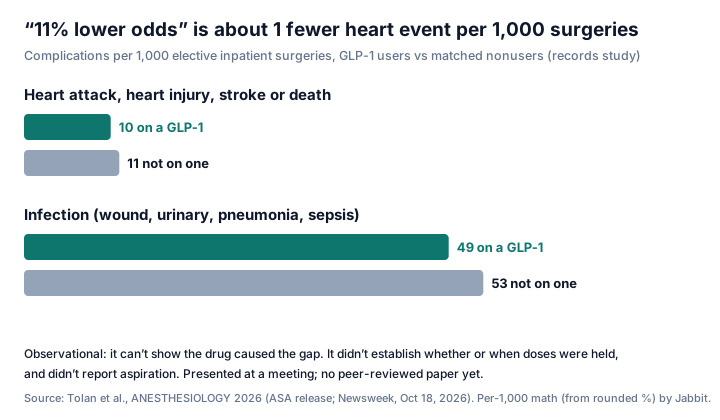
Three limits matter for a reader. First, it is observational. People prescribed and staying on a GLP-1 may have better access to care or other differences that matching can’t remove, and the authors say it “does not prove cause and effect.”[1] Second, Newsweek reports that it “did not establish whether or when patients stopped taking GLP-1 medication before surgery,” and that it didn’t report aspiration.[2] So it can’t tell you whether to take this week’s shot. Third, it has been presented at a meeting but not yet published as a peer-reviewed paper.[3] Newsweek’s outside expert called the results “reassuring and hypothesis-generating.” She is Dr. Jessica Duncan, chief medical officer of Ivím Health, a telehealth company that sells compounded tirzepatide and semaglutide and is listed as a partner of the peptide-medicine group lobbying the White House this week. Her advice was still careful: tell your team which drug, the dose and when you last took it, and don’t start a GLP-1 just to prevent complications.[2][19]
Other records studies point the same way, with the same caveat
An analysis by Mass General Brigham anesthesiologists, published in Anesthesiology on September 25 compared surgical patients with type 2 diabetes on a GLP-1 against those on other diabetes drugs. Against metformin, 0.98% vs 2.20% died within 14 days. It found “no increased aspiration risk compared with any other drug class.”[16] A drop of more than half in deaths within two weeks is hard to credit to a weekly shot alone. It is the kind of result that warns how much these comparisons can reflect who gets prescribed what.[16]
Two insurance-claims studies looked straight at lung complications. In 23,679 people with diabetes having same-day emergency surgery, who had no time to hold the drug, respiratory complications were 3.5% with a GLP-1 vs 4.0% on other diabetes drugs (adjusted odds ratio 1.03).[14] In 366,476 people having common operations, aspiration pneumonia was 0.7% vs 0.6% (adjusted odds ratio 0.78, not significant). Acute respiratory failure was more common in GLP-1 users before adjustment, at 13.5% vs 11.1%.[15] Both studies predate wide tirzepatide use, and in the larger one the drugs were mostly semaglutide and dulaglutide.[15]
The stomach problem is real, even if aspiration is rare
The Zepbound label says tirzepatide delays stomach emptying, with the delay “largest after the first dose,” fading over time.[17] The Wegovy label added a warning in November 2024, and the current Zepbound label carries the same one. It cites “rare postmarketing reports” of aspiration under anesthesia in people who still had food in the stomach after fasting as told. FDA adds that the data are “insufficient” to say whether changing fasting or pausing the drug lowers the risk.[18][17]
When anesthesiologists look with ultrasound, they often find food. In a Belgian study, 44 semaglutide users were matched with 44 similar patients for age, BMI and diabetes. After fasting, 49% of users had a full stomach, against 18% of the comparison group, and 42% vs 7% had solid food. The authors say the higher risk held “even after withholding one administration of semaglutide.”[12] In 316 GLP-1 users at three Mayo Clinic hospitals, 35.8% had a lot left in the stomach. Among weekly injectors, those patients had held their shot for a median of 6 days, against 8 days for those with emptier stomachs. Holding 7.5 days or less and fasting from solids for 21.3 hours or less were the cutoffs linked to more food.[13]
The one randomized trial
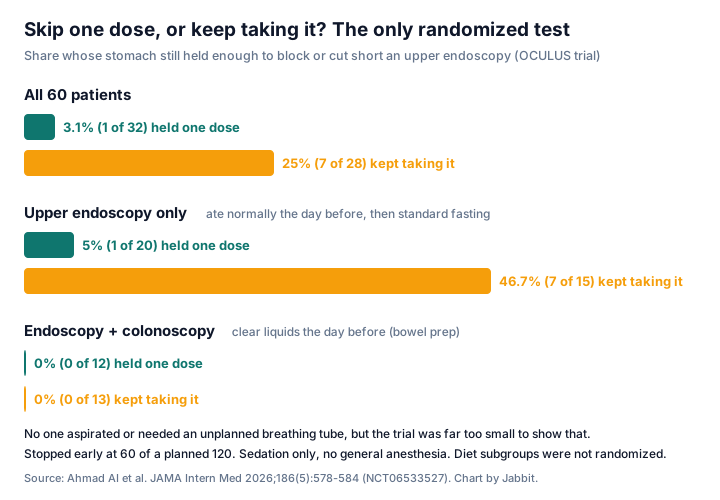
OCULUS, at two Cleveland Clinic hospitals, randomized people on a stable dose for at least a month. Before a sedated upper endoscopy, they either skipped one dose or kept taking the drug. For weekly drugs, skipping meant 7 to 13 days without it. No one had general anesthesia.[11] Food that blocked or cut short the exam occurred in 25.0% of those who continued, against 3.1% of those who held a dose. The gap crossed the trial’s preset stopping line at 60 of 120 planned patients.[11] Among people who ate normally the day before, it was 46.7% vs 5.0%. Among the 25 who had clear liquids the day before for a colonoscopy, there were no cases in either group.[11]
Two details cut against parts of current guidance. First, none of the patients with a full stomach reported nausea, heartburn or other stomach symptoms that day. The authors conclude that “symptom-based strategies may be insufficient.”[11] Screening for symptoms is one of the main ways U.S. guidance sorts patients into higher risk.[9] Second, the trial was small, and more continuers were on tirzepatide (54% vs 25%). There were no aspirations, unplanned breathing tubes or hospital stays, but the authors say the trial was not powered to show that, and warn against reading that as proof of safety.[11]
What the guidelines say, country by country
U.S. advice reversed in 16 months. In June 2023 the ASA said to hold weekly shots for a week before any procedure.[7] In October 2024 it joined four other societies in saying most patients can continue.[8] That guidance calls itself “guidance, and not an evidence-based guideline.” It says the right hold time is “unknown,” and it adds that it may need to change for dual and triple agonists.[9] Other bodies landed in different places:[10]
| Who | Stop the drug routinely? | Diet before the procedure |
|---|---|---|
| United States (ASA and 4 societies, 2024) | No, for most people. If higher risk, hold weekly shots a week before and daily drugs on the day | Consider 24 hours of clear liquids for higher-risk patients |
| United Kingdom (Association of Anaesthetists / RCoA, 2025) | No | Standard fasting; no clear-fluid diet mentioned |
| Australia and New Zealand (ANZCA, 2025) | No | Required: 24 hours of clear fluids, then a 6-hour fast; erythromycin before the procedure is an option |
| SPAQI (Society for Perioperative Assessment and Quality Improvement, 2025) | No | Required: 24 hours of clear liquids, then 4 hours nothing by mouth |
| Europe (ESAIC, 2025) | Yes: weekly shots at least 1 week; if taken for obesity, 2 weeks | Consider 24 hours of clear fluids |
| Canada (2025 review and algorithm) | Not routinely. Higher risk includes starting a long-acting drug within 16 weeks or still raising the dose; then reschedule, or hold for five half-lives | 24-hour liquid diet the day before |
| ISMP Canada (2023) | Yes: at least three half-lives | Standard fasting |
All seven recommend a bedside stomach ultrasound, the Canadian one only when there are stomach symptoms on the day.[10]
What we counted on ClinicalTrials.gov
We pulled 2,174 studies that list a GLP-1 drug or match GLP-1 plus anesthesia, sedation, endoscopy, aspiration or post-surgery terms. Then we read the 239 keyword hits. 40 are about these drugs around a procedure. Only 1, OCULUS, has posted results.[20]
- 7 randomized tests of what to do beforehand. Three compare holding with continuing, all before endoscopy or colonoscopy. Two test a liquid diet or longer fasting, and two test a drug that speeds the stomach. None compares holding with continuing before surgery under general anesthesia, the setting the labels warn about.[20][17]
- 3 drugmaker studies. Novo Nordisk and Lilly are each running ultrasound studies of fasting length and pausing their own drugs. Lilly’s dulaglutide study finished in August, and none has posted results.[20]
- 3 randomized trials asking the new study’s question. They test whether giving a GLP-1 prevents heart injury, delirium or wound problems after surgery. None has results, and the earliest is due in March 2027.[20]
- 27 observational stomach-content studies, none with results posted on the registry. Some, like the Belgian study, are published as papers.[20][12]
- Retatrutide: none of the 33 registered retatrutide studies is about procedures.[20]
| Trial | What it tests | People | Status | Primary completion | Results |
|---|---|---|---|---|---|
| NCT06533527 | Hold 1 dose vs keep taking, before upper endoscopy (OCULUS) | 69 | finished | 2025-05-20 | posted |
| NCT07127354 | Hold vs keep taking, before colonoscopy (OCULUS 2; bowel-prep quality) | 132 | recruiting | 2026-08 | none |
| NCT07736911 | Stop 1 week vs keep taking, before upper endoscopy (Taiwan) | 140 | recruiting | 2029-06-01 | none |
| NCT06654219 | Longer solid-food fast plus 24-hour clear liquids vs standard fasting, before upper endoscopy (UTHealth Houston) | 136 | recruiting | 2026-12-31 | none |
| NCT06839248 | 24-hour clear liquids vs standard fasting (Melbourne) | 154 | recruiting | 2027-02-01 | none |
| NCT07100691 | Metoclopramide vs usual care before surgery, GLP-1 continued, weight-loss users (Dublin) | 80 | not started | 2026-05 | none |
| NCT07254715 | Itopride vs placebo in semaglutide users before anesthesia (Egypt) | 60 | finished | 2026-07-30 | none |
| NCT07225816 | Novo Nordisk: fasting length and pausing liraglutide, oral or injected semaglutide (not randomized) | 71 | recruiting | 2026-12-13 | none |
| NCT07299084 | Lilly: fasting length and withholding tirzepatide (not randomized) | 40 | running, not recruiting | 2026-11 | none |
| NCT07313813 | Lilly: fasting length and withholding dulaglutide | 20 | finished | 2026-08-13 | none |
| NCT06324461 | One dulaglutide dose before noncardiac surgery vs usual care: heart-muscle injury (Hong Kong) | 372 | recruiting | 2028-12-31 | none |
| NCT06361238 | Liraglutide vs placebo before heart surgery: delirium (Nanjing) | 260 | recruiting | 2027-03-31 | none |
| NCT07755085 | GLP-1 vs placebo for 6+ months before hip/knee replacement: wound problems (Nova Scotia) | 100 | not started | 2028-06-01 | none |
Every record, the 27 observational studies and the ones we excluded, with reasons, are in our source file.[20]
Strengths and limits
Strengths. The records studies are very large. They agree with each other: no clear rise in aspiration pneumonia in routine care, and slightly fewer heart and infection complications.[1][14][15][16] OCULUS was randomized, and the endoscopists and anesthesiologists didn’t know who had held a dose. The stomach was seen directly rather than estimated.[11]
Limits. Records studies can’t see who skipped a dose or what anyone ate. They also count only aspiration that got coded, and they can’t separate the drug from the kind of patient who takes it.[2][16] The ultrasound studies measure food in the stomach, a stand-in for risk, not aspiration itself.[12][13] OCULUS was 60 people, stopped early, and used sedation for endoscopy, not general anesthesia for surgery.[11] The new study isn’t peer reviewed yet.[3]
Bottom line
Should you stop Ozempic, Wegovy, Zepbound or Mounjaro before surgery? The honest answer is that it depends on your situation and your team, and the evidence behind any fixed rule is thin. U.S. guidance says most people can keep taking these drugs. Holding a dose or a 24-hour liquid diet is suggested if you’re early in treatment, on a rising or high dose, or having stomach symptoms.[9][8] The one randomized trial suggests holding one dose, or clear liquids the day before, cuts the chance of food in the stomach a lot. It also found symptoms don’t reliably warn you.[11] The new study suggests GLP-1 users don’t do worse after surgery and may do slightly better. It can’t show the drug caused that, and it didn’t look at whether a dose was held.[1][2]
The question every anesthesia team will ask is when you took your last dose, and how much. A dated log answers that in seconds. Jabbit keeps one privately on your iPhone.
Frequently asked questions
- Should I stop Ozempic, Wegovy, Zepbound or Mounjaro before surgery?
- Ask your surgical and anesthesia team, and tell them early. Since late 2024, U.S. guidance from the American Society of Anesthesiologists and four other societies says most people can keep taking these drugs before elective surgery. It suggests holding them, or a 24-hour liquid diet, for people at higher risk of food staying in the stomach: early in treatment or while the dose is going up, on higher doses, with nausea, vomiting or other stomach symptoms, or with other conditions that slow the stomach. Some countries’ guidelines say to stop weekly shots for one to two weeks. Don’t start, stop or skip doses on your own.
- How long before surgery do you stop a GLP-1 if your team says to?
- U.S. guidance says that if a hold is chosen, skip the weekly shot in the week before the procedure, or a daily drug on the day of the procedure, while admitting “the duration to hold therapy is unknown.” The European anesthesia society says at least one week for weekly shots and two weeks when the drug is taken for obesity. In one 316-patient ultrasound study, food was more often left in the stomach when the shot had been held 7.5 days or less.
- Why do anesthesiologists worry about GLP-1 drugs?
- These drugs slow how fast the stomach empties. Under general anesthesia or deep sedation, food left in the stomach can come back up and be breathed into the lungs (pulmonary aspiration). The Wegovy and Zepbound labels now warn about this, citing rare reports in people who still had food in the stomach despite fasting as instructed. In stomach ultrasound studies, roughly a third to a half of users still had food in the stomach after fasting. In one matched study the figure was 18% for similar people not on the drug.
- Does the new study mean GLP-1 drugs make surgery safer?
- Not yet. The study of about 2 million surgical records presented October 18, 2026 found GLP-1 users had 11% lower odds of heart complications and 8% lower odds of infections. In absolute terms that is about 1.0% vs 1.1% for heart events and 4.9% vs 5.3% for infections. It is observational, so people on GLP-1s may differ in ways the matching missed. It did not establish whether people held their dose, and it did not report aspiration. Three randomized trials are testing whether a GLP-1 prevents a complication after surgery, and none has results.
- Does a clear liquid diet the day before help?
- It looks promising. In the OCULUS randomized trial, none of the 25 patients who had clear liquids the day before (for a colonoscopy) had a problem from food left in the stomach, whether or not they kept taking their drug. That was a subgroup that wasn’t randomized by diet. Two randomized trials testing a 24-hour liquid diet or longer fasting are recruiting, and Australia, New Zealand and one U.S. society already require it.
- What about compounded semaglutide or tirzepatide, or retatrutide bought as a peptide?
- Compounded versions use the same active ingredients, so the same stomach-emptying effect is expected, but no study we found looked at them separately. Retatrutide, which is not approved, has no registered study on procedures at all, and the U.S. guidance says it may need to change for dual and triple agonists. Tell your team exactly what you inject, the dose and the date of your last shot, even if it came from a compounding pharmacy or a peptide seller.
References
- American Society of Anesthesiologists. GLP-1 drugs linked to lower risk of serious heart-related complications and infections after surgery. News release, ANESTHESIOLOGY 2026, San Diego, October 18, 2026 (Tolan J et al., UTHealth Houston; Epic Cosmos records, U.S. adults having elective surgery longer than 60 minutes with at least a 24-hour hospital stay, January 2016 to December 2024; 2,028,601 patients, 145,610 (about 7%) on GLP-1 drugs; after matching, 11% lower odds of major cardiovascular complications (heart attack, heart injury, stroke or death) and 8% lower odds of infections (surgical site, urinary tract, pneumonia, sepsis); “does not prove cause and effect”; releases “may contain updated data that was not originally available at the time abstracts were submitted”). https://www.asahq.org/about-asa/newsroom/news-releases/2026/10/glp-1-drugs-linked-to-lower-risk-of-serious-heart-related-complications-and-infections-after-surgery. Checked October 19, 2026.
- Gray D. Millions of surgery records raise new questions about GLP-1 drugs. Newsweek, October 18, 2026 (major cardiovascular events 1% of GLP-1 users vs 1.1% of nonusers; infections 4.9% vs 5.3%; MACE included death from any cause; Tolan: “Our findings do not eliminate that concern”; the research “did not establish whether or when patients stopped taking GLP-1 medication before surgery”; did not report aspiration outcomes; outside comment from Dr. Jessica Duncan, chief medical officer at Ivím Health: “reassuring and hypothesis-generating”). https://www.newsweek.com/millions-of-surgery-records-raise-new-questions-about-glp-1-drugs-12578788. Checked October 19, 2026.
- Vega E. GLP-1 users had slightly lower odds of heart problems and infections after surgery among 2 million adults. Medical Daily, October 19, 2026 (“about one fewer heart complication and four fewer infections for every 1,000 patients”; presented at a medical meeting “rather than published as a full peer-reviewed journal article”; the release did not describe funding). https://www.medicaldaily.com/glp-1-surgery-heart-complications-infections-study-2-million-480122. Checked October 19, 2026.
- KFF Health News Morning Briefing, October 19, 2026 (“GLP-1 Use Before Surgery May Have Unexpected Positive Results: Study”). https://kffhealthnews.org/morning-breakout/pharma-and-tech-101926/. Checked October 19, 2026.
- IARS. Featured sessions at the ANESTHESIOLOGY 2026 annual meeting (RCL112, “Update on Postoperative Nausea and Vomiting and GLP-1 Receptor Agonists,” October 17; PN309, “Preoperative Fasting and Pulmonary Aspiration: New Data and Practice Trends,” October 19). https://iars.org/iarsat2026asa/. Checked October 19, 2026.
- Jabbit count of English posts on X (no reposts) pairing Ozempic, Wegovy, Zepbound, Mounjaro, semaglutide, tirzepatide or GLP-1 with surgery or anesthesia: 18 to 38 a day, October 13–18 (UTC days), via the X API recent-counts endpoint; @ASALifeline’s Oct 18 post on the study had 1,044 views by about 12:30 PM ET Oct 19. https://x.com/ASALifeline/status/2111909464102117485. Checked October 19, 2026.
- American Society of Anesthesiologists. Consensus-based guidance on preoperative management of patients (adults and children) on glucagon-like peptide-1 (GLP-1) receptor agonists. June 29, 2023 (hold daily doses on the day of the procedure and weekly doses a week before). https://www.asahq.org/about-asa/newsroom/news-releases/2023/06/american-society-of-anesthesiologists-consensus-based-guidance-on-preoperative. Checked October 19, 2026.
- American Society of Anesthesiologists. New multi-society GLP-1 clinical practice guidance released. News release, October 2024 (most patients can continue GLP-1 drugs before surgery; joint guidance with the American Gastroenterological Association, American Society for Metabolic and Bariatric Surgery, International Society of Perioperative Care of Patients with Obesity and Society of American Gastrointestinal and Endoscopic Surgeons; dose-escalation phase “typically lasts four to eight weeks”; elective surgery “should be deferred” until it has passed and GI side effects have gone). https://www.asahq.org/about-asa/newsroom/news-releases/2024/10/new-multi-society-glp-1-guidance. Checked October 19, 2026.
- Kindel TL, Wang AY, Wadhwa A, et al. Multi-society clinical practice guidance for the safe use of glucagon-like peptide-1 receptor agonists in the perioperative period. Surg Endosc. 2025;39(1):180-183. doi:10.1007/s00464-024-11263-2. PMID 39370500 (risk factors: escalation phase, higher dose, weekly dosing, GI symptoms, other conditions that slow the stomach; continue if not elevated risk; if holding, “the duration to hold therapy is unknown,” suggest the original ASA timing; liquid diet for at least 24 hours when there is concern; gastric ultrasound “could be used”; “guidance, and not an evidence-based guideline”; may need changes for “dual and triple agonists”; two authors disclose Novo Nordisk consulting or honoraria). https://pubmed.ncbi.nlm.nih.gov/39370500/. Checked October 19, 2026.
- Lam C, Thiruvenkatarajan V, Nanjappa N, Endlich Y, Lin DY. Perioperative management of glucagon-like peptide-1 receptor agonists: international guidance and variability in recommendations. Br J Anaesth. 2026;136(5):1682-1685. doi:10.1016/j.bja.2026.01.028. PMID 41741283 (Table 1 compares ANZCA 2025, Canadian 2025 (Goldenberg et al.), SPAQI 2025, AoA/RCoA 2025, ESAIC 2025, ASA 2024 and ISMP Canada 2023 on stopping, diet, gastric ultrasound and prokinetics). https://pubmed.ncbi.nlm.nih.gov/41741283/. Checked October 19, 2026.
- Ahmad AI, et al. Holding vs continuing GLP-1/GIP agonists before upper endoscopy: the OCULUS randomized clinical trial. JAMA Intern Med. 2026;186(5):578-584. doi:10.1001/jamainternmed.2026.0027. PMID 41837981; NCT06533527 (Cleveland Clinic Florida and Ohio; sedation, not planned general anesthesia; stable dose at least 1 month; hold group skipped 1 dose, 7–13 drug-free days for weekly drugs; clinically significant residual gastric volume 3.1% hold vs 25.0% continue, stopped early at the 50% interim analysis; upper endoscopy only 5.0% vs 46.7%; endoscopy plus colonoscopy on clear liquids 0 cases; no aspiration, unplanned intubation or hospitalization, “not powered” for those; tirzepatide 25% of hold vs 54% of continue group; holding more than 3 days 92.7% vs 62.5% without the outcome; “none of patients with clinically significant RGV … reported any upper gastrointestinal (GI) symptoms”; funded by a Cleveland Clinic grant and an ASGE award). https://pubmed.ncbi.nlm.nih.gov/41837981/. Checked October 19, 2026.
- Vlaeminck N, Van de Putte P, Dekeyser M, et al. Gastric ultrasound in patients receiving semaglutide: a prospective, multicentre, matched control study. Anaesthesia. 2026;81(6):801-809. doi:10.1111/anae.70129. PMID 41631344; NCT06292065 (Belgium; 44 semaglutide users and 44 controls matched for age, BMI and diabetes; full stomach 21/43 (49%) vs 8/44 (18%); solids 42% vs 7%; elevated risk “even after withholding one administration of semaglutide”). https://pubmed.ncbi.nlm.nih.gov/41631344/. Checked October 19, 2026.
- Pai SL, Nimma SR, Beam WB, et al.; MAGIC Collaborators. Assessment of gastric content using gastric ultrasound in patients on glucagon-like peptide-1 receptor agonists before anesthesia. Anesth Analg. 2026;142(4):640-649. doi:10.1213/ANE.0000000000007764. PMID 41032460 (316 patients at 3 Mayo Clinic hospitals, June 2023 to August 2024; 35.8% high residual gastric content; among weekly injectors, median hold 8 days with low vs 6 days with high content; cutoffs ≤7.5 days of withholding and ≤21.3 hours of solid-food fasting). https://pubmed.ncbi.nlm.nih.gov/41032460/. Checked October 19, 2026.
- Dixit AA, Bateman BT, Hawn MT, et al. Preoperative GLP-1 receptor agonist use and risk of postoperative respiratory complications. JAMA. 2024;331(19):1672-1673. doi:10.1001/jama.2024.5003. PMID 38648036 (MarketScan, 2015–2021; 23,679 adults with type 2 diabetes having same-day emergency surgery, so unlikely to have held the drug; aspiration pneumonitis, respiratory failure or ICU 3.5% with a GLP-1 fill vs 4.0% on other diabetes drugs; adjusted OR 1.03, 95% CI 0.82–1.29). https://pubmed.ncbi.nlm.nih.gov/38648036/. Checked October 19, 2026.
- Chen YH, Zink T, Chen YW, et al. Postoperative aspiration pneumonia among adults using GLP-1 receptor agonists. JAMA Netw Open. 2025;8(3):e250081. doi:10.1001/jamanetworkopen.2025.0081. PMID 40036031 (MarketScan, April 2020–September 2022, 14 common operations; 366,476 patients, 5,931 GLP-1 users, mostly semaglutide and dulaglutide; aspiration pneumonia 0.7% vs 0.6%, adjusted OR 0.78, 95% CI 0.57–1.06; acute respiratory failure 13.5% vs 11.1% unadjusted). https://pubmed.ncbi.nlm.nih.gov/40036031/. Checked October 19, 2026.
- Choi UE, Nicholson RC, Messinger C, et al. Preoperative glucagon-like peptide-1 receptor agonists and postoperative outcomes: an observational analysis. Anesthesiology. Published online September 25, 2026. doi:10.1097/ALN.0000000000006326. PMID 42585629 (TriNetX, June 2013–June 2023, adults with type 2 diabetes; 14-day death 0.98% vs 2.20% compared with metformin, RR 0.44; vs DPP-4 inhibitors 1.84% vs 2.89%; “no increased aspiration risk compared with any other drug class”). https://pubmed.ncbi.nlm.nih.gov/42585629/. Checked October 19, 2026.
- Zepbound (tirzepatide) prescribing information, DailyMed set 487cd7e7-434c-4925-99fa-aa80b1cc776b, version effective August 28, 2026: section 5.9, Pulmonary Aspiration During General Anesthesia or Deep Sedation (“rare postmarketing reports”; “Available data are insufficient to inform recommendations … including whether modifying preoperative fasting recommendations or temporarily discontinuing ZEPBOUND could reduce the incidence of retained gastric contents”); section 12.2 (gastric-emptying delay “is largest after the first dose and this effect diminishes over time”). https://dailymed.nlm.nih.gov/dailymed/drugInfo.cfm?setid=487cd7e7-434c-4925-99fa-aa80b1cc776b. Checked October 19, 2026.
- Wegovy (semaglutide) prescribing information, revised 11/2024, section 5.11, Pulmonary Aspiration During General Anesthesia or Deep Sedation (added November 2024). https://www.accessdata.fda.gov/drugsatfda_docs/label/2024/215256s015lbl.pdf. Checked October 19, 2026.
- Ivím Health home page (“12 months of compounded Tirzepatide $117 per month”; “12 months of compounded Semaglutide $65 per month”; “Dr. Jessica Duncan testified before the FDA to advocate for peptide access”). https://www.ivimhealth.com/. Checked October 19, 2026.
- Jabbit review of ClinicalTrials.gov (API v2), pulled October 19, 2026, about 12:20 PM ET: 2,174 unique studies listing semaglutide, tirzepatide, liraglutide, dulaglutide, exenatide or retatrutide, or matching GLP-1 plus anesthesia, sedation, endoscopy, perioperative, aspiration or postoperative-complication terms; 239 keyword hits read by hand; 40 kept: 7 randomized tests of a pre-procedure strategy (3 hold vs continue, all endoscopy or colonoscopy; 2 diet or fasting; 2 stomach-emptying drugs), 3 drugmaker fasting/withholding studies (Novo Nordisk 1, Lilly 2), 3 randomized trials giving a GLP-1 to prevent a complication after surgery, and 27 observational stomach-content studies; 1 of 40 (OCULUS) has posted results on the registry; none involves retatrutide. Lower bound; method, every study and reasons for exclusions: https://jabbitapp.com/research/sources/glp1-surgery-ctgov-2026-10-19.json. Checked October 19, 2026.
This page analyzes a conference presentation, published studies, guidance documents, drug labels, press reports and trial-registry records. It is not medical advice and does not recommend starting, stopping or changing any medicine before a procedure; follow your surgical and anesthesia team. The registry review is Jabbit’s own; its inputs are cited above.