Home / Research / Stopping GLP-1s
Evidence review · Ozempic and Wegovy (semaglutide), Zepbound and Mounjaro (tirzepatide) · withdrawal trials, labels, ClinicalTrials.gov review · Sources checked October 19, 2026
What happens when you stop Ozempic, Wegovy, Zepbound or Mounjaro? In trials, half to two-thirds of the lost weight came back within a year, and in the one trial that checked, thoughts about food came back within 12 weeks.
More than half of people who start a GLP-1 drug stop within a year. That figure, from a study of 125,474 US adults, went around X again last week.[1][3] So what happens next? In three randomized trials that switched people from Wegovy or Zepbound to placebo, about half to two-thirds of the lost weight came back within about a year, and blood pressure and blood sugar drifted back with it.[7][8][9] The question X is asking this week is whether “food noise” comes back too. We found one trial that measured that. In it, thoughts about food were back to where people started 12 weeks after stopping semaglutide, even though most of the weight had not come back yet. That result is posted only on ClinicalTrials.gov.[13] Stepping down to a lower dose kept off more weight than stopping. A slow taper all the way to zero has never been tested to the finish: of 18 registered trials of ways to stop or step down, 1 has posted results.[17][25]
Why this matters this week
Three stories on X are about the same moment. On October 13, a trending story on dropout from weight-loss drugs cited “a 2025 study of over 125,000 adults”: 53.6% stopped within a year, and 64.8% of those without diabetes did.[1] We checked: that is Rodriguez and colleagues in JAMA Network Open, and both numbers are in the paper.[3] A few days earlier, Gallup’s finding that 11% of US adults now take a GLP-1 for weight loss trended alongside a drop in obesity. The Gallup report itself dates from July and was updated September 8. It gives 36.8% obesity in its text and 36.4% in its chart.[1][2] Gallup also found that 15% of adults have used one for weight loss at some point, so roughly 4 in 15 people who have tried one aren’t on it now (our arithmetic from Gallup’s rounded figures).[2] And on October 19, retatrutide users were trending for describing “no food noise.”[1] With that many people starting and stopping, what happens after the last shot matters to a lot of them.
The short answer
- Weight: in trials, about half to two-thirds of the loss came back within about a year of switching to placebo. A 2026 BMJ review estimated regain of 0.8 kg a month after the newer drugs.[7][8][9][11]
- Food noise: in the one trial that measured food thoughts after stopping, they were back to starting levels within 12 weeks. Measured lunch intake did not differ significantly.[13]
- Blood pressure, A1C, cholesterol: these mostly go back with the weight. Blood pressure rose even in people who kept most of the weight off.[7][10][11]
- Tapering: dropping to a lower dose kept off more weight than stopping. Tapering to zero has no trial results.[17][22][25]
- Exercise: exercise helped people keep weight off after stopping an older GLP-1, liraglutide. It hasn’t been tested after Wegovy or Zepbound.[23][25]
Weight: how much comes back, and how fast
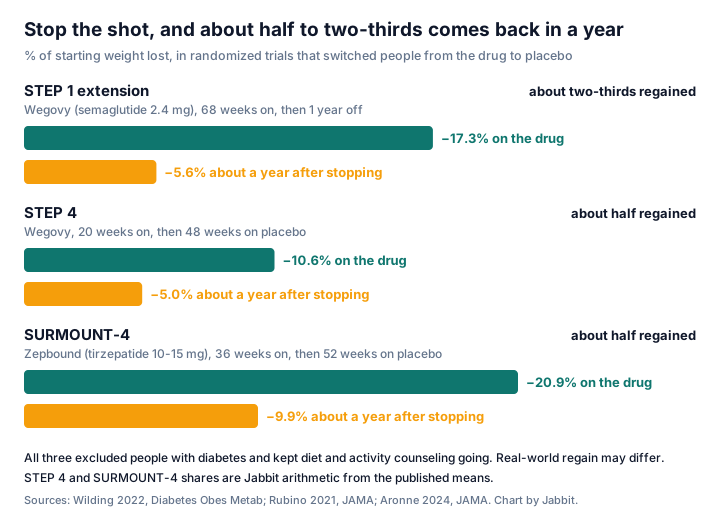
STEP 1 extension (Wegovy). 327 people were followed for a year after semaglutide 2.4 mg and the trial’s lifestyle program both ended at week 68. They had lost 17.3% of their weight. They regained 11.6 percentage points, leaving a net loss of 5.6%. That is about two-thirds of the loss back.[7]
STEP 4 (Wegovy). Everyone took semaglutide for 20 weeks and lost 10.6%. Then 268 people were switched to placebo without being told. Over the next 48 weeks they gained 6.9%, and 82.4% of them gained weight. Those who stayed on the drug lost another 7.9%. By week 68 the placebo group was 5.0% below its starting weight, so about half the loss had come back (our arithmetic).[8]
SURMOUNT-4 (Zepbound). After 36 weeks of tirzepatide 10 or 15 mg, 670 people had lost 20.9%. Those switched to placebo gained 14.0% over the next year. Only 16.6% of them kept at least 80% of their loss, compared with 89.5% of those who stayed on the drug. They ended 9.9% below their starting weight, again about half the loss back.[9]
Across all trials. A 2026 BMJ meta-analysis pooled 37 studies of people who stopped a weight-loss drug. For the newer, stronger incretin drugs, people had lost 14.7 kg by the time they stopped. They regained about 0.8 kg a month, or 9.9 kg in the first year, and the model projects a return to starting weight at about 1.5 years. Across all weight drugs, the average was 0.4 kg a month.[11]
The real-world counterpoint. Health records tell a less uniform story. Among 4,182 patients, about two-thirds had stable weight or kept losing in the 6 months after their last semaglutide or tirzepatide prescription. But when 300 charts were read, only 40% clearly documented that the patient had stopped, so some of the rest may not have stopped at all.[12] Six months is also short. The trials show regain continuing for most of a year.
Food noise: does it come back?
“Food noise” has no standard definition or scale. The closest validated measure is the Control of Eating Questionnaire, which asks how often thoughts of food bothered you and how hungry you felt over the past week, each scored 0 to 100. A University of Pennsylvania trial used it. 120 adults got semaglutide 2.4 mg or placebo, plus lifestyle counseling, for 60 weeks. Then most people on the drug were switched to placebo without being told, for 12 more weeks.[13][14]
The 60-week results were published in June. While people stayed on semaglutide, they kept eating 240 to 290 fewer calories at a buffet lunch than the placebo group. Their lower hunger and food preoccupation, though, stood out only at week 20. By weeks 40 and 60 the difference from placebo was no longer significant.[14] The 12 weeks after stopping were not in that paper. They were posted on ClinicalTrials.gov on August 3:[13]
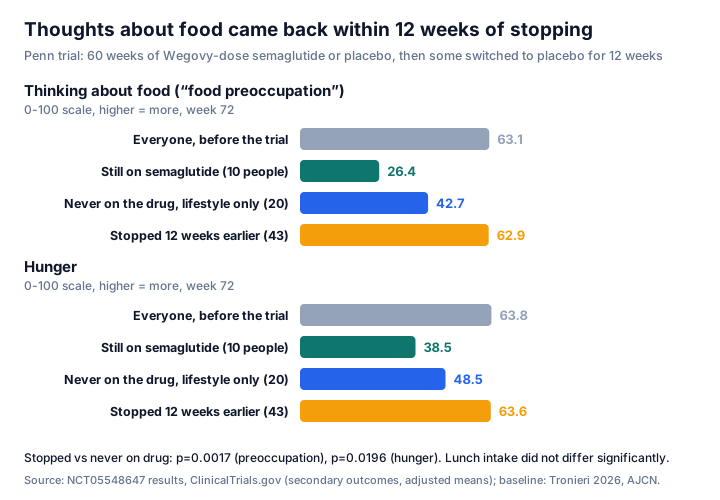
What it shows. Twelve weeks after switching to placebo, food preoccupation scored 62.9, about where the whole trial started (63.1). People who had been on placebo with lifestyle counseling the whole time scored 42.7 (p=0.0017). Hunger followed the same pattern, 63.6 versus 48.5 (p=0.02). The thoughts came back before the weight did: the switched group still weighed 88.9 kg, against 98.3 kg for the always-placebo group.[13]
What it doesn’t show. At the buffet lunch, the switched group did not eat significantly more (952 vs 1,073 kcal, p=0.15). Lab ratings of appetite after a set breakfast didn’t differ either. On a computer task measuring “wanting” of fatty, savory foods, the switched group actually scored lower. These are secondary outcomes from a small trial, with 43 and 20 people compared, and Novo Nordisk was a collaborator.[13] A May 2026 national survey points the same way but proves less. Frequent “food noise” was reported by 26.8% of former GLP-1 users and 16.3% of people who had never used one. It was a single question asked at one point in time, so it can’t show the drug caused anything.[15] If you’re weighing retatrutide’s “no food noise” reputation, our retatrutide review covers what its trials measured. None of them has reported what happens after stopping.
Blood pressure, A1C and cholesterol
In the STEP 1 extension, average systolic blood pressure fell from 129 to 121 mm Hg on semaglutide and was 131 a year after stopping. HbA1c went from 5.7% to 5.2% and back to 5.6%. Triglycerides went from 131 to 96 and back to 122 mg/dL. One gain partly held. Of people who started with prediabetes, 43.3% still had normal blood sugar at the end, compared with 34.0% in the placebo group.[7] In STEP 4, systolic pressure rose 4.4 mm Hg on placebo, compared with 0.5 on semaglutide. LDL cholesterol rose 8% on placebo and 1% on the drug, and triglycerides rose 15% on placebo while falling 6% on the drug.[8]
A Lilly post hoc analysis of SURMOUNT-4 split the placebo group by how much weight came back. The more people regained, the more their waist, cholesterol, A1C and insulin worsened. Blood pressure was the exception: it rose 6.8 mm Hg even in the 54 people who regained less than a quarter of their loss. One possible reading is that part of the blood-pressure benefit comes from the drug itself, not just the weight loss. A post hoc analysis can’t settle that.[10] The BMJ review projected that, across all weight drugs, cardiometabolic markers return to baseline within 1.4 years of stopping. There were too few data to model this for the newer drugs alone.[11]
With type 2 diabetes: all of these withdrawal trials excluded diabetes. The closest evidence is from the shortages. In 71 people whose GLP-1 or tirzepatide-type treatment was interrupted by shortages, HbA1c rose from 6.9% to 7.2% over 12 months. That was a small, single-center chart review.[16]
How many people stop, and why
In the 125,474-person study, 53.6% stopped within a year and 72.2% within two. Without type 2 diabetes the numbers were 64.8% and 84.4%. With diabetes they were 46.5% and 64.1%. People who lost more weight were less likely to stop, and moderate or severe stomach side effects were linked to stopping. Within a year, 36.3% of those without diabetes started again.[3] That cohort began in 2018 and includes liraglutide and the shortage years. A newer claims study suggests persistence has improved since then. Among commercially insured Wegovy and Zepbound starters without diabetes, 33.2% of 2021 starters were still on treatment at a year, compared with 60.9% of those starting in early 2024.[4]
Why do people stop? In a June 2025 national survey of 440 people who had stopped, the top reasons were cost (36.1%), side effects (33.3%), no insurance coverage (28.2%) and reaching a weight goal (26.1%). More than half (54.6%) had stopped within 6 months.[5] At Kaiser Permanente Colorado, the reasons doctors wrote down most often were side effects (26.8%) and cost (14.4%).[6] Our GLP-1 cost guide covers current self-pay prices.
Does tapering help?
Stepping down to a lower dose: yes, partly. SURMOUNT-MAINTAIN is the only finished trial. After 60 weeks on Zepbound 10 or 15 mg, 378 people were randomized to stay on that dose, drop to 5 mg, or switch to placebo for a year. At the end, they were 21.9%, 16.6% and 9.9% below their starting weight. From week 84, anyone who had regained more than half their loss could get rescue tirzepatide. That happened to 8% on the top dose, 25% on 5 mg and 67% on placebo.[17] By Lilly’s on-treatment figures, the 5 mg group regained an average of 5.6 kg of the roughly 24 kg they had lost.[18] The current Zepbound label lists 5 mg as one of the maintenance doses for long-term weight maintenance.[20]
Switching to a pill. In ATTAIN-MAINTAIN, people who had plateaued on Zepbound or Wegovy switched to Lilly’s orforglipron pill (Foundayo) or placebo. On the pill they kept 74.7% (after Zepbound) and 79.3% (after Wegovy) of their earlier loss. On placebo they kept 49.2% and 37.6%. No group stayed on the injection for comparison.[19] Our Foundayo teardown has more.
Less often. A clinic case series moved 30 people at a plateau to an injection every other week, usually at the same dose. Their weight held, going from 74.1 to 72.4 kg over about 36 weeks. But it was retrospective, with no comparison group.[21]
Tapering to zero: no results yet. Only two registered trials compare a gradual taper all the way off with stopping at once. One is Toronto’s REST trial, which cuts the semaglutide dose by 25% every 4 weeks; it has been recruiting since February 2026. The other is in Egypt and has not started.[22][25] Every withdrawal trial above stopped the drug abruptly. So no one can yet say whether a slow taper softens the rebound.
What we counted on ClinicalTrials.gov
We pulled all 1,006 studies on ClinicalTrials.gov that list semaglutide or tirzepatide and read the 119 that mention stopping, tapering, withdrawal or maintenance. Of those, 18 test a way to stop or step down: 7 use a lower dose or slower taper, 3 switch to another drug, and 8 add something during or after stopping, such as fiber, a diet program, an exercise program, a duodenal procedure, or a new drug. 5 have finished. One has posted results.[25] That one is RDX-002, a 68-person phase 2 trial. People on placebo after stopping semaglutide or tirzepatide gained 8.4% of their weight in just 12 weeks, and 24 of 34 gained at least 5%. People on the study drug gained 5.7%, and no statistical comparison was posted.[24] Of the 25 studies we kept, 8 measure appetite, cravings or food thoughts after stopping. Only the Penn trial has posted those results.[25][13]
| Trial | What it tests | People | Status | Results |
|---|---|---|---|---|
| NCT06047548 | SURMOUNT-MAINTAIN (Lilly): stay on Zepbound 10–15 mg vs drop to 5 mg vs placebo | 441 | finished | Published (Lancet); no results posted on the registry |
| NCT07294950 | REST (Toronto): cut semaglutide 25% every 4 weeks to zero vs stop at once | 98 | recruiting | Protocol published |
| NCT07859176 | Alexandria, Egypt, after bariatric surgery: semaglutide stepped down 1.7, 1.0, 0.5, 0.25 mg vs abrupt stop with dummy pens | 100 | not started | None |
| NCT07783854 | Wuhan: semaglutide 1.7 mg cut 25% every 8 weeks vs staying on 1.7 mg | 72 | not started | None |
| NCT07832084 | Pittsburgh: full dose vs lower dose every other week vs switch to phentermine/topiramate | 60 | not started | None |
| NCT07325500 | Houston, adults with HIV: semaglutide 0.5 mg weekly vs nothing after 12 weeks | 30 | recruiting | None |
| NCT07555730 | Wuhan, type 2 diabetes: tirzepatide 5 mg vs an AI-assisted lifestyle program | 400 | not started | None |
The full list, with sponsors, dates and the posted numbers, is in our source file. Keyword searches miss some records. STEP 1 and STEP 4 never use the words, so we added them by hand. Treat these counts as a floor.[25]
Does exercise help?
The best evidence is from S-LiTE, a trial that used liraglutide (Saxenda), an older daily GLP-1. A year after all treatment ended, people who had taken liraglutide alone regained 9.6 kg. Those who had done a year of supervised exercise regained 3.6 kg, and those who did both regained 7.1 kg. Only 109 of 195 came back for that check.[23] In health records, exercise counseling was noted more often for people who kept weight off after their last prescription than for those who regained (26.2% vs 14.7%). That is an association, not proof.[12] No finished trial has tested exercise after stopping semaglutide or tirzepatide. One Washington University trial with 40 people is recruiting and follows participants for a year after the drug stops.[25] Our cardio teardown goes through the exercise evidence in more detail.
Strengths and limits of this evidence
Strengths. The weight findings come from large, double-blind, randomized trials. Each switched people to placebo without telling them, and each found regain. The results agree across semaglutide and tirzepatide, and an independent meta-analysis agrees with them.[7][8][9][11]
Limits. Novo Nordisk or Lilly funded every withdrawal trial except the Penn study, which Novo supported as a collaborator. Both companies sell these drugs for long-term use.[8][9][17][13] All of them excluded people with diabetes. All stopped the drug abruptly. Most followed people for a year or less. Most kept up diet and activity counseling, which real life often doesn’t.[7][8][9] Averages also hide wide spread. In SURMOUNT-4, 54 of 308 people regained less than a quarter of their loss.[10] Real-world records suggest many people’s weight holds for months, but those records often can’t tell who truly stopped.[12] The food-noise result rests on one small trial.[13]
If you’re thinking about stopping
Stopping, stepping down and spacing out doses are all decisions to make with your prescriber. This page doesn’t recommend any of them. The trials suggest a few things worth watching in the months after a change: your weight, hunger and food thoughts, and your blood pressure if you have hypertension. If you have diabetes or prediabetes, watch your A1C too.[7][10][13][16] A plain log of dates, doses and how you feel makes that conversation easier. Jabbit keeps one privately on your iPhone.
Bottom line
What happens when you stop Ozempic, Wegovy, Zepbound or Mounjaro? In randomized trials, about half to two-thirds of the weight came back within a year, and blood pressure, blood sugar and cholesterol mostly followed.[7][8][9] In the one trial that measured them, thoughts about food and hunger returned within 12 weeks, before most of the weight did.[13] Dropping to a lower dose kept more weight off than stopping. Whether a slow taper to zero helps is still unknown: of 18 registered trials of ways to stop or step down, only 1 has posted results.[17][25]
Frequently asked questions
- How fast does weight come back after stopping Wegovy or Zepbound?
- In the randomized trials, people who switched to placebo regained about half to two-thirds of the weight they had lost within about a year. A 2026 BMJ review estimated regain of about 0.8 kg a month after the newer drugs, with a return to starting weight projected at about 1.5 years. Real-world records show more variation: in one large health-record study, about two-thirds of people had stable weight in the 6 months after their last prescription, though many may not have actually stopped.
- Does food noise come back when you stop Ozempic or Wegovy?
- In the only trial we found that measured it after stopping, yes. In a University of Pennsylvania trial, people switched from semaglutide to placebo for 12 weeks reported past-week food preoccupation of 62.9 on a 0–100 scale, about where everyone started (63.1) and well above people who had been on placebo with lifestyle counseling all along (42.7). Hunger rose the same way. Lunch intake measured in the lab did not differ significantly, and the trial is small.
- Does tapering off Zepbound or Wegovy prevent weight regain?
- Stepping down to a lower dose has been tested; tapering all the way to zero has not. In SURMOUNT-MAINTAIN, people who dropped from Zepbound 10–15 mg to 5 mg kept off more weight than those switched to placebo, but less than those who stayed on the top dose, and 25% regained enough to need rescue treatment. The two trials comparing a slow taper to zero with stopping at once have no results yet.
- Will my blood pressure, A1C and cholesterol go back up after stopping?
- Mostly, yes, roughly in step with the weight. In the STEP 1 extension, average systolic blood pressure went from 129 to 121 mm Hg on semaglutide and back to 131 a year after stopping; HbA1c went from 5.7% to 5.2% and back to 5.6%. In SURMOUNT-4, blood pressure rose about 7 mm Hg after stopping tirzepatide even in people who regained less than a quarter of their weight.
- How many people stop GLP-1 drugs, and why?
- In a study of 125,474 US adults, 53.6% stopped within a year, and 64.8% of those without diabetes did. Persistence has improved since the shortages ended: among commercially insured Wegovy and Zepbound starters, 60.9% of those starting in early 2024 were still on treatment a year later. In a national survey, the top reasons for stopping were cost, side effects, lack of insurance coverage and reaching a weight goal.
- Does exercise help keep weight off after stopping a GLP-1?
- Probably, but the best evidence is with an older drug. In the S-LiTE trial, people who stopped liraglutide alone regained 9.6 kg over the next year, compared with 3.6 kg for those who stopped a supervised exercise program. No finished trial has tested this with semaglutide or tirzepatide.
References
- X trending stories (summaries of user posts, not data sources): “High Dropout Rates from Weight-Loss Drugs Spark Talks on Walking Habits” (updated October 13, 2026, 4:46 PM ET; cites “a 2025 study of over 125,000 adults” with 53.6% stopping within a year and 64.8% without diabetes) https://x.com/i/trending/2110107098680082839; “U.S. Adult Obesity Rates Drop to 36.8% Amid GLP-1 Medication Boom” (updated October 11, 2026, 4:00 PM ET) https://x.com/i/trending/2109031954654134273; “Retatrutide Users Report No Food Noise and Major Weight Loss” (updated October 19, 2026) https://x.com/i/trending/2112013837738389567. Checked October 19, 2026.
- Witters D. In U.S., GLP-1 Usage Reaches New High. Gallup, July 7, 2026, updated September 8, 2026 (National Health and Well-Being Index; 11% of adults currently take a GLP-1 for weight loss, up from 3% in 2024; 15% have ever used one for weight loss; obesity 36.8% so far in 2026 in the text, 36.4% in the accompanying chart; self-reported). https://news.gallup.com/poll/712157/glp-usage-reaches-new-high.aspx. Checked October 19, 2026.
- Rodriguez PJ, Zhang V, Gratzl S, et al. Discontinuation and reinitiation of dual-labeled GLP-1 receptor agonists among US adults with overweight or obesity. JAMA Netw Open. 2025;8(1):e2457349. doi:10.1001/jamanetworkopen.2024.57349. PMID 39888616 (Truveta electronic health records, 125,474 adults starting liraglutide, semaglutide or tirzepatide in 2018–2023; 53.6% stopped by 1 year and 72.2% by 2 years; without type 2 diabetes 64.8% and 84.4%; with type 2 diabetes 46.5% and 64.1%; 1-year restart 36.3% without and 47.3% with diabetes; each 1% of weight lost linked to a 3.3% lower hazard of stopping in people without diabetes; moderate or severe GI side effects HR 1.19). https://pubmed.ncbi.nlm.nih.gov/39888616/. Checked October 19, 2026.
- Marshall LZ, Gleason PP, Friedlander N, et al. Trends in 1-year persistence and adherence among initiators of high-potency, weight loss-indicated glucagon-like peptide 1 receptor agonists. J Manag Care Spec Pharm. 2026;32(3):281-291. doi:10.18553/jmcp.2026.32.3.281. PMID 41760566 (Prime Therapeutics claims, 33,607 commercially insured adults without diabetes starting Wegovy or Zepbound; 1-year persistence 33.2% for 2021 starters vs 60.9% for first-half-2024 starters; tirzepatide 64.0% and 64.8% for 2023 and 1H 2024). https://pubmed.ncbi.nlm.nih.gov/41760566/. Checked October 19, 2026.
- DiStefano MJ, Zon J, Olson EG, et al. Discontinuation of glucagon-like peptide-1 receptor agonists among US adults: a national survey. J Manag Care Spec Pharm. 2026;32(8):903-910. doi:10.18553/jmcp.2026.32.8.903. PMID 42504813 (Ipsos survey, June 2025, 440 adults who started and then stopped a GLP-1; 54.6% stopped within 6 months; reasons: cost 36.1%, side effects 33.3%, no insurance coverage 28.2%, reached weight goal 26.1%). https://pubmed.ncbi.nlm.nih.gov/42504813/. Checked October 19, 2026.
- Van Laren J, Friesleben C, Gershovich O, et al. Characterisation of real-world patients who discontinued a glucagon-like peptide-1 agonist. Diabetes Obes Metab. 2026;28(5):3965-3973. doi:10.1111/dom.70579. PMID 41713959 (Kaiser Permanente Colorado, 1,374 people starting semaglutide or liraglutide; 31.7% stopped within 180 days; documented reasons: adverse drug reaction 26.8%, cost 14.4%, non-adherence 11.2%). https://pubmed.ncbi.nlm.nih.gov/41713959/. Checked October 19, 2026.
- Wilding JPH, Batterham RL, Davies M, et al. Weight regain and cardiometabolic effects after withdrawal of semaglutide: the STEP 1 trial extension. Diabetes Obes Metab. 2022;24(8):1553-1564. doi:10.1111/dom.14725. PMID 35441470; PMC9542252; NCT03548935 (327 of 1,961 STEP 1 participants followed for a year after semaglutide 2.4 mg and the lifestyle program both stopped at week 68; semaglutide group lost 17.3%, regained 11.6 percentage points, net 5.6% at week 120; systolic BP 129 to 121 to 131 mm Hg; HbA1c 5.7% to 5.2% to 5.6%; triglycerides 131 to 96 to 122 mg/dL; 43.3% vs 34.0% of those with prediabetes at baseline still had normal glucose at week 120; exploratory; Novo Nordisk funded). https://pubmed.ncbi.nlm.nih.gov/35441470/. Checked October 19, 2026.
- Rubino D, Abrahamsson N, Davies M, et al. Effect of continued weekly subcutaneous semaglutide vs placebo on weight loss maintenance in adults with overweight or obesity: the STEP 4 randomized clinical trial. JAMA. 2021;325(14):1414-1425. doi:10.1001/jama.2021.3224. PMID 33755728; PMC7988425; NCT03548987 (803 adults without diabetes lost 10.6% in a 20-week run-in, then 268 switched to placebo; week 20–68: +6.9% weight on placebo vs −7.9% on semaglutide; week 0–68: −5.0% vs −17.4%; 82.4% of the placebo group gained weight; systolic BP +4.4 vs +0.5 mm Hg; LDL +8% vs +1%, triglycerides +15% vs −6%; Novo Nordisk funded and involved in analysis). https://pubmed.ncbi.nlm.nih.gov/33755728/. Checked October 19, 2026.
- Aronne LJ, Sattar N, Horn DB, et al. Continued treatment with tirzepatide for maintenance of weight reduction in adults with obesity: the SURMOUNT-4 randomized clinical trial. JAMA. 2024;331(1):38-48. doi:10.1001/jama.2023.24945. PMID 38078870; NCT04660643 (783 adults without diabetes; 670 who lost a mean 20.9% over a 36-week lead-in randomized to continue tirzepatide 10–15 mg or switch to placebo for 52 weeks; +14.0% weight on placebo vs −5.5% on tirzepatide; week 0–88 −9.9% vs −25.3%; 16.6% vs 89.5% kept at least 80% of their loss; Lilly funded). https://pubmed.ncbi.nlm.nih.gov/38078870/. Checked October 19, 2026.
- Horn DB, Linetzky B, Davies MJ, et al. Cardiometabolic parameter change by weight regain on tirzepatide withdrawal in adults with obesity: a post hoc analysis of the SURMOUNT-4 trial. JAMA Intern Med. 2026;186(2):157-167. doi:10.1001/jamainternmed.2025.6112. PMID 41284285; PMC12645400 (308 placebo-switched participants who had lost 10% or more; 54 regained under 25% of the loss, 77 regained 25–50%, 103 regained 50–75%, 74 regained 75% or more; systolic BP rose 6.8, 7.3, 9.6 and 10.4 mm Hg; non-HDL cholesterol −0.4%, +1.6%, +8.4%, +10.8%; HbA1c +0.14 to +0.35 points; waist, non-HDL and insulin did not change significantly in the under-25% group; Lilly funded, post hoc). https://pubmed.ncbi.nlm.nih.gov/41284285/. Checked October 19, 2026.
- West S, Scragg J, Aveyard P, et al. Weight regain after cessation of medication for weight management: systematic review and meta-analysis. BMJ. 2026;392:e085304. doi:10.1136/bmj-2025-085304. PMID 41500720; PMC12776922 (37 studies, 9,341 people; across all weight drugs, regain 0.4 kg a month and cardiometabolic markers projected back to baseline within 1.4 years; for the newer, more effective incretin drugs (10 arms, 1,776 people): 14.7 kg lost, regain 0.8 kg a month, 9.9 kg in the first year, projected return to baseline weight at 1.5 years; too few data to model their cardiometabolic markers; funded in part by NIHR; some authors partly funded by a Novo Nordisk Foundation grant). https://pubmed.ncbi.nlm.nih.gov/41500720/. Checked October 19, 2026.
- Murugadoss K, Varma G, Venkatakrishnan AJ, et al. Weight trajectories after last tirzepatide or semaglutide prescription across a federated health network. Biol Methods Protoc. 2026;11(1):bpag020. doi:10.1093/biomethods/bpag020. PMID 42163990 (4,182 patients; about two-thirds had stable weight or kept losing in the 6 months after their last prescription; in 300 charts reviewed with a language model, stopping was documented for only 119 (40%), and 72% of those did not regain; exercise counseling documented in 26.2% of durable losers vs 14.7% of regainers; authors from nference). https://pubmed.ncbi.nlm.nih.gov/42163990/. Checked October 19, 2026.
- ClinicalTrials.gov NCT05548647, University of Pennsylvania with Novo Nordisk as collaborator: Study 1, 120 adults randomized 3:2 to semaglutide 2.4 mg or placebo plus lifestyle counseling for 60 weeks; Study 2, at week 60 semaglutide participants were re-randomized to placebo (switched) or continued drug, and placebo participants stayed on placebo, for 12 weeks. Results first posted August 3, 2026. Week 72 (means adjusted for Study 1 baseline): past-week food preoccupation 62.9 switched vs 42.7 always placebo vs 26.4 continued, p=0.0017 switched vs always placebo; past-week hunger 63.6 vs 48.5 vs 38.5, p=0.0196; fullness after meals p=0.74; Power of Food Scale p=0.12; lab appetite composites p=0.82 and 0.88; buffet lunch 952 vs 1,073 vs 658 kcal, p=0.15; implicit wanting of high-fat savory foods −7.2 vs +4.6, p=0.044; weight 88.9 vs 98.3 vs 85.3 kg; analyzed n = 43, 20 and 10. Secondary outcomes. https://clinicaltrials.gov/study/NCT05548647. Checked October 19, 2026.
- Tronieri JS, Allison KC, DeRouen K, et al. Short- and long-term effects of semaglutide 2.4 mg on energy intake, appetite, and food reward: a 60-week, double-blind randomized controlled trial. Am J Clin Nutr. 2026;124(2):101403. doi:10.1016/j.ajcnut.2026.101403. PMID 42323166 (Study 1 of NCT05548647; semaglutide group ate 292, 240 and 270 kcal less at lunch than placebo at weeks 20, 40 and 60; hunger and food preoccupation were lower at week 20 but not significantly different at weeks 40 or 60; baseline past-week food preoccupation 63.1 and hunger 63.8 for all 120; the 12-week withdrawal phase is not reported in this paper). https://pubmed.ncbi.nlm.nih.gov/42323166/. Checked October 19, 2026.
- Hayashi D, Masterson TD. Prevalence and correlates of perceived food noise among U.S. adults in a nationally representative sample. Obes Sci Pract. 2026;12(5):e70201. doi:10.1002/osp4.70201. PMID 42801078 (Verasight survey, May 2026, 1,000 adults, single self-report item; frequent food noise 17.98% overall, 25.76% in current GLP-1 users, 26.78% in former users, 16.30% in non-users, p=0.009; cross-sectional). https://pubmed.ncbi.nlm.nih.gov/42801078/. Checked October 19, 2026.
- Dacon C, Kale-Pradhan P, Lipari M. Assessing the impact of glucagon-like peptide-1 and glucagon-like peptide-1/glucose-dependent insulinotropic polypeptide receptor agonist shortages on glycemic control: a single center study. J Pharm Pract. 2026 May 5 (online ahead of print). doi:10.1177/08971900261449175. PMID 42084545 (71 people with type 2 diabetes whose incretin therapy was interrupted by shortages; HbA1c 6.9% before to 7.2% at 12 months, P<0.001; retrospective, single center). https://pubmed.ncbi.nlm.nih.gov/42084545/. Checked October 19, 2026.
- Horn DB, Aronne LJ, Wharton S, et al. Tirzepatide for maintenance of bodyweight reduction in people with obesity in the USA (SURMOUNT-MAINTAIN): a multicentre, double-blind, randomised, placebo-controlled trial. Lancet. 2026;407(10545):2305-2318. doi:10.1016/S0140-6736(26)00656-2. PMID 42119587; NCT06047548 (441 enrolled, 60 weeks on tirzepatide 10 or 15 mg, then 378 randomized 3:3:2 to stay on, drop to 5 mg, or placebo for 52 weeks; week 112: −21.9%, −16.6%, −9.9%; rescue tirzepatide for regain over 50% from week 84: 8%, 25% and 67%; no diabetes; Lilly funded). https://pubmed.ncbi.nlm.nih.gov/42119587/. Checked October 19, 2026.
- Eli Lilly and Company. Lilly’s Foundayo and lower-dose Zepbound helped people maintain weight loss after switching from higher doses of injectable incretin therapy in two late-phase trials. Press release, May 12, 2026 (SURMOUNT-MAINTAIN efficacy estimand: 5 mg group 113.4 kg at start, 89.0 kg at week 60, 94.6 kg after 52 weeks, “all but 5.6 kg”; top-dose group 112.2, 89.5, 88.7 kg). https://investor.lilly.com/news-releases/news-release-details/lillys-foundayo-and-lower-dose-zepbound-helped-people-maintain. Checked October 19, 2026.
- Aronne LJ, Horn DB, le Roux CW, et al. Orforglipron for maintenance of body weight reduction: the double-blind, randomized phase 3b ATTAIN-MAINTAIN trial. Nat Med. 2026;32(7):2679. doi:10.1038/s41591-026-04386-7 (published online May 13, 2026). NCT06584916 (376 SURMOUNT-5 completers who reached a plateau on Zepbound or Wegovy switched to the orforglipron (Foundayo) pill or placebo for 52 weeks; share of prior loss kept, treatment-regimen estimand: 74.7% vs 49.2% after Zepbound, 79.3% vs 37.6% after Wegovy; placebo participants could get orforglipron rescue after week 24; no arm stayed on the injection; Lilly funded). https://www.nature.com/articles/s41591-026-04386-7. Checked October 19, 2026.
- Eli Lilly and Company. ZEPBOUND (tirzepatide) injection, prescribing information, revised 08/2026 (indication includes “to reduce excess body weight and maintain weight reduction long term”; recommended maintenance dosage for weight reduction and long-term maintenance is 5 mg, 10 mg or 15 mg once weekly; 2.5 mg is not a maintenance dose; Study 4 is SURMOUNT-4). https://pi.lilly.com/us/zepbound-uspi.pdf. Checked October 19, 2026.
- Wong M, Wu A, Garhe PK, Biermann M. Reduced-frequency GLP1 therapy maintains weight, body composition, and metabolic syndrome improvements: a case series. Obesity (Silver Spring). 2026;34 Suppl 1:112-120. doi:10.1002/oby.70137. PMID 41732031; PMC13250739 (retrospective, 30 adults at a weight plateau on weekly semaglutide or tirzepatide moved to dosing usually every other week at the same dose; weight 87.9 kg before treatment, 74.1 kg at plateau, 72.4 kg after an average 36.3 weeks; no control group). https://pubmed.ncbi.nlm.nih.gov/41732031/. Checked October 19, 2026.
- Yevusiak T, Weisman A, Retnakaran R, et al. Impact of semaglutide withdrawal on cardiometabolic profile and physiology of energy balance: Recovery Effects after Semaglutide Termination – the REST trial study protocol. PLoS One. 2026;21(7):e0354237. doi:10.1371/journal.pone.0354237. PMID 42507673; NCT07294950 (people who lost at least 10% on semaglutide randomized to cutting the dose 25% every 4 weeks to zero over 16 weeks or stopping at once; outcomes include weight, 24-hour blood pressure and ghrelin). https://pubmed.ncbi.nlm.nih.gov/42507673/. Checked October 19, 2026.
- Jensen SBK, Blond MB, Sandsdal RM, et al. Healthy weight loss maintenance with exercise, GLP-1 receptor agonist, or both combined followed by one year without treatment: a post-treatment analysis of a randomised placebo-controlled trial. EClinicalMedicine. 2024;69:102475. doi:10.1016/j.eclinm.2024.102475. PMID 38544798; PMC10965408; NCT04122716 (S-LiTE; after an 8-week diet and a year of exercise, liraglutide 3.0 mg, both, or placebo, 109 of 195 returned a year after treatment ended; regain 3.6 kg after exercise, 9.6 kg after liraglutide, 7.1 kg after both; regain 6.0 kg larger after liraglutide than after exercise; funded by Helsefonden and the Novo Nordisk Foundation). https://pubmed.ncbi.nlm.nih.gov/38544798/. Checked October 19, 2026.
- ClinicalTrials.gov NCT06640972, Response Pharmaceuticals, phase 2: 68 adults without diabetes who had lost at least 10% on semaglutide or tirzepatide and were stopping, randomized to RDX-002 or placebo for 12 weeks. Results first posted July 2, 2026: mean weight change +8.4% on placebo vs +5.7% on RDX-002; 24 of 34 on placebo and 19 of 34 on RDX-002 gained at least 5%; no statistical analysis posted. https://clinicaltrials.gov/study/NCT06640972. Checked October 19, 2026.
- Jabbit analysis of ClinicalTrials.gov (API v2), pulled October 19, 2026, about 6 AM ET: 1,006 unique studies listing semaglutide or tirzepatide as an intervention; 119 matched stopping, tapering, withdrawal or maintenance keywords and were read by hand; 18 test a way to stop or step down (7 lower dose or slower taper, 3 switch to another drug, 8 add something after or while stopping); 4 withdrawal trials and 3 stopping-physiology studies also listed. Keyword searches miss some records (STEP 1 and STEP 4 were added by hand), so counts are a lower bound. Method, study list and posted results: https://jabbitapp.com/research/sources/glp1-stopping-ctgov-2026-10-19.json. Checked October 19, 2026.
This page analyzes published trials, drug labels and trial-registry records. It is not medical advice and does not recommend stopping, tapering or changing the dose of any medicine. The trial-registry review is Jabbit’s own; its inputs are cited above.