Home / Research / GLP-1s and aging clocks
Evidence review · Ozempic, Wegovy and Rybelsus (semaglutide), Zepbound and Mounjaro (tirzepatide) · Novo preprint and ADA poster, Lilly conference data, independent trials, ClinicalTrials.gov review · Sources checked October 19, 2026
Do Ozempic, Wegovy and Zepbound slow aging? Some blood-protein aging clocks read younger in sick, mostly diabetic patients, but that is not proof anyone ages slower.
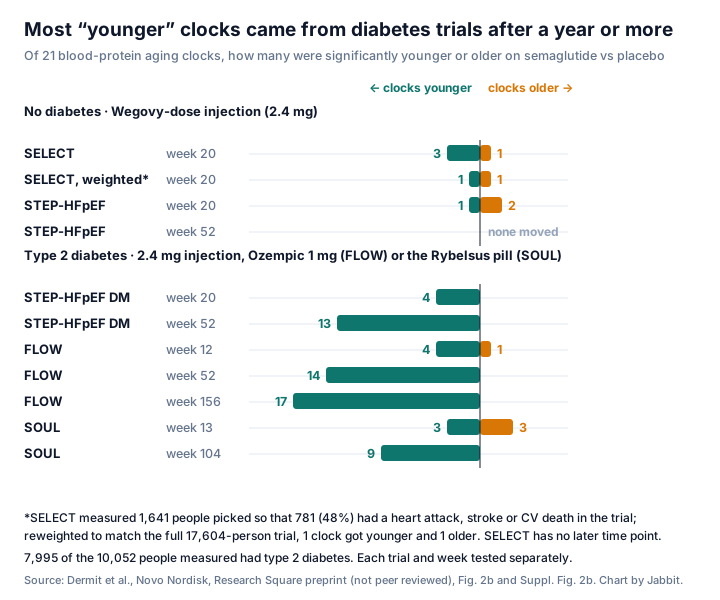
Novo Nordisk and Eli Lilly say people on their GLP-1 drugs show younger “biological age” on molecular aging clocks, by about two to three years overall and up to four for a heart clock.[1] We read Novo’s preprint, its supplement and its earlier poster, and the public accounts of Lilly’s data. The readings are real and mostly point the same way, but they are narrower than the headlines. Of the 10,052 people Novo measured, 80% had type 2 diabetes and more than half took the Rybelsus pill, not a Wegovy shot.[4][22] In SELECT, the big Wegovy heart trial in people without diabetes, blood was tested once after the start, at week 20: 3 of 21 clocks read younger, one read older, and 17 didn’t change.[4][22] The clock that read older was the fat-tissue clock, because the drug lowered leptin, a hormone that falls with fat loss.[4][6] Lilly’s tirzepatide data had no placebo group.[2][10] No clock is an accepted measure of aging, and none of the 8 registered GLP-1 trials with an aging-clock outcome has results.[16][21]
Why this matters now
Both companies showed these data at the Aging Research & Drug Discovery meeting at Harvard, October 1–3.[9] MIT Technology Review broke the story on October 6, and Medical Daily and CNN followed on October 8 and 13.[1][3][2] On X, posts tying GLP-1 drugs to aging clocks or longevity have run at 16 to 33 a day since then. This morning one account was still circulating the line that semaglutide made hearts test “2 to 4 years biologically younger.”[23] For anyone weighing whether to start or stay on one of these drugs, “anti-aging” is now part of the pitch.
The short answer
- What moved: blood-protein estimates of organ age, most consistently a heart clock, 2 to 4 years younger than placebo. Most of the broad changes came from diabetes trials after a year or more.[4][22]
- What didn’t: the clock built from proteins outside the organ sets, the closest thing to a whole-body clock, was “unchanged” in people without diabetes. In one heart-failure trial without diabetes, no clock differed from placebo at one year.[5][4][22]
- What went the wrong way: the fat-tissue clock read older early on, because the drug lowered leptin.[4][6]
- Tirzepatide: two small analyses with no placebo, presented at a conference. There is no paper or preprint.[2][10][9]
- What is proven: fewer heart attacks, strokes and kidney failures in high-risk patients, and fewer deaths from any cause in one kidney trial. None of this has been tested in healthy people.[17][18][19]
What Novo actually measured
Novo used blood samples it had already stored from five of its outcome trials. It ran them on a large protein panel (Olink Explore HT), then applied clocks published in 2025 by Goeminne and colleagues.[4][7] Those clocks were trained in UK Biobank to predict death. Each organ clock is a weighted sum of proteins linked to that organ, converted into “years.” There are 18 organ clocks and 3 combined ones, 21 in all.[4][7]
Who the 10,052 were. SOUL alone contributed 5,255 people with type 2 diabetes taking oral semaglutide, the Rybelsus pill. FLOW added 2,271 with diabetes and kidney disease on 1.0 mg, the Ozempic dose. Only 2,526 (25%) were in trials of the 2.4 mg Wegovy dose, and only 2,057 people did not have diabetes.[4][22] About half of each trial got placebo.[4] Every trial enrolled people who were already sick: heart disease, heart failure, chronic kidney disease or high cardiovascular risk.[4]
SELECT, the Wegovy trial most readers would think of. Blood was tested only at the start and at week 20. The 1,641 people were not a random sample. They were picked to over-represent people who went on to have heart events: 781 of them had a heart attack, stroke or cardiovascular death, against 1,270 of all 17,604 in the trial.[4] At week 20, the heart, kidney and thyroid clocks read younger than placebo, the fat-tissue clock read older, and the other 17 didn’t differ significantly. That included all three combined clocks.[4][22] When Novo weighted the sample to look like the full trial, 1 clock read younger and 1 older.[4][22]
Where the big numbers come from. The clocks moved more over time in the diabetes trials. In FLOW, 17 of 21 clocks read younger than placebo at week 156, and in SOUL 9 did at week 104. In STEP-HFpEF, a heart-failure trial without diabetes, 1 read younger and 2 read older at week 20, and none differed at week 52.[4][22] Novo’s June ADA abstract, which added the STEP 1 and STEP 2 weight-loss trials, reported the combined-organ clock 5.2% lower in SELECT, 4.5% lower in STEP 1 and 7.2% lower in STEP 2.[5]
The “whole body” clock didn’t move
Medical Daily listed a “whole body” clock among those that got younger.[3] The preprint abstract names a “multiorgan” clock. It combines the 569 proteins in the organ clocks.[4][6] A different clock, called organismal, uses the 2,347 proteins that are not organ-specific, so it is the nearest thing to a whole-body reading. Novo’s June ADA abstract says plainly: “We found no effect of semaglutide on organismal biological age.” On the cross-platform data, the poster calls it a “consistent but nonsignificant trend.”[5][6] In the preprint’s chart, the organismal clock did read lower at one year or later in two diabetes trials, STEP-HFpEF DM and FLOW. It did not in SELECT, STEP-HFpEF or SOUL. That reading is ours, from Figure 2a.[4]
What the “younger heart” is made of
The heart clock is seven proteins. Its top contributors include NPPB, the gene for BNP, and TNNI3, cardiac troponin I.[6][8] Doctors already test for those proteins as signs of heart strain and damage. Novo names NPPB among the proteins behind the lower heart score. In its outcome models, NPPB was also the protein most tied to the heart clock’s link with fewer deaths.[4] So in plain terms, a “2 to 4 years younger heart” means lower levels of a few heart-strain proteins. That fits the drug’s known benefits in heart disease and heart failure. It is a different claim from slower aging of the whole body.[4][17]
The clock that got older
In SELECT at week 20, the fat-tissue (adipose) clock read older on semaglutide than on placebo. It did the same early in three other trials.[4][6] The cause was leptin, a hormone fat cells release, which falls as people lose fat. In UK Biobank, where the clock was trained, low leptin may reflect unintended weight loss from frailty or illness. So the clock treats lower leptin as a sign of aging.[4][8] Novo’s authors say this “highlights an important limitation of mortality-trained clocks in interventional studies.” Weight loss was the main driver of this signal, and at later time points the fat-tissue clock read younger.[4] In Novo’s outcome model for SELECT, the adipose clock’s rise offset an estimated 48% of the effect on death from any cause. The heart clock explained an estimated 36%.[4] Lilly’s poster flags the same problem from the other side. The top protein in the artery clock was elastin, which rose more in people who lost more weight. Lilly’s authors say that clock may be tracking “weight-loss-driven elastin turnover, not arterial aging.”[11]
Is it just weight loss?
The companies answer differently. Novo’s mediation analysis found that most heart and kidney clock changes were not explained by weight change, HbA1c or C-reactive protein.[4] At the meeting, Novo’s Aguayo-Orozco added that this doesn’t prove the effect is independent of weight loss.[11] Lilly’s Kevin Duffin told the same audience that the drugs work through blood-sugar reduction and weight loss, and that “the effects we’re seeing are mostly due to that.”[2] One comparison cuts against weight loss as the whole story. A review of 41 human studies lists semaglutide among drugs that lowered at least one epigenetic clock, while a 12-month diet-based weight-loss trial in 112 adults with obesity showed no significant change.[15]
What Lilly showed for Zepbound and Mounjaro
Lilly’s data come from SURMOUNT-5, an open-label trial that randomized 751 adults without diabetes to tirzepatide or semaglutide for 72 weeks.[12] For DNA-methylation clocks, Lilly analyzed 71 people over 50, from the tirzepatide arm only. In the parent trial, which enrolled people without diabetes, average HbA1c was about 5.6%.[11] All 15 clocks advanced less than the 1.38 years that passed, but only 2 differences were statistically significant. DunedinPACE, which estimates pace of aging, went from a median 1.13 to 1.08.[2][10] There was no placebo group, and the reports show no comparison with the semaglutide arm, though the trial had one.[2][10][11] A separate Lilly poster used the same protein clocks as Novo on 301 tirzepatide patients. It found 7 of 18 clocks lower at week 72, again with no placebo.[9][11] We found no paper or preprint for either analysis. Lilly says it plans to extend the work to semaglutide.[10]
Independent studies
The strongest evidence from outside Novo and Lilly is a small randomized trial. Researchers reanalyzed blood from a 32-week trial of semaglutide 1.0 mg in 84 people with HIV and abnormal fat buildup. Several next-generation epigenetic clocks slowed compared with placebo; PhenoAge, for example, by 4.9 years per year, and DunedinPACE by 9%.[13] Clocks weren’t planned in that trial, and two authors work for the epigenetic-testing company TruDiagnostic.[13] In another group of 41 people with HIV and fatty liver, given semaglutide for 24 weeks with no control group, two clocks didn’t slow on average: DunedinPACE rose 0.018 and PCGrimAge 0.54 years.[14] In mice, semaglutide started late in life extended lifespan in females.[20]
What the hard outcomes already show
For the kinds of patients in these analyses, outcome trials have counted real events. In SELECT, semaglutide cut heart attacks, strokes and cardiovascular deaths by 20% over a mean of 39.8 months.[17] In FLOW, it cut death from any cause by 20% in people with diabetes and kidney disease.[18] In SOUL, the pill cut major cardiovascular events by 14%.[19] Those results are the real reason to believe these drugs help sick people live longer. The clocks add a guess at how. In SELECT, the heart clock change accounted for an estimated 36% of the drop in death from any cause. That analysis was exploratory, and the authors say it doesn’t establish “causal mediation.”[4][6]
What we counted on ClinicalTrials.gov
We pulled all 1,040 studies that list semaglutide, tirzepatide or retatrutide and read the 14 that mention biological age, aging clocks, epigenetic age, longevity or senescence. 8 register an aging clock as an outcome, and none has results. 5 are randomized, the largest with 110 people, and only 2 compare against placebo or no drug. All 8 together plan to enroll 1,036 people. None is run by Novo or Lilly, and none tests retatrutide. The trials behind the industry analyses (SELECT, STEP-HFpEF, STEP-HFpEF DM, FLOW, SOUL, STEP 1, STEP 2 and SURMOUNT-5) list no aging-clock outcome, because the clock work was done afterward.[21] The first registered completion date is December 31, 2026. An ARPA-H-funded trial of semaglutide in healthy people in their 60s has been announced, but recruitment isn’t due to start until 2027.[21][3][1]
| Trial | What it tests | Clock | People | Status | Primary completion |
|---|---|---|---|---|---|
| NCT07220473 | UTMB Galveston: tirzepatide 2.5 mg vs no drug, adults 55–70, 24 weeks | DNAm clocks incl. GrimAge, DunedinPACE | 90 | recruiting | 2027-11 |
| NCT07218445 | Mayo Clinic: tirzepatide vs placebo, postmenopausal women with obesity, 24 weeks | Epigenetic clock, senescence markers | 40 | recruiting | 2027-09-18 |
| NCT07057310 | Mayo Clinic: semaglutide or tirzepatide vs lifestyle only, postmenopausal women | Epigenetic clock, senescence markers | 30 | enrolling by invitation | 2026-12-31 |
| NCT07293325 | Zhejiang: semaglutide vs tirzepatide vs metformin, adults with obesity, 24 weeks | iWatchAge methylation clock | 66 | recruiting | 2027-04-02 |
| NCT05356104 | Hong Kong: semaglutide vs standard care, small vessel disease of the brain | Epigenetic age (secondary) | 110 | recruiting | 2027-05 |
| NCT06975111 | Colorado: menopause program; semaglutide offered only in the obesity arm (not randomized) | PhenoAge, GrimAge | 200 | recruiting | 2029-10-31 |
| NCT07707778 | Taiwan: tirzepatide vs standard care in people with HIV (not randomized) | PCGrimAge, DunedinPACE | 60 | enrolling by invitation | 2027-12 |
| NCT07444073 | Singapore: commercial weight-loss program cohort (observational) | LinAge2 clinical-lab clock | 440 | not started | 2026-12-31 |
The full list, with the 6 records we excluded and why, is in our source file.[21]
Strengths and limits
Strengths. Novo’s data are large and randomized. They come from five placebo-controlled trials, and the clocks were published before the analysis and not retrained. The heart clock read younger in all five trials, and a check on a second protein platform in STEP 1 and STEP 2 pointed the same way.[4] The baseline clock readings also predicted later heart and kidney events in placebo patients, so these clocks track something that matters.[4]
Limits. The preprint isn’t peer reviewed, and Novo funded it; 8 of its 12 authors are current or former Novo employees. The two Harvard authors are inventors on a patent application for the clocks they applied.[4][7] Lilly’s data are conference slides without a control group.[10] The clocks both companies used were trained on observational data, not on treated patients, and can misread weight loss.[4][11][10] Each trial and time point was tested separately, with different drug doses and forms, so there is no pooled answer.[4] Researchers have not agreed how to validate any biomarker of aging, and clocks can vary day to day in the same person.[16][2] None of the people tested was a healthy, lean adult.[4][1]
Bottom line
Do Ozempic, Wegovy and Zepbound slow aging? The honest answer is that nobody has shown it. In sick, mostly diabetic patients, semaglutide made several blood-protein clocks read younger, especially a heart clock built largely from heart-strain proteins, and more of them over one to three years.[4][6] In SELECT at week 20, most clocks didn’t move and one moved the wrong way, and the whole-body clock was unchanged in people without diabetes.[4][5][22] Lilly’s tirzepatide data have no placebo.[10] What these drugs have proven is fewer heart, stroke and kidney events in high-risk patients.[17][18][19] Whether they slow aging in healthy people is a question for trials that haven’t reported, and of the 8 registered so far, none has results.[21]
If you’re on one of these drugs, the measures that matter clinically are the usual ones your prescriber tracks: weight, blood pressure, A1C, lipids, kidney function and side effects. A simple log of doses and how you feel helps that conversation. Jabbit keeps one privately on your iPhone.
Frequently asked questions
- Do Ozempic, Wegovy or Zepbound slow aging?
- Nobody knows yet. Novo Nordisk and Eli Lilly report that some blood-based aging clocks read younger on their drugs, but those clocks are estimates that have not been validated as proof of slower aging. The people tested were mostly sick: in Novo’s data, about 80% had type 2 diabetes and all had heart disease, heart failure, kidney disease or high cardiovascular risk. What the drugs have shown in large trials is fewer heart attacks, strokes and kidney failures, and in one kidney trial fewer deaths, in those high-risk groups.
- What did Novo Nordisk find about semaglutide and biological age?
- In a preprint that has not been peer reviewed, Novo applied 21 published blood-protein clocks to 10,052 people in five semaglutide trials. The heart clock read about 2 to 4 years younger than placebo, and kidney, brain, pancreas, lung and combined-organ clocks 1 to 4 years younger at some time points. In SELECT, the large Wegovy heart-outcomes trial in people without diabetes, 3 clocks read younger, 1 read older and 17 did not change at week 20, the only time point measured there.
- What did Lilly find about Zepbound or Mounjaro (tirzepatide) and aging?
- Lilly presented two small analyses at a conference, with no paper or preprint. In 71 people over 50 on tirzepatide, 15 DNA-methylation clocks all advanced less than the 1.38 years that passed, but only 2 of the differences were statistically significant, and there was no placebo or comparison group. A second Lilly poster found 7 of 18 protein clocks lower in the tirzepatide arm, again with no placebo, and its authors said the artery clock may just be tracking elastin changes from weight loss.
- Why did one aging clock get older on semaglutide?
- The adipose (fat-tissue) clock read older early in treatment because leptin fell, as it does when people lose fat. The clock was built from UK Biobank data, where low leptin may reflect frailty or illness, so it counts low leptin as a bad sign. Novo’s own authors say this shows how clocks trained on observational data can misread intentional weight loss. At later time points the adipose clock read younger.
- Should healthy people take a GLP-1 to slow aging?
- There is no evidence for that yet. None of these analyses studied lean, healthy people, and Gladyshev, a Harvard scientist who helped Novo with the analysis, told MIT Technology Review that in a healthy population “no one knows.” Trials in older adults are planned or recruiting. Of 8 registered trials of these drugs that list an aging-clock outcome, none has results yet. The drugs have side effects, and in SELECT twice as many people stopped semaglutide as placebo because of adverse events.
- Are aging clocks accepted proof that a drug slows aging?
- No. Researchers have not agreed how to validate biomarkers of aging, and Novo’s preprint itself says its clock readouts are “not yet surrogate endpoints.” Clocks can also vary from day to day in the same person, which is why one expert quoted by CNN warned against over-reading them.
References
- Regalado A. Weight-loss drugs show signs of slowing biological aging, say drugmakers. MIT Technology Review, October 6, 2026 (Novo’s Nikolaj Roed: “two to three years” overall; heart-protein clock “as much as 4 years”; Steve Horvath: “Two years is a pretty strong effect”; Vadim Gladyshev, “who assisted Novo with its molecular measurements”: “In an unhealthy population, I do think it’s an anti-aging drug. But in a healthy population, no one knows”; Lilly’s Kevin Duffin: “It’s not like we’re going to reverse age by 30 years”; Horvath: not “sufficient evidence that they will benefit skinny people”; side effects including muscle loss; ARPA-H $38 million for a Texas study of semaglutide in healthy people over 60). https://www.technologyreview.com/2026/10/06/1145836/weight-loss-drugs-glp1-lilly-novo-aging-clocks/. Checked October 19, 2026.
- Goodman B. Could GLP-1 drugs be anti-aging medications? CNN, October 13, 2026 (Lilly’s ARDD data: 71 tirzepatide-treated SURMOUNT-5 participants over 50, 72 weeks, 1.38 years of elapsed time, “no placebo group”; Duffin: “the effects we’re seeing are mostly due to” blood-sugar reduction and weight loss; Novo: heart 2 to 4 years, lung, kidney, brain and pancreas 1 to 4 years; James Kirkland: clocks “can vary tremendously from day to day within a person” and “people could overread some of this stuff”). https://www.cnn.com/2026/10/13/health/glp-1-drugs-anti-aging. Checked October 19, 2026.
- Brooks D. Ozempic and Zepbound makers report slower aging clocks, but unreviewed data do not prove patients age slower. Medical Daily, October 8, 2026 (lists “kidney, brain, pancreas, lung, and whole body” clocks; ARPA-H-funded trials at UT Health San Antonio, semaglutide vs dapagliflozin vs rapamycin vs placebo in adults in their 60s, recruitment set for 2027, and at UTMB Galveston, tirzepatide, ages 55 to 70). https://www.medicaldaily.com/glp1-aging-clocks-novo-lilly-unreviewed-data-479718. Checked October 19, 2026.
- Dermit M, Colhoun HM, Goeminne LJE, et al. Semaglutide reduces proteomic organ-specific biological age across randomized clinical trials. Research Square preprint, posted September 22, 2026; not peer reviewed. doi:10.21203/rs.3.rs-11082091/v1 (10,052 participants with Olink proteomics from SELECT 1,641, STEP-HFpEF 416, STEP-HFpEF DM 469, FLOW 2,271 and SOUL 5,255; semaglutide 2.4 mg weekly in the first three, 1.0 mg weekly in FLOW, oral 14 mg daily in SOUL; SELECT proteomics only at week 20, a nested case-control subset in which 781 of 1,641 had MACE vs 1,270 of 17,604 in the full trial; survey-weighted analyses “reduced the number of statistically significant organ-level changes”; heart score supported by NPPB, PXDNL and BMP10; leptin lowering “increased the adipose biological-age score because leptin has a negative coefficient in the model”; adipose increase “largely mediated by weight change”; heart clock mediated an estimated 36% of the effect on all-cause death and 40% on cardiovascular death in SELECT, adipose clock −48% and −54%; proteomic frailty score not significantly changed at week 20 in SELECT; “not yet surrogate endpoints”; funded by Novo Nordisk; 8 of 12 authors current or former Novo employees, Gladyshev on advisory panels for Retro Biosciences and others; Fig. 2a, Fig. 2b, Suppl. Fig. 2b). https://www.researchsquare.com/article/rs-11082091/v1. Checked October 19, 2026.
- Dermit M, Aguayo Orozco A, Voisin SAC, et al. 1703-P: Semaglutide reduces multiorgan proteomic-based biological age across cohorts. Diabetes. 2026;75(Suppl 1):1703-P. doi:10.2337/db26-1703-p (ADA Scientific Sessions, June 2026; SELECT, STEP 1 and STEP 2; multiorgan clock −5.2% in SELECT (p<0.0001), −4.5% in STEP 1 and −7.2% in STEP 2 (p<0.05); “We found no effect of semaglutide on organismal biological age”). https://diabetesjournals.org/diabetes/article/75/Supplement_1/1703-P/167598/1703-P-Semaglutide-Reduces-Multiorgan-Proteomic. Checked October 19, 2026.
- Novo Nordisk ScienceHub. Poster 1703-P, ADA 2026 (SELECT proteomic clocks subset of 1,676, case-enriched for MACE or heart-failure events; organismal clock 2,347 proteins, multiorgan clock 569; heart clock seven proteins, top contributors MYL4, NPPB, NMRK2, TNNI3 and ITGB1BP2; adipose clock FABP4, LEP, CD300LG, PLIN1 and ADIPOQ; adipose clock older at week 20; heart-clock change accounted for “approximately 36% of the all-cause mortality benefit”; organismal clock “consistent but nonsignificant trend” on SomaScan data). https://sciencehub.novonordisk.com/content/dam/sciencehub/global/en/congresses-and-scientific-publications/congresses/ada2026/aguayo-orozco/documents/aguayo-orozco-ada26-longevity-poster-14may26.pdf. Checked October 19, 2026.
- Goeminne LJE, Vladimirova A, Eames A, et al. Plasma protein-based organ-specific aging and mortality models unveil diseases as accelerated aging of organismal systems. Cell Metab. 2025;37(1):205-222.e6. doi:10.1016/j.cmet.2024.10.005. PMID 39488213 (the UK Biobank Olink clocks Novo and Lilly applied; L.J.E.G. and V.N.G. “are the inventors on a U.S. Patent Application related to this work”). https://pubmed.ncbi.nlm.nih.gov/39488213/. Checked October 19, 2026.
- NCBI Gene: NPPB, natriuretic peptide B (alias BNP), Gene ID 4879; TNNI3, troponin I3, cardiac type (alias cTnI), Gene ID 7137; LEP, leptin, Gene ID 3952. https://www.ncbi.nlm.nih.gov/gene/4879; https://www.ncbi.nlm.nih.gov/gene/7137; https://www.ncbi.nlm.nih.gov/gene/3952. Checked October 19, 2026.
- Aging Research & Drug Discovery Meeting (ARDD) 2026, October 1–3, 2026, Harvard University. Poster session abstracts: poster 13, James C, Lin Y, Duffin K, O’Dushlaine C, Haupt A (Eli Lilly), “Organ-specific proteomic age changes in adults with obesity treated with tirzepatide” (SURMOUNT-5 “phase 3b open-label”; post hoc Olink proteomics from 301 participants in the tirzepatide arm only; Goeminne clocks; predicted age +4.5-year offset); poster 35, Dermit M et al. (Novo). https://agingpharma.org/files/ARDD2026_Poster_Abstracts.pdf. Checked October 19, 2026.
- Newman P. Lilly and Novo share GLP-1 longevity data. Longevity.Technology, October 4, 2026 (Lilly’s SURMOUNT-5 epigenetic sub-study: tirzepatide arm only, 71 people with paired baseline and week-72 whole-blood samples, 15 epigenetic clocks, all advanced less than the 1.38 years elapsed, 2 statistically significant; DunedinPACE median 1.13 to 1.08; “single-arm and not placebo-corrected”; some predicted protein changes did not match measured ones). https://longevity.technology/news/lilly-and-novo-share-glp-1-longevity-data/. Checked October 19, 2026.
- Wilczok D. Big Pharma at ARDD: aging clocks in clinical trials, China, and why longevity biotech struggles to secure licensing deals. Regeneration.ai (newsletter), October 9, 2026 (Lilly poster 13: 7 of 18 organ and conventional clocks decreased within the tirzepatide arm, no placebo; elastin (ELN) was the top-weighted artery-clock protein and rose more with more weight loss, so the authors say the artery clock “may be weight-loss-driven elastin turnover, not arterial aging”; the semaglutide arm of the head-to-head trial was not shown; Novo’s Alejandro Aguayo-Orozco said the mediation result is not proof the effect is independent of weight loss). https://www.regeneration.ai/p/big-pharma-at-ardd-aging-clocks-in. Checked October 19, 2026.
- Aronne LJ, Horn DB, le Roux CW, et al. Tirzepatide as compared with semaglutide for the treatment of obesity. N Engl J Med. 2025;393(1):26-36. doi:10.1056/NEJMoa2416394. PMID 40353578; NCT05822830 (SURMOUNT-5; open-label; 751 adults with obesity, no type 2 diabetes; −20.2% vs −13.7% at 72 weeks; Lilly funded). https://pubmed.ncbi.nlm.nih.gov/40353578/. Checked October 19, 2026.
- Corley MJ, Dwaraka VB, Pang AP, et al. Semaglutide slows epigenetic aging in a randomized trial of HIV-associated lipohypertrophy. Nat Commun. 2026;17(1):6606. doi:10.1038/s41467-026-72861-3. PMID 42156721; NCT04019197 (post hoc; semaglutide n=45, placebo n=39, 32 weeks; PhenoAge −4.9 years/year, PCGrimAge −3.1, GrimAge V2 −2.3, DunedinPACE −0.09 (9% slower); “epigenetic aging was not pre-specified”; two authors employed by and one adviser to TruDiagnostic). https://pubmed.ncbi.nlm.nih.gov/42156721/. Checked October 19, 2026.
- Corley MJ, Pang APS, Erlandson KM, et al. Pilot study of epigenetic aging and treatment response to semaglutide in the SLIM LIVER study. NPJ Aging. 2026;12(1):88. doi:10.1038/s41514-026-00383-9. PMID 42014432; NCT04216589 (single arm, 41 people with HIV and fatty liver, semaglutide 1.0 mg for 24 weeks; median change DunedinPACE +0.018, PCGrimAge +0.54 years). https://pubmed.ncbi.nlm.nih.gov/42014432/. Checked October 19, 2026.
- Johnson AA, Sinclair DA. Turning back time: a comprehensive list of interventions that decrease next-generation epigenetic aging clocks in humans. Front Genet. 2026;17:1836446. doi:10.3389/fgene.2026.1836446. PMID 42294499 (41 human studies; semaglutide, exercise, plant-rich diet, caloric restriction and others lowered at least one clock; rapamycin, nicotinamide riboside and senolytics showed no detectable effect; a 12-month diet-based weight-loss trial in 112 adults with obesity (MACRO) showed no significant clock change; clocks “have not yet been thoroughly validated as clinical surrogate endpoints”; first author employed by Tally Health, which sells epigenetic tests). https://pubmed.ncbi.nlm.nih.gov/42294499/. Checked October 19, 2026.
- Moqri M, Herzog C, Poganik JR, et al. Validation of biomarkers of aging. Nat Med. 2024;30(2):360-372. doi:10.1038/s41591-023-02784-9. PMID 38355974 (“no consensus exists on how biomarkers of aging should be validated before their translation to the clinic”). https://pubmed.ncbi.nlm.nih.gov/38355974/. Checked October 19, 2026.
- Lincoff AM, Brown-Frandsen K, Colhoun HM, et al. Semaglutide and cardiovascular outcomes in obesity without diabetes. N Engl J Med. 2023;389(24):2221-2232. doi:10.1056/NEJMoa2307563. PMID 37952131 (17,604 adults with cardiovascular disease and overweight or obesity; MACE 6.5% vs 8.0%, HR 0.80, 95% CI 0.72–0.90; adverse events leading to stopping 16.6% vs 8.2%; Novo funded). https://pubmed.ncbi.nlm.nih.gov/37952131/. Checked October 19, 2026.
- Perkovic V, Tuttle KR, Rossing P, et al. Effects of semaglutide on chronic kidney disease in patients with type 2 diabetes. N Engl J Med. 2024;391(2):109-121. doi:10.1056/NEJMoa2403347. PMID 38785209 (3,533 adults; kidney composite HR 0.76; death from any cause HR 0.80, 95% CI 0.67–0.95; Novo funded). https://pubmed.ncbi.nlm.nih.gov/38785209/. Checked October 19, 2026.
- McGuire DK, Marx N, Mulvagh SL, et al. Oral semaglutide and cardiovascular outcomes in high-risk type 2 diabetes. N Engl J Med. 2025;392(20):2001-2012. doi:10.1056/NEJMoa2501006. PMID 40162642 (9,650 adults; MACE HR 0.86, 95% CI 0.77–0.96; confirmatory secondary outcomes did not differ significantly; Novo funded). https://pubmed.ncbi.nlm.nih.gov/40162642/. Checked October 19, 2026.
- Feng Y, et al. Late-life semaglutide treatment slows ageing and extends lifespan in female mice. Nature. 2026;657(8131):469-476. doi:10.1038/s41586-026-10940-7. PMID 42686906 (20-month-old female mice; compared with matched calorie restriction; the University of California filed a patent application on GLP-1 receptor agonists for healthy ageing). https://pubmed.ncbi.nlm.nih.gov/42686906/. Checked October 19, 2026.
- Jabbit analysis of ClinicalTrials.gov (API v2), pulled October 19, 2026, about 10 AM ET: 1,040 unique studies listing semaglutide, tirzepatide or retatrutide as an intervention; 14 matched biological-age, aging-clock, epigenetic-age, longevity or senescence keywords and were read by hand; 8 register a biological-age clock as an outcome (5 randomized; largest randomized trial 110 people; 1,036 planned participants in all 8); 0 have posted results; none is sponsored by Novo Nordisk or Lilly; none tests retatrutide; SELECT, STEP-HFpEF, STEP-HFpEF DM, FLOW, SOUL, STEP 1, STEP 2 and SURMOUNT-5 register no aging-clock outcome. Method, study list and reasons for each exclusion: https://jabbitapp.com/research/sources/glp1-aging-clock-ctgov-2026-10-19.json. Checked October 19, 2026.
- Jabbit transcription of the preprint’s Table 1, Fig. 2b and Supplementary Fig. 2b (number of the 21 clocks significantly younger or older after Holm–Bonferroni correction, by trial and week), with our arithmetic: 7,995 of 10,052 (79.5%) had type 2 diabetes; 5,255 (52.3%) were in SOUL (oral semaglutide); 2,526 (25.1%) were in the three 2.4 mg trials. https://jabbitapp.com/research/sources/glp1-aging-clock-preprint-counts-2026-10-19.json. Checked October 19, 2026.
- X, October 19, 2026: @PeptidePub, “Novo just ran 10,052 trial participants through proteomic aging clocks and reported semaglutide made hearts test 2 to 4 years biologically younger than placebo” (9:39 AM ET) https://x.com/PeptidePub/status/2112176769726034084. Jabbit count of English posts (no reposts) pairing a GLP-1 drug name with aging-clock, biological-age, anti-aging, longevity or epigenetic terms: 16 to 33 a day, October 13–18 (UTC days), via the X API recent-counts endpoint. Checked October 19, 2026.
This page analyzes a preprint, conference abstracts and posters, published trials, press reports and trial-registry records. It is not medical advice and does not recommend starting, stopping or changing any medicine. The registry review and the counts transcribed from the preprint are Jabbit’s own; their inputs are cited above.