Evidence review · Ozempic, Wegovy and Rybelsus (semaglutide), Zepbound and Mounjaro (tirzepatide), Trulicity, Victoza and Saxenda · NAION, sudden vision loss · Cohort studies, trials, regulators, 9 US drug labels, 835 FDA adverse event reports, federal court data, ClinicalTrials.gov · Sources checked October 20, 2026
Published · Updated
Can Ozempic, Wegovy, Mounjaro or Zepbound cause sudden vision loss? Possibly, but rarely: the biggest studies find about 3 to 10 extra cases of NAION per 10,000 users, Europe, the UK and Australia now warn about it, and US labels still don’t.
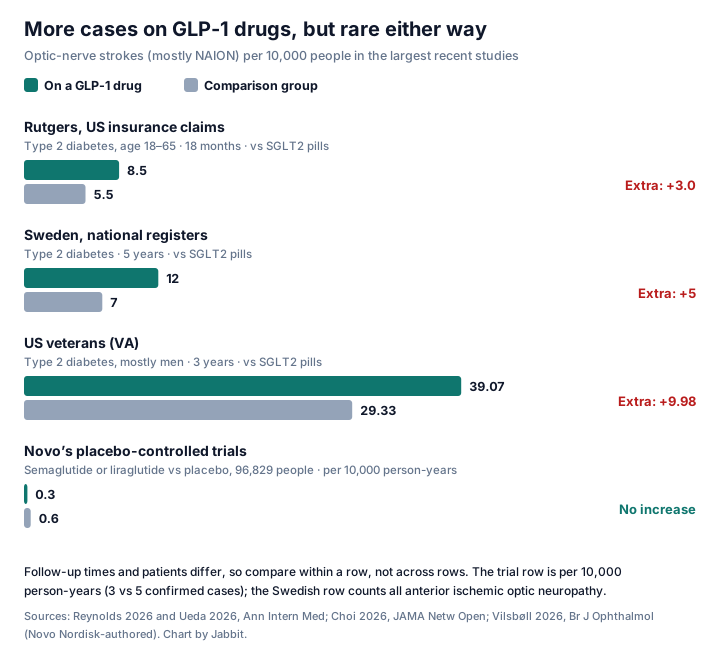
NAION is a stroke of the optic nerve. It usually dims or blurs part of the vision in one eye, without pain, and often permanently.[6][20] The largest recent studies of people with type 2 diabetes found it more often on GLP-1 drugs than on other diabetes pills: 8.5 vs 5.5 per 10,000 over 18 months in one, 39 vs 29 per 10,000 over three years in another.[6][8] Novo Nordisk’s own placebo-controlled trials found no increase, and part of the gap may come from who gets prescribed these drugs.[14][7] Europe and the UK list NAION as a very rare side effect of semaglutide, and Australia added warnings to five GLP-1 drugs in July.[19][20][21] We read all 9 current US labels: none mentions NAION.[23] FDA’s adverse event database holds 835 NAION reports naming a GLP-1 drug, 821 of them received since 2024, and federal vision-loss lawsuits grew from 29 to 247 this year.[25][27]
Why this matters now
On October 10, NPR told the story of Todd Engel, a Maryland man who lost vision in one eye and then the other while taking Ozempic for diabetes, and reported that FDA is still studying the risk.[1] Four days earlier, a study presented at the American Academy of Ophthalmology’s annual meeting found that among people who lost vision in both eyes, GLP-1 users lost the second eye sooner.[2] The Rutgers study recirculated on October 15, and the federal vision-loss litigation reached 247 cases on October 1.[3][27] English posts on X about GLP-1 drugs and vision loss peaked at 33 on October 15 (UTC).[5] NPR, citing Gallup, reports that more than one in 10 Americans are taking a GLP-1 drug for weight loss.[1] Readers want to know if their eyes are at risk and what to watch for.
The short answer
- The risk looks real but small. Most large studies find more NAION on GLP-1 drugs, roughly 3 to 10 extra cases per 10,000 people over 1½ to 5 years.[6][7][8]
- It isn’t proven to be caused by the drugs. Randomized trials haven’t shown a clear increase, the gap shrank in Sweden when researchers compared people with similar diabetes, and the US studies lacked full data on weight and diabetes severity.[14][15][7][6]
- Who is most at risk: men, people over 50, and people with heart disease or other eye conditions. The extra risk was minimal in women and people under 50.[6]
- Regulators disagree. Europe, the UK and Australia warn about it. The FDA hasn’t changed any label, and none of 9 US labels we checked mentions NAION.[19][20][21][23]
- Sudden vision loss is an emergency. Get a same-day eye exam and mention the GLP-1. Don’t stop the drug just because of this risk without talking to your prescriber.[20][21][17]
What NAION is
Non-arteritic anterior ischemic optic neuropathy happens when blood flow to the front of the optic nerve drops. It typically causes sudden, painless vision loss in one eye, often described as blurring or cloudiness.[20] The vision loss is usually permanent. About a third of patients improve somewhat, usually within six months, but some deficit often remains.[6] There is no treatment shown to improve vision afterward.[21]
It is rare to begin with. In people 40 and older, the UK regulator puts the background rate at about 8 to 11 cases per 100,000 people a year. In type 2 diabetes, estimates range from 11 to 82 per 100,000. Diabetes, smoking, high blood pressure and high cholesterol all raise the risk.[20] About 15% of people who have NAION in one eye get it in the other within five years.[2] That overlap is the core problem for research. The people who take GLP-1 drugs are, on average, already at higher risk.
What the studies show
| Study | Who | Finding | Extra cases | Source |
|---|---|---|---|---|
| Rutgers, US claims (Annals, 2026) | Type 2 diabetes, age 18–65, vs SGLT2 or DPP-4 pills | 8.5 vs 5.5 per 10,000 over 18 months | +3.0 to +3.6 per 10,000 | [6] |
| Sweden, national registers (Annals, 2026) | Type 2 diabetes, 293,416 people, vs SGLT2 | 0.12% vs 0.07% over 5 years; RR 1.69 (0.95–3.01) | +5 per 10,000; shrank in metformin users | [7] |
| US veterans (JAMA Netw Open, 2026) | Type 2 diabetes, 588,168 people, vs SGLT2 | 39.07 vs 29.33 per 10,000 over 3 years | +9.98 per 10,000 | [8] |
| US veterans, semaglutide (JAMA Ophthalmol, 2026) | Type 2 diabetes on metformin, 102,361 people | 123 vs 67 per 100,000 person-years; HR 2.33 | about +5.6 per 10,000 a year | [9] |
| Denmark and Norway (DOM, 2025) | Type 2 diabetes, semaglutide vs SGLT2 | HR 2.81 (1.67–4.75) | +1.41 per 10,000 a year | [10] |
| Novo’s placebo-controlled trials (BJO, 2026) | 96,829 people, semaglutide or liraglutide vs placebo | 3 vs 5 confirmed cases | No increase | [14] |
| Multinational records (Ophthalmology, 2025) | Diabetes and/or obesity, semaglutide vs other drugs | No significant link at 1, 2 or 3 years | No significant increase | [13] |
| Mass Eye and Ear (JAMA Ophthalmol, 2024) | Patients referred to neuro-ophthalmologists | HR 4.28 (diabetes), 7.64 (obesity) | Not comparable: referral clinic | [11] |
Most big records studies point the same way. In US insurance claims, Rutgers researchers found 3.0 extra cases per 10,000 GLP-1 users over 18 months compared with SGLT2 pills, and 3.6 compared with DPP-4 pills. That is one extra case for every 3,333 and 2,778 people treated.[6] A VA study of 588,168 veterans found 9.98 extra cases per 10,000 over three years. GLP-1 users weren’t more likely to get other eye diseases, such as diabetic retinopathy or optic neuritis, a check the authors used to test whether the link is specific to NAION.[8] A meta-analysis in Neurology put semaglutide’s relative risk at 2.52.[16]
But confounding is a real possibility. In Sweden, the 5-year risk ratio fell from 1.69 to 1.23, no longer significant, when researchers limited the comparison to people already on metformin. They did that to compare people with similar diabetes severity.[7] Rutgers saw a smaller gap versus SGLT2 pills in people on metformin alone (2.0 vs 5.7 extra cases per 10,000 in people on two or more diabetes drugs), and noted it lacked data on body weight and how long people had diabetes.[6] A large multinational records study found no significant link at all.[13]
Randomized trials haven’t settled it. Novo Nordisk pooled its placebo-controlled semaglutide and liraglutide trials, 96,829 people in all, and found 3 confirmed cases on the drugs and 5 on placebo. Three of the authors work for Novo.[14] An independent meta-analysis counted 5 vs 1 ischemic optic neuropathy events in diabetes trials and 4 vs 1 in weight-loss trials. Neither difference was statistically significant, because the events were so rare.[15] Europe’s safety committee, which had access to trial data, said the trials “also point to a slightly higher risk.”[19]
Weight-loss users and tirzepatide are the gaps. Nearly all the large studies involve people with type 2 diabetes. In observational studies of semaglutide for weight loss, the hazard ratio was 1.57 and not significant.[15] The 2024 Mass Eye and Ear study that started the concern found much larger hazard ratios, but it drew on patients already referred to neuro-ophthalmologists.[11] For tirzepatide, the one large analysis pooled it with semaglutide: 0.04% vs 0.02% over two years.[12] One editorial in Ophthalmology last month summed it up in its title: “An Important Rare Issue, Lacking Adequate Data.”[18]
The second eye. The new AAO meeting study looked at about 1,440 GLP-1 users and 20,700 non-users who lost vision in both eyes. On GLP-1 drugs, 56.8% of second-eye events came within six months, versus 40.6% without them. GLP-1 users also had higher blood sugar, and the study used pooled records, so it can’t show cause. It was a meeting presentation, not a peer-reviewed paper.[2]
Regulators: three warnings and one open study
| Regulator | When | Drugs | What it says | Source |
|---|---|---|---|---|
| European Union (EMA safety committee) | June 2025 | Semaglutide: Ozempic, Wegovy, Rybelsus | “Very rare” (up to 1 in 10,000); about 1 extra case per 10,000 person-years; stop if NAION is confirmed | [19] |
| United Kingdom (MHRA) | February 2026 | Semaglutide | Same frequency and stop rule; ask about private prescriptions; reviewing other GLP-1 drugs | [20] |
| Australia (TGA) | July 2026 | Class-wide: Ozempic, Wegovy, Mounjaro, Trulicity, Saxenda | NAION warnings added to all five; urgent eye exam for sudden vision loss | [21] |
| United States (FDA) | — | None | No label change; Sentinel study posted June 2025, still “In progress” | [22] |
The US labels are silent. We read the current prescribing information for Ozempic, Wegovy, Rybelsus, Zepbound, Mounjaro, Trulicity, Saxenda, Victoza and Foundayo. None mentions NAION, ischemic optic neuropathy or the optic nerve. Seven tell patients to report “changes in vision,” which the prescriber sections tie to a warning about diabetic retinopathy, a different eye disease.[23] The FDA’s Sentinel study of GLP-1 drugs and NAION in type 2 diabetes was posted in June 2025 and is still listed as in progress. The FDA told NPR it will “determine the need for regulatory action” once its assessment is complete.[22][1]
The Viagra precedent. A US label already handles evidence of a similar size with a warning. Viagra’s FDA-approved label tells patients to stop and get care for sudden vision loss. It cites observational risk estimates of 2.15 and 2.27, and it says neither the reports nor the studies prove cause.[24] Europe’s estimate for semaglutide is “approximately two-fold,” but no US semaglutide label carries a similar warning.[19][23]
What FDA’s adverse event reports show
We pulled every report in the FDA Adverse Event Reporting System coded as optic ischaemic neuropathy, the medical term that covers NAION, through June 30, 2026.[25]
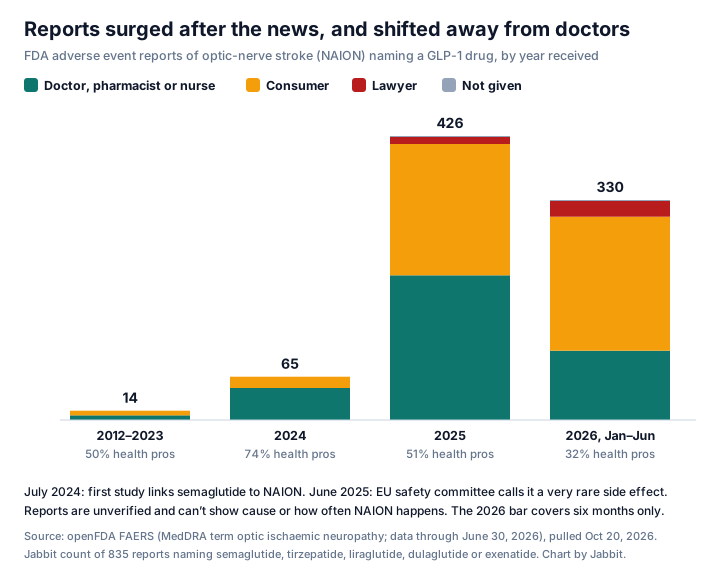
- Almost all of the reports are recent. Of 669 reports naming semaglutide as a suspect drug, 4 arrived before 2024. Then came 57 in 2024, 337 in 2025 and 271 in the first half of 2026.[25] The first study linking semaglutide to NAION came out in mid-2024.[11][1] Sildenafil shows the same pattern: 344 of its 555 NAION reports arrived in 2005–2007.[25]
- Who reports has changed. In 2024, doctors filed 40 of the 65 GLP-1 NAION reports. In early 2026 they filed 68 of 330, while consumers filed 201 and lawyers 24.[25] Reports filed after publicity and lawsuits don’t prove anything either way.
- The patients fit NAION’s usual profile. The median reported age was 60, and 455 of the 528 reports with an age were 50 or older. 425 were men and 308 women. 157 reports were coded as disabling.[25]
- Tirzepatide has fewer reports. FDA has 149 reports naming it as a suspect drug, against 669 for semaglutide, even though FAERS holds about twice as many reports of any kind for tirzepatide.[25]
| Drug | NAION reports | All reports | Per 10,000 |
|---|---|---|---|
| Semaglutide (Ozempic, Wegovy, Rybelsus) | 669 | 80,369 | 83.2 |
| Sildenafil (Viagra; label warns about NAION) | 555 | 130,205 | 42.6 |
| Amiodarone (heart rhythm drug) | 115 | 67,284 | 17.1 |
| Tadalafil (Cialis; label warns about NAION) | 139 | 102,524 | 13.6 |
| Tirzepatide (Zepbound, Mounjaro) | 151 | 160,793 | 9.4 |
| Liraglutide (Victoza, Saxenda) | 26 | 53,265 | 4.9 |
| Empagliflozin (Jardiance, SGLT2) | 26 | 73,564 | 3.5 |
| Dulaglutide (Trulicity) | 30 | 88,299 | 3.4 |
| Dapagliflozin (Farxiga, SGLT2) | 21 | 62,067 | 3.4 |
| Metformin | 151 | 461,399 | 3.3 |
| Sitagliptin (Januvia, DPP-4) | 21 | 98,174 | 2.1 |
Semaglutide’s share of NAION reports is the highest of the 13 drugs we checked, about double that of sildenafil, whose label already warns about NAION. These counts mix suspect and background drugs, which is why metformin shows up. Treat them as a measure of how much attention the issue has drawn, not of risk.[25][24] The UK shows the other extreme. Its Yellow Card scheme had received just 3 reports suggestive of NAION on semaglutide by August 2025, against roughly 10.2 million packs dispensed.[20]
The lawsuits
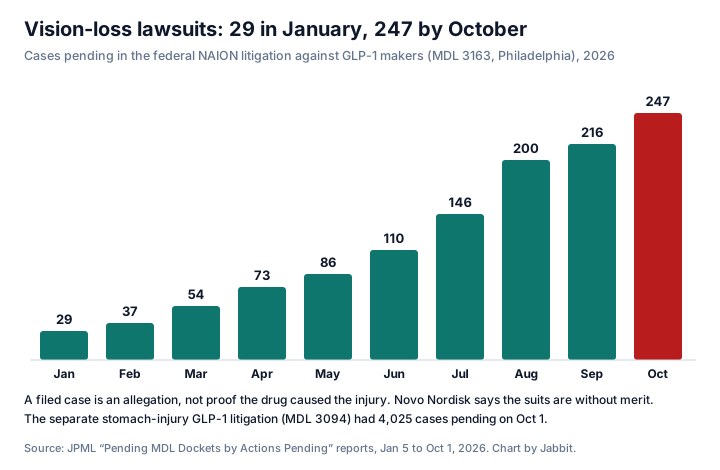
Federal NAION cases against GLP-1 makers were consolidated in Philadelphia in December 2025 under Judge Karen Marston. They numbered 29 on January 5 and 247 on October 1.[27] The biggest jump came between July 1 and August 3, from 146 to 200 cases, around the July 14 publication of the Rutgers and Swedish studies.[27][6][7] A separate GLP-1 stomach-injury litigation has 4,025 pending cases.[27] Novo Nordisk calls the suits without merit, and Eli Lilly says it will “vigorously defend against these claims.”[1][4] One plaintiffs’ firm alone says it represents at least 150 people with NAION after GLP-1 use.[4]
What is being studied
Of 77 studies of NAION or ischemic optic neuropathy registered on ClinicalTrials.gov, one looks at NAION in GLP-1 users. It is a 28-person retrospective chart review in Istanbul, not yet recruiting.[26] No randomized trial registers NAION as an outcome, and we found no registered NAION study run by Novo Nordisk or Eli Lilly. Novo’s 1,500-person FOCUS eye trial of semaglutide tracks diabetic retinopathy and visual acuity but registers no optic nerve outcome, and its primary results are due in late 2027.[26] The study most likely to move US regulators is the FDA’s own Sentinel analysis, which has no published date.[22]
What to do with this
- Know the sign. Sudden blurring, dimming, a dark patch or a missing part of vision in one eye, usually painless. Both patients in the recent news coverage noticed it on waking.[20][6][1][4]
- Treat it as an emergency. UK guidance says to go urgently to eye casualty or A&E. Tell the eye doctor you take a GLP-1 drug, including compounded or private prescriptions, which may not be in your records.[20]
- Don’t stop just because of the headlines. The US ophthalmology societies don’t recommend stopping, and Optometry Australia says people without symptoms shouldn’t be told to stop solely because they take a GLP-1. Decisions belong in a shared discussion with your clinician.[1][21][17]
- If NAION is confirmed, Europe, the UK and Australia say semaglutide should be stopped.[19][20][21]
- Have the risk talk if you are in a higher-risk group. That means men over 50, people with heart disease or eye conditions, and anyone who has already had NAION in one eye.[6][2]
Strengths and limits
Strengths. The largest studies used active comparators, adjusted for dozens of factors and include hundreds of thousands of people from the US, Sweden, Denmark and Norway.[6][7][8][10] Our label, adverse event, registry and court counts are direct reads of primary records.[23][25][26][27]
Limits. Every large study is observational and mostly in type 2 diabetes. None can rule out confounding by diabetes severity or body weight.[7][6] Diagnostic codes for NAION are imperfect; Rutgers had to use a broader code.[6] Trials are too small to detect an event this rare.[15][14] Adverse event reports are unverified, influenced by publicity, and can’t give rates.[25] Data on tirzepatide and on people taking GLP-1 drugs for weight loss alone are thin.[12][15]
Bottom line
If GLP-1 drugs cause NAION, they do so rarely: a few extra cases per 10,000 people over a couple of years, concentrated in older men and people with vascular disease.[6][8] Eye specialists quoted in the coverage say the benefits likely outweigh that risk for most people, and the ophthalmology societies call the overall risk low. But the risk isn’t zero, it is permanent when it hits, and three major regulators now warn about it while US labels don’t.[4][17][19][20][21][23] Knowing the warning sign and acting the same day is the one thing every user can do.
If you ever need to tell an eye doctor exactly when you started, which drug and dose you were on, and when you last injected, Jabbit keeps that as a private, dated log on your iPhone.
Frequently asked questions
- Can Ozempic or Wegovy make you go blind?
- Rarely, it may cause NAION, a stroke of the optic nerve that causes sudden, usually painless vision loss in one eye. It usually blurs or dims part of the vision rather than causing total blindness, and the loss is often permanent. Europe’s and the UK’s drug regulators list it as a very rare side effect of semaglutide, the drug in Ozempic and Wegovy, affecting up to 1 in 10,000 users. Studies disagree on whether the drug causes it or whether people who get these drugs are simply at higher risk.
- How common is NAION on a GLP-1 drug?
- Rare. In the largest recent studies of people with type 2 diabetes, it occurred in about 8.5 per 10,000 GLP-1 users over 18 months versus 5.5 on other diabetes pills, and 39 versus 29 per 10,000 over three years in older, mostly male veterans. That works out to roughly 3 to 10 extra cases per 10,000 people. Novo Nordisk’s pooled placebo-controlled trials found no increase (3 vs 5 cases).
- What are the warning signs, and what should I do?
- Sudden loss of vision in one eye, sometimes noticed on waking: blurring, dimming, a dark patch, or a missing wedge of vision, usually without pain. UK guidance says to go urgently to eye casualty or A&E. Treat it as an emergency, get a same-day eye exam, and tell the doctor you take a GLP-1 drug, including compounded or privately prescribed versions.
- Should I stop my GLP-1 because of the NAION risk?
- Not because of the risk alone. The US ophthalmology societies don’t recommend stopping, Optometry Australia says people without symptoms shouldn’t be told to stop just because they take a GLP-1, and the societies say decisions to start, continue or stop belong in a shared discussion with your clinician. If NAION is confirmed, European, UK and Australian guidance says to stop semaglutide. People who already had NAION in one eye, men over 50 and people with heart disease or other eye conditions have the most to discuss.
- Do Zepbound and Mounjaro (tirzepatide) carry the same risk?
- Less is known. Most studies looked at semaglutide. One US study that pooled semaglutide and tirzepatide found NAION in 0.04% of users vs 0.02% of comparison patients over two years. Australia added the warning to Mounjaro in July 2026, while Europe’s 2025 and the UK’s 2026 warnings cover semaglutide. FDA has received 149 NAION reports naming tirzepatide as a suspect drug, versus 669 for semaglutide.
- Why don’t US labels warn about NAION?
- The FDA hasn’t changed them. Its own Sentinel study has been in progress since June 2025, and it told NPR it will determine the need for regulatory action once that is done. None of the 9 US GLP-1 labels we checked mentions NAION. A US label already warns on similar-sized evidence: Viagra’s label cites a roughly two-fold risk estimate from observational studies, while saying the data don’t prove cause.
References
- Noguchi Y. Serious harms from GLP-1 drugs aren’t well understood. NPR, October 10, 2026 (Todd Engel, Maryland, NAION in one eye on New Year’s Eve after starting Ozempic in early 2023, then the other eye; his lawsuit alleges Novo Nordisk failed to warn; NPR found “more than 1,000 reports of optic neuropathy linked to GLP-1s since 2024” in FDA’s database; plaintiffs’ attorney Jonathan Orent: “Orent’s cases include 247 plaintiffs with NAION”; Novo Nordisk said the cases are without merit; Eli Lilly said it will “vigorously defend against these claims”; FDA said it has undertaken its own study and will “determine the need for regulatory action” once its assessment is complete). https://www.npr.org/2026/10/10/nx-s1-5996652/glp1-fda-naion-blind-lawsuit-ozempic. Checked October 20, 2026.
- American Academy of Ophthalmology. GLP-1 drugs linked to faster vision loss in the second eye, new study finds. News release, October 6, 2026, from the AAO 130th annual meeting, New Orleans (Tin A, Kay MD, et al.; Epic Cosmos records 2015–2025, about 1,440 GLP-1 users vs about 20,700 non-users with NAION in both eyes; second eye affected within 6 months in 56.8% vs 40.6%; shift toward early events about 1.98 times as strong; GLP-1 users had A1C 1.0 to 1.4 points higher; “approximately 15% of patients will develop NAION in the fellow eye within five years”; aggregated data, cannot establish cause; meeting presentation, not a peer-reviewed paper). https://www.aao.org/newsroom/news-releases/detail/glp-1-drugs-linked-to-faster-vision-loss-in-second. Checked October 20, 2026.
- Rutgers University. Ozempic and Wegovy linked to rare risk of sudden vision loss. ScienceDaily, October 15, 2026 (republished Rutgers release on the Annals study). https://www.sciencedaily.com/releases/2026/10/261014015521.htm. Checked October 20, 2026.
- Martin P, Pawlowski A. Woman details losing vision in 1 eye after taking GLP-1 as hundreds of patients sue drug companies. TODAY/NBC News, updated September 22, 2026 (Diane Wirth, 66, Georgia nurse practitioner on Wegovy; suit filed in the Eastern District of Pennsylvania; her firm represents “at least 150 people”; Novo says the suits are “without merit”; Lilly: “We will continue to review data, including any data regarding ophthalmic issues”). https://www.today.com/health/news/vision-loss-ozempic-semaglutide-glp-1-lawsuit-rcna599232. Checked October 20, 2026.
- Jabbit count of English posts on X (no reposts) pairing Ozempic, Wegovy, Mounjaro, Zepbound, semaglutide, tirzepatide or GLP-1 with NAION, vision loss, blindness, “optic nerve” or “eye stroke”: 10, 33, 29, 16, 10 and 11 a day, October 14–19 (UTC days), via the X API recent-counts endpoint. Checked October 20, 2026.
- Reynolds KR, O’Malley KM, Roy JA, Dave CV. Glucagon-like peptide-1 receptor agonists and risk for ischemic optic neuropathy: a target trial emulation. Ann Intern Med. 2026;179(9):1244-1253. doi:10.7326/ANNALS-25-00860. PMID 42441967 (US commercial claims 2017–2022, type 2 diabetes, age 18–65; 18-month ischemic optic neuropathy 8.5 vs 5.5 per 10,000 vs SGLT2 inhibitors, risk difference 3.0, 95% CI 0.4–5.7; 7.8 vs 4.2 vs DPP-4 inhibitors, RD 3.6, 1.1–6.1; numbers needed to harm 3,333 and 2,778; 69 of 81 events in people over 50, 57 in men; risk differences larger in men, people 50 and older and those with cardiovascular or eye conditions, minimal in women and people under 50; attenuated in metformin-only users; no NAION-specific code; funded by NIH). https://pubmed.ncbi.nlm.nih.gov/42441967/. Rutgers news release, July 14, 2026: “approximately three to four additional cases per 10,000 patients treated with GLP-1s over 18 months”; about one-third of NAION patients see some improvement, usually within six months; it typically causes “blurring, dimming or loss of part of the visual field in one eye rather than complete blindness.” https://www.rutgers.edu/news/researchers-find-small-increased-risk-sudden-vision-loss-associated-glp-1-medications. Checked October 20, 2026.
- Ueda P, Svanström H, Söderling J, et al. Glucagon-like peptide-1 receptor agonists and risk for anterior ischemic optic neuropathy: a nationwide cohort study. Ann Intern Med. 2026;179(9):1232-1243. doi:10.7326/ANNALS-25-02096. PMID 42441962 (Sweden 2013–2024; 62 of 107,518 GLP-1 users vs 64 of 185,898 SGLT2 users; 1 year 0.04% vs 0.02%, RR 1.93, 1.00–3.73; 5 years 0.12% vs 0.07%, RD 0.05%, RR 1.69, 0.95–3.01; restricted to metformin users, 5-year RR 1.23, 0.65–2.33; “observed increases in risk may reflect residual confounding”). https://pubmed.ncbi.nlm.nih.gov/42441962/. Checked October 20, 2026.
- Choi T, Al-Aly Z, Xie Y. GLP-1 receptor agonists or SGLT2 inhibitors and nonarteritic anterior ischemic optic neuropathy. JAMA Netw Open. 2026;9(4):e269917. doi:10.1001/jamanetworkopen.2026.9917. PMID 42060307 (US veterans with type 2 diabetes, 2017–2024; 139,546 GLP-1 vs 448,622 SGLT2 initiators, 90% male; 3-year NAION 39.07 vs 29.33 per 10,000, difference 9.98, 95% CI 3.48–14.03, ratio 1.35; consistent with specialist-diagnosed and repeated diagnoses; no difference in diabetic retinopathy, macular degeneration, retinal vascular occlusion or optic neuritis; funded by the VA). https://pubmed.ncbi.nlm.nih.gov/42060307/. Checked October 20, 2026.
- Heberer K, Bress AP, Cogill S, et al. New-onset nonarteritic anterior ischemic optic neuropathy and initiators of semaglutide in US veterans with type 2 diabetes. JAMA Ophthalmol. 2026;144(3):259-264. doi:10.1001/jamaophthalmol.2025.6262. PMID 41678180 (11,478 semaglutide vs 90,883 SGLT2 initiators, all on metformin; 123 vs 67 per 100,000 person-years; HR 2.33, 1.54–3.54). https://pubmed.ncbi.nlm.nih.gov/41678180/. Checked October 20, 2026.
- Simonsen E, Lund LC, Ernst MT, et al. Use of semaglutide and risk of non-arteritic anterior ischemic optic neuropathy: a Danish-Norwegian cohort study. Diabetes Obes Metab. 2025;27(6):3094-3103. doi:10.1111/dom.16316. PMID 40098249 (61,377 semaglutide users with type 2 diabetes, 32 NAION events; pooled HR 2.81, 1.67–4.75; +1.41 per 10,000 person-years; “the absolute risk remains low”). https://pubmed.ncbi.nlm.nih.gov/40098249/. Checked October 20, 2026.
- Hathaway JT, Shah MP, Hathaway DB, et al. Risk of nonarteritic anterior ischemic optic neuropathy in patients prescribed semaglutide. JAMA Ophthalmol. 2024;142(8):732-739. doi:10.1001/jamaophthalmol.2024.2296. PMID 38958939 (patients seen by neuro-ophthalmologists at one academic center; type 2 diabetes HR 4.28, 1.62–11.29, 17 vs 6 events; overweight or obesity HR 7.64, 2.21–26.36, 20 vs 3 events). https://pubmed.ncbi.nlm.nih.gov/38958939/. Checked October 20, 2026.
- Wang L, Volkow ND, Kaelber DC, Xu R. Semaglutide or tirzepatide and optic nerve and visual pathway disorders in type 2 diabetes. JAMA Netw Open. 2025;8(8):e2526327. doi:10.1001/jamanetworkopen.2025.26327. PMID 40788646 (79,699 matched pairs; 2-year NAION 35 vs 19 patients, 0.04% vs 0.02%, HR 1.76, 1.01–3.07; semaglutide and tirzepatide analyzed together). https://pubmed.ncbi.nlm.nih.gov/40788646/. Checked October 20, 2026.
- Chou CC, Pan SY, Sheen YJ, et al. Association between semaglutide and nonarteritic anterior ischemic optic neuropathy: a multinational population-based study. Ophthalmology. 2025;132(4):381-388. doi:10.1016/j.ophtha.2024.10.030. PMID 39491755 (no significant association in type 2 diabetes only, obesity only, or both, at 1, 2 or 3 years). https://pubmed.ncbi.nlm.nih.gov/39491755/. Checked October 20, 2026.
- Vilsbøll T, Arun Kumar D, Aiello LP, et al. Non-arteritic anterior ischaemic optic neuropathy incidence in placebo-controlled clinical trials of liraglutide or semaglutide. Br J Ophthalmol. Published online April 28, 2026. doi:10.1136/bjo-2025-328729. PMID 42049287 (pooled Novo Nordisk phase 2–4 placebo-controlled trials, 96,829 participants; 3 confirmed cases in 3 drug-treated people vs 5 cases in 4 placebo-treated people, about 3 vs 6 per 100,000 participant-years; three authors are Novo Nordisk employees). https://pubmed.ncbi.nlm.nih.gov/42049287/. Checked October 20, 2026.
- Liu Z, Raveendran D, Fourlanos S, Chong EW. Rate and risk of nonarteritic anterior ischemic optic neuropathy with semaglutide use for diabetes and weight loss: a systematic review and meta-analysis. Ophthalmology. 2026;133(5):589-598. doi:10.1016/j.ophtha.2025.12.022. PMID 41475544 (8 RCTs, 31,174 patients, and 8 observational studies, 1,611,278 patients; diabetes observational 26.7 vs 18.9 per 100,000 person-years, HR 1.85, 1.20–2.85; diabetes RCTs 5 vs 1 events, RR 1.76, 0.43–7.25; weight-loss observational HR 1.57, 0.69–3.59; weight-loss RCTs 4 vs 1, RR 2.18, 0.33–14.34). https://pubmed.ncbi.nlm.nih.gov/41475544/. Checked October 20, 2026.
- Dhivagaran T, Butt F, Arunasalam L, et al. Glucagon-like peptide-1 receptor agonists and risk of nonarteritic anterior ischemic optic neuropathy: systematic review and meta-analysis. Neurology. 2026;106(10):e214864. doi:10.1212/WNL.0000000000214864. PMID 42060879 (5 studies, 1,593,554 patients; semaglutide RR 2.52, 95% credible interval 1.56–4.72; low-to-moderate certainty). https://pubmed.ncbi.nlm.nih.gov/42060879/. Checked October 20, 2026.
- DeParis SW, Oke I, Gaier ED, et al. Glucagon-like peptide-1 receptor agonists and the risk of non-arteritic anterior ischemic optic neuropathy: a consensus statement by the North American Neuro-Ophthalmology Society and the American Academy of Ophthalmology. Ophthalmology. 2026;133(8):1029-1035. doi:10.1016/j.ophtha.2026.04.008. PMID 42132708 (“the overall magnitude of the risk of NAION remains low”; “Shared decision-making between each patient and their care team is warranted to decide whether to start, continue, or discontinue GLP-1 RAs”). https://pubmed.ncbi.nlm.nih.gov/42132708/. Checked October 20, 2026.
- Kupersmith MJ. Nonarteritic anterior ischemic optic neuropathy and glucagon-like peptide-1 agonist therapies: an important rare issue, lacking adequate data. Ophthalmology. Published online September 18, 2026. doi:10.1016/j.ophtha.2026.08.024. PMID 42758068 (editorial; title quoted). https://pubmed.ncbi.nlm.nih.gov/42758068/. Checked October 20, 2026.
- European Medicines Agency. PRAC concludes eye condition NAION is a very rare side effect of semaglutide medicines Ozempic, Rybelsus and Wegovy. June 6, 2025 (revised June 13, 2025): “very rare” (“may affect up to 1 in 10,000 people taking semaglutide”); in type 2 diabetes about a two-fold increase, “approximately one additional case of NAION per 10,000 person-years of treatment”; “If NAION is confirmed, treatment with semaglutide should be stopped”; “Data from clinical trials also point to a slightly higher risk.” https://www.ema.europa.eu/en/news/prac-concludes-eye-condition-naion-very-rare-side-effect-semaglutide-medicines-ozempic-rybelsus-wegovy. Checked October 20, 2026.
- Medicines and Healthcare products Regulatory Agency. Semaglutide (Wegovy, Ozempic and Rybelsus): risk of non-arteritic anterior ischemic optic neuropathy (NAION). Drug Safety Update, February 5, 2026 (up to 1 in 10,000; discontinue if confirmed; “privately prescribed semaglutide may not appear on the patient’s medical history”; 3 UK Yellow Card reports suggestive of NAION from 2018 to August 1, 2025, against roughly 10.2 million packs dispensed in 5 years; background NAION incidence 11.4 to 82 per 100,000 person-years in type 2 diabetes and 7.73 to 11.35 per 100,000 in people 40 and older; “The MHRA is reviewing any evidence for an association with other GLP-1 agonists”). https://assets.publishing.service.gov.uk/media/69847cb7468d351e1406b4d2/DSU_-_Semaglutide_and_NAION_-_5_Feb_2026.pdf. Checked October 20, 2026.
- Optometry Australia. TGA safety alert: GLP-1 medicines and rare, severe vision loss. July 23, 2026 (Product Information for Trulicity, Ozempic and Wegovy, Mounjaro and Saxenda updated with NAION warnings; for semaglutide, treatment should be stopped if NAION is confirmed; “currently no treatment shown to improve visual acuity outcomes following NAION”; patients without symptoms should not be advised to stop solely because they take a GLP-1; no routine screening requirement). https://www.optometry.org.au/patient_care_management/tga-safety-alert-glp-1-medicines-and-rare-severe-vision-loss/. TGA’s own notice, GLP-1 RAs and rare vision disorder, returned server errors to our fetches. Checked October 20, 2026.
- FDA Sentinel Initiative. Risk of non-arteritic anterior ischemic optic neuropathy (NAION) following GLP-1 receptor agonist use in patients with type 2 diabetes mellitus. Posted June 12, 2025; status “In progress”; revised protocol approved for implementation by August 1, 2025; claims data January 2018 to June 2024 compared with SGLT2 inhibitors. https://sentinelinitiative.org/studies/drugs/individual-drug-analyses/risk-non-arteritic-anterior-ischemic-optic-neuropathy-naion. Checked October 20, 2026.
- Jabbit scan of the current DailyMed prescribing information (versions re-checked against DailyMed history October 20, 2026): Foundayo (v10, 2026-07-29), Mounjaro (v40, 2026-08-27), Ozempic (v20, 2026-06-01), Rybelsus (v14, 2026-01-30), Saxenda (v22, 2026-02-25), Trulicity (v62, 2026-06-16), Victoza (v31, 2025-10-14), Wegovy (v19, 2026-06-18), Zepbound (v40, 2026-08-28). None mentions NAION, ischemic optic neuropathy or the optic nerve. Seven tell patients to report “changes in vision,” which each label’s counseling section places under a diabetic retinopathy heading; Saxenda and Victoza mention blurred vision only as a low-blood-sugar symptom. Matched sentences: https://jabbitapp.com/research/sources/glp1-naion-faers-labels-2026-10-20.json. Checked October 20, 2026.
- Viagra (sildenafil) prescribing information, Viatris, DailyMed set d905dc8d-917f-4ea3-a4ee-a1ecf6967d4e, version 6, effective November 17, 2023: warns that sudden vision loss may be NAION, “reported rarely post-marketing in temporal association with the use of all PDE5 inhibitors”; “An observational case-crossover study … suggest[s] an approximate 2-fold increase in the risk of NAION, with a risk estimate of 2.15 (95% CI 1.06, 4.34)”; neither the reports nor the studies “substantiate a causal relationship.” https://dailymed.nlm.nih.gov/dailymed/drugInfo.cfm?setid=d905dc8d-917f-4ea3-a4ee-a1ecf6967d4e. Checked October 20, 2026.
- Jabbit analysis of FDA Adverse Event Reporting System data via openFDA (drug/event endpoint, last updated July 30, 2026; receive dates through June 30, 2026), pulled October 20, 2026: reports coding the MedDRA term optic ischaemic neuropathy, which covers NAION. 835 reports name semaglutide, tirzepatide, liraglutide, dulaglutide or exenatide; as suspect drug: semaglutide 669, tirzepatide 149, dulaglutide 28, liraglutide 24. Reporter type, physician/pharmacist/other health professional/consumer/lawyer, by year, and per-drug totals for 8 comparison drugs are in the source file. FAERS reports are unverified, can’t establish cause and can’t give rates. Checked October 20, 2026.
- Jabbit review of ClinicalTrials.gov (API v2), pulled October 20, 2026, about 8:15 AM ET: 77 studies with NAION or ischemic optic neuropathy as a condition or pairing those terms with GLP-1 drug names (12 with posted results); 6 mention a GLP-1 drug, and 1 studies NAION in GLP-1 users (NCT07846956, Istanbul, 28 people, retrospective, not yet recruiting, completion estimated November 30, 2026); the others concern Wolfram syndrome, idiopathic intracranial hypertension or prediabetes. Novo Nordisk’s FOCUS eye trial (NCT03811561, 1,500 people, primary completion estimated November 7, 2027) registers diabetic retinopathy and visual acuity outcomes but no optic nerve outcome. Method and reasons: https://jabbitapp.com/research/sources/glp1-naion-faers-labels-2026-10-20.json. Checked October 20, 2026.
- United States Judicial Panel on Multidistrict Litigation. MDL Statistics Report: Distribution of Pending MDL Dockets by Actions Pending, reports dated January 5, February 2, March 2, April 1, May 1, June 1, July 1, August 3, September 1 and October 1, 2026 (MDL 3163, In re: GLP-1 RAs Non-Arteritic Anterior Ischemic Optic Neuropathy Products Liability Litigation, E.D. Pa., Judge Karen S. Marston, transferred December 15, 2025: 29, 37, 54, 73, 86, 110, 146, 200, 216 and 247 actions pending; MDL 3094, GLP-1 RAs Products Liability Litigation: 4,025 pending on October 1, 2026). https://www.jpml.uscourts.gov/sites/jpml/files/Pending_MDL_Dockets_By_Actions_Pending-October-1-2026.pdf. Checked October 20, 2026.
This page analyzes published cohort studies, trials, meta-analyses, regulator notices, drug labels, FDA adverse event reports, court statistics and trial-registry records. It is not medical advice. It does not recommend starting, stopping or changing any drug. Sudden vision loss needs urgent in-person care. The label, adverse event, registry and court analyses are Jabbit’s own; their inputs are cited above.