Evidence teardown · Ozempic · Wegovy · Zepbound · Mounjaro · GI safety · Healthy aging · Updated October 28, 2026
Published · Updated
Do Ozempic, Wegovy and Zepbound cause gastroparesis, pancreatitis or bowel obstruction?
This week a GLP-1 safety story trended on X, and widely shared posts repeated the same numbers: roughly 9 times the pancreatitis risk, 4 times the bowel obstruction risk and 3.6 times the gastroparesis risk, drawn from 16 million records. Those figures come from a 2023 JAMA research letter, and the 9x pancreatitis figure rests on 2 cases in the semaglutide group and 1 case in the comparison group.[1] Our plain answer: these drugs do slow the stomach, and some newer large studies link them to more gastroparesis diagnoses. But the extra risk in absolute terms looks like about 1% or less a year, and randomized trials have not shown a clear rise in pancreatitis or bowel obstruction.[11][4][5][7] The best-supported serious digestive risk is gallbladder disease.[2][12]
Why this matters now
New research keeps arriving. In October 2026 a review in the Journal of Internal Medicine concluded that, for acute pancreatitis and intestinal obstruction, “evidence regarding causality remains uncertain.”[2] A five-year records study of 78,277 GLP-1 users was published the same month, and a Chinese study posted as a preprint (not yet peer-reviewed) reported a doubled gastroparesis risk.[3][13] Meanwhile, the federal court panel that tracks mass lawsuits listed 4,025 pending cases in the combined GLP-1 product-liability litigation as of October 1, 2026.[17] Those are allegations, not findings, and we come back to them below.
| Date | Event |
|---|---|
| Oct 2023 | JAMA research letter reports the 9.09, 4.22 and 3.67 hazard ratios from US insurance claims[1] |
| Apr 2024 | Meta-analysis: semaglutide-class drugs delay stomach emptying by about 36 minutes on the gold-standard scan[11] |
| Jun 2025 | Gastroenterology meta-analysis of 55 placebo-controlled trials: gallstones and reflux up, little or no effect on other GI events[7] |
| Jun to Aug 2026 | Large cohort studies and a pancreatitis meta-analysis published[5][4][8] |
| Oct 1, 2026 | Court panel lists 4,025 pending actions in MDL 3094, the GLP-1 litigation[17] |
| Oct 2026 | Journal of Internal Medicine review, five-year GI symptom study, opioid study, preprint posted[2][3][6][13] |
Where the “9x pancreatitis” number comes from
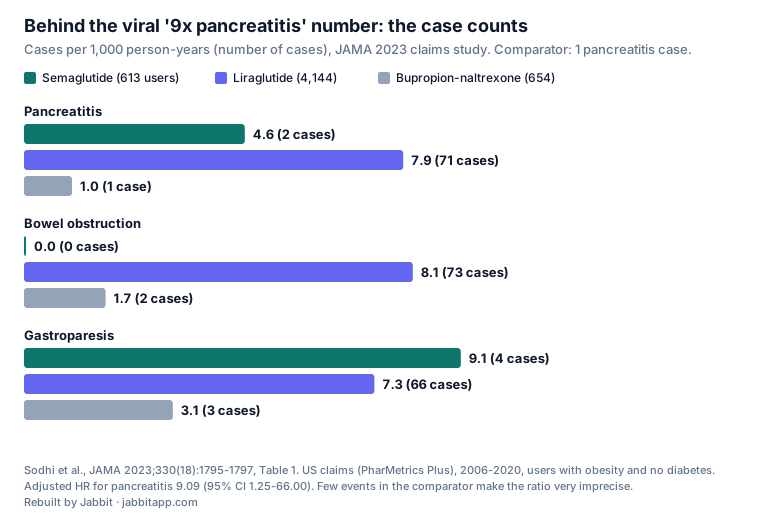
The study used a random sample of 16 million patients from a US insurance-claims database, covering 2006 to 2020. But it compared only 613 semaglutide users and 4,144 liraglutide users with 654 people taking bupropion-naltrexone, another weight-loss drug.[1] With groups that small, each case moves the result a lot:
- Pancreatitis: 2 cases on semaglutide and 71 on liraglutide, against 1 case on bupropion-naltrexone. The adjusted hazard ratio was 9.09, but the 95% confidence interval ran from 1.25 to 66.[1]
- Bowel obstruction: 0 cases on semaglutide. The 4.22 ratio came from liraglutide (73 cases) against 2 comparator cases (interval 1.02 to 17.4).[1]
- Gastroparesis: 4 cases on semaglutide and 66 on liraglutide, against 3 comparator cases. The ratio was 3.67 (1.15 to 11.9).[1]
The groups also differed: 82.4% of bupropion-naltrexone users were men, compared with 55.8% of semaglutide users and 61.0% of liraglutide users. The authors also wrote that whether the GLP-1 drugs “were all used for weight loss is uncertain.”[1] In our analysis, this was a reasonable early safety signal, which is what a research letter is for. It was never a precise estimate of how much more likely you are to get pancreatitis. Viral posts that quote “9x” without the case counts or the interval leave out the most important context.
What randomized trials show
Randomized trials are the best test of cause, because they compare similar people assigned at random. A 2025 meta-analysis of 55 placebo-controlled trials with 106,395 participants found more gallstones (2 more cases per 1,000 people) and more reflux (4 more per 1,000). It concluded the drugs “probably have little or no effect” on other GI or biliary events, a list that included pancreatitis, intestinal obstruction, ileus and gastroparesis.[7] A 2026 network meta-analysis of 50 trials found no GLP-1 drug that significantly raised obstruction risk.[10]
The FDA labels give the pancreatitis counts from the makers’ own trials. The absolute rates are low in both the drug and comparison groups:[14][15][16]
| Label (trials) | Drug | Comparison |
|---|---|---|
| Wegovy (weight trials) | 4 cases, 0.2 per 100 patient-years | Placebo: 1 case, under 0.1[14] |
| Ozempic (diabetes trials) | 7 cases, 0.3 per 100 patient-years | Comparators: 3 cases, 0.2[15] |
| Zepbound (weight trials) | 0.2%, 0.14 per 100 years of exposure | Placebo: 0.2%, 0.15[16] |
Trials also catch severe GI side effects in general, mostly severe nausea, vomiting or diarrhea. The Wegovy label reports 4.1% compared with 0.9% on placebo. For Zepbound the figures are 1.7% to 3.1% by dose arm compared with 1%, and for Ozempic 0.4% to 0.8% compared with 0%.[14][16][15] The catch is that trials last one to two years and enroll selected patients, so rare problems may not show up.
What the newer real-world studies show
Large records studies can pick up rare events that trials miss, but they cannot rule out other explanations. Their results point in different directions:
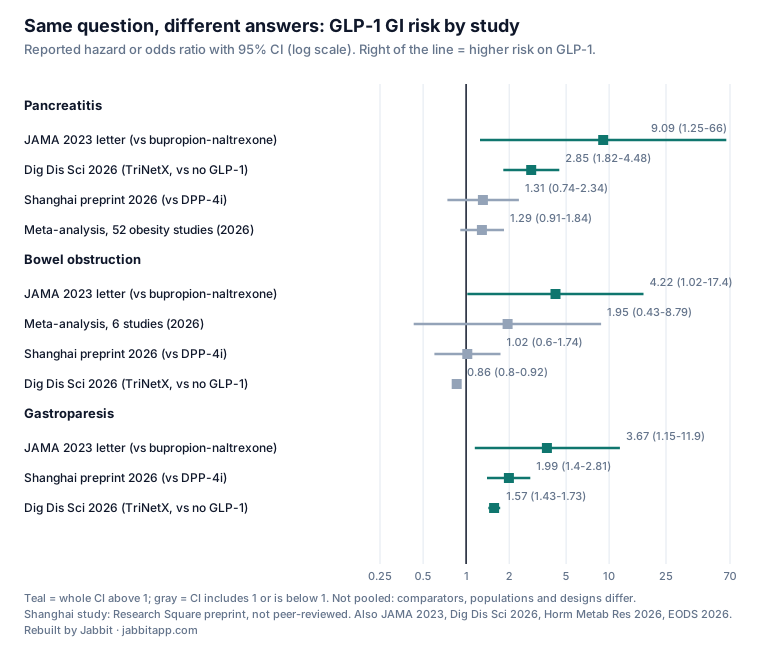
- A 2026 Diabetes, Obesity and Metabolism study compared 313,342 matched pairs of GLP-1 users with users of SGLT-2 inhibitors, another diabetes drug class. A combined outcome of severe constipation, gastroparesis or obstruction occurred in 1.02 compared with 0.75 per 100 person-years (HR 1.37). In Jabbit’s arithmetic, that difference of 0.27 is about 1 extra event per 370 person-years of treatment.[5]
- A 2026 Digestive Diseases and Sciences study (164,987 people per group) linked GLP-1s to more gastroparesis (HR 1.57) and more coded drug-induced pancreatitis (HR 2.85). But bowel obstruction was lower (HR 0.86), as were ER visits and hospital admissions.[4]
- The Shanghai preprint (2,656 GLP-1 users compared with 26,560 DPP-4 inhibitor users) found gastroparesis HR 1.99, with no significant change in pancreatitis (1.31) or obstruction (1.02). It has not been peer-reviewed.[13]
- Meta-analyses: pooled pancreatitis OR 1.29 (0.91 to 1.84, not significant).[8] A 2026 meta-analysis of obstruction found a non-significant OR of 1.95 with very high heterogeneity (I² 94%).[9]
Gastroparesis: the most consistent signal, with a caveat
Slower stomach emptying is part of how these drugs work. A 2024 meta-analysis found an average delay of 36 minutes on scintigraphy, the gold-standard scan.[11] So it is not surprising that records studies find more gastroparesis diagnoses.[4][5][13] The caveat: in a 2026 study of 78,277 GLP-1 users, 696 people with symptoms were sent for a gastric emptying scan, and only 34.6% of them actually had delayed emptying.[3] In our analysis, this means a “gastroparesis” code in a database can include people with nausea or fullness whose stomach empties normally. Some studies may count symptoms as the disease.
All three labels say the drug is “not recommended in patients with severe gastroparesis.”[14][15][16] Slower emptying is also why the Wegovy label notes “rare postmarketing reports of pulmonary aspiration” during surgery and sedation. If you have a procedure planned, tell the care team you take a GLP-1.[14]
Bowel obstruction: conflicting evidence
The labels list “ileus, intestinal obstruction, severe constipation including fecal impaction” under postmarketing reports. For those reports the labels say it is “not always possible to reliably estimate their frequency or establish a causal relationship to drug exposure.”[14][15][16] The study evidence conflicts. One 2026 meta-analysis found liraglutide linked to more obstruction (OR 3.0), but a network meta-analysis of randomized trials found it linked to less (OR 0.44).[9][10] The largest new cohort found obstruction slightly lower on GLP-1s.[4] Other medicines matter too. In people with diabetes on a GLP-1 who started an opioid painkiller, the 30-day risk of a motility-related GI event was 0.51% with oxycodone, compared with 0.33% with tramadol.[6]
The risk with the strongest evidence: gallbladder
Experts disagree about pancreatitis and obstruction, but gallbladder disease has stronger evidence. A 2022 meta-analysis of 76 trials found a 37% higher relative risk of gallbladder or biliary disease, more than doubled (RR 2.29) in weight-loss trials.[12] The October 2026 review called it the outcome with “the most consistent evidence supporting a causal association.”[2] In the Wegovy weight trials, gallstones were reported in 1.6% compared with 0.7% on placebo.[14]
What about the lawsuits?
The Judicial Panel on Multidistrict Litigation report dated October 1, 2026 lists MDL 3094, “In re: Glucagon-like Peptide-1 Receptor Agonists (GLP-1 RAs) Products Liability Litigation,” in the Eastern District of Pennsylvania with 4,025 actions pending (4,139 filed in total).[17] A lawsuit count tells you how many claims were filed, not whether the claims are right. It is not evidence that any drug caused any person’s injury, and the report says nothing about the merits.
The longevity question
For people thinking long-term, the useful question is not “is there any risk?” but “how big is it compared with what the drug does for me?” The October 2026 review makes that point: because these events are rare, “even substantial relative risk increases generally correspond to small absolute risk increases in broad populations but may become relevant in patients with high baseline risk.”[2] In practice, that means people with prior pancreatitis, gallstones, existing gastroparesis or bowel surgery, or those taking opioids, have the most reason to go over these risks with a prescriber.[2][6][14]
What a careful reader should notice
- A hazard ratio built on 1 comparator case can be very large and very uncertain at the same time (interval 1.25 to 66).[1]
- A relative risk is not an absolute risk. The best-measured combined GI-obstruction difference was 0.27 events per 100 person-years.[5]
- Records studies depend on diagnosis codes. Only about a third of symptomatic users who were tested had delayed emptying.[3]
- Different comparison drugs (bupropion-naltrexone, SGLT-2 inhibitors, DPP-4 inhibitors or no GLP-1) give different answers.[1][5][13][4]
- Preprints and lawsuit counts are not settled evidence.[13][17]
FAQ
- Does Ozempic cause gastroparesis?
- Semaglutide slows stomach emptying, by about 36 minutes on average on scans, and large 2026 records studies link GLP-1 drugs to more gastroparesis diagnoses (HR about 1.6 to 2). The absolute increase appears small, and only about a third of symptomatic users who were tested had truly delayed emptying.[11][4][13][3]
- Is it true GLP-1s raise pancreatitis risk 9 times?
- That figure comes from a 2023 claims study in which the comparison group had a single pancreatitis case. Its 95% interval ran from 1.25 to 66. Randomized-trial meta-analyses and the Zepbound and Wegovy labels show small or no differences.[1][7][8][16][14]
- Can Wegovy or Zepbound cause a bowel obstruction?
- The labels list ileus and intestinal obstruction among postmarketing reports, where cause and frequency cannot be reliably established. The studies conflict, and the largest 2026 cohort found obstruction slightly lower on GLP-1s.[14][16][4][10]
- How common are serious stomach side effects on GLP-1s?
- In label trials, severe GI side effects occurred in 4.1% on Wegovy compared with 0.9% on placebo, and 1.7% to 3.1% on Zepbound compared with 1%. These are mostly severe nausea, vomiting or diarrhea, not pancreatitis or obstruction.[14][16]
- Can I take a GLP-1 if I already have gastroparesis?
- The Wegovy, Ozempic and Zepbound labels say the drugs are not recommended in severe gastroparesis. This is a decision to make with your prescriber.[14][15][16]
- What symptoms should prompt a call to a doctor?
- The Wegovy label describes pancreatitis symptoms as persistent or severe abdominal pain, sometimes spreading to the back, with or without nausea or vomiting. Severe or persistent belly pain, repeated vomiting or being unable to pass stool or gas should be checked promptly.[14]
Bottom line
GLP-1 drugs reliably cause stomach symptoms, slow stomach emptying and raise gallbladder risk.[14][11][12] Newer real-world data suggest a modest rise in gastroparesis diagnoses, though some of those may be symptoms rather than the disease.[4][3] For pancreatitis and bowel obstruction, causation is still uncertain and the absolute risks look small.[2][7] The viral “9x” figure is real, but it comes from very few cases.[1]
References
- Sodhi M, Rezaeianzadeh R, Kezouh A, et al. Risk of Gastrointestinal Adverse Events Associated With Glucagon-Like Peptide-1 Receptor Agonists for Weight Loss. JAMA. 2023;330(18):1795-1797. PMID 37796527. Research letter, US PharMetrics Plus claims. Full text (https://pmc.ncbi.nlm.nih.gov/articles/PMC10557026/): “We used a random sample of 16 million patients (2006-2020)”; “Our cohort included 4144 liraglutide, 613 semaglutide, and 654 bupropion-naltrexone users.” Table 1, incidence per 1,000 person-years (cases), semaglutide / liraglutide / bupropion-naltrexone: pancreatitis 4.6 (2) / 7.9 (71) / 1.0 (1); bowel obstruction 0 / 8.1 (73) / 1.7 (2); gastroparesis 9.1 (4) / 7.3 (66) / 3.1 (3); male 55.8% / 61.0% / 82.4%. Adjusted HRs: pancreatitis 9.09 (95% CI 1.25-66.00), bowel obstruction 4.22 (1.02-17.40), gastroparesis 3.67 (1.15-11.90), biliary disease 1.50 (0.89-2.53). “Limitations include that although all GLP-1 agonist users had a record for obesity without diabetes, whether GLP-1 agonists were all used for weight loss is uncertain.” “Conflict of Interest Disclosures: None reported.” Full text read. https://pubmed.ncbi.nlm.nih.gov/37796527/. Checked October 28, 2026.
- Ueda P. GLP-1 receptor agonists and serious adverse events: Evidence, uncertainty and clinical implications. J Intern Med. 2026. PMID 42851139. Narrative review, published online October 9, 2026. Abstract: “Gallbladder and biliary disease has the most consistent evidence supporting a causal association.” “For thyroid cancer, NAION, suicidal behaviour and self-harm, acute pancreatitis and intestinal obstruction, evidence regarding causality remains uncertain.” “Because these events are rare, even substantial relative risk increases generally correspond to small absolute risk increases in broad populations but may become relevant in patients with high baseline risk.” Abstract read. https://pubmed.ncbi.nlm.nih.gov/42851139/. Checked October 28, 2026.
- Cisneros JZ, Lupianez-Merly C, Dilmaghani S, et al. Gastrointestinal Symptom Events and Motility Alterations Associated With GLP-1 Receptor Agonists. Neurogastroenterol Motil. 2026;38(10):e70458. PMID 42894471. Retrospective cohort, real-world records. Abstract: “Among 78,277 patients, 87% reported no baseline GI symptoms.” “At 60 months, 53% reported at least one GISE, most commonly abdominal pain (28%) and nausea (25%).” Women vs men HR 1.4. “Among 696 symptomatic patients clinically referred for GES after GLP-1RA initiation, 34.6% (N = 241) exhibited delayed GE.” Abstract read. https://pubmed.ncbi.nlm.nih.gov/42894471/. Checked October 28, 2026.
- Nathani P, Hamamah S, Velji J, et al. Incidence of Gastrointestinal Adverse Events and Healthcare Resource Utilization in Patients Using Glucagon-Like Peptide-1 Analogs: A Real-World Study. Dig Dis Sci. 2026;71(11):5405-5415. PMID 42418075. TriNetX propensity-matched cohort, adults with diabetes and obesity, GLP-1 vs no GLP-1, published online July 8, 2026. Abstract: “After matching, 164,987 patients were included in each cohort”; one-year de-novo gastroparesis 0.7%; “gastroparesis (HR 1.57 [1.43, 1.73]), drug-induced pancreatitis (HR 2.85 [1.82, 4.48]) and a decreased risk of bowel obstruction (HR 0.86 [0.80, 0.92])”; ER visits HR 0.96 and hospital admissions HR 0.92, both lower in the GLP-1 group. Abstract read. https://pubmed.ncbi.nlm.nih.gov/42418075/. Checked October 28, 2026.
- Alkabbani W, Crisafulli S, Paik JM, et al. Glucagon-Like Peptide-1 Based Therapies and the Risk of Severe Gastrointestinal Motility Adverse Events: A Cohort Study. Diabetes Obes Metab. 2026;28(8):7494-7504. PMID 42244136. New-user cohort, two US commercial databases, adults with type 2 diabetes, GLP-1 based therapies (including tirzepatide) vs SGLT-2 inhibitors. Abstract: “Among 313 342 matched pairs”; median on-treatment follow-up 5.2 months; composite of severe constipation, gastroparesis and GI obstruction “1.02 among GLP-1 based therapies versus 0.75 among SGLT-2i initiators per 100 person-years”; “(rate difference 0.27 per 100 person-years; HR 1.37, 95% CI 1.30, 1.45) for the composite event and each individual component.” Abstract read. https://pubmed.ncbi.nlm.nih.gov/42244136/. Checked October 28, 2026.
- Bea S, Patorno E, Sreedhara SK, et al. Comparative Short-term Risk of Severe Gastrointestinal Events Associated With Opioid Type Among Patients Receiving Glucagon-Like Peptide 1 Receptor Agonists. Diabetes Care. 2026;49(11):2050-2059. PMID 42684335. US claims cohort, 411,188 adults with type 2 diabetes on a GLP-1 who started an opioid. Abstract: “The weighted 30-day absolute risk of motility-related GI events was 0.51% for oxycodone, 0.35% for hydrocodone, and 0.33% for tramadol.” “We did not observe differences in the risk of gastroparesis.” Abstract read. https://pubmed.ncbi.nlm.nih.gov/42684335/. Checked October 28, 2026.
- Chiang CH, Jaroenlapnopparat A, Colak SC, et al. Glucagon-Like Peptide-1 Receptor Agonists and Gastrointestinal Adverse Events: A Systematic Review and Meta-Analysis. Gastroenterology. 2025;169(6):1268-1281. PMID 40499738. Systematic review and meta-analysis of placebo-controlled RCTs. Abstract: “We included 55 randomized controlled trials involving 106,395 participants.” Cholelithiasis “(risk ratio [RR], 1.46; 95% CI, 1.09-1.97; 2 more cases per 1000)”; GERD “(RR, 2.19; 95% CI, 1.48-3.25; 4 more cases per 1000)”; “GLP-1RAs probably have little or no effect on the risk of other gastrointestinal or biliary events.” The outcomes list included pancreatitis, intestinal obstruction, paralytic ileus and gastroparesis. Abstract read. https://pubmed.ncbi.nlm.nih.gov/40499738/. Checked October 28, 2026.
- Zhong X, Zhao Y, Han M, et al. Effects of Glucagon-Like Peptide-1 Receptor Agonists as Weight Loss Drugs on Pancreatitis and Pancreatic Cancer: A Meta-Analysis. Horm Metab Res. 2026;58(9):354-363. PMID 42600634. Meta-analysis of studies in people with obesity, searched through June 15, 2026. Abstract: “This meta-analysis included 52 studies”; “pancreatitis (odds ratio=1.29; 95% confidence interval: 0.91-1.84; p>0.05).” Abstract read. https://pubmed.ncbi.nlm.nih.gov/42600634/. Checked October 28, 2026.
- Alfehaid L, Alyami M, Almohareb S, et al. Evaluating bowel obstruction and ileus events in patients on GLP-1 receptor agonists: a systematic review and meta-analysis. Expert Opin Drug Saf. 2026;25(6):1057-1065. PMID 39964295. Systematic review and meta-analysis, published online February 22, 2025. Abstract: “The use of GLP-1 RA did not show an incremental risk of bowel obstruction or ileus compared to controls (OR 1.95, 95% CI 0.43-8.79). However, the studies had high heterogeneity (I2 = 94%).” Liraglutide subgroup “(OR 3.0, 95% CI 2.03-4.45; I2 = 0%).” Abstract read. https://pubmed.ncbi.nlm.nih.gov/39964295/. Checked October 28, 2026.
- Chen JJ, Hsu CW, Hung CM, et al. Agent- and Dose-Specific Intestinal Obstruction Safety of GLP-1 Receptor Agonists and SGLT2 Inhibitors: A Network Meta-Analysis of Randomized Trials. Int J Mol Sci. 2026;27(2). PMID 41596262. Network meta-analysis of RCTs. Abstract: “Fifty RCTs (47 publications; 192,359 participants) met inclusion criteria.” “liraglutide was associated with a lower risk of intestinal obstruction (OR 0.44, 95% CI 0.24-0.81)”; “No other GLP-1 receptor agonist or SGLT2 inhibitor demonstrated a statistically significant increase in obstruction risk.” Abstract read. https://pubmed.ncbi.nlm.nih.gov/41596262/. Checked October 28, 2026.
- Hiramoto B, McCarty TR, Lodhia NA, et al. Quantified Metrics of Gastric Emptying Delay by Glucagon-Like Peptide-1 Agonists: A Systematic Review and Meta-Analysis With Insights for Periprocedural Management. Am J Gastroenterol. 2024;119(6):1126-1140. PMID 38634551. Systematic review and meta-analysis of gastric emptying studies. Abstract: scintigraphy “pooled mean difference of 36.0 minutes (95% CI 17.0-55.0, P < 0.01, I2 = 79.4%)”; “Ten studies (n = 411) utilized the acetaminophen absorption test, with no significant delay in gastric emptying.” Abstract read. https://pubmed.ncbi.nlm.nih.gov/38634551/. Checked October 28, 2026.
- He L, Wang J, Ping F, et al. Association of Glucagon-Like Peptide-1 Receptor Agonist Use With Risk of Gallbladder and Biliary Diseases: A Systematic Review and Meta-analysis of Randomized Clinical Trials. JAMA Intern Med. 2022;182(5):513-519. PMID 35344001. Systematic review and meta-analysis of RCTs. Abstract: “A total of 76 RCTs involving 103 371 patients”; gallbladder or biliary diseases “(RR, 1.37; 95% CI, 1.23-1.52)”; in weight-loss trials “(n = 13; RR, 2.29; 95% CI, 1.64-3.18).” Abstract read. https://pubmed.ncbi.nlm.nih.gov/35344001/. Checked October 28, 2026.
- Yan, Xu, Lu, Liang, Shen, et al. GLP-1 receptor agonists vs DPP-4 inhibitors and gastrointestinal adverse events in type 2 diabetes: a target trial emulation (Shanghai, three hospitals). Research Square preprint rs-11029518/v1, posted October 2026, doi 10.21203/rs.3.rs-11029518/v1. “This is a preprint; it has not been peer reviewed by a journal.” Abstract: “After 1:10 propensity score matching, 29,216 patients were included, comprising 2,656 GLP-1RA initiators and 26,560 DPP-4i initiators”; composite “(hazard ratio [HR] 1.32, 95% confidence interval [CI] 1.08 to 1.61; P=0.006)”; “Gastroparesis showed the strongest signal (HR 1.99, 95% CI 1.40 to 2.81; P<0.001)”; “pancreatitis (HR 1.31, 95% CI 0.74 to 2.34), and intestinal obstruction (HR 1.02, 95% CI 0.60 to 1.74) were not significantly elevated.” https://www.researchsquare.com/article/rs-11029518/v1. Checked October 28, 2026.
- Wegovy (semaglutide) US prescribing information, Novo Nordisk, Revised 06/2026 (FDA Reference ID 5819850). Section 6.1: “acute pancreatitis was confirmed by adjudication in 4 WEGOVY-treated patients (0.2 cases per 100 patient years) and 1 in placebo-treated patients (less than 0.1 cases per 100 patient years).” Section 5.2: symptoms “may include persistent or severe abdominal pain (sometimes radiating to the back), and which may or may not be accompanied by nausea or vomiting.” Section 5.6: “Severe gastrointestinal adverse reactions were reported in 4.1% and 0.9% of WEGOVY injection and placebo-treated patients, respectively”; “WEGOVY is not recommended in patients with severe gastroparesis.” Section 5.3: cholelithiasis 1.6% vs 0.7%. Section 5.10: “There have been rare postmarketing reports of pulmonary aspiration.” Section 6.2 postmarketing (“it is not always possible to reliably estimate their frequency or establish a causal relationship to drug exposure”): “ileus, intestinal obstruction, severe constipation including fecal impaction.” https://www.accessdata.fda.gov/drugsatfda_docs/label/2026/215256s025lbl.pdf. Checked October 28, 2026.
- Ozempic (semaglutide) injection US prescribing information, Novo Nordisk, DailyMed set adec4fd2-6858-4c99-91d4-531f5f2a2d79. Section 6.1: in glycemic control trials “acute pancreatitis was confirmed by adjudication in 7 OZEMPIC-treated patients (0.3 cases per 100 patient years) versus 3 in comparator-treated patients (0.2 cases per 100 patient years).” Section 5.7: severe GI adverse reactions “(0.5 mg 0.4%, 1 mg 0.8%) than placebo (0%)”; “OZEMPIC is not recommended in patients with severe gastroparesis.” Postmarketing: “ileus, intestinal obstruction, severe constipation including fecal impaction.” https://dailymed.nlm.nih.gov/dailymed/drugInfo.cfm?setid=adec4fd2-6858-4c99-91d4-531f5f2a2d79. Checked October 28, 2026.
- Zepbound (tirzepatide) US prescribing information, Eli Lilly, DailyMed set 487cd7e7-434c-4925-99fa-aa80b1cc776b, version effective August 28, 2026 (read via openFDA). Weight-reduction trials: “0.2% of ZEPBOUND-treated patients had acute pancreatitis confirmed by adjudication (0.14 patients per 100 years of exposure) versus 0.2% of placebo-treated patients (0.15 patients per 100 years of exposure).” Section 5.2: severe GI adverse reactions “(5 mg 1.7%, 10 mg 2.5%, 15 mg 3.1%) than placebo (1%)”; “ZEPBOUND is not recommended in patients with severe gastroparesis.” Postmarketing: “ileus, intestinal obstruction, severe constipation including fecal impaction.” https://dailymed.nlm.nih.gov/dailymed/drugInfo.cfm?setid=487cd7e7-434c-4925-99fa-aa80b1cc776b. Checked October 28, 2026.
- United States Judicial Panel on Multidistrict Litigation, MDL Statistics Report, Distribution of Pending MDL Dockets by District, report date October 1, 2026. Eastern District of Pennsylvania: “MDL -3094 IN RE: Glucagon-like Peptide-1 Receptor Agonists (GLP-1 RAs) Products Liability Litigation”, actions now pending 4,025, total actions (historical) 4,139. Case counts are filed claims, not findings. https://www.jpml.uscourts.gov/sites/jpml/files/Pending_MDL_Dockets_By_District-October-1-2026.pdf. Checked October 28, 2026.
- Jabbit source extract for this page: every quote above asserted against cached copies, plus chart values. https://jabbitapp.com/research/sources/glp1-gi-risks-2026-10-28.json. Generated October 28, 2026.
This page analyzes published studies, a preprint, FDA labels and a federal court statistics report. It is not medical advice and does not recommend any product or dose. Lawsuit counts are allegations, not findings. Observational results show associations, not proof of cause. Comparisons across separate studies are Jabbit’s analysis. Charts were rebuilt by Jabbit from the sources cited in each caption.