Evidence teardown · Ozempic · Wegovy · Zepbound · Mounjaro · Men’s health · Healthy aging · Updated October 28, 2026
Published · Updated
Do Ozempic, Wegovy and Zepbound cause erectile dysfunction or low libido?
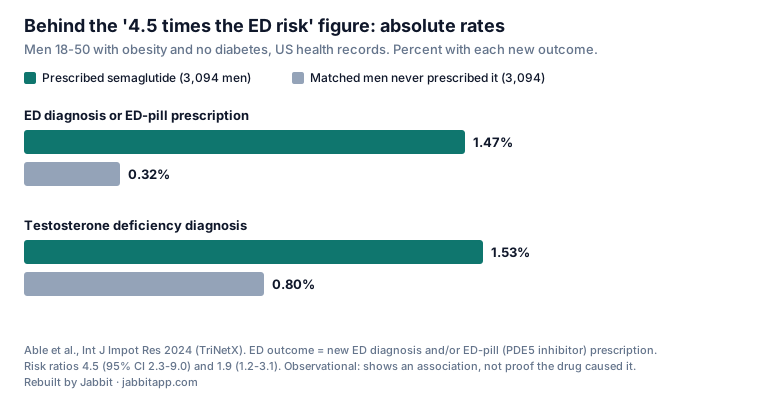
A GLP-1 safety story trending on X this week summed up posts citing “studies linking them to” higher risks of several problems, including “erectile dysfunction in non-diabetics.”[1] The study behind that line found that young men with obesity who were prescribed semaglutide were 4.5 times as likely to get a new ED diagnosis or ED-pill prescription. In absolute terms that was 1.47% compared with 0.32%.[2] Our plain answer: the evidence is mixed and mostly observational. A large randomized trial of a related drug found slightly less new ED, weight loss itself tends to help erections, and GLP-1 drugs usually raise low testosterone in men with obesity.[4][17][11][12] But a few studies do report more ED or more ED reports, and no trial has yet made sexual function its main endpoint for Wegovy or Zepbound.[2][3][7]
Why this matters now
On October 19, 2026, two authors from Stanford’s urology department published a comment in the International Journal of Impotence Research on a March 2026 perspective on this question. They wrote that the observational signals “should not be viewed as definitive evidence of harm but do warrant further investigation.”[10][9] An FDA adverse-event analysis, a large US records study and a meta-analysis, all published in 2026, also point in different directions.[7][3][11] With more younger, healthier men now taking these drugs, the question is coming up more often.[9]
| Date | Event |
|---|---|
| 2004 | Randomized trial: weight loss and exercise improve erectile function in men with obesity[16] |
| Jun 2021 | REWIND analysis: dulaglutide vs placebo, slightly fewer new moderate or severe ED cases[4] |
| May 2024 | Records study: semaglutide linked to 4.5 times the ED risk in men 18 to 50 without diabetes[2] |
| Jun 2025 | Records study: tirzepatide linked to lower ED risk than three other diabetes drugs[6] |
| Mar to Apr 2026 | FAERS analysis, a perspective in IJIR, a target-trial emulation in eClinicalMedicine and an Andrology meta-analysis[7][9][3][11] |
| Oct 19, 2026 | IJIR comment by Sellke and Eisenberg calls for caution and further study[10] |
| Oct 27 to 28, 2026 | X trending story on GLP-1 risks cites erectile dysfunction[1] |
Where the “4.5 times” figure comes from
The 2024 study used TriNetX, a network of US health records. It matched 3,094 men aged 18 to 50 with obesity and no diabetes who were prescribed semaglutide against 3,094 similar men who were never prescribed it. The average man was 37.8 years old with a BMI of 38.6.[2] The outcome was a new ED diagnosis or a new prescription for an ED pill such as sildenafil. It occurred in 1.47% of the semaglutide group compared with 0.32% of the comparison group (risk ratio 4.5, 95% CI 2.3 to 9.0). A new testosterone-deficiency diagnosis occurred in 1.53% compared with 0.80%.[2]
In Jabbit’s arithmetic, the difference is about 1.2 percentage points, or roughly 1 extra man with the outcome for every 87 prescribed semaglutide. The numbers are small, and the design has limits. Men who see a doctor for a weight-loss prescription may also be more likely to bring up and be treated for other problems. A prescription for an ED pill is not the same as a diagnosis. And the study cannot tell whether men actually took the drug.[2][9] The March 2026 perspective lists “confounding, detection bias, or rare idiosyncratic effects” as possible explanations for signals like this.[9]
What the randomized evidence shows
No randomized trial of Wegovy, Ozempic, Zepbound or Mounjaro has made erectile function its main outcome. The closest evidence comes from a related GLP-1 drug, dulaglutide (Trulicity):
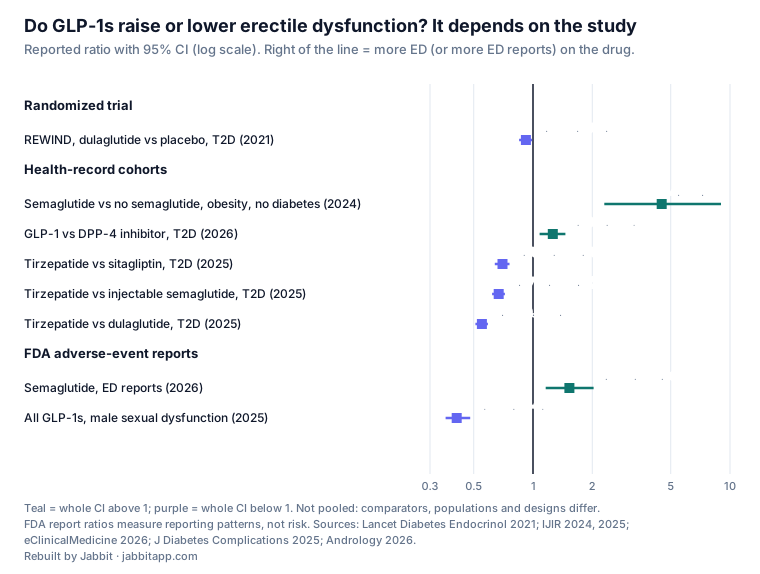
- REWIND was a large placebo-controlled heart trial. In an exploratory analysis of 3,725 men with type 2 diabetes, average age 65.5, more than half (56.5%) already had moderate or severe ED at the start. New moderate or severe ED occurred at 21.3 per 100 person-years on dulaglutide compared with 22.0 on placebo (HR 0.92, 95% CI 0.85 to 0.99). The analysis was exploratory, and the abstract lists Eli Lilly, which makes dulaglutide, as the funder.[4]
- A small crossover trial gave healthy men aged 18 to 50 four weeks of dulaglutide or placebo. Sexual desire scores did not change, and hormones and sperm stayed normal. Only 24 men completed it, and four weeks is short.[5]
- A randomized open-label trial in 25 men with diabetes, obesity and low testosterone compared semaglutide with testosterone therapy for 24 weeks. Both raised testosterone, but erectile-function scores improved significantly only with testosterone.[15]
What the newer real-world studies show
Health-record studies are large, but they cannot fully separate the drug from the kind of person who takes it. Their results point in different directions:[3][6][7][8]
- eClinicalMedicine, 2026: In about 10,400 men with type 2 diabetes, new ED occurred at 35.2 per 1,000 person-years in GLP-1 starters compared with 28.0 in DPP-4 inhibitor starters (HR 1.26). After the authors calibrated for hidden bias using a “negative control” outcome, the link was no longer statistically significant. They wrote that the findings “may reflect residual or selection bias and do not establish causation.”[3]
- Journal of Diabetes and its Complications, 2025: In men with type 2 diabetes, tirzepatide was linked to lower ED risk than sitagliptin (RR 0.70), injectable semaglutide (0.67) and dulaglutide (0.55). The authors called for randomized trials to confirm it.[6]
- FDA adverse-event reports: A 2026 analysis found a reporting signal for semaglutide (ROR 1.53, from 49 reports), but also for the non-GLP-1 diabetes drugs sitagliptin and dapagliflozin, and none for dulaglutide or metformin.[7] A 2025 analysis of all GLP-1s found 182 male sexual-dysfunction cases and a low overall ratio (0.41), with exenatide the most reported drug.[8] Report databases show what people chose to report, not how often something happens.
Testosterone: usually up, not down
Obesity lowers testosterone, and losing weight tends to bring it back up. Studies of GLP-1 drugs mostly show the same pattern.[12][11][13] In 215 men on incretin drugs, average total testosterone rose from 332 to 399 ng/dL with about 5% weight loss, and the share with normal levels went from 67% to 86%. Men who lost the most weight gained the most.[12] A 2026 meta-analysis of 8 studies (375 men) found GLP-1 drugs raised total and free testosterone and improved erectile function.[11] A smaller 2025 meta-analysis found rises in bioavailable testosterone but no significant change in free testosterone.[13] A small 2-month study in men with obesity and low testosterone, which was not randomized, reported larger rises in testosterone and erectile-function scores with tirzepatide plus diet than with diet alone.[14]
Researchers disagree about why. The meta-analysis authors suggest the testosterone effect may be partly independent of weight loss.[11] The October 2026 comment says the benefits are “most plausibly indirect” and that there is “no evidence to support a direct effect of GLP-1 receptor activation” on testosterone in men whose levels are already normal.[10] That matters for men who start with normal testosterone: they should not expect a boost.
Libido and desire: a theory, little data
GLP-1 drugs act on reward pathways in the brain, which is one reason they reduce cravings. A 2026 review proposed that the same effect could lower sexual desire through serotonin signaling. The authors called this a theoretical model and said trials rarely measure desire at all.[18] The October 2026 comment adds that “rapid weight loss and nutritional deficits could influence libido, energy levels, or sexual performance,” and that muscle loss may also play a part.[10] So far, the only placebo-controlled test of desire, in healthy men over four weeks, found no change.[5]
What the labels say
We searched the current US prescribing information for Wegovy, Ozempic, Zepbound and Mounjaro on October 28, 2026. None mentions erectile dysfunction, sexual dysfunction, libido or impotence.[20] The 2024 study’s abstract says package inserts “include sexual dysfunction as a side effect.” We could not find that in the US labels we checked, though labels in other countries or other versions may differ.[2][20] The Zepbound label reports that in rat studies tirzepatide had no effect on “sperm morphology, mating, fertility, and conception.”[20] A 2026 counseling review notes that labels mostly cover genital safety and animal reproductive data, and it says these drugs “should be selected for metabolic indications, not as treatments for ED or infertility.”[19]
The longevity question
ED is often an early sign of blood-vessel disease, because the penile arteries are small and show damage early. That is why weight loss helps. In a 2004 randomized trial, 17 of 55 men with obesity and ED who lost weight and exercised more (about 31%) reached normal erectile scores, compared with 3 of 55 controls.[16] A meta-analysis of weight-loss trials found an average improvement of about 2 points on the erectile function scale.[17] In our analysis, for most men with obesity, the larger effect of a GLP-1 drug on erections is likely to come through weight, blood sugar and blood vessels, which on average should help rather than hurt.[9][10][4] The open question is whether a minority of men, perhaps younger men without diabetes, have a different experience. The current data cannot answer that.[2][10]
What a careful reader should notice
- A 4.5 times relative risk on a 0.32% baseline is about a 1-point absolute difference.[2]
- The best randomized evidence is for dulaglutide in older men with diabetes, not for semaglutide or tirzepatide in younger men.[4]
- Comparison drugs change the answer: GLP-1 vs no GLP-1, vs DPP-4 inhibitors or between GLP-1s give different results.[2][3][6]
- Adverse-event report ratios also flagged non-GLP-1 diabetes drugs, which suggests the reports may reflect diabetes itself or reporting habits.[7]
- Testosterone rises in men with obesity-related low levels. That is not evidence of a boost in men with normal levels.[12][10]
FAQ
- Does Ozempic cause erectile dysfunction?
- It has not been shown to. One 2024 records study linked semaglutide to more new ED diagnoses or ED-pill prescriptions in men 18 to 50 without diabetes (1.47% compared with 0.32%). Other studies found no increase or a decrease, and a randomized trial of a related drug found slightly fewer new cases.[2][4][6]
- Does Zepbound or Mounjaro cause ED?
- We found no trial testing this directly. In a 2025 records study of men with type 2 diabetes, tirzepatide was linked to lower ED risk than sitagliptin, injectable semaglutide or dulaglutide. That is an association, not proof.[6]
- Do GLP-1 drugs lower testosterone?
- In men with obesity, studies mostly show testosterone going up, not down, with larger rises in men who lose more weight. One study found average total testosterone rose from 332 to 399 ng/dL.[12][11][13]
- Can Wegovy lower sex drive?
- A 2026 review proposed this as a theory through brain reward pathways, and rapid weight loss could affect energy and libido. The only placebo-controlled test, a four-week trial in healthy men, found no change in desire.[18][10][5]
- Is erectile dysfunction listed on the Ozempic or Zepbound label?
- Not in the US labels we checked on October 28, 2026. We found no mention of erectile dysfunction, sexual dysfunction, libido or impotence in the Wegovy, Ozempic, Zepbound or Mounjaro prescribing information.[20]
- What should I do if I notice ED on a GLP-1?
- Tell your prescriber. ED can be an early sign of heart or blood-vessel disease and can also be linked to low testosterone, diabetes, mood or other medicines, so it is worth checking out rather than assuming the cause. GLP-1 drugs are not approved as ED treatments.[16][19][10]
Bottom line
The claim that GLP-1 drugs cause erectile dysfunction rests mainly on one 2024 records study with small absolute numbers, plus mixed adverse-event data.[2][7][8] The larger and randomized evidence points the other way on average: less new ED with dulaglutide, rising testosterone in men with obesity, and better erections with weight loss.[4][11][16] Researchers agree on one thing: trials need to measure sexual function directly, especially in younger men.[10][18]
References
- X trending story (a summary of posts on X, which X says “may evolve over time”): “GLP-1 Weight-Loss Drugs Fuel Mixed Reactions on Rapid Changes and Risks,” updated October 28, 2026, 1:50 AM ET. Summary cites “studies linking them to higher risks of pancreatitis, bowel obstruction, gastroparesis, and erectile dysfunction in non-diabetics.” https://x.com/i/trending/2115318919309209846. Checked October 28, 2026.
- Able C, Liao B, Saffati G, et al. Prescribing semaglutide for weight loss in non-diabetic, obese patients is associated with an increased risk of erectile dysfunction: a TriNetX database study. Int J Impot Res. 2025;37(4):315-319. PMID 38778151. TriNetX health-records study, published online May 22, 2024. Abstract: “3,094 non-diabetic, obese men ages 18-50 who received a prescription of semaglutide were identified and subsequently matched to an equal number cohort of non-diabetic, obese men who never received a prescription of semaglutide”; mean age 37.8, mean BMI 38.6; new ED diagnosis and/or PDE5-inhibitor prescription “(1.47% vs 0.32%; RR: 4.5; 95% CI [2.3, 9.0])”; “testosterone deficiency (1.53% vs 0.80%; RR: 1.9; 95% CI [1.2, 3.1]).” The abstract also states: “While package inserts include sexual dysfunction as a side effect, no study has assessed the degree of this risk.” Abstract read. https://pubmed.ncbi.nlm.nih.gov/38778151/. Checked October 28, 2026.
- Tang H, Lu Y, Zhang B, et al. GLP-1 receptor agonist and risk of erectile dysfunction in men with type 2 diabetes: a target trial emulation. EClinicalMedicine. 2026;94:103857. PMID 42005929. Target trial emulation, US health-system records, January 2019 to September 2024, men with type 2 diabetes, GLP-1 vs DPP-4 inhibitor starters. Abstract: “4910 GLP-1RA initiators and 5524 DPP4i initiators”; “The incidence rate of ED was higher in the GLP-1RA users (35.2 vs. 28.0 per 1000 person-years) than DPP4i users, with a slightly increased rate (HR, 1.26; 95% CI, 1.08-1.46)”; “the association was attenuated and no longer statistically significant after NCO calibration”; “These observational findings may reflect residual or selection bias and do not establish causation.” Abstract read. https://pubmed.ncbi.nlm.nih.gov/42005929/. Checked October 28, 2026.
- Bajaj HS, Gerstein HC, Rao-Melacini P, et al. Erectile function in men with type 2 diabetes treated with dulaglutide: an exploratory analysis of the REWIND placebo-controlled randomised trial. Lancet Diabetes Endocrinol. 2021;9(8):484-490. PMID 34153269. Exploratory analysis of the REWIND randomized, placebo-controlled cardiovascular trial; funder listed in the abstract: Eli Lilly and Company. Abstract: “3725 (70·1%) of 5312 male participants with a mean age of 65·5 years”; “2104 (56·5%) had moderate or severe erectile dysfunction at baseline”; “21·3 per 100 person-years in the dulaglutide group and 22·0 per 100 person-years in the placebo group (HR 0·92, 95% CI 0·85-0·99, p=0·021).” Abstract read. https://pubmed.ncbi.nlm.nih.gov/34153269/. Checked October 28, 2026.
- Lengsfeld S, Probst L, Emara Y, et al. Effects of the glucagon-like peptide-1 receptor agonist dulaglutide on sexuality in healthy men: a randomised, double-blind, placebo-controlled crossover study. EBioMedicine. 2024;107:105284. PMID 39232425. Randomized, double-blind, placebo-controlled crossover trial in healthy men aged 18 to 50. Abstract: “24 out of 26 randomised participants completed the study”; “No change in the MGH-SFQ was observed after four weeks of dulaglutide versus placebo (estimated difference 0.58 [95% CI -0.83 to 2.00], p-value = 0.402)”; hormones and sperm parameters stayed in the normal range. Abstract read. https://pubmed.ncbi.nlm.nih.gov/39232425/. Checked October 28, 2026.
- Cowart K, Murphy C, Carris N. Association of tirzepatide with erectile dysfunction in people with type 2 diabetes. J Diabetes Complications. 2025;39(10):109116. PMID 40614622. TriNetX health-records study, men aged 18 to 70 with type 2 diabetes and no prior ED, May 2022 to May 2025. Abstract, ED diagnosis or PDE5-inhibitor prescription: “tirzepatide vs. sitagliptin: RR, 0.70 (95 % CI: 0.64,0.76); tirzepatide vs. injectable semaglutide: RR, 0.67 (95 % CI: 0.62,0.72); tirzepatide vs. dulaglutide: RR, 0.55 (95 % CI: 0.51,0.59)”; “Randomized trials are needed to confirm these findings.” Abstract read. https://pubmed.ncbi.nlm.nih.gov/40614622/. Checked October 28, 2026.
- Lin S, Ding X, Dang X, et al. Sexual Safety Signals of Common Antidiabetic Drugs: Insights From FAERS Disproportionality Analysis. Andrology. 2026;14(6):1627-1635. PMID 41883294. FDA Adverse Event Reporting System (FAERS) disproportionality study, published online March 26, 2026. Abstract: “We identified 49 semaglutide-, 54 sitagliptin-, and 42 dapagliflozin-associated erectile dysfunction reports”; reporting odds ratios semaglutide 1.53 (1.16-2.03), sitagliptin 1.52 (1.16-1.98), dapagliflozin 1.51 (1.11-2.04); “Other agents in the same drug classes, including dulaglutide, linagliptin, and metformin, did not show significant signals”; “These findings do not establish causality and should be regarded as preliminary and hypothesis-generating.” Abstract read. https://pubmed.ncbi.nlm.nih.gov/41883294/. Checked October 28, 2026.
- Pourabhari Langroudi A, Chen AL, Basran S, et al. Male sexual dysfunction associated with GLP-1 receptor agonists: a cross-sectional analysis of FAERS data. Int J Impot Res. 2025;37(8):661-667. PMID 40240532. FAERS analysis of orgasmic dysfunction, erectile dysfunction or decreased libido in men, Q4 2003 to Q1 2024. Abstract: “Among 182 cases identified, patients were predominantly aged 40-60 years, with exenatide accounting for 24.2% of reports, followed by semaglutide (21.4%)”; “low ROR (0.41, 95% Confidence interval (CI): 0.36-0.48)” suggesting “a weak association.” Abstract read. https://pubmed.ncbi.nlm.nih.gov/40240532/. Checked October 28, 2026.
- Noakes J, Daffner M, Burns JT, et al. GLP-1 receptor agonists and male sexual health: Translating cardiometabolic benefits into erectile outcomes. Int J Impot Res. 2026. PMID 41840125. Perspective, published March 16, 2026. Article preview (https://www.nature.com/articles/s41443-026-01254-3): “Two competing narratives have emerged”; the second asks “whether a true safety signal exists or whether observed associations reflect confounding, detection bias, or rare idiosyncratic effects.” Preview read; full text paywalled. https://pubmed.ncbi.nlm.nih.gov/41840125/. Checked October 28, 2026.
- Sellke N, Eisenberg ML. Comment on: GLP-1 receptor agonists and male sexual health: translating cardiometabolic benefits into erectile outcomes. Int J Impot Res. Published October 19, 2026 (open access). PMID 42897274. “In this context, the beneficial effects on erectile function are most plausibly indirect based on the current literature”; “there is no evidence to support a direct effect of GLP-1 receptor activation on this effect in eugonadal men”; adverse effects “were most commonly seen in men using exenatide but were also seen with contemporary GLP-1 RA such as semaglutide”; “These observations should not be viewed as definitive evidence of harm but do warrant further investigation”; “rapid weight loss and nutritional deficits could influence libido, energy levels, or sexual performance.” Competing interests: none declared. Full text read. https://www.nature.com/articles/s41443-026-01325-5. Checked October 28, 2026.
- Corona G, Sparano C, Romeo M, et al. Emerging Effects of Glucagon-Like Peptide-1 Receptor Agonists and Sodium-Glucose Cotransporter 2 Inhibitors on Male Sexual Hormones and Behaviors: Systematic Review and Meta-Analysis. Andrology. 2026;14(7):1988-2001. PMID 42011503. Systematic review and meta-analysis, published online April 21, 2026. Abstract: “Eight studies, including 375 subjects, evaluated the effects of GLP1-RAs”; positive erectile function outcomes; “Only GLP1-RAs significantly increased total and calculated free testosterone along with gonadotropins”; the authors suggest the testosterone effect was independent of weight loss; testosterone therapy “showed better results as compared to GLP1-RAs when orgasm and sexual satisfaction domains were investigated.” Abstract read. https://pubmed.ncbi.nlm.nih.gov/42011503/. Checked October 28, 2026.
- Portillo-Canales S, Iqbal I, Akande R, et al. Effect of Incretin-Based Weight Loss Drugs on Testosterone Concentrations in Men. Endocr Pract. 2026;32(5):696-703. PMID 41544705. Retrospective records study, men treated with incretin drugs, 2021 to 2024; 77% had type 2 diabetes. Abstract: 215 men; “Incretin therapy resulted in a 5% weight loss”; “Total testosterone increased from 332 ± 134 to 399 ± 152 ng/dL (P < .001)”; normal total testosterone “increased from 67% to 86%”; larger gains with more weight loss. Abstract read. https://pubmed.ncbi.nlm.nih.gov/41544705/. Checked October 28, 2026.
- Orra SH, Martinez JVN, Porto BC, et al. Effect of GLP-1 agonists on testosterone levels: a systematic review and meta-analysis. BMC Urol. 2025;25(1):311. PMID 41291666. Systematic review and meta-analysis. Abstract: “Four studies comprising 219 patients pre-treatment and 216 post-treatment were included”; bioavailable testosterone rose; “Free testosterone (MD -1.62; p = 0.051) and SHBG (MD -6.62; p = 0.120) showed no significant changes.” Abstract read. https://pubmed.ncbi.nlm.nih.gov/41291666/. Checked October 28, 2026.
- La Vignera S, Cannarella R, Garofalo V, et al. Short-term impact of tirzepatide on metabolic hypogonadism and body composition in patients with obesity: a controlled pilot study. Reprod Biol Endocrinol. 2025;23(1):92. PMID 40604795. Nonrandomized 2-month study, 83 men with obesity and low testosterone; tirzepatide plus diet vs diet alone vs testosterone gel. Abstract: tirzepatide group had a larger rise in IIEF-5 score and in LH, FSH and testosterone. Group allocation was not randomized and baseline differences were reported. Abstract read. https://pubmed.ncbi.nlm.nih.gov/40604795/. Checked October 28, 2026.
- Gregorič N, Šikonja J, Janež A, et al. Semaglutide improved sperm morphology in obese men with type 2 diabetes mellitus and functional hypogonadism. Diabetes Obes Metab. 2025;27(2):519-528. PMID 39511836. Randomized open-label trial, 25 men with type 2 diabetes, obesity and functional hypogonadism, semaglutide vs testosterone for 24 weeks. Abstract: both groups raised total testosterone; “the IIEF-15 score significantly improved only in the TRT group.” Abstract read. https://pubmed.ncbi.nlm.nih.gov/39511836/. Checked October 28, 2026.
- Esposito K, Giugliano F, Di Palo C, et al. Effect of lifestyle changes on erectile dysfunction in obese men: a randomized controlled trial. JAMA. 2004;291(24):2978-84. PMID 15213209. Randomized trial, 110 men with obesity and ED, no diabetes, hypertension or high lipids; 2 years. Abstract: IIEF improved “from 13.9 [4.0] to 17 [5]” with intensive lifestyle change vs stable in controls; “Seventeen men in the intervention group and 3 in the control group (P =.001) reported an IIEF score of 22 or higher.” Abstract read. https://pubmed.ncbi.nlm.nih.gov/15213209/. Checked October 28, 2026.
- Li H, Xu W, Wang T, et al. Effect of weight loss on erectile function in men with overweight or obesity: A meta-analysis of randomised controlled trials. Andrologia. 2022;54(1):e14250. PMID 34644814. Meta-analysis of randomized trials. Abstract: “5 studies with 619 participants”; “The mean difference of IIEF between weight loss group and control group was 1.99 with p < .01.” Abstract read. https://pubmed.ncbi.nlm.nih.gov/34644814/. Checked October 28, 2026.
- Gelfand ST, Tveit MC, Simon JA. Clinical review of how glucagon-like peptide-1 agonist obesity medications decrease sexual desire, and a biopsychosocial model for why we don't 'see' it. Obes Pillars. 2026;17:100233. PMID 41404471. Narrative review proposing a hypothesis. Abstract: “We established a theoretical model for how GLP-1 agonist modulation via increased serotonergic activity at the 5-HT2C receptor may result in diminished sexual desire”; “Failing to systematically measure and report on sexual desire as a potential adverse outcome of GLP-1 agonist use overlooks an essential aspect of patient well-being.” Abstract read. https://pubmed.ncbi.nlm.nih.gov/41404471/. Checked October 28, 2026.
- Broul M, Dubský M, Hujová A, et al. Male Sexual and Reproductive Health in Diabetes and Obesity Pharmacotherapy: A Source-Triangulated Counseling Map. Andrology. 2026. PMID 42661473. Source-triangulated review of studies, trial registries, FDA/EMA labels and patents. Abstract: “Regulatory labels mainly inform genital-safety counseling and nonclinical reproductive toxicology language”; “These drugs should be selected for metabolic indications, not as treatments for ED or infertility.” Abstract read. https://pubmed.ncbi.nlm.nih.gov/42661473/. Checked October 28, 2026.
- Jabbit search of cached US prescribing information, October 28, 2026: Wegovy (Novo Nordisk, Revised 06/2026, https://www.accessdata.fda.gov/drugsatfda_docs/label/2026/215256s025lbl.pdf); Ozempic injection (Novo Nordisk, DailyMed set adec4fd2-6858-4c99-91d4-531f5f2a2d79, https://dailymed.nlm.nih.gov/dailymed/drugInfo.cfm?setid=adec4fd2-6858-4c99-91d4-531f5f2a2d79); Zepbound (Eli Lilly, DailyMed set 487cd7e7-434c-4925-99fa-aa80b1cc776b, effective August 28, 2026, https://dailymed.nlm.nih.gov/dailymed/drugInfo.cfm?setid=487cd7e7-434c-4925-99fa-aa80b1cc776b); Mounjaro (Eli Lilly, DailyMed set 0818426a-53eb-4db7-9609-bbae1e7a3964, effective July 29, 2026, https://dailymed.nlm.nih.gov/dailymed/drugInfo.cfm?setid=0818426a-53eb-4db7-9609-bbae1e7a3964). Case-insensitive matches for “erectil”, “sexual dysfunction”, “libido” and “impoten”: 0 in each label. Zepbound section 13.1 (rats): “No effects of tirzepatide were observed on sperm morphology, mating, fertility, and conception.” Labels in other countries, and future versions, may differ. Checked October 28, 2026.
- Jabbit source extract for this page: every quote above asserted against cached copies, label term counts, and chart values. https://jabbitapp.com/research/sources/glp1-erectile-dysfunction-2026-10-28.json. Generated October 28, 2026.
This page analyzes published studies, an X trending-story summary and FDA labels. It is not medical advice and does not recommend any product or dose. Observational and adverse-event results show associations or reporting patterns, not proof of cause. Comparisons across separate studies are Jabbit’s analysis. Charts were rebuilt by Jabbit from the sources cited in each caption.