Evidence teardown · Ozempic · Wegovy · Zepbound · Side effects · Updated October 27, 2026
Published · Updated
Is there a pill to stop Ozempic, Wegovy or Zepbound nausea and vomiting? Not an approved one yet. Tradipitant (NEREUS), a Vanda Pharmaceuticals pill approved only for motion sickness, cut vomiting from 58.5% to 43.0% after a semaglutide shot in a Phase 3 trial Vanda reported on October 27, 2026. The effect was smaller than in Phase 2, the trial skipped the usual dose step-up, and the results are not yet peer-reviewed.
Nausea and vomiting are the side effects people on Ozempic, Wegovy, Zepbound and Mounjaro complain about most, and on October 27, 2026, Vanda Pharmaceuticals reported a Phase 3 trial of a pill meant to prevent them. The reader’s question: is there finally a pill that stops GLP-1 nausea and vomiting, and should you ask for it? Our plain answer: tradipitant (brand name NEREUS) did reduce vomiting in two company-run trials, but it is approved only for motion sickness, the GLP-1 trials used a harsher-than-normal start, and the newest result is smaller than the first. For now, the proven tools are still the slow dose step-up in the Wegovy and Zepbound labels and a conversation with your prescriber.
Why this matters now
On October 27, 2026, Vanda announced that Study 3601, a Phase 3 trial, met its main goal: 43.0% of people given tradipitant vomited after a semaglutide injection, vs 58.5% on placebo.[1] Vanda says it will discuss the results with FDA and plans to apply to add GLP-1 vomiting to the NEREUS label; its own statements point to FDA feedback “during 2027.”[1] Meanwhile, GI side effects are common on these drugs: in the Wegovy label, 44% of adults had nausea and 24% vomited, vs 16% and 6% on placebo.[11]
Timeline
| Date | Event |
|---|---|
| Before 2025 | Motion Syros, a Phase 3 boat-trip trial in 365 people prone to motion sickness, finds less vomiting on tradipitant than placebo.[8] |
| Feb–Oct 2025 | Vanda runs Study 2601, a Phase 2 GLP-1 vomiting trial.[4] |
| Nov 17, 2025 | Vanda reports Study 2601: vomiting 29.3% on tradipitant vs 58.6% on placebo.[2] |
| Dec 30, 2025 | FDA approves NEREUS for prevention of vomiting induced by motion in adults.[6][5] |
| Mar 27, 2026 | Study 3601, the Phase 3 GLP-1 trial, starts, per its registry record.[3] |
| Oct 27, 2026 | Vanda reports Study 3601: vomiting 43.0% vs 58.5%.[1] |
What tradipitant is
- An NK-1 blocker. Tradipitant blocks the NK-1 receptor, where the brain chemical substance P helps trigger vomiting.[10]
- Approved, but for something else. FDA approved NEREUS in December 2025 to prevent vomiting caused by motion in adults.[6][5] In Vanda’s two boat-trip Phase 3 trials, vomiting fell from 44.3% to 18.3–19.5% and from 37.7% to 10.4–18.3%.[7][8]
- Not approved for GLP-1 side effects. GLP-1 vomiting is still an investigational use. A drug profile notes Vanda is also developing it for gastroparesis.[9]
What the two GLP-1 trials show
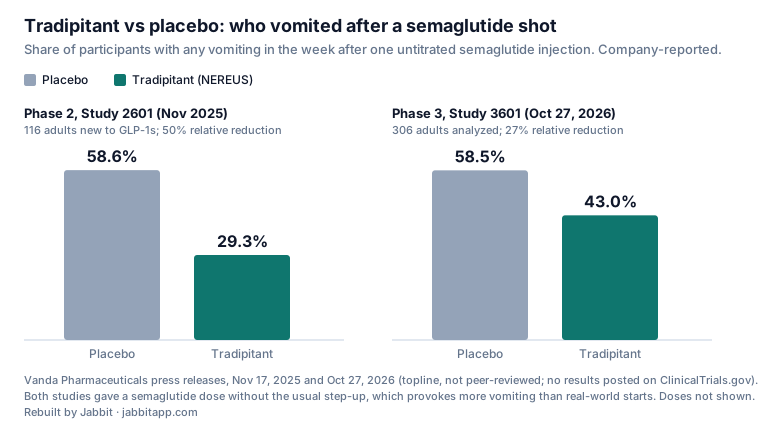
- The setup. In both trials, adults with overweight or obesity who had not used GLP-1s got one semaglutide injection at a dose that, Vanda notes, normally takes weeks of step-up to reach.[2][1] They took tradipitant or placebo pills for about 2 weeks around the shot.[3][2] We are not listing tradipitant doses.
- Phase 2 (116 people): vomiting 29.3% vs 58.6%, a 50% relative reduction. Vomiting plus what Vanda calls significant nausea: 22.4% vs 48.3%.[2]
- Phase 3 (306 people analyzed): vomiting 43.0% vs 58.5%, a 27% relative reduction. Vomiting plus nausea rated 3 or higher on Vanda’s worst-nausea score: 33.1% vs 50.6%.[1]
- Heavy vomiting. Fewer people on tradipitant vomited on several days (6.3% vs 15.9%) or more than 10 times (2.8% vs 14.6%). Vanda says these were post hoc analyses, run after the fact, and presents them as “supportive.”[1]
- Timing. “Almost all vomiting episodes in either group occurred by Day 2.”[1]
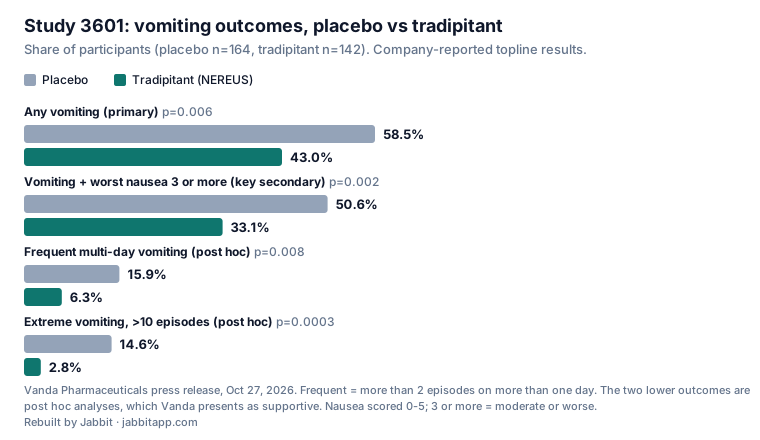
Jabbit’s analysis: put in absolute terms, about 15 fewer people in every 100 vomited in Phase 3 (58.5% minus 43.0%), compared with about 29 in every 100 in Phase 2.[2][1] That is a real effect in a company-reported trial, but even on tradipitant, more than 4 in 10 people still vomited.
Safety: what is known
- In the GLP-1 trials: Vanda says tradipitant was “generally well tolerated” and that “No new safety signals were observed.” It has not published side-effect rates for these trials.[1][2]
- From the NEREUS label: drowsiness (6% and 12% across the two doses studied) and fatigue (6% and 8%), with a warning that it may impair driving. The most common side effects are drowsiness, headache and fatigue.[5]
- Interactions and who should avoid it: strong CYP3A4 inhibitors can raise tradipitant levels. The label says to avoid it with any degree of liver impairment.[5]
- Long use is untested. The label says safety and effectiveness beyond 90 doses has not been established.[5] The GLP-1 trials covered about 2 weeks.[3]
- Vomiting itself has risks. The Wegovy and Zepbound labels link most reported kidney injury cases to GI side effects that led to dehydration.[11][12] Preventing heavy vomiting could matter for that reason, though no trial has tested whether tradipitant changes it.
The case for tradipitant
There is a real problem to solve. In a US survey of people who stopped a GLP-1, 33.3% cited side effects, second only to cost.[15] In one health system’s records, 14.6% stopped because they could not tolerate side effects, though cost and insurance were far more common (47.6%).[14] Tradipitant has now beaten placebo in two randomized GLP-1 trials and two motion-sickness Phase 3 trials, and it is already FDA-approved, so its basic safety profile is on a label.[2][1][7][5] Vanda argues that because most vomiting happens in the first two days, a short course around starting or stepping up a dose is the right window.[1]
What a careful reader should notice
- The test was harsher than real life. Both trials skipped the gradual step-up, which Vanda calls “a rigorous test.”[1] With the usual step-up, vomiting rates in the label trials were lower: 24% on Wegovy and 8% to 13% on Zepbound, vs 58% on placebo in Vanda’s trial.[11][12][1] Vanda says a pooled analysis supports applying the effect to real-world dosing; that analysis has not been published.[1]
- The effect shrank. The relative reduction fell from 50% in Phase 2 to 27% in Phase 3.[2][1] Our read: larger, later trials often show smaller effects than early ones.
- Not peer-reviewed yet. Both results come from press releases. Neither trial has results posted on ClinicalTrials.gov, and on October 27, 2026 the Phase 3 record still listed the study as recruiting, with 280 estimated participants; Vanda reports 306 analyzed.[3][4][1] Registry records often lag.
- Vomiting is not nausea. The main outcome was vomiting. Nausea was measured only together with vomiting in the published endpoints.[1][3]
- Most GI side effects already fade. In the STEP trials, 98.1% of semaglutide GI events were mild to moderate, most were short-lived, and they clustered around dose increases; 4.3% stopped treatment for them.[13]
- All trials are Vanda’s. That does not make them wrong, but independent replication would carry more weight.[3][4]
What to do about GLP-1 nausea today
The labels’ main tool is the slow step-up: Wegovy and Zepbound both tell prescribers to follow the dose escalation “to reduce the risk of gastrointestinal adverse reactions.”[11][12] Wegovy’s label adds that if a dose is not tolerated during escalation, prescribers can consider delaying the next step by 4 weeks, and Zepbound’s label says most nausea and vomiting “occurred during dose escalation and decreased over time.”[11][12] If you are vomiting repeatedly or cannot keep fluids down, contact your prescriber; dehydration is a labeled risk.[11] Logging dose changes alongside symptoms can make that conversation easier.
FAQ
- Is there a pill to stop Ozempic or Wegovy nausea and vomiting?
- Not one approved for that use. Tradipitant (NEREUS), approved for motion sickness, reduced vomiting after a semaglutide shot in two Vanda trials, and Vanda plans to seek FDA approval for GLP-1 vomiting. Until then, the labels rely on slow dose increases, and prescribers manage symptoms case by case.
- What is NEREUS (tradipitant)?
- NEREUS is an oral NK-1 receptor blocker from Vanda Pharmaceuticals. FDA approved it in December 2025 to prevent vomiting caused by motion in adults. It is being studied for vomiting caused by GLP-1 drugs and for gastroparesis.
- How well did tradipitant work in the Phase 3 GLP-1 trial?
- Vanda reported that 43.0% of people on tradipitant vomited after one semaglutide injection, vs 58.5% on placebo, a 27% relative reduction. In the earlier Phase 2 trial it was 29.3% vs 58.6%. Both results are company-reported and not yet peer-reviewed.
- Can my doctor prescribe NEREUS for Ozempic or Zepbound side effects now?
- NEREUS is approved only for motion-induced vomiting, so any other use would be off-label and a decision for your prescriber. The GLP-1 trials used a different, 2-week schedule than the label, and long-term safety has not been established.
- What are the side effects of tradipitant?
- The NEREUS label lists drowsiness, headache and fatigue as the most common, warns that it may impair driving, and says to avoid it with liver impairment. Strong CYP3A4 inhibitors can raise its levels. Vanda reported no new safety signals in the GLP-1 trials.
- How common is vomiting on Wegovy and Zepbound?
- In the Wegovy label, 24% of adults vomited vs 6% on placebo; nausea was 44% vs 16%. In the Zepbound label, vomiting was 8% to 13% by dose vs 2% on placebo. Most of it happens while the dose is being increased.
Bottom line
Tradipitant is the first drug to beat placebo in a Phase 3 trial aimed at GLP-1 vomiting, and that is genuine news. But the trial used an artificially harsh start, the benefit was about half the size seen in Phase 2, the data are a press release, and the GLP-1 use is not approved. If it reaches the label, it may help the minority who vomit badly in the first days of a new dose. Today, slow titration and your prescriber remain the evidence-based route.
References
- Vanda Pharmaceuticals press release via PR Newswire, “Vanda Pharmaceuticals Announces Positive Results from Study 3601 of NEREUS™ (tradipitant) for Prevention of GLP-1-Induced Vomiting,” October 27, 2026. Company statements: Study 3601 (VP-VLY-686-3601) was “a Phase III randomized, placebo-controlled study”; “Vomiting occurred in 43.0% of NEREUS™-treated participants (61/142) compared with 58.5% on placebo (96/164) (p=0.006, adjusted for site), a 27% relative reduction”; any vomiting with worst nausea ≥3 “33.1% of participants on NEREUS™ (47/142) versus 50.6% on placebo (83/164) (p=0.002, adjusted for site)”; frequent vomiting 6.3% vs 15.9% (p=0.008) and extreme vomiting (more than 10 episodes) 2.8% vs 14.6% (p=0.0003), with the note “These analyses are post hoc and are presented as supportive evidence”; “Almost all vomiting episodes in either group occurred by Day 2”; participants received a single semaglutide dose “without the gradual titration used in clinical practice”; Vanda says an exposure–response analysis supports “extrapolation of the effect to real-world dosing of semaglutide”; “NEREUS™ was generally well tolerated, with a safety profile consistent with previous studies. No new safety signals were observed”; Vanda “intends to submit an sNDA”; its forward-looking statements refer to FDA feedback on the proposed sNDA “during 2027.” Company-reported topline results, not peer-reviewed. https://www.prnewswire.com/news-releases/vanda-pharmaceuticals-announces-positive-results-from-study-3601-of-nereus-tradipitant-for-prevention-of-glp-1induced-vomiting-302920054.html. Checked October 27, 2026.
- Vanda Pharmaceuticals press release via PR Newswire, “Vanda Pharmaceuticals Reports Positive Results for Tradipitant in Preventing GLP-1 Induced Nausea and Vomiting,” November 17, 2025. Company statements: Study VP-VLY-686-2601 “studied 116 healthy overweight or obese adults (BMI 25–40 kg/m²) without prior GLP-1 agonist experience”; participants received a Wegovy injection at “a dose that normally takes 9 weeks of titration to reach”; tradipitant or placebo was given for a week before and “1 week of continued treatment post-dosing”; vomiting “29.3% of tradipitant-treated participants (17/58) … compared to 58.6% on placebo (34/58) (p=0.0016), representing a 50% relative reduction”; vomiting plus significant nausea “22.4% in the tradipitant group (13/58) versus 48.3% on placebo (28/58) (p=0.0039).” Company-reported, not peer-reviewed. Tradipitant dose amounts are not reproduced here. https://www.prnewswire.com/news-releases/vanda-pharmaceuticals-reports-positive-results-for-tradipitant-in-preventing-glp-1-induced-nausea-and-vomiting-302617739.html. Checked October 27, 2026.
- ClinicalTrials.gov record NCT07446439 (Study 3601), API v2, read October 27, 2026: Phase 3, randomized, quadruple-masked; lead sponsor Vanda Pharmaceuticals; tradipitant or placebo twice daily for about 2 weeks; adults with a BMI of 25 to under 40 and no type 1 or type 2 diabetes; primary outcome vomiting over 1 week on a daily diary. Listed status “Recruiting,” estimated enrollment 280, estimated primary completion December 1, 2026; last updated April 20, 2026; no results posted. https://clinicaltrials.gov/study/NCT07446439. Checked October 27, 2026.
- ClinicalTrials.gov record NCT06804603 (Study 2601), API v2, read October 27, 2026: Phase 2, randomized, quadruple-masked; lead sponsor Vanda Pharmaceuticals; completed (February 25 to October 6, 2025); enrollment 124; no results posted. https://clinicaltrials.gov/study/NCT06804603. Checked October 27, 2026.
- NEREUS (tradipitant) capsules, US prescribing information, Revised 12/2025, NDA 220152: indicated for the prevention of vomiting induced by motion in adults; safety and effectiveness “for more than 90 doses has not been established”; “somnolence (6%, 12%) and fatigue (6%, 8%)” in placebo-controlled trials, with a warning that NEREUS may impair driving; most common adverse reactions somnolence, headache and fatigue; “Tradipitant is a CYP3A4 substrate. Strong CYP3A4 inhibitors may increase tradipitant exposure”; “Avoid NEREUS in patients with mild, moderate, or severe hepatic impairment”; “Monitor breastfed infants for somnolence.” Dose amounts are not reproduced here. https://www.accessdata.fda.gov/drugsatfda_docs/label/2025/220152s000lbl.pdf. Checked October 27, 2026.
- US Food and Drug Administration approval letter for NDA 220152 (NEREUS), dated December 30, 2025. https://www.accessdata.fda.gov/drugsatfda_docs/appletter/2025/220152Orig1s000ltr.pdf. Checked October 27, 2026.
- Vanda Pharmaceuticals press release via PR Newswire, “Vanda Pharmaceuticals Announces FDA Approval of NEREUS™ (tradipitant) for the Prevention of Vomiting Induced by Motion …,” December 30, 2025. Company statements: “In Motion Syros (n=365), vomiting incidence was 18.3–19.5% with NEREUS™ versus 44.3% with placebo (p<0.0001)”; “In Motion Serifos (n=316), vomiting rates were 10.4–18.3% with NEREUS™ versus 37.7% with placebo (p≤0.0014).” https://www.prnewswire.com/news-releases/vanda-pharmaceuticals-announces-fda-approval-of-nereus-tradipitant-for-the-prevention-of-vomiting-induced-by-motion-a-historic-scientific-milestone-in-the-prevention-of-motion-sickness-302650965.html. Checked October 27, 2026.
- Polymeropoulos VM, Kiely L, Bushman ML, et al. Motion Syros: tradipitant effective in the treatment of motion sickness; a multicenter, randomized, double-blind, placebo-controlled study. Front Neurol. 2025;16:1550670. PMID 40103934. Motion Syros Phase 3 randomized trial (NCT04327661), 365 adults with a history of motion sickness on boat trips. Abstract: vomiting with both tradipitant doses vs “placebo = 44.3%, p < 0.0001 for both dose comparisons against placebo.” Dose amounts are not reproduced here. Abstract read. https://pubmed.ncbi.nlm.nih.gov/40103934/. Checked October 27, 2026.
- Lee A. Tradipitant: First Approval. Drugs. 2026;86(6):957-961. PMID 41945307. Drug profile. Abstract: “Tradipitant received its first approval in the USA in December 2025 for the prevention of vomiting induced by motion in adults, and is also being developed for the treatment of gastroparesis and prevention of vomiting induced by GLP-1 receptor agonists.” Abstract read. https://pubmed.ncbi.nlm.nih.gov/41945307/. Checked October 27, 2026.
- Nguyen T, Willett KC, Daly LR, et al. Tradipitant: A Novel Neurokinin-1 Receptor Antagonist for Motion Sickness. Am J Ther. 2026;33(4):e324-e328. PMID 42150111. Drug review. Abstract: tradipitant is “a selective neurokinin-1 (NK-1) receptor antagonist, blocking the actions of substance P”; “The half-life is 34 hours”; it “is predominately metabolized by CYP450-mediated pathways and through glucuronidation.” Abstract read. https://pubmed.ncbi.nlm.nih.gov/42150111/. Checked October 27, 2026.
- Wegovy (semaglutide) US prescribing information, DailyMed set ee06186f-2aa3-4990-a760-757579d8f77b, version effective June 18, 2026 (read via openFDA). Adverse reactions table in adults with obesity or overweight: nausea 44% vs 16% on placebo, vomiting 24% vs 6%; “Permanent discontinuation of treatment as a result of a gastrointestinal adverse reaction occurred in 4.3% of WEGOVY injection-treated adult patients versus 0.7% of placebo-treated patients”; “Follow the dosage escalation … to reduce the risk of gastrointestinal adverse reactions”; “If patients do not tolerate a dose during dosage escalation, consider delaying dosage escalation for 4 weeks”; for acute kidney injury, “The majority of the reported events occurred in patients who experienced gastrointestinal adverse reactions leading to dehydration such as nausea, vomiting, or diarrhea.” https://dailymed.nlm.nih.gov/dailymed/drugInfo.cfm?setid=ee06186f-2aa3-4990-a760-757579d8f77b. Checked October 27, 2026.
- Zepbound (tirzepatide) US prescribing information, DailyMed set 487cd7e7-434c-4925-99fa-aa80b1cc776b, version effective August 28, 2026 (read via openFDA). Pooled weight-reduction trials: nausea 25%, 29% and 28% across the three maintenance doses vs 8% on placebo; vomiting 8%, 11% and 13% vs 2%; discontinuation for gastrointestinal adverse reactions up to 4.3% vs 0.5% on placebo; “The majority of nausea, vomiting, and/or diarrhea events occurred during dose escalation and decreased over time”; “Follow the dosage escalation below for all indications to reduce the risk of gastrointestinal adverse reactions.” https://dailymed.nlm.nih.gov/dailymed/drugInfo.cfm?setid=487cd7e7-434c-4925-99fa-aa80b1cc776b. Checked October 27, 2026.
- Wharton S, Calanna S, Davies M, et al. Gastrointestinal tolerability of once-weekly semaglutide 2.4 mg in adults with overweight or obesity, and the relationship between gastrointestinal adverse events and weight loss. Diabetes Obes Metab. 2022;24(1):94-105. PMID 34514682. Pooled analysis of the STEP 1–3 trials (semaglutide n = 2117, placebo n = 1262), funded by Novo Nordisk. Abstract: “nausea (43.9% vs. 16.1% of participants)”; “vomiting (24.5% vs. 6.3%)”; “Most GI AEs with semaglutide were non-serious (99.5% of AEs), mild-to-moderate (98.1%), transient and occurred most frequently during/shortly after dose escalation”; “Few semaglutide-treated participants (4.3%) permanently discontinued treatment for GI AEs”; of the extra weight loss with semaglutide, “<1 percentage point was mediated by GI AEs.” Abstract read. https://pubmed.ncbi.nlm.nih.gov/34514682/. Checked October 27, 2026.
- Gasoyan H, Butsch WS, Casacchia NJ, et al. Reasons for Discontinuation of Obesity Pharmacotherapy With Semaglutide or Tirzepatide in Clinical Practice. Obesity (Silver Spring). 2025;33(12):2296-2303. PMID 41039650. Cross-sectional electronic health record study, one US health system, 2022–2024. Abstract: “We randomly selected 288 patients” who stopped injectable semaglutide or tirzepatide within a year; “137 patients (47.6%) discontinued their medication due to cost or insurance-related issues, 42 (14.6%) due to inability to tolerate the side effects, 34 (11.8%) as they were unable to fill the medication due to shortages.” One of the papers Vanda cites. Abstract read. https://pubmed.ncbi.nlm.nih.gov/41039650/. Checked October 27, 2026.
- DiStefano MJ, Zon J, Olson EG, et al. Discontinuation of glucagon-like peptide-1 receptor agonists among US adults: A national survey. J Manag Care Spec Pharm. 2026;32(8):903-910. PMID 42504813. National US survey, June 2025. Abstract: “440 respondents met eligibility criteria” (people who started and then stopped a GLP-1 drug); “The most frequently cited reasons for discontinuation were cost (36.1%), side effects (33.3%), no insurance coverage (28.2%), and achieving a weight-loss goal (26.1%).” One of the papers Vanda cites. Abstract read. https://pubmed.ncbi.nlm.nih.gov/42504813/. Checked October 27, 2026.
- Jabbit source extract for this page: press-release quotes, label text, registry fields and abstract quotes checked against cached copies on October 27, 2026. https://jabbitapp.com/research/sources/tradipitant-glp1-vomiting-2026-10-27.json. Checked October 27, 2026.
This page analyzes company press releases, FDA labels and letters, trial registries and published studies. It is not medical advice and does not recommend any product or dose. Company-reported results are labeled. Charts were rebuilt by Jabbit from the sources cited in each caption.