Policy explainer · retatrutide, tirzepatide (Mounjaro, Zepbound), semaglutide (Ozempic, Wegovy) · FDA’s October 2 decision, the Seventh Circuit appeal, patents, generics and compounding · Sources checked October 19, 2026
Published · Updated
Why is Lilly suing FDA to call retatrutide a biologic? The label mostly decides how long it stays copy-free after approval, and whether anyone can ever legally compound it.
Eli Lilly wants FDA to treat retatrutide, its triple-hormone weight-loss shot, as a biologic, the category for proteins. FDA said no again on October 2.[1] Here is what that means for you. As a drug, cheaper copies could apply four years after approval, and compounding could reopen in a shortage. As a biologic, no copy could be approved for 12 years, and compounding would be shut for good. Lilly’s main patent probably runs to about January 2039 either way, and the label doesn’t change the brand’s own timing much.[11][10][19][14][4]
Why this matters now
On October 2, FDA’s drug center ruled again, on remand from a federal court, that retatrutide is not a biologic.[1][2] In September, the appeals court asked both sides whether it even has jurisdiction to hear Lilly’s appeal. Their answers came in on October 8. The government attached FDA’s new decision and asked the court to dismiss the appeal.[3][5] Lilly said it will file for approval “no later than the first quarter of 2027” and needs to know which pathway to use.[4] Trade press picked up the filing on October 14.[32] Retatrutide drew 178 to 270 posts a day on X last week.[34] The court hasn’t ruled.
The short answer
- The brand’s timing barely changes. Lilly plans to file by early 2027, and the same FDA center reviews it on either path.[4][1]
- The copy clock does. As a drug, a generic maker could apply four years after approval by challenging Lilly’s patents. As a biologic, no copy could be approved for 12 years.[11][10]
- The patent may matter more than the label. The patent that covers retatrutide’s exact structure runs to about January 2039, before any extension.[14]
- Compounding is illegal now, either way. As a drug, it could reopen only in narrow cases such as a shortage. As a biologic, it couldn’t reopen at all.[17][18][19]
- Medicare price cuts would come four years later as a biologic, at about 13 years after approval instead of 9.[16] For scale, Medicare’s negotiated price for Ozempic and Wegovy, starting in 2027, is 71% below the 2024 list price. That covers Medicare, not your cash price.[24]
The fight: 39 or 41?
FDA’s rule says a protein is a chain of alpha amino acids, the standard building blocks, with a defined sequence “greater than 40 amino acids in size.” Proteins are biologics.[9] Retatrutide’s backbone is a chain of 39 alpha amino acids. A side chain hangs off one of them: a linker called ADO, then a gamma-linked glutamate, then a long fatty acid that helps the drug last a week. FDA says ADO is an amino acid but not an alpha amino acid. Even if the glutamate counted, the total would reach only 40, which is not greater than 40.[1] Lilly counts both side-chain pieces and gets 41.[7]
Lilly sued in September 2024.[1] In September 2025 a federal judge in Indianapolis sided with FDA on the count, writing that retatrutide “contains, at most, forty alpha amino acids.” She ruled for Lilly on a second question, whether retatrutide is “analogous” to a protein. She found FDA’s bright-line approach to that question “flouts the statutory text” and sent it back to FDA, while noting FDA could lawfully reach the same answer.[2] It did. FDA’s October 2 decision says a product analogous to a protein must share a protein’s two key traits: more than 40 alpha amino acids, and a specific defined sequence. Retatrutide fails the first.[1]
Both sides, fairly
Lilly’s case. Lilly says the rule counts the total number of amino acids, and ADO and the glutamate are amino acids, so retatrutide has 41.[7] It also argues that the law gives FDA 60 days to decide these requests, that FDA took nearly ten months after the remand, and that Lilly’s own proposed designation should therefore take effect. And it says only a ruling now gives it certainty before it files.[7][4] CEO Dave Ricks told analysts in August that “we believe retatrutide is a biologic application,” on both the count and the analogy argument.[29]
FDA’s case. FDA says alpha amino acids are what make up a protein’s chain. It says side chains don’t count, the same way it counted insulin degludec as 50 amino acids, not more.[1] The government’s brief points out that Lilly once described a protein to FDA as a “linear polymer of α-amino acids.”[6] FDA also notes Lilly’s own 2023 Mounjaro label called tirzepatide, which has a similar side chain, “a 39-amino-acid … peptide.” Lilly’s later labels dropped that wording.[1] FDA rejects the 60-day argument. It says it answered Lilly’s request on time, in March 2024, and that the statute sets no deadline for a remand.[1][6]
Who else weighed in. The only friend-of-the-court brief we found came from the Outsourcing Facilities Association, a compounders’ trade group. It argued that Lilly “seeks a windfall” and that a biologic label would make retatrutide “immune to competition from compounders.”[8] That group has its own stake. Compounders sold copies of semaglutide and tirzepatide during the shortages.[18] Its chairman, Lee Rosebush, also chairs the peptide lobbying group in our White House peptide meeting report.
What changes for you
| Question | If retatrutide is a drug (FDA’s view) | If it is a biologic (Lilly’s view) |
|---|---|---|
| Brand application | New Drug Application under the drug law (FD&C Act section 505) | Biologics License Application under the Public Health Service Act (section 351)[1] |
| Who reviews it at FDA | FDA’s drug center (CDER) | The same drug center (CDER)[1] |
| Cheaper copy | Generic, through an abbreviated application (ANDA) | Biosimilar or interchangeable biosimilar[22][23] |
| Earliest a copy can apply | 4 years after approval with a patent challenge, 5 otherwise | 4 years after approval[11][10] |
| Earliest a copy can be approved | 5 years; about 7½ if Lilly sues over the patent challenge, unless a court rules sooner | 12 years, whatever happens to the patents[11][10] |
| Compounding after approval | Possible only in narrow cases, such as an FDA-declared shortage | Not allowed: compounding exemptions don’t cover biologics[18][19] |
| Medicare-negotiated price | Starts about 9 years after approval | Starts about 13 years after approval[16][12] |
| Main patent | U.S. 11,542,313, to about January 2039 (an extension is possible) | Same patent, same date[14][13] |
The generic route is no longer hypothetical for this kind of molecule. Tirzepatide, also a 39-amino-acid Lilly drug, was approved in May 2022. In July 2026, just past the four-year mark, Lilly said several generic companies had filed applications to copy Mounjaro or Zepbound before some patents expire. Lilly said it plans to sue.[16][25] That same month, FDA published draft guidance for generic copies of Ozempic, Wegovy, Mounjaro and Zepbound. It covers synthetic peptides submitted as standard generics.[22] Generic liraglutide, the older daily GLP-1, has had eight approvals since December 2024.[25]
The biologic route isn’t a wall forever, either. In October 2025 FDA moved to cut the extra studies biosimilars need. It said it “now generally does not recommend” the switching studies once required for pharmacists to swap one in.[23] But no biosimilar could be approved before year 12.[10]
The patent may set the date either way
Headlines frame the fight as 5 years of protection versus 12. The patent record makes it more complicated. U.S. Patent 11,542,313, granted to Lilly in January 2023, claims retatrutide’s exact structure. With 37 days of adjustment, it runs to about January 20, 2039.[14] Lilly can seek up to 5 more years for time lost in testing and review. By law, the patent can’t run past 14 years after approval.[13]
Here is a rough illustration, not a forecast. Suppose FDA approved retatrutide in 2028. As a drug, its 5-year exclusivity would end in 2033, years before the 2039 patent date, so the patent would be the real barrier. As a biologic, the 12-year period would end in 2040, close to when the patent ends anyway. So if the patent holds, the label adds little time. The label matters most if generic makers break the patent. As a drug, a copy could then win approval years before 2039. As a biologic, nothing could be approved before 2040, no matter what a patent court decided.[11][10][14] For comparison, Lilly lists tirzepatide’s compound patent to 2036 and its data protection to 2027. Generic makers filed anyway.[15][16]
Compounding: illegal now, and the label decides later
FDA says plainly that “retatrutide and cagrilintide cannot be used in compounding under federal law.”[17] Anything sold online as retatrutide today is unapproved. Our retatrutide review covers a lab test of gray-market vials.
If it is approved as a drug, compounding could come back only in narrow cases. That happened with semaglutide and tirzepatide, which compounders could copy while FDA listed them in shortage. The shortages ended in December 2024 and February 2025, and FDA then set end dates for those copies.[18] If it is a biologic, that door never opens. The compounding sections of the drug law don’t cover biologics.[19] When insulin and similar products became biologics in March 2020, FDA told compounders that several, including hCG, could no longer be compounded under those sections.[20][21]
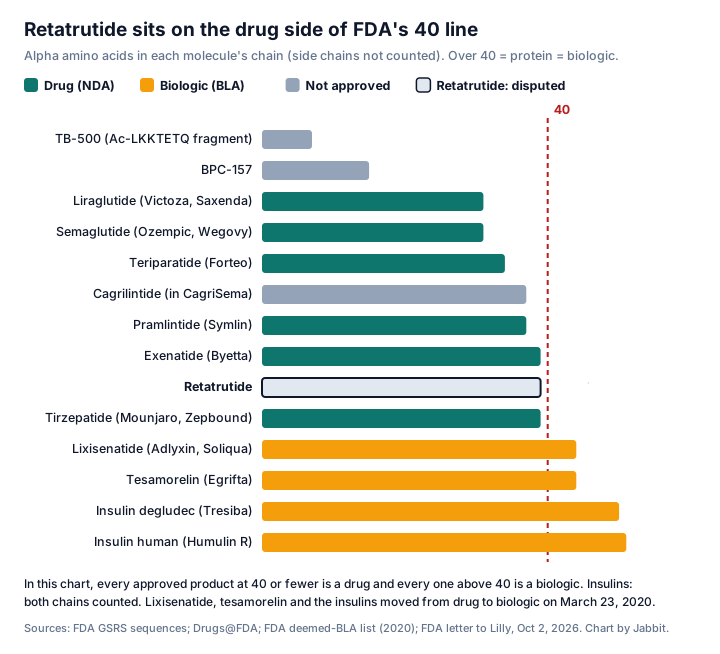
Where the 40 line falls: Jabbit’s table
We counted the alpha amino acids in each molecule’s sequence in FDA’s own substance registry. We counted modified building blocks on the main chain once and left out side chains, as FDA does.[26][27][1] Status comes from Drugs@FDA and FDA’s 2020 transition list.[25][21] In this set, every approved product at 40 or fewer is a drug, and every one above 40 is a biologic. Lixisenatide, at 44, and tesamorelin, at 44, moved from drug to biologic in March 2020. Exenatide, at 39, stayed a drug and now has a generic.[21][25]
| Molecule | Alpha amino acids | U.S. status |
|---|---|---|
| TB-500 (Ac-LKKTETQ fragment) | 7 | Not approved |
| BPC-157 | 15 | Not approved |
| Liraglutide (Victoza, Saxenda) | 31 | Drug; generics approved since December 2024 |
| Semaglutide (Ozempic, Wegovy) | 31 | Drug |
| Teriparatide (Forteo) | 34 | Drug; a generic approved December 2025 |
| Cagrilintide (in CagriSema) | 37 | Not approved; in CagriSema, filed as a drug (NDA) |
| Pramlintide (Symlin) | 37 | Drug |
| Exenatide (Byetta) | 39 | Drug; a generic approved November 2024 |
| Tirzepatide (Mounjaro, Zepbound) | 39 | Drug; generic applications filed by July 2026 |
| Retatrutide | 39 | Not approved; FDA says drug, Lilly says biologic |
| Lixisenatide (Adlyxin, Soliqua) | 44 | Biologic since March 23, 2020 |
| Tesamorelin (Egrifta) | 44 | Biologic since March 23, 2020 |
| Insulin degludec (Tresiba) | 50 (two chains) | Biologic since March 23, 2020 |
| Insulin human (Humulin R) | 51 (two chains) | Biologic since March 23, 2020 |
Novo Nordisk didn’t fight this line. It filed CagriSema, which pairs cagrilintide (37) with semaglutide (31), as a New Drug Application in December 2025.[28][26]
Did Lilly lobby on it?
Not in any public lobbying report. We pulled all 173 federal lobbying reports filed for Lilly from early 2024 through September 2026. None mention retatrutide, the protein definition or amino acids. Lilly’s own reports use broad labels like “FDA policy issues.” Some outside firms list compounding bills.[31] Broad labels mean the topic could still have come up. Lilly has made its case in court and on earnings calls.[7][29]
What happens next
The Seventh Circuit could dismiss the appeal for lack of jurisdiction, as the government asks. Then Lilly would probably have to file a new lawsuit to challenge the October 2 decision.[5][4] Or the court could keep the case and rule on how to count amino acids and on the 60-day argument. Neither outcome has a date. Lilly has said since July that it plans to submit retatrutide in the first quarter of 2027, and it calls that a biologics application.[30][4] FDA says it belongs under the drug law.[1]
Strengths and limits
Strengths. We read the court filings, FDA’s decision, the statutes and the patent itself. Every amino-acid count comes from FDA’s substance registry.[1][2][14][27]
Limits. We checked one patent. Lilly may hold others on formulations or uses, and courts may cut any patent short. Our timeline is an illustration with an assumed approval year. Lobbying reports are often vague. We aren’t lawyers, and this isn’t legal or investing advice. Other coverage, such as AJMC’s explainer, walks through the exclusivity and Medicare rules.[33]
Bottom line
Lilly wants the 12-year biologic clock. FDA has now said twice that retatrutide is a drug, and a federal judge agreed on the amino-acid count. Neither label is likely to change when you can get the brand. The label decides how firmly that brand is shielded from cheaper copies, and whether compounding can ever return. If Lilly’s patents hold to about 2039, the practical gap is smaller than “12 versus 5” suggests. If the patents fall, the label decides everything.[1][2][10][11][14]
Weekly shots are easy to lose track of. Jabbit keeps a private, dated log of each injection and site on your iPhone.
Frequently asked questions
- Is retatrutide a biologic or a drug?
- FDA says it is a drug. On October 2, 2026 the agency again concluded that retatrutide is neither a protein nor something analogous to a protein, so an application would go under the drug law. Lilly disagrees, and its appeal is pending at the U.S. Court of Appeals for the Seventh Circuit.
- Will the lawsuit delay retatrutide’s approval?
- Not on its own. Lilly told the appeals court on October 8 that it plans to file for approval no later than the first quarter of 2027, and FDA’s drug center reviews it on either path. Lilly also warned that an unresolved fight could force it to choose between filing on time and filing under the label it wants.
- Can retatrutide be legally compounded?
- No. FDA says retatrutide cannot be used in compounding under federal law today. If it is approved as a drug, compounding could become possible only in narrow cases, such as an FDA-declared shortage. If it is a biologic, the compounding exemptions never apply.
- When could a generic or cheaper copy of retatrutide come out?
- Not soon either way. As a drug, a copy could apply 4 years after approval if it challenges Lilly’s patents, but the main patent runs to about January 2039. As a biologic, no copy could be approved for 12 years after approval, even if the patents fell.
- Why does the number 40 matter?
- FDA’s rule defines a protein as a chain of alpha amino acids with a defined sequence greater than 40 amino acids. Proteins are regulated as biologics. Retatrutide’s chain has 39; Lilly counts 41 by adding two building blocks from its side chain.
- Is CagriSema a biologic?
- No. Novo Nordisk filed CagriSema, which combines cagrilintide and semaglutide, as a New Drug Application in December 2025. Each of its parts has fewer than 40 amino acids.
- Did Lilly lobby Congress or the White House on this?
- We found no public lobbying report that names it. None of the 173 federal lobbying reports filed for Lilly from 2024 through September 2026 mention retatrutide or the protein definition, though many use broad labels like FDA policy issues.
References
- U.S. Food and Drug Administration, Center for Drug Evaluation and Research (Janice L. Weiner). Letter to Eli Lilly and Company on remand: retatrutide is neither a “protein” nor an “analogous product” to a protein, so “an application for retatrutide would need to be submitted under section 505.” October 2, 2026. Filed as Exhibit 2 to the government’s letter brief, Eli Lilly and Co. v. Kennedy, 7th Cir. No. 26-1301, Dkt. 46-2 (October 8, 2026). Points used: 39-alpha-amino-acid chain plus a side chain of ADO, gamma glutamate and a C20 fatty diacid; ADO is not an alpha amino acid, and counting gamma glutamate gives 40 at most; the two “critical characteristics” of a protein; Lilly’s July 28, 2023 Mounjaro label calling tirzepatide “a 39-amino-acid … peptide”; CDER reviews the product either way. https://storage.courtlistener.com/recap/gov.uscourts.ca7.55916/gov.uscourts.ca7.55916.46.2.pdf. Checked October 19, 2026.
- Eli Lilly and Co. v. Kennedy, No. 1:24-cv-01503-TWP-KMB (S.D. Ind.), Order on cross-motions for summary judgment (Judge Tanya Walton Pratt), Dkt. 47, September 30, 2025 (amended October 3, 2025). Holdings: the regulation counts alpha amino acids and retatrutide “contains, at most, forty alpha amino acids”; FDA’s “bright line” approach to “analogous product” “flouts the statutory text,” so that finding was vacated and sent back to FDA, with a “meaningful possibility” FDA could reach the same result. https://www.govinfo.gov/content/pkg/USCOURTS-insd-1_24-cv-01503/pdf/USCOURTS-insd-1_24-cv-01503-0.pdf. Checked October 19, 2026.
- U.S. Court of Appeals for the Seventh Circuit, No. 26-1301, Order (Brennan, Chief Judge; Easterbrook and Kirsch, Circuit Judges), September 24, 2026: parties to file supplemental memoranda on appellate jurisdiction, including how appeals by private parties from remands to agencies have been treated, due October 8, 2026. Dkt. 45. https://storage.courtlistener.com/recap/gov.uscourts.ca7.55916/gov.uscourts.ca7.55916.45.0.pdf. Checked October 19, 2026.
- Eli Lilly and Company. Supplemental memorandum on appellate jurisdiction, 7th Cir. No. 26-1301, Dkt. 47, October 8, 2026 (“Lilly plans to file its application for retatrutide’s approval no later than the first quarter of 2027”; Lilly “needs to know which application pathway (biological product or drug) to pursue”; FDA waited “nearly ten months” after the remand; a remand or new suit “could force Lilly to choose between having retatrutide submitted when it is ready for patients and having it classified correctly”). https://storage.courtlistener.com/recap/gov.uscourts.ca7.55916/gov.uscourts.ca7.55916.47.0.pdf. Checked October 19, 2026.
- U.S. Department of Justice for FDA and HHS. Letter brief on appellate jurisdiction, 7th Cir. No. 26-1301, Dkt. 46, October 8, 2026 (argues a private party cannot appeal a remand order and that the appeal should be dismissed; attaches FDA’s October 2 decision). https://storage.courtlistener.com/recap/gov.uscourts.ca7.55916/gov.uscourts.ca7.55916.46.1.pdf. Checked October 19, 2026.
- Brief for the federal appellees, 7th Cir. No. 26-1301, Dkt. 23, May 15, 2026 (biologics “generally benefit from a substantially longer exclusivity period”; Lilly’s own earlier comment to FDA described a protein as a “linear polymer of α[alpha]-amino acids with a specific defined sequence”; Lilly’s request for designation was submitted January 19, 2024 and answered March 18, 2024). https://storage.courtlistener.com/recap/gov.uscourts.ca7.55916/gov.uscourts.ca7.55916.23.0.pdf. Checked October 19, 2026.
- Brief of plaintiff-appellant Eli Lilly and Company, 7th Cir. No. 26-1301, Dkt. 12, April 1, 2026 (“Retatrutide is composed of 41 amino acids”; the regulation counts the “total number of amino acids”; FDA must make designation decisions promptly, and its decision should be treated as taking effect after 60 days). https://storage.courtlistener.com/recap/gov.uscourts.ca7.55916/gov.uscourts.ca7.55916.12.0.pdf. Checked October 19, 2026.
- Outsourcing Facilities Association. Amicus curiae brief supporting appellees (Baker & Hostetler LLP), 7th Cir. No. 26-1301, Dkt. 27, May 19, 2026 (“Lilly Seeks a Windfall at the Expense of Patients”; if retatrutide is a biologic “it will be immune to competition from compounders”). The association represents compounding outsourcing facilities. https://storage.courtlistener.com/recap/gov.uscourts.ca7.55916/gov.uscourts.ca7.55916.27.0.pdf. Checked October 19, 2026.
- 21 CFR 600.3(h)(6): “Protein means any alpha amino acid polymer with a specific, defined sequence that is greater than 40 amino acids in size.” Electronic Code of Federal Regulations. https://www.ecfr.gov/current/title-21/chapter-I/subchapter-F/part-600/subpart-A/section-600.3. Checked October 19, 2026.
- 42 U.S.C. 262(k)(7) (Public Health Service Act section 351(k)): a biosimilar approval cannot take effect until 12 years after the reference product was first licensed, and an application cannot be submitted until 4 years after. Legal Information Institute. https://www.law.cornell.edu/uscode/text/42/262. Checked October 19, 2026.
- 21 U.S.C. 355(j)(5)(F)(ii): no generic application for a new chemical entity may be submitted for 5 years after approval, except after 4 years with a patent challenge (paragraph IV certification); if the brand sues, approval is stayed until 7½ years after the brand’s approval unless a court rules sooner. Legal Information Institute. https://www.law.cornell.edu/uscode/text/21/355. Checked October 19, 2026.
- 42 U.S.C. 1320f-1(e)(1): a drug becomes eligible for Medicare price negotiation 7 years after approval; a biologic, 11 years after licensure. Legal Information Institute. https://www.law.cornell.edu/uscode/text/42/1320f-1. Checked October 19, 2026.
- 35 U.S.C. 156 (patent term extension): an extension is capped at 5 years, and the remaining patent term after FDA approval cannot exceed 14 years. Legal Information Institute. https://www.law.cornell.edu/uscode/text/35/156. Checked October 19, 2026.
- U.S. Patent 11,542,313 B2, “Incretin analogs and uses thereof,” assigned to Eli Lilly and Company. International filing December 14, 2018 (priority December 21, 2017); granted January 3, 2023; 37 days of patent term adjustment; Google Patents lists the adjusted expiration as January 20, 2039. Claim 18 recites retatrutide’s exact structure (Aib at position 2, alpha-methyl-leucine at 13, lysine 17 carrying the ADO–gamma-glutamate–C20 diacid side chain, and the rest of the sequence). https://patents.google.com/patent/US11542313B2/en. Checked October 19, 2026.
- Eli Lilly and Company. Form 10-K for 2025, filed February 12, 2026 (patent table: Mounjaro/Zepbound U.S. compound patent 2036, U.S. data protection 2027; no row for retatrutide, which is not approved). https://www.sec.gov/Archives/edgar/data/59478/000005947826000013/lly-20251231.htm. Checked October 19, 2026.
- Eli Lilly and Company. Form 10-Q for the quarter ended June 30, 2026, filed August 5, 2026 (“In July 2026, Lilly received notice that multiple generic companies had filed ANDAs seeking approval to market generic versions of Mounjaro and/or Zepbound before the expiration of some or all of the patents”; “We intend to file suit”; government-set Medicare prices “generally apply beginning at nine years (for medicines approved under a New Drug Application) or thirteen years (for medicines approved under a Biologics License Application)”). https://www.sec.gov/Archives/edgar/data/59478/000005947826000081/lly-20260630.htm. Checked October 19, 2026.
- U.S. Food and Drug Administration. FDA’s concerns with unapproved GLP-1 drugs used for weight loss (content current as of October 1, 2026): “Retatrutide and cagrilintide cannot be used in compounding under federal law.” https://www.fda.gov/drugs/drug-alerts-and-statements/fdas-concerns-unapproved-glp-1-drugs-used-weight-loss. Checked October 19, 2026.
- U.S. Food and Drug Administration. FDA clarifies policies for compounders as national GLP-1 supply begins to stabilize (tirzepatide shortage resolved December 19, 2024; semaglutide February 21, 2025; end dates for shortage-based compounding in 2025). https://www.fda.gov/drugs/drug-alerts-and-statements/fda-clarifies-policies-compounders-national-glp-1-supply-begins-stabilize. Checked October 19, 2026.
- U.S. Food and Drug Administration. Mixing, Diluting, or Repackaging Biological Products Outside the Scope of an Approved Biologics License Application. Guidance for industry, January 2018, section II.C: “Sections 503A and 503B of the FD&C Act Do Not Exempt Biological Products.” https://www.fda.gov/media/90986/download. Checked October 19, 2026.
- U.S. Food and Drug Administration. Notice to compounders: changes that affect compounding on March 23, 2020 (products moving to biologic status, including human chorionic gonadotropin and hyaluronidase, can no longer be compounded under sections 503A and 503B). https://www.fda.gov/drugs/human-drug-compounding/notice-compounders-changes-affect-compounding-march-23-2020. Checked October 19, 2026.
- U.S. Food and Drug Administration. List of approved NDAs for biological products that were deemed to be BLAs on March 23, 2020 (includes Humulin R, Tresiba, Adlyxin, Soliqua and Egrifta). https://www.fda.gov/media/119229/download. Checked October 19, 2026.
- U.S. Food and Drug Administration. FDA publishes revised draft product-specific guidances for certain generic peptide products, July 28, 2026 (17 guidances, including Ozempic, Wegovy, Mounjaro and Zepbound; covers recombinant, synthetic or semi-synthetic peptides submitted as ANDAs; withdraws the May 2021 guidance on synthetic peptide ANDAs). https://www.fda.gov/drugs/drug-alerts-and-statements/fda-publishes-revised-draft-product-specific-guidances-certain-generic-peptide-products. Checked October 19, 2026.
- U.S. Food and Drug Administration. FDA moves to accelerate biosimilar development and lower drug costs. Press release, October 29, 2025 (draft guidance to cut comparative efficacy studies; FDA “now generally does not recommend switching studies” for interchangeability). https://www.fda.gov/news-events/press-announcements/fda-moves-accelerate-biosimilar-development-and-lower-drug-costs. Checked October 19, 2026.
- Centers for Medicare & Medicaid Services. Negotiated prices for the second cycle, effective 2027 (Ozempic, Rybelsus and Wegovy: 71% below the 2024 list price for a 30-day supply), and HHS announcement of the 15 drugs selected. https://www.cms.gov/newsroom/press-releases/hhs-announces-15-additional-drugs-selected-medicare-drug-price-negotiations-continued-effort-lower. Checked October 19, 2026.
- U.S. Food and Drug Administration. Drugs@FDA via the openFDA drugsfda endpoint, searched by active ingredient (application types and dates, including 8 generic liraglutide approvals December 23, 2024 to March 11, 2026; generic exenatide November 19, 2024; generic teriparatide December 12, 2025; Ozempic NDA 209637 approved December 5, 2017; Mounjaro NDA 215866 approved May 13, 2022). https://open.fda.gov/apis/drug/drugsfda/. Checked October 19, 2026.
- Jabbit table: alpha-amino-acid counts from FDA Global Substance Registration System sequences and U.S. regulatory status for 14 molecules (data file). Built October 19, 2026. https://jabbitapp.com/research/sources/retatrutide-biologic-amino-acid-table-2026-10-19.json. Checked October 19, 2026.
- U.S. Food and Drug Administration / NCATS. Global Substance Registration System (GSRS), substance records for retatrutide (UNII NOP2Y096GV), tirzepatide (OYN3CCI6QE), semaglutide (53AXN4NNHX), cagrilintide (AO43BIF1U8) and the other molecules in the table. https://gsrs.ncats.nih.gov/. Checked October 19, 2026.
- Novo Nordisk. Novo Nordisk submits New Drug Application to the FDA for CagriSema. Press release, December 18, 2025. https://www.novonordisk-us.com/media/press-releases/novo-nordisk-cagrisema-fda-nda-submission.html. Checked October 19, 2026.
- Armstrong A. Lilly, FDA retatrutide biologic dispute comes to a head as submission nears. BioSpace, August 5, 2026 (CEO Dave Ricks on the second-quarter call: “we believe retatrutide is a biologic application, both in terms of [the] amino acid count rule as well as analogous to a protein”). https://www.biospace.com/fda/lilly-fda-retatrutide-biologic-dispute-comes-to-a-head-as-submission-nears. Checked October 19, 2026.
- Eli Lilly and Company. Lilly’s triple agonist, retatrutide, successful in two additional Phase 3 obesity trials. Press release, July 23, 2026 (submission planned in the first quarter of 2027). https://investor.lilly.com/news-releases/news-release-details/lillys-triple-agonist-retatrutide-successful-two-additional. Checked October 19, 2026.
- U.S. Senate Lobbying Disclosure Act database, all 173 reports listing Eli Lilly and Company as client, first quarter 2024 through third quarter 2026, pulled via the LDA API October 19, 2026 (none mention retatrutide, “protein,” “biologic” definitions or amino acids; outside firms list compounding issues such as H.R. 5316, the Drug Shortage Compounding Patient Access Act of 2025). https://lda.senate.gov/filings/public/filing/search/. Checked October 19, 2026.
- On The Pen. FDA reiterates retatrutide is NOT a biologic in new filing. October 14, 2026. https://onthepen.com/news/new-fda-reiterates-retatrutide-is. Checked October 19, 2026.
- Steinzor P. 5 things to know if retatrutide is classified as a biologic. AJMC, October 7, 2026. https://www.ajmc.com/view/5-things-to-know-if-retatrutide-is-classified-as-a-biologic. Checked October 19, 2026.
- Jabbit count of posts on X mentioning retatrutide (no reposts), via the X API recent-counts endpoint: 178 to 270 a day, October 13–18, 2026 (UTC days). Checked October 19, 2026.
This page explains court filings, FDA decisions and guidance, federal statutes, a patent, SEC filings and lobbying reports. It is not legal, investment or medical advice. Retatrutide is investigational and not FDA approved; this page does not recommend buying, using or dosing it. The amino-acid table and lobbying scan are Jabbit’s own; their inputs are cited above.