Home / Research / Retatrutide with type 2 diabetes
Study teardown · TRIUMPH-2, The Lancet, October 2026 · Sources checked October 16, 2026
Will retatrutide work as well if you have type 2 diabetes? Not quite: about 19% weight loss, versus about 25% in people without diabetes.
If you have type 2 diabetes, expect less weight loss from retatrutide than the headlines suggest. In Lilly’s 1,152-person diabetes trial, people on the top 12 mg dose lost 18.8% of their body weight over 80 weeks, against 5.1% on placebo.[1] In the matching trial in people without diabetes, the same dose produced 25.0%.[4] Blood sugar improved a lot, too. But it is not 28%.
Why the diabetes number is lower
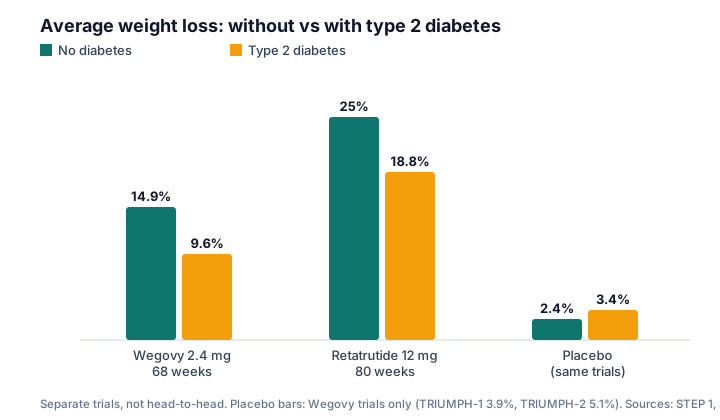
This gap is not new, and it is not special to retatrutide. Doctors have long noticed that people with type 2 diabetes lose less weight on GLP-1 drugs than people without it at a similar BMI, a point the Lancet’s own commentary on this trial opens with.[2] Wegovy showed the same pattern. At 2.4 mg, semaglutide produced 14.9% weight loss in people without diabetes (STEP 1) but 9.6% in people with it (STEP 2), against placebo results of 2.4% and 3.4%.[7][6]
The question going into TRIUMPH-2 was whether a stronger drug would close that gap. It didn’t. Subtract placebo and retatrutide 12 mg beat it by 13.8 percentage points in diabetes[1] versus 21.0 points without diabetes[4], so people with diabetes got roughly two-thirds of the extra effect. Wegovy’s ratio was about half (6.2 versus 12.4 points).[6][7] These are separate trials with different lengths and populations, so treat that comparison as rough. What it does show is that the strongest drug yet still runs into the same diabetes headwind.
Where the 28.3% comes from
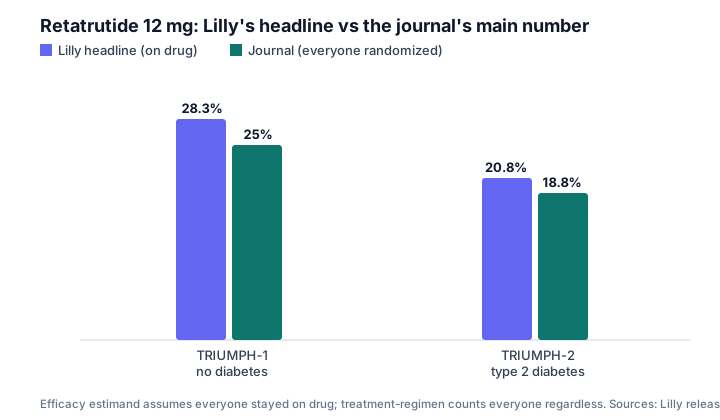
Lilly’s press releases lead with a different way of counting. Its TRIUMPH-1 release headlined 28.3% weight loss at 12 mg and its TRIUMPH-2 release headlined 20.8%.[5][3] Both are the “efficacy estimand,” which estimates what happens if everyone stays on the drug without starting other weight or diabetes rescue treatment.[9] The journals report the “treatment-regimen estimand” as the main result, counting everyone who was randomized whether or not they stuck with it: 25.0% in the NEJM paper and 18.8% in the Lancet paper.[4][1] Neither number is false. The first answers “what can the drug do?” and the second answers “what happened to the people who were offered it?”, which is closer to what a new patient should expect. In TRIUMPH-1, the 4 mg to 12 mg doses span 17.6% to 25.0% on that stricter count.[4]
What the trial got right
TRIUMPH-2 is a solid trial. It randomized 1,152 adults at 92 sites in eight countries, double-blind against placebo, for 80 weeks, and it was registered in advance (NCT05929079).[1] These were typical patients with diabetes: average age 55, BMI 38.2, HbA1c 7.7%, diabetes for a median of 5.6 years, and 92% already on oral diabetes drugs. Eighty-four percent finished treatment.[1] All three doses beat placebo clearly (4 mg: 11.9%; 9 mg: 16.8%; 12 mg: 18.8%).[1] Blood sugar also dropped. HbA1c fell 1.4 to 1.6 points versus 0.2 on placebo, and Lilly reports that up to 40% of people reached a non-diabetic HbA1c under 5.7%, though that was an analysis not adjusted for multiple comparisons.[1][9] Interestingly, 9 mg did about as well as 12 mg on blood sugar.
Side effects, including a new one
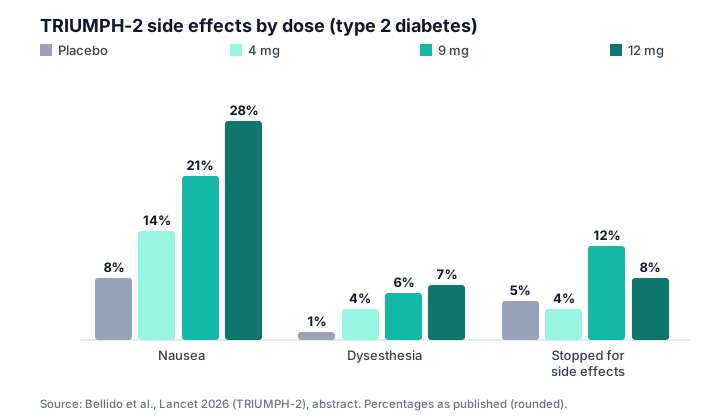
Most side effects were the familiar GLP-1 kind and rose with dose. Nausea hit 28% on 12 mg versus 8% on placebo, and diarrhea 34% versus 13%.[1] Two signals stand out. The first is hypotension (low blood pressure), reported in 6% on 12 mg versus under 1% on placebo. That is worth knowing if you already take blood-pressure medication.[1] The second is dysesthesia, abnormal or unpleasant skin sensations such as tingling or burning, in 4% to 7% on retatrutide versus 1% on placebo.[1] The abstract doesn’t say how long it lasted or whether anyone stopped because of it.
More people quit for side effects at 9 mg (12%) than at 12 mg (8%), compared with 4% on 4 mg and 5% on placebo.[1] There were seven deaths in total (six across the retatrutide arms, one on placebo), all judged unrelated by the investigators.[1]
What a careful reader should notice
Lilly funded and designed the program, and six of the eleven authors are Lilly employees and shareholders.[1] That is normal for a phase 3 trial and doesn’t undo the blinding or the registered endpoints, but every retatrutide phase 3 result so far comes from the same sponsor. Eighty weeks is also not a lifetime, so we don’t yet know what happens after stopping, or anything about heart attacks, strokes or deaths. Those need outcome trials. And retatrutide is still not approved. In an October 2 decision, the FDA again said it will regulate retatrutide as a drug rather than a biologic, part of an ongoing legal dispute with Lilly that doesn’t reject the drug itself.[8]
About gray-market retatrutide
Retatrutide is already widely sold as a “research” peptide and shows up in stacks on social media. Reporting on those products has raised questions about whether vials contain what their labels say.[8] None of the numbers on this page apply to them. Trial participants got a known dose of a pharmaceutical-grade product, stepped up slowly every four weeks under supervision.[1][9] A vial of uncertain strength combined with a side-effect profile that includes low blood pressure and nerve-type skin symptoms is a different experiment, and nobody has run it carefully.
The bottom line
For people with type 2 diabetes, retatrutide produced about 19% average weight loss at the top dose and large drops in blood sugar in a well-run 80-week trial. That is less than the 25% to 28% figures from people without diabetes, the same kind of gap Wegovy showed. It also brought more low blood pressure and a skin-sensation side effect that needs a closer look. The decision about any of these drugs belongs with your prescriber. If you do end up on a weekly injection, logging doses and side effects in a tracker like Jabbit can make that conversation easier.
References
- Bellido V, le Roux CW, Ekinci EI, et al. Retatrutide in adults with obesity and type 2 diabetes (TRIUMPH-2): a double-blind, parallel-group, randomised, placebo-controlled, phase 3 trial. Lancet. 2026;408(10563):1455-1472. doi:10.1016/S0140-6736(26)01861-1. PMID 42810372. Funded by Eli Lilly. Abstract and declarations read. https://pubmed.ncbi.nlm.nih.gov/42810372/. Checked October 16, 2026.
- Holst JJ. Retatrutide in adults with obesity and type 2 diabetes: what have we learned from TRIUMPH-2? Lancet. 2026;408(10563):1398-1399 (comment, published October 10, 2026). doi:10.1016/S0140-6736(26)01987-2. PMID 42849462. https://pubmed.ncbi.nlm.nih.gov/42849462/. Checked October 16, 2026.
- Eli Lilly and Company. Lilly's triple agonist, retatrutide, delivered substantial weight loss and A1C reduction... (TRIUMPH-2 press release, September 29, 2026; efficacy-estimand results). https://www.prnewswire.com/news-releases/lillys-triple-agonist-retatrutide-delivered-substantial-weight-loss-and-a1c-reduction-underscoring-its-potential-promise-for-people-with-obesity-and-type-2-diabetes-302891798.html. Checked October 16, 2026.
- Jastreboff AM, Kaplan LM, Davies MJ, et al. Retatrutide, a Triple Hormone Receptor Agonist, for Treatment of Obesity (TRIUMPH-1). N Engl J Med. Published online September 29, 2026. doi:10.1056/NEJMoa2604169. PMID 42814954. https://pubmed.ncbi.nlm.nih.gov/42814954/. Checked October 16, 2026.
- Eli Lilly and Company. Lilly's triple agonist, retatrutide, delivered powerful weight loss in pivotal Phase 3 obesity trial (TRIUMPH-1 press release, May 21, 2026; efficacy and treatment-regimen estimands). https://investor.lilly.com/node/54321/pdf. Checked October 16, 2026.
- Davies M, Færch L, Jeppesen OK, et al. Semaglutide 2·4 mg once a week in adults with overweight or obesity, and type 2 diabetes (STEP 2). Lancet. 2021;397(10278):971-984. doi:10.1016/S0140-6736(21)00213-0. PMID 33667417. https://pubmed.ncbi.nlm.nih.gov/33667417/. Checked October 16, 2026.
- Wilding JPH, Batterham RL, Calanna S, et al. Once-Weekly Semaglutide in Adults with Overweight or Obesity (STEP 1). N Engl J Med. 2021;384(11):989-1002. PMID 33567185. https://www.nejm.org/doi/full/10.1056/NEJMoa2032183. Checked October 16, 2026.
- On The Pen. FDA Reiterates Retatrutide is NOT a Biologic in New Filing (October 14, 2026). https://onthepen.com/news/new-fda-reiterates-retatrutide-is. Checked October 16, 2026.
- Steinzor P. Retatrutide Yields Up to 20.8% Weight Loss in Obesity With T2D. AJMC, September 30, 2026 (estimand used in Lilly's figures). https://www.ajmc.com/view/retatrutide-yields-up-to-20-8-weight-loss-in-obesity-with-t2d. Checked October 16, 2026.
This page analyzes published research and company disclosures. It is not medical advice and does not recommend using, sourcing, or dosing retatrutide, which is investigational and not FDA approved. Charts were rebuilt by Jabbit from the published numbers cited in each caption.