Home / Research / CagriSema teardown
Study teardown · CagriSema (cagrilintide + semaglutide) · FDA decision expected Q4 2026 · Trials, filings and labels read · Sources checked October 17, 2026
Is CagriSema better than Wegovy or Zepbound? Better than Wegovy, not Zepbound. In the only head-to-head weight trial, people lost 20.2% on CagriSema and 23.6% on Zepbound.
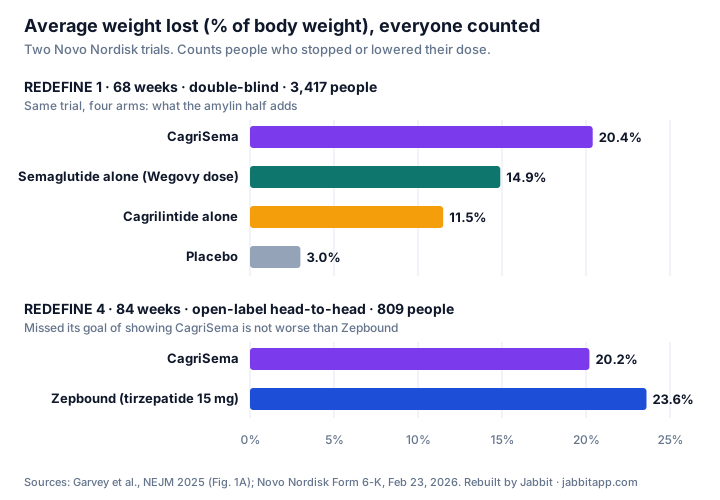
CagriSema is Novo Nordisk’s once-weekly shot that pairs semaglutide, the drug in Wegovy, with cagrilintide, a long-acting copy of the fullness hormone amylin. In its main trial, people lost 20.4% of their body weight over 68 weeks, versus 14.9% on semaglutide alone at the Wegovy dose and 3.0% on placebo.[1] But in the only head-to-head weight trial, Zepbound won: 23.6% versus 20.2% over 84 weeks, and CagriSema missed its goal of showing it was no worse.[3] The FDA is expected to decide on it this quarter.[5][7]
Why this matters now
Novo filed CagriSema with the FDA in December 2025, and on September 30, 2026 it said “a decision is expected in Q4 2026.”[3][5] The FDA doesn’t publish its target dates. Optum Rx, a large pharmacy benefit manager, lists December 18, 2026.[7] The same day as Novo’s update, at the European diabetes meeting (EASD), Novo promoted brain-scan data on “food noise” and Lilly reported its own amylin combination, eloralintide plus tirzepatide.[5][13] On October 6, the design of CagriSema’s 7,076-person heart outcomes trial was published.[14] Amylin drugs are the next big obesity bet, and people are already asking whether to wait for CagriSema. On X, the drug has drawn about 110 posts in the past week, alongside “CagriSema” vials sold as research chemicals.[16]
The numbers, counted the same way
REDEFINE 1 is the cleanest test of what the amylin half adds, because it ran four arms side by side: CagriSema, semaglutide alone, cagrilintide alone and placebo, in 3,417 adults without diabetes.[1] Counting everyone randomized, including people who stopped or cut their dose, weight loss at 68 weeks was 20.4% on CagriSema, 14.9% on semaglutide, 11.5% on cagrilintide and 3.0% on placebo.[1] So adding cagrilintide bought 5.5 extra percentage points over the Wegovy dose of semaglutide.[1] About a third of people on CagriSema (34.7%) lost a quarter or more of their weight, versus 14.8% on semaglutide alone.[1]
One number circulating on X gets this wrong. A post this month said REDEFINE 1 “showed 22.7% loss vs 11.8% on sema alone.”[16] In the paper, 11.8% is the cagrilintide-alone arm. Semaglutide alone was 16.1% on the same “if everyone stayed on it” basis that gives CagriSema 22.7%.[1] The real gap over semaglutide is about 5 to 7 points depending on the method, not 11.[1]
Against Zepbound, it lost
REDEFINE 4 put CagriSema directly against Zepbound’s top dose (tirzepatide 15 mg) in 809 people with obesity for 84 weeks. Counting everyone, CagriSema produced 20.2% weight loss and Zepbound 23.6%. Counting only people who kept taking the drug, the figures were 23.0% and 25.5%. The trial’s main goal was to show CagriSema was “non-inferior,” meaning not meaningfully worse, and it failed.[3] Novo’s release led with “23% weight loss,” the higher of the two figures.[3]
In type 2 diabetes the result was closer. In REIMAGINE 4, a 68-week trial against the same Zepbound dose, CagriSema was non-inferior for weight (15.2% versus 15.8%, counting people who stayed on treatment). It failed non-inferiority for blood sugar, lowering HbA1c by 1.9 points versus 2.2.[4] Both head-to-head trials were open-label, so everyone knew which drug they were on.[3][4]
This is also a lesson in why cross-trial math misleads. Compare each drug with its own placebo group and CagriSema looks like Zepbound’s equal: 17.3 points above placebo in REDEFINE 1, versus 17.8 points on Zepbound’s label (20.9% versus 3.1%).[1][11] Put them in the same trial and Zepbound comes out about 3.4 points ahead.[3]
And against high-dose Wegovy, the edge is small
The real alternative to CagriSema isn’t only standard Wegovy. The FDA approved Wegovy HD, a 7.2 mg dose of semaglutide, in March 2026.[10] In its trial, STEP UP, people lost 18.7% on 7.2 mg, 15.6% on 2.4 mg and 3.9% on placebo, everyone counted.[9] That’s 14.8 points above placebo, versus 17.3 for CagriSema in a different trial. Optum Rx puts CagriSema’s advantage over Wegovy HD at about 2%.[7][9][1] No trial has compared the two directly yet. Novo is now testing CagriSema built on 7.2 mg semaglutide against both the current CagriSema and Wegovy HD, with results expected in the first half of 2028.[4] In other words, the version the FDA is reviewing, 2.4 mg of each drug, may not be the version Novo ends up pushing.
Why it came in below the hype: the dose
Before REDEFINE 1 read out, Novo had told CNBC it expected about 25% weight loss. The 22.7% result sent its shares down about 20% on December 20, 2024.[8] The trial let people slow or lower their dose if they couldn’t tolerate it. By week 68, only 57.4% of people on CagriSema were on the full dose, versus 70.9% on semaglutide alone and 82.5% on cagrilintide alone. About a quarter (25.3%) of the CagriSema group never reached the full dose at all.[1] So a sizeable share of people couldn’t stay on the full combination, and the average result reflects that. Novo has since tested lower doses too (1.0 mg and 1.7 mg of each), which beat placebo in REDEFINE 9.[4]
What CagriSema gets right
The extra weight loss is real and came from a large, double-blind trial. Waist size fell 13.4 cm more than with placebo.[1] In a scan subgroup, about two-thirds of the weight lost was fat and a third was lean mass. That subgroup was only 7.4% of participants.[1] In people with type 2 diabetes (REDEFINE 2, 1,206 adults), weight loss was 13.7% versus 3.4% on placebo, and 73.5% reached an HbA1c of 6.5% or lower, versus 15.9%.[2] The newest data from Novo add a few signals. In a diabetes trial, CagriSema reduced fat in the abdomen and around the liver and pancreas. A post hoc look at bone markers gave what the authors call “preliminary reassurance,” and a brain-scan study found less “food noise” and craving.[5] Those are conference abstracts, not peer-reviewed papers. The food-noise study enrolled 164 people in total, including a group that received no medicine, and its registered main outcome was an appetite score at week 24.[6]
Side effects and safety
Side effects were more common with the combination than with either drug alone. Gastrointestinal side effects such as nausea, vomiting, diarrhea and constipation hit 79.6% of people on CagriSema, 73.8% on semaglutide, 54.0% on cagrilintide and 39.9% on placebo. Most were mild to moderate, and nausea, diarrhea and vomiting peaked while the dose was being raised.[1] Side effects made 5.9% stop CagriSema, versus 3.6% on semaglutide and 3.5% on placebo.[1] Serious adverse events were reported in 9.8%, versus 5.0% on semaglutide and 6.1% on placebo.[1] Injection-site reactions were 12.2% versus 2.6% with semaglutide, and they appear to come from the cagrilintide (16.9% on cagrilintide alone).[1] Gallbladder problems affected 4.1% versus 1.0% on placebo. There were 4 cases of pancreatitis (0.2%).[1] Two people on CagriSema died. The trial’s event committee classified the causes as suicide and a cancer of unknown origin.[1]
Heart protection is unknown. Wegovy carries a US indication for cutting heart attacks, strokes and cardiovascular deaths in people with established heart disease.[12] CagriSema’s own heart outcomes trial, REDEFINE 3, has enrolled 7,076 people with heart disease but hasn’t reported.[14] For anyone weighing these drugs for long-term health rather than weight alone, that matters. See our SELECT teardown for what Wegovy’s heart trial showed.
Gray-market cagrilintide stacks are untested
Cagrilintide is already sold online as a “research” peptide. One X vendor this week advertised “CagriSema 10 mg … Research Use Only,” and one user described taking cagrilintide alongside retatrutide.[16] We searched ClinicalTrials.gov for every study of cagrilintide. All 44 are sponsored by Novo Nordisk. Tirzepatide appears only as the comparison drug in three of them. None tests cagrilintide combined with tirzepatide or retatrutide.[15] The closest real data comes from Lilly, with a different amylin drug, eloralintide, given alongside tirzepatide. In its phase 2 trial, 10.8% to 27.0% of people on the combinations quit because of side effects, versus 2.9% on tirzepatide alone. Each arm in that trial was small (367 people across 10 groups).[13] Stacking amylin on top of a strong incretin drug is exactly where tolerability gets harder. Doing it with unregulated vials skips both the dose-finding and the purity checks.
What a careful reader should notice
Every CagriSema trial cited here was funded by Novo Nordisk, and Novo employees co-wrote the papers.[1][2][14] The two trials that went badly for CagriSema, REDEFINE 4 and REIMAGINE 4, are so far known only from Novo’s own announcements and SEC filings. We haven’t seen full data on side effects or dropouts from them.[3][4] Novo filed with the FDA on REDEFINE 1 and 2, two months before the Zepbound head-to-head came out.[3] The “food noise” numbers come from a press release about a conference abstract.[5] On the other side, REDEFINE 1 is large, double-blind, published in the NEJM, and includes the single-drug arms that most combination trials lack.[1]
The bottom line
CagriSema works. Counting everyone, it gives about 20% weight loss, roughly 5.5 points more than the Wegovy dose of semaglutide in the same trial.[1] It isn’t better than what’s already sold. In the one head-to-head weight trial, Zepbound beat it by 3.4 points. High-dose Wegovy, approved in March, closes much of the gap without adding a second drug.[3][9][10] It also has more stomach side effects than semaglutide alone, and only 57% of people stayed on the full dose.[1] If it’s approved, CagriSema’s real case will be for people who respond better to amylin, or who can’t take tirzepatide. No trial has tested that yet. Its heart outcomes trial is still running.[14]
References
- Garvey WT, Blüher M, Osorto Contreras CK, et al.; REDEFINE 1 Study Group. Coadministered Cagrilintide and Semaglutide in Adults with Overweight or Obesity. N Engl J Med. 2025;393(7):635-647. doi:10.1056/NEJMoa2502081. PMID 40544433. 3,417 adults without diabetes, randomized 21:3:3:7, 68 weeks. Treatment-policy estimand (Fig. 1A): CagriSema −20.4%, semaglutide 2.4 mg −14.9%, cagrilintide 2.4 mg −11.5%, placebo −3.0% (CagriSema vs placebo −17.3 points; vs semaglutide −5.5; vs cagrilintide −8.9). Trial-product estimand (Fig. 1B): −22.7%, −16.1%, −11.8%, −2.3%. On the maximum dose at week 68: 57.4% (CagriSema), 70.9% (semaglutide), 82.5% (cagrilintide), 70.6% (placebo); ever reached it: 74.7%, 86.1%, 95.4%, 91.6%. ≥25% loss: 34.7% vs 14.8% (semaglutide) vs 6.5% (cagrilintide). Table 3: gastrointestinal adverse events 79.6%, 73.8%, 54.0%, 39.9%; stopped for adverse events 5.9%, 3.6%, 2.6%, 3.5%; serious adverse events 9.8%, 5.0%, 8.9%, 6.1%; injection-site reactions 12.2%, 2.6%, 16.9%, 3.0%; gallbladder disorders 4.1%, 3.0%, 2.3%, 1.0%; pancreatitis 4 (0.2%), 1, 0, 0; two deaths on CagriSema (suicide, cancer of unknown primary). DXA subgroup (7.4% of participants): 67% of weight lost was fat. Funded by Novo Nordisk. https://www.nejm.org/doi/full/10.1056/NEJMoa2502081 (abstract: https://pubmed.ncbi.nlm.nih.gov/40544433/). Checked October 17, 2026.
- Davies MJ, Bajaj HS, Broholm C, et al.; REDEFINE 2 Study Group. Cagrilintide-Semaglutide in Adults with Overweight or Obesity and Type 2 Diabetes. N Engl J Med. 2025;393(7):648-659. doi:10.1056/NEJMoa2502082. PMID 40544432. 1,206 adults, 68 weeks: −13.7% vs −3.4% (difference −10.4 points); HbA1c ≤6.5% in 73.5% vs 15.9%; gastrointestinal adverse events 72.5% vs 34.4%. Funded by Novo Nordisk. https://pubmed.ncbi.nlm.nih.gov/40544432/. Checked October 17, 2026.
- Novo Nordisk A/S. Form 6-K, February 23, 2026: “CagriSema demonstrated 23% weight loss in an open-label head-to-head REDEFINE 4 trial in people with obesity, the primary endpoint was not achieved.” 809 people, 84 weeks, mean baseline weight 114.2 kg; efficacy estimand 23.0% vs 25.5% (tirzepatide 15 mg); treatment-regimen estimand 20.2% vs 23.6%; “did not achieve its primary endpoint of demonstrating non-inferiority”; NDA “submitted to the US FDA in December 2025 based on the REDEFINE 1 and REDEFINE 2 pivotal trials”; REDEFINE 11 data expected first half of 2027. https://www.sec.gov/Archives/edgar/data/353278/000117184326000996/f6k_022326.htm. Checked October 17, 2026.
- Novo Nordisk A/S. Financial report for the period 1 January 2026 to 30 June 2026 (Company announcement No 48/2026), Form 6-K filed August 4, 2026, R&D pipeline section. REIMAGINE 4 (open-label, 68 weeks, type 2 diabetes): CagriSema non-inferior to tirzepatide 15 mg for weight but not for HbA1c; 15.2% and 1.9 points vs 15.8% and 2.2 points (efficacy estimand). REDEFINE 9: lower doses 1.0/1.0 mg and 1.7/1.7 mg beat placebo. High-dose phase 3 trial of CagriSema 2.4 mg/7.2 mg vs CagriSema 2.4/2.4 mg and semaglutide 7.2 mg started; readout expected first half of 2028. https://www.sec.gov/Archives/edgar/data/353278/000035327826000023/caq22026.htm. Checked October 17, 2026.
- Novo Nordisk. Novo’s investigational obesity and diabetes drug CagriSema reduces ‘food noise’ and shows benefits in organ and bone health – EASD 2026 (press release, 30 September 2026). 52-week fMRI study: 22.4% body-weight reduction vs placebo (estimated treatment difference); REIMAGINE 1 MRI sub-study: 14.3% weight reduction at week 40 with less abdominal, liver and pancreas fat; REIMAGINE 2 post hoc bone-marker analysis: “preliminary reassurance regarding bone changes”; all three cited as late-breaking abstracts; “A decision is expected in Q4 2026.” https://www.globenewswire.com/news-release/2026/09/30/3371858/0/en/novo-s-investigational-obesity-and-diabetes-drug-cagrisema-reduces-food-noise-and-shows-benefits-in-organ-and-bone-health-easd-2026.html (PDF copy: https://ml-eu.globenewswire.com/Resource/Download/32e733f1-44f3-4f24-925b-fb970f09eda6). Checked October 17, 2026.
- ClinicalTrials.gov. NCT06267092, “A Study of How CagriSema Works on Appetite in People With Excess Body Weight” (Novo Nordisk). Completed; actual enrollment 164 across Part A (no medicine given) and Part B (CagriSema or placebo); primary outcome: change in appetite score (visual analogue scale) from baseline to week 24. https://clinicaltrials.gov/study/NCT06267092. Checked October 17, 2026.
- Optum Rx. A Busy End To 2026 For New Drug Approvals (Notable new drugs report, fall 2026): cagrilintide/semaglutide “Expected FDA decision: December 18, 2026”; “approximately 2% greater weight loss versus Wegovy HD … based on indirect comparisons.” https://business.optum.com/en/insights/notable-new-drugs-report-fall-2026.html. Checked October 17, 2026.
- Gilchrist K. Novo Nordisk shares plunge 20% after disappointing trial results; Lilly jumps. CNBC, December 20, 2024: 22.7% “below the 25% it told CNBC it had previously forecast”; “just 57.3% of patients treated with CagriSema were on the highest dose.” https://www.cnbc.com/2024/12/20/novo-nordisk-shares-plunge-22percent-after-cagrisema-obesity-drug-trial-results.html. Checked October 17, 2026.
- Wharton S, Freitas P, Hjelmesæth J, et al.; STEP UP trial group. Once-weekly semaglutide 7·2 mg in adults with obesity (STEP UP): a randomised, controlled, phase 3b trial. Lancet Diabetes Endocrinol. 2025;13(11):949-963. doi:10.1016/S2213-8587(25)00226-8. PMID 40961952. 1,407 adults: −18.7% (7.2 mg) vs −15.6% (2.4 mg) vs −3.9% (placebo); dysaesthesia 22.9% vs 6.0% vs 0.5%. Funded by Novo Nordisk. https://pubmed.ncbi.nlm.nih.gov/40961952/. Checked October 17, 2026.
- U.S. Food and Drug Administration. FDA Approves Fourth Product Under National Priority Voucher Program: Higher-Dose Semaglutide (press release, March 19, 2026): Wegovy HD (7.2 mg) approved for weight loss and long-term maintenance; altered skin sensation “occurred more frequently at the higher Wegovy dosage.” https://www.fda.gov/news-events/press-announcements/fda-approves-fourth-product-under-national-priority-voucher-program-higher-dose-semaglutide. Checked October 17, 2026.
- U.S. Food and Drug Administration. ZEPBOUND (tirzepatide) prescribing information (217806s042), section 14, Table 2: Study 1 (SURMOUNT-1) 15 mg −20.9% vs −3.1% placebo at 72 weeks. https://www.accessdata.fda.gov/drugsatfda_docs/label/2026/217806s042lbl.pdf. Checked October 17, 2026.
- U.S. Food and Drug Administration. WEGOVY (semaglutide) injection and WEGOVY tablets prescribing information, revised 06/2026 (NDA 215256 / 218316), section 1 (indication to reduce the risk of major adverse cardiovascular events in adults with established cardiovascular disease and obesity or overweight). https://www.accessdata.fda.gov/drugsatfda_docs/label/2026/215256s025lbl.pdf. Checked October 17, 2026.
- Eli Lilly and Company. Lilly’s EloraTZP (combination of eloralintide and tirzepatide) delivered greater weight loss and A1C reduction vs. tirzepatide 15 mg in adults with obesity and type 2 diabetes (press release, September 30, 2026). Phase 2b, 367 adults, 48 weeks, separate injections (NCT06603571): top combination −23.3% vs −14.8% tirzepatide 15 mg (efficacy estimand); stopped for adverse events 10.8% to 27.0% on the combinations vs 2.9% on tirzepatide and 16.7% on placebo; phase 3 to start by end of 2026. https://investor.lilly.com/news-releases/news-release-details/lillys-eloratzp-combination-eloralintide-and-tirzepatide. Checked October 17, 2026.
- Cavender MA, Jastreboff AM, Cheng AYY, et al. Design and baseline characteristics of the CagriSema cardiovascular outcomes trial (REDEFINE 3). Am Heart J. Published online October 6, 2026. doi:10.1016/j.ahj.2026.107626. PMID 42838477. 7,076 adults with established cardiovascular disease, randomized 2023-2024; primary safety and efficacy objectives on major adverse cardiovascular events. NCT05669755. https://pubmed.ncbi.nlm.nih.gov/42838477/. Checked October 17, 2026.
- ClinicalTrials.gov search, intervention “cagrilintide” (API v2), run October 17, 2026: 44 records, every one with Novo Nordisk as lead sponsor; tirzepatide appears only as the comparator, in NCT06131437 (REDEFINE 4), NCT06221969 (REIMAGINE 4) and NCT06534411; no record tests cagrilintide together with tirzepatide or retatrutide. https://clinicaltrials.gov/search?intr=cagrilintide. Checked October 17, 2026.
- X posts, checked October 17, 2026: @eliterecomp, October 9, 2026 (“REDEFINE 1 showed 22.7% loss vs 11.8% on sema alone”) https://x.com/eliterecomp/status/2108624796359508340; @aussiepeptideco, October 15, 2026 (“CagriSema 10 mg … Research Use Only”) https://x.com/aussiepeptideco/status/2110693615911727278; @BurnedChaff, October 14, 2026 (cagrilintide alongside retatrutide for about 8 weeks) https://x.com/BurnedChaff/status/2110450163902759077. X recent-search count for “cagrisema OR cagrilintide” (no reposts), October 10-16, 2026: 113 posts.
This page analyzes published trials, company filings, regulatory documents and prescribing information. It is not medical advice and does not recommend any medication or dose. CagriSema is investigational and not FDA-approved. Cross-trial comparisons are approximate. The chart was rebuilt by Jabbit from the sources in its caption.