Research review · Water fasting · Ozempic · Wegovy · Zepbound · Muscle and lean mass · Updated October 27, 2026
Published · Updated
Does a long water fast burn more muscle than Ozempic or Zepbound? On the scale, it seems to, though the evidence is thin. In the only two water-fast studies a 2024 review found that measured body composition, lean mass made up roughly 57% to 67% of the weight lost over 8 to 10 days, vs about 29% to 34% in the drug arms of recent semaglutide and tirzepatide trials. But much of a fast’s “lean” loss is water and glycogen, and the studies are tiny.
A viral post this week said a long water fast cost one person about 1 pound of lean mass for every 3 pounds lost, and many people on Ozempic, Wegovy, Zepbound or Mounjaro worry about the same trade-off. The reader’s question: is a multi-day water fast a “muscle-sparing” shortcut, and how does it compare with GLP-1 drugs? Our plain answer: the few fasting studies that measured body composition found a larger lean share of weight loss than recent GLP-1 trials, but a big part of fasting’s lean loss is water and stored glycogen, the studies are small and mostly uncontrolled, and the risks of fasting for days are real. Neither approach is “all fat.”
Why this matters now
On October 26, 2026, a public post on X described a well-known YouTuber’s 14-day water-only fast with DEXA scans before and after: about 13 lb of fat and about 7 lb of lean mass lost, by the post’s account. The post reported 988,584 impressions by the evening of October 27.[1] English posts on X mentioning a “water fast” ran at roughly 40 to 90 a day over the past week, by Jabbit’s count.[2] We have not seen the scans and cannot verify the numbers, so we treat them as one person’s reported result and compare them with published studies.
Timeline
| Date | Event |
|---|---|
| 1967–1969 | Classic starvation studies show the brain switching to ketones and protein breakdown falling as a fast goes on.[13][14] |
| 1969–1973 | Reports from therapeutic starvation for obesity describe electrolyte hazards and heart-muscle findings; one supervised patient fasted for 382 days.[16][17][15] |
| 2021 | A 10-day, about 250 kcal fast in 16 men breaks lean loss into water, glycogen and tissue.[5] |
| 2024 | A narrative review of water-only fasting trials finds about two-thirds of weight lost was lean mass.[3] |
| 2026 | A meta-analysis of 49 studies and the randomized LEANER trial add mixed signals; a case report combines a water fast with tirzepatide.[4][8][19] |
| Oct 26, 2026 | A viral X post on a 14-day water fast and DEXA scans.[1] |
What “lean mass” means on a scan
- Lean is not the same as muscle. Lean or fat-free mass on DXA and similar scans includes “not only muscle but also organs, bone, fluids, and water in fat tissue,” a 2024 review notes.[21]
- Glycogen is heavy with water. The body stores glycogen in hydrated form, with “three to four parts water,” and its loss can distort body-composition estimates during dieting.[12] Early in a fast, glycogen and its water are among the first things lost.[5]
- The method matters. The studies below used DXA, bioimpedance, air displacement or calculations from urine nitrogen, and these can disagree during rapid fluid shifts.[3][5][8]
What the fasting studies show
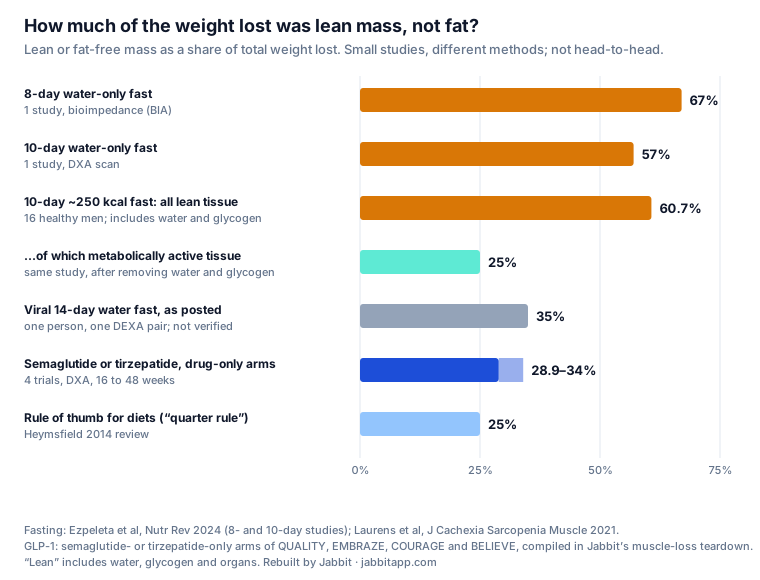
- Water-only, 8 to 10 days: a 2024 review found only two studies that measured fat and lean mass. One (DXA) reported a 7 kg weight loss after a 10-day water fast, 3 kg fat and 4 kg lean; the other (bioimpedance) reported 6 kg lost after 8 days, 2 kg fat and 4 kg lean. The review sums it up as about two-thirds lean and one-third fat.[3] Jabbit’s arithmetic: that is about 57% and 67% lean, from rounded figures.
- 49 studies pooled: a 2026 meta-analysis found standardized drops in fat-free mass (g = −0.51) and total body water (g = −0.68) that were larger than the drop in fat mass (g = −0.25), and concluded that fasting weight loss “reflects complex changes in body composition rather than isolated fat loss.”[4]
- A 7-day water-only fast: 12 volunteers lost an average of 5.7 kg, and blood-protein changes across the body showed up only after about 3 days without calories.[6]
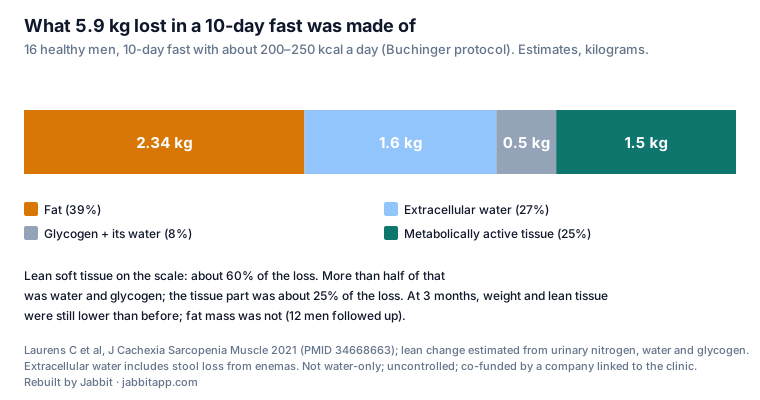
- A breakdown of the lean loss: in 16 healthy men on a 10-day fast with about 200–250 kcal a day of juice and broth (not water-only), lean soft tissue was about 60% of the 5.9 kg lost. The authors estimate that 44% of that lean loss was extracellular water (including stool lost with enemas), 14% glycogen and its water, and 42% metabolically active tissue such as muscle, liver and gut, about 25% of total weight lost.[5]
- A randomized 5-day fast (about 250 kcal a day, not water-only): in the LEANER trial of 38 healthy adults, weight loss was “predominantly driven by loss of fat mass,” and the lean mass lost during fasting “completely reverted” by the 12-week follow-up.[8]
- The viral case: 7 of 20 pounds is 35% lean, by Jabbit’s arithmetic from the post’s figures.[1] That is lower than the two water-fast studies above, closer to what GLP-1 trials report, and one person’s scan pair.
How GLP-1 drugs compare
In the drug-only arms of four recent trials of semaglutide or tirzepatide with DXA scans, lean mass was 28.9% to 34% of the weight lost, over 16 to 48 weeks.[22] A widely cited rule of thumb from diet studies is that about a quarter of weight lost is fat-free mass.[11] Reported lean shares vary widely across weight-loss studies, from about 15% or less to 40%–60%.[21]
Jabbit’s analysis: on these numbers, a long water fast looks lean-heavier per pound lost than a GLP-1, mainly in the first days, when water and glycogen go first. But the comparison is weak: different people, methods and time frames, with no head-to-head trial. A GLP-1 also produces far more total weight loss over months than a 1- to 2-week fast, so lean mass lost in kilograms can be larger on a drug even if the share is smaller.
Safety: what is known
- Common side effects. In 768 supervised fasting visits at one US facility (median 7 days), the most common reported events were fatigue (48.2%), insomnia (33.5%), nausea (32.2%), headache (30.1%), high blood pressure (29.2%, mostly in people who arrived with it) and near-fainting (28.3%).[9]
- Serious events happen. In the same review, one 73-year-old man had dehydration on day 3, and one 70-year-old man had grade 4 hyponatremia (low blood sodium) on day 9; no deaths were reported.[9] A 2024 review of trials found no serious adverse events or deaths, but noted metabolic acidosis, headaches, insomnia and hunger.[3]
- Refeeding syndrome. UK NICE criteria list “little or no nutritional intake for >5 days” as a risk factor, and a BMJ review notes that low phosphate is its hallmark and that NICE advises restarting at no more than half of energy needs in that situation.[18]
- Electrolytes and the heart. Older reports of long therapeutic starvation describe “a breakdown in electrolyte homoeostasis,” low magnesium in a 382-day supervised fast, and a 1969 Lancet paper titled “Gross fragmentation of cardiac myofibrils after therapeutic starvation for obesity.”[16][15][17] Those were far longer fasts, but they are why fasting clinics monitor patients.
- Inflammation signal. A 2025 study of water-only fasts averaging 9.8 days found a rise in C-reactive protein, and its authors wrote that this “raises concerns regarding potential cardiometabolic effects that could persist after refeeding.”[7]
- Slower metabolism. In the 10-day study, basal metabolic rate fell 12%.[5] The 2024 review notes that lean loss “can translate into lower resting metabolic rate after fasting,” a possible risk for regain.[3]
- With a GLP-1. We found one published case of a water fast combined with tirzepatide, done as a 27-day inpatient stay with structured refeeding, and no trials.[19][20] Prolonged fasting on a GLP-1 has not been tested in trials, and fasting while on insulin, sulfonylureas or blood pressure drugs needs a prescriber’s input.
The case for prolonged fasting
It produces fast weight loss: 2% to 10% over 5 to 20 days, per the 2024 review, with no serious events in the trials it covered.[3] Physiology studies going back to the 1960s show the body shifting to ketones and cutting protein breakdown as a fast continues, and the 10-day study saw protein loss early that eased “as ketogenesis increases.”[13][14][5] Strength held in that study and rose 33% in weight-bearing muscles.[5] In the randomized LEANER trial, a 5-day, roughly 250 kcal-a-day fast mostly removed fat, and lean losses recovered by 12 weeks.[8] An observational study of 1,422 people on a supervised 4- to 21-day low-calorie fast reported adverse effects in under 1%.[10]
What a careful reader should notice
- Tiny evidence base. The two-thirds lean figure rests on two water-only studies with rounded numbers, and the 10-day breakdown on 16 men without a control group.[3][5]
- Water-only vs “fasting.” Several studies, including the 10-day breakdown and LEANER, allowed about 200–250 kcal a day, which may not match a strict water fast.[5][8]
- Lean is mostly water early on. In the 10-day study, more than half of the lean loss was water and glycogen, which tends to return with food.[5][12] The muscle and organ share was about a quarter of weight lost, close to the diet rule of thumb.[5][11]
- But not all of it came back. At 3 months in that study, weight and lean tissue were still lower than before, while fat mass was not.[5] In LEANER, the opposite: fat stayed down and lean recovered.[8]
- Benefits fade. The 2024 review says metabolic benefits were gone 3 to 4 months after fasting, even when weight loss was kept, and that the effects of refeeding on body composition remain unknown.[3]
- Who ran the studies. Several safety datasets come from fasting facilities or authors tied to them, as their own funding and competing-interest statements disclose.[9][7][5] That does not make the data wrong, but independent replication is thin.
- A likely typo. The 768-visit review prints “2 (0.002%)” serious events; by Jabbit’s arithmetic, 2 of 768 is about 0.26%.[9]
- One viral scan pair is an anecdote. DXA after a fast is affected by hydration and glycogen, and we cannot check the post’s figures.[1][12]
If you are thinking about a long fast, on or off a GLP-1
Talk with your prescriber first, especially if you take a GLP-1, insulin, a sulfonylurea or blood pressure medicine, or are older, pregnant or have heart, kidney or eating-disorder history. The randomized LEANER trial, for example, excluded people on prescription drugs or with heart, lung, liver or kidney disease needing treatment.[8] For protecting muscle during weight loss on Ozempic, Wegovy or Zepbound, our muscle-loss teardown covers what trials show for protein and resistance training. Logging doses, weight and side effects can help you and your prescriber see what is changing. Jabbit keeps that log privately on your iPhone.
FAQ
- Does water fasting burn muscle?
- Some, along with a lot of water and glycogen. In the two water-only studies a 2024 review found, about two-thirds of the weight lost was lean mass. In a detailed 10-day study, muscle and organ tissue was about a quarter of the weight lost; the rest of the lean loss was water and glycogen.
- Do you lose more muscle with a water fast than on Ozempic or Zepbound?
- Per pound lost, the small fasting studies show a higher lean share (about 57% to 67%) than the drug arms of recent semaglutide and tirzepatide trials (about 29% to 34%). No trial has compared them directly, and much of the fasting loss is water.
- Does extended fasting “spare muscle”?
- Partly. Classic studies show protein breakdown falls as the body shifts to ketones over a long fast, and strength held in one 10-day study. But lean mass still fell in every fasting study cited here, and a 2026 meta-analysis found fat-free mass fell more than fat mass.
- Does the lean mass come back after you eat again?
- Much of the water and glycogen does. In the randomized LEANER trial, lean mass lost in a 5-day, roughly 250 kcal-a-day fast fully recovered by 12 weeks. In a 10-day study, lean tissue was still lower at 3 months, while fat had returned to baseline.
- Is it safe to water fast while taking a GLP-1?
- It has not been studied in trials. We found one published case, done as a supervised inpatient stay. Insulin, some diabetes pills and blood pressure drugs may need adjusting when you stop eating, so talk with your prescriber first.
- What are the risks of a long water fast?
- Common ones are fatigue, insomnia, nausea, headache and near-fainting. Rarer but serious ones include dehydration, low blood sodium and refeeding syndrome, which UK guidance flags after more than 5 days of little or no food.
Bottom line
A long water fast is not a muscle-free way to lose weight. In the little data there is, lean mass made up a larger share of fasting weight loss than in recent GLP-1 trials, though much of it is water and glycogen, and one randomized 5-day low-calorie fasting trial found lean mass recovered. The benefits seen at the end of a fast tend to fade, the studies are small and often run by fasting clinics, and the safety risks grow with length. If muscle is your worry, our read of the evidence points to what GLP-1 muscle trials focus on, such as protein, resistance training and medical follow-up, rather than longer fasts.
References
- Public post on X created October 26, 2026, 4:29 PM ET (poster, a private individual, not named here). It describes a well-known YouTuber who “did a 14-day water-only fast and got a DEXA scan before and after,” with “about 13 lbs of fat lost, and about 7 lbs of lean mass lost,” and says: “That means roughly 1 in every 3 pounds he lost wasn’t fat.” and “The internet keeps saying extended fasting “spares muscle,”” The X API reported 988,584 impressions and 813 bookmarks when Jabbit read it on October 27, 2026 at about 6:03 PM ET. Jabbit has not seen the scans; the numbers are as the post reports them. https://x.com/i/status/2114816804166176827. Checked October 27, 2026.
- Jabbit counts of English posts on X (reposts excluded) with “water fast” or “water fasting,” X API recent-counts endpoint, read October 27, 2026 at about 6:03 PM ET, by UTC day from October 21: 69, 86, 90, 56, 41, 70, and 78 for October 27 through 22:03 UTC; 496 total. https://jabbitapp.com/research/sources/water-fasting-lean-mass-2026-10-27.json. Checked October 27, 2026.
- Ezpeleta M, Cienfuegos S, Lin S, et al. Efficacy and safety of prolonged water fasting: a narrative review of human trials. Nutr Rev. 2024;82(5):664-675. PMID 37377031. Narrative review of human trials of water-only fasting for 5 days or more; open access. Abstract: “prolonged fasting for 5-20 days produces potent increases in circulating ketones, and mild to moderate weight loss of 2-10%”; “Approximately two-thirds of the weight lost is lean mass, and one-third is fat mass. The excessive lean mass loss suggests that prolonged fasting may increase the breakdown of muscle proteins, which is a concern.”; “3-4 months after the fast was completed, all metabolic benefits were no longer observed, even when weight loss was maintained”; “metabolic acidosis, headaches, insomnia, and hunger were observed in some studies.” Full text: “Only 2 studies … measured changes in fat mass and lean mass during prolonged fasting”; by DXA, “Following a 10-day water fast, body weight decreased by 7 kg, fat mass by 3 kg, and lean mass by 4 kg”; by bioelectrical impedance, “After 8 days of water-only fasting, body weight decreased by 6 kg, fat mass by 2 kg, and lean mass by 4 kg”; “Reductions in lean mass can translate into lower resting metabolic rate after fasting, which can put individuals at risk for future weight regain”; “the effects of refeeding on these body composition parameters remain unknown”; “No serious adverse events or deaths were reported in any of the studies reviewed here.” Abstract and full text read. https://pubmed.ncbi.nlm.nih.gov/37377031/ · https://pmc.ncbi.nlm.nih.gov/articles/PMC11494232/. Checked October 27, 2026.
- Ulupınar S, Terzi M, Çamli A, et al. Duration-Dependent Changes in Body Composition During Prolonged Fasting: A Systematic Review and Meta-Analysis. Nutr Rev. 2026. PMID 42440276. Systematic review and meta-analysis. Abstract: “A total of 49 studies met the inclusion criteria”; pooled standardized effects (Hedges g) of “fat mass (g = -0.25), fat-free mass (g = -0.51), total body water (g = -0.68)”; “No clear duration-dependent effects were observed for most outcomes”; prolonged fasting “is also associated with substantial losses in fat-free mass and total body water, indicating that fasting-induced weight loss reflects complex changes in body composition rather than isolated fat loss.” Abstract read. https://pubmed.ncbi.nlm.nih.gov/42440276/. Checked October 27, 2026.
- Laurens C, Grundler F, Damiot A, et al. Is muscle and protein loss relevant in long-term fasting in healthy men? A prospective trial on physiological adaptations. J Cachexia Sarcopenia Muscle. 2021;12(6):1690-1703. PMID 34668663. Uncontrolled study of 16 healthy men at the Buchinger Wilhelmi Clinic, Germany. Abstract: they “fasted with a supplement of 200-250 kcal/day”; “The 10 day fast decreased BW by 7% (-5.9 ± 0.2 kg, P < 0.001) and BMR by 12% (P < 0.01)”; “Fat mass and lean soft tissues (LST) accounted for about 40% and 60% of weight loss”; “LST loss was explained by the reduction in extracellular water (44%), muscle and liver glycogen and associated water (14%), and metabolic active lean tissue (42%)”; “Strength was maintained in non-weight-bearing muscles and increased in weight-bearing muscles (+33%, P < 0.001)”; “Protein loss occurs in early fast but decreases as ketogenesis increases.” Full text: metabolically active tissue was “1.5 ± 0.1 kg representing 25% of weight loss”; extracellular water loss “includes loss of faeces by enemas”; at 3-month follow-up “body mass and LST, but not FM, remained lower”; “We cannot specifically ascertain how much muscle mass breakdown explained the LST decrease”; “This study was funded by the CNRS and Amplius GmbH,” and the authors state that two co-authors work with the clinic or a company that documents its science. Abstract and full text read. https://pubmed.ncbi.nlm.nih.gov/34668663/ · https://pmc.ncbi.nlm.nih.gov/articles/PMC8718030/. Checked October 27, 2026.
- Pietzner M, Uluvar B, Kolnes KJ, et al. Systemic proteome adaptions to 7-day complete caloric restriction in humans. Nat Metab. 2024;6(4):764-777. PMID 38429390. Proteomics study of a 7-day water-only fast. Abstract: “a 7-day water-only fast leads to an average weight loss of 5.7 kg (±0.8 kg) among 12 volunteers”; “systemic changes evident only after 3 days of complete calorie restriction.” Abstract read. https://pubmed.ncbi.nlm.nih.gov/38429390/. Checked October 27, 2026.
- Commissati S, Cagigas ML, Masedunskas A, et al. Prolonged fasting promotes systemic inflammation and platelet activation in humans: A medically supervised, water-only fasting and refeeding study. Mol Metab. 2025;96:102152. PMID 40268190. Abstract: “a medically supervised water-only fast (mean duration: 9.8 ± 3.1 days)”; “Fasting resulted in a 7.7% mean weight loss”; it “induced an acute inflammatory response, characterized by elevated plasma C-reactive protein (CRP)”; “it raises concerns regarding potential cardiometabolic effects that could persist after refeeding.” Full text: one author “is the founder of TrueNorth Health Center, a private facility that offers medically supervised fasting interventions.” Abstract and competing-interest statement read. https://pubmed.ncbi.nlm.nih.gov/40268190/ · https://pmc.ncbi.nlm.nih.gov/articles/PMC12088818/. Checked October 27, 2026.
- Kaufhold G, Bartolomaeus TUP, Schütte K, et al. Machine learning identifies microbiome and clinical predictors of sustained weight loss following prolonged fasting. Genome Med. 2026;18(1). PMID 42754908. LEANER randomized, waitlist-controlled trial. Abstract: “38 healthy adults completed a 5-day fasting intervention with 12-week follow-up”; “Fasting reduced body mass index acutely, predominantly driven by loss of fat mass, and these improvements partially persisted at 12 weeks.” Full text: “a 5-day period with 250 kcal/day”; body composition by “air displacement plethysmography”; fat loss “was accompanied by a reduction in lean mass during fasting that completely reverted at follow-up”; limitation: “the absence of an active dietary comparator”; exclusions included “prescribed medication (except oral contraceptives).” Abstract and full text read. https://pubmed.ncbi.nlm.nih.gov/42754908/ · https://pmc.ncbi.nlm.nih.gov/articles/PMC13587497/. Checked October 27, 2026.
- Finnell JS, Saul BC, Goldhamer AC, et al. Is fasting safe? A chart review of adverse events during medically supervised, water-only fasting. BMC Complement Altern Med. 2018;18(1):67. PMID 29458369. Retrospective chart review at TrueNorth Health Center, a facility that offers supervised fasting; the full text says “Additional support was provided by the TrueNorth Health Foundation.” Abstract: “768 visits met our inclusion and exclusion criteria”; the most severe adverse event was grade 3 in 212 visits, grade 4 in 1 visit, “and there were no grade 5 events”; “There were 2 (0.002%) visits with a serious adverse event (SAE).” Full text: median fast 7 days (range 2 to 41); fatigue 48.2%, insomnia 33.5%, nausea 32.2%, headache 30.1%, hypertension 29.2%, presyncope 28.3%; “Of the 77 visits with a grade 3 hypertension AE, 75 had hypertension as a chief complaint upon arrival”; the two serious events were “a grade 3 dehydration event that occurred on fasting day 3 in a 73-year-old, male patient” and “a grade 4 hyponatremia event that occurred on fasting day 9 in a 70-year-old, male patient.” Abstract and full text read. https://pubmed.ncbi.nlm.nih.gov/29458369/ · https://pmc.ncbi.nlm.nih.gov/articles/PMC5819235/. Checked October 27, 2026.
- Wilhelmi de Toledo F, Grundler F, Bergouignan A, et al. Safety, health improvement and well-being during a 4 to 21-day fasting period in an observational study including 1422 subjects. PLoS One. 2019;14(1):e0209353. PMID 30601864. Observational study of “Buchinger periodic fasting within a specialised clinic.” Abstract: “1422 subjects participated in a fasting program consisting of fasting periods of between 4 and 21 days” “with a daily caloric intake of 200-250 kcal”; “Adverse effects were reported in less than 1% of the participants.” Abstract read. https://pubmed.ncbi.nlm.nih.gov/30601864/. Checked October 27, 2026.
- Heymsfield SB, Gonzalez MC, Shen W, et al. Weight loss composition is one-fourth fat-free mass: a critical review and critique of this widely cited rule. Obes Rev. 2014;15(4):310-21. PMID 24447775. Review. Abstract: “approximately one-fourth of weight loss will be FFM (i.e. ΔFFM/ΔWeight = ∼0.25).” Abstract read. https://pubmed.ncbi.nlm.nih.gov/24447775/. Checked October 27, 2026.
- Kreitzman SN, Coxon AY, Szaz KF. Glycogen storage: illusions of easy weight loss, excessive weight regain, and distortions in estimates of body composition. Am J Clin Nutr. 1992;56(1 Suppl):292S-293S. PMID 1615908. Abstract: “Glycogen is stored in the liver, muscles, and fat cells in hydrated form (three to four parts water)”; “Potassium released from glycogen can distort estimates of body composition during dieting.” Abstract read. https://pubmed.ncbi.nlm.nih.gov/1615908/. Checked October 27, 2026.
- Owen OE, Morgan AP, Kemp HG, et al. Brain metabolism during fasting. J Clin Invest. 1967;46(10):1589-95. PMID 6061736. Classic study of prolonged starvation in obese patients. Abstract: “beta-hydroxybutyrate and acetoacetate replaced glucose as the predominant fuel for brain metabolism.” Abstract read. https://pubmed.ncbi.nlm.nih.gov/6061736/. Checked October 27, 2026.
- Felig P, Owen OE, Wahren J, et al. Amino acid metabolism during prolonged starvation. J Clin Invest. 1969;48(3):584-94. PMID 5773094. Abstract: “protein catabolism is minimized in prolonged fasting.” Abstract read. https://pubmed.ncbi.nlm.nih.gov/5773094/. Checked October 27, 2026.
- Stewart WK, Fleming LW. Features of a successful therapeutic fast of 382 days' duration. Postgrad Med J. 1973;49(569):203-9. PMID 4803438. Case report. Abstract: “A 27-year-old male patient fasted under supervision for 382 days”; “Decreased plasma magnesium concentrations were a consistent feature from the first month onwards.” Abstract read. https://pubmed.ncbi.nlm.nih.gov/4803438/. Checked October 27, 2026.
- Runcie J, Thomson TJ. Prolonged starvation--a dangerous procedure?. Br Med J. 1970;3(5720):432-5. PMID 5454322. Abstract: “Experience with 18 obese patients who have undergone prolonged (60 days) therapeutic starvation shows that in general this is a safe procedure, but there are significant associated hazards, particularly a breakdown in electrolyte homoeostasis.” Abstract read. https://pubmed.ncbi.nlm.nih.gov/5454322/. Checked October 27, 2026.
- Garnett ES, Barnard DL, Ford J, et al. Gross fragmentation of cardiac myofibrils after therapeutic starvation for obesity. Lancet. 1969;1(7601):914-6. PMID 4180896. Title only; PubMed lists no abstract. Cited for the title. https://pubmed.ncbi.nlm.nih.gov/4180896/. Checked October 27, 2026.
- Mehanna HM, Moledina J, Travis J. Refeeding syndrome: what it is, and how to prevent and treat it. BMJ. 2008;336(7659):1495-8. PMID 18583681. Clinical review. Full text: “The hallmark biochemical feature of refeeding syndrome is hypophosphataemia”; NICE criteria for high risk include “Little or no nutritional intake for >5 days”; “The NICE guidelines recommend that refeeding is started at no more than 50% of energy requirements in “patients who have eaten little or nothing for more than 5 days.”” Full text read. https://pubmed.ncbi.nlm.nih.gov/18583681/ · https://pmc.ncbi.nlm.nih.gov/articles/PMC2440847/. Checked October 27, 2026.
- Palmisano T, Roeschenthaler P, Passerini H, et al. Combination of prolonged water fasting and GLP-1 for refractory morbid obesity: Case report. Eur J Clin Nutr. 2026;80(7):734-737. PMID 41998348. Case report. Abstract: prior water-fasting studies did not focus on severe obesity “or utilized treatment with glucagon-like peptide-1 receptor agonists (GLP-1)”; one patient “underwent a 27 day inpatient fast with weekly tirzepatide, including 21 day water fast with structured refeeding”; “The patient lost 125 pounds during the fast”; “the only complication was mild transaminitis.” Abstract read. https://pubmed.ncbi.nlm.nih.gov/41998348/. Checked October 27, 2026.
- PubMed search for prolonged or water-only fasting together with semaglutide, tirzepatide, liraglutide or GLP-1 in titles and abstracts, run October 27, 2026: 21 records. By Jabbit’s title screen, one is a case report of a supervised water fast combined with tirzepatide; the rest concern fasting before surgery or endoscopy, Ramadan, refeeding-risk physiology or laboratory work. https://pubmed.ncbi.nlm.nih.gov/?term=%28%22prolonged+fasting%22%5Btiab%5D+OR+%22water-only+fasting%22%5Btiab%5D+OR+%22water+fasting%22%5Btiab%5D+OR+%22water-only+fast%22%5Btiab%5D%29+AND+%28semaglutide%5Btiab%5D+OR+tirzepatide%5Btiab%5D+OR+liraglutide%5Btiab%5D+OR+%22GLP-1%22%5Btiab%5D%29. Checked October 27, 2026.
- Neeland IJ, Linge J, Birkenfeld AL. Changes in lean body mass with glucagon-like peptide-1-based therapies and mitigation strategies. Diabetes Obes Metab. 2024;26 Suppl 4:16-27. PMID 38937282. Review. Abstract: “in some studies, reductions in lean mass range between 40% and 60% as a proportion of total weight lost, while other studies show lean mass reductions of approximately 15% or less of total weight lost”; lean mass “includes not only muscle but also organs, bone, fluids, and water in fat tissue.” Abstract read. https://pubmed.ncbi.nlm.nih.gov/38937282/. Checked October 27, 2026.
- Jabbit, “Muscle loss on Ozempic, Wegovy and Zepbound” teardown: in GLP-1-plus-placebo arms, lean mass was 31.9% of weight lost in QUALITY, 30.2% in EMBRAZE, 34% in COURAGE and 28.9% in BELIEVE (Jabbit’s arithmetic from the published fat loss index), each cited to its primary source there. https://jabbitapp.com/research/muscle-loss-ozempic-wegovy-zepbound-lean-mass-creatine.html. Checked October 27, 2026.
- Jabbit source extract for this page: abstract and full-text quotes checked against cached copies, X API reads, search results and chart values, October 27, 2026. https://jabbitapp.com/research/sources/water-fasting-lean-mass-2026-10-27.json. Checked October 27, 2026.
This page analyzes published studies, a public post on X and Jabbit’s own counts. It is not medical advice and does not recommend fasting, any product or any dose. Numbers from the viral post are as reported and unverified. Charts were rebuilt by Jabbit from the sources cited in each caption.