Evidence teardown · Fat burners · Experimental drugs · Updated October 27, 2026
Published · Updated
What is HU6, and is it a “safe DNP”? HU6 is an experimental Rivus Pharmaceuticals pill that the liver turns into DNP, the 1930s diet drug that still kills people. In supervised trials of up to six months it cut liver fat by roughly 27% to 36% but body weight by under 3 kg, and no treatment-related serious side effects were reported. It is not approved, and no study shows that safety record would hold outside a trial.
HU6 is having a moment online as the “safe” version of DNP (2,4-dinitrophenol), a chemical that melts fat by making cells burn energy as heat, and that has killed people since the 1930s. The reader’s question: is HU6 actually a safe DNP, and does it work? Our plain answer: HU6 is a real drug in real, placebo-controlled trials, and in those trials it lowered liver fat a lot and body weight a little, without the disasters DNP is known for. But every one of those trials was run by its maker, under medical supervision, and HU6 is not approved or legally sold. The safety record belongs to the trial setting, not to anything bought online.
Why this matters now
On October 21, 2026, a “Ranking fat burners” tier list on X put HU6 in its second-highest tier, next to Ozempic, and put DNP in a bottom “death tier.” It passed 1.29 million impressions.[1] In a reply, the same account summed up the appeal: “HU6 is basically like DNP but you can’t kill yourself with it.”[2] Meanwhile, HU6’s maker began a new Phase 2 trial in April 2026, and FDA warned in June 2026 that a fat burner sold online contained hidden DNP.[8][19] So what do the trials show, and what don’t they?
Timeline: from DNP to HU6
| Date | Event |
|---|---|
| Early 1930s | DNP, an industrial chemical, becomes a popular diet drug in the US after work at Stanford.[12] |
| 1935 | An outbreak of cataracts is traced to DNP diet pills.[13] |
| 1938 | The Food, Drug, and Cosmetic Act gives federal regulators the power to stop DNP sales.[12] |
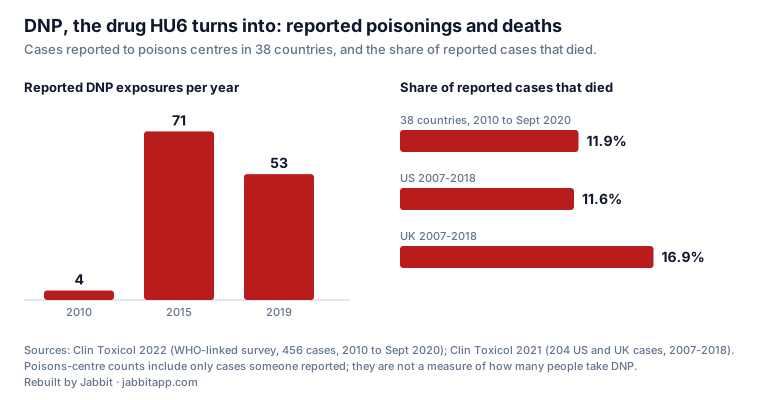
| 2010–2015 | Reports of DNP poisoning to poisons centres in 38 countries rise from 4 a year to 71.[15] A 2011 review counts 62 published deaths.[14] |
| 2020–2021 | Rivus Pharmaceuticals starts Phase 1 trials of HU6 and a Phase 2a liver-fat trial.[9][3] |
| 2023 | The Phase 2a results are published in The Lancet Gastroenterology & Hepatology.[3] |
| 2025 | The HuMAIN heart failure trial is published in JAMA Cardiology.[4] Rivus reports M-ACCEL liver results in June and presents them at the AASLD liver meeting in November.[6][7] |
| Apr 14, 2026 | Rivus doses the first patients in AMPLIFY, a 180-patient Phase 2 trial; top-line data expected mid-2027.[8] |
| Jun 4, 2026 | FDA warns that a fat burner sold online contained DNP not listed on its label.[19] |
| Oct 21, 2026 | A viral fat-burner tier list ranks HU6 near the top and DNP at the bottom.[1] |
What HU6 is
- A DNP prodrug. The 2023 trial paper calls HU6 “a controlled metabolic accelerator that is metabolised in the liver to the mitochondrial uncoupler 2,4-dinitrophenol.”[3] In other words, the active chemical is DNP; the design aims to control how much reaches the body and how fast.
- A different idea from Ozempic. Drugs like semaglutide mostly cut how much people eat. HuMAIN’s designers wrote that uncouplers aim at “increased catabolism rather than reduced caloric intake.”[5] Rivus says its drugs raise metabolism in a way that is “consistent and imperceptible to the patient.”[6]
- Still experimental. ClinicalTrials.gov lists 11 HU6 studies, all sponsored by Rivus: 6 Phase 1 and 5 Phase 2. None is Phase 3.[9] Rivus calls itself “a clinical-stage biopharmaceutical company.”[8] HU6 has no FDA approval.
What the trials show
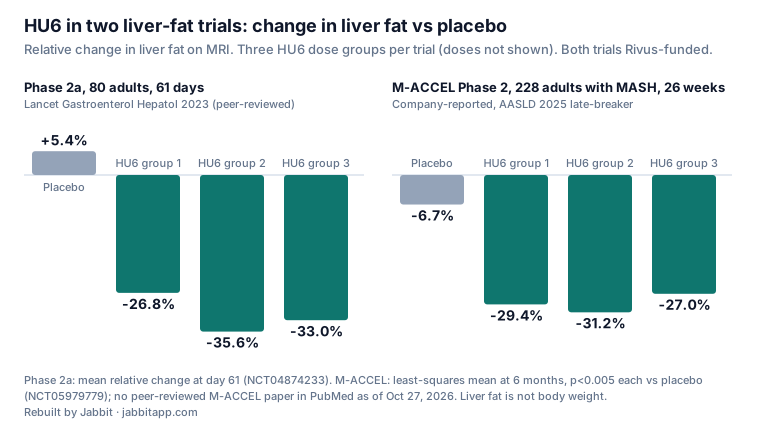
- Liver fat, 61 days (peer-reviewed). In 80 adults with fatty liver and a high BMI, liver fat fell 26.8% to 35.6% across three HU6 dose groups and rose 5.4% on placebo.[3]
- Liver fat, 6 months (company-reported). In M-ACCEL, 228 adults with MASH, an inflamed form of fatty liver disease that can lead to scarring, liver fat fell 27.0% to 31.2% on HU6 vs 6.7% on placebo. Half or more of HU6 patients (50% to 58%) cut liver fat by at least 30%, vs 22% on placebo.[7] We found no peer-reviewed M-ACCEL paper in PubMed, and no results are posted on ClinicalTrials.gov.[10][9]
- Weight: small. In HuMAIN, 66 people with obesity and heart failure lost 2.86 kg more on HU6 than on placebo over 19 weeks, almost all of it fat (2.96 kg less fat mass), “with no significant loss of muscle mass.”[4] In M-ACCEL, Rivus reports a 2.4% (2.6 kg) weight drop at the highest dose.[7]
- No better exercise capacity. HuMAIN’s heart failure measures, including peak oxygen use and the 6-minute walk, did not change significantly.[4]
Jabbit’s analysis: on weight, HU6 is not in Ozempic’s league so far. In STEP 1, semaglutide users lost 14.9% of body weight over 68 weeks vs 2.4% on placebo.[11] HU6’s trials were shorter and in different patients, so this is not a head-to-head comparison, but the weight results reported so far are a few kilograms. HU6’s case rests on liver fat and on fat loss that spares muscle.
What the trials say about safety
- Phase 2a: no serious adverse events and no deaths. The most common side effects on HU6 were flushing (32%), diarrhoea (25%) and palpitations (12%), vs 10%, 0% and 5% on placebo.[3] Flushing and a racing heart fit how an uncoupler works: it turns energy into heat.
- HuMAIN: serious adverse events in 4 people on HU6 and 1 on placebo, including 1 death, all judged unrelated to treatment.[4]
- M-ACCEL (company-reported): “no treatment-related serious adverse events,” gastrointestinal problems in 14% on HU6 vs 16% on placebo, and fewer than 5% of patients discontinuing.[6][7]
- Scale: Rivus says more than 500 patients have been treated with HU6.[8] That is too few to rule out rare harms.
Why DNP is in the “death tier”
- A razor-thin margin. A history of the 1930s craze calls DNP’s therapeutic index “razor thin” and says “thousands of people suffered irreversible harm.”[12] It was withdrawn because of “high toxicity, a narrow therapeutic window, and a lack of an antidote.”[18]
- How it kills. Poisoning brings very high body temperature, a fast heart, sweating and fast breathing, “eventually leading to death.”[14] In US and UK cases, a fast heart, high fever, acidosis and confusion each predicted death.[16]
- Who it kills. Of 204 US and UK cases, 86% were under 40 and 71% were men. About 1 in 9 reported US cases and 1 in 6 UK cases died.[16] In an earlier UK poisons-service series, the median age was 23.5 and 5 of 30 reported cases died.[17] Worldwide, 11.9% of reported cases died.[15]
- It is still sold. FDA says DNP “is illegally marketed as a weight-loss product and is not approved by the FDA for any use,” and in June 2026 found it hidden in a fat burner sold online.[19]
Is HU6 a “safe DNP”? What the claim gets right and wrong
Jabbit’s analysis:
- Right: HU6 is designed to deliver DNP in a controlled way, and the trials so far have not reported the heatstroke-type poisonings seen with DNP.[3][4][7]
- Unproven: “you can’t kill yourself with it”[2] is not something any study has tested. The trials enrolled screened adults, used set amounts of a known product, and monitored them. They tell us nothing about overdose, heat, heavy exercise, or mixing HU6 with other drugs.
- Wrong in practice: HU6 is investigational and, as far as we found, is legally available only inside Rivus’s trials.[9][8] Anything sold online under that name cannot be checked against the trial drug, and FDA has found undeclared DNP in an online fat burner this year.[19] A product labeled HU6 could contain anything, including DNP itself.
The case for HU6
It is fair to say HU6 is one of the more interesting obesity-adjacent ideas in development. It works by raising energy use rather than cutting appetite, the 2023 trial was randomized, placebo-controlled and peer-reviewed, liver fat fell substantially, and the fat-only weight loss with no significant muscle loss in HuMAIN stands out at a time when muscle loss on GLP-1 drugs is a common worry.[3][4][5] A review of DNP itself notes that its efficacy “surpasses that of many contemporary anti-obesity drugs,” which is why researchers want a safer way to use it “under controlled conditions.”[18]
What a careful reader should notice
- All HU6 trials are sponsored by Rivus, and the 2023 paper’s first author disclosed owning shares in Rivus. That does not make the results wrong, but it is worth knowing.[9][3]
- The six-month M-ACCEL results come from company releases and a conference talk, not a peer-reviewed paper we could find.[7][10]
- Liver fat is not body weight. The large percentages are liver fat; the weight changes were a few kilograms.[3][4][7]
- No HU6 trial has reached Phase 3, and the next data are expected mid-2027.[9][8]
- Tier lists rank by vibes. A ranking that puts an unapproved, Phase 2 drug next to Ozempic is not based on comparable evidence.[1][11]
FAQ
- What is HU6?
- HU6 is an experimental pill from Rivus Pharmaceuticals that the liver converts into DNP (2,4-dinitrophenol), a chemical that makes cells burn energy as heat. Rivus calls it a controlled metabolic accelerator. It has been tested in Phase 1 and Phase 2 trials, mainly for fatty liver disease, and is not approved.
- Is HU6 the same as DNP?
- Not exactly. HU6 is a prodrug: the body turns it into DNP. It is designed to release DNP in a controlled way, and its trials have not reported the poisonings seen with DNP. But the active chemical is the same, and the trials only tested supervised use in screened adults.
- How much weight do people lose on HU6?
- Not much so far. In the HuMAIN trial, people lost 2.86 kg more than on placebo over 19 weeks, almost all of it fat. Rivus reported a 2.4% weight drop at the highest dose over six months in M-ACCEL. Semaglutide’s STEP 1 trial reported 14.9% vs 2.4% over 68 weeks.
- Is HU6 safe?
- In trials, no serious side effects were linked to HU6. Flushing, diarrhoea and palpitations were more common than on placebo. About 500 people have been treated, too few to rule out rare harms, and nothing is known about use outside supervised trials.
- Is HU6 FDA approved or available to buy?
- No. HU6 is investigational and, as far as we found, legally available only in Rivus’s clinical trials. Products sold online under the name cannot be verified, and FDA has found hidden DNP in a fat burner sold online in 2026.
- Why is DNP so dangerous?
- DNP has a very narrow margin between an effective and a deadly amount and no antidote. Poisoning causes very high body temperature, a racing heart and fast breathing. About 12% of DNP cases reported to poisons centres in 38 countries ended in death.
Bottom line
HU6 is a serious attempt to tame DNP, and in its maker’s trials it cut liver fat substantially, trimmed a few kilograms of fat, and did not produce DNP-style poisonings. That is promising for fatty liver disease, but it is not evidence that HU6 is a strong weight-loss drug or that it is safe outside a supervised trial. Until AMPLIFY and later trials report, the honest description is: interesting, unapproved, and not something to buy.
References
- Public post on X created October 21, 2026, 2:57 PM ET, “Ranking fat burners,” with a tier-list image (poster, a private individual, not named here). The image places HU6 in its second-highest tier alongside Ozempic, phentermine and tesamorelin, and DNP in a bottom “death tier.” The X API reported 1,295,390 impressions and 1,248 bookmarks when Jabbit read it on October 27, 2026 at about 10:05 AM ET. https://x.com/i/status/2112981516892639669. Checked October 27, 2026.
- Public reply on X by the same account, October 21, 2026, 3:35 PM ET: “HU6 is basically like DNP but you can’t kill yourself with it.” The X API reported 5,200 impressions on October 27, 2026. https://x.com/i/status/2112991074616549635. Checked October 27, 2026.
- Noureddin M, Khan S, Portell F, et al. Safety and efficacy of once-daily HU6 versus placebo in people with non-alcoholic fatty liver disease and high BMI: a randomised, double-blind, placebo-controlled, phase 2a trial. Lancet Gastroenterol Hepatol. 2023;8(12):1094-1105. PMID 37806314. Phase 2a randomized trial, funded by Rivus Pharmaceuticals (NCT04874233). Abstract: “HU6 is a controlled metabolic accelerator that is metabolised in the liver to the mitochondrial uncoupler 2,4-dinitrophenol”; “80 adults (39 [49%] women and 41 [51%] men)”; treatment “for 61 days”; relative change in liver fat was −26·8%, −35·6% and −33·0% in the three HU6 dose groups “and 5·4% (19·8) for the placebo group”; “No serious TEAEs were reported”; “flushing (19 [32%] participants), diarrhoea (15 [25%] participants), and palpitations (seven [12%] participants) were the most frequently reported TEAEs” (placebo: flushing 10%, diarrhoea none, palpitations 5%); “There were no deaths.” Disclosure: the first author “is a minor shareholder or has stocks in Anaetos, Rivus Pharma” and others. Dose amounts are not reproduced here. Abstract read. https://pubmed.ncbi.nlm.nih.gov/37806314/. Checked October 27, 2026.
- Pandey A, Lewis GD, Borlaug BA, et al. Novel Controlled Metabolic Accelerator for Obesity-Related HFpEF: The HuMAIN-HFpEF Randomized Clinical Trial. JAMA Cardiol. 2025;10(6):609-616. PMID 40072462. HuMAIN-HFpEF Phase 2a randomized trial in obesity-related heart failure with preserved ejection fraction (NCT05284617, sponsor Rivus Pharmaceuticals per ClinicalTrials.gov). Abstract: “Of 66 participants randomized,” “56 completed the trial”; weight “between-group difference, −2.86 kg; 95% CI, −4.68 to −1.04 kg; P = .003”; “total fat mass (between-group difference, −2.96 kg …)”; “with no significant loss of muscle mass”; “There were no statistically significant changes in peak VO2, 6-minute walk distance, Kansas City Cardiomyopathy Questionnaire score …”; “Serious adverse events were noted in 5 participants (4 in the HU6 group; 1 in the placebo group), including 1 death, all judged unrelated to treatment.” Dose amounts are not reproduced here. Abstract read. https://pubmed.ncbi.nlm.nih.gov/40072462/. Checked October 27, 2026.
- Kitzman DW, Lewis GD, Pandey A, et al. A novel controlled metabolic accelerator for the treatment of obesity-related heart failure with preserved ejection fraction: Rationale and design of the Phase 2a HuMAIN trial. Eur J Heart Fail. 2024;26(9):2013-2024. PMID 38924328. HuMAIN design paper. Abstract: “Current weight loss strategies (diet, drug, and surgical) work through decreased energy intake rather than increased expenditure”; “Mitochondrial uncoupling agents may have unique beneficial effects by producing weight loss via increased catabolism rather than reduced caloric intake.” Disclosure: the first author “has been a consultant for … Rivus” among other companies. Abstract read. https://pubmed.ncbi.nlm.nih.gov/38924328/. Checked October 27, 2026.
- Rivus Pharmaceuticals press release via PR Newswire, “Rivus Pharmaceuticals Announces Positive Topline Results from Phase 2 M-ACCEL Trial of HU6 …,” June 24, 2025. Company statements: the trial “met its primary endpoint”; “A total of 221 adult patients were randomized”; “Treatment with HU6 was associated with entirely fat-specific weight loss, with no significant change in lean mass at any dose”; “no treatment-related serious adverse events”; “CMAs increase metabolism in a manner that is consistent and imperceptible to the patient by leveraging the natural metabolic process of mitochondrial uncoupling.” Company-reported, not peer-reviewed. https://www.prnewswire.com/news-releases/rivus-pharmaceuticals-announces-positive-topline-results-from-phase-2-m-accel-trial-of-hu6-showing-significant-reductions-in-liver-fat-in-patients-with-mash-302488778.html. Checked October 27, 2026.
- Rivus Pharmaceuticals press release, “… New Data from Phase 2 M-ACCEL Trial of HU6 in MASH in Late-Breaker Oral Presentation at AASLD The Liver Meeting 2025,” November 7, 2025. Company statements: “analysis of 228 patients”; liver fat “least-squares mean difference −29.4%, −31.2%, −27.0%” across the three dose groups “versus −6.7% with placebo”; “57%, 58%, and 50% of patients achieving a response” (≥30% liver-fat reduction) “versus 22% for placebo”; body weight at the highest dose “(−2.4%, or −2.6 kg,”; “Weight loss was entirely fat-selective, with lean and skeletal muscle mass preserved”; “gastrointestinal disorders (14% with HU6 versus 16% with placebo)”; “Low discontinuation rate (<5%).” Company-reported, not peer-reviewed. Dose amounts are not reproduced here. https://www.rivuspharma.com/news/press-releases/110725/. Checked October 27, 2026.
- Rivus Pharmaceuticals press release, “Rivus Pharmaceuticals Announces First Patients Dosed in AMPLIFY Phase 2 Trial for HU6 in MASH,” April 14, 2026: “Top-line data expected in mid-2027”; the trial “will enroll up to 180 patients with F2/F3 MASH” for six months; “With over 500 patients treated to date”; Rivus describes itself as “a clinical-stage biopharmaceutical company.” Company statements. https://www.rivuspharma.com/news/press-releases/041426/. Checked October 27, 2026.
- ClinicalTrials.gov API v2, intervention “HU6,” read October 27, 2026: 11 studies, all with lead sponsor Rivus Pharmaceuticals, Inc.: 6 Phase 1 and 5 Phase 2. AMPLIFY (NCT07491458) is recruiting, estimated 180 participants, primary completion February 2027; M-ACCEL (NCT05979779) is listed as active, not recruiting, with no results posted; NCT06104358 was withdrawn. Only NCT04874233 has posted results. https://clinicaltrials.gov/search?intr=HU6. Checked October 27, 2026.
- Jabbit PubMed search, October 27, 2026: HU6[tiab] AND (MASH OR steatohepatitis OR M-ACCEL) returned 1 record, the 2023 Phase 2a paper; we found no peer-reviewed M-ACCEL paper. https://pubmed.ncbi.nlm.nih.gov/?term=HU6%5Btiab%5D+AND+%28MASH+OR+steatohepatitis+OR+M-ACCEL%29. Checked October 27, 2026.
- Wilding JPH, Batterham RL, Calanna S, et al. Once-Weekly Semaglutide in Adults with Overweight or Obesity. N Engl J Med. 2021;384(11):989-1002. PMID 33567185. STEP 1 randomized trial of semaglutide in 1,961 adults with overweight or obesity over 68 weeks. Abstract: “The mean change in body weight from baseline to week 68 was −14.9% in the semaglutide group as compared with −2.4% with placebo.” Abstract read. https://pubmed.ncbi.nlm.nih.gov/33567185/. Checked October 27, 2026.
- Colman E. Dinitrophenol and obesity: an early twentieth-century regulatory dilemma. Regul Toxicol Pharmacol. 2007;48(2):115-7. PMID 17475379. History. Abstract: “In the early 1930s, the industrial chemical dinitrophenol found widespread favor as a weight-loss drug, due principally to the work of Maurice Tainter, a clinical pharmacologist from Stanford University”; “the compound's therapeutic index was razor thin and it was not until thousands of people suffered irreversible harm …”; “it took passage of the Food, Drug, and Cosmetic Act in 1938 before federal regulators had the ability to stop patent medicine men from selling dinitrophenol.” Abstract read. https://pubmed.ncbi.nlm.nih.gov/17475379/. Checked October 27, 2026.
- Margo CE, Harman LE. Diet pills and the cataract outbreak of 1935: reflections on the evolution of consumer protection legislation. Surv Ophthalmol. 2014;59(5):568-73. PMID 24913328. History. Abstract: “An outbreak of cataracts in 1935 caused by dinitrophenol (DNP), the active ingredient of popular diet pills”; “medical opinion concerning the safety of DNP may have contributed to the voluntary withdrawal of the diet drug from the market.” Abstract read. https://pubmed.ncbi.nlm.nih.gov/24913328/. Checked October 27, 2026.
- Grundlingh J, Dargan PI, El-Zanfaly M, et al. 2,4-dinitrophenol (DNP): a weight loss agent with significant acute toxicity and risk of death. J Med Toxicol. 2011;7(3):205-12. PMID 21739343. Review. Abstract: “DNP is sold mostly over the internet under a number of different names as a weight loss/slimming aid”; toxicity is “a combination of hyperthermia, tachycardia, diaphoresis and tachypnoea, eventually leading to death”; “To date, there have been 62 published deaths in the medical literature attributed to DNP.” Abstract read. https://pubmed.ncbi.nlm.nih.gov/21739343/. Checked October 27, 2026.
- Gziut T, Thomas SHL. International trends in systemic human exposures to 2,4 dinitrophenol reported to poisons centres. Clin Toxicol (Phila). 2022;60(5):628-631. PMID 34812657. Survey of poisons centres with the World Health Organization, January 2010 to September 2020. Abstract: “Responses were received from poisons centres in 38 countries which reported 456 separate cases of DNP exposure”; “Annual case numbers increased from 4 in 2010 to 71 in 2015, with subsequent reductions to 53 in 2019”; “case fatality was high (11.9%, 95% CI 9.0, 15.4).” Abstract read. https://pubmed.ncbi.nlm.nih.gov/34812657/. Checked October 27, 2026.
- Potts AJ, Bowman NJ, Seger DL, et al. Toxicoepidemiology and predictors of death in 2,4-dinitrophenol (DNP) toxicity. Clin Toxicol (Phila). 2021;59(6):515-520. PMID 33021407. US and UK poisons-centre cases, 2007–2018. Abstract: “There were 204 cases (n = 86, US; n = 118, UK) of systemic DNP exposure identified, of which 86% were under the age of 40 and 71% were males”; case fatality “US 11.6% …: UK 16.9%”; “Tachycardia, hyperpyrexia, acidosis, and agitation/confusion are independent risk factors for mortality.” Abstract read. https://pubmed.ncbi.nlm.nih.gov/33021407/. Checked October 27, 2026.
- Kamour A, George N, Gwynnette D, et al. Increasing frequency of severe clinical toxicity after use of 2,4-dinitrophenol in the UK: a report from the National Poisons Information Service. Emerg Med J. 2015;32(5):383-6. PMID 24957806. UK National Poisons Information Service, 2007–2013. Abstract: “Of the 30 separate systemic exposures to DNP reported by telephone to NPIS during the study period”; patients had “a median age of 23.5 years”; “Commonly reported clinical features were fever (47%), tachycardia (43%), sweating (37%)”; “There were five (17%, 95% CI 6.9% to 34%) fatalities, four involving acute overdose.” Abstract read. https://pubmed.ncbi.nlm.nih.gov/24957806/. Checked October 27, 2026.
- Pohl EE, Jovanović O. Molecular mechanisms of mitochondrial uncoupling: focus on 2,4-dinitrophenol. Eur Biophys J. 2026;55(5):905-917. PMID 41838137. Review of how DNP works. Abstract: DNP “was used as an anti-obesity treatment until it was withdrawn due to high toxicity, a narrow therapeutic window, and a lack of an antidote”; “Despite these concerns, DNP’s efficacy surpasses that of many contemporary anti-obesity drugs, sparking renewed interest in its potential use under controlled conditions.” Authors: “The authors declare no conflict of interest.” Abstract read. https://pubmed.ncbi.nlm.nih.gov/41838137/. Checked October 27, 2026.
- US Food and Drug Administration, Medication Health Fraud Notification dated June 4, 2026: FDA testing found “2,4-dinitrophenol in the nighttime (“pm”) tablets not listed on the product label” of a fat burner sold online; DNP “is illegally marketed as a weight-loss product and is not approved by the FDA for any use”; “long-term exposure can damage the eyes, skin, bone marrow, nervous system and heart”; “DNP toxicity also can cause dangerously high body temperature, rapid heart rate and breathing, cardiac arrest and death.” https://www.fda.gov/drugs/medication-health-fraud-notifications/lipofit-extreme-20-fat-burner-may-be-harmful-due-hidden-drug-ingredients. Checked October 27, 2026.
- Jabbit source extract for this page: abstract quotes, disclosures, press-release quotes, FDA text, registry fields, PubMed search result and X metrics checked against cached copies on October 27, 2026. https://jabbitapp.com/research/sources/hu6-dnp-2026-10-27.json. Checked October 27, 2026.
This page analyzes published studies, company press releases, FDA notices, trial registries and public posts. It is not medical advice and does not recommend any product or dose. Company-reported results are labeled. Charts were rebuilt by Jabbit from the sources cited in each caption.