Home / Research / GHK-Cu teardown
Paper-trail teardown · original papers, SEC filings, 1994 press, FDA and trial registries read · Sources checked October 16, 2026
Does GHK-Cu rebuild aging skin or heal you from the inside? Its biggest trial failed, and nobody has tested the injections.
GHK-Cu is a real copper-carrying peptide in human blood, and in lab dishes and animal wounds it does a lot.[1][3][27] But the one time it was put through a large drug trial, 511 people with diabetic foot ulcers, it did no better than placebo.[11][13] The company behind it then sold it as a wound dressing, a device route FDA cleared mainly on safety and similarity to existing dressings, not proof that it heals, and moved into skin creams.[13][15] Two of the most-repeated claims about it, that blood levels fall 60% with age and that it resets 4,000 genes, trace back to an uncited sentence and to tests in two kinds of cancer cells.[4][6] We found no trial of the way it’s used on X now: injected.[17][19]
Why this matters this week
GHK-Cu is having a moment. We counted 1,001 posts on X mentioning it from October 10 to 16, 2026, more than 100 every day.[26] The pitch is big: “GHK-Cu literally REBUILDS aging skin,” one account with 20,000 followers posted on October 7.[26] Others repeat that levels in your blood fall “approximately 60 percent between the ages of 20 and 60” and that it “affects about 31.2% of human genes.”[26] Another says “the decline is so consistent across studies.” On October 16 one account called “GHK-Cu influences 4,000 genes” “the most repeated line in peptides.”[26] People are injecting it (“GHK-Cu 2mg + topical”), sellers advertise 100 mg vials, and some pair it with retatrutide “to help loose skin.”[26] Meanwhile FDA is deciding what to do about it. On October 14 the agency sent an interim peptide compounding policy to the White House; its text isn’t public.[22] FDA still warns that injectable GHK-Cu may trigger immune reactions, and its compounding advisory committee is due to review GHK-Cu at a meeting before the end of February 2027. No date had been set when we checked.[20][21][23] So we went back to where GHK-Cu came from and what has actually been tested in people.
Where GHK-Cu came from
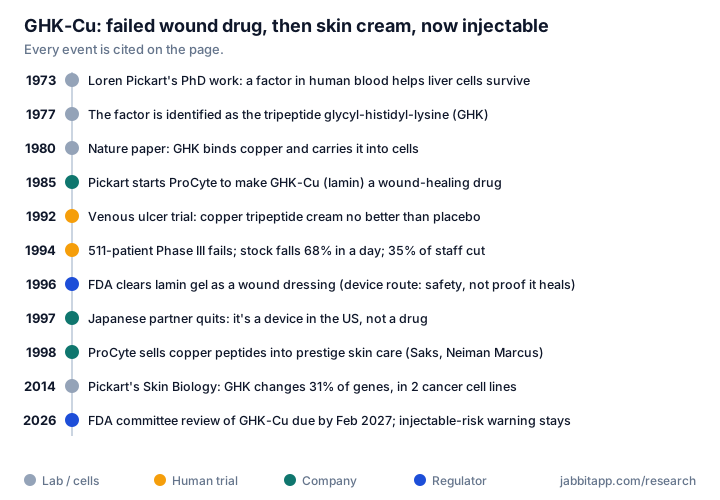
In 1973 Loren Pickart, then working on his PhD at the University of California, San Francisco, reported a factor in human blood serum that helped normal liver cells survive in culture and made liver cancer cells grow faster.[1][8] By 1977 his group had identified it as a three-amino-acid peptide, glycyl-histidyl-lysine, or GHK.[2] In 1980 they reported in Nature that GHK grabs copper and helps carry it into cells.[3] That copper-bound form is GHK-Cu. Pickart says he started a company, ProCyte, in 1985 “to turn these discoveries into useful skincare products,” and he now sells GHK-Cu creams through another company, Skin Biology.[8] The record from the time tells it differently: ProCyte was built around a wound-healing drug, and skin care came after that drug failed.[11][13][15]
The big trial failed
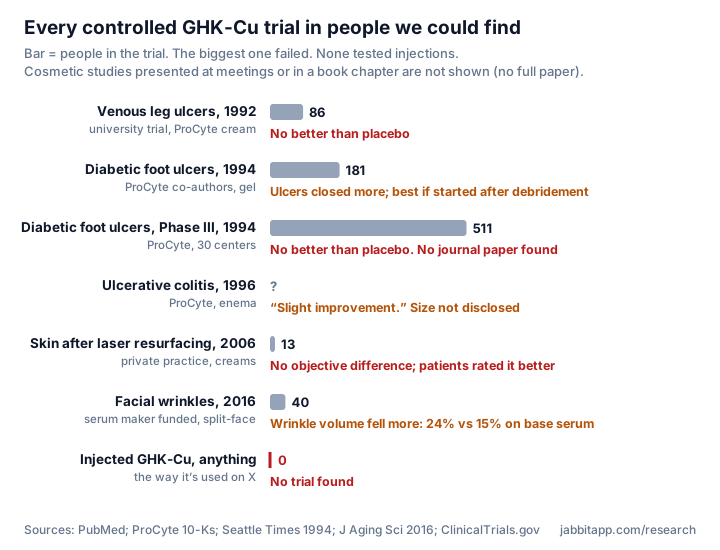
ProCyte’s lead product was Iamin gel, GHK-Cu for chronic wounds.[13] The first outside test went badly. In a 1992 trial at the University of Texas Medical Branch and Washington University in St. Louis, 86 people with venous leg ulcers used a 0.4% GHK-Cu cream supplied by ProCyte, a dummy cream, or silver sulfadiazine, an old burn cream, for 4 weeks. Ulcers shrank by 18.7% on GHK-Cu and 22.5% on the dummy cream, no real difference. Silver sulfadiazine shrank them 44%. Six of 28 people on silver sulfadiazine healed completely, against none of 29 on GHK-Cu.[9]
ProCyte’s own diabetic foot ulcer study looked better. Published in 1994 with ProCyte scientists as co-authors, it enrolled 181 people. Plantar ulcers closed more on Iamin gel than on a dummy gel, a median 98.5% versus 60.8%. The authors added that “treatment must commence immediately after the initial wound debridement to obtain optimal enhancement,” and in ulcers treated that way, infections were less common (7% versus 34%).[10]
Then came the test that counted. ProCyte ran a Phase III trial in 511 people with diabetic foot ulcers at 30 medical centers, using 0.5% or 2% gel against placebo for 8 or 16 weeks.[11][12] On October 17, 1994, the company announced that it worked no better than placebo. “Nothing in our experience led us to expect this outcome,” its research chief told The Seattle Times. A company executive told BioWorld, “what was surprising to us was the placebo worked.” Both doses and the placebo each fully closed about a third of ulcers, and all three groups reached 80 to 90% median closure.[11][12] As one analyst read it to The Seattle Times, the drug did about as well as it had in Phase II; the placebo did much better.[11] The stock fell 68% that day, from $8.87 to $2.81. ProCyte cut 35% of its staff, and shareholders sued.[12][13] We could not find a journal paper reporting this trial.
From drug to dressing to face cream
After the failure, ProCyte took a different route to market. In February 1996 FDA cleared Iamin gel as an over-the-counter wound dressing under the 510(k) device process. ProCyte’s own annual report explains the difference: unlike approval as a drug, 510(k) clearance requires “primarily that a new product’s safety be established” and that it be comparable to wound products already on the market.[13] In other words, the clearance was not a finding that GHK-Cu heals wounds. ProCyte’s Japanese partner, Kissei, pulled out in March 1997 “in large part because the Iamin compound was cleared to be marketed in the U.S. as a device and is not presently being developed in the U.S. as a drug.”[14]
An early-stage trial of a GHK-Cu enema for ulcerative colitis, finished in November 1996, found that the high dose gave “slight improvement in disease remission” and “statistically significant differences in the number of patients with improved disease symptoms.”[14] We found no later trial. By 1998 ProCyte’s copper peptides were in “Blue Copper,” an anti-aging cream sold at Saks and Neiman Marcus counters.[15] That is how ProCyte’s copper-peptide business ended up in skin care: a failed drug, cleared as a dressing, then sold as a cosmetic.
The “60% decline with age” number has no source we could find
The claim on X that blood GHK falls by about 60% between 20 and 60 comes from Pickart’s reviews. His 2015 review says levels are “about 200 ng/mL … at age 20, but declines to 80 ng/mL by age 60.” That sentence has no citation, and neither does the same claim in his 2018 review.[4][5] We searched PubMed for any study measuring GHK in the blood of people at different ages and found none. The six results were a worm study, three mouse studies, a review and the 2015 review itself.[7] The measurement may exist somewhere unindexed, but we couldn’t find it, and the papers that repeat it don’t say where it came from. Oddly, the first registered study we found that plans to measure GHK in human blood is sponsored by LifeWave, a company that sells skin patches. It hasn’t started recruiting yet.[19]
The “4,000 genes” came from cancer cells
The gene claim comes from a 2014 paper by Pickart and two colleagues at Skin Biology. They didn’t test GHK on skin or people. They downloaded data from the Broad Institute’s Connectivity Map, a public library of how drugs change gene activity in lab cells. It had three GHK experiments: two in PC3 prostate cancer cells and one in MCF7 breast cancer cells, at 1 micromolar.[6] Counting every gene whose activity moved by 50% or more, they arrived at 31.2% of genes. The 2015 review describes GHK as able to change “at least 4,000 human genes, essentially resetting DNA to a healthier state.”[6][4] How does 1 micromolar compare with blood? The same authors give the young-adult level two ways that don’t match. 200 ng/mL works out to about 0.6 micromolar, while 10−7 M is 0.1 micromolar, or about 34 ng/mL. So the gene tests used roughly 2 to 10 times the blood level they cite.[4][6][25] A gene moving up or down in a cancer cell line in a dish doesn’t tell you what happens in your skin. Both papers declare no conflict of interest, though their authors work for a company that sells GHK-Cu products.[4][6][8]
What the skin studies actually are
Pickart’s 2015 review says “a number of placebo-controlled clinical studies” found GHK-Cu creams improved skin in women around 50.[4] We checked the references it gives. One is a pilot study. One is a presentation at a 2002 dermatology meeting, another is listed only as “University of Pennsylvania” with no journal, and the fourth is a chapter in a cosmetics book.[4] None is a full peer-reviewed trial report we could read. We found two randomized skin trials with full published reports. The first, from 2006, put GHK-Cu products on 13 people’s skin after laser resurfacing. Blinded evaluators and computer analysis found no difference in redness, wrinkles or overall skin quality. Patients on GHK-Cu did rate their skin better on a questionnaire (P = .04).[16] The second, from 2016, is more favorable. A University of Auckland team, funded by the serum’s maker, had 40 women put a GHK-Cu serum in a nano-carrier on one side of the face for 8 weeks. Wrinkle volume fell 24.1% on that side versus 15.0% with the plain serum base, and the GHK-Cu serum also beat a Matrixyl 3000 product on wrinkle volume. The base had neither GHK-Cu nor the nano-carrier, so the trial can’t say which did the work, and the paper isn’t in PubMed.[31] A 2026 systematic review in Aesthetic Surgery Journal counted 20 studies of GHK-Cu on its own for aesthetic uses: 18 preclinical and 2 randomized trials.[32]
We counted the whole literature. PubMed has 394 records on GHK, GHK-Cu or copper tripeptide. Only four are indexed as clinical trials. Two are in rabbits, and the two in people are the 1992 ulcer trial and the 2006 laser study. Neither found an objectively measured benefit.[9][16][17] On ClinicalTrials.gov, the only listing that tests GHK-Cu on its own is a topical gel study from “Hudson Biotech,” the same sponsor whose other entries call themselves “fictional” and a “(Mock Study).” We covered those in our TB-500 teardown. A 2023 facial-device trial used a serum with GHK-Cu as one of several ingredients. We found no registered trial of injected GHK-Cu.[18][19]
What GHK-Cu has going for it
It isn’t made up. GHK is a natural peptide that binds copper and helps carry it into cells, and copper is a cofactor for enzymes involved in building connective tissue.[3][24] Animal wound studies, several from groups outside Pickart’s companies, found faster healing. A French group, with a ProCyte co-author, found more connective tissue in rat wounds.[27] Turkish veterinary researchers found faster healing of rabbit wounds, and a Hong Kong group that injected it into rats’ knees found better ligament-graft healing at 6 weeks, though not at 12.[28][30] In human skin samples in the lab, it does get through the outer layer.[29] ProCyte’s 1994 study found plantar ulcers closed more on the gel, and the company cited a safety profile “evaluated in over 800 patients.”[10][13] So a modest cosmetic effect from creams is plausible, and one industry-funded face-serum trial supports it.[31] It just hasn’t been shown well or independently.
Side effects and safety
Creams and gels have the most human use behind them. ProCyte described the compound’s safety profile as “evaluated in over 800 patients,” though that is the company’s own summary. The independent 1992 ulcer trial concluded the cream “was safe to use in humans” over its 4 weeks.[13][9] Injecting it is a different question. FDA says compounded injectable GHK-Cu “may pose risk for immunogenicity,” meaning the immune system could react to it, “due to the potential for aggregation and peptide-related impurities,” and that “there are limited data in humans to inform safety-related considerations.”[20] Nobody has published a study of injecting it into people.[17][19]
What about the copper? We did the math. GHK-Cu is about 16% copper by weight in its simplest form, and about 7% as the acetate salt.[25] So a 2 mg injection holds roughly 0.15 to 0.3 mg of copper. The recommended daily intake for adults is 0.9 mg, and the upper limit from food and supplements is 10 mg.[24] The copper dose itself looks small. But those limits are for copper you swallow, which the gut regulates, not copper injected under the skin, and nobody has published what repeated injections do. One more thing from the history: the 1973 discovery paper reported that the factor made liver cancer cells grow faster in culture.[1] That’s a lab observation, not evidence of cancer risk in people, but it’s worth knowing for a peptide marketed as a growth signal.
Where it stands now
GHK-Cu isn’t an approved drug. It’s sold in cosmetics, and the FDA clearance we found was as a wound dressing in 1996.[13] On FDA’s page of compounding substances that may present significant safety risks, injectable GHK-Cu now sits in the table of nominations that were withdrawn, with its immune-reaction warning intact. FDA’s advisory committee is due to take up GHK-Cu before the end of February 2027; no date had been set when we checked.[20][21] It isn’t one of the peptides the committee voted on in July 2026.[23] For the regulatory details, see our FDA peptide policy explainer.
Bottom line: GHK-Cu is a real copper peptide with interesting lab and animal results. As a wound drug it failed its one large trial. The skin-cream evidence is thin: company-run studies that were never fully published, one industry-funded 2016 trial that found fewer wrinkles, and one small independent trial that found no objective difference. The age-decline and gene claims don’t hold up as stated. Nobody has tested what injecting it does.[9][11][16][31][4][6][17]
References
- Pickart L, Thaler MM. Tripeptide in human serum which prolongs survival of normal liver cells and stimulates growth in neoplastic liver. Nat New Biol. 1973;243(124):85-87. PMID 4349963. https://pubmed.ncbi.nlm.nih.gov/4349963/. Checked October 16, 2026.
- Schlesinger DH, Pickart L, Thaler MM. Growth-modulating serum tripeptide is glycyl-histidyl-lysine. Experientia. 1977;33(3):324-325. doi:10.1007/BF02002806. PMID 858356. https://pubmed.ncbi.nlm.nih.gov/858356/. Checked October 16, 2026.
- Pickart L, Freedman JH, Loker WJ, et al. Growth-modulating plasma tripeptide may function by facilitating copper uptake into cells. Nature. 1980;288(5792):715-717. doi:10.1038/288715a0. PMID 7453802. https://pubmed.ncbi.nlm.nih.gov/7453802/. Checked October 16, 2026.
- Pickart L, Vasquez-Soltero JM, Margolina A. GHK peptide as a natural modulator of multiple cellular pathways in skin regeneration. Biomed Res Int. 2015;2015:648108. PMID 26236730; full text PMC4508379. Authors’ affiliation: Skin Biology, Research & Development Department, Bellevue, WA. The sentence “In plasma the level of GHK is about 200 ng/mL (10−7 M) at age 20, but declines to 80 ng/mL by age 60” carries no citation. Section 7 (“Facial Studies”) cites refs 32–35: Abdulghani et al. (pilot), Leyden et al. (American Academy of Dermatology meeting, February 2002), Leyden et al. (“University of Pennsylvania,” 2002, no journal), and Finkley et al. (book chapter, 2005). Conflict statement: “The authors declare that there is no conflict of interests.” https://pubmed.ncbi.nlm.nih.gov/26236730/. Checked October 16, 2026.
- Pickart L, Margolina A. Regenerative and protective actions of the GHK-Cu peptide in the light of the new gene data. Int J Mol Sci. 2018;19(7):1987. PMID 29986520; full text PMC6073405. Repeats the 200 to 80 ng/mL age figures without a citation. https://pubmed.ncbi.nlm.nih.gov/29986520/. Checked October 16, 2026.
- Pickart L, Vasquez-Soltero JM, Margolina A. GHK and DNA: resetting the human genome to health. Biomed Res Int. 2014;2014:151479. PMID 25302294; full text PMC4180391. Methods: Broad Institute Connectivity Map, “three GHK gene signatures”; “GHK was tested on 2 of the 5 cell lines”: two profiles in PC3 (prostate cancer) cells and one in MCF7 (breast cancer) cells; GHK at 1 micromolar; “The number of genes stimulated or suppressed by GHK with a change greater than or equal to 50% is 31.2%.” Conflict statement: none declared. https://pubmed.ncbi.nlm.nih.gov/25302294/. Checked October 16, 2026.
- Jabbit PubMed search, October 16, 2026, via NCBI E-utilities: (GHK[tiab] OR glycyl-histidyl-lysine[tiab] OR “Gly-His-Lys”[tiab]) AND (plasma[tiab] OR serum[tiab]) AND (age[tiab] OR aging[tiab] OR elderly[tiab]): 6 records (PMIDs 42084774, 37257226, 37035833, 36905132, 35083444, 26236730): a worm study, three mouse studies, a review and the 2015 review above. None reports measuring GHK in people of different ages. https://pubmed.ncbi.nlm.nih.gov/?term=%28GHK%5Btiab%5D+OR+glycyl-histidyl-lysine%5Btiab%5D+OR+%22Gly-His-Lys%22%5Btiab%5D%29+AND+%28plasma%5Btiab%5D+OR+serum%5Btiab%5D%29+AND+%28age%5Btiab%5D+OR+aging%5Btiab%5D+OR+elderly%5Btiab%5D%29.
- Skin Biology (skinbiology.com), home page: sells GHK-Cu creams and serums (for example “Super GHK Copper Cream,” “3% GHK VIP Luxury Serum”) under Dr. Loren Pickart’s name; Pickart writes that he isolated the factor “when I was working on my PhD thesis in Biochemistry at the University of California in San Francisco,” that “In 1985, I started a company called ProCyte to turn these discoveries into useful skincare products” and “Today, the baton has been passed on to my company: Skin Biology.” https://skinbiology.com/. Checked October 16, 2026.
- Bishop JB, Phillips LG, Mustoe TA, et al. A prospective randomized evaluator-blinded trial of two potential wound healing agents for the treatment of venous stasis ulcers. J Vasc Surg. 1992;16(2):251-257. doi:10.1067/mva.1992.37086. PMID 1495150 (86 evaluable patients; 0.4% tripeptide copper complex, glycyl-L-histidyl-L-lysine with copper, “provided by ProCyte Corporation”; mean decrease in ulcer size 18.7% vs 22.5% placebo vs 44.0% silver sulfadiazine; complete healing 0 of 29, 1 of 29 and 6 of 28). https://pubmed.ncbi.nlm.nih.gov/1495150/. Checked October 16, 2026.
- Mulder GD, Patt LM, Sanders L, et al. Enhanced healing of ulcers in patients with diabetes by topical treatment with glycyl-l-histidyl-l-lysine copper. Wound Repair Regen. 1994;2(4):259-269. doi:10.1046/j.1524-475X.1994.20406.x. PMID 17147644 (co-authors Patt, Hanley and Duncan were at ProCyte; “Treatment must commence immediately after the initial wound debridement”). Trial size (181) from NHS Centre for Reviews and Dissemination, Effective Health Care bulletin 5(4), Complications of diabetes, 1999: “A larger RCT (n=181) suggested possible benefits … applied immediately after debridement.” https://pubmed.ncbi.nlm.nih.gov/17147644/; https://www.york.ac.uk/media/crd/ehc54.pdf. Checked October 16, 2026.
- Heberlein G. ProCyte drug fails test; stock plunges: clinical trials cast doubt on company’s future. The Seattle Times. October 17, 1994 (511 people in 30 medical centers; “worked no better than a placebo”; Gordon Duncan: “Nothing in our experience led us to expect this outcome”; market value about $115 million to about $30 million; “The wound-healing gel was the basis for forming the company eight years ago”; the paper’s summary of analyst Deborah Wardwell: “Iamin performed equally well in Phase II and Phase III, but the placebo performed much better in Phase III, Wardwell said”). https://archive.seattletimes.com/archive/19941017/1936453/procyte-drug-fails-test-stock-plunges----clinical-trials-cast-doubt-on-companys-future. Checked October 16, 2026.
- BioWorld, October 1994 coverage of ProCyte’s Iamin gel Phase III (stock “fell 68 percent, from $8.87 to $2.81, on Oct. 17”; 0.5% and 2% gel vs placebo, 8 or 16 weeks; Karen Hedine: “what was surprising to us was the placebo worked”; Oct. 25: “two drug groups and the placebo each achieved a one-third full-closure rate” and “80 to 90 percent median wound closure”). https://www.bioworld.com/articles/488959; https://www.bioworld.com/articles/488991. Checked October 16, 2026.
- ProCyte Corporation. Annual report on Form 10-K for 1995, filed March 25, 1996 (“disappointing results from its Phase III Iamin gel study in diabetic plantar ulcers”; restructuring October 21, 1994, staff cut “thirty-five percent”; shareholder suit filed October 1994; “a Phase III, 511 patient study in 1994”; Iamin gel is “GHK:Cu (2:1)” with a safety profile “evaluated in over 800 patients”; 510(k) guidelines “require primarily that a new product’s safety be established and that the product be comparable to predicate wound care products”; FDA clearance as an over-the-counter wound dressing, February 1996). https://www.sec.gov/Archives/edgar/data/856072/0000912057-96-005087.txt. Checked October 16, 2026.
- ProCyte Corporation. Annual report on Form 10-K405 for 1996 (ulcerative colitis Phase II of Iamin-IB enema, completed November 1996: the high dose “induced slight improvement in disease remission and statistically significant differences in the number of patients with improved disease symptoms”; Kissei notice of March 7, 1997 to terminate its Japan license “in large part because the Iamin compound was cleared to be marketed in the U.S. as a device and is not presently being developed in the U.S. as a drug”). https://www.sec.gov/Archives/edgar/data/856072/0000912057-97-011255.txt. Checked October 16, 2026.
- ProCyte Corporation. Annual reports on Form 10-K405 for 1997 and Form 10-K for 1998 (Osmotics agreement for prestige skin care; “Blue Copper” anti-aging product at Saks and Neiman Marcus counters, 1998; Tricomin hair products contain a different “triamino copper complex”; Nasdaq minimum-bid deficiency, 1998). https://www.sec.gov/Archives/edgar/data/856072/0001047469-98-013066.txt; https://www.sec.gov/Archives/edgar/data/856072/0001032210-99-000219.txt. Checked October 16, 2026.
- Miller TR, Wagner JD, Baack BR, Eisbach KJ. Effects of topical copper tripeptide complex on CO2 laser-resurfaced skin. Arch Facial Plast Surg. 2006;8(4):252-259. doi:10.1001/archfaci.8.4.252. PMID 16847171 (13 completers; no significant difference in redness, wrinkles or skin quality by blinded evaluators; patients’ questionnaire favored GHK-Cu, P = .04). https://pubmed.ncbi.nlm.nih.gov/16847171/. Checked October 16, 2026.
- Jabbit PubMed count, October 16, 2026, via NCBI E-utilities. Query: GHK[tiab] OR “glycyl-histidyl-lysine”[tiab] OR “glycyl-L-histidyl-L-lysine”[tiab] OR prezatide[tiab] OR “GHK-Cu”[tiab] OR “Gly-His-Lys”[tiab] OR “copper tripeptide”[tiab] OR “tripeptide-copper”[tiab] OR “tripeptide copper”[tiab]: 394 records; 31 indexed as reviews; 14 with Pickart L as an author; 4 indexed as clinical trials or randomized controlled trials: PMIDs 18177285 and 17083573 (rabbits), 1495150 and 16847171 (people). Mulder 1994 is not indexed as a trial. https://pubmed.ncbi.nlm.nih.gov/?term=GHK%5Btiab%5D+OR+%22GHK-Cu%22%5Btiab%5D+OR+%22copper+tripeptide%22%5Btiab%5D.
- ClinicalTrials.gov. NCT07437586 (“CuHeal”): topical GHK-Cu gel on punch-biopsy wounds, Phase 2, 60 planned, sponsor “Hudson Biotech,” Peking University Shenzhen Hospital, first posted February 27, 2026, listed as recruiting. https://clinicaltrials.gov/study/NCT07437586. Our extract of all eight Hudson Biotech records, including one that calls itself “fictional” and one titled “(Mock Study)”: https://jabbitapp.com/research/sources/hudson-biotech-ctgov-2026-10-16.json. Checked October 16, 2026.
- ClinicalTrials.gov. NCT07706361: effect of the LifeWave X39 patch on circulating blood levels of GHK and GHK-Cu in healthy adults, sponsor LifeWave, Inc. with KGK Science, 100 planned, not yet recruiting, estimated start January 2027. https://clinicaltrials.gov/study/NCT07706361. Searches for “GHK,” “GHK-Cu,” “prezatide” and “copper tripeptide” found no trial of injected GHK-Cu; NCT05932732 (HydraFacial, Austin Institute for Clinical Research, completed 2023) used a booster serum listing “Copper Peptide Cu-GHK” among several peptides. Checked October 16, 2026.
- U.S. Food and Drug Administration. Certain Bulk Drug Substances for Use in Compounding that May Present Significant Safety Risks. Content current as of April 22, 2026. Listed in the table “Bulk drug substances nominated but withdrawn”: “GHK-Cu (for injectable routes of administration): Compounded injectable drugs containing GHK-Cu may pose risk for immunogenicity due to the potential for aggregation and peptide-related impurities. There are limited data in humans to inform safety-related considerations.” https://www.fda.gov/drugs/human-drug-compounding/certain-bulk-drug-substances-use-compounding-may-present-significant-safety-risks. Checked October 16, 2026.
- U.S. Food and Drug Administration. Meeting of the Pharmacy Compounding Advisory Committee (“FDA will host an advisory committee meeting before the end of February 2027”; agenda includes GHK-Cu, LL-37, Dihexa acetate, Melanotan II and PEG-MGF for the 503A bulks list). Content current as of April 15, 2026. https://www.fda.gov/advisory-committees/pharmacy-compounding-advisory-committee/meeting-pharmacy-compounding-advisory-committee. Checked October 16, 2026.
- Office of Information and Regulatory Affairs (OMB). Pending EO 12866 Regulatory Review: Interim Access Policy for Compounding Using Certain Peptides, RIN 0910-ZD94, received 10/14/2026. https://www.reginfo.gov/public/do/eoDetails?rrid=1568964. Checked October 16, 2026.
- Eglovitch JS. FDA considers adding a dozen peptides to its bulk drug compounding list. RAPS Regulatory News. April 16, 2026 (July 23–24, 2026 meeting on seven peptides; a later meeting on GHK-Cu and four others). https://www.raps.org/resource/fda-considers-adding-a-dozen-peptides-to-its-bulk-drug-compounding-list.html. Checked October 16, 2026.
- NIH Office of Dietary Supplements. Copper: Fact Sheet for Health Professionals (copper “is a cofactor for several enzymes (known as cuproenzymes) involved in … connective tissue synthesis”; RDA for adults 900 mcg a day; Tolerable Upper Intake Level 10,000 mcg a day). https://ods.od.nih.gov/factsheets/Copper-HealthProfessional/. Checked October 16, 2026.
- PubChem. Prezatide copper, CID 71587328 (C14H23CuN6O4+, 402.92 g/mol), prezatide copper acetate, CID 9876021 (C32H54CuN12O12, 862.4 g/mol), and GHK (glycyl-L-histidyl-L-lysine), CID 73587 (C14H24N6O4, 340.38 g/mol). Jabbit’s conversions: 200 ng/mL ÷ 340.38 g/mol ≈ 0.59 µM; 10−7 M × 340.38 g/mol ≈ 34 ng/mL. https://pubchem.ncbi.nlm.nih.gov/compound/71587328; https://pubchem.ncbi.nlm.nih.gov/compound/9876021; https://pubchem.ncbi.nlm.nih.gov/compound/73587. Checked October 16, 2026.
- X posts and counts, pulled by Jabbit on October 16, 2026. Recent-search counts for (“GHK-Cu” OR GHKCu OR “copper peptide”), excluding reposts, UTC days: 122, 115, 141, 153, 166, 159 and 145 posts on October 10–16 (1,001 in all). Posts: @HealthyAlfred, October 7, “GHK-Cu literally REBUILDS aging skin” (3,594 views when checked) https://x.com/HealthyAlfred/status/2107838808637034534; @regenhealthapp, October 7, “Human plasma levels of GHK-Cu decline by approximately 60 percent between the ages of 20 and 60” https://x.com/regenhealthapp/status/2107637875449745607; @readypep_labs, October 7, “affects about 31.2% of human genes” https://x.com/readypep_labs/status/2107924058633535626; @Amberlywave, October 11, “GHK-Cu 2mg + topical” https://x.com/Amberlywave/status/2109154754198946099; @June_Loong, October 16, GHK-Cu “to help loose skin while using Retatrutide” https://x.com/June_Loong/status/2111026826504192286; @GiffenHealth, October 11, “Because the decline is so consistent across studies” https://x.com/GiffenHealth/status/2109131878171324738; @RegenRandy, October 16, “‘GHK-Cu influences 4,000 genes’ is the most repeated line in peptides” https://x.com/RegenRandy/status/2111225926788726911; @LifeIgniteRsrch, October 15, “GHK-Cu - 100 freaking mg’s” https://x.com/LifeIgniteRsrch/status/2110880258329296918.
- Maquart FX, Bellon G, Chaqour B, et al. In vivo stimulation of connective tissue accumulation by the tripeptide-copper complex glycyl-L-histidyl-L-lysine-Cu2+ in rat experimental wounds. J Clin Invest. 1993;92(5):2368-2376. doi:10.1172/JCI116842. PMID 8227353 (Reims group; co-author Patt LM of ProCyte). https://pubmed.ncbi.nlm.nih.gov/8227353/. Checked October 16, 2026.
- Cangul IT, Gul NY, Topal A, Yilmaz R. Evaluation of the effects of topical tripeptide-copper complex and zinc oxide on open-wound healing in rabbits. Vet Dermatol. 2006;17(6):417-423. PMID 17083573; and Gul NY, Topal A, Cangul IT, Yanik K. The effects of topical tripeptide copper complex and helium-neon laser on wound healing in rabbits. Vet Dermatol. 2008;19(1):7-14. PMID 18177285. https://pubmed.ncbi.nlm.nih.gov/17083573/; https://pubmed.ncbi.nlm.nih.gov/18177285/. Checked October 16, 2026.
- Hostynek JJ, Dreher F, Maibach HI. Human skin penetration of a copper tripeptide in vitro as a function of skin layer. Inflamm Res. 2011;60(1):79-86. doi:10.1007/s00011-010-0238-9. PMID 20721598. https://pubmed.ncbi.nlm.nih.gov/20721598/. Checked October 16, 2026.
- Fu SC, Cheuk YC, Chiu WY, et al. Tripeptide-copper complex GHK-Cu (II) transiently improved healing outcome in a rat model of ACL reconstruction. J Orthop Res. 2015;33(7):1024-1033. doi:10.1002/jor.22831. PMID 25731775 (Chinese University of Hong Kong; intra-articular injections; benefit at 6 weeks, no significant difference at 12 weeks). https://pubmed.ncbi.nlm.nih.gov/25731775/. Checked October 16, 2026.
- Badenhorst T, Svirskis D, Merrilees M, Bolke L, Wu Z. Effects of GHK-Cu on MMP and TIMP expression, collagen and elastin production, and facial wrinkle parameters. J Aging Sci. 2016;4(3):166. doi:10.4172/2329-8847.1000166 (University of Auckland; randomized, double-blind, split-face, 40 women aged 40–65, 8 weeks; GHK-Cu nano-carrier serum vs serum vehicle without GHK-Cu or nano-carrier: wrinkle volume −24.1% vs −15.0%, reported as 55.8% greater reduction, and depth −20.3% vs −15.3%; vs a Matrixyl 3000 product: volume 31.6% greater reduction, p = 0.0044, depth p = 0.0577; “This study was funded by Snowberry New Zealand Ltd in collaboration with Callaghan Innovation”; not found in PubMed). https://doi.org/10.4172/2329-8847.1000166. Checked October 16, 2026.
- Mokhtar J, Mohamad B, Haddad J, et al. The regenerative potential of GHK-Cu in aesthetic medicine. Aesthet Surg J. 2026 Aug 20:sjag169. doi:10.1093/asj/sjag169. PMID 42619529 (systematic review through March 2026: “20 studies (18 preclinical; 2 RCTs) were included”; “a limited number of well-designed clinical trials”). https://pubmed.ncbi.nlm.nih.gov/42619529/. Checked October 16, 2026.
This page analyzes published research, SEC filings, news reports, trial registries and FDA documents. It is not medical advice and does not recommend using, sourcing, or dosing GHK-Cu. The PubMed count, copper and concentration arithmetic, and X counts are Jabbit’s own; inputs are cited above.