Evidence teardown · FDA and CDC outbreak notices, recall notices, human trials, history and two viral claims · Sources checked October 23, 2026
Published · Updated
Do glutathione IV drips and shots work, and are they safe? There is no FDA-approved glutathione product in the US, the few IV trials we found showed no clear benefit, and contaminated batches made in 2026 have been linked to at least 30 illnesses.
Glutathione drips and shots are sold as skin brighteners, detox and “anti-aging” boosts. In 2026, FDA said at least 30 patients had reactions after IV glutathione made by compounding pharmacies from one lot of an ingredient labeled dietary supplement grade, and CDC counted more than 25 people sick in at least four states, three or more of them hospitalized.[1][2] Four Texas pharmacies have recalled glutathione products.[4][5][6][7] The trials behind the drips are thin: the IV skin-lightening evidence rests on one small study that reviewers call flawed, and a small IV trial in Parkinson’s disease found no significant benefit.[23][27] Oral glutathione is better studied, with mixed results.[17][18][19] We also checked two claims from a widely shared October 20 X post. One is unsupported, the other only partly right.[10]
Why this matters this week
Glutathione is having a moment on X. Original posts mentioning it rose from 86–110 a day on October 17–19 to 164 on October 21 and 141 on October 22, by our count, after a widely shared October 20 post claiming that ejaculation “depletes glutathione” passed 240,782 views.[10] The same week, Health Secretary Robert F. Kennedy Jr. said the administration wants “a regulated marketplace” for compounded peptides, and the policy is still under White House review.[38][39] We don’t know whether that policy would cover glutathione, because its text isn’t public. But this year’s outbreak is a live example of what can go wrong inside the pharmacy route that policy relies on. (More on that below.)
The 2026 outbreak, in the official record
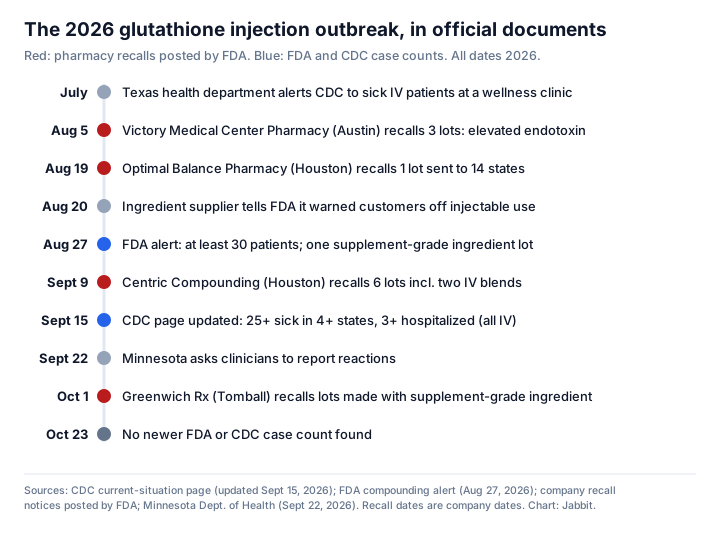
CDC says Texas health officials told it in July 2026 about patients who got sick after IV glutathione at an outpatient wellness clinic. By its September 15 update, CDC had “reports of over 25 people becoming sick in at least four states: Texas, Washington, Florida, and New York,” after IV, under-the-skin or intramuscular doses. At least three were hospitalized, all after IV doses, and one needed intensive care for shock and abnormal clotting. CDC says the illnesses are likely linked to endotoxins, toxic fragments of bacteria, and that every linked product was made by a compounding pharmacy from glutathione intended for dietary supplements.[1]
FDA’s August 27 alert counts “at least 30 patients” with reactions after IV glutathione. It says the pharmacies involved “all … obtained their glutathione (Lot #229536) from Medisca Inc.,” and that the ingredient “was labeled as dietary supplement grade, which is not an appropriate ingredient to make injectable drugs.” FDA also reports that “Medisca informed the agency on August 20, 2026, that it sent its U.S. customers a warning not to use its dietary supplement grade glutathione in the compounding of injectable drugs.”[2] The two agencies count differently (FDA: IV reactions; CDC: illnesses across routes), and as of October 23 we found no newer count from either.[1][2]
| Pharmacy (as named in the notice) | Date | What the notice says |
|---|---|---|
| Victory Medical Center Pharmacy, Austin, TX | Aug 5 | Certain lots of 200 mg/mL vials; “pharmacy testing identified elevated bacterial endotoxin levels”; sent to TX, FL and NY[4] |
| Optimal Balance Pharmacy, Houston, TX | Aug 19 (FDA posted Aug 20) | One lot; elevated endotoxin found in pharmacy testing; sent to 14 states[5] |
| Centric Compounding, Houston, TX | Sept 9 (FDA posted Sept 13) | 6 lots, including Myer’s Cocktail and Tri-Immune Boost IV blends; made with “a Glutathione API containing elevated endotoxin levels”; 9 reports of reactions[6] |
| Greenwich Rx, Tomball, TX | Oct 1 | Vials “intended for subcutaneous injection”; “potential elevated endotoxin levels”; two emergency visits after IV use of a product “not formulated for IV use”[7] |
Two details stand out in our reading. First, none of the four recall notices names an ingredient supplier, and FDA’s alert names no pharmacies, so the public record doesn’t say which recalls involve the lot FDA identified.[2][4][5][6][7] Second, Greenwich Rx’s recall letter says “each of the recalled lots was tested for bacterial endotoxins prior to release, and all results met specifications,” and that it recalled them because the glutathione was “compounded using an ingredient that was labeled as dietary supplement grade.”[8] That is the situation CDC’s advice to pharmacies addresses: “Do not rely on testing alone.”[1] (The FDA-posted notice lists 10 lots; the pharmacy’s letter on the California board’s site lists 12.[7][8]) We found no glutathione recall posted after October 1.[40]
This has happened before. In 2015, seven people in Sydney got probable endotoxin poisoning from compounded glutathione infusions, five of them being treated for Lyme disease.[11] In 2019, FDA warned about L-glutathione repackaged by Letco Medical after seven clinic patients reacted within minutes of IV doses; FDA’s lab found endotoxin “as high as five times the appropriate limit,” and the manufacturer told FDA its ingredient was sold in the US only for supplements.[3] In our analysis, the 2026 cluster is the third on record we found in which the same failure, supplement-grade glutathione ending up in injections, has made people sick.[1][3][11]
What glutathione is: a 138-year paper trail
Glutathione is a small molecule of three amino acids (glutamate, cysteine and glycine) that nearly every cell makes for itself.[12] Its story starts in 1888, when the French scientist de Rey-Pailhade described something in yeast extracts that turned sulfur into hydrogen sulfide. He called it “philothion,” Greek for “love of sulfur.”[12] In 1921 Frederick Gowland Hopkins at Cambridge isolated it, thought it was a two-amino-acid peptide of glutamate and cysteine, and named it glutathione.[12][13] In 1929 he and, separately, Edward Kendall’s group at the Mayo Clinic showed it has three amino acids, including glycine.[14] Hopkins won a Nobel Prize that year, though for vitamins, not glutathione.[16] The first lab synthesis is often credited to Vincent du Vigneaud in 1936, but C. R. Harington and T. H. Mead published “Synthesis of glutathione” in the Biochemical Journal in July 1935.[12][15]
Why the history matters: glutathione has been a mainstream research molecule for a century, and nobody disputes that the body depends on it. The open question is whether putting more of it into your bloodstream from outside does anything useful.
What the human trials show
By mouth. A 1992 study gave 7 volunteers a single 3 g dose and found plasma glutathione did not rise significantly; the authors called its systemic availability “negligible.”[17] A 4-week randomized trial in 40 adults in 2011 found no change in oxidative stress markers.[18] A larger, longer 2015 trial in 54 adults found the opposite for body stores: after 6 months on the higher dose, glutathione was 30–35% higher in blood cells and plasma, and immune natural-killer cell activity had more than doubled at 3 months. Levels fell back to baseline a month after stopping.[19] In our reading, oral glutathione can raise body stores with months of use, but the trials haven’t shown that this improves health outcomes.
Skin lightening. A 2019 systematic review found 4 small studies, none of IV glutathione, and called the evidence “still inconclusive.”[20] One 4-week oral trial in 60 medical students found lighter skin at 2 of 6 sites measured, and its authors wrote that “long-term safety has not been established.”[21] A 12-week Thai trial of 250 mg a day by mouth found the melanin index only “tended to be lower” than with placebo.[22] For IV use, a 2018 review by dermatologists found the evidence “limited to a single study with a dubious study design and apparently flawed analysis”: 25 patients per group, 9 of 25 treated patients dropped out, and the results “did not favor IV glutathione.”[23][24] The Philippine FDA warned in 2019 that “to date there are no published clinical trials that have evaluated the use of injectable glutathione for skin lightening,” listing possible harms including liver, kidney and nerve toxicity and the severe skin reaction Stevens-Johnson syndrome.[25] The US FDA has said it has not approved any injectable product for skin lightening.[26]
Parkinson’s disease. In a 2009 randomized pilot, 21 patients got IV glutathione or placebo three times a week for 4 weeks. Parkinson’s rating-scale scores did not differ significantly during treatment (P = .32) or after (P = .54). The drug was well tolerated, and the authors suggested a larger study to test a possible mild effect.[27]
Precursors and aging. Another approach is to give the building blocks instead. In a 2023 trial, 24 older adults were randomized to glycine plus N-acetylcysteine (NAC), sold together as “GlyNAC,” or placebo for 16 weeks. The authors report improvements in glutathione deficiency, oxidative stress and several aging markers.[28] It is one small trial from one group, and it tested oral precursors, not glutathione infusions. For longevity, it is the more interesting lead, and it needs replication.
Fact-check: two claims from the viral post
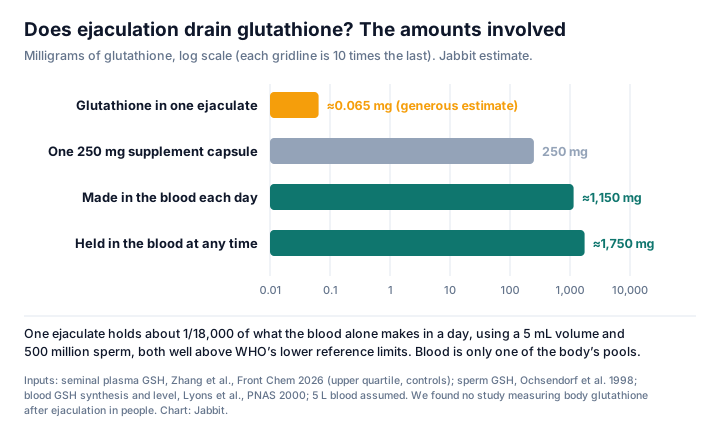
Claim 1: “Ejaculation depletes glutathione.” Rating: unsupported. Semen does contain glutathione; studies measure it in both seminal fluid and sperm, and levels tend to be lower in infertile men.[33][34][35] But the amounts are tiny. Using deliberately generous inputs (5 mL of semen at the top quartile of a 2026 study, plus 500 million sperm, both well above WHO’s lower reference limits), we estimate about 64.5 micrograms of glutathione per ejaculate.[33][34][36][37] Blood alone makes roughly 1.15 g a day, based on a 2000 tracer study and an assumed 5 L of blood, so one ejaculate is about 1/18,000 of a day’s blood production, before counting the liver and other tissues.[29][37] Measurements of seminal glutathione vary widely by method, and one study found levels lower still.[35] We found no human study measuring blood or tissue glutathione against how often people ejaculate.[37] That is our analysis, not a measured result, and a study could change it.
Claim 2: Glutathione is the “master antioxidant” that vitamin C, vitamin E and alpha-lipoic acid “depend on” to be recycled. Rating: partly supported. Glutathione does help regenerate vitamin C from its oxidized form.[30] Vitamin E is regenerated mainly by vitamin C, so glutathione’s role there is indirect.[31] For alpha-lipoic acid, the direction is partly reversed: lipoic acid is reduced by enzymes that use NADH and NADPH, and the reduced form can in turn help restore glutathione.[32] “Master antioxidant” is a popular nickname, not a scientific term, and the claim that every other antioxidant depends on glutathione goes beyond what these studies show.[30][31][32]
Is a pharmacy route enough?
On October 20, Kennedy said the goal is “a regulated marketplace, so that what they’re getting is what they claim to be, that is safe, that the factories are inspected,” Reuters reported.[38] The interim compounding policy for peptides, RIN 0910-ZD94, was still listed as pending at the White House on October 23, and its text is not public.[39] Our policy explainer covers what is known.
In our analysis, glutathione shows that a pharmacy route alone doesn’t guarantee quality. Every product tied to this outbreak was made by a compounding pharmacy, CDC says, and the problem was the starting ingredient.[1] In one recall, the pharmacy says its release tests passed.[8] FDA’s and CDC’s fixes are about sourcing, ingredient grade and full certificates of analysis, not only testing the final vial.[1][2] Any new marketplace for peptides would face the same supply-chain question.
Before an injection: CDC’s questions
We don’t give doses or recommend for or against glutathione. If you are considering an injection or drip, CDC suggests asking your healthcare provider these five questions, quoted from its September 15 guidance:[1]
| # | Question |
|---|---|
| 1 | Was the product made with ingredients intended for injection? |
| 2 | Are there other treatment options that don’t involve an injection? |
| 3 | Who made (compounded) the injectable glutathione? Is the pharmacy or facility licensed or registered, and are there any current recalls or safety warnings for it or this product? |
| 4 | What steps were taken to make sure it is sterile and does not contain unsafe levels of endotoxins? |
| 5 | What symptoms should I watch for after the injection, and what should I do if they occur? |
CDC also says to contact your provider promptly if you develop fever, chills, severe body aches, nausea, vomiting, dizziness or injection-site pain or swelling after an injection, to seek emergency care for severe symptoms such as difficulty breathing, fainting or signs of shock, and to report reactions to FDA MedWatch.[1]
What holds up
Glutathione is a real, essential molecule with a century of research behind it.[12][13][14] Oral glutathione has GRAS (“generally recognized as safe”) status in the US, according to a dermatology review, and a 6-month randomized trial found it raised body stores.[19][23] IV glutathione was well tolerated in the small Parkinson’s trial, and some countries approve injectable glutathione for specific medical uses, such as an add-on to cisplatin chemotherapy.[23][25][27] The precursor approach has a promising, small trial in older adults.[28] What doesn’t hold up yet: good evidence that IV or injected glutathione lightens skin, slows aging or treats Parkinson’s, and there is no FDA-approved glutathione product in the US.[1][23][25][27]
Frequently asked questions
- Is IV glutathione FDA-approved?
- No. CDC says “there are no FDA-approved glutathione products in the United States”; injectable versions are compounded.[1]
- What made people sick in the 2026 outbreak?
- CDC and FDA say the linked injections were compounded from glutathione labeled dietary supplement grade, and the illnesses are consistent with endotoxin exposure.[1][2]
- Does oral glutathione get absorbed?
- A single large dose did not raise blood levels in a 1992 study, but a 6-month randomized trial in 2015 found body stores rose 30–35% on the higher dose.[17][19]
- Does glutathione lighten skin?
- Small oral trials found modest effects, a 2019 review called the evidence inconclusive, and reviewers describe the IV evidence as a single flawed study.[20][21][23]
- Does ejaculation deplete glutathione?
- We found no human study showing that. By our estimate, one ejaculate contains about 65 micrograms, a tiny fraction of what the blood makes each day.[29][33][37]
Bottom line
Glutathione is essential and well studied, and by mouth it is generally recognized as safe in the US, with mixed evidence of benefit.[17][18][19][23] Glutathione drips and shots have little trial support for skin, aging or Parkinson’s, and in 2026 contaminated batches made from supplement-grade powder sent people to the hospital.[1][2][23][27] If you choose one anyway, CDC’s five questions are the place to start.[1]
References
- U.S. Centers for Disease Control and Prevention. Adverse Events Linked to Injectable Glutathione Compounded with Dietary Supplement Grade Ingredient: Current Situation. Updated September 15, 2026. States that Texas notified CDC in July 2026; “over 25 people becoming sick in at least four states: Texas, Washington, Florida, and New York”; patients received glutathione intravenously, under the skin or into a muscle; at least three hospitalized, all after IV doses, one needing intensive care for shock and abnormal blood clotting; “There are no FDA-approved glutathione products in the United States”; advises compounders “Do not rely on testing alone”; lists five questions for patients to ask before an injection; cites a 2015 Australian outbreak and a 2019 FDA alert. https://www.cdc.gov/healthcare-associated-infections/current-situation/index.html. Checked October 23, 2026.
- U.S. Food and Drug Administration. FDA reminds compounders not to use dietary supplement grade glutathione for injectables. August 27, 2026. “FDA is aware of reports of at least 30 patients who experienced adverse events following the administration of intravenous (IV) glutathione”; the pharmacies “all of which obtained their glutathione (Lot #229536) from Medisca Inc.”; the ingredient “was labeled as dietary supplement grade”; “Medisca informed the agency on August 20, 2026, that it sent its U.S. customers a warning not to use its dietary supplement grade glutathione in the compounding of injectable drugs”; FDA “is actively investigating.” https://www.fda.gov/drugs/human-drug-compounding/fda-reminds-compounders-not-use-dietary-supplement-grade-glutathione-injectables. Page unchanged when re-fetched October 23, 2026, about 2 PM ET.
- U.S. Food and Drug Administration. FDA highlights concerns with using dietary ingredient glutathione to compound sterile injectables. Compounding alert, June 7, 2019 (warning first issued February 1, 2019): seven patients at an outpatient clinic had reactions within minutes of IV glutathione compounded from L-glutathione repackaged by Letco Medical; FDA lab samples contained excessive bacterial endotoxin, “some results as high as five times the appropriate limit”; the manufacturer told FDA its ingredient was marketed in the US only for dietary supplements. https://www.fda.gov/drugs/human-drug-compounding/fda-highlights-concerns-using-dietary-ingredient-glutathione-compound-sterile-injectables. Checked October 23, 2026.
- Victory Medical Center Pharmacy (Austin, Texas). Company announcement posted by FDA, August 5, 2026: recall of certain lots of compounded glutathione 200 mg/mL multi-dose vials “because pharmacy testing identified elevated bacterial endotoxin levels”; adverse event reports including fever, chills, severe headache and changes in blood pressure; distributed in Texas, Florida and New York. https://www.fda.gov/safety/recalls-market-withdrawals-safety-alerts/victory-medical-center-pharmacy-issues-voluntary-nationwide-recall-certain-lots-compounded. Checked October 23, 2026.
- Optimal Balance Pharmacy (Houston, Texas). Company announcement dated August 19, 2026, posted by FDA August 20, 2026: recall of one lot of compounded glutathione 200 mg/mL 30 mL vials “because pharmacy testing identified elevated bacterial endotoxin levels”; distributed to consumers in 14 states. https://www.fda.gov/safety/recalls-market-withdrawals-safety-alerts/optimal-balance-pharmacy-issues-voluntary-nationwide-recall-certain-lots-compounded-glutathione-200. Checked October 23, 2026.
- Centric Compounding (Houston, Texas). Company announcement dated September 9, 2026, posted by FDA September 13, 2026: recall of 6 lots of glutathione 200 mg/mL, Myer’s Cocktail and Tri-Immune Boost vials, which “have been found to be compounded with a Glutathione API containing elevated endotoxin levels”; 9 reports of fever, chills, chest pain, nausea or vomiting, headache or malaise. https://www.fda.gov/safety/recalls-market-withdrawals-safety-alerts/centric-compounding-issues-nationwide-recall-glutathione-myers-cocktail-and-tri-immune-boost-due. Checked October 23, 2026.
- Greenwich Rx (Tomball, Texas), a 503A compounding pharmacy. Company announcement posted by FDA, October 1, 2026: recall of specific lots of compounded glutathione 200 mg/mL in 10 mL vials “intended for subcutaneous injection,” due to “potential elevated endotoxin levels”; “two reports involving patients who received emergency department care following intravenous (IV) administration of a glutathione product that was not formulated for IV use”; distributed nationwide June 26 to September 21, 2026; the FDA-posted lot table lists 10 lots. https://www.fda.gov/safety/recalls-market-withdrawals-safety-alerts/greenwich-rx-issues-voluntary-nationwide-recall-compounded-glutathione-due-elevated-endotoxin-levels. Checked October 23, 2026.
- Greenwich Rx recall letter posted by the California State Board of Pharmacy (dated October 1, 2026): “Greenwich Rx does not compound Glutathione for IV administration. However, we are initiating this recall because the recalled Glutathione was compounded using an ingredient that was labeled as dietary supplement grade”; “Each of the recalled lots was tested for bacterial endotoxins prior to release, and all results met specifications”; the letter’s lot table lists 12 lots and gives the dispensing window as June 29 to September 21, 2026. https://www.pharmacy.ca.gov/about/recall_alerts/100126_greenwich.pdf. Checked October 23, 2026.
- Minnesota Department of Health. MLS Laboratory Update: Glutathione Injections Linked to Illnesses, Including Hospitalizations. September 22, 2026 (asks providers to report adverse events after glutathione injections; repeats CDC’s count of more than 25 cases in at least four states). https://www.health.state.mn.us/diseases/idlab/mls/LabAlerts/260922gluta.pdf. Checked October 23, 2026.
- X post, October 20, 2026, 9:29 AM ET, beginning “ejaculation depletes glutathione” and describing glutathione as the “master antioxidant” that vitamin C, vitamin E and alpha lipoic acid depend on “to recycle them back into their active” form; 240,782 impressions as of October 23, about 2:10 PM ET. https://x.com/i/status/2112536563280425033. Jabbit count of original X posts containing “glutathione” (no reposts), X API recent counts, UTC days: October 17: 86; 18: 71; 19: 110; 20: 120; 21: 164; 22: 141. Checked October 23, 2026.
- Johnstone T, Quinn E, Tobin S, et al. Seven cases of probable endotoxin poisoning related to contaminated glutathione infusions. Epidemiol Infect. 2018;146(7):931-934. doi:10.1017/S0950268818000420. PMID 29673413; PMC6088536 (Sydney, 2015; five of the seven were being treated for Lyme disease). https://pubmed.ncbi.nlm.nih.gov/29673413/. Checked October 23, 2026.
- Aoyama K. Glutathione in the brain. Int J Mol Sci. 2021;22(9):5010. doi:10.3390/ijms22095010. PMID 34065042; PMC8125908 (history: in 1888 J. de Rey-Pailhade described a substance in yeast extracts that reduced sulfur to hydrogen sulfide and called it “philothion,” from the Greek for “love” and “sulfur”; Hopkins’ 1921 isolation as a dipeptide; the 1929 tripeptide structure; synthesis credited to du Vigneaud in 1936; also describes glutathione as made from glutamate, cysteine and glycine). https://pmc.ncbi.nlm.nih.gov/articles/PMC8125908/. Checked October 23, 2026.
- Hopkins FG. On an autoxidisable constituent of the cell. Biochem J. 1921;15(2):286-305. doi:10.1042/bj0150286. PMID 16742989; PMC1258982. https://pmc.ncbi.nlm.nih.gov/articles/PMC1258982/. Checked October 23, 2026.
- Hopkins FG. On glutathione: a reinvestigation. J Biol Chem. 1929;84:269-320. doi:10.1016/S0021-9258(18)77062-2; and Kendall EC, McKenzie BF, Mason HL. A study of glutathione. J Biol Chem. 1929;84:657-674. doi:10.1016/S0021-9258(18)77022-1. https://doi.org/10.1016/S0021-9258(18)77062-2; https://doi.org/10.1016/S0021-9258(18)77022-1. Checked October 23, 2026.
- Harington CR, Mead TH. Synthesis of glutathione. Biochem J. 1935;29(7):1602-1611. doi:10.1042/bj0291602. PMID 16745829; PMC1266669. https://pmc.ncbi.nlm.nih.gov/articles/PMC1266669/. Checked October 23, 2026.
- The Nobel Prize in Physiology or Medicine 1929: Christiaan Eijkman “for his discovery of the antineuritic vitamin” and Sir Frederick Gowland Hopkins “for his discovery of the growth-stimulating vitamins.” https://www.nobelprize.org/prizes/medicine/1929/summary/. Checked October 23, 2026.
- Witschi A, Reddy S, Stofer B, Lauterburg BH. The systemic availability of oral glutathione. Eur J Clin Pharmacol. 1992;43(6):667-669. doi:10.1007/BF02284971. PMID 1362956 (7 healthy volunteers, single 3 g dose; plasma glutathione did not rise significantly over 270 minutes; the authors concluded that systemic availability is “negligible”). https://pubmed.ncbi.nlm.nih.gov/1362956/. Checked October 23, 2026.
- Allen J, Bradley RD. Effects of oral glutathione supplementation on systemic oxidative stress biomarkers in human volunteers. J Altern Complement Med. 2011;17(9):827-833. doi:10.1089/acm.2010.0716. PMID 21875351; PMC3162377 (randomized, double-blind, placebo-controlled; 40 adults; 500 mg twice daily for 4 weeks; no significant change in oxidative stress markers or blood glutathione). https://pubmed.ncbi.nlm.nih.gov/21875351/. Checked October 23, 2026.
- Richie JP Jr, Nichenametla S, Neidig W, et al. Randomized controlled trial of oral glutathione supplementation on body stores of glutathione. Eur J Nutr. 2015;54(2):251-263. doi:10.1007/s00394-014-0706-z. PMID 24791752 (6 months; 54 non-smoking adults; 250 or 1,000 mg a day vs placebo; at 6 months glutathione rose 30–35% in red cells, plasma and lymphocytes and 260% in cheek cells on the high dose; levels returned to baseline after a 1-month washout; natural killer cell cytotoxicity more than doubled at 3 months on the high dose). https://pubmed.ncbi.nlm.nih.gov/24791752/. Checked October 23, 2026.
- Dilokthornsakul W, Dhippayom T, Dilokthornsakul P. The clinical effect of glutathione on skin color and other related skin conditions: a systematic review. J Cosmet Dermatol. 2019;18(3):728-737. doi:10.1111/jocd.12910. PMID 30895708 (4 studies: 3 randomized trials and 1 single-arm study, 3 oral and 1 topical; no IV studies; concluded the evidence is “still inconclusive”). https://pubmed.ncbi.nlm.nih.gov/30895708/. Checked October 23, 2026.
- Arjinpathana N, Asawanonda P. Glutathione as an oral whitening agent: a randomized, double-blind, placebo-controlled study. J Dermatolog Treat. 2012;23(2):97-102. doi:10.3109/09546631003801619. PMID 20524875 (60 medical students, 500 mg a day for 4 weeks; melanin index fell significantly at 2 of 6 sites; “long-term safety has not been established”). https://pubmed.ncbi.nlm.nih.gov/20524875/. Checked October 23, 2026.
- Weschawalit S, Thongthip S, Phutrakool P, Asawanonda P. Glutathione and its antiaging and antimelanogenic effects. Clin Cosmet Investig Dermatol. 2017;10:147-153. doi:10.2147/CCID.S128339. PMID 28490897 (12 weeks of 250 mg a day by mouth vs placebo; melanin index “tended to be lower”). https://pubmed.ncbi.nlm.nih.gov/28490897/. Checked October 23, 2026.
- Sonthalia S, Jha AK, Lallas A, Jain G, Jakhar D. Glutathione for skin lightening: a regnant myth or evidence-based verity? Dermatol Pract Concept. 2018;8(1):15-21. doi:10.5826/dpc.0801a04. PMID 29445569; PMC5808366 (says evidence for IV glutathione is “limited to a single study with a dubious study design and apparently flawed analysis,” a 2016 Pakistani trial of 25 patients per group, IV vs saline for 6 weeks, in which 9 of 25 treated patients dropped out, and whose results “did not favor IV glutathione”; notes parenteral glutathione is approved in some countries only for uses such as severe liver disorders and reducing chemotherapy nerve toxicity; notes the Philippine FDA’s 2011 warning and that oral glutathione is “generally recognized as safe” in the US). https://pmc.ncbi.nlm.nih.gov/articles/PMC5808366/. Checked October 23, 2026.
- Sonthalia S, Daulatabad D, Sarkar R. Glutathione as a skin whitening agent: facts, myths, evidence and controversies. Indian J Dermatol Venereol Leprol. 2016;82(3):262-272. doi:10.4103/0378-6323.179088. PMID 27088927. https://pubmed.ncbi.nlm.nih.gov/27088927/. Checked October 23, 2026.
- Food and Drug Administration Philippines. FDA Advisory No. 2019-182, Unsafe use of glutathione as skin lightening agent (posted July 5, 2019): “To date there are no published clinical trials that have evaluated the use of injectable glutathione for skin lightening”; says injectable glutathione is approved there as an adjunct to cisplatin chemotherapy, and lists possible harms including toxic effects on the liver, kidneys and nervous system and Stevens-Johnson syndrome. https://www.fda.gov.ph/fda-advisory-no-2019-182-unsafe-use-of-glutathione-as-skin-lightening-agent/. Checked October 23, 2026.
- U.S. Food and Drug Administration. Mga iniiniksyong produkto na pampaputi ng balat: ano ang kailangan mong malaman (Tagalog-language consumer update on injectable skin lightening products; content current as of September 2, 2015): FDA says it has not approved any injectable products for skin lightening and warns about unapproved, mislabeled injectable products marketed for it that may contain glutathione, vitamin C, collagen or placenta. The English version did not load for us on October 23, 2026. https://www.fda.gov/consumers/consumer-updates/mga-iniiniksyong-produkto-na-pampaputi-ng-balat-ano-ang-kailangan-mong-malaman. Checked October 23, 2026.
- Hauser RA, Lyons KE, McClain T, Carter S, Perlmutter D. Randomized, double-blind, pilot evaluation of intravenous glutathione in Parkinson’s disease. Mov Disord. 2009;24(7):979-983. doi:10.1002/mds.22401. PMID 19230029 (21 patients randomized; IV glutathione or placebo three times a week for 4 weeks; motor score difference not significant during treatment (P = .32) or after (P = .54); well tolerated; the authors say a larger study could test the “possibility of a mild symptomatic effect”). https://pubmed.ncbi.nlm.nih.gov/19230029/. Checked October 23, 2026.
- Kumar P, Liu C, Suliburk J, et al. Supplementing glycine and N-acetylcysteine (GlyNAC) in older adults improves glutathione deficiency, oxidative stress, mitochondrial dysfunction, inflammation, physical function, and aging hallmarks: a randomized clinical trial. J Gerontol A Biol Sci Med Sci. 2023;78(1):75-89. doi:10.1093/gerona/glac135. PMID 35975308; PMC9879756 (24 older adults randomized to GlyNAC or placebo for 16 weeks, plus 12 young adults for comparison; funded by an NIH grant and a gift; the paper states “Conflict of Interest: None declared”). https://pmc.ncbi.nlm.nih.gov/articles/PMC9879756/. Checked October 23, 2026.
- Lyons J, Rauh-Pfeiffer A, Yu YM, et al. Blood glutathione synthesis rates in healthy adults receiving a sulfur amino acid-free diet. Proc Natl Acad Sci U S A. 2000;97(10):5071-5076. doi:10.1073/pnas.090083297. PMID 10792033; PMC25783 (whole-blood glutathione about 1,142 µM and absolute synthesis about 747 µmol per liter of blood per day on an adequate diet). https://pmc.ncbi.nlm.nih.gov/articles/PMC25783/. Checked October 23, 2026.
- Meister A. Glutathione-ascorbic acid antioxidant system in animals. J Biol Chem. 1994;269(13):9397-9400. PMID 8144521. https://pubmed.ncbi.nlm.nih.gov/8144521/. Checked October 23, 2026.
- Packer JE, Slater TF, Willson RL. Direct observation of a free radical interaction between vitamin E and vitamin C. Nature. 1979;278(5706):737-738. doi:10.1038/278737a0. PMID 431730. https://pubmed.ncbi.nlm.nih.gov/431730/. Checked October 23, 2026.
- Haramaki N, Han D, Handelman GJ, Tritschler HJ, Packer L. Cytosolic and mitochondrial systems for NADH- and NADPH-dependent reduction of alpha-lipoic acid. Free Radic Biol Med. 1997;22(3):535-542. doi:10.1016/s0891-5849(96)00400-5. PMID 8981046 (lipoic acid is reduced by enzymes using NADH and NADPH, including glutathione reductase). https://pubmed.ncbi.nlm.nih.gov/8981046/. Checked October 23, 2026.
- Zhang T, et al. Quantitative analysis of vitamin E, 5-methyltetrahydrofolate, and glutathione in seminal plasma. Front Chem. 2026;14:1900122. doi:10.3389/fchem.2026.1900122. PMID 42597427; PMC13467896 (LC-MS/MS; seminal plasma glutathione in healthy controls median 9,049 ng/mL, interquartile range 6,128–11,828; lower in infertile men, median 4,314). https://pmc.ncbi.nlm.nih.gov/articles/PMC13467896/. Checked October 23, 2026.
- Ochsendorf FR, Buhl R, Bästlein A, Beschmann H. Glutathione in spermatozoa and seminal plasma of infertile men. Hum Reprod. 1998;13(2):353-359. doi:10.1093/humrep/13.2.353. PMID 9557837 (sperm glutathione about 3.49 nmol per 108 sperm in controls; seminal plasma levels did not correlate with blood plasma levels). https://pubmed.ncbi.nlm.nih.gov/9557837/. Checked October 23, 2026.
- Kanďár R, Drábková P, Hampl R. Assay of total glutathione and glutathione disulphide in seminal plasma of male partners of couples presenting for a fertility evaluation. Andrologia. 2014;46(10):1079-1088. doi:10.1111/and.12176. PMID 24124871 (total glutathione roughly 1.6–2.1 µM, far lower than ref 33’s figures; methods differ). https://pubmed.ncbi.nlm.nih.gov/24124871/; and Raijmakers MT, et al. Fertil Steril. 2003;79(1):169-172. PMID 12524083 (“considerable amounts” of glutathione in seminal plasma, higher in fertile men). https://pubmed.ncbi.nlm.nih.gov/12524083/. Checked October 23, 2026.
- Cooper TG, Noonan E, von Eckardstein S, et al. World Health Organization reference values for human semen characteristics. Hum Reprod Update. 2010;16(3):231-245. doi:10.1093/humupd/dmp048. PMID 19934213 (lower reference limits: semen volume 1.5 mL, total sperm number 39 million per ejaculate). https://pubmed.ncbi.nlm.nih.gov/19934213/. Checked October 23, 2026.
- Jabbit analysis, October 23, 2026. (a) Three PubMed searches combining glutathione with ejaculation frequency, abstinence or masturbation, or with blood or plasma levels in humans returned 24, 8, 17 records; none measured blood or tissue glutathione in people against how often they ejaculate (the hits were animal, sperm-freezing and fertility studies). (b) Arithmetic, with generous assumptions: 5 mL semen × 11,828 ng/mL (ref 33, upper quartile) ≈ 59.1 µg; 500 million sperm × 3.49 nmol per 108 (ref 34) × 307.3 g/mol ≈ 5.4 µg; total ≈ 64.5 µg. Blood synthesis 747 µmol/L/day × an assumed 5 L of blood (ref 29) ≈ 1.15 g a day; blood pool 1,142 µM × 5 L ≈ 1.75 g. Data: https://jabbitapp.com/research/sources/glutathione-iv-outbreak-evidence-2026-10-23.json. Script: ops/scripts/glutathione_sources.py.
- Jones RP, Aboulenein A. Kennedy says Trump administration aims for regulated market for peptides. Reuters, October 20, 2026 (quoting Health Secretary Robert F. Kennedy Jr. on Fox News’ “The Will Cain Show”: “Our objective was to make sure that there is a regulated marketplace, so that what they’re getting is what they claim to be, that is safe, that the factories are inspected”). Via Yahoo News: https://www.yahoo.com/news/politics/articles/kennedy-says-trump-administration-aims-220108409.html. Checked October 23, 2026.
- Office of Information and Regulatory Affairs. Pending EO 12866 Regulatory Review: Interim Access Policy for Compounding Using Certain Peptides, RIN 0910-ZD94, received October 14, 2026. https://www.reginfo.gov/public/do/eoDetails?rrid=1568964. Still listed as pending (no concluded date) when checked October 23, 2026, about 2 PM ET.
- U.S. Food and Drug Administration. Drug recalls list. https://www.fda.gov/drugs/drug-safety-and-availability/drug-recalls. No glutathione recall posted after October 1, 2026 when checked October 23, 2026.
This page analyzes public health notices, recall notices, published studies and social media data. It is not medical advice, and it does not recommend for or against glutathione in any form. Talk to a qualified clinician before any injection or infusion. Ratings, comparisons and arithmetic labeled as analysis are Jabbit’s own; inputs are cited above. Company statements are quoted from their recall notices as posted by FDA or a state board.