Study teardown · SLU-PP-332 (an ERR agonist billed as an “exercise pill”) and its successor SLU-PP-915 · The developers’ mouse studies, an independent aging-kidney study, a human muscle-cell study, anti-doping lab papers, the WADA 2027 Prohibited List, FDA’s NDC, FAERS and compounding lists, registry and PubMed counts · Sources checked October 25, 2026
Published · Updated
SLU-PP-332: does the “exercise in a pill” work in people, and is it safe? Mice given injections ran about 70% longer and obese mice gained less fat, but every result so far comes from mice or cells, we found no human trial, its developers report it is poorly absorbed by mouth, it is not FDA-approved, and anti-doping rules ban it in sport from January 2027.
SLU-PP-332 is a lab-made small molecule that activates estrogen-related receptors (ERRs), control switches inside muscle cells that help turn on many of the same genes endurance training does.[1][24] The “exercise pill” nickname echoes the researchers’ own press releases, titled “Exercise-mimicking drug sheds weight, boosts muscle activity in mice” and “Mimicking exercise with a pill.”[13][14] Does it work? In mice, yes for some measures: after a week of injections, 6 treated mice ran about 70% longer than 6 untreated mice, and obese mice gained far less fat.[1][2] In people, nobody knows. We found no human trial in ClinicalTrials.gov or PubMed, its developers write that it “lacks oral bioavailability,” its safety in humans has never been tested, it is not FDA-approved, and the World Anti-Doping Agency (WADA) adds it to the list of substances banned at all times from January 1, 2027.[22][23][7][19][15]
Why this matters now
On September 21, 2026, WADA published its 2027 Prohibited List, which names “SLU-PP-332, SLU-PP-915 and related substances” as banned metabolic modulators from January 1, 2027; USADA’s athlete advisory flags the same addition.[15][16][17] Anti-doping laboratories in Cologne and at UCLA published methods in 2026 to find its breakdown products, writing that this may help uncover “illicit use” and detect “misuse.”[9][10] FDA’s National Drug Code directory also shows bulk-powder listings under the name SLU-PP-332, two of them categorized for human prescription compounding and dated 2026.[18]
Timeline
| Date | Event |
|---|---|
| 2023 | The developers report SLU-PP-332 as an agonist of all three ERRs, most potent at ERRα; injected mice gain oxidative muscle fibers and run longer.[1] The same group describes a second, structurally different agonist, SLU-PP-915.[5] An independent team reports that it reversed signs of kidney aging in old mice.[4] |
| September 2023 | A University of Florida release calls it an “exercise-mimicking drug” and says it “could one day be tested in people.”[13] |
| 2024 | Mouse studies report less fat gain in obese mice and better heart function in a heart-failure model.[2][3] An American Chemical Society release quotes the lead chemist: “We cannot replace exercise.”[14] |
| 2025 | An Italian team adds SLU-PP-332 to muscle cells grown from 10 inactive women’s muscle samples.[6] Plain bulk-ingredient listings under the name appear in FDA’s NDC directory.[18] |
| 2026 | The developers say it lacks oral bioavailability and report an oral successor, SLU-PP-915.[7] Doping labs publish metabolite methods; a review says “Clinical trials are needed.”[9][10][11] Two NDC listings for prescription compounding appear (April and August).[18] |
| September 21, 2026 | WADA publishes the 2027 Prohibited List naming SLU-PP-332; it takes effect January 1, 2027.[15][16] |
What SLU-PP-332 is
SLU-PP-332 is a small synthetic chemical (molecular weight about 290), not a peptide and not a hormone.[24] It was designed to switch on ERRα, ERRβ and ERRγ, nuclear receptors that control genes for mitochondria and fat burning in muscle.[1] Despite the name, ERRs do not respond to estrogen. Every animal study we read gave it by injection; the developers’ 2026 paper says it “lacks oral bioavailability,” meaning it is not shown to work when swallowed, and the university release said the next step was “ideally making it available as a pill instead of an injection.”[1][2][7][13] A later compound from the same program, SLU-PP-915, is described as orally bioavailable in mice; it has not been tested in people either.[7][22]
The evidence, rung by rung
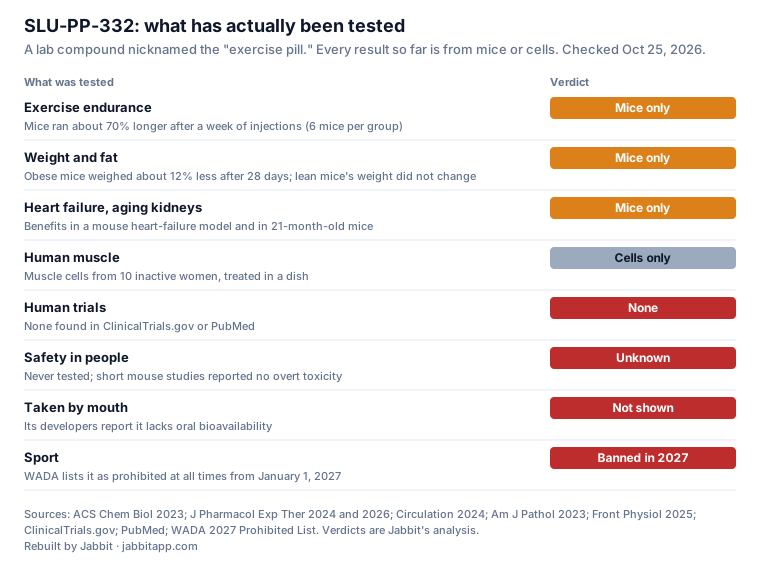
- Exercise endurance (mice). Sedentary mice injected for 7 days ran about 70% longer and 45% farther on a treadmill than untreated mice, in groups of 6.[1] In mice bred without muscle ERRα, the compound gave no extra endurance, which supports the idea that it works through that receptor.[1]
- Weight and fat (mice). Obese mice weighed about 12% less after 28 days and gained under half a gram of fat, against about 5 grams in untreated obese mice; groups had 8 to 10 male mice.[2] In lean mice, body weight did not change, and glucose tolerance did not change after three weeks.[2]
- Heart and kidneys (mice). In a mouse heart-failure model, it improved pumping function and survival.[3] In 21-month-old mice treated for 8 weeks, an independent team reported it “reversed the age-related increases in albuminuria, podocyte loss, mitochondrial dysfunction, and inflammatory cytokines.”[4]
- Human muscle (cells only). One study took muscle samples from women having hip surgery and treated the muscle cells in a dish; no woman took the compound.[6]
- Humans. ClinicalTrials.gov lists 0 studies of SLU-PP-332 or SLU-PP-915, and none of 12 PubMed records reports giving it to a person.[22][23] A 2026 systematic review covered only “experimental studies in animals and cell models.”[11]
The key studies, in one chart
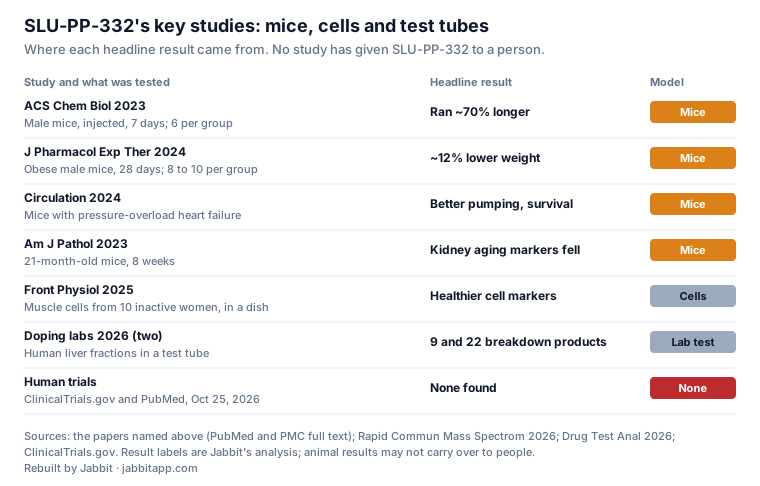
Our analysis: the endurance result that drives the “exercise pill” headlines rests on a one-week injection study with 6 mice per group.[1] Small mouse studies are a normal first step, but many compounds that work in mice never work, or turn out unsafe, in people. The only human material tested so far is cells in a dish and liver fractions in a test tube.[6][9][10]
The developers’ case, in fairness
The developers report more than a single treadmill result. The compound turned on a gene program that overlapped with human acute-exercise data, its endurance effect disappeared in mice lacking muscle ERRα, and it showed benefits in separate mouse models of obesity and heart failure.[1][2][3] A separate team, whose paper declared no competing interests, reported kidney benefits in old mice.[4] The program has moved toward an oral successor, and the developers have been explicit about limits: a university release said human trials would come only after more animal safety testing, and the lead chemist said, “We cannot replace exercise; exercise is important on all levels.”[7][13][14]
Who funds and holds stakes
Authors of the developers’ papers disclose their interests. The 2023 paper states: “T.P.B., B.E., and J.K.W. are stockholders in Myonid Therapeutics, Inc., which focuses on ERR based therapeutics.”[1] The 2026 paper states that SLU-PP-915 “is covered under the intellectual property of Saint Louis University” and that an author is a stockholder in Myonid Therapeutics and Pelagos Pharmaceuticals, “which are both active in developing ERR agonists.”[7] An author of the heart-failure study discloses being “the co-founder and consultant for Pelagos Pharmaceuticals Inc.”[3] A chemistry paper discloses a patent licensed to Myonid, and a 2026 structure study, which calls SLU-PP-332 a “widely used chemical probe,” discloses that two authors “are cofounders and hold stock in Pelagos Pharmaceuticals, Inc.”[5][8] Our analysis: these disclosures are standard and do not mean the results are wrong; they are a reason to want independent replication, which so far exists only for the kidney study.[4]
Safety
- In people: unknown. No human safety study exists that we could find.[22][23] The 2026 review says “Clinical trials are needed to confirm their efficacy and safety in humans.”[11]
- In mice: no obvious problems in short studies. The developers reported “no overt toxicity” and normal blood counts and electrolytes in the short 2023 study; the university release said it “hasn’t generated any severe side effects” so far.[1][13] Short studies in a few dozen mice cannot rule out rare or long-term harms.
- A theoretical question about cancer. Our analysis: SLU-PP-332 works by activating ERRα, and a 2026 review describes the body’s own ERRα as “a crucial driver of breast cancer progression.”[1][12] That review did not test SLU-PP-332, and we found no study of whether the compound changes cancer risk; this is an open question, not a finding.[12][23]
- Reports to FDA. FDA’s adverse-event database returned no reports for SLU-PP-332. An empty search does not show safety; it may simply mean nobody has reported problems.[19]
Purity and what is in the vial
There is no FDA-approved SLU-PP-332 product and no official quality standard.[19][21] FDA’s NDC directory lists 5 bulk-powder registrations under the name, from 5 labelers. Only 2 list a substance name matching the published structure; 2 list a different, simpler chemical (4-hydroxybenzoic acid), and 1 lists an unrelated chemical name.[18][24] Our analysis: the mismatches may be data-entry errors, but they show that a label reading “SLU-PP-332” is not a guarantee of identity. A listing is a registration, not an FDA approval or quality finding, and says nothing about what any product contains.[18]
Legal status
SLU-PP-332 is not an FDA-approved drug, and Drugs@FDA lists no product containing it.[19] Under section 503A, a pharmacy may compound from a bulk substance that has a USP or NF monograph, is part of an FDA-approved drug, or is on FDA’s 503A bulks list.[21] SLU-PP-332 is not on FDA’s list of nominated bulk substances (categories 1 to 3, updated May 14, 2026).[20] Our analysis, which is not legal advice: based on these records it does not appear to fit any of those three pathways; FDA has not, to our knowledge, issued a statement specific to it. In sport, WADA’s 2027 list names it as banned at all times, in and out of competition, from January 1, 2027; USADA describes it as an example added to the existing metabolic-modulators category, so athletes should not assume it is permitted before then and should check with their anti-doping organization.[15][17]
What a careful reader should notice
These points are our analysis of the sources cited.
- “Exercise pill” is a nickname that echoes press releases, not a description of a tested human medicine; the compound studied was injected, and its developers say it is not shown to work by mouth.[13][14][7]
- The headline 70% figure comes from 6 mice per group over 7 days.[1]
- Lean mice did not lose weight; the weight effect was in obese mice.[2]
- The “human” study used cells in a dish, and the human liver work was done by doping labs to detect the compound.[6][9][10]
- Anti-doping authorities moved before any human trial: the 2027 ban arrives with zero registered trials.[15][22]
Frequently asked questions
- Does SLU-PP-332 work in humans?
- Nobody knows. All results come from mice and cells; we found no human trial in ClinicalTrials.gov or PubMed.[22][23][11]
- Is SLU-PP-332 safe?
- Its safety in people has never been tested. Short mouse studies reported no obvious toxicity, which cannot rule out long-term or rare harms.[1][11]
- Is SLU-PP-332 FDA approved?
- No. Drugs@FDA lists no product containing it, and it is not on FDA’s list of substances nominated for 503A compounding.[19][20]
- Does SLU-PP-332 work as a pill?
- Not shown. The mouse studies used injections, and its developers write that it “lacks oral bioavailability.” An oral successor, SLU-PP-915, has only been tested in mice.[1][7]
- Is SLU-PP-332 banned in sport?
- WADA’s 2027 Prohibited List, in force from January 1, 2027, names SLU-PP-332, SLU-PP-915 and related substances as metabolic modulators banned at all times. USADA calls them examples added to an existing category, so athletes should check with their anti-doping organization before then.[15][16][17]
- Does SLU-PP-332 cause weight loss?
- In obese mice it cut fat gain and they weighed about 12% less after 28 days; lean mice did not lose weight. There are no human data.[2][22]
- Is SLU-PP-332 a peptide?
- No. It is a small synthetic chemical with a molecular weight of about 290, not a chain of amino acids.[24]
Bottom line
SLU-PP-332 is a promising research tool in mice: injected animals ran longer, obese mice gained less fat, and separate mouse models showed heart and kidney benefits.[1][2][3][4] It has never been tested in people, is not shown to work by mouth, is not FDA-approved, and products labeled with its name are not checked for identity or purity.[22][7][19][18] For athletes, it is banned from January 1, 2027.[15]
References
- Billon C, Sitaula S, Banerjee S, et al. Synthetic ERRα/β/γ Agonist Induces an ERRα-Dependent Acute Aerobic Exercise Response and Enhances Exercise Capacity. ACS Chem Biol. 2023;18(4):756-771. PMID 36988910. Developers’ discovery paper. Abstract: “we report the identification of a synthetic ERR pan agonist, SLU-PP-332, that targets all three ERRs but has the highest potency for ERRα”; “When administered to mice, SLU-PP-332 increased the type IIa oxidative skeletal muscle fibers and enhanced exercise endurance.” Full text: sedentary mice were treated “for 7 days” by intraperitoneal injection, and “mice treated with the ERR agonist were able to run ∼70% longer and ∼45% further than vehicle-treated mice” (figure legend: “n = 6 per group”); “the mERRα−/− treated with SLU-PP-332 displayed exercise endurance equivalent to vehicle-treated mERRα−/− mice”; “We observed no overt toxicity in mice administered SLU-PP-332” over the short study, “which is consistent with the normal complete blood count and electrolyte levels”; the authors compared the treated mice’s muscle gene changes with genes changed in “human acute aerobic exercise.” Competing interests: “T.P.B., B.E., and J.K.W. are stockholders in Myonid Therapeutics, Inc., which focuses on ERR based therapeutics.” Full text read. https://pubmed.ncbi.nlm.nih.gov/36988910/; full text: https://pmc.ncbi.nlm.nih.gov/articles/PMC11584170/. Checked October 25, 2026.
- Billon C, Schoepke E, Avdagic A, et al. A Synthetic ERR Agonist Alleviates Metabolic Syndrome. J Pharmacol Exp Ther. 2024;388(2):232-240. PMID 37739806. Mouse study of obesity and metabolic syndrome: “Here we examine the effects of this exercise mimetic in mouse models of obesity and metabolic syndrome”; “These effects were accompanied by decreased fat mass accumulation.” Full text: “8 to 10 male C57BL6/J or ob/ob mice per group,” injected; in diet-induced obese mice “after 28 days of treatment the drug treated mice weighed ∼12% less,” and “vehicle-treated mice had gained ∼5 g of fat mass while drug-treated mice had gained less than 0.5 g of fat mass”; in lean mice, “No difference in total body weight was observed after 28 days of treatment with SLU-PP-332”; “Three weeks of SLU-PP-332 treatment did not affect glucose tolerance” in lean mice. Competing interests: “T.P.B., J.K.W., and B.E. are stockholders in Myonid Therapeutics, Inc. and Pelagos Pharmaceuticals, Inc.” Full text read. https://pubmed.ncbi.nlm.nih.gov/37739806/; full text: https://pmc.ncbi.nlm.nih.gov/articles/PMC10801787/. Checked October 25, 2026.
- Xu W, Billon C, Li H, et al. Novel Pan-ERR Agonists Ameliorate Heart Failure Through Enhancing Cardiac Fatty Acid Metabolism and Mitochondrial Function. Circulation. 2024;149(3):227-250. PMID 37961903. Mouse heart-failure study: “Both SLU-PP-332 and SLU-PP-915 significantly improved ejection fraction, ameliorated fibrosis, and increased survival associated with pressure overload-induced HF without affecting cardiac hypertrophy.” Competing interests (full text): “Lilei Zhang is the co-founder and consultant for Pelagos Pharmaceuticals Inc.” Full text read. https://pubmed.ncbi.nlm.nih.gov/37961903/; full text: https://pmc.ncbi.nlm.nih.gov/articles/PMC10842599/. Checked October 25, 2026.
- Wang XX, Myakala K, Libby AE, et al. Estrogen-Related Receptor Agonism Reverses Mitochondrial Dysfunction and Inflammation in the Aging Kidney. Am J Pathol. 2023;193(12):1969-1987. PMID 37717940. Aging-kidney study by a team including Georgetown University and Johns Hopkins authors: “The ERRs were decreased in both aging human and mouse kidneys”; “A pan-ERR agonist, SLU-PP-332, was used to treat 21-month-old mice for 8 weeks”; treatment “reversed the age-related increases in albuminuria, podocyte loss, mitochondrial dysfunction, and inflammatory cytokines.” Disclosure statement: “None declared.” Abstract read. https://pubmed.ncbi.nlm.nih.gov/37717940/. Checked October 25, 2026.
- Hampton CS, Sitaula S, Billon C, et al. Development and pharmacological evaluation of a new chemical series of potent pan-ERR agonists, identification of SLU-PP-915. Eur J Med Chem. 2023;258:115582. PMID 37421886. Chemistry paper describing a second, structurally different agonist, “SLU-PP-915 (10s).” Competing interests include: “John K. Walker has patent #WO2019036562; Heteroaromatics as ERR inverse agonists and their preparation licensed to Myonid Therapeutics.” Abstract and disclosure read. https://pubmed.ncbi.nlm.nih.gov/37421886/. Checked October 25, 2026.
- Bonanni R, Falvino A, Matticari A, et al. Targeting ERRs to counteract age-related muscle atrophy associated with physical inactivity: a pilot study. Front Physiol. 2025;16:1616693. PMID 40692696. Human cell study from Italy: “Twenty women undergoing hip arthroplasty for coxarthrosis were enrolled” (10 active, 10 inactive); “Primary cultures of myoblasts were set up from the muscle tissue of inactive women and treated with the ERRs agonist, SLU-PP-332.” The women did not take the compound; it was added to their cells in the lab. Authors: “Targeting ERRs could represent a promising therapeutic strategy to counteract muscle atrophy in elderly and sedentary subjects.” Abstract read. https://pubmed.ncbi.nlm.nih.gov/40692696/. Checked October 25, 2026.
- Billon C, Appourchaux K, Côté I, et al. An orally active estrogen receptor-related receptor agonist, SLU-PP-915, enhances aerobic exercise capacity. J Pharmacol Exp Ther. 2026;393(1):103787. PMID 41421047. Developers’ follow-up: “We previously developed an ERR pan-agonist, SLU-PP-332 (332), which improves aerobic performance in mice but lacks oral bioavailability”; SLU-PP-915 is “a chemically distinct ERR pan-agonist that is orally bioavailable.” Conflict of interest: “SLU-PP-915 is covered under the intellectual property of Saint Louis University, with Thomas P. Burris as an inventor. Thomas P. Burris is also a stockholder in Myonid Therapeutics, Inc, and Pelagos Pharmaceuticals, Inc, which are both active in developing ERR agonists.” Abstract and disclosure read. https://pubmed.ncbi.nlm.nih.gov/41421047/. Checked October 25, 2026.
- Okda HE, Zhao P, Hayes M, et al. Chemical optimization of the exercise mimetic SLU-PP-332 enables insight into estrogen-related receptor signaling. Int J Biol Macromol. 2026;355:151450. PMID 41850449. Structure-activity study: “SLU-PP-332 is a well-established exercise mimetic and widely used chemical probe for ERR activation.” Competing interests: “B.E. and T.P.B. are cofounders and hold stock in Pelagos Pharmaceuticals, Inc.” Abstract and disclosure read. https://pubmed.ncbi.nlm.nih.gov/41850449/. Checked October 25, 2026.
- Möller T, Krug O, Thevis M. In Vitro Metabolism and Analytical Characterization of SLU-PP-332 and SLU-PP-915: Novel Pan-ERR Agonists With Doping Potential. Rapid Commun Mass Spectrom. 2026;40(8):e70039. PMID 41588687. Anti-doping laboratory study (German Sport University Cologne): the compounds’ effects “prompted the consideration of these compounds as drugs potentially relevant for sports drug testing programs”; using “human liver S9 fraction” and microsomes in the lab, “A total of nine metabolites were identified for SLU-PP-332”; “This may help to uncover the illicit use of these novel compounds as potential performance-enhancing substances.” Authors: “The authors declare no conflicts of interest.” Abstract read. https://pubmed.ncbi.nlm.nih.gov/41588687/. Checked October 25, 2026.
- Avliyakulov NK, Sobolevsky T, Ahrens E. Analysis and Identification of In Vitro Metabolites of Exercise Mimetic SLU-PP-332 ERRα/β/γ Agonist for Doping-Control Purposes. Drug Test Anal. 2026;18(3):439-450. PMID 41688415. Anti-doping laboratory study (UCLA Olympic Analytical Laboratory): “The World Anti-Doping Agency (WADA) prohibits the use of exercise mimetics and metabolic modulators in sports”; “The identification of metabolites of this emerging therapeutic molecule is a critical step towards detecting its misuse”; it reports 22 metabolites made by human liver fractions in the lab. Abstract read. https://pubmed.ncbi.nlm.nih.gov/41688415/. Checked October 25, 2026.
- de Souza-Lima J, Astrosa-Martin BD, Galaz-Rodríguez CA, et al. [Pharmacological Activation of ERRα/β/γ as an Exercise Mimetic: Potential Therapeutic Applications]. Rev Med Chil. 2026;154(2):237-245. PMID 42024694. Systematic review of 2020-2024 literature, “including experimental studies in animals and cell models”: “SLU-PP-332 and SLU-PP-915 reduce adiposity, improve glycemic control, and increase basal energy expenditure in obesity models, without evident toxicity”; “Clinical trials are needed to confirm their efficacy and safety in humans.” Abstract read. https://pubmed.ncbi.nlm.nih.gov/42024694/. Checked October 25, 2026.
- Pradhan J, Samal AP, Khatoon U, et al. Estrogen-related receptor α in breast cancer: From molecular insights to targeted therapy. Biochim Biophys Acta Rev Cancer. 2026;1881(1):189525. PMID 41475667. Review of the ERRα receptor in breast cancer: ERRα “has emerged as a key regulator of tumor energy metabolism and a crucial driver of breast cancer progression.” This review is about the body’s own receptor in tumors; it did not test SLU-PP-332. Abstract read. https://pubmed.ncbi.nlm.nih.gov/41475667/. Checked October 25, 2026.
- University of Florida News. “Exercise-mimicking drug sheds weight, boosts muscle activity in mice,” September 27, 2023 (university press release). “The new treatment is in the early stages of development but could one day be tested in people”; “So far, the drug hasn’t generated any severe side effects”; “The next step in developing SLU-PP-332 into a drug candidate will be to refine its structure, ideally making it available as a pill instead of an injection. Then the drug would be tested for side effects in more animal models before making the jump to human trials.” The lead researcher is quoted: “This compound is basically telling skeletal muscle to make the same changes you see during endurance training.” https://news.ufl.edu/2023/09/exercise-mimicking-drug/. Checked October 25, 2026.
- American Chemical Society. “Mimicking exercise with a pill,” press release, March 18, 2024 (ACS Spring 2024 meeting presentation). New compounds “appear capable of mimicking the physical boost of working out — at least within rodent cells”; the principal investigator is quoted: “We cannot replace exercise; exercise is important on all levels”; “While SLU-PP-332 cannot pass into the brain, some of the new compounds were developed to do so”; the team hopes “to test the new compounds in animal models through Pelagos Pharmaceuticals, a startup company they have co-founded.” https://www.acs.org/pressroom/presspacs/2024/march/mimicking-exercise-with-a-pill.html. Checked October 25, 2026.
- World Anti-Doping Agency. World Anti-Doping Code International Standard, Prohibited List 2027. Section S4 (hormone and metabolic modulators), prohibited at all times (in and out of competition): S4.4.1 metabolic modulators include “SLU-PP-332, SLU-PP-915 and related substances,” alongside AMPK activators such as MOTS-c and PPARδ agonists such as GW1516. “This List shall come into effect on 1 January 2027.” https://www.wada-ama.org/sites/default/files/2026-09/2027list_en_final_clean_26_august_2026_2.pdf (text checked against an identical copy of the file). Checked October 25, 2026.
- World Anti-Doping Agency. “WADA publishes 2027 Prohibited List,” September 21, 2026: the list was approved by WADA’s Executive Committee on 10 September 2026 and “enters into force on 1 January 2027.” https://www.wada-ama.org/en/news/wada-publishes-2027-prohibited-list. Checked October 25, 2026.
- U.S. Anti-Doping Agency. Athlete advisory on the 2027 Prohibited List: for S4 metabolic modulators, “This category was updated by adding a few examples,” including “SLU-PP-332 and SLU-PP-915 (metabolic modulators acting on oxidative metabolism)”; the list takes effect “January 1, 2027.” https://www.usada.org/spirit-of-sport/athlete-advisory-2027-prohibited-list/. Checked October 25, 2026.
- U.S. Food and Drug Administration. National Drug Code directory via openFDA (data updated October 23, 2026), generic name “SLU-PP-332,” October 25, 2026: 5 bulk-ingredient powder listings from 5 labelers, 2 of them categorized as “bulk ingredient for human prescription compounding” (marketing start dates in 2026); the other 3 are plain bulk-ingredient listings from 2025. The substance name entered for 2 listings matches SLU-PP-332’s published chemical structure; 2 list a different, simpler chemical (4-hydroxybenzoic acid) and 1 lists an unrelated chemical name. A listing is a registration, not an FDA approval or quality finding, and says nothing about what any product contains. Labelers counted, not named. https://www.fda.gov/drugs/drug-approvals-and-databases/national-drug-code-directory; counts: https://jabbitapp.com/research/sources/slu-pp-332-2026-10-25.json. Checked October 25, 2026.
- openFDA searches, October 25, 2026: Drugs@FDA, no approved product containing SLU-PP-332; FDA Adverse Event Reporting System, no reports found for SLU-PP-332; enforcement (recall) reports, none. An empty adverse-event search does not mean the compound is safe; it may mean few people report its use. https://open.fda.gov/apis/; results: https://jabbitapp.com/research/sources/slu-pp-332-2026-10-25.json. Checked October 25, 2026.
- U.S. Food and Drug Administration. “Bulk Drug Substances Nominated for Use in Compounding Under Section 503A of the Federal Food, Drug, and Cosmetic Act” (categories 1-3), updated May 14, 2026: SLU-PP-332 does not appear. https://www.fda.gov/media/94155/download. Checked October 25, 2026.
- U.S. Food and Drug Administration. “Bulk Drug Substances Used in Compounding Under Section 503A of the FD&C Act” (content current as of 05/14/2026). Under section 503A a pharmacy may compound with a bulk substance that complies with a USP or NF monograph, if one exists; is a component of an FDA-approved drug product, if no monograph exists; or appears on FDA’s 503A bulks list. https://www.fda.gov/drugs/human-drug-compounding/bulk-drug-substances-used-compounding-under-section-503a-fdc-act. Checked October 25, 2026.
- ClinicalTrials.gov API v2, searches for “SLU-PP-332” and “SLU-PP-915,” October 25, 2026: 0 studies. https://clinicaltrials.gov/search?term=SLU-PP-332; counts: https://jabbitapp.com/research/sources/slu-pp-332-2026-10-25.json. Checked October 25, 2026.
- PubMed search “SLU-PP-332,” October 25, 2026: 12 records, all laboratory, animal, cell, chemistry, anti-doping or review papers; none reports giving SLU-PP-332 to people. https://pubmed.ncbi.nlm.nih.gov/?term=SLU-PP-332; IDs: https://jabbitapp.com/research/sources/slu-pp-332-2026-10-25.json. Checked October 25, 2026.
- PubChem. SLU-PP-332, CID 5338394: molecular formula C18H14N2O2, molecular weight 290.3, IUPAC name 4-hydroxy-N-[(E)-naphthalen-2-ylmethylideneamino]benzamide (a small molecule, not a peptide). https://pubchem.ncbi.nlm.nih.gov/compound/5338394. Checked October 25, 2026.
This page analyzes published studies, regulator documents, registry data and anti-doping rules. It is not medical or legal advice and does not recommend any product or dose. SLU-PP-332 is an experimental compound that is not FDA-approved and has not been tested in people. Charts were rebuilt by Jabbit from the sources cited in each caption.