Study teardown · AOD-9604 (AOD9604, hGH fragment 176-191, sold online and by clinics for fat loss) · 25 years of records from the 1990s obesity program to 2026: rodent studies, six developer-funded human trials, the 2007 phase 2b result, the GRAS food-ingredient route, FDA’s 2024 review, recalls, WADA status, registry, FAERS and PubMed counts · Sources checked October 25, 2026
Published · Updated
AOD-9604: does the “fat-loss fragment” of growth hormone work, and is it safe? Its developer tested it as an obesity pill in six trials of about 890 people, the largest missed its weight-loss goal and the program was ended in 2007, nobody has published a human trial of the injection sold today, and FDA’s advisers voted 12-0 against allowing it in compounding.
AOD-9604 is a short, modified piece of human growth hormone: the hormone’s last 15 amino acids with one extra amino acid added at the front.[16] An Australian company, Metabolic Pharmaceuticals, developed it in the late 1990s as an obesity drug, on the idea that this end of growth hormone carries its fat-burning effect without its effects on blood sugar and growth.[1][14][12] It cut weight gain in obese rats and mice.[11][12] In people, the company ran six placebo-controlled trials in about 890 adults, mostly with oral doses, and in February 2007 it announced that its phase 2b trial did not support the drug’s commercial viability and that the obesity program was terminated.[9][5] Today AOD-9604 is mainly sold as an injection, yet FDA found no human data at all for injection under the skin, and in December 2024 FDA’s compounding advisers voted 12-0 against allowing it.[1][2] The honest answer: there is no good evidence that it helps people lose fat, and its safety as sold today is largely untested.[1][3]
Why this matters now
AOD-9604 is promoted online and by some wellness clinics and medical spas as a “fat-loss peptide,” and FDA’s 2024 review found it marketed for uses from weight loss and metabolism to cartilage, osteoarthritis and anti-aging.[1] Three of the five bulk-powder listings for AOD-9604 in FDA’s drug directory have 2026 marketing start dates, which shows raw material is being registered, not that any product is approved.[26] Two 2026 medical reviews group it with other unapproved peptides, and one warns that rigorous human safety data for such peptides are scarce.[19][20] And FDA’s interim peptide compounding policy has been under White House review since October 14, 2026, with its peptide list not public.[22] For where every peptide stands, see our FDA peptide compounding status tracker.
Timeline
| Date | Event |
|---|---|
| Late 1990s | Metabolic Pharmaceuticals in Australia develops and patents AOD-9604 as an anti-obesity drug.[1][14] |
| 2000-2001 | Animal studies: it reduces weight gain in obese rats and mice and does not bind the growth hormone receptor.[11][12][13] |
| 2002 | By February, phase 2a trials are underway.[14] |
| 2005 | A 300-person, 12-week oral trial is described in a meeting abstract; full results were not published.[1] |
| February 21, 2007 | The company announces its 24-week phase 2b results do not support commercial viability and ends the obesity program.[5] |
| 2012 | The company reports a “self-affirmed conditional GRAS status” to market it as a food and supplement ingredient in the US.[6] |
| 2013-2014 | Two company-authored safety papers appear; the parent company announces “full” GRAS status and licences to compounding pharmacies in Australia.[9][10][7] |
| 2013-2015 | Doping labs develop tests; products are seized in Belgium and confiscated vials identified in the US.[18][17][16] |
| 2020-2021 | Two compounded AOD-9604 injectables are recalled for lack of assurance of sterility.[25] |
| November-December 2024 | FDA recommends against adding AOD-9604 to the 503A bulks list; its advisory committee votes 12-0 against.[1][2] |
| 2026 | FDA lists the nomination as withdrawn and flags safety risks; WADA’s 2026 list still names AOD-9604.[3][4][21] |
| October 14, 2026 | FDA’s interim peptide compounding policy goes to White House review; its contents are not public.[22] |
What AOD-9604 is
The name stands for “anti-obesity drug” 9604.[19] It is 16 amino acids long: growth hormone’s amino acids 177 to 191 plus an added tyrosine, which is why it is also sold as “hGH fragment 176-191.”[16][20] In obese mice it did not compete for the growth hormone receptor, did not make cells multiply and did not raise blood sugar, unlike growth hormone itself.[12] In the developer’s human trials, it did not raise IGF-1, the main growth hormone signal in blood.[9] How it works is unclear: one mouse study linked its weight effect to the beta-3 adrenergic receptor, though the authors concluded its action is not mediated directly through that receptor, and FDA’s 2024 review says the molecular target and mechanism “remain unknown.”[13][1] It also breaks down fast: in pigs its half-life was about 3 minutes, and FDA noted that the developer’s oral absorption estimate of 170% “unrealistically exceeds the theoretical maximal 100%.”[1][10] FDA found no human studies of how the body handles it by any route.[1]
The evidence, rung by rung
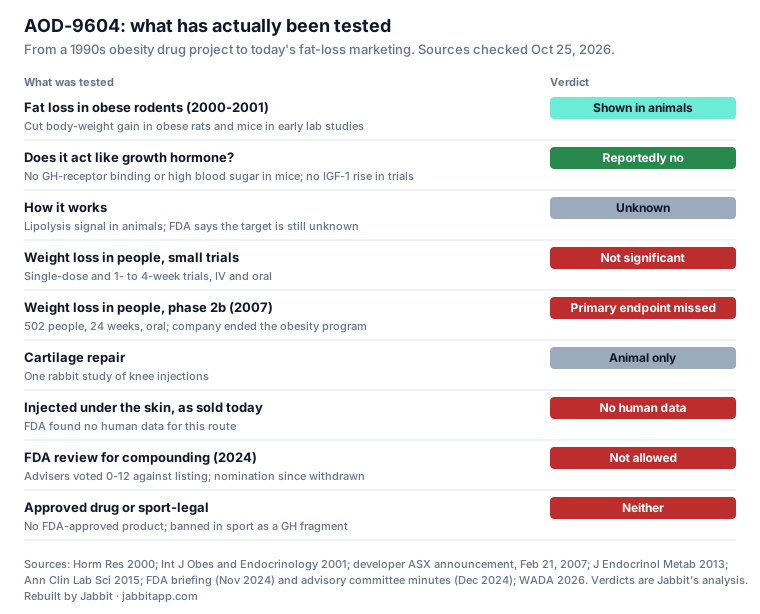
- Animals. In obese Zucker rats, oral AOD-9604 for 19 days cut body-weight gain by more than half versus controls, and in obese mice 14 days of treatment reduced weight gain and raised fat burning.[11][12] FDA cautioned that these studies did not test dose-response for weight loss and that their statistics were not corrected for multiple comparisons.[1]
- Small human trials. Four early trials in groups of 15 to 36 men used single IV or oral doses or courses of up to a few weeks. They were mainly safety and dosing studies, and where weight was reported it did not differ significantly from placebo, according to FDA’s summary of the published record.[1][14]
- The 12-week trial. A 300-person oral trial was reported only in a 2005 meeting abstract, which said weight loss was greater than placebo at all doses and “significant” for women at one dose. FDA noted that the details were not provided.[1]
- The phase 2b trial. The largest study (called OPTIONS) enrolled 536 adults with obesity and randomized 502 to one of three daily oral doses or placebo for 24 weeks, alongside a supervised diet and exercise program. It was powered to detect 1.8 kg of extra weight loss. Weight loss versus placebo was “less than 1 kg in all dose groups” and not statistically significant, and the company ended the program.[1][5]
- Other uses. The cartilage and osteoarthritis claims rest on a study of knee injections in 32 rabbits.[15] We found no human trial of AOD-9604 for joints, skin, cholesterol or aging, and ClinicalTrials.gov has no AOD-9604 records.[23][27]
The human trials, in one chart
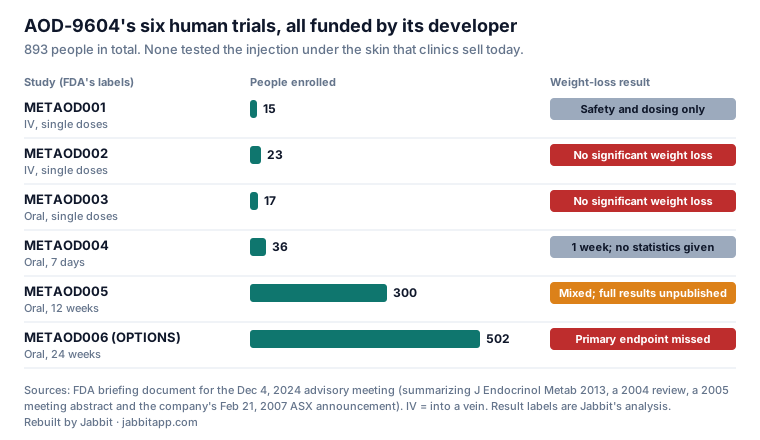
All six trials were funded by the developer, and the paper pooling their safety data was written by its employees or consultants, as FDA notes.[9][1] FDA matched the 2005 abstract and the 2007 phase 2b announcement to two of these six trials, so they are not extra studies.[1] The company itself pointed to a prespecified subgroup that did lose weight and suggested that the strong diet-and-exercise effect in the placebo group may have masked the drug; the overall result was still negative.[5]
From obesity drug to “food ingredient”
After the obesity program ended, the developer took a different route. In 2012 its parent company announced a “self-affirmed conditional GRAS status,” a determination by an expert panel it contracted, saying it would allow AOD-9604 to be added to foods, drinks and dietary supplements in the US once its safety data were published.[6] The two safety papers appeared in 2013 and 2014, and in July 2014 the company announced “full” GRAS status; the same announcement said it had licensed AOD-9604 to two Australian compounding pharmacies.[9][10][7] Our analysis: telling FDA about a GRAS determination is voluntary, and FDA’s public GRAS notice inventory lists no notice for AOD-9604, so this was the company’s own conclusion rather than an FDA finding.[8] GRAS also concerns use in food; it says nothing about injecting a substance, and FDA’s 2024 review evaluated AOD-9604 as a drug ingredient for compounding.[8][1]
Safety
- What the trials reported. The developer described safety and tolerability as indistinguishable from placebo, with no antibodies against the peptide detected in the samples tested.[9][5] FDA’s review of the same record lists serious adverse events in oral trials, including diarrhea, chest tightness and several cancers (basal cell and squamous cell skin cancers, breast cancer and melanoma in the 12-week trial), which the investigator judged unrelated; FDA said there was not enough information to assess whether they were related.[1] In an IV study, severe chest tightness and euphoria were judged possibly related.[1]
- Long-term use. FDA concluded there is “insufficient information to support patient safety for the long-term use” of AOD-9604 in obesity, a condition that may need long-term treatment.[1]
- Animal signals. FDA flagged changes in a bone hormone (osteocalcin) in rats as “a clinically relevant nonclinical safety signal,” and a liver finding seen in all high-dose female monkeys after 9 months as a possible signal of liver injury.[1] The developer’s paper reported no genotoxicity, while FDA described the bacterial mutation test results as “equivocal” and noted the paper gives no data tables.[10][1]
- Injection under the skin. FDA found no human data and no repeat-dose animal toxicity studies for this route.[1]
- Quality. FDA says the substance is “not well characterized,” that endotoxin testing for injectable forms is lacking, and that there is no USP monograph; its safety-risk page flags immune-reaction and impurity risks and serious adverse events “though causality is not clear.”[1][3] Two compounded injectables were recalled in 2020 and 2021 for lack of assurance of sterility.[25]
- Reports. FAERS holds no AOD-9604 reports, which FDA itself says “does not imply that the substance is safe.”[24]
Legal status
No AOD-9604 drug is approved by FDA.[24] In 2024, FDA proposed not adding it to the 503A bulks list, the list that would let pharmacies compound it, and the advisory committee agreed 12-0 without discussion.[1][2] The nomination is now listed by FDA as withdrawn, AOD-9604 does not appear on FDA’s May 2026 list of nominated substances, and FDA’s page of compounding substances that may present significant safety risks includes it.[3][4] FDA’s pending interim peptide policy could change how some peptides are handled, but its list is not public.[22] Five bulk-powder listings exist in FDA’s NDC directory, and a listing is not approval.[26] FDA’s briefing also notes that Australia’s medicines scheduling committee added AOD-9604 to its poisons standard among performance and image enhancing drugs.[1] In sport, WADA bans “growth hormone fragments, e.g. AOD-9604 and hGH 176-191” at all times.[21]
What a careful reader should notice
These points are our analysis of the sources cited.
- The fat-loss claim comes from rodents. In the human trials, the largest and longest one missed its weight-loss goal, and the developer itself called the program commercially unviable.[11][12][5]
- Almost all human data are for oral doses. The injection sold today has no published human trial, so even the reassuring safety summary does not describe how it is used now.[1][9]
- The main human safety paper and the GRAS determination came from the developer and a panel it hired, and FDA has not reviewed a GRAS notice for it. That does not make them wrong, but it is not independent confirmation.[9][6][8]
- “Not growth hormone” is supported for the growth hormone receptor, IGF-1 and blood sugar in the studies cited, but what it does act on is still unknown.[12][9][1]
- “Banned in sport” and “safe” are separate questions; the ban reflects its classification as a growth hormone fragment, not proof that it works.[21][16]
Frequently asked questions
- Does AOD-9604 work for fat loss?
- Not in the human trials that have been reported. It reduced weight gain in obese rats and mice, but in people the developer’s largest trial, with 502 adults over 24 weeks, found weight loss versus placebo of less than 1 kg and not statistically significant, and the obesity program was ended in 2007.[11][12][5][1]
- Is AOD-9604 safe?
- Its long-term safety is unknown. Short oral trials funded by the developer reported placebo-like tolerability, but FDA found no human data for injection under the skin, flagged animal safety signals and quality concerns, and concluded there is not enough information to support long-term safety.[9][1][3]
- Is AOD-9604 FDA approved?
- No. There is no approved AOD-9604 product, FDA recommended against allowing it in pharmacy compounding, and its advisers voted 12-0 against.[24][1][2]
- Does AOD-9604 have GRAS status?
- Its developer announced a self-affirmed GRAS determination for food and supplement use in 2012 and 2014, made by an expert panel it contracted. FDA’s GRAS notice inventory lists no notice for AOD-9604, and GRAS concerns food use, not injections.[6][7][8]
- Is AOD-9604 the same as HGH fragment 176-191?
- They are used as names for the same peptide: growth hormone’s amino acids 177-191 with an added tyrosine. WADA’s list names both.[16][21]
- Does AOD-9604 raise IGF-1 or blood sugar like growth hormone?
- In the studies reported, no: it did not bind the growth hormone receptor or raise blood sugar in mice, and the developer reported no effect on IGF-1 in its human trials.[12][9]
- Is AOD-9604 banned in sport?
- Yes. WADA’s 2026 Prohibited List names AOD-9604 as a growth hormone fragment, prohibited at all times.[21]
Bottom line
AOD-9604 began as a serious drug program, and its developer tested it in about 890 people before concluding in 2007 that the results did not support it as an obesity treatment.[9][5] The food-ingredient GRAS status that followed was the company’s own determination, not an FDA review.[6][8] The injection sold today has no published human trial, FDA flags it as a compounding safety risk, its advisers voted 12-0 against it, and it is banned in sport.[1][2][3][21] People who want medical help with weight have FDA-approved options with large trials behind them to discuss with a doctor; see our teardowns of semaglutide’s STEP 1 trial and tirzepatide’s SURMOUNT-1 trial.
References
- U.S. Food and Drug Administration. Briefing memorandum for the Pharmacy Compounding Advisory Committee, “AOD-9604 (free base) and AOD-9604 acetate,” dated November 5, 2024, for the December 4, 2024 meeting. Reviews the nomination to the 503A Bulks List. Quotes used: developed by Metabolic Pharmaceuticals “in the late 1990s”; “there is a lack of evidence to support the effectiveness of AOD-9604 (free base) and AOD-9604 acetate for the treatment of obesity for any ROA”; the 536-patient study “did not find a significant difference in weight loss after 12 weeks (the primary endpoint)”; FDA did not find information on products “administered by the subcutaneous or transdermal routes of administration in humans”; “FDA did not identify clinical studies in humans assessing pharmacokinetics or pharmacodynamics of AOD-9604 via any ROA”; “the molecular target(s) and the mechanism(s) of action underlying the pharmacological effects of AOD-9604 remain unknown”; “Accordingly, we propose not adding AOD-9604 acetate or AOD-9604 (free base) to the 503A Bulks List.” https://www.fda.gov/media/183584/download. Checked October 25, 2026.
- U.S. Food and Drug Administration. Pharmacy Compounding Advisory Committee, final summary minutes of the meeting of December 4, 2024. Members first agreed 12-0 to take a single vote on both forms, then voted on “Should AOD-9604 (free base) and AOD-9604 acetate be placed on the list?”: “Yes: 0 No: 12 Abstain: 0.” “There was no committee discussion regarding this question.” https://www.fda.gov/media/185642/download. Checked October 25, 2026.
- U.S. Food and Drug Administration. “Certain Bulk Drug Substances for Use in Compounding that May Present Significant Safety Risks” (content current as of 04/22/2026), table “Bulk drug substances nominated but withdrawn.” AOD-9604: compounded drugs containing it “may pose significant risk for immunogenicity for certain routes of administration and may have complexities with regard to peptide-related impurities and API characterization. FDA has identified no, or only limited, safety-related information. Therefore, the agency lacks sufficient information to know whether the drug would cause harm when administered to humans. FDA has also identified serious adverse events that may be associated with AOD-9604, though causality is not clear.” https://www.fda.gov/drugs/human-drug-compounding/certain-bulk-drug-substances-use-compounding-may-present-significant-safety-risks. Checked October 25, 2026.
- U.S. Food and Drug Administration. “Bulk Drug Substances Nominated for Use in Compounding Under Section 503A,” updated May 14, 2026. AOD-9604 does not appear in any category of this list (searched October 25, 2026), consistent with its nomination being listed as withdrawn. https://www.fda.gov/media/94155/download. Checked October 25, 2026.
- Metabolic Pharmaceuticals Limited. ASX announcement, “Metabolic’s obesity drug - Phase 2B clinical trial results,” Melbourne, February 21, 2007, as filed with the U.S. Securities and Exchange Commission (scanned). Quotes: “Trial results do not support commercial viability of obesity project: programme is terminated”; weight loss versus placebo “was too low to reach statistical significance” and, after allowing for diet and exercise, “was less than 1 kg in all dose groups”; “There was a subgroup, predetermined in the trial design, which did show weight loss at the levels seen in the previous trial … but the overall population did not respond consistently”; the company suggested high weight loss in the diet-and-exercise placebo group may have overwhelmed drug effects; “The safety and tolerability of AOD9604 was excellent with no evidence of any difference from placebo.” https://www.sec.gov/Archives/edgar/vprr/0702/07021963.pdf. Checked October 25, 2026.
- Calzada Limited (parent of Metabolic Pharmaceuticals). ASX announcement, June 25, 2012. Reports a “conditional GRAS status determination by an expert scientific panel” contracted by Metabolic, conditional on publishing safety studies, and describes “Achievement of a self-affirmed conditional GRAS status,” saying GRAS status “allows AOD9604 to be added to foods, drinks & dietary supplements in the US”. https://announcements.asx.com.au/asxpdf/20120625/pdf/4270mj9x71tv3k.pdf. Checked October 25, 2026.
- Calzada Limited. ASX announcement, July 31, 2014 (copy hosted by Market Index). States that AOD9604 “has received a full Generally Recognised As Safe” status in the USA, lists “The journal articles published to achieve GRAS status” (the two J Endocrinol Metab papers cited here), and that Metabolic had entered “non-exclusive licences with two Australian compounding pharmacies.” https://www.marketindex.com.au/data-api/api/v1/announcements/XASX:PNV:6A685907/pdf/inline/calzada-update-on-metabolic-pharmaceuticals. Checked October 25, 2026.
- U.S. Food and Drug Administration. “How U.S. FDA’s GRAS Notification Program Works”: the program “provides a voluntary mechanism whereby a person may inform FDA of a determination that the use of a substance is GRAS.” https://www.fda.gov/food/generally-recognized-safe-gras/how-us-fdas-gras-notification-program-works. FDA GRAS Notice Inventory, searched for “9604” and “AOD9604” on October 25, 2026: “Records Found: 0.” https://hfpappexternal.fda.gov/scripts/fdcc/index.cfm?set=GRASNotices. Checked October 25, 2026.
- Stier H, Vos E, Kenley D. Safety and tolerability of the hexadecapeptide AOD9604 in humans. J Endocrinol Metab. 2013;3(1-2):7-15. doi:10.4021/jem157w. Pools six randomized, double-blind, placebo-controlled trials (METAOD001-006) and reports a “very good safety and tolerability profile indistinguishable from placebo.” FDA notes the authors “are either employees or consultants of Metabolic Pharmaceuticals Pty Ltd (Australia) which funded the six trials.” https://jofem.org/index.php/jofem/article/view/157. Checked October 25, 2026.
- Moré MI, Kenley D. Safety and metabolism of AOD9604, a novel nutraceutical ingredient for improved metabolic health. J Endocrinol Metab. 2014;4(3):64-77. doi:10.14740/jem213w. Animal and lab safety studies: “There was no evidence of any genotoxic activities of AOD9604.” FDA’s review describes the bacterial mutation (Ames) results as “equivocal.” https://jofem.org/index.php/jofem/article/view/213. Checked October 25, 2026.
- Ng FM, Sun J, Sharma L, et al. Metabolic studies of a synthetic lipolytic domain (AOD9604) of human growth hormone. Horm Res. 2000;53(6):274-278. PMID 11146367. Obese Zucker rats, oral dosing for 19 days, “reduced over 50% … body weight gain” versus control; no adverse effect on insulin sensitivity. Abstract read. https://pubmed.ncbi.nlm.nih.gov/11146367/. Checked October 25, 2026.
- Heffernan MA, Thorburn AW, Fam B, et al. Increase of fat oxidation and weight loss in obese mice caused by chronic treatment with human growth hormone or a modified C-terminal fragment. Int J Obes Relat Metab Disord. 2001;25(10):1442-1449. PMID 11673763. 14 days in obese mice: reduced body-weight gain, more fat oxidation; “AOD9604 did not induce hyperglycaemia or reduce insulin secretion”; “AOD9604 does not compete for the hGH receptor and nor does it induce cell proliferation.” Abstract read. https://pubmed.ncbi.nlm.nih.gov/11673763/. Checked October 25, 2026.
- Heffernan M, Summers RJ, Thorburn A, et al. The effects of human GH and its lipolytic fragment (AOD9604) on lipid metabolism following chronic treatment in obese mice and beta(3)-AR knock-out mice. Endocrinology. 2001;142(12):5182-5189. PMID 11713213. In mice lacking the beta-3 adrenergic receptor, long-term treatment “failed to produce the change in body weight”; the authors conclude its actions “are not mediated directly through the beta(3)-AR.” Abstract read. https://pubmed.ncbi.nlm.nih.gov/11713213/. Checked October 25, 2026.
- Wilding J. AOD-9604 Metabolic. Curr Opin Investig Drugs. 2004;5(4):436-440. PMID 15134286. Drug-development profile: “By February 2002, phase IIa trials were underway.” FDA summarizes this review as showing no statistically significant weight loss versus placebo in the early trials. Abstract read. https://pubmed.ncbi.nlm.nih.gov/15134286/. Checked October 25, 2026.
- Kwon DR, Park GY. Effect of intra-articular injection of AOD9604 with or without hyaluronic acid in rabbit osteoarthritis model. Ann Clin Lab Sci. 2015;45(4):426-432. PMID 26275694. 32 rabbits with chemically induced knee osteoarthritis; joint injections “enhanced cartilage regeneration,” more so combined with hyaluronic acid. Abstract read. https://pubmed.ncbi.nlm.nih.gov/26275694/. Checked October 25, 2026.
- Cox HD, Smeal SJ, Hughes CM, et al. Detection and in vitro metabolism of AOD9604. Drug Test Anal. 2015;7(1):31-38. PMID 25208511. AOD9604 is hGH amino acids 177-191 with an added tyrosine; “banned by the World Anti-doping Agency”; “available on several Internet websites and was recently identified in confiscated vials in the USA.” Abstract read. https://pubmed.ncbi.nlm.nih.gov/25208511/. Checked October 25, 2026.
- Vanhee C, Moens G, Deconinck E, et al. Identification and characterization of peptide drugs in unknown pharmaceutical preparations seized by the Belgian authorities: case report on AOD9604. Drug Test Anal. 2014;6(9):964-968. PMID 24976118. Case report on seized products. Record read. https://pubmed.ncbi.nlm.nih.gov/24976118/. Checked October 25, 2026.
- Orlovius AK, Thomas A, Schänzer W, Thevis M. AOD-9604 does not influence the WADA hGH isoform immunoassay. Drug Test Anal. 2013;5(11-12):850-852. PMID 24124033. Record read. https://pubmed.ncbi.nlm.nih.gov/24124033/. Checked October 25, 2026.
- Mendias CL, Awan TM. Safety and efficacy of approved and unapproved peptide therapies for musculoskeletal injuries and athletic performance. Sports Med. 2026;56(8):1921-1935. PMID 41966639. Narrative review covering AOD-9604 among others: “rigorous human safety data are scarce, and there is potential for serious harm to patients.” Abstract read. https://pubmed.ncbi.nlm.nih.gov/41966639/. Checked October 25, 2026.
- Dominikowski A, Rękoś Z, Olejarz M, et al. The emerging landscape of performance-enhancing peptides modulating GH-IGF1 axis: bridging the gap between clinical evidence and patient self-administration. Front Endocrinol (Lausanne). 2026;17:1822475. PMID 42395176. Lists AOD9604 (hGH 176-191) among unregulated “research compounds” and stratifies peptides “into evidence tiers.” Abstract read. https://pubmed.ncbi.nlm.nih.gov/42395176/. Checked October 25, 2026.
- World Anti-Doping Agency. 2026 Prohibited List, in force January 1, 2026. Section S2.2.3, “Growth hormone (GH), its analogues and fragments,” names “growth hormone fragments, e.g. AOD-9604 and hGH 176-191”; class S2 is prohibited at all times. https://www.wada-ama.org/sites/default/files/2025-09/2026list_en_final_clean_september_2025.pdf. Checked October 25, 2026.
- Office of Information and Regulatory Affairs. RIN 0910-ZD94, “Interim Access Policy for Compounding Using Certain Peptides” (FDA), received October 14, 2026; status “Pending EO 12866 Regulatory Review.” The text and any peptide list are not public. https://www.reginfo.gov/public/do/eoDetails?rrid=1568964. Checked October 25, 2026.
- ClinicalTrials.gov API v2, query “AOD9604 OR AOD-9604 OR AOD 9604,” pulled October 25, 2026: 0 records. The developer’s trials ran in Australia in the early 2000s and are not in this registry. https://clinicaltrials.gov/search?term=AOD9604; pull: https://jabbitapp.com/research/sources/aod-9604-2026-10-25.json. Checked October 25, 2026.
- openFDA, October 25, 2026. FDA Adverse Event Reporting System (data through July 30, 2026): no reports naming AOD-9604. Drugs@FDA: no AOD-9604 product. FDA’s 2024 review likewise found no FAERS reports, adding that “the lack of reports for AOD-9604 does not imply that the substance is safe or lacks toxicities.” https://open.fda.gov/apis/drug/event/; counts: https://jabbitapp.com/research/sources/aod-9604-2026-10-25.json. Checked October 25, 2026.
- openFDA drug enforcement reports, October 25, 2026: 2 recalls of compounded AOD-9604 injectables, reported December 23, 2020 and July 28, 2021, both Class II for “Lack of Assurance of Sterility.” Firms not named here. https://api.fda.gov/drug/enforcement.json?search=product_description:AOD*. Checked October 25, 2026.
- openFDA NDC directory, October 25, 2026: five bulk-ingredient (powder) listings for AOD-9604 or its acetate, with marketing start dates from July 2019 to July 2026, three of them in 2026. A listing is a registration, not FDA approval. Labelers not named here. https://api.fda.gov/drug/ndc.json?search=generic_name:AOD*. Checked October 25, 2026.
- PubMed search “AOD9604 OR AOD-9604,” October 25, 2026: 23 records from 2000 to 2026, including reviews and doping-control methods papers; none is indexed as a clinical trial report. Yearly counts and IDs: https://jabbitapp.com/research/sources/aod-9604-2026-10-25.json. Checked October 25, 2026.
This page analyzes published studies, regulator documents, company announcements and registry data. It is not medical or legal advice and does not recommend any product or dose. AOD-9604 is not approved by FDA. Charts were rebuilt by Jabbit from the sources cited in each caption.