Study teardown · Methylene blue (methylthioninium chloride; ProvayBlue; TauRx’s derivative LMTM/HMTM) · The FDA label, Drugs@FDA, FAERS, Australia’s TGA alert, the Alzheimer’s phase 3 trials, small memory and mood trials, lab work on mitochondria, registry and PubMed counts · Sources checked October 25, 2026
Published · Updated
Methylene blue: does the viral brain and longevity supplement work, and is it safe? It is an FDA-approved IV hospital drug for one blood disorder, the related Alzheimer’s drug showed no clear benefit in randomized comparisons in three large trials, the memory evidence in healthy people is one 26-person study, we found no human anti-aging trial, and its label carries a boxed warning for serotonin syndrome with common antidepressants.
Methylene blue is a blue dye that is also a real prescription drug: in the US it is approved as an intravenous hospital treatment for acquired methemoglobinemia, a blood disorder in which red blood cells cannot carry oxygen properly.[1][2] Online it is sold as an oral brain, mood and anti-aging supplement, which Australia’s drug regulator warned about in 2025.[4] Does it work for those uses? The evidence is thin. In three large Alzheimer’s trials, a related drug did not show a clear benefit in randomized comparisons, according to an independent review, the only memory study in healthy people we found gave 26 people a single dose, and we found no human trial of it for aging.[9][12][16][22][27] Is it safe? Its FDA label carries a boxed warning: it can cause serious or fatal serotonin syndrome when combined with common antidepressants and opioids.[1]
Why this matters now
In September 2025, Australia’s Therapeutic Goods Administration (TGA) reported “increasing importation and use of unregistered oral methylene blue” promoted for “cognitive enhancement, mood improvement, and anti-ageing effects,” and said it would ask border officers to seize non-compliant imports.[4] A 2026 nursing journal article is titled “Methylene blue and the social media phenomenon.”[7] The Alzheimer’s story is also moving: results of TauRx’s LUCIDITY trial were published in 2026, and the company says a UK decision on its drug is expected in 2026.[12][18]
Timeline
| Date | Event |
|---|---|
| 2007 | A lab study finds methylene blue strongly blocks MAO-A, an enzyme that breaks down serotonin, which explains reports of serotonin toxicity in people on SSRIs.[5] |
| 2014 | A trial in 42 people with claustrophobia finds methylene blue after exposure training helped some participants and may have hurt others.[25] |
| 2015 | An exploratory phase 2 Alzheimer’s trial in 321 people reports benefits at one middle dose on some measures and calls for more study.[11] |
| April 2016 | FDA approves ProvayBlue injection for acquired methemoglobinemia.[2][1] |
| 2016 | The first phase 3 trial of TauRx’s derivative LMTM (891 people) reports no benefit on its main goals; a 26-person brain-scan study reports better memory answers after one dose.[9][22] |
| 2017 | Small trials in bipolar disorder (37 people) and PTSD (42) report mixed results.[23][24] |
| 2018 | The second phase 3 trial (800 people) reports analyses under a plan revised before unblinding, using non-randomized comparisons.[10] |
| 2021 | An open-label trial of IV methylene blue during surgery in 248 older adults reports less delirium afterwards.[26] |
| 2022 | TauRx says its drug HMTM received an MHRA Innovation Passport; the LUCIDITY design paper describes a placebo-controlled phase.[18][13] |
| June and October 2025 | TauRx says it answered an MHRA request for information, then that the MHRA needs “some further information.”[20][19] |
| September 2025 | Australia’s TGA warns about imported oral methylene blue products.[4] |
| 2026 | LUCIDITY results (598 people) report it was “not possible to demonstrate significant differences” on its main goals at 52 weeks; TauRx expects a UK decision in 2026.[12][18] |
What methylene blue is
Methylene blue is a synthetic dye and an old medicine. The US product is an injection made to a USP standard and given into a vein; it turns skin and body fluids blue and can make pulse oximeters read oxygen levels too low.[1] Drugs@FDA lists one brand, ProvayBlue, approved in 2016, and seven generics, all intravenous; we found no FDA-approved oral methylene blue product.[2] The “mitochondria” idea comes from lab and animal research: a review explains that methylene blue can pass electrons along the cell’s energy chain, and it reports protective effects in animal models of brain disease.[8] The Alzheimer’s drug LMTM (later called HMTM) is a different, related molecule from TauRx, and a review describes it as “derived from methylene blue.”[16]
The evidence, rung by rung
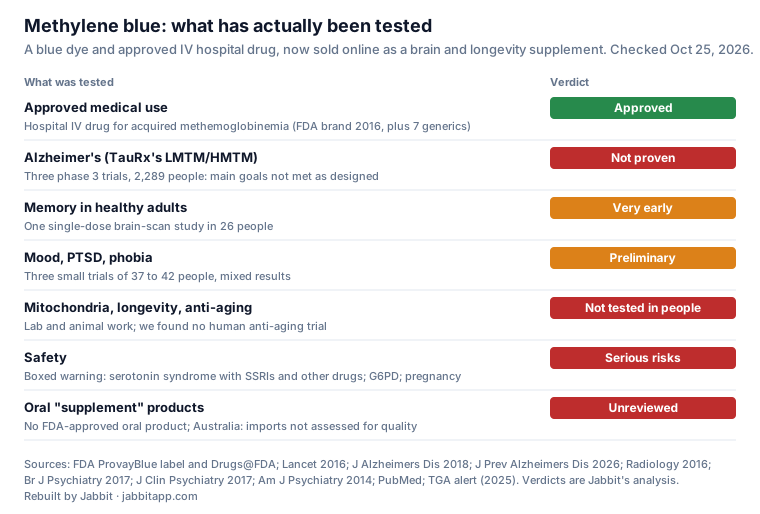
- Approved use. The FDA label covers one use, acquired methemoglobinemia, treated in a medical setting by IV.[1]
- Alzheimer’s disease. In the 891-person phase 3 trial, the authors reported that the main analyses “did not show any treatment benefit.”[9] In the 800-person trial, the analysis plan was revised before unblinding and the reported comparisons were not randomized; the authors wrote that “A further suitably randomized trial is required to test this hypothesis.”[10] In LUCIDITY, 598 people, the trial did not show significant differences on its two main goals at 52 weeks; the authors, who include TauRx staff, attribute this to activity in the control group, which got a small amount of the related compound to color urine.[12] Two independent reviews concluded that the randomized trials did not show a clear or consistent benefit.[16][17]
- Memory in healthy people. One randomized brain-scan study gave 26 healthy adults a single dose and reported 7% more correct answers on a memory task about an hour later.[22] We found no trial testing whether taking it over weeks or months improves memory or focus in healthy people.[27]
- Mood and anxiety. In bipolar disorder (37 people), depression and anxiety scores improved as an add-on, but thinking scores did not.[23] In PTSD (42 people), both exposure-therapy groups improved and neither differed from standard therapy at three months, though methylene blue improved evaluator-rated response and quality of life compared with placebo.[24] In claustrophobia (42 people), it seemed to help people whose fear had dropped during training and may have hurt those whose fear had not.[25]
- Surgery. One open-label trial in China gave IV methylene blue during surgery to older adults and reported less delirium; this was a hospital IV use with no placebo and no blinding.[26]
- Mitochondria and longevity. The case rests on lab and animal work.[8] A PubMed search for randomized trials of methylene blue with aging, longevity or lifespan terms found two records, neither about taking it to slow aging.[27] ClinicalTrials.gov lists 343 studies mentioning methylene blue across all uses; we did not classify them all.[28]
The key trials, in one chart
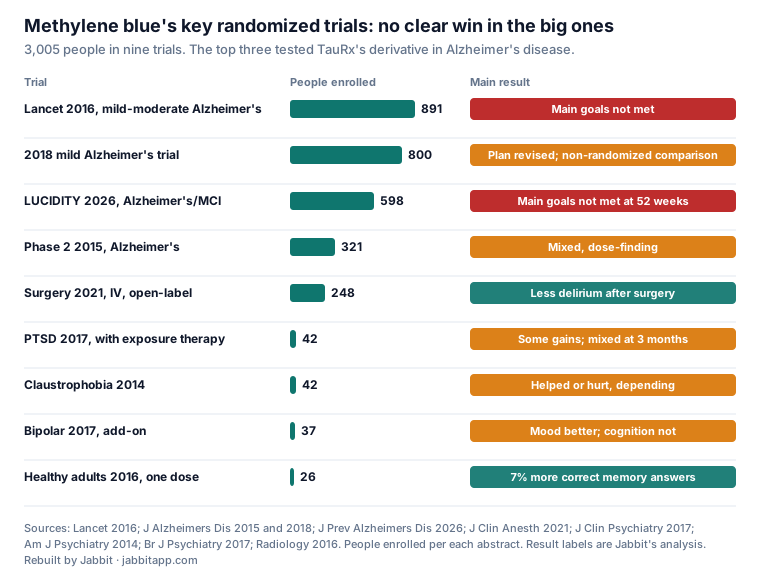
Our analysis: the three biggest trials, which together enrolled more than three times as many people as the other six combined, tested the TauRx derivative in Alzheimer’s disease, and none showed a clear benefit in its randomized comparisons; the claimed benefits come from revised or non-randomized analyses.[9][10][12][16] The positive signals in the chart come from studies of 26 to 248 people, one of them open-label and in hospital, and the only healthy-person study measured the effect of a single dose.[22][26]
The Alzheimer’s argument, in fairness
TauRx and its co-authors make a specific case. They report that the small amount of the compound used to color urine in the control group was itself active, so a normal placebo comparison was not possible.[12][14][15] A 2026 analysis compared LUCIDITY participants with outside control groups, matching 127 pairs.[14] The company says HMTM is investigational and “not approved or licensed by any medicines regulator,” that the UK’s MHRA asked for more information in October 2025, and that it expects a decision in 2026.[18][19] TauRx’s website also highlights biomarker results from LUCIDITY and the outside-group comparison.[18] Our analysis: comparisons with outside groups are weaker evidence than randomized ones, and the 2018 authors themselves wrote: “A further suitably randomized trial is required to test this hypothesis.”[10] A regulator’s decision would be the next real data point.
Safety
- Serotonin syndrome. The label’s boxed warning says it “may cause serious or fatal serotonergic syndrome” with serotonergic drugs and opioids, and tells prescribers to avoid using it with SSRIs, SNRIs, MAOIs and opioids.[1] Lab work shows it strongly blocks MAO-A, the same enzyme targeted by older MAOI antidepressants.[5] The TGA gives the same warning for oral products, naming SSRIs and some painkillers.[4] A 2024 toxicology case series describes serotonin toxicity linked to methylene blue.[6]
- G6PD deficiency. The label rules it out in people with G6PD deficiency, a common inherited condition, because of the risk of hemolytic anemia (red blood cells breaking down).[1][4]
- Pregnancy. The label says it may cause fetal harm; the TGA says it should not be used during pregnancy.[1][4]
- Other effects. The label lists confusion, dizziness and vision changes, blue skin and body fluids, and falsely low pulse-oximeter readings.[1] The LUCIDITY paper lists headache and diarrhea as the most common side effects of the derivative.[12]
- Reports. FAERS holds 1,605 reports naming methylene blue, and 518 include serotonin syndrome, the most common term; such reports are unverified and do not show cause.[3]
Purity and “supplement” products
The FDA-approved product is an injection made to a USP standard and given under medical care.[1][2] The TGA says imported oral products “have not been assessed by us for quality, safety or efficacy,” may contain “incorrect or undisclosed and harmful ingredients,” and mostly “do not include clear instructions or warnings.”[4] Our analysis: a product sold as a supplement, a “research chemical” or a dye has had no regulator check of what is in it, so its purity and strength cannot be assumed. We do not name or rate sellers.
Legal status
In the US, methylene blue injection is an FDA-approved prescription drug for acquired methemoglobinemia, and Drugs@FDA lists no approved oral product.[1][2] In Australia, the TGA says unregistered oral products are being imported for off-label uses and that it will ask the Australian Border Force to seize those that do not meet import conditions.[4] TauRx’s HMTM is investigational everywhere, according to the company, with a UK application under review.[18][19][21]
What a careful reader should notice
These points are our analysis of the sources cited.
- Two different molecules get blended together. The large Alzheimer’s trials tested TauRx’s derivative, not supplement methylene blue.[16][9][12]
- The trial design changed its description. The 2022 design paper described a “placebo-controlled phase”; the 2026 results paper describes the control as a urine colorant that its authors now say was active.[13][12]
- “Boosts mitochondria” is a lab finding, not a human outcome. We found no randomized trial of methylene blue for aging.[8][27]
- The interaction risk is not hypothetical. It is in a boxed warning, explained by lab work, and repeated by a second regulator.[1][5][4]
- The best-supported human uses are in hospitals, by IV, under monitoring.[1][26]
Frequently asked questions
- Does methylene blue improve memory?
- One small study of 26 healthy adults found 7% more correct answers on a memory task after a single dose. A bipolar trial found no effect on thinking. We found no long-term trial in healthy people.[22][23][27]
- Is methylene blue safe?
- Its FDA label has a boxed warning for serious or fatal serotonin syndrome with SSRIs, SNRIs, MAOIs and opioids. It is ruled out in G6PD deficiency and may harm a fetus.[1][4]
- Is methylene blue FDA approved?
- Yes, but only as an injection (ProvayBlue and generics) for acquired methemoglobinemia. Drugs@FDA lists no approved oral product.[1][2]
- Can you take methylene blue with antidepressants?
- The FDA label says to avoid combining it with SSRIs, SNRIs, MAOIs and opioids because of serotonin syndrome. Australia’s TGA gives the same warning for oral products. Ask your prescriber.[1][4]
- Is methylene blue approved for Alzheimer’s disease?
- No. TauRx’s related drug HMTM is investigational; its phase 3 trials did not show a clear benefit in randomized comparisons, according to an independent review, and the company says a UK decision is expected in 2026.[9][12][16][18]
- Does methylene blue help mitochondria or slow aging?
- Lab and animal studies show effects on the cell’s energy chain, but we found no human trial showing it slows aging.[8][27]
- Are methylene blue supplements pure?
- There is no guarantee. Australia’s TGA says imported oral products were not assessed for quality and may contain wrong or undisclosed ingredients.[4]
Bottom line
Methylene blue is a useful hospital drug for one blood disorder.[1] As a brain or longevity supplement, the human evidence is a few small studies with mixed results, and the large Alzheimer’s trials of a related drug did not show a clear benefit in randomized comparisons.[22][23][9][12][16] Its risks are documented: a boxed warning for serotonin syndrome with common antidepressants and opioids, plus G6PD and pregnancy cautions, and regulators have not checked oral products sold online.[1][4]
References
- Provepharm SAS. PROVAYBLUE (methylene blue) injection, USP, for intravenous use. FDA-approved prescribing information, DailyMed setid 4f6848e5-35ed-4046-b13c-3032b5ba3232 (version published June 2025). “Initial U.S. Approval: 2016.” Boxed warning: serotonin syndrome with concomitant use of serotonergic drugs: “PROVAYBLUE may cause serious or fatal serotonergic syndrome when used in combination with serotonergic drugs and opioids. Avoid concomitant use of PROVAYBLUE with selective serotonin reuptake inhibitors (SSRIs), serotonin norepinephrine reuptake inhibitors (SNRIs), monoamine oxidase inhibitors (MAOIs) and opioids.” Indication: “PROVAYBLUE is indicated for the treatment of pediatric and adult patients with acquired methemoglobinemia.” Contraindications include “Patients with glucose-6-phosphate dehydrogenase deficiency (G6PD) due to the risk of hemolytic anemia.” Also: “The presence of methylene blue in the blood may result in an underestimation of the oxygen saturation reading by pulse oximetry”; “PROVAYBLUE may cause fetal harm when administered to a pregnant woman”; “Treatment with PROVAYBLUE may cause confusion, dizziness and disturbances in vision”; “PROVAYBLUE may cause a blue discoloration of the skin and body fluids.” https://dailymed.nlm.nih.gov/dailymed/drugInfo.cfm?setid=4f6848e5-35ed-4046-b13c-3032b5ba3232. Checked October 25, 2026.
- U.S. Food and Drug Administration, Drugs@FDA via openFDA, search “methylene blue,” October 25, 2026: 8 applications, all intravenous solutions: NDA 204630 (PROVAYBLUE, Provepharm SAS), original approval April 8, 2016, and 7 generic (ANDA) approvals. No oral methylene blue product is listed. https://www.accessdata.fda.gov/scripts/cder/daf/index.cfm?event=overview.process&ApplNo=204630; list: https://jabbitapp.com/research/sources/methylene-blue-2026-10-25.json. Checked October 25, 2026.
- openFDA, FDA Adverse Event Reporting System (data through July 30, 2026), October 25, 2026: 1,605 reports name methylene blue; 518 of them include the term serotonin syndrome, the most frequent reaction term. Such reports are unverified, mostly cannot show which product or route was involved, and do not show that a drug caused an event. https://open.fda.gov/apis/drug/event/; counts: https://jabbitapp.com/research/sources/methylene-blue-2026-10-25.json. Checked October 25, 2026.
- Therapeutic Goods Administration (Australia). Safety alert on imported, unregistered methylene blue products, published 25 September 2025. Reports “increasing importation and use of unregistered oral methylene blue (methylthioninium chloride) products in Australia”; “These products are being promoted for unapproved (off-label) uses, such as cognitive enhancement, mood improvement, and anti-ageing effects.” “They have not been assessed by us for quality, safety or efficacy”; they “may contain incorrect or undisclosed and harmful ingredients”; “Most methylene blue products imported from online stores do not include clear instructions or warnings.” Also: “Medicines that affect serotonin levels such as some painkillers and selective serotonin reuptake inhibitors (SSRIs), a common type of antidepressant, can cause serotonin syndrome when taken with methylene blue”; people with G6PD deficiency “may experience red blood cell damage (haemolysis) if they take methylene blue”; “Methylene blue should not be used during pregnancy”; “Do not use oral methylene blue products unless advised or prescribed by a healthcare professional”; “We will notify the Australian Border Force (ABF) to seize and destroy” non-compliant imports. https://www.tga.gov.au/safety/safety-monitoring-and-information/safety-alerts/imported-unregistered-methylene-blue-products; archived copy read: https://web.archive.org/web/20251125152237/https://www.tga.gov.au/safety/safety-monitoring-and-information/safety-alerts/imported-unregistered-methylene-blue-products. Checked October 25, 2026.
- Ramsay RR, Dunford C, Gillman PK. Methylene blue and serotonin toxicity: inhibition of monoamine oxidase A (MAO A) confirms a theoretical prediction. Br J Pharmacol. 2007;152(6):946-51. PMID 17721552. Laboratory study with purified human enzyme: “MB was a potent (tight binding) inhibitor for MAO A”; “MB is a potent reversible inhibitor of MAO A with implications for gut uptake of amines when administered orally”; “This inhibition of MAO A would be expected to lead to perturbations of 5-hydroxytryptamine metabolism and hence account for ST occurring when administered to patients on SSRI treatment.” Abstract read. https://pubmed.ncbi.nlm.nih.gov/17721552/. Checked October 25, 2026.
- Hazekamp C, Schmitz Z, Scoccimarro A. Methylene Blue-Induced Serotonin Toxicity: Case Files of the Medical Toxicology Fellowship at the New York City Poison Control Center. J Med Toxicol. 2024;20(1):54-58. PMID 37828274. Case discussion from a medical toxicology fellowship series; no abstract in PubMed; title read. https://pubmed.ncbi.nlm.nih.gov/37828274/. Checked October 25, 2026.
- Robinson VT, Adamick C, Rehman A. Methylene blue and the social media phenomenon: Key information for nurses. Nursing. 2026;56(3):16-18. PMID 41725094. Clinical article for nurses on methylene blue’s social media popularity; no abstract in PubMed; title read. https://pubmed.ncbi.nlm.nih.gov/41725094/. Checked October 25, 2026.
- Tucker D, Lu Y, Zhang Q. From Mitochondrial Function to Neuroprotection-an Emerging Role for Methylene Blue. Mol Neurobiol. 2018;55(6):5137-5153. PMID 28840449. Narrative review: “MB can reroute electrons in the mitochondrial electron transfer chain directly from NADH to cytochrome c”; “In both in vitro and in vivo studies, MB has shown impressive efficacy in mitigating neurodegeneration” in animal models. Abstract read. https://pubmed.ncbi.nlm.nih.gov/28840449/. Checked October 25, 2026.
- Gauthier S, Feldman HH, Schneider LS, et al. Efficacy and safety of tau-aggregation inhibitor therapy in patients with mild or moderate Alzheimer's disease: a randomised, controlled, double-blind, parallel-arm, phase 3 trial. Lancet. 2016;388(10062):2873-2884. PMID 27863809. Phase 3, randomized, controlled trial of LMTM in mild to moderate Alzheimer’s disease (NCT01689246): “we recruited and randomly assigned 891 participants”; “The prespecified primary analyses did not show any treatment benefit at either of the doses tested for the coprimary outcomes”; “the results do not suggest benefit of LMTM as an add-on treatment for patients with mild to moderate Alzheimer's disease”; “Gastrointestinal and urinary effects were the most common adverse events.” Author affiliations include TauRx Therapeutics. Abstract read. https://pubmed.ncbi.nlm.nih.gov/27863809/. Checked October 25, 2026.
- Wilcock GK, Gauthier S, Frisoni GB, et al. Potential of Low Dose Leuco-Methylthioninium Bis(Hydromethanesulphonate) (LMTM) Monotherapy for Treatment of Mild Alzheimer's Disease: Cohort Analysis as Modified Primary Outcome in a Phase III Clinical Trial. J Alzheimers Dis. 2018;61(1):435-457. PMID 29154277. Phase 3 trial of LMTM in mild Alzheimer’s disease (NCT01689233): “Mild AD patients (n = 800)”; “Prior to unblinding, the Statistical Analysis Plan was revised”; the reported comparisons are “non-randomized cohort analyses”; “A further suitably randomized trial is required to test this hypothesis.” Author affiliations include TauRx Therapeutics. Abstract read. https://pubmed.ncbi.nlm.nih.gov/29154277/. Checked October 25, 2026.
- Wischik CM, Staff RT, Wischik DJ, et al. Tau aggregation inhibitor therapy: an exploratory phase 2 study in mild or moderate Alzheimer's disease. J Alzheimers Dis. 2015;44(2):705-20. PMID 25550228. “An exploratory double-blind, randomized, placebo-controlled, dose-finding trial” of methylthioninium “conducted in 321 mild/moderate AD subjects”; benefits reported at one middle dose in separate subgroups; “The delivery of the highest dose was impaired due to dose-dependent dissolution and absorption limitations”; “further study of MT is warranted in AD.” Abstract read. https://pubmed.ncbi.nlm.nih.gov/25550228/. Checked October 25, 2026.
- Wischik CM, Stefanacci R, Bentham P, et al. Clinical, imaging and blood biomarker outcomes in a Phase 3 clinical trial of tau aggregation inhibitor hydromethylthionine mesylate in mild cognitive impairment and mild to moderate dementia due to Alzheimer's disease. J Prev Alzheimers Dis. 2026;13(3):100480. PMID 41570392. LUCIDITY phase 3 results (NCT03446001): “A total of 598 amyloid β-PET positive participants were included”; the control arm received methylthioninium chloride (MTC) “intended as an inactive urinary colourant”; “It was not possible to demonstrate significant differences on the co-primary clinical endpoints (ADAS-cog11 and ADCS-ADL23) at 52 weeks due to symptomatic activity in the control arm”; “In participants with MCI, significant clinical separation was seen only at 78 and 104 weeks”; “Headache (1·5%) and diarrhoea (1·2%) were the most frequent adverse effects.” Author affiliations include TauRx Therapeutics. Abstract read. https://pubmed.ncbi.nlm.nih.gov/41570392/. Checked October 25, 2026.
- Wischik CM, Bentham P, Gauthier S, et al. Oral Tau Aggregation Inhibitor for Alzheimer's Disease: Design, Progress and Basis for Selection of the […] Dose in a Phase 3, Randomized, Placebo-Controlled Trial of Hydromethylthionine Mesylate. J Prev Alzheimers Dis. 2022;9(4):780-790. PMID 36281683. LUCIDITY design paper: “The trial comprises a 12-month double-blind, placebo-controlled phase” followed by an open-label phase. Author affiliations include TauRx Therapeutics. Abstract read. https://pubmed.ncbi.nlm.nih.gov/36281683/. Checked October 25, 2026.
- Schelter BO, Shiells H, Lo S, et al. Assessment of clinical and neuroimaging efficacy of treatment targeting tau pathology in mild cognitive impairment and mild to moderate Alzheimer's disease with hydromethylthionine mesylate using external control data. J Prev Alzheimers Dis. 2026;13(6):100560. PMID 42000569. Comparison of LUCIDITY participants with external control data: “A traditional randomised placebo-controlled trial (RCT) was precluded by loss of blinding due to urinary colouration and therapeutic activity” at the lowest dose that keeps blinding; “Propensity score matching yielded 127 pairs.” Author affiliations include TauRx Therapeutics. Abstract read. https://pubmed.ncbi.nlm.nih.gov/42000569/. Checked October 25, 2026.
- van Maanen E, Gonçalves A, Chen L, et al. Atypical population pharmacokinetics of hydromethylthionine in patients with Alzheimer's disease explains unexpected phase 3 trial results. Br J Clin Pharmacol. 2026;92(8):2645-2656. PMID 41917677. Population pharmacokinetic analysis: “The data suggest it is not possible to maintain comparable urinary discolouration without therapeutic activity in a standard placebo-controlled trial design.” Author affiliations include TauRx Therapeutics. Abstract read. https://pubmed.ncbi.nlm.nih.gov/41917677/. Checked October 25, 2026.
- Hashweh NN, Bartochowski Z, Khoury R, et al. An evaluation of hydromethylthionine as a treatment option for Alzheimer's disease. Expert Opin Pharmacother. 2020;21(6):619-627. PMID 32037892. Independent review: “Derived from methylene blue, hydromethylthionine is a tau aggregation inhibitor”; “Randomized clinical trials with hydromethylthionine failed to show any impact of the doses used on the disease course”; a later non-randomized analysis suggested a smaller dose may slow decline. Abstract read. https://pubmed.ncbi.nlm.nih.gov/32037892/. Checked October 25, 2026.
- Yin L, Ren R, Leo C, et al. From target engagement to translational disconnect: A systematic review and narrative synthesis of direct tau-targeted clinical trials in Alzheimer's disease and primary tauopathies. Pharmacol Res. 2026;232:108439. PMID 42702342. Systematic review of tau-targeted trials: “the small-molecule aggregation inhibitor LMTM did not demonstrate consistent clinical benefit in phase 3 trials.” Abstract read. https://pubmed.ncbi.nlm.nih.gov/42702342/. Checked October 25, 2026.
- TauRx Therapeutics. Frequently asked questions (company statement): “Hydromethylthionine mesylate (HMTM) is an investigational medicine. It is not approved or licensed by any medicines regulator and is not available to be prescribed”; “HMTM was granted an Innovation Passport by the MHRA in 2022”; “a final decision on our Marketing Authorisation Application (MAA) expected in 2026.” https://taurx.com/medical-professionals/frequently-asked-questions. Checked October 25, 2026.
- TauRx Therapeutics. “MHRA response to HMTM marketing authorisation application,” 1 October 2025 (company statement): the MHRA said “it requires some further information before a final determination on the suitability of hydromethylthionine mesylate (HMTM), as a potential oral treatment for Alzheimer’s disease, can be reached.” https://taurx.com/insights/industry-news/mhra-response-to-hmtm-marketing-authorisation-application. Checked October 25, 2026.
- TauRx Therapeutics. “TauRx finalises responses to MHRA request for information,” 4 June 2025 (company statement): “TauRx can confirm it has completed the request for information (RFI) received from the Medicines and Healthcare products Regulatory Agency (MHRA).” https://taurx.com/insights/industry-news/taurx-finalises-responses-to-mhra-request-for-information. Checked October 25, 2026.
- ClinicalTrials.gov API v2, records for TauRx’s LMTM/HMTM (TRx0237), October 25, 2026: completed phase 3 trials NCT01689246 (891 enrolled), NCT01689233 (800), NCT03446001 LUCIDITY (598) and NCT01626378 (220, behavioral-variant frontotemporal dementia); an open-label extension NCT02245568 (terminated); and an expanded-access program NCT03539380 listed as available. https://clinicaltrials.gov/study/NCT03446001; IDs: https://jabbitapp.com/research/sources/methylene-blue-2026-10-25.json. Checked October 25, 2026.
- Rodriguez P, Zhou W, Barrett DW, et al. Multimodal Randomized Functional MR Imaging of the Effects of Methylene Blue in the Human Brain. Radiology. 2016;281(2):516-526. PMID 27351678. Randomized, placebo-controlled brain-imaging (fMRI) study of one oral dose: “Twenty-six subjects (age range, 22-62 years) were enrolled”; “Methylene blue was also associated with a 7% increase in correct responses during memory retrieval (P = .01).” Abstract read. https://pubmed.ncbi.nlm.nih.gov/27351678/. Checked October 25, 2026.
- Alda M, McKinnon M, Blagdon R, et al. Methylene blue treatment for residual symptoms of bipolar disorder: randomised crossover study. Br J Psychiatry. 2017;210(1):54-60. PMID 27284082. Randomized crossover add-on trial in bipolar disorder: “Thirty-seven participants were enrolled”; depression and anxiety improved; “The effects of methylene blue on cognitive symptoms were not significant.” Abstract read. https://pubmed.ncbi.nlm.nih.gov/27284082/. Checked October 25, 2026.
- Zoellner LA, Telch M, Foa EB, et al. Enhancing Extinction Learning in Posttraumatic Stress Disorder With Brief Daily Imaginal Exposure and Methylene Blue: A Randomized Controlled Trial. J Clin Psychiatry. 2017;78(7):e782-e789. PMID 28686823. Randomized trial in chronic PTSD: “Patients with chronic PTSD (DSM-IV-TR; N = 42)”; “Both IE + MB and IE + PBO showed strong clinical gains that did not differ from standard PE at 3-month follow-up”; methylene blue improved evaluator-rated response and quality of life compared with placebo; “The findings provide preliminary efficacy for a brief IE treatment for PTSD.” Abstract read. https://pubmed.ncbi.nlm.nih.gov/28686823/. Checked October 25, 2026.
- Telch MJ, Bruchey AK, Rosenfield D, et al. Effects of post-session administration of methylene blue on fear extinction and contextual memory in adults with claustrophobia. Am J Psychiatry. 2014;171(10):1091-8. PMID 25018057. Randomized, double-blind trial in claustrophobic fear, methylene blue “(N=23)” vs placebo “(N=19)” after exposure training: people with low fear after training did better at one month, while “participants displaying moderate to high levels of posttraining fear tended to fare worse at the follow-up if they received methylene blue posttraining”; it “may have a deleterious effect on extinction when administered after an unsuccessful exposure session.” Abstract read. https://pubmed.ncbi.nlm.nih.gov/25018057/. Checked October 25, 2026.
- Deng Y, Wang R, Li S, et al. Methylene blue reduces incidence of early postoperative cognitive disorders in elderly patients undergoing major non-cardiac surgery: An open-label randomized controlled clinical trial. J Clin Anesth. 2021;68:110108. PMID 33091706. “Prospective, randomized, open-label clinical trial” of intravenous methylene blue during surgery in “Two hundred and forty-eight elderly patients”: postoperative delirium “(7.3% vs. 24.2%, OR = 0.24” vs saline. Abstract read. https://pubmed.ncbi.nlm.nih.gov/33091706/. Checked October 25, 2026.
- PubMed searches, October 25, 2026: randomized controlled trials of methylene blue with cognition, memory or nootropic terms in humans: 8 records; randomized controlled trials mentioning methylene blue with aging, longevity, lifespan or anti-aging: 2 records, both dental or photodynamic-therapy studies, not trials of taking methylene blue to slow aging. https://pubmed.ncbi.nlm.nih.gov/?term=%22methylene+blue%22%5Btiab%5D+AND+%28aging%5Btiab%5D+OR+longevity%5Btiab%5D+OR+lifespan%5Btiab%5D+OR+anti-aging%5Btiab%5D%29+AND+randomized+controlled+trial%5Bpt%5D; queries and IDs: https://jabbitapp.com/research/sources/methylene-blue-2026-10-25.json. Checked October 25, 2026.
- ClinicalTrials.gov API v2, intervention “methylene blue,” October 25, 2026: 343 records across all uses; we did not classify them all. https://clinicaltrials.gov/search?intr=methylene%20blue; count: https://jabbitapp.com/research/sources/methylene-blue-2026-10-25.json. Checked October 25, 2026.
This page analyzes published studies, regulator documents, company records and registry data. It is not medical or legal advice and does not recommend any product or dose. Methylene blue is FDA-approved only as an injection for acquired methemoglobinemia. Charts were rebuilt by Jabbit from the sources cited in each caption.