Study teardown · Cerebrolysin (FPF-1070; discussed online as a “nootropic peptide”) · From a 1998 study in healthy men to 2026: the stroke, brain-injury and dementia trials, two Cochrane reviews, a European guideline, the Austrian label, the maker’s US notice, an FDA warning letter, WADA, registry, FAERS and PubMed counts · Sources checked October 25, 2026
Published · Updated
Cerebrolysin: does the pig-brain “nootropic peptide” work, and is it safe? Its largest stroke trial missed its main goal, a Cochrane review found no effect on death and a possible rise in serious side effects, the positive trials are mostly small, it has barely been tested in healthy people, and it is not approved in the US.
Cerebrolysin is an injectable mixture of small peptides and amino acids made from pig brain protein.[1][22] It is widely used for stroke in Russia, Eastern Europe, China and other parts of Asia, and in Austria it is a prescription drug for dementia and for recovery after stroke or brain injury.[1][22] Its record is weaker than its reputation. The largest stroke trial, 1,070 patients, found no difference on its main goal, and a 2023 Cochrane review found no effect on death and a possible increase in non-fatal serious adverse events.[2][1] Smaller trials, some with authors from the manufacturer, report benefits.[3][4][14][10] We found one study in healthy people, from 1998, and it measured brain waves, not everyday thinking.[21] Its maker says it is not approved for sale in the United States.[23]
Why this matters now
New trials keep arriving: a 2025 aphasia trial, a 2025 meta-analysis of 14 trials, a 2026 analysis of patients treated with clot removal, and nine studies on ClinicalTrials.gov that are recruiting, about to start or still running.[10][9][12][30] In the US, FDA’s new peptide compounding policy has been under White House review since October 14, 2026, and its text is not public.[27] Cerebrolysin is not on FDA’s May 2026 list of nominated compounding ingredients, and in 2020 FDA told a pharmacy it was not eligible for compounding and had not been nominated.[25][24] Our analysis: that leaves it outside the group of peptides the policy debate has focused on. Our FDA peptide compounding status tracker follows the ones that are on FDA’s lists.
Timeline
| Date | Event |
|---|---|
| March 1996 | Austria authorizes Cerebrolysin as a prescription drug, held by EVER Neuro Pharma.[22] |
| 1998 | A 10-day placebo-controlled study in 48 healthy men reports brain-wave (EEG) changes and only a trend on short-term memory.[21] |
| 2000 | A 4-week trial in 53 people with Alzheimer’s disease in Korea reports better cognitive scores but no change in daily living.[20] |
| 2012 | CASTA, 1,070 stroke patients in Asia, finds no significant difference on its main outcome.[2] |
| 2013 | A Cochrane review finds insufficient evidence to recommend it routinely for vascular dementia.[18] |
| 2015-2016 | An Alzheimer’s meta-analysis of six trials reports benefits; the exploratory CARS trial reports better arm function after stroke.[19][3] |
| 2017 | A meta-analysis of six trials and 1,649 stroke patients finds no effect on functional recovery at day 90.[5] |
| 2018 | A meta-analysis of nine trials, 1,879 patients, reports better early stroke-scale scores.[6] |
| April 2020 | An FDA warning letter to a compounding pharmacy says cerebrolysin is not eligible for compounding and has not been nominated.[24] |
| 2020 | Two CAPTAIN trials in traumatic brain injury, 46 and 142 patients, report one near-miss and one small-to-medium benefit on combined scores.[13][14] |
| 2021 | A European neurology guideline recommends it for early rehabilitation after ischaemic stroke; a safety meta-analysis of 2,202 patients finds no significant difference from placebo.[7][8] |
| 2023 | The updated Cochrane stroke review finds no effect on death and a possible increase in non-fatal serious adverse events.[1] |
| 2025 | The ESCAS aphasia trial (132 patients) reports better language scores; a 14-trial meta-analysis calls for more high-quality trials.[10][9] |
| 2026 | A meta-analysis of three observational studies looks at it alongside clot removal; FDA’s May 2026 compounding list does not include it; FDA’s peptide policy goes to White House review on October 14.[12][25][27] |
What cerebrolysin is
The Austrian label describes a “proteolytic peptide fraction from pig brain protein,” in our translation, made of short peptides similar or identical to ones the body makes, which is why, the label says, its levels in the body cannot be measured directly.[22] It is a solution given by injection into a muscle or a vein or by drip, in courses of treatment, and the label does not recommend it for anyone under 18 because there are not enough data.[22] It is not a single molecule like most of the peptides we cover, so “a peptide” here means a mixture of many short peptides rather than one defined molecule.[22][1] EVER Neuro Pharma holds the Austrian authorization, and its product site tells US visitors that Cerebrolysin “is not registered with the U.S. Food and Drug Administration (FDA) and is not approved for sale or distribution in the United States.”[22][23]
The evidence, rung by rung
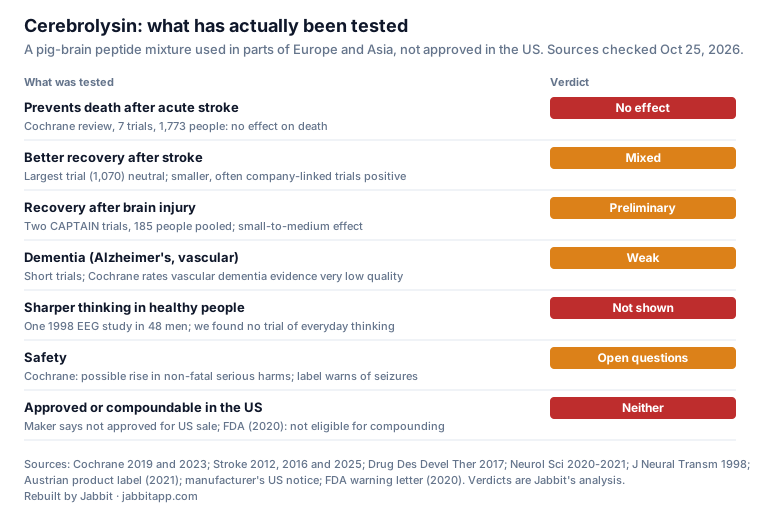
- Death after stroke. Across six trials and 1,689 people, the Cochrane review found no effect on death from any cause (risk ratio 0.96), rated moderate-certainty evidence, and none of the trials reported poor functional outcome as Cochrane defines it.[1]
- Recovery after stroke. The largest trial, CASTA, found no significant difference on its main outcome; a benefit in more severe patients was found only after the fact, and its authors said it needed confirming.[2] A 2017 meta-analysis of six trials and 1,649 patients found no effect on function at day 90.[5] Meta-analyses that pooled early stroke-scale scores report benefits, including one of nine trials and 1,879 patients and a 2025 analysis of 14 trials that found only a non-significant trend on functional independence.[6][9] In 2021, a European neurology guideline recommended cerebrolysin for early rehabilitation after ischaemic stroke.[7]
- Rehabilitation. In CARS, patients in a rehabilitation program had much better arm function at day 90 on cerebrolysin, but its authors called the trial exploratory and too small to be conclusive.[3] In ESCAS, 132 patients with aphasia who all had speech therapy scored better on a language test with cerebrolysin, and the authors called for larger trials.[10]
- Brain injury. The two CAPTAIN trials together enrolled 188 people and analyzed 185; the smaller one just missed its main goal in the main analysis, and the pooled result was a small-to-medium effect on a combined score of many scales.[13][14][15] A broader 2023 meta-analysis of ten studies and 8,749 patients, including retrospective ones, found no effect on death or length of hospital stay.[16]
- Dementia. Trials were short: four weeks in the Korean Alzheimer’s trial, with daily living unchanged.[20] An Alzheimer’s meta-analysis of six trials reported better cognition at 4 weeks, not significantly at 6 months.[19] For vascular dementia, Cochrane rated the cognitive benefit very low-quality evidence and said the data “are not definitive.”[17][18]
- Healthy people. A 1998 study gave cerebrolysin or placebo to 48 healthy men for 10 days. It reported EEG changes; on short-term memory it found only a trend, and that trend came from the placebo group doing worse.[21] We found no trial testing whether it improves focus, memory or learning in healthy people.[31][30]
The key trials, in one chart
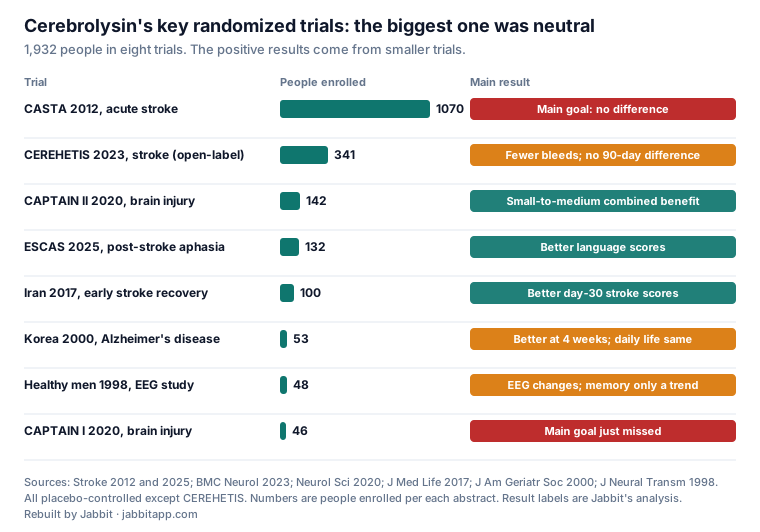
Our analysis: the largest of these trials, with more people than the next seven combined, was the one that found no difference on its main goal.[2] The positive results in the chart come from trials of 53 to 142 people, often measured on combined scores, test scores or early stroke scales rather than death or long-term disability.[20][4][14][10][6] At least two positive stroke trials list authors from the manufacturer.[3][4] Cochrane noted that the manufacturer supported three of the multicentre stroke studies it reviewed.[1] Company support does not make a trial wrong, but it is a reason to want independent replication, which the trial authors themselves called for.[2][3][10]
Safety
- Serious adverse events. The 2023 Cochrane review found a possible increase in non-fatal serious adverse events (risk ratio 2.39, three trials, 1,335 people, moderate certainty), while it found probably little to no difference in the total number of people with serious adverse events (risk ratio 1.16).[1] A 2021 meta-analysis of 12 trials and 2,202 patients found no significant differences from placebo.[8] Our analysis: the two reviews pooled different trials and outcomes, so the question is open.
- Seizures. The Austrian label lists status epilepticus as a reason not to use it, warns that seizure frequency may rise in people with epilepsy, and lists isolated grand mal seizures among very rare side effects.[22]
- Allergy and kidneys. The label lists allergic reactions, very rarely up to a shock-like state, and does not allow use with severe kidney impairment or known hypersensitivity.[22]
- Pregnancy and children. The label says it should not be used in pregnancy unless the woman’s condition requires it, and it is not recommended under 18.[22]
- Reports. FAERS holds 80 reports naming cerebrolysin; such reports are unverified and do not show cause.[29]
- Outside medical supervision. Its maker describes it as a prescription medicine for use under a health professional’s supervision.[23] Our analysis: in the US, where no approved product exists, there is no FDA-reviewed source and no US label.[29][23]
Legal status
No cerebrolysin product appears in Drugs@FDA or the NDC directory, and its maker says it is not approved for sale or distribution in the US.[29][23] In an April 2020 warning letter, FDA said cerebrolysin was not eligible for the compounding exemptions because it has no USP or NF monograph, is not part of an approved drug and is not on the 503A bulks list, and that it had not been nominated for that list.[24] It does not appear on FDA’s May 2026 list of nominated substances or on its compounding safety-risk list.[25][26] FDA’s interim peptide policy is pending White House review and its contents are not public.[27] WADA’s 2026 Prohibited List does not name cerebrolysin; whether any general category applies is a question for anti-doping authorities, and we make no call on it.[28]
What a careful reader should notice
These points are our analysis of the sources cited.
- The biggest trial is the most neutral one. CASTA enrolled more patients than the other trials in our chart combined, and it missed its main goal.[2]
- Outcomes matter. Benefits show up most on early stroke scales and combined scores; on death, Cochrane found none, and a 2017 meta-analysis found no day-90 functional effect.[6][1][5]
- Experts disagree. A European guideline recommends it for early stroke rehabilitation, while a 2017 meta-analysis said routine use “cannot be supported by the available evidence from RCTs.”[7][5]
- “Nootropic” is a leap. Every trial with real outcomes was in sick people, and the one healthy-person study we found measured brain waves.[21]
- It is a mixture from animal tissue, given by injection, with no US label, so people outside licensed settings have no US-reviewed information on what they are getting.[22][23]
Frequently asked questions
- Does cerebrolysin work?
- For stroke, the evidence is mixed: the largest trial found no difference on its main outcome, Cochrane found no effect on death, and smaller trials report better early recovery scores. For brain injury and dementia, the trials are small or short. We found no good evidence that it improves thinking in healthy people.[2][1][6][15][17][21]
- Is cerebrolysin safe?
- A 2023 Cochrane review found a possible increase in non-fatal serious adverse events after stroke, while another meta-analysis found no difference from placebo. The Austrian label warns about seizures and allergic reactions and rules it out in severe kidney impairment.[1][8][22]
- What is cerebrolysin made from?
- It is a mixture of small peptides and amino acids made by breaking down pig brain protein, given by injection or drip.[1][22]
- Is cerebrolysin FDA approved?
- No. Its maker says it is not registered with FDA or approved for sale in the US, and no product appears in FDA’s databases.[23][29]
- Can a US pharmacy compound cerebrolysin?
- In 2020, FDA said it was not eligible for compounding and had not been nominated for the 503A bulks list, and it is not on FDA’s May 2026 list. FDA’s new peptide policy is pending, and its text is not public.[24][25][27]
- Is cerebrolysin a nootropic?
- Some papers call it one, but the only placebo-controlled study in healthy people we found was a 10-day EEG study in 48 men from 1998, which found brain-wave changes and only a trend on memory.[21]
- Is cerebrolysin banned in sport?
- WADA’s 2026 Prohibited List does not name it. Athletes should ask their anti-doping organization about any unapproved substance.[28]
Bottom line
Cerebrolysin is a real medicine in parts of Europe and Asia, with decades of trials behind it.[1][22] Those trials do not add up to a clear benefit: the largest stroke trial was neutral, Cochrane found no effect on death and flagged a possible rise in serious side effects, and the positive results come mostly from smaller trials.[2][1][3][14] Its use as a brain booster for healthy people rests on almost nothing.[21] In the US it is not approved, and FDA said in 2020 that it cannot be compounded.[23][24]
References
- Ziganshina LE, Abakumova T, Nurkhametova D, et al. Cerebrolysin for acute ischaemic stroke. Cochrane Database Syst Rev. 2023;10(10):CD007026. PMID 37818733. Cochrane review of randomized trials in acute ischaemic stroke: cerebrolysin is a “mixture of low-molecular-weight peptides and amino acids derived from porcine brain,” “widely used in the treatment of acute ischaemic stroke in Russia, Eastern Europe, China, and other Asian and post-Soviet countries”; “Seven RCTs (1773 participants)”; all-cause death “(risk ratio (RR) 0.96, 95% confidence interval (CI) 0.65 to 1.41; 6 trials, 1689 participants; moderate-certainty evidence)”; “None of the included studies reported on poor functional outcome”; non-fatal serious adverse events “(RR 2.39, 95% CI 1.10 to 5.23; 3 trials, 1335 participants; moderate-certainty evidence)”; total people with serious adverse events “(RR 1.16, 95% CI 0.81 to 1.66; 3 trials, 1335 participants; moderate-certainty evidence)”; “The manufacturer of Cerebrolysin supported three multicentre studies.” Abstract read. https://pubmed.ncbi.nlm.nih.gov/37818733/. Checked October 25, 2026.
- Heiss WD, Brainin M, Bornstein NM, et al. Cerebrolysin in patients with acute ischemic stroke in Asia: results of a double-blind, placebo-controlled randomized trial. Stroke. 2012;43(3):630-6. PMID 22282884. CASTA, randomized, double-blind, placebo-controlled, in Asia: “A total of 1070 patients were enrolled”; “The confirmatory end point showed no significant difference between the treatment groups.” A trend in more severe patients was a post hoc finding, and the authors wrote: “This observation should be confirmed by a further clinical trial.” Abstract read. https://pubmed.ncbi.nlm.nih.gov/22282884/. Checked October 25, 2026.
- Muresanu DF, Heiss WD, Hoemberg V, et al. Cerebrolysin and Recovery After Stroke (CARS): A Randomized, Placebo-Controlled, Double-Blind, Multicenter Trial. Stroke. 2016;47(1):151-9. PMID 26564102. CARS, randomized, double-blind, placebo-controlled, with a standardized rehabilitation program: arm function on day 90 “indicated a large superiority of Cerebrolysin compared with the placebo (Mann-Whitney estimator, 0.71”; “Because this study was exploratory and had a relatively small sample size, the results should be confirmed in a large-scale, randomized clinical trial.” Author affiliations include EVER Neuro Pharma GmbH. Abstract read. https://pubmed.ncbi.nlm.nih.gov/26564102/. Checked October 25, 2026.
- Gharagozli K, Harandi AA, Houshmand S, et al. Efficacy and safety of Cerebrolysin treatment in early recovery after acute ischemic stroke: a randomized, placebo-controlled, double-blinded, multicenter clinical trial. J Med Life. 2017;10(3):153-160. PMID 29075343. Randomized, double-blind, placebo-controlled, multicenter trial in Iran that “enrolled a total of 100 patients”; day-30 stroke-scale change “indicated a medium to large superiority of cerebrolysin compared to placebo.” Author affiliations include EVER Neuro Pharma GmbH. Abstract read. https://pubmed.ncbi.nlm.nih.gov/29075343/. Checked October 25, 2026.
- Wang Z, Shi L, Xu S, et al. Cerebrolysin for functional recovery in patients with acute ischemic stroke: a meta-analysis of randomized controlled trials. Drug Des Devel Ther. 2017;11:1273-1282. PMID 28458521. Meta-analysis: “A total of 1,649 patients with AIS were pooled from six randomized controlled trials (RCTs)”; “Cerebrolysin had no significant effect on functional recovery at Day 90”; “routine administration of cerebrolysin to patients with AIS cannot be supported by the available evidence from RCTs.” Abstract read. https://pubmed.ncbi.nlm.nih.gov/28458521/. Checked October 25, 2026.
- Bornstein NM, Guekht A, Vester J, et al. Safety and efficacy of Cerebrolysin in early post-stroke recovery: a meta-analysis of nine randomized clinical trials. Neurol Sci. 2018;39(4):629-640. PMID 29248999. Meta-analysis of nine randomized, placebo-controlled trials (“N = 1879”): better early stroke-scale (NIHSS) scores at day 30 or 21; “Safety aspects were comparable to placebo.” Abstract read. https://pubmed.ncbi.nlm.nih.gov/29248999/. Checked October 25, 2026.
- Beghi E, Binder H, Birle C, et al. European Academy of Neurology and European Federation of Neurorehabilitation Societies guideline on pharmacological support in early motor rehabilitation after acute ischaemic stroke. Eur J Neurol. 2021;28(9):2831-2845. PMID 34152062. European Academy of Neurology and European Federation of Neurorehabilitation Societies guideline: cerebrolysin and citalopram “are recommended for clinical use for early neurorehabilitation after acute ischaemic stroke.” Abstract read. https://pubmed.ncbi.nlm.nih.gov/34152062/. Checked October 25, 2026.
- Strilciuc S, Vécsei L, Boering D, et al. Safety of Cerebrolysin for Neurorecovery after Acute Ischemic Stroke: A Systematic Review and Meta-Analysis of Twelve Randomized-Controlled Trials. Pharmaceuticals (Basel). 2021;14(12). PMID 34959697. Safety meta-analysis: “The meta-analysis pooled 2202 patients from twelve randomized clinical trials, registering non-statistically significant (p > 0.05) differences between Cerebrolysin and placebo.” Abstract read. https://pubmed.ncbi.nlm.nih.gov/34959697/. Checked October 25, 2026.
- Patel PN, Mangal D, Patel K. Safety and Efficacy of Cerebrolysin for Neurorecovery After Acute Ischemic Stroke: A Systematic Review and Meta-Analysis of 14 Randomized Controlled Trials. Cureus. 2025;17(8):e91054. PMID 41018475. Meta-analysis of “Fourteen randomized controlled trials (N = 2,884 patients)”: better stroke-scale scores, a non-significant trend on functional independence; “Further high-quality trials are warranted.” Abstract read. https://pubmed.ncbi.nlm.nih.gov/41018475/. Checked October 25, 2026.
- Homberg V, Jianu DC, Stan A, et al. Speech Therapy Combined With Cerebrolysin in Enhancing Nonfluent Aphasia Recovery After Acute Ischemic Stroke: ESCAS Randomized Pilot Study. Stroke. 2025;56(4):937-947. PMID 39957612. ESCAS, randomized, placebo-controlled, 132 patients with nonfluent aphasia after stroke, all receiving speech and language therapy: language-test difference “14.805 (95% CI, 9.521-20.089) points (P<0.001)”; “Further research with larger cohorts is needed.” Abstract read. https://pubmed.ncbi.nlm.nih.gov/39957612/. Checked October 25, 2026.
- Khasanova DR, Kalinin MN. Cerebrolysin as an Early Add-on to Reperfusion Therapy: Risk of Hemorrhagic Transformation after Ischemic Stroke (CEREHETIS), a prospective, randomized, multicenter pilot study. BMC Neurol. 2023;23(1):121. PMID 36973684. CEREHETIS, open-label, 126 patients given cerebrolysin with reperfusion therapy vs. 215 without: fewer symptomatic bleeding complications (hemorrhagic transformation), but “no difference in the mRS score was observed on day 90.” Abstract read. https://pubmed.ncbi.nlm.nih.gov/36973684/. Checked October 25, 2026.
- Afridi A, Sajjad F, Arshad A, et al. Efficacy and Safety of Cerebrolysin as an Adjunct to Mechanical Thrombectomy in Acute Ischemic Stroke: A Systematic Review and Meta-Analysis of Observational Studies. Brain Behav. 2026;16(3):e71252. PMID 41880098. Meta-analysis of “three observational studies involving a total of 294 patients” given cerebrolysin with mechanical thrombectomy vs. thrombectomy alone; observational designs cannot rule out confounding. Abstract read. https://pubmed.ncbi.nlm.nih.gov/41880098/. Checked October 25, 2026.
- Poon W, Matula C, Vos PE, et al. Safety and efficacy of Cerebrolysin in acute brain injury and neurorecovery: CAPTAIN I-a randomized, placebo-controlled, double-blind, Asian-Pacific trial. Neurol Sci. 2020;41(2):281-293. PMID 31494820. CAPTAIN I, randomized, double-blind, placebo-controlled, moderate-to-severe traumatic brain injury: “In 46 enrolled TBI patients (Cerebrolysin 22, placebo 24)”; for the primary outcome, “statistical significance was just missed in the intention-to-treat population.” Abstract read. https://pubmed.ncbi.nlm.nih.gov/31494820/. Checked October 25, 2026.
- Muresanu DF, Florian S, Hömberg V, et al. Efficacy and safety of cerebrolysin in neurorecovery after moderate-severe traumatic brain injury: results from the CAPTAIN II trial. Neurol Sci. 2020;41(5):1171-1181. PMID 31897941. CAPTAIN II, single-center, randomized, double-blind, placebo-controlled: “The study enrolled 142 patients”; the combined primary outcome “indicated a "small-to-medium"-sized effect in favor of Cerebrolysin” at day 90. Abstract read. https://pubmed.ncbi.nlm.nih.gov/31897941/. Checked October 25, 2026.
- Vester JC, Buzoianu AD, Florian SI, et al. Cerebrolysin after moderate to severe traumatic brain injury: prospective meta-analysis of the CAPTAIN trial series. Neurol Sci. 2021;42(11):4531-4541. PMID 33620612. Prospective meta-analysis of the two CAPTAIN trials: “A total 185 patients”; small-to-medium effect on the combined outcome at days 30 and 90. Abstract read. https://pubmed.ncbi.nlm.nih.gov/33620612/. Checked October 25, 2026.
- Jarosz K, Kojder K, Andrzejewska A, et al. Cerebrolysin in Patients with TBI: Systematic Review and Meta-Analysis. Brain Sci. 2023;13(3). PMID 36979317. Systematic review and meta-analysis in traumatic brain injury: “Ten clinical studies were eligible and included in the final analysis, including both retrospective and prospective studies of 8749 patients”; “Mortality of any cause and the length of stay was not affected by the treatment.” Abstract read. https://pubmed.ncbi.nlm.nih.gov/36979317/. Checked October 25, 2026.
- Cui S, Chen N, Yang M, et al. Cerebrolysin for vascular dementia. Cochrane Database Syst Rev. 2019;2019(11). PMID 31710397. Cochrane review, vascular dementia: six trials, 597 participants; “all studies were supported by the pharmaceutical industry (three studies)” where funding was reported; cognitive benefit rated “very low-quality evidence”; “However, these data are not definitive.” Abstract read. https://pubmed.ncbi.nlm.nih.gov/31710397/. Checked October 25, 2026.
- Chen N, Yang M, Guo J, et al. Cerebrolysin for vascular dementia. Cochrane Database Syst Rev. 2013(1):CD008900. PMID 23440834. Earlier version of the Cochrane vascular dementia review: “there is still insufficient evidence to recommend Cerebrolysin as a routine treatment for vascular dementia.” Abstract read. https://pubmed.ncbi.nlm.nih.gov/23440834/. Checked October 25, 2026.
- Gauthier S, Proaño JV, Jia J, et al. Cerebrolysin in mild-to-moderate Alzheimer's disease: a meta-analysis of randomized controlled clinical trials. Dement Geriatr Cogn Disord. 2015;39(5-6):332-47. PMID 25832905. Meta-analysis in mild-to-moderate Alzheimer’s disease: “There were 6 eligible randomized controlled trials comparing Cerebrolysin with placebo”; better cognition at 4 weeks but not significantly at 6 months; better global clinical change at both times. Abstract read. https://pubmed.ncbi.nlm.nih.gov/25832905/. Checked October 25, 2026.
- Bae CY, Cho CY, Cho K, et al. A double-blind, placebo-controlled, multicenter study of Cerebrolysin for Alzheimer's disease. J Am Geriatr Soc. 2000;48(12):1566-71. PMID 11129744. Randomized, double-blind, placebo-controlled trial in Korea: “Fifty-three men and women at least 50 years of age” with mild to moderate Alzheimer’s disease, treated “over 4 weeks”; cognitive scores improved; depression and daily-living scales did not. Abstract read. https://pubmed.ncbi.nlm.nih.gov/11129744/. Checked October 25, 2026.
- Funke M, Fiehler J, Mewes I, et al. Dose-dependent effects of Cerebrolysin on EEG and short-term memory of healthy volunteers during control and hyperventilation induced cerebral ischemia. J Neural Transm Suppl. 1998;53:385-98. PMID 9700674. The only placebo-controlled study in healthy people we found: “Cerebrolysin, a peptidergic nootropic drug”; “48 healthy males were enrolled” for 10 days; EEG changes, and for short-term memory only “a trend towards less effective word recall for the baseline situation during the first 4 hours for the placebo.” The authors also report signs of overdosage at the highest concentration. Abstract read. https://pubmed.ncbi.nlm.nih.gov/9700674/. Checked October 25, 2026.
- EVER Neuro Pharma GmbH. Cerebrolysin – parenterale Lösung, Fachinformation (Austrian summary of product characteristics), March 2021, in German. Holder EVER Neuro Pharma GmbH, Unterach; first authorized March 25, 1996; prescription only. Describes a “proteolytischen Peptidfraktion aus Schweinehirnprotein” (proteolytic peptide fraction from pig brain protein) for supportive treatment of cerebrovascular disorders, notably Alzheimer-type and vascular dementia, deficits after stroke and brain trauma; given by injection into a muscle or vein or by infusion; use under 18 not recommended because of insufficient data; contraindicated in hypersensitivity, “Status epilepticus.” and “Schwere Nierenfunktionsstörungen.” (severe kidney impairment); caution in epilepsy “da hierbei eine Steigerung der Anfallfrequenz auftreten kann” (because seizure frequency may increase); very rare reported effects include allergic reactions up to a shock-like state and “Einzelne Grand mal Anfälle und ein Fall von Konvulsion” (isolated grand mal seizures and one case of convulsion); “Eine direkte Messung pharmakokinetischer Parameter kann daher nicht durchgeführt werden” (direct measurement of pharmacokinetic parameters cannot be done). Translations are Jabbit’s. https://www.everpharma.com/aut/wp-content/uploads/sites/5/2023/01/Cere-SPC_v_ev1_AT_5.1_clean-1.pdf. Checked October 25, 2026.
- Cerebrolysin product site (EVER Pharma), “About Cerebrolysin,” notice to U.S. visitors: “Please be advised that Cerebrolysin is not registered with the U.S. Food and Drug Administration (FDA) and is not approved for sale or distribution in the United States. Cerebrolysin is a prescription medication for use under the supervision of an authorized health care professional.” https://www.cerebrolysin.com/cerebrolysin/about-cerebrolysin. Checked October 25, 2026.
- U.S. Food and Drug Administration. Warning letter 594743 to a compounding pharmacy, April 1, 2020 (recipient not named here). Lists cerebrolysin among bulk substances that “are not the subject of an applicable USP or NF monograph, are not a component of an FDA-approved human drug,” and do not appear on the 503A bulks list, and states that substances including “Cerebrolysin, DSIP, Epitalon” “have not been nominated for inclusion on the 503A bulks list.” https://www.fda.gov/inspections-compliance-enforcement-and-criminal-investigations/warning-letters/tailor-made-compounding-llc-594743-04012020. Checked October 25, 2026.
- U.S. Food and Drug Administration. “Bulk Drug Substances Nominated for Use in Compounding Under Section 503A,” updated May 14, 2026: cerebrolysin does not appear in any category. https://www.fda.gov/media/94155/download. Checked October 25, 2026.
- U.S. Food and Drug Administration. “Certain Bulk Drug Substances for Use in Compounding that May Present Significant Safety Risks” (content current as of 04/22/2026): cerebrolysin is not listed. https://www.fda.gov/drugs/human-drug-compounding/certain-bulk-drug-substances-use-compounding-may-present-significant-safety-risks. Checked October 25, 2026.
- Office of Information and Regulatory Affairs. RIN 0910-ZD94, “Interim Access Policy for Compounding Using Certain Peptides” (FDA), received October 14, 2026; status “Pending EO 12866 Regulatory Review.” The text and any peptide list are not public. https://www.reginfo.gov/public/do/eoDetails?rrid=1568964. Checked October 25, 2026.
- World Anti-Doping Agency. 2026 Prohibited List, in force January 1, 2026: cerebrolysin is not named. https://www.wada-ama.org/sites/default/files/2025-09/2026list_en_final_clean_september_2025.pdf. Checked October 25, 2026.
- openFDA, October 25, 2026. Drugs@FDA and the NDC directory: no cerebrolysin product. FDA Adverse Event Reporting System (data through July 30, 2026): 80 reports naming cerebrolysin. Such reports are unverified and do not show that a substance caused an event. https://open.fda.gov/apis/drug/event/; counts: https://jabbitapp.com/research/sources/cerebrolysin-2026-10-25.json. Checked October 25, 2026.
- ClinicalTrials.gov API v2, intervention “cerebrolysin,” pulled October 25, 2026: 43 records (19 completed, 11 unknown status, 4 recruiting, 3 not yet recruiting, 1 enrolling by invitation, 1 active and not recruiting, 3 terminated, 1 withdrawn); EVER Neuro Pharma is the lead sponsor on 10. https://clinicaltrials.gov/search?intr=cerebrolysin; IDs: https://jabbitapp.com/research/sources/cerebrolysin-2026-10-25.json. Checked October 25, 2026.
- PubMed search “cerebrolysin,” October 25, 2026: 676 records. https://pubmed.ncbi.nlm.nih.gov/?term=cerebrolysin. Checked October 25, 2026.
This page analyzes published studies, regulator documents, company records and registry data. It is not medical or legal advice and does not recommend any product or dose. Cerebrolysin is not approved by FDA. Charts were rebuilt by Jabbit from the sources cited in each caption.