Study teardown · Dihexa (dihexa acetate, PNB-0408, sold online as a “nootropic peptide”) · FDA documents, the original rat papers and their journal notices, SEC filings on its prodrug fosgonimeton, registry and FAERS counts · Sources checked October 24, 2026
Published · Updated
Dihexa (the “10 million times stronger than BDNF” nootropic peptide): does it work, and is it safe? It has never been tested in a human trial, FDA says it has no human exposure data, three related papers from its home lab were retracted in 2025, and the drug designed to turn into it failed its Alzheimer’s trials.
Dihexa is a small, modified fragment of angiotensin IV made at Washington State University (WSU) and described in 2013 as an oral, brain-penetrant compound that reversed memory deficits in rats.[5] The famous claim that it is “10 million times” stronger than the brain growth factor BDNF comes from a 2012 WSU news release about a lab dish assay, not from a human study.[4] As of October 24, 2026, no trial of dihexa itself appears on ClinicalTrials.gov, FDA says it has found no human exposure data, and no product is approved.[16][1][17] The closest human evidence comes from fosgonimeton, a drug its developer says turns into dihexa in the blood: it missed its main goals in two Alzheimer’s trials, though it was generally well tolerated.[12][13][14]
Why this matters now
FDA says its Pharmacy Compounding Advisory Committee will discuss dihexa acetate, with LL-37, GHK-Cu, melanotan II and PEG-MGF, at a meeting before the end of February 2027, as candidates for the list of substances pharmacies may compound.[2] No date or briefing materials have been posted. FDA’s separate peptide compounding policy, under White House review since October 14, 2026, has no public list, so whether it covers dihexa is unknown.[3] Dihexa is also widely discussed online as a “nootropic peptide.” This page sets out what the record shows before that meeting. We covered the wider policy in our FDA peptide compounding explainer.
Timeline
| Date | Event |
|---|---|
| 2011–2015 | Athira (then M3 Biotechnology) works on dihexa under an exclusive WSU license, then drops it, saying it lacked “the appropriate characteristics needed to be a successful therapeutic product.”[12] |
| Oct 2012 | WSU news release: dihexa “seven orders of magnitude more powerful than BDNF” in a cell assay.[4] |
| 2013 | Discovery paper in J Pharmacol Exp Ther (rats); WSU patent US8598118B2 granted.[5][19] |
| 2014 | Mechanism paper links dihexa’s effects to the HGF/c-Met receptor.[7] |
| 2020–2024 | Athira tests fosgonimeton, which it says metabolizes into dihexa, in Alzheimer’s and related dementias.[12][16] |
| Sep 2021 | Journal issues an expression of concern on the 2013 discovery paper.[6] |
| Oct 2021 | Athira 8-K reports its board special committee’s findings on altered images in WSU-era papers; its then-CEO resigns.[12] |
| Jun 2022 | ACT-AD phase 2 misses its primary endpoint.[13] |
| Sep 2024 | LIFT-AD phase 2/3 misses its primary and key secondary endpoints.[14] |
| Jan 2025 | Journal retracts the 2014 mechanism paper and two earlier HGF/Met papers after a WSU investigation.[8][9][10] |
| Jan–Mar 2026 | Athira renames itself LeonaBio; its annual report says fosgonimeton development is paused.[15] |
| By Feb 2027 | FDA compounding advisory committee due to discuss dihexa acetate.[2] |
Where “10 million times stronger than BDNF” comes from
The figure traces to WSU’s October 2012 news release. It says that “in bench assays using living nerve cells to monitor new neuronal connections,” the researchers found dihexa “seven orders of magnitude more powerful than BDNF,” and translates that as needing “10 million times as much BDNF to get as much new synapse formation.”[4] That is a comparison of concentrations in a lab dish, not of effects in people. The same release said the rat results needed “additional studies with larger test groups” and that FDA safety testing had to come before any human trial.[4] We could not find a human trial that followed.[16][18]
The animal evidence
The 2013 discovery paper reported that dihexa, given by mouth, reversed memory deficits in rats treated with scopolamine and in aged rats, and increased new synapses in brain cells.[5] Its conflict of interest statement says two authors “are founders and shareholders of M3 Biotechnology, LLC, which is developing pharmaceuticals based on this technology.”[5]
Some later work came from outside WSU. A 2021 study from China reported better maze performance and less brain inflammation in Alzheimer’s model mice given dihexa, and its authors declared no conflict of interest.[20] A 2018 systematic review of animal studies found that 8 of 9 studies of angiotensin IV and its analogs, dihexa among them, improved performance in models of memory deficit.[23] Not every result was positive: a 2024 rat study of a Huntington’s-like model found dihexa “did not protect rats” from the induced deficits.[21] Researchers have also tested it in a rat nerve-injury model.[22] PubMed lists 19 records for “dihexa,” 14 of them actually about the compound, and none is a human trial.[18] A 2026 review that lists dihexa among popular peptides notes “a current lack of clinical trials.”[24]
Papers behind dihexa that were retracted or flagged
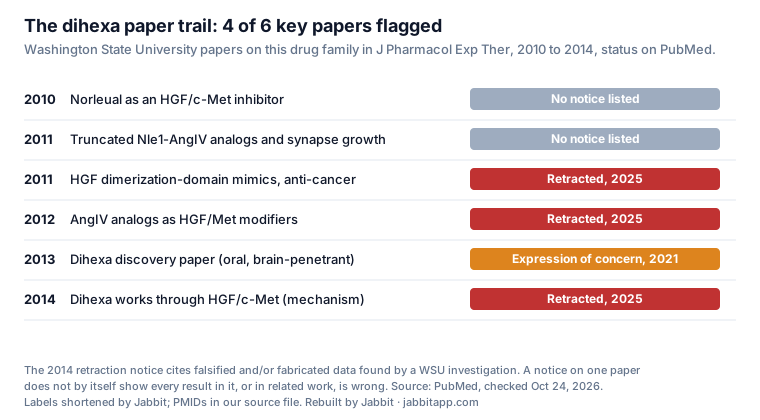
In January 2025 the Journal of Pharmacology and Experimental Therapeutics retracted the 2014 paper that tied dihexa’s effects to the HGF/c-Met receptor. Its notice says: “Following an investigation by Washington State University, Figures 1B, 2A/C, and data in the subsequent erratum submission for the article have been found to contain falsified and/or fabricated data,” and names two authors as solely responsible.[8] The journal retracted two earlier papers from the same lab on HGF/Met-targeting angiotensin IV analogs at the same time, citing the same WSU investigation.[9][10]
The 2013 paper that first described dihexa has not been retracted. Since 2021 it has carried an expression of concern in which the editors cite “possible image manipulation” and say they “will await the results of an inquiry.”[6] An expression of concern is not a finding of misconduct, and as of October 24, 2026 PubMed lists no retraction or correction for that paper.[11]
Separately, Athira said in an October 2021 SEC filing that a special committee of its board found that its then-chief executive “altered images in her 2011 doctoral dissertation and at least four research papers” co-authored as a WSU graduate student and published from 2011 to 2014, and that “WSU’s dihexa patent incorporates images from papers” she co-authored, “certain of which were altered.” The filing reports her resignation effective October 18, 2021.[12] Athira’s filing also says its own drug, fosgonimeton, belongs to a different patent family from the dihexa patent.[12] A retraction removes a paper from the record; it does not by itself show that every result in it, or in related work by other groups, is wrong.
The only human data: fosgonimeton, which turns into dihexa
Athira says that fosgonimeton (ATH-1017) “metabolizes rapidly in plasma into … dihexa.”[12] So its trials are the nearest thing to human data on dihexa exposure, with caveats: fosgonimeton is a different molecule, it was given by injection under the skin to screened patients, and the trials were not designed to measure dihexa’s own effects.[14] This is our analysis, not a claim Athira makes.
- ACT-AD (phase 2, 77 patients): the primary endpoint, a brainwave measure, “was not statistically significant for the full study population.” Athira pointed to a pre-specified subgroup that did not take standard Alzheimer’s drugs.[13]
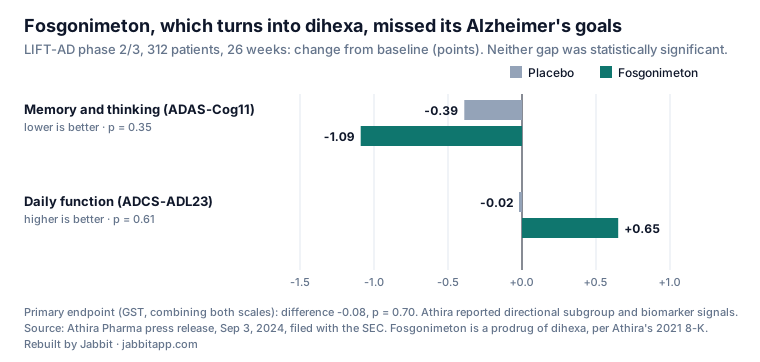
- LIFT-AD (phase 2/3, 312 patients in the primary analysis): missed its primary endpoint (p=0.70) and its key memory and daily-function endpoints (p=0.35 and p=0.61). Athira reported a reduction in the blood marker pTau217 and better numbers in some subgroups, and its chief medical officer said a placebo group that barely declined over a short study may have made a benefit hard to detect.[14]
- What came next: the open-label extension and the SHAPE dementia trial were terminated, and the company’s 2025 annual report says it “decided to pause further development of fosgonimeton.”[16][15]
Safety: what is and isn’t known
- Dihexa itself: FDA says it “has not identified any human exposure data on drug products containing dihexa acetate administered via any route of administration” and “lacks important information regarding any safety issues,” including “whether it would cause harm if administered to humans.”[1]
- The prodrug in trials: Athira reported fosgonimeton was generally well tolerated over 26 weeks, with more adverse events than placebo, mainly injection site reactions, a similar rate of serious adverse events and no deaths; 22% of LIFT-AD participants stopped early.[14][13] Those results come from screened patients under medical supervision and do not tell us about unregulated products.
- Adverse event reports: FAERS has no reports coded to dihexa.[17] With no approved product, that reflects how little it is tracked rather than evidence of safety.
- A theoretical concern (our analysis): dihexa’s developers described it as activating the HGF/MET pathway.[5][19] MET is a well-known cancer gene, and drugs that block it are used against some cancers.[25] Nobody has shown that dihexa causes cancer; the point is only that long-term effects of switching this pathway on in people have not been studied.
Legal status
No dihexa product is approved by FDA.[17] FDA lists dihexa acetate among bulk substances whose nominations for compounding were withdrawn, with the safety summary quoted above, and its advisory committee is due to discuss it by February 2027.[1][2] Whether the pending interim peptide policy covers dihexa is not public.[3] The WSU patent that covers dihexa and related molecules remains active, according to Google Patents.[19]
What a careful reader should notice
These points are our analysis of the cited sources.
- The best-known claim about dihexa, “10 million times stronger than BDNF,” comes from a university news release about a cell-culture assay, not from a peer-reviewed human result.[4]
- The company that licensed dihexa said in an SEC filing that it stopped developing it because it lacked the characteristics of a successful drug.[12]
- The paper linking dihexa to HGF/c-Met is retracted, and the discovery paper carries an unresolved expression of concern, which is not a finding of misconduct.[8][6]
- Independent animal studies point in both directions, and none is in humans.[20][21][23]
- The one drug tested in people that turns into dihexa failed its main Alzheimer’s goals in two trials, and its development is paused.[13][14][15]
- FDA’s committee will be weighing a compound for which FDA itself says it has no human exposure data.[1][2]
Frequently asked questions
- Is dihexa safe?
- Nobody knows. FDA says it has no human exposure data on dihexa and lacks information on whether it would cause harm in people. No trial of dihexa itself has been registered.[1][16]
- Does dihexa work for memory or Alzheimer’s?
- It improved memory in some rat and mouse studies but not in others, and it has never been tested for that in people. Fosgonimeton, a drug that turns into dihexa, missed its main goals in two Alzheimer’s trials.[5][20][21][13][14]
- Is dihexa really 10 million times stronger than BDNF?
- That figure comes from a 2012 WSU news release about a lab dish assay of new nerve connections. It is not a measure of effects in people.[4]
- Is dihexa FDA approved or legal to compound?
- No dihexa product is FDA approved. FDA lists dihexa acetate among withdrawn compounding nominations, and its advisory committee is due to discuss it before the end of February 2027.[17][1][2]
- Were dihexa studies retracted?
- The 2014 paper linking dihexa to the HGF/c-Met receptor and two related papers were retracted in 2025 after a WSU investigation. The 2013 discovery paper has an expression of concern, which is not a finding of misconduct, and has not been retracted.[8][9][10][6]
- What is the difference between dihexa and fosgonimeton?
- Fosgonimeton (ATH-1017) is a different molecule that Athira says breaks down into dihexa in the blood. It was injected in clinical trials; dihexa itself was dropped by Athira before human testing.[12]
- Could dihexa raise cancer risk?
- There is no evidence that it does, but it is described as activating HGF/MET, a pathway that drives some cancers. Long-term human effects have not been studied.[19][25]
Bottom line
Dihexa has interesting rat data and a striking marketing line, but no human trial, no FDA safety data, a retracted mechanism paper, and a discovery paper under an expression of concern.[5][4][16][1][8][6] The only drug tested in people that becomes dihexa was generally well tolerated but did not beat placebo on its main Alzheimer’s goals.[14] Anyone considering it would be relying on animal data alone.
References
- U.S. Food and Drug Administration. “Certain Bulk Drug Substances for Use in Compounding that May Present Significant Safety Risks” (content current as of 04/22/2026). Dihexa acetate is listed under bulk drug substances nominated for compounding whose nominations were later withdrawn. FDA’s summary: “FDA has not identified any human exposure data on drug products containing dihexa acetate administered via any route of administration. FDA lacks important information regarding any safety issues raised by dihexa acetate, including whether it would cause harm if administered to humans.” https://www.fda.gov/drugs/human-drug-compounding/certain-bulk-drug-substances-use-compounding-may-present-significant-safety-risks. Checked October 24, 2026.
- U.S. Food and Drug Administration. “Meeting of the Pharmacy Compounding Advisory Committee” (content current as of 04/15/2026). “FDA will host an advisory committee meeting before the end of February 2027”; agenda: Cathelicidin (LL-37), GHK-Cu, Dihexa acetate, Melanotan II and PEG-MGF, “being considered for inclusion on the 503A bulks list.” Time, location and materials not yet posted. https://www.fda.gov/advisory-committees/pharmacy-compounding-advisory-committee/meeting-pharmacy-compounding-advisory-committee. Checked October 24, 2026.
- Office of Information and Regulatory Affairs (OMB). Pending EO 12866 Regulatory Review: Interim Access Policy for Compounding Using Certain Peptides, RIN 0910-ZD94, received 10/14/2026, stage: Notice. The text and the list of peptides are not public. https://www.reginfo.gov/public/do/eoDetails?rrid=1568964. Checked October 24, 2026.
- Washington State University News. “Prospective Alzheimer’s drug builds new brain cell connections,” October 11, 2012. “In bench assays using living nerve cells to monitor new neuronal connections, [the researchers] found Dihexa to be seven orders of magnitude more powerful than BDNF … In other words, it would take 10 million times as much BDNF to get as much new synapse formation as Dihexa.” The release says the rat results needed “additional studies with larger test groups,” that FDA safety testing had to come first, and that development would be funded partly through the researchers’ company, M3 Biotechnology. https://archive.news.wsu.edu/news/2012/10/11/prospective-alzheimer%c2%92s-drug-builds-new-brain-cell-connections/. Checked October 24, 2026.
- McCoy AT, et al. Evaluation of metabolically stabilized angiotensin IV analogs as procognitive/antidementia agents. J Pharmacol Exp Ther. 2013;344(1):141-154. PMID 23055539. Washington State University. Describes dihexa as “orally active, blood-barrier permeant” with “excellent antidementia activity in the scopolamine and aged rat models.” Conflict of interest statement in the paper: two authors “are founders and shareholders of M3 Biotechnology, LLC, which is developing pharmaceuticals based on this technology.” Subject of a 2021 expression of concern (next reference); no retraction listed as of October 24, 2026. Abstract read. https://pubmed.ncbi.nlm.nih.gov/23055539/. Checked October 24, 2026.
- The Journal of Pharmacology and Experimental Therapeutics. Notice of Concern regarding McCoy et al. (2013). J Pharmacol Exp Ther. 2021;378(3):313. PMID 34551989. “The editors wish to express concern about the article by McCoy et al. of possible image manipulation after reviewing information received from several sources. They have shared these concerns with the corresponding author and their institution, Washington State University, and will await the results of an inquiry to determine appropriate next steps.” An expression of concern is not a finding of misconduct. https://jpet.aspetjournals.org/article/S0022-3565(24)25718-9/fulltext. Checked October 24, 2026.
- Benoist CC, et al. The procognitive and synaptogenic effects of angiotensin IV-derived peptides are dependent on activation of the hepatocyte growth factor/c-met system. J Pharmacol Exp Ther. 2014;351(2):390-402. PMID 25187433. The paper that tied dihexa’s effects to HGF/c-Met. Retracted (next reference). https://pubmed.ncbi.nlm.nih.gov/25187433/. Checked October 24, 2026.
- The Journal of Pharmacology and Experimental Therapeutics. Retraction notice to Benoist et al. (2014), dated January 3, 2025. doi:10.1016/j.jpet.2025.103567; PMID 40312093. “Following an investigation by Washington State University, Figures 1B, 2A/C, and data in the subsequent erratum submission for the article have been found to contain falsified and/or fabricated data and [two authors named in the notice] were found to be solely responsible. The Journal of Pharmacology and Experimental Therapeutics has retracted this article.” https://jpet.aspetjournals.org/article/S0022-3565(25)39780-6/fulltext. Checked October 24, 2026.
- The Journal of Pharmacology and Experimental Therapeutics. Retraction notice to “Development of angiotensin IV analogs as hepatocyte growth factor/Met modifiers,” J Pharmacol Exp Ther 2012;340:539-548 (PMID 22129598), dated January 3, 2025. doi:10.1016/j.jpet.2025.103566; PMID 40312092. “Following an investigation by Washington State University, Figures 3A and 4 have been found to contain falsified and/or fabricated data.” https://jpet.aspetjournals.org/article/S0022-3565(25)39779-X/fulltext. Checked October 24, 2026.
- The Journal of Pharmacology and Experimental Therapeutics. Retraction notice to “Mimics of the dimerization domain of hepatocyte growth factor exhibit anti-Met and anticancer activity,” J Pharmacol Exp Ther 2011;339:509-518 (PMID 21859930), dated January 3, 2025. doi:10.1016/j.jpet.2025.103568; PMID 40312094. “Following an investigation by Washington State University, Figures 2A and 3A/C have been found to contain falsified and/or fabricated data.” https://jpet.aspetjournals.org/article/S0022-3565(25)39781-8/fulltext. Checked October 24, 2026.
- PubMed records for Washington State University papers on angiotensin IV analogs and HGF/c-Met in J Pharmacol Exp Ther, 2010 to 2014 (search: the lab’s senior author in the journal, 2008 to 2026), with linked notices: PMIDs 20086056 (2010) and 21719467 (2011), no notice listed; 21859930 (2011), 22129598 (2012) and 25187433 (2014), retracted 2025; 23055539 (2013), expression of concern 2021. Table and query: https://jabbitapp.com/research/sources/dihexa-2026-10-24.json. Checked October 24, 2026.
- Athira Pharma, Inc. Form 8-K, filed October 21, 2021 (special committee findings). “When ATH-1017 is administered, it metabolizes rapidly in plasma into hexanoic-tyrosine-isoleucine-(6)-amino-hexanoic amide, or dihexa. From 2011 to 2015, Athira sought to develop dihexa, a drug candidate discovered at Washington State University (“WSU”) and exclusively licensed to Athira. While the studies performed at Athira during this period demonstrated the pharmacologic activity of dihexa to enhance HGF/MET, they failed to demonstrate that it had the appropriate characteristics needed to be a successful therapeutic product.” The filing says a special committee of the board found that the company’s then-chief executive (named in the filing) “altered images in her 2011 doctoral dissertation and at least four research papers that she co-authored while a graduate student at WSU, and published from 2011 to 2014,” and that “WSU’s dihexa patent incorporates images from papers co-authored by [her], certain of which were altered”; it also says “The ATH-1017 patent family is distinct from, and not part of the same patent family as, the dihexa patent licensed from WSU.” The filing reports her resignation effective October 18, 2021. https://www.sec.gov/Archives/edgar/data/1620463/000119312521304002/d179221d8k.htm. Checked October 24, 2026.
- Athira Pharma, Inc. Press release, June 22, 2022, filed as Exhibit 99.1 to Form 8-K: ACT-AD phase 2 (77 patients, 26 weeks). “Primary endpoint of change in biomarker ERP P300 latency was not statistically significant for the full study population”; Athira reported a pre-specified monotherapy subgroup signal and that fosgonimeton “was generally well tolerated, with a favorable safety profile.” https://www.sec.gov/Archives/edgar/data/1620463/000095017022011935/atha-ex99_1.htm. Checked October 24, 2026.
- Athira Pharma, Inc. Press release, September 3, 2024, filed as Exhibit 99.1 to Form 8-K: LIFT-AD phase 2/3 topline (312 patients with mild-to-moderate Alzheimer’s not on acetylcholinesterase inhibitors, 26 weeks). GST change −0.08 (p=0.70); ADAS-Cog11 change −0.39 placebo vs −1.09 fosgonimeton, difference −0.70 (p=0.35); ADCS-ADL23 +0.65 vs −0.02 (p=0.61); plasma pTau217 −0.12 pg/mL vs placebo (p<0.01). “Fosgonimeton was generally well tolerated”; “a higher incidence of treatment emergent adverse events compared to placebo, mainly driven by injection site reactions. The incidence of serious adverse events (SAEs) was similar between treatment groups … no deaths”; 22 percent early termination rate. Athira’s chief medical officer said the lack of decline in the placebo group and the short study “may have impacted the trial’s ability to translate the effect.” https://www.sec.gov/Archives/edgar/data/1620463/000095017024102788/atha-ex99_1.htm. Checked October 24, 2026.
- LeonaBio, Inc. (formerly Athira Pharma). Form 10-K for fiscal 2025, filed March 31, 2026: “Based on these results, we decided to pause further development of fosgonimeton.” Athira changed its name to LeonaBio on January 9, 2026 after licensing a breast cancer drug (press release, Form 8-K exhibit: https://www.sec.gov/Archives/edgar/data/1620463/000119312526008904/atha-ex99_1.htm). https://www.sec.gov/Archives/edgar/data/1620463/000119312526134565/lona-20251231.htm. Checked October 24, 2026.
- ClinicalTrials.gov API v2, pulled October 24, 2026. Search “dihexa”: 0 studies. Search “fosgonimeton”: 5 studies, all sponsored by LeonaBio (formerly Athira): LIFT-AD https://clinicaltrials.gov/study/NCT04488419 (phase 2/3, completed, 554 enrolled including a later cohort), ACT-AD https://clinicaltrials.gov/study/NCT04491006 (phase 2, completed, 77), open-label extension https://clinicaltrials.gov/study/NCT04886063 (terminated, 423), SHAPE in Parkinson’s disease dementia and dementia with Lewy bodies https://clinicaltrials.gov/study/NCT04831281 (phase 2, terminated, 28), and a phase 1 absorption study https://clinicaltrials.gov/study/NCT05511558 (8). Census: https://jabbitapp.com/research/sources/dihexa-2026-10-24.json. Checked October 24, 2026.
- FDA Adverse Event Reporting System via openFDA, search patient.drug.medicinalproduct:"dihexa", and Drugs@FDA, search openfda.generic_name:"dihexa", October 24, 2026: both return “No matches found,” meaning no reports coded to dihexa and no approved US product. Spontaneous report counts depend on coding and reporting; zero reports is not evidence of safety. https://api.fda.gov/drug/event.json?search=patient.drug.medicinalproduct:%22dihexa%22. Checked October 24, 2026.
- PubMed search “dihexa” [All Fields], October 24, 2026: 19 records, of which 5 are chemistry or physiology papers that match the word by accident; none of the remaining 14 is a human trial of dihexa. https://pubmed.ncbi.nlm.nih.gov/?term=dihexa. List: https://jabbitapp.com/research/sources/dihexa-2026-10-24.json. Checked October 24, 2026.
- US Patent 8,598,118 B2, “Hepatocyte growth factor mimics as therapeutic agents,” granted December 3, 2013; assignee Washington State University; status active, anticipated expiration April 2, 2032 (Google Patents). Abstract: the molecules “have been shown or predicted to have therapeutic potential for numerous pathologies including dementia, neurodegenerative disease, diabetes and metabolic syndrome, cancer, and defective wound healing.” https://patents.google.com/patent/US8598118B2/en. Checked October 24, 2026.
- Sun X, Deng Y, Fu X, et al. AngIV-analog dihexa rescues cognitive impairment and recovers memory in the APP/PS1 mouse via the PI3K/AKT signaling pathway. Brain Sci. 2021;11(11):1487. PMID 34827486. Independent group (China); Alzheimer’s model mice; improved water maze performance and lower inflammatory markers; authors declare no conflict of interest. Abstract read. https://pubmed.ncbi.nlm.nih.gov/34827486/. Checked October 24, 2026.
- Wells RG, Azzam AF, Hiller AL, et al. Effects of an angiotensin IV analog on 3-nitropropionic acid-induced Huntington’s disease-like symptoms in rats. J Huntingtons Dis. 2024;13(1):55-66. PMID 38489193. 40 rats; “PNB-0408 did not protect rats from the deficits induced by 3-NP neurotoxicity.” Abstract read. https://pubmed.ncbi.nlm.nih.gov/38489193/. Checked October 24, 2026.
- Weiss JB, Phillips CJ, Malin EW, et al. Stem cell, granulocyte-colony stimulating factor and/or dihexa to promote limb function recovery in a rat sciatic nerve damage-repair model. Ann Med Surg (Lond). 2021;71:102917. PMID 34703584. Rat nerve injury model. Title read. https://pubmed.ncbi.nlm.nih.gov/34703584/. Checked October 24, 2026.
- Ho JK, Nation DA. Cognitive benefits of angiotensin IV and angiotensin-(1-7): a systematic review of experimental studies. Neurosci Biobehav Rev. 2018;92:209-225. PMID 29733881. Systematic review of animal studies only; “eight of nine studies found Ang IV and its analogs (Nle1-Ang IV, dihexa, LVV-hemorphin-7) improved performance” in models of cognitive deficit. Abstract read. https://pubmed.ncbi.nlm.nih.gov/29733881/. Checked October 24, 2026.
- Rahman OF, Lee SJ, Seeds WA, et al. Therapeutic peptides in orthopaedics: applications, challenges, and future directions. J Am Acad Orthop Surg Glob Res Rev. 2026;10. PMID 41490200. Narrative review listing dihexa among neuroactive peptides; “there is a current lack of clinical trials.” Abstract read. https://pubmed.ncbi.nlm.nih.gov/41490200/. Checked October 24, 2026.
- Comoglio PM, Trusolino L, Boccaccio C. Known and novel roles of the MET oncogene in cancer: a coherent approach to targeted therapy. Nat Rev Cancer. 2018;18(6):341-358. PMID 29674709. Review of MET, the receptor dihexa is reported to activate, as a cancer driver and drug target. https://pubmed.ncbi.nlm.nih.gov/29674709/. Checked October 24, 2026.
This page analyzes regulator documents, published studies, journal notices, company filings and registry records. It is not medical or legal advice and does not recommend any product or dose. Dihexa is not approved by FDA. Charts were rebuilt by Jabbit from the sources cited in each caption.