Evidence review · Ozempic, Wegovy (semaglutide), Zepbound, Mounjaro (tirzepatide), retatrutide · A 60-week randomized trial’s posted results, retatrutide phase 2 data, 9 US drug labels, ClinicalTrials.gov review, surveys · Sources checked October 20, 2026
Published · Updated
Does food noise come back on Ozempic, Wegovy, Zepbound or retatrutide? Often, partly. In the longest trial that tracked it, the quiet faded by week 40, but people kept eating less.
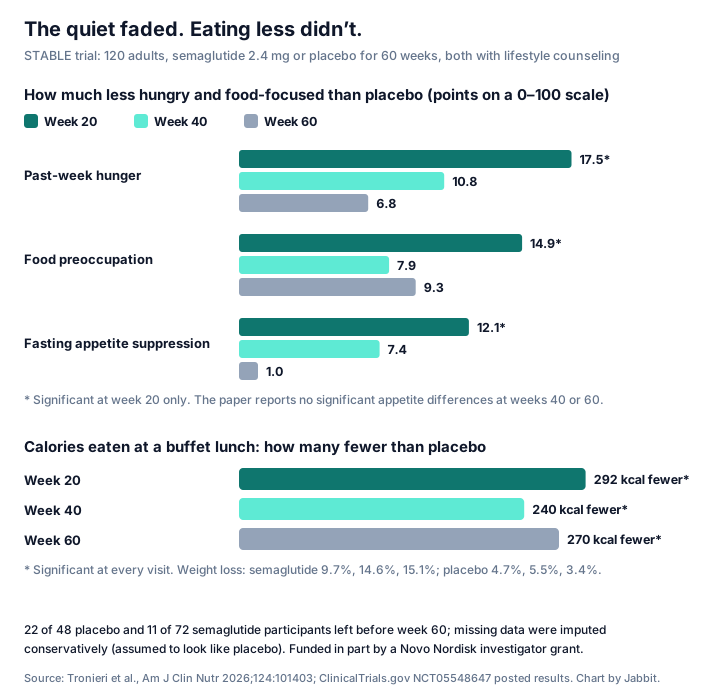
The quiet that people describe in the first weeks on a GLP-1 drug is real, and it often fades. In the longest randomized trial to track appetite on semaglutide 2.4 mg, the drug’s edge over placebo on past-week hunger shrank from 17.5 points at week 20 to 10.8 at week 40 and 6.8 at week 60 on a 100-point scale. The paper reports no significant appetite differences after week 20.[5] But the same people kept eating about 270 fewer calories at a buffet lunch than the placebo group at week 60, and had lost 15.1% of their weight versus 3.4%.[5] Food noise coming back doesn’t mean the drug stopped working. Weight loss itself pushes appetite up, and four Lilly labels say the stomach-slowing effect is “largest after the first dose” and fades.[13][15] For retatrutide, Lilly’s phase 2 data show lower hunger at 48 weeks, but no one has measured food noise.[10] We also checked the registry: 27 studies now measure food noise, 1 has posted results, and none is a Lilly or Novo Nordisk randomized trial.[26]
Why this matters now
On October 19, X ran a trending story titled “Retatrutide Users Report No Food Noise and Major Weight Loss.” Its own summary noted that some users report “returning food noise with doses.”[1] The night before, an anonymous peptide account posted: “It’s usually gone for the first 2 weeks of a new dose then comes back strong.” That post had about 24,500 views by Tuesday morning.[2] English posts about food noise on X ran at 68 to 161 a day last week, peaking October 19, and posts pairing it with a GLP-1 or peptide hit 41 that day.[3] The same day, Diabetes, Obesity and Metabolism published a commentary on food noise in the era of these drugs.[4] If you’re on one of them and the quiet is slipping, the useful questions are whether that’s expected, whether it matters, and what the data say about chasing it with a higher dose.
The short answer
- Yes, the quiet often fades. In trials of semaglutide and liraglutide, the hunger and food-preoccupation advantage over placebo or lifestyle treatment alone was clear at 20 to 24 weeks and gone or no longer significant by about a year.[5][7][6]
- The drug keeps working anyway. At week 60 people on semaglutide still ate about 270 fewer calories at a test lunch and kept their weight off.[5]
- Some effects last longer. In STEP 5, craving control was still better than placebo at 2 years, though hunger and fullness were not.[6]
- Losing weight turns hunger up. One estimate is about 100 extra calories a day of appetite per kilogram lost.[13]
- Stopping brings it back hard. Twelve weeks after switching to placebo, hunger and food preoccupation were higher than in people who had been on placebo all along.[5]
- For retatrutide, nobody knows yet. Hunger was still lower at 48 weeks in phase 2. There are no food-noise data.[10][27]
What “food noise” means, and who built the yardsticks
The term came from patients and social media, not medicine. A 2025 paper defines it as “persistent thoughts about food that are perceived by the individual as being unwanted and/or dysphoric.”[19] PubMed lists 40 papers using the phrase, 28 of them from 2026, and none is a randomized trial.[27] In a nationally representative survey in May 2026, 18% of US adults said they experience food noise often or always. Current and former GLP-1 users reported it more than non-users (26% and 27% vs 16%), and loss of control over eating was the strongest predictor. The survey can’t say why users report more: people with more food noise may be the ones who start the drugs.[21]
The two questionnaires now in use were built with companies that sell weight-loss care. Four authors of the five-item Food Noise Questionnaire are WW (WeightWatchers) employees or shareholders.[18] The RAID-FN inventory is named for Ro, the telehealth company that prescribes GLP-1 drugs. Ro says it organized the work, and a 2026 letter from the authors lists Roman Health Ventures as the grant source.[19] The best-known estimate of how much semaglutide quiets food noise, a median drop from 13 to 6 on a 20-point scale, comes from Novo Nordisk’s INFORM survey. In that survey, 550 users recalled how noisy things were before they started, and the survey firm was paid by Novo Nordisk.[20] None of this makes the tools wrong. It means the first numbers came from people with a stake in the answer.
What happens over time: the trials
- Semaglutide 2.4 mg, 60 weeks (STABLE, Penn). 120 adults, all with lifestyle counseling, were randomized 3:2 to semaglutide or placebo. Lab tests ran at weeks 20, 40 and 60. Compared with placebo, past-week hunger was 17.5, 10.8 and 6.8 points lower, food preoccupation 14.9, 7.9 and 9.3, and fasting appetite suppression 12.1, 7.4 and 1.0. Only the week-20 gaps were statistically significant. Meanwhile the semaglutide group ate 292, 240 and 270 fewer calories at a buffet lunch, significant every time.[5] One caveat cuts the other way: the registry’s week-60 interval for food preoccupation (0.9 to 17.8) excludes zero, though the paper didn’t formally test it.[5]
- Semaglutide 2.4 mg, 2 years (STEP 5). In 174 people, hunger and fullness were better than placebo only at week 20. Craving control and savory cravings stayed better at weeks 20, 52 and 104.[6]
- Liraglutide 3.0 mg, 1 year. Hunger, fullness and food preoccupation were better than lifestyle treatment alone through week 24, but not at week 52, even though the liraglutide group had lost more weight (11.8% vs 6.2%).[7]
- Tirzepatide. In a 6-week Lilly trial, people ate 525 fewer calories than placebo at a test lunch by week 3, with fewer cravings.[9] In type 2 diabetes, appetite on tirzepatide 15 mg or semaglutide 1 mg was still lower than placebo at week 28.[8] No tirzepatide trial has published appetite or food-noise data beyond that.[27]
- Retatrutide (phase 2, Lilly). In 338 adults with obesity, self-reported hunger and disinhibition fell more than placebo for every dose at weeks 24 and 48, while weight fell 8.7% to 24.2% versus 2.1%.[10] In type 2 diabetes, appetite ratings were lower than placebo at week 24 on 4 mg and above, and self-reported hunger and disinhibition at weeks 24 and 36 on 8 and 12 mg.[11] In exit interviews, 31 of 36 people on retatrutide noticed eating changes within 8 weeks, and 3 described frustration with disappointing weight loss.[12] These measures are about hunger and disinhibition, not food noise, and they stop at 48 weeks. Our retatrutide page covers the phase 3 results.
Outside trials, the pattern matches. In a cross-sectional study, people six months into treatment scored lower on the Food Noise Questionnaire than people about to start.[22] In interviews with 31 patients, the early phase brought “reduced ‘food noise’,” and in the stable phase some described “a perceived loss of efficacy” and thought about switching drugs.[23]
Why the quiet fades
Losing weight raises appetite. Using a diabetes drug that causes weight loss without acting on appetite, researchers estimated that people eat about 100 kcal a day more than before for every kilogram they lose. That’s more than three times the drop in calories burned.[13] After diet-driven weight loss, appetite hormones and hunger still hadn’t returned to baseline a year later.[14] By week 60 in STABLE, the semaglutide group had lost 15.1% of its weight, so the drug was pushing against a much louder body signal than at the start.[5]
The stomach effect fades. GLP-1 drugs slow stomach emptying, which adds to feeling full. In a 1-day GLP-1 infusion study, that effect was already weaker at the second meal.[16] Our scan of 9 US labels found that all four Lilly labels say so directly. Zepbound and Mounjaro: “The delay is largest after the first dose and this effect diminishes over time.” The five Novo Nordisk labels say the drug “delays gastric emptying” without saying whether that fades.[15] In rats, liraglutide’s stomach effect faded within 14 days while its effect on weight did not, which suggests the brain, not the stomach, carries the long-term effect.[17]
Weekly drug levels rise and fall. Semaglutide’s half-life is about a week and tirzepatide’s about 5 days, so levels are lower just before the next shot than after it.[15] Users often say they feel this at the end of the week, but we found no published trial that measured appetite or food noise by day since the last injection.[27]
| Label | Drug | Says the effect fades? | After each dose step |
|---|---|---|---|
| Zepbound, Mounjaro (Lilly) | tirzepatide | Yes: “largest after the first dose” and “diminishes over time” | Backup birth control for 4 weeks after each dose step |
| Trulicity (Lilly) | dulaglutide | Yes: “largest after the first dose and diminishes with subsequent doses” | — |
| Foundayo (Lilly) | orforglipron | Yes: “largest after the first dose and diminishes over time” | Backup birth control for 30 days after each dose step |
| Wegovy, Ozempic, Rybelsus (Novo Nordisk) | semaglutide | Not stated: “delays gastric emptying” | — |
| Saxenda, Victoza (Novo Nordisk) | liraglutide | Not stated: “delays gastric emptying” | — |
None of the 9 labels mentions food noise or cravings. Wegovy and Zepbound say their weight effects are “likely mediated by affecting appetite.”[15]
The “new dose” pattern
The X post that went around this weekend describes food noise vanishing for about two weeks after each dose increase, then returning.[2] No trial has measured food noise week by week after a dose step, so this can’t be confirmed. What the labels do support is that a new dose resets some effects. Zepbound and Mounjaro tell people on birth-control pills to use backup contraception for 4 weeks after starting and for 4 weeks after each dose step, because the stomach-slowing effect is biggest then. Zepbound’s label also says most nausea, vomiting and diarrhea happened during dose escalation.[15] For gray-market retatrutide there is an extra variable. In an Australian lab test, three vials labelled 10 mg held 5.13, 16.5 and 19.0 mg, so a “new dose” may not be the dose on the label.[25]
What happens when you stop
STABLE re-randomized people at week 60. Those switched from semaglutide to placebo for 12 weeks rated past-week hunger at 63.6 and food preoccupation at 62.9 on 100-point scales. That was higher than the group that had been on placebo all along (48.5 and 42.7; p=0.02 and p=0.002). They ate a little less at the buffet lunch (952 vs 1,073 kcal, not significant), and were still about 9 kg lighter.[5] More on regain is in our stopping review.
What’s being studied
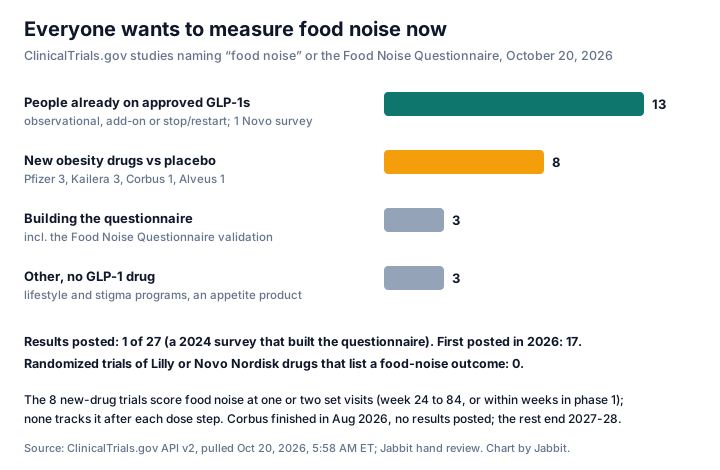
We found 27 ClinicalTrials.gov studies that name food noise or the Food Noise Questionnaire. 17 were first posted this year. 8 are company-run, placebo-controlled trials of obesity drugs not yet approved: three each from Pfizer and Kailera, and one each from Corbus and Alveus. Lilly and Novo Nordisk list no food-noise outcome in any randomized trial of their own drugs. Novo’s only entry is a survey of 1,260 semaglutide users whose data were captured over four days in August.[26] Only 1 of the 27 has posted results, the 2024 survey that built the questionnaire. Corbus finished in August without posted results, and the rest end in 2027 or 2028. The closest test of the “does it come back” question is a University of Texas at Dallas study that will measure intrusive food thoughts in 40 people on tirzepatide, after 3 to 4 weeks off it and again after restarting.[26]
A caution about chasing quiet
A lot of food-noise talk online comes from people restricting food, not just from people on GLP-1s. A 2026 review in the International Journal of Eating Disorders warns that “the same mechanisms that reduce appetite and food preoccupation may also reinforce restriction” in vulnerable people. It recommends eating-disorder screening before and during treatment.[24] In the national survey, loss of control over eating was the strongest predictor of frequent food noise.[21] If the goal has become total silence about food, that’s worth raising with a clinician before raising a dose.
Strengths and limits
Strengths. The STABLE numbers are randomized, placebo-controlled and posted on the registry, and they include measured eating, not only ratings.[5] STEP 5 and the liraglutide trial show the same pattern in different groups of people.[6][7] The label and registry reviews are direct reads of primary records.[15][26]
Limits. STABLE is small. Nearly half the placebo group dropped out, and missing data were imputed as if they looked like placebo, which tends to shrink differences.[5] None of the long trials used a food-noise questionnaire. They measured hunger and food preoccupation, which overlap with food noise but aren’t the same thing.[5][19] The tirzepatide and retatrutide data are Lilly-funded and stop at 28 and 48 weeks.[8][10] The appetite feedback estimate comes from a different drug.[13] Registry searches miss studies that don’t use the words we searched for.[26]
Bottom line
Food noise often does come back on Ozempic, Wegovy or Zepbound, usually within the first year. Weight loss turns appetite up, and the stomach effect fades. In the one long trial that measured eating directly, people kept eating less and kept their weight off even after their hunger ratings had drifted back toward placebo.[5][13][15] For retatrutide, Lilly’s phase 2 data show lower hunger at 48 weeks, but there are no food-noise data, and gray-market vials don’t reliably hold what they say.[10][25]
If you want to know whether your quiet tracks your dose day, your dose steps or your weight, the useful record is simple: the date and dose of each shot, your weight, and a note when food noise returns. Jabbit keeps that private, dated log on your iPhone, so you and your prescriber can see the pattern instead of guessing.
Frequently asked questions
- What is food noise?
- Researchers define it as persistent thoughts about food that feel unwanted or upsetting, more intense and intrusive than ordinary thinking about meals. In a May 2026 national survey, about half of US adults said they experience it at least occasionally and 18% frequently. Two questionnaires now measure it: the Food Noise Questionnaire, built with WW (WeightWatchers) staff, and the RAID-FN inventory, organized by the telehealth company Ro.
- Why does food noise come back on Ozempic, Wegovy or Zepbound?
- Probably several reasons at once. Weight loss itself raises appetite: one study estimated people eat about 100 kcal a day more for every kilogram lost. The stomach-slowing effect of these drugs is strongest after the first dose and fades, as four Lilly labels state. And in a 60-week semaglutide trial, the gap in hunger and food preoccupation versus placebo shrank after week 20 and was no longer significant at weeks 40 or 60.
- If food noise comes back, has the drug stopped working?
- Not necessarily. In that 60-week trial, people on semaglutide still ate 270 fewer calories than the placebo group at a buffet lunch at week 60, even though their hunger ratings had drifted back toward placebo levels, and they had lost 15.1% of their weight versus 3.4%. The feeling and the eating effect came apart.
- Why does food noise go quiet for a couple of weeks after a dose increase?
- No trial has tracked food noise week by week after a dose step, so this is not proven. What the labels do say: tirzepatide’s effect on stomach emptying is largest after the first dose and fades, which is why Zepbound and Mounjaro advise backup birth control for 4 weeks after each dose step, and most nausea and vomiting happens during dose escalation. A fresh dose step brings back more of those effects, which fits what users describe.
- Does retatrutide keep food noise away longer?
- Unknown. In Lilly’s phase 2 obesity trial, every retatrutide dose lowered self-reported hunger more than placebo at weeks 24 and 48, but nobody measured food noise, and no longer appetite data have been published. Retatrutide is not approved anywhere, and products sold online have tested at half to nearly double their labelled amount, which can make the effect unpredictable.
- What happens to food noise if I stop?
- In the 60-week trial, people switched from semaglutide to placebo for 12 weeks reported more hunger (63.6 vs 48.5 on a 100-point scale) and more food preoccupation (62.9 vs 42.7) than people who had been on placebo all along. They were still about 9 kg lighter than the placebo group at that point.
- Should I raise my dose to get rid of food noise?
- That is a prescriber’s decision, and the labels set the steps and maximums. Higher doses bring more stomach side effects, which cluster during escalation. If food noise is tied to restricting, bingeing or distress about eating, an eating-disorder review in 2026 recommends screening before and during GLP-1 treatment, so tell your clinician.
References
- X trending story, “Retatrutide Users Report No Food Noise and Major Weight Loss” (a summary of posts on X; it quotes a user who described food as “just fuel” after three weeks and notes that “some note returning food noise with doses”), updated October 19, 2026, 1:35 AM ET. https://x.com/i/trending/2112013837738389567. Checked October 20, 2026.
- @pepfessions (anonymous “Peptide Confessions” account), post of October 18, 2026, 10:05 PM ET: “Have been on Reta since June… just started 8mg this week. Im actually tired of titrating up… I just want the food noise gone. It’s usually gone for the first 2 weeks of a new dose then comes back strong.” 24,491 views and 29 replies when checked October 20, about 6:05 AM ET. The account describes itself as supported by peptide accounts. https://x.com/pepfessions/status/2112002127241331159. Quoted as the poster’s own account; doses are the poster’s, not advice. Checked October 20, 2026.
- Jabbit count of posts on X via the recent-counts endpoint (no reposts), UTC days October 13 (from 09:52 UTC) to October 19, 2026: “food noise” in English: 117, 139, 97, 127, 72, 68 and 161 a day. “Food noise” together with a GLP-1 or peptide term (retatrutide, reta, tirzepatide, Zepbound, Mounjaro, semaglutide, Ozempic, Wegovy, GLP-1, tirz, sema or peptide; any language): 20, 31, 25, 36, 15, 12 and 41 a day. Checked October 20, 2026.
- Patoulias D, Popovic DS, Koufakis T. Food noise in the era of incretin-based obesity pharmacotherapy: current evidence, clinical implications and research priorities. Diabetes Obes Metab. Published online October 19, 2026. doi:10.1111/dom.71445. PMID 42897102. https://doi.org/10.1111/dom.71445. We could read only its reference list and disclosures (two authors report fees from GLP-1 makers); the text is paywalled. Checked October 20, 2026.
- Tronieri JS, Allison KC, DeRouen K, et al. Short- and long-term effects of semaglutide 2.4 mg on energy intake, appetite, and food reward: a 60-week, double-blind randomized controlled trial. Am J Clin Nutr. 2026;124(2):101403. doi:10.1016/j.ajcnut.2026.101403. PMID 42323166; full text PMC13494093 (120 adults, 3:2 semaglutide or placebo, both with lifestyle counseling; buffet lunch “291.9 ± 64.4, 240.2 ± 87.8, and 269.5 ± 83.6 kcal less” at weeks 20, 40 and 60; “the groups did not differ significantly in appetite outcomes at weeks 40 or 60”; weight −9.7%, −14.6%, −15.1% vs −4.7%, −5.5%, −3.4%; funded in part by a Novo Nordisk investigator-sponsored grant). Registry results: NCT05548647 (STABLE Wt Loss; results posted August 3, 2026; we used the posted mean differences, e.g. past-week hunger 17.5, 10.8, 6.8 mm; food preoccupation 14.9, 7.9, 9.3 mm, week-60 95% CI 0.9 to 17.8; fasting appetite suppression 12.1, 7.4, 1.0 mm; weeks 60-72: hunger 63.6 vs 48.5 mm, p=0.0196; food preoccupation 62.9 vs 42.7 mm, p=0.0017; buffet lunch 951.8 vs 1,073.0 kcal, p=0.15; 22 of 48 placebo and 11 of 72 semaglutide participants did not complete week 60). https://pmc.ncbi.nlm.nih.gov/articles/PMC13494093/. Checked October 20, 2026.
- Wharton S, Batterham RL, Bhatta M, et al. Two-year effect of semaglutide 2.4 mg on control of eating in adults with overweight/obesity: STEP 5. Obesity (Silver Spring). 2023;31(3):703-715. doi:10.1002/oby.23673. PMID 36655300 (Control of Eating Questionnaire subgroup, 88 semaglutide, 86 placebo; Craving Control and Craving for Savory better at weeks 20, 52 and 104; hunger and fullness better at week 20 only; p values not controlled for multiplicity; Novo Nordisk trial). https://pubmed.ncbi.nlm.nih.gov/36655300/. Checked October 20, 2026.
- Tronieri JS, Wadden TA, Walsh O, et al. Effects of liraglutide on appetite, food preoccupation, and food liking: results of a randomized controlled trial. Int J Obes (Lond). 2020;44(2):353-361. doi:10.1038/s41366-019-0348-6. PMID 30926955 (113 adults; hunger, fullness and food preoccupation differences “persisted for 24 weeks but were not maintained at week 52, despite the relatively greater weight losses” on liraglutide 3.0 mg: 11.8% vs 6.2%). https://pubmed.ncbi.nlm.nih.gov/30926955/. Checked October 20, 2026.
- Heise T, DeVries JH, Urva S, et al. Tirzepatide reduces appetite, energy intake, and fat mass in people with type 2 diabetes. Diabetes Care. 2023;46(5):998-1004. doi:10.2337/dc22-1710. PMID 36857477 (tirzepatide 15 mg, n=45; semaglutide 1 mg, n=44; placebo, n=28; appetite lower than placebo with both drugs at week 28; Lilly-funded). https://pubmed.ncbi.nlm.nih.gov/36857477/. Checked October 20, 2026.
- Martin CK, Carmichael OT, Carnell S, et al. Tirzepatide on ingestive behavior in adults with overweight or obesity: a randomized 6-week phase 1 trial. Nat Med. 2025;31(9):3141-3150. doi:10.1038/s41591-025-03774-9. PMID 40555748; NCT04311411 (114 adults; buffet lunch −524.6 kcal vs placebo at week 3; lower appetite, cravings and food-cue reactivity; Lilly-funded). https://pubmed.ncbi.nlm.nih.gov/40555748/. Checked October 20, 2026.
- Kanu C, Wu Q, Poon JL, et al. Association between patient-reported eating behaviours and weight change: secondary analyses of a randomized, double-blind trial comparing retatrutide and placebo in people with obesity or overweight. Diabetes Obes Metab. 2025;27(10):6088-6091. doi:10.1111/dom.16662. PMID 40735804; full text PMC12409224 (338 adults; Eating Inventory perceived hunger and disinhibition fell more than placebo for every retatrutide dose at weeks 24 and 48, p<0.01, not adjusted for multiple comparisons; weight −8.7% to −24.2% at week 48 vs −2.1%; authors are mostly Lilly employees). https://pmc.ncbi.nlm.nih.gov/articles/PMC12409224/. Checked October 20, 2026.
- Kanu C, Boye KS, Poon JL, Goetz I, et al. Appetite, eating attitudes, and eating behaviours during treatment with retatrutide in adults with type 2 diabetes: results of a phase 2 study. Diabetes Obes Metab. 2025;27(12):6988-6998. doi:10.1111/dom.70097. PMID 40916752 (275 adults; overall appetite, hunger and prospective food consumption fell more than placebo at week 24 on 4 mg and above; perceived hunger and disinhibition at weeks 24 and 36 on 8 and 12 mg; Lilly employees). https://pubmed.ncbi.nlm.nih.gov/40916752/. Checked October 20, 2026.
- Goetz IA, Kanu C, Hoover A, et al. Perceived benefits of treatment for obesity with retatrutide: a qualitative study of patients in a phase 2 clinical trial. Obes Pillars. 2025;16:100220. doi:10.1016/j.obpill.2025.100220. PMID 41216380 (40 exit interviews; 31 of 36 on retatrutide reported eating changes within the first 8 weeks; 3 described frustration over disappointing weight loss; Lilly-funded). https://pubmed.ncbi.nlm.nih.gov/41216380/. Checked October 20, 2026.
- Polidori D, Sanghvi A, Seeley RJ, Hall KD. How strongly does appetite counter weight loss? Quantification of the feedback control of human energy intake. Obesity (Silver Spring). 2016;24(11):2289-2295. doi:10.1002/oby.21653. PMID 27804272 (153 people on canagliflozin, a diabetes drug that causes weight loss through the urine; “weight loss leads to a proportional increase in appetite resulting in eating above baseline by ∼100 kcal/day per kilogram of lost weight”). https://pubmed.ncbi.nlm.nih.gov/27804272/. Checked October 20, 2026.
- Sumithran P, Prendergast LA, Delbridge E, et al. Long-term persistence of hormonal adaptations to weight loss. N Engl J Med. 2011;365(17):1597-1604. doi:10.1056/NEJMoa1105816. PMID 22029981 (50 people, 13.5 kg lost on a very-low-energy diet; ghrelin, leptin, peptide YY and hunger still differed from baseline a year later). https://pubmed.ncbi.nlm.nih.gov/22029981/. Checked October 20, 2026.
- Jabbit scan of current DailyMed prescribing information: Zepbound (v40, https://dailymed.nlm.nih.gov/dailymed/drugInfo.cfm?setid=487cd7e7-434c-4925-99fa-aa80b1cc776b), Mounjaro (v40, https://dailymed.nlm.nih.gov/dailymed/drugInfo.cfm?setid=d2d7da5d-ad07-4228-955f-cf7e355c8cc0), Trulicity (v62), Foundayo (v10), Wegovy (v19, https://dailymed.nlm.nih.gov/dailymed/drugInfo.cfm?setid=ee06186f-2aa3-4990-a760-757579d8f77b), Ozempic (v20), Rybelsus (v14), Saxenda (v22) and Victoza (v31). Quotes: Zepbound and Mounjaro “The delay is largest after the first dose and this effect diminishes over time” and “The impact of tirzepatide on gastric emptying was greatest after a single dose of 5 mg and diminished after subsequent doses”; backup contraception “for 4 weeks after initiation… and for 4 weeks after each dose escalation” (Foundayo: 30 days); Trulicity “largest after the first dose and diminishes with subsequent doses”; Zepbound “The majority of nausea, vomiting, and/or diarrhea events occurred during dose escalation and decreased over time”; Wegovy and Zepbound “The effects are likely mediated by affecting appetite”; half-lives: semaglutide about 1 week, tirzepatide about 5 days (5-6 days in obesity), orforglipron 29 to 49 hours. Wegovy, Ozempic, Rybelsus, Saxenda and Victoza say the drug delays gastric emptying but not whether the effect fades. None of the 9 mentions food noise or cravings. Details: https://jabbitapp.com/research/sources/food-noise-ctgov-labels-2026-10-20.json. Checked October 20, 2026.
- Nauck MA, Kemmeries G, Holst JJ, Meier JJ. Rapid tachyphylaxis of the glucagon-like peptide 1-induced deceleration of gastric emptying in humans. Diabetes. 2011;60(5):1561-1565. doi:10.2337/db10-0474. PMID 21430088 (9 healthy volunteers, 8.5-hour GLP-1 infusion; gastric emptying slowed significantly more after the first meal than after a second meal 4 hours later). https://pubmed.ncbi.nlm.nih.gov/21430088/. Checked October 20, 2026.
- Jelsing J, Vrang N, Hansen G, et al. Liraglutide: short-lived effect on gastric emptying, long lasting effects on body weight. Diabetes Obes Metab. 2012;14(6):531-538. doi:10.1111/j.1463-1326.2012.01557.x. PMID 22226053 (rats; the stomach-slowing effect “markedly diminished following 14 days of dosing with liraglutide” while weight effects persisted; authors from Gubra and Novo Nordisk). https://pubmed.ncbi.nlm.nih.gov/22226053/. Checked October 20, 2026.
- Diktas HE, Cardel MI, Foster GD, et al. Development and validation of the Food Noise Questionnaire. Obesity (Silver Spring). 2025;33(2):289-297. doi:10.1002/oby.24216. PMID 39828656; NCT06315907 (5 items, 400 online participants; four authors are employees and/or shareholders of WW International). https://pubmed.ncbi.nlm.nih.gov/39828656/. Checked October 20, 2026.
- Dhurandhar EJ, Maki KC, Dhurandhar NV, et al. Food noise: definition, measurement, and future research directions. Nutr Diabetes. 2025;15:30. doi:10.1038/s41387-025-00382-x. PMID 40628707 (definition: “persistent thoughts about food that are perceived by the individual as being unwanted and/or dysphoric”; the Ro Allison Indiana Dhurandhar Food Noise Inventory). https://pubmed.ncbi.nlm.nih.gov/40628707/. The validation paper (Appetite 2026;217:108339, PMID 41101555) and a 2026 letter (Obesity 2026;34(7):1363-1364, PMID 42125907, grant listed: Roman Health Ventures, LLC) document Ro’s role; Ro’s press release of October 24, 2025 calls the scale “the result of a years-long collaboration, organized by Ro.” https://ro.co/press/raid-fn/. Checked October 20, 2026.
- Arnaut T, Duncan S, Faurby M, et al. Retrospective assessment of food noise changes after initiation of injectable semaglutide for weight management in the USA: the INFORM survey. Adv Ther. 2026;43(8):3649-3659. doi:10.1007/s12325-026-03636-x. PMID 42217114 (550 panel members, 86% women; recalled pre-treatment median FNQ 13 of 20 vs 6 now; agreement with food-noise statements 47-63% before vs 15-20% after; authors include Novo Nordisk employees; the survey firm was paid by Novo Nordisk). https://pubmed.ncbi.nlm.nih.gov/42217114/. Checked October 20, 2026.
- Hayashi D, Masterson TD. Prevalence and correlates of perceived food noise among U.S. adults in a nationally representative sample. Obes Sci Pract. 2026;12(5):e70201. doi:10.1002/osp4.70201. PMID 42801078 (1,000 adults, May 2026; 50.89% at least occasionally, 17.98% frequently; frequent food noise in 25.76% of current and 26.78% of former GLP-1 users vs 16.30% of non-users; loss of control over eating OR 5.95, current GLP-1 use OR 1.60; authors report no conflicts). https://pubmed.ncbi.nlm.nih.gov/42801078/. Checked October 20, 2026.
- Rutigliani G, Mattes RD. The effects of glucagon-like peptide-1 receptor agonists on chemosensory function and ingestive behavior. Physiol Behav. 2026;316:115486. PMID 42641845; NCT07611201 (cross-sectional, 79 adults; Food Noise Questionnaire scores lower in 6-month users than in people about to start, P=.026). https://pubmed.ncbi.nlm.nih.gov/42641845/. Checked October 20, 2026.
- Chong MC, Ko TYL, le Roux PL, le Roux CW. Changes in eating behaviour during treatment with obesity medications. Clin Obes. 2026;16(1):e70065. PMID 41420306 (31 interviews; early phase: “reduced ‘food noise’ with diminished cravings”; stable phase: “With a perceived loss of efficacy, some also report consideration of switching medications”). https://pubmed.ncbi.nlm.nih.gov/41420306/. Checked October 20, 2026.
- Škudar S. Eating disorders in the GLP-1 era: a spotlight on emerging clinical risks, research gaps, and practice priorities. Int J Eat Disord. 2026;59(10):2148-2152. doi:10.1002/eat.70145. PMID 42223191 (“the same mechanisms that reduce appetite and food preoccupation may also reinforce restriction… in vulnerable individuals”; calls for eating-disorder screening before and during treatment). https://pubmed.ncbi.nlm.nih.gov/42223191/. Checked October 20, 2026.
- Piatkowski T, Craven A, Cornell S, Ferris J. Composition and labelling accuracy of products sold as retatrutide in Australia. Drug Alcohol Rev. 2026;45(6):e70231. PMID 42559975 (three vials labelled 10 mg held 5.13, 16.5 and 19.0 mg; Craven is CEO of the testing service). https://pmc.ncbi.nlm.nih.gov/articles/PMC13445994/. Checked October 20, 2026.
- Jabbit review of ClinicalTrials.gov (API v2), pulled October 20, 2026, 5:58 AM ET: query.term “food noise” (27 studies) and “Food Noise Questionnaire” (20, all inside the 27). Hand categories: 13 studies of people taking approved GLP-1 drugs (observational, add-on, or stop-and-restart such as NCT07387796, plus Novo Nordisk’s sEMa-LIFE survey NCT07850765, 1,260 people, data captured August 28-31, 2026); 8 industry randomized placebo-controlled trials of drugs not yet approved (Pfizer MET097 NCT07311850, PF-08653944 NCT07400653 and berobenatide NCT07595549; Kailera ribupatide NCT07284875, NCT07284901, NCT07284979; Corbus CRB-913 NCT07310901, completed August 3, 2026, no results posted; Alveus ALV-100 NCT07837973); 3 questionnaire or data-method studies; 3 with no GLP-1 drug. Results posted: 1 (NCT06315907, the 2024 questionnaire survey). First posted in 2026: 17. Randomized trials sponsored by Eli Lilly or Novo Nordisk that list a food-noise outcome: 0. A separate search pairing “food preoccupation” with GLP-1 names found the STABLE trial (NCT05548647). Full list: https://jabbitapp.com/research/sources/food-noise-ctgov-labels-2026-10-20.json. Checked October 20, 2026.
- Jabbit PubMed searches, October 20, 2026: “food noise”[tiab] returns 40 records (28 dated 2026, 8 in 2025, 2 in 2024, 1 in 2023, and an unrelated 1988 nursing paper); none is indexed as a randomized controlled trial. retatrutide AND (appetite OR hunger OR “food noise” OR craving OR “energy intake”) returns 19 records; the only ones reporting retatrutide appetite data in people are the three Lilly phase 2 analyses cited here. We found no published trial that measured appetite or food noise by day since the last injection. List: https://jabbitapp.com/research/sources/food-noise-ctgov-labels-2026-10-20.json. Checked October 20, 2026.
This page analyzes published trials, registry results, drug labels, surveys and posts on X. It is not medical advice and not a dosing guide. It does not recommend any drug, dose, schedule or product. Retatrutide is not approved anywhere. Don’t change your dose without your prescriber. The label, registry, PubMed and X reviews are Jabbit’s own; their inputs are cited above.