News analysis · Retatrutide (LY3437943, “Reta”) · BPC-157, TB-500, CJC-1295, GHK-Cu · NSW Health emergency department surveillance, TGA and MHRA findings, FDA adverse event reports · Sources checked October 19–20, 2026
Published · Updated
Should Australia’s 1,180 peptide ER visits worry anyone using gray-market retatrutide? The count proves mentions, not harm, but monthly visits rose from 5 to 217 in 15 months, skew young, and matches lab tests of vials holding the wrong dose or the wrong drug.
On Monday, October 19, Sydney time, the health department of New South Wales, Australia’s most populous state, said its emergency departments logged 1,180 visits mentioning unapproved peptides in 15 months, up from 5 in July 2025 to 217 in September 2026. 833 of those visits mentioned retatrutide, Eli Lilly’s experimental weight-loss drug.[1][2] The short answer for anyone using it outside a trial: the report counts mentions in triage notes, not proven harm, and it says so.[2] But it lines up with what regulators keep finding in the vials: the wrong dose, a different drug, and in one cluster, liver injuries that officials blame on a likely contaminant.[12][11][8]
Why this matters now
The NSW release came out Sunday evening, U.S. Eastern time, and was covered Monday by ABC News, the Sydney Morning Herald and AAP.[1][6][7] It caps a run of warnings in October alone: on October 13, CBS News reported two death reports filed with the FDA in July and September after people used products sold as retatrutide; neither has been verified and causation is unknown.[14] On October 14, Britain’s medicines regulator seized more than 12,000 fake retatrutide and tirzepatide pens in Birmingham.[13] In the U.S., FDA’s interim policy on compounding certain peptides has been under White House review since October 14, and a peptide lobby group meets the reviewers on October 21. The text isn’t public.[21] (Background: who is lobbying on BPC-157 and TB-500.) BPC-157, TB-500, CJC-1295 and GHK-Cu all appear in the NSW search terms.[2]
The short answer
- It’s a count of mentions. Visits were found by searching nurses’ triage notes. Past use counts, and the report says it can’t say peptides caused any visit.[2]
- Retatrutide dominates. By our arithmetic from the report, 735 visits mentioned only retatrutide, 347 only “peptide” or another name, and 98 both.[2][5]
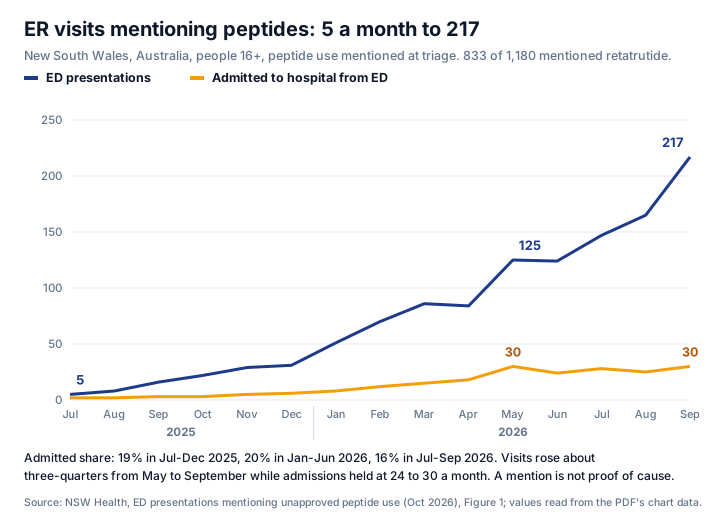
- Visits rose faster than admissions. About 19% were admitted in late 2025 and 16% in July to September 2026. Admissions held at 24 to 30 a month from May while visits went from 125 to 217.[5]
- The patients are young. 57% were under 35, against 9% of NSW adults who use GLP-1 medicines.[2][4][5]
- The vials are a gamble. Tests have found half to nearly double the labelled dose, and a “retatrutide” product that was really semaglutide.[12][11]
- The U.S. has no equivalent count. Poison centers logged 862 retatrutide exposures last quarter. FDA’s public file held 44 reports through June.[14][15][5]
What NSW actually counted
NSW Health searched the free-text triage notes, the “nursing assessment” and “presenting problem” fields, for every unplanned visit by someone 16 or older at the 88 hospitals that feed the state’s emergency surveillance system from July 1, 2025 to September 30, 2026. The search terms were retatrutide, with more than 30 spellings and misspellings from “reta” to “ratatrutide,” plus “peptide,” BPC-157, TB-500, CJC-1295, GHK-Cu, ipamorelin and melanotan. It screened out C-peptide (a routine blood test), “heart reta” (a typo for heart rate) and an infant formula brand.[2]
The report lists the most common main diagnoses as stomach and bowel problems (abdominal pain, nausea, vomiting), heart and circulation problems (including chest pain), and allergic reactions, anaphylaxis and medication reactions. 18% of visits ended in a hospital admission.[2]
A note on the headline split. The report says 833 visits (71%) mentioned “‘retatrutide’ only,” 445 (38%) mentioned “peptide” or another name, and 98 (8%) mentioned both. Those three numbers only add to 1,180 if the 833 includes the 98. So 735 visits mentioned retatrutide alone and 347 mentioned other peptides alone.[2][5]
The report is candid about its limits. It says it “does not provide an accurate indication of the volume” of peptide-related visits. It counts visits, not people. It catches past use written in the medical history. It misses visits where nobody mentioned peptides, and probably more severe ones, where triage notes are brief. And changes in how often nurses ask or write it down could move the trend on their own.[2] The Sydney Morning Herald called the count conservative because it only captures people who disclosed their use.[7]
The curve: visits up, admissions flat
The report gives only the first and last months in words, but its Figure 1 is drawn from data embedded in the PDF. We read those values back out. They add up to exactly 1,180 visits and 211 admissions (17.9%, against the stated 18%), so they match the report’s totals.[5]
- July to December 2025: 111 visits, 21 admitted (19%).
- January to June 2026: 540 visits, 107 admitted (20%).
- July to September 2026: 529 visits in three months, 83 admitted (16%).[5]
From May to September, monthly visits rose from 125 to 217 while admissions stayed between 24 and 30. That could mean more people are using peptides with milder problems, more people are telling triage nurses, or nurses are asking more often. The data can’t separate those. It does mean the number of people sick enough to be admitted has not grown as fast as the headline.[2][5]
Who shows up: younger and more male than GLP-1 users
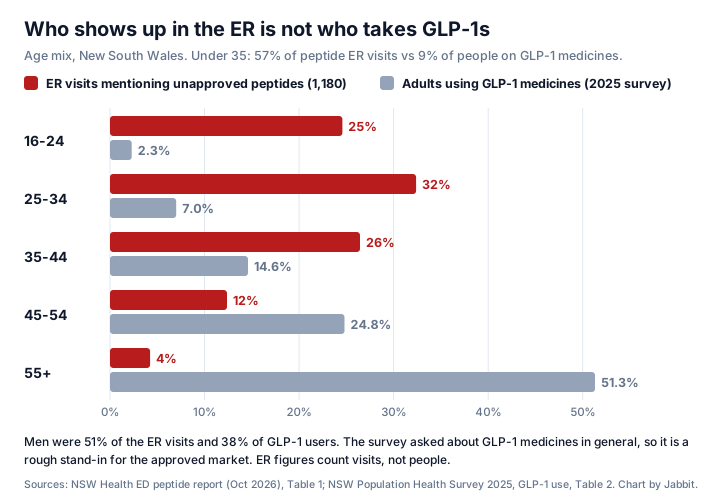
NSW also ran a 2025 population survey on GLP-1 medicines such as semaglutide and tirzepatide. About 8% of adults said they were using one, mostly people 45 and over, and 61% of users were women.[4] Set beside it, the ER visits look nothing like that market. 25% were people aged 16 to 24, against 2.3% of GLP-1 users. 57% were under 35, against 9%. Only 4% were 55 or older, against 51% of GLP-1 users. Men made up 51% of the visits but 38% of GLP-1 users.[2][4][5]
The comparison is rough: the survey counts people and its published results don’t say where their medicine came from, and the ER data counts visits. But the gap is too wide to be a quirk. A GP told ABC News he has had patients “as young as 14” tell him they order peptides online.[6] The visits were concentrated in Sydney’s south-west (21%), south-east (15%) and west (13%).[2]
What’s in the vials
The NSW report doesn’t say what was in anyone’s vial. Other investigations have looked.
| Who checked | What | What they found |
|---|---|---|
| TGA lab test (Sept 2026) | One product sold as retatrutide, after a patient tore their oesophagus from vomiting | No retatrutide. Semaglutide at about 8 times the level in approved products.[11] |
| Piatkowski et al., PEDTest Australia (2026) | Three vials labelled 10 mg retatrutide | All had retatrutide, at 5.1 mg, 16.5 mg and 19.0 mg. Sterility not tested.[12] |
| Victoria health alert (June–Aug 2026) | Seven people with acute liver injury after products labelled Retatrutide, Reta, R-10 or R-20 | Health officials suspect a contaminant or a bad batch. No test result published yet.[8][10] |
| UK MHRA raid (Oct 14, 2026) | An industrial unit in Birmingham | Over 12,000 fake retatrutide and tirzepatide pens, plus packaging for about 30,000 more.[13] |
| Eli Lilly (Oct 2026) | Suspect products Lilly has tested | “Too much, too little, or the wrong active ingredient,” plus contaminants.[14] |
Two different problems show up. One is the real drug at an unknown dose: a vial holding 190% of its label is close to double what the buyer thinks they’re injecting.[12] The other is a different or contaminated product. Victoria’s Chief Health Officer said the liver cases’ clinical picture suggests “additional contaminants may be contributing.”[8] The liver specialist treating them called a bad batch “purely a hypothesis” until testing comes back.[10]
How that compares with the trials
The drug in Lilly’s trials does cause stomach trouble, often. In TRIUMPH-1, the first big phase 3 trial, nausea hit 42.4% on the top 12 mg dose vs 14.8% on placebo, vomiting 25.3% vs 4.8%, and 11.3% stopped for side effects vs 4.9%. Dysesthesia, odd tingling or burning skin sensations, reached 12.5% vs 0.9%. Trial doses were raised in steps every four weeks under supervision.[17] In phase 2, heart rate rose with dose and peaked at 24 weeks.[18]
So it’s plausible that some of the NSW stomach visits come from real retatrutide. Someone who doesn’t know their dose, or got close to double it, is the person the trials warn about. Liver failure, contamination and a different drug in the vial are a separate risk that trials can’t tell you anything about.[12][11][8]
Self-reports point the same way. A JAMA Network Open study of 13,589 Reddit users who said they were taking retatrutide found nausea in 11.6% of those who reported any symptom, and vomiting in 2.6%, far below trial rates. Appetite returning, fatigue, insomnia and a faster heart rate were more common. The authors couldn’t verify what or how much anyone took.[16] A case report from Edinburgh describes a man in his mid-30s with type 1 diabetes who needed IV insulin and fluids for dangerous ketone levels after using online “retatrutide,” while also fighting a Shigella gut infection, so the drug’s role is unclear.[20]
And in the U.S.?
We found no U.S. emergency-department count like the NSW one. The closest data:
| Source | What it counts | Number |
|---|---|---|
| NSW emergency departments | Visits where a nurse wrote down peptide use at triage | 1,180 in 15 months; 833 mention retatrutide[2] |
| U.S. poison centers | Calls about an exposure, not proof of poisoning | 249, then 460, then 862 retatrutide exposures per quarter in 2026[14] |
| FDA’s FAERS (public data to June 30) | Voluntary reports, mostly from consumers | 44 reports naming retatrutide, ever; 0 deaths in the public file[15][5] |
| Reddit posts (to Dec 2025) | What users say happened to them | 13,589 users; nausea in 11.6% of those reporting a symptom[16] |
| Lilly’s TRIUMPH-1 trial | Real drug, known dose, placebo group | Nausea 42.4% vs 14.8% at 12 mg; 11.3% stopped for side effects[17] |
We pulled every report in FDA’s public adverse event file that names retatrutide. There are 44, and 39 came in between July 2025 and June 2026, the same stretch NSW counted. 26 were filed by consumers and 7 came through manufacturers. 33 were marked serious, 17 with a hospital stay and 6 as life-threatening. None in the public file, which runs through June 30, records a death; the two death reports CBS obtained came in July and September.[15][14][5] The most common terms were vomiting (8 reports) and nausea (7). 10 reports flagged a counterfeit, labeling, advertising or product-quality problem.[5]
The other peptides in the NSW search barely register in FDA’s file. Over all the years we searched, BPC-157 appears in 18 reports, ipamorelin in 11, CJC-1295 in 4, GHK-Cu in 2 and TB-500 in 1. MOTS-c, KPV and epitalon appear in none.[15][5] That isn’t evidence they’re safe. FAERS depends on someone choosing to file, and it was built for approved drugs.[15]
What this means if you’re experimenting
We don’t give doses, and nothing here is a recommendation to use or avoid any product. What the health agencies ask is practical:
- Know the warning signs. NSW Health lists vomiting that doesn’t stop, stomach pain, unusual tiredness, intense itching, dark urine, yellow skin or eyes, unusual bruising, fever, and a red, swollen injection site as reasons for urgent care. Trouble breathing, severe swelling or collapse means calling emergency services.[3]
- Tell the people treating you. NSW asks people to tell their clinicians about peptide use, “particularly before surgery.”[1] See GLP-1 drugs before surgery for why that matters with this drug class.
- Keep the details. Victoria asked doctors to record the product name, advertised ingredients, intended and actual dose, where it was bought, and to get the vial or a photo if possible.[9] That is information you can only give if you wrote it down.
Strengths and limits
The NSW report is official, statewide, uses a published keyword list, and is unusually frank about what it can’t show. Its weaknesses are built in: triage notes are short and inconsistent, a mention isn’t a cause, past use is included, the same person can be counted twice, and severe cases may be missed.[2] Our monthly figures are read from the report’s chart data, not a table, though they match its totals. Our age comparison sets visits beside survey respondents, two different kinds of count. Our FAERS numbers rest on name searches; reports that spell the drug differently would be missed, and none of them is verified.[5][15]
Bottom line
Australia now has the clearest public count of what the gray market for retatrutide and other peptides looks like from an emergency room: monthly mentions up from 5 to 217 in 15 months, mostly people under 35, mostly retatrutide. It doesn’t prove the drug caused those visits, and admissions have grown more slowly than visits. But every published lab check we found of what’s actually in these vials turned up something other than the label, from the wrong dose to the wrong drug. The trial drug’s side effects are well documented. The risks of the vial are not. Retatrutide is not approved anywhere yet; Lilly plans to file for approval in early 2027.[19]
Frequently asked questions
- Did peptides cause 1,180 ER visits in New South Wales?
- Not necessarily. NSW Health counted emergency visits where peptide use was written in the triage notes, including past use. Its report says it cannot conclude that peptides caused any visit. It also says it likely misses some severe cases, where triage notes are short. So 1,180 is neither a count of harm nor a full count of visits, but the steep rise is real.
- Why does retatrutide show up in most of the visits?
- 833 of the 1,180 visits mentioned retatrutide, an Eli Lilly drug still in trials and not approved anywhere, which is sold widely online. The most common emergency diagnoses were stomach problems such as pain, nausea and vomiting, the same side effects that are most common in Lilly’s trials. But tests show products sold under that name can hold the wrong dose or a different drug, so the label on the vial may not be what the person took.
- Is gray-market retatrutide the same as Lilly’s drug?
- Not reliably. In one published test, three vials labelled 10 mg held 5.1, 16.5 and 19.0 mg. Australia’s regulator tested a product sold as retatrutide and found none, only semaglutide at about eight times approved levels. Sterility is rarely tested. Lilly says counterfeit products it has found had too much, too little or the wrong ingredient.
- What happened with the liver injuries in Victoria?
- Victoria’s health department reported six people with acute liver injury after using products labelled Retatrutide, Reta, R-10 or R-20 between January and June 2026, and a seventh by August. Officials think a contaminant or a bad batch is more likely than the drug itself, but no test result has been published. Warning signs include tiredness, stomach pain, itching, dark urine, yellow skin or eyes and easy bruising.
- Is the U.S. seeing the same thing?
- There is no U.S. emergency-room count like NSW’s that we could find. America’s Poison Centers logged 862 retatrutide exposures in July to September 2026, up from 249 in the first quarter, according to CBS News. FDA’s public adverse event file held 44 reports naming retatrutide through June 2026. Two death reports filed later are unverified, and it isn’t known whether the drug was to blame.
- When should someone using a peptide get medical help?
- NSW Health says to call emergency services for trouble breathing, severe swelling, collapse or a severe reaction, and to get urgent care for vomiting that won’t stop, stomach pain, unusual tiredness, intense itching, dark urine, yellow skin or eyes, unusual bruising, fever, or a red, swollen injection site. Tell the doctors exactly what you used, and keep the vial or a photo of it.
- Is retatrutide approved anywhere?
- No. It is still in Eli Lilly’s trials, and Lilly says it plans to file for approval in the first quarter of 2027. Lilly says it is legally available only to people in its clinical trials. It is not approved in Australia, the UK or the U.S.
References
- NSW Government, Minister for Health. “NSW Health warns of surge in hospital presentations linked to peptide use.” Ministerial media release, published October 19, 2026 (Sydney time): 1,180 presentations between July 1, 2025 and September 30, 2026; five in July 2025 to “more than 217” in September 2026; products may claim to contain BPC‑157, GHK‑Cu, TB‑500, retatrutide and CJC‑1295, none approved in Australia; serious illness reports include kidney damage and liver injury; NSW Health works with the TGA and, where relevant, law enforcement to investigate the source of products; advice to tell treating clinicians about peptide use “particularly before surgery.” https://www.nsw.gov.au/ministerial-releases/nsw-health-warns-of-surge-hospital-presentations-linked-to-peptide-use. Checked October 19–20, 2026.
- NSW Ministry of Health. Emergency department presentations mentioning unapproved peptide use, NSW, July 2025 to September 2026. SHPN (CEE) 260832, October 2026 (6 pages). Rapid Emergency Department Data for Surveillance keyword search of triage “nursing assessment” and “presenting problem” text, people 16 and over, 88 PHREDSS reporting hospitals; 833 presentations mentioned retatrutide, 445 the word “peptide” or other unapproved peptide names (BPC‑157, TB‑500, CJC‑1295, GHK‑Cu, ipamorelin, melanotan) and 98 both; 18% admitted; most common diagnoses gastrointestinal, cardiovascular (including chest pain) and anaphylaxis, allergic reactions and medication-related adverse events; Tables 1–3 (age, sex, local health district); Figure 1 (monthly); limitations: “We cannot conclude that peptide use caused the presentation,” past use is included, severe presentations with limited triage notes may be missed, and visits rather than people are counted. https://www.health.nsw.gov.au/epidemiology/Publications/unapproved-peptide-use.pdf. Checked October 19–20, 2026.
- NSW Health. Peptide products (“Pause before you buy”), consumer page: call 000 for trouble breathing, severe swelling, collapse or a severe reaction; seek urgent care for vomiting that doesn’t stop, unusual tiredness, stomach pain, intense itching, dark urine, yellow skin or eyes, unusual bruising, fever, or pain, redness or swelling at the injection site; NSW Poisons Information Centre 13 11 26. https://www.health.nsw.gov.au/pharmaceutical/patients/Pages/peptides.aspx. Checked October 19–20, 2026.
- NSW Ministry of Health, Health Survey Program. GLP-1 receptor agonist use, NSW, 2025: preliminary results from the NSW Population Health Survey. SHPN (CEE) 260559, PDF dated June 2026, published July 14, 2026: about 8% of adults 16+ reported current GLP-1 use (8,457 respondents); Table 2, current users by age (16–24 2.3%, 25–34 7.0%, 35–44 14.6%, 45–54 24.8%, 55–64 23.7%, 65–74 19.1%, 75+ 8.5%) and sex (men 38.2%). The published results do not report where users got their medicine. https://www.health.nsw.gov.au/surveys/methods-results/Publications/glp-1-2025.pdf. Checked October 19–20, 2026.
- Jabbit data file: NSW report tables; monthly presentations and admissions read from the vector data in the report’s Figure 1 (rounded values sum to the stated 1,180 and to 211 admissions, 17.9%, against the stated 18%); age and sex comparison with the 2025 survey; openFDA FAERS pull for retatrutide and 14 other peptide names; U.S. poison center figures as reported by CBS News; X post counts. Built October 20, 2026. https://jabbitapp.com/research/sources/nsw-peptide-ed-faers-2026-10-20.json. Checked October 19–20, 2026.
- Coote G. “Health authorities issue unapproved peptide use warning after surge in NSW hospital visits.” ABC News, October 19, 2026 (Sydney time): RACGP’s Dr Tim Jones: “I’ve seen people as young as 14 tell me they’ve been ordering peptides online”; Health Minister Ryan Park: “People present to the emergency departments quite unwell … this is not minor.” https://www.abc.net.au/news/2026-10-19/nsw-peptide-emergency-department-surge-prompts-warning/107281674. Checked October 19–20, 2026.
- McSweeney J. “‘Russian roulette’: NSW emergency department visits surge amid dangerous peptide fad.” Sydney Morning Herald, October 19, 2026: NSW Poisons Information Centre medical director Dr Darren Roberts on liver injury patients “requiring admission and care under a liver transplant service”; the paper’s own report calls the count “conservative” because it “only captures patients whose peptide use was disclosed.” https://www.smh.com.au/politics/nsw/russian-roulette-nsw-emergency-department-visits-surge-amid-dangerous-peptide-fad-20261019-p6167k.html. Checked October 19–20, 2026.
- Victorian Department of Health. Health alert: “Toxicity linked to unapproved peptide product labelled Retatrutide,” issued June 19, 2026 by Chief Health Officer Dr Caroline McElnay (status active): six cases of acute liver injury in Victoria since January 2026 in people who used products labelled Retatrutide, Reta, R-10 or R-20; “possibly associated with a contaminant”; transaminitis with possible raised bilirubin and coagulopathy. https://www.health.vic.gov.au/health-alerts/toxicity-linked-to-unapproved-peptide-retatrutide. Checked October 19–20, 2026.
- Wisbey M. “Illegal peptide warnings intensify amid acute liver toxicity.” newsGP (RACGP), June 22, 2026: Victoria’s CHO asks doctors to “collect specific information about the product including the name, advertised ingredients, recommended and actual dose taken and place of purchase” and, where possible, a sample or photos. https://www1.racgp.org.au/newsgp/clinical/illegal-peptide-warnings-intensify-amid-acute-live. Checked October 19–20, 2026.
- Gribbin C, Carbonell R, Yu A. “Doctors fear possible contaminated counterfeit peptide batch after seventh case of acute liver damage.” ABC News, August 24, 2026: seven Victorian patients hospitalized with acute liver toxicity after using products labelled retatrutide; liver specialist Dr Marie Sinclair: a contaminated batch is “purely a hypothesis at this stage”; TGA chief medical adviser Prof Robyn Langham: “the localised nature” suggests “a batch problem.” https://www.abc.net.au/news/2026-08-24/contaminated-peptide-tests-liver-damage-hospitalisations/107070478. Checked October 19–20, 2026.
- Davey M. “Peptide user tore oesophagus after using counterfeit product, Australian regulator warns.” The Guardian, September 13, 2026 (U.S. Eastern): the TGA tested a sample of the product, sold as retatrutide, after a patient’s uncontrollable vomiting tore their oesophagus; it contained semaglutide and no retatrutide, at about eight times the levels in approved semaglutide products the TGA has assessed. (The TGA’s own alert page blocked our fetch.) https://www.theguardian.com/australia-news/2026/sep/14/counterfeit-retratrutide-warning-peptide-torn-oesophagus-australia-tga. Checked October 19–20, 2026.
- Piatkowski T, Craven A, Cornell S, Ferris J. Composition and labelling accuracy of products sold as retatrutide in Australia. Drug Alcohol Rev. 2026;45(6):e70231. PMID 42559975. Three vials labelled 10 mg, all containing retatrutide: 5.13 mg (51%), 16.5 mg (165%) and 19.0 mg (190%); trace lead (0.14% of the injectable limit); sterility and endotoxin not tested. Craven is CEO of PEDTest Australia, the testing service. Full text read. https://pmc.ncbi.nlm.nih.gov/articles/PMC13445994/. Checked October 19–20, 2026.
- Medicines and Healthcare products Regulatory Agency (UK). “Counterfeit weight loss pens worth £2 million seized by MHRA and West Midlands Police,” October 15, 2026: over 12,000 fake retatrutide and tirzepatide pens and packaging for about 30,000 more seized October 14 in Birmingham; “Retatrutide has not been authorised for use in the UK.” https://www.gov.uk/government/news/counterfeit-weight-loss-pens-worth-2-million-seized-by-mhra-and-west-mids-police. Checked October 19–20, 2026.
- Gilbert D. “Two deaths were reported to the FDA. Is the bootleg weight-loss drug ‘Reta’ to blame?” CBS News, updated October 13, 2026: FAERS reports obtained under FOIA, a 41-year-old woman (July) and a 49-year-old (September), details unverified and causation unknown; America’s Poison Centers logged 249 retatrutide exposures in January–March 2026, 460 in April–June and 862 in July–September; Lilly says it has found suspect products “with too much, too little, or the wrong active ingredient.” https://www.cbsnews.com/news/deaths-reported-fda-bootleg-reta-weight-loss-drug/. Checked October 19–20, 2026.
- U.S. Food and Drug Administration. FDA Adverse Event Reporting System via the openFDA drug event API, searched by drug name (patient.drug.medicinalproduct) for retatrutide and 14 other peptide names; data last updated July 30, 2026, latest report received June 30, 2026. FAERS reports are voluntary and unverified and cannot establish that a product caused an event. Jabbit pull and counts in the data file. https://open.fda.gov/apis/drug/event/. Checked October 19–20, 2026.
- Sehgal NKR, Tronieri JS, Rader B, Ungar L, Guntuku SC. Self-reported adverse effects among social media users taking nonapproved retatrutide. JAMA Netw Open. 2026;9(10):e2638929. PMID 42873503. 13,589 Reddit users reporting current use (March 2023–December 2025); among 7,823 with a mapped symptom: increased appetite 17.1%, fatigue 15.2%, increased energy 12.4%, nausea 11.6%, insomnia 6.1%, heart rate increased 4.8%, vomiting 2.6%. Product, dose and stacking could not be verified. https://pmc.ncbi.nlm.nih.gov/articles/PMC13670051/. Checked October 19–20, 2026.
- Eli Lilly and Company. “Lilly’s triple agonist, retatrutide, delivered powerful weight loss in pivotal Phase 3 obesity trial” (TRIUMPH-1 topline, May 21, 2026): at 4, 9 and 12 mg vs placebo, nausea 28.6%, 38.4%, 42.4% vs 14.8%; vomiting 10.6%, 22.8%, 25.3% vs 4.8%; diarrhea 25.2%, 34.1%, 32.0% vs 13.5%; dysesthesia 5.1%, 12.3%, 12.5% vs 0.9%; stopped for adverse events 4.1%, 6.9%, 11.3% vs 4.9%; doses were raised in steps every four weeks. Peer-reviewed report: N Engl J Med, September 29, 2026, PMID 42814954. https://investor.lilly.com/node/54321/pdf · https://pubmed.ncbi.nlm.nih.gov/42814954/. Checked October 19–20, 2026.
- Jastreboff AM, Kaplan LM, Frías JP, et al. Triple-hormone-receptor agonist retatrutide for obesity — a phase 2 trial. N Engl J Med. 2023;389(6):514-526. PMID 37366315. Gastrointestinal events were the most common, dose-related, mostly mild to moderate, and partly reduced with a lower starting dose; “Dose-dependent increases in heart rate peaked at 24 weeks and declined thereafter.” Funded by Eli Lilly. https://pubmed.ncbi.nlm.nih.gov/37366315/. Checked October 19–20, 2026.
- Eli Lilly and Company. “Lilly’s triple agonist, retatrutide, successful in two additional Phase 3 obesity trials” (TRIUMPH-2 and TRIUMPH-3, July 23, 2026; submission planned for the first quarter of 2027). https://investor.lilly.com/news-releases/news-release-details/lillys-triple-agonist-retatrutide-successful-two-additional. Checked October 19–20, 2026.
- Branine N. Online-sourced retatrutide complicating impending diabetic ketoacidosis in a patient with type 1 diabetes and concurrent Shigella gastroenteritis. Cureus. 2026;18(8):e115260. PMID 42669023. Case report (Edinburgh): severe vomiting, diarrhea, ketonemia up to 4.3 mmol/L and acute kidney injury; a Shigella infection was also found, so causation is uncertain. https://pubmed.ncbi.nlm.nih.gov/42669023/. Checked October 19–20, 2026.
- Office of Information and Regulatory Affairs. RIN 0910-ZD94, “Interim Access Policy for Compounding Using Certain Peptides” (FDA), received October 14, 2026, under EO 12866 review; text not public. https://www.reginfo.gov/public/do/eom12866SearchResults?pubId=&rin=0910-ZD94&viewRule=true. Checked October 19–20, 2026.
This page explains public health surveillance reports, regulator findings, adverse event data, published studies and trial results. It is not medical advice and not a dosing guide. Retatrutide is not approved for any use outside Eli Lilly’s clinical trials. If you are unwell after using any product, seek medical care and tell the clinicians what you used. The monthly figures, age comparison and FAERS counts are Jabbit’s own; their inputs are cited above.